It's 8:30 on Monday, and benefits administration is already competing with payroll, onboarding, and leadership reporting. A carrier wants clarification on a denied dental claim, a new hire can't complete an election, last Friday's deductions don't quite match the current carrier roster, and the CEO wants a headcount number before the next meeting. None of these tasks is unusual. Together, they reveal the actual work behind a small business benefits program.
The strongest teams treat benefits as an operating discipline, not an annual plan-shopping event. They connect employee records, eligibility rules, payroll deductions, carrier files, notices, and employee support through repeatable workflows. This guide shows how to build that discipline, one reconciliation, trigger, and budget checkpoint at a time.
Table of Contents
- A Monday Morning in the Life of a Benefits Lead
- What Small Business Benefits Administration Actually Is
- Why Administration Quality Is a Competitive Issue
- Compliance Triggers Every SMB HR Lead Must Know
- Choosing an Administration Model That Fits Your Team
- Building a Reconciliation Habit Around One Employee Record
- Cost Control When the Budget Is Already Tight
- A Practical 90-Day Rollout Checklist
A Monday Morning in the Life of a Benefits Lead
Dana leads HR operations at a 42-person professional services firm. Her first message is from the dental carrier. An employee's claim was denied, and the carrier needs confirmation that the person was enrolled on the date of service.
Before Dana can answer, onboarding flags two new hires whose benefit elections are still incomplete. One employee selected medical coverage but not dental, while the other appears eligible in the HR system but hasn't received the enrollment task. Dana opens the payroll register from last Friday and compares deductions with the latest carrier statement. One deduction appears to reflect an old rate.
Then Slack lights up. The CEO asks for the current headcount, probably for a budget discussion. Dana needs to distinguish active employees from new hires awaiting setup, terminated employees still appearing in a file, and workers whose eligibility depends on hours or location.
Operational reality: Benefits administration is the point where people data, money movement, deadlines, and employee trust meet.
Dana isn't having a bad week. This is the job. Each request pulls on the same underlying system: the employee record, eligibility rules, payroll feed, carrier portal, and compliance calendar. If those elements don't agree, HR spends the morning investigating symptoms instead of managing the program.
A useful first step is formalizing the work through benefits administration training. The goal isn't to turn every HR lead into an insurance specialist. It's to create a dependable routine for identifying changes, validating data, resolving exceptions, and documenting decisions.
The remaining disciplines are practical. Each one turns a Monday-morning friction into a workflow a small business can install and review this quarter.
What Small Business Benefits Administration Actually Is
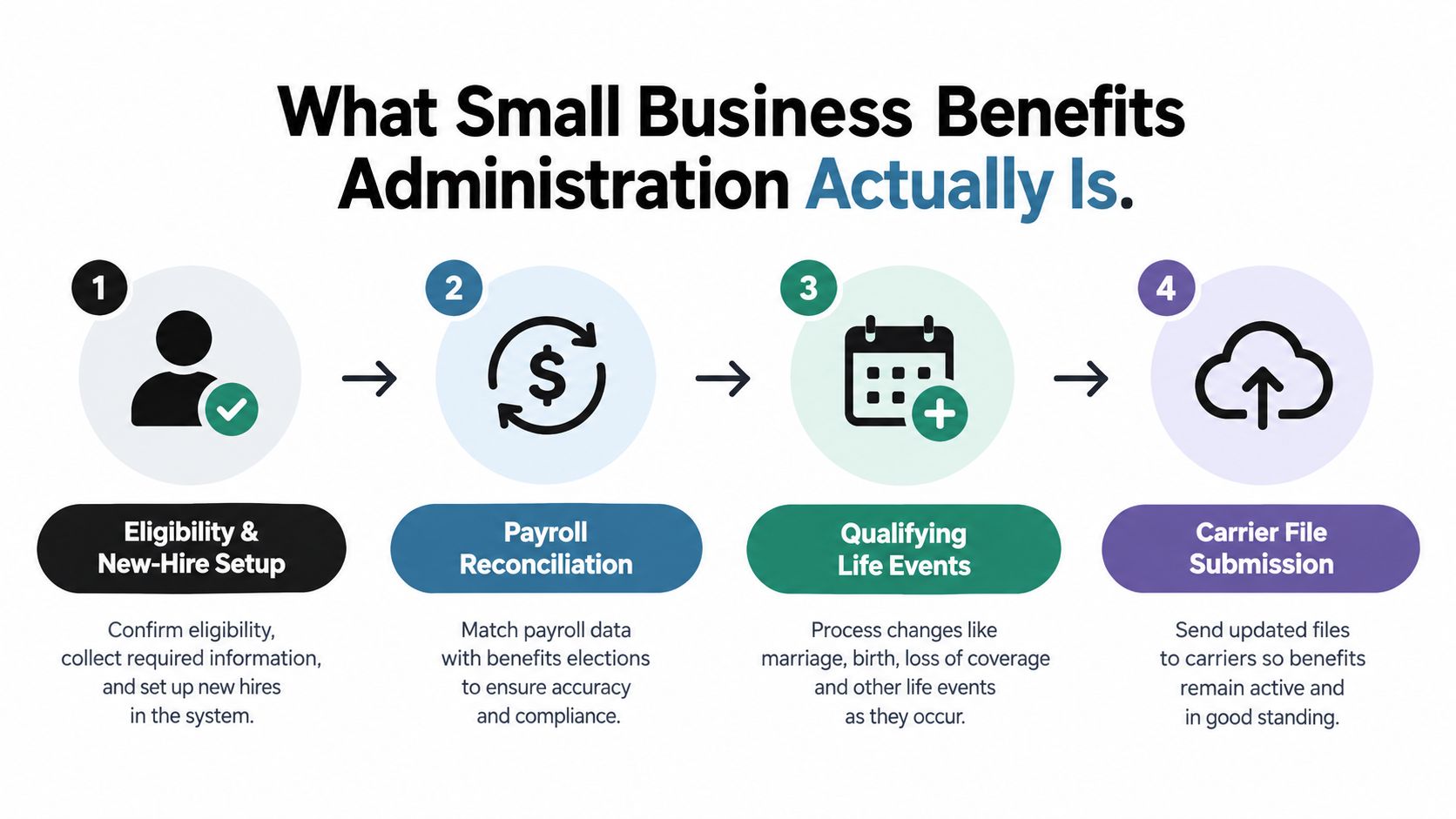
Small business benefits administration is the recurring work required to keep a benefits program accurate from an employee's first day through every change in employment status. It includes four connected stages.
- Eligibility and new-hire setup. Determine which plans an employee can access, collect elections, verify dependents when required, and transmit accurate information to the carrier.
- Payroll reconciliation. Match employee deductions and employer contributions with plan rates, payroll registers, and carrier billing.
- Qualifying life events and enrollment cycles. Process changes caused by marriage, birth, loss of coverage, relocation, or other permitted events, then manage annual enrollment.
- Carrier submission and compliance reporting. Send clean files, confirm acceptance, issue required notices, and preserve an audit trail.
Plan selection matters, but it's only one moment in the lifecycle. A founder may choose a medical, dental, or retirement plan during renewal and feel the major decision is complete. Administration begins immediately afterward, when someone must make sure the selected plan appears correctly in onboarding, deductions, carrier records, employee communications, and compliance files.
The operating layer beneath the plan
Choosing a plan can take an afternoon. Running that plan requires standing workflows with owners, deadlines, approval points, and evidence that each change was completed.
For example, a new hire's address can affect eligibility, state obligations, and the carrier file. A termination can require a payroll change, coverage end date, carrier update, and continuation notice. A promotion might change compensation without changing benefits, but the payroll deduction still needs to remain correct.
The practical takeaway is simple: create a task for every trigger, not just for annual enrollment. Use a central record, assign a responsible person, and require confirmation when the payroll or carrier system accepts the change.
A platform can reduce duplicate entry, but software won't fix undocumented eligibility rules or an owner who never reviews exceptions. Good administration combines clear policy, connected data, recurring checks, and accountable follow-through.
Why Administration Quality Is a Competitive Issue
Small employers face a benefits access disadvantage before an HR lead makes a single administrative error. In 2024, workers at businesses with 50 or fewer full-time equivalent employees had access to medical care benefits at a 55% rate, compared with 88% at businesses with 100 or more employees, according to the Congressional Budget Office analysis of employer benefits.
The same comparison shows a broad pattern across benefit categories. Access to defined contribution plans was 54% versus 85%, dental care was 27% versus 59%, and long-term disability coverage was 22% versus 54% for smaller versus larger employers, respectively, as reported by the CBO source above.
| Metric | Finding |
|---|---|
| Medical care access | 55% at businesses with 50 or fewer FTEs, versus 88% at businesses with 100 or more employees |
| Defined contribution access | 54% versus 85% |
| Dental care access | 27% versus 59% |
| Long-term disability access | 22% versus 54% |
These figures make administration a competitive issue in two ways. First, a smaller employer may already be competing with a richer benefits package from a larger organization. Second, employees judge the benefit experience through everyday interactions: whether enrollment works, whether deductions are correct, whether coverage starts on time, and whether HR can answer a question without sending them through a maze.
A payroll-feed mismatch can create an incorrect paycheck. A stale eligibility record can delay coverage. A broken onboarding page can make a candidate question the company's operational maturity. The plan may be valuable, but employees experience the back office.
A benefit that exists on paper but fails during enrollment doesn't strengthen the employee value proposition.
The answer isn't automatically adding more plans. It's making the existing program reliable. A clean enrollment workflow, clear employee instructions, fast exception handling, and accurate carrier transmission can help a small employer present its benefits with confidence. That reliability won't erase the structural access gap, but it can prevent avoidable administration failures from widening the competitive disadvantage.
Compliance Triggers Every SMB HR Lead Must Know
Compliance usually changes through triggers, not dramatic announcements. A company crosses a headcount threshold, an employee leaves, or a new hire reaches an election deadline. The HR lead's job is to connect each trigger to the payroll calendar and compliance calendar.
The headcount threshold
Businesses generally aren't required to offer health coverage under the ACA unless they have 50 or more full-time employees plus full-time equivalents, and an employer becomes an Applicable Large Employer when it averages 50 or more FTEs in the prior calendar year, according to this overview of health benefits for small businesses.
Don't rely on a casual headcount. Track full-time employees and the combined equivalent of eligible hours worked by part-time employees, then preserve the calculation. The threshold can affect whether the employer has additional offer, affordability, minimum-value, and reporting responsibilities.
The continuation coverage trigger
Federal COBRA generally applies to private-sector group health plans maintained by employers with at least 20 employees on more than half of their typical business days in the prior calendar year. Employers below that level may still face state mini-COBRA requirements, as explained in this benefits compliance glossary.
That means a termination workflow needs more than an HRIS status change. It should identify the coverage end date, notify the responsible administrator, record the notice deadline, and confirm delivery.
The election window
Referenced open enrollment guidance says employers with 50 or more FTEs are generally expected to provide annual enrollment under ACA-related administration practices, and employees must receive a minimum of 14 days to make benefit elections, according to open enrollment guidance from Paycor.
Keep the deadline visible in the payroll calendar. For broader employee support, a plain-language mental health guide for leaders can help managers communicate available resources without turning benefits conversations into clinical advice.
| Trigger | Threshold | What It Activates | Cadence to Monitor |
|---|---|---|---|
| ACA employer status | 50 or more FTEs averaged in the prior calendar year | Additional health coverage and reporting responsibilities | Review headcount monthly and preserve the annual calculation |
| Federal COBRA | At least 20 employees on more than half of typical business days in the prior calendar year | Federal continuation coverage obligations for applicable group plans | Review during hiring, termination, and annual compliance checks |
| Election window | Minimum 14 days under the referenced guidance | Time for employees to make benefit elections | Track for each new-hire and open-enrollment cycle |
Use a documented employee benefits compliance checklist to assign owners and evidence completion. Thresholds shouldn't live in one person's memory.
Choosing an Administration Model That Fits Your Team
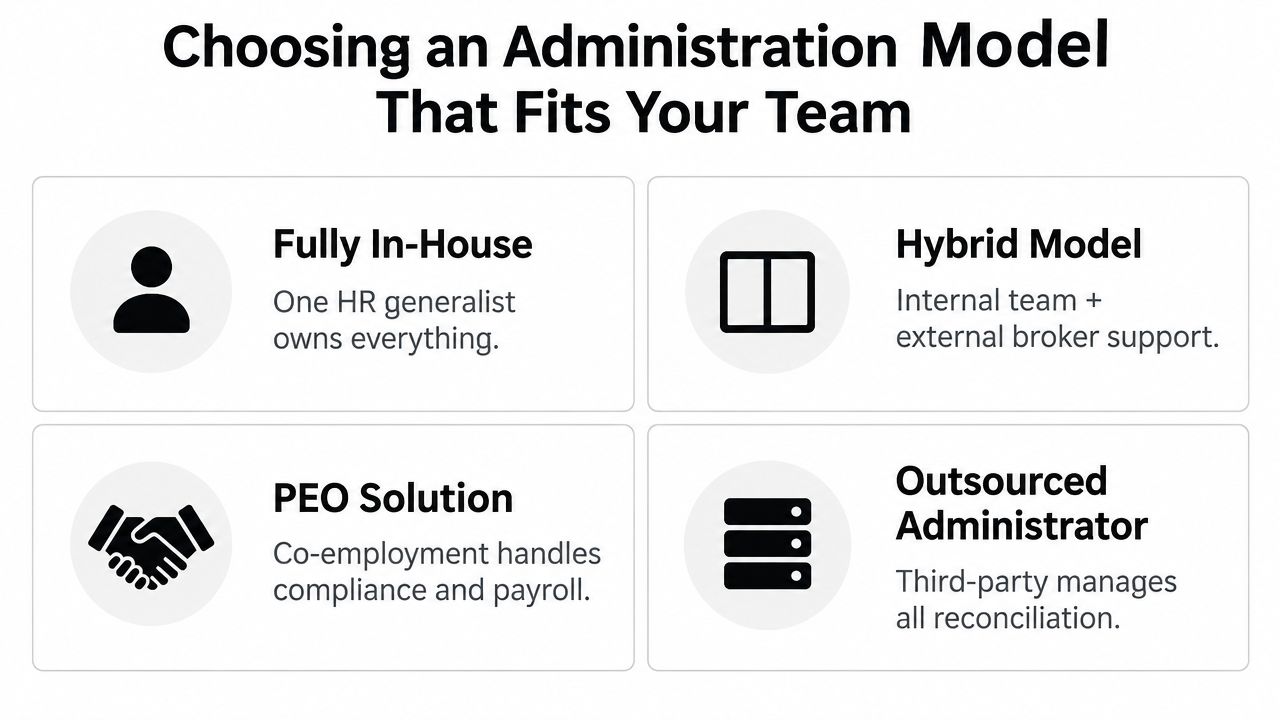
The useful question isn't, “Who sells the plan?” It's, “Who owns the reconciliation when the records disagree?” Every administration model assigns that work differently.
Four common structures
Fully in-house means an HR generalist or payroll lead owns eligibility, enrollment, carrier contact, billing checks, notices, and employee questions. This can fit a small, single-state employer with simple plans and a hands-on operator. Its failure mode is concentration risk. When that person is absent, the process often stops.
Broker-supported administration keeps most day-to-day work inside the company while the broker assists with plan selection, renewal, and carrier questions. It can work well when the internal team understands payroll but needs market guidance. The weak point is the carrier-portal burden. A broker may advise on a discrepancy without owning the correction.
Platform-based administration connects benefits elections with HR and payroll workflows. It can reduce duplicate entry and provide enrollment tracking, employee self-service, and reporting. The risk is false confidence. A platform can transmit an incorrect eligibility rule efficiently if nobody validates the setup.
A full PEO bundles payroll, HR services, benefits access, and compliance support through a co-employment arrangement. It may suit a company expanding across states or lacking internal HR capacity. The trade-off is less direct control over some processes, plus the need to understand service boundaries, pricing, and the co-employment structure.
Estimate workload by asking three questions:
- Who completes new-hire setup and life-event changes?
- Who compares the payroll register with the carrier invoice each cycle?
- Who prepares year-end reporting and maintains the compliance calendar?
For a very small, single-state team, in-house or broker-supported administration may be workable. Multi-state growth, frequent hiring, or repeated billing corrections point toward an integrated platform or outsourced support. A company that wants operational help without giving up benefits strategy can explore employee benefits administration outsourcing.
Score each option against enrollment, billing reconciliation, compliance, employee support, integration, and exception ownership. The right model is the one that leaves no workflow without a named owner.
Building a Reconciliation Habit Around One Employee Record
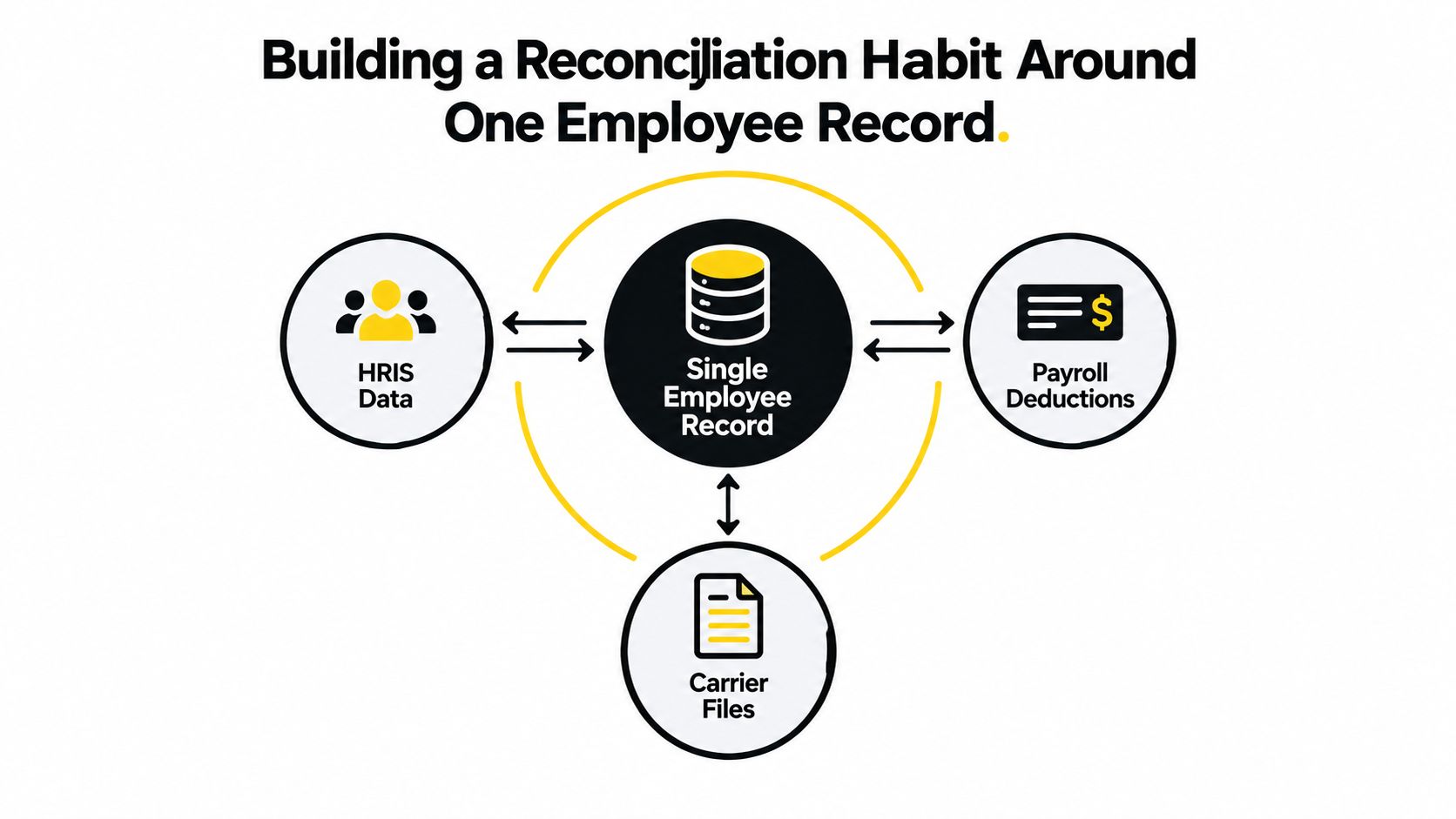
Benefits errors often begin with duplicate or stale records. An employee appears under one name in payroll, another identifier in the carrier portal, and an outdated address in the HR system. Each system may look reasonable on its own. The mismatch appears only when someone compares them.
Build one employee record that connects HRIS information, payroll deductions, and carrier eligibility. The record should show employment status, work location, hire and termination dates, eligible plans, elections, coverage dates, employee contributions, employer contributions, and the date of the last review.
Put reviews on triggers
Review the record when something changes, not only when an invoice arrives.
- At hire: Confirm eligibility, waiting-period rules, plan availability, dependent data, and the effective date.
- At a life event: Validate the event, permitted election change, supporting documentation, and carrier submission.
- At termination: Confirm the final deduction, coverage end date, carrier update, and applicable continuation notice.
- At a location or status change: Recheck state rules, plan availability, classification, and payroll treatment.
Neutral payroll guidance recommends using the payroll calendar as a benefits review calendar. That approach keeps payroll, benefits, and compliance from operating as separate silos.
Reconcile in a fixed order
Before transmitting a file, validate elections against the employee record. During each billing cycle, compare the carrier invoice with the payroll deduction report, plan rate table, and employer and employee contribution totals. Record every variance, its owner, its resolution, and whether the correction affects a future payroll.
Open enrollment needs a measurable completion target. SMB HR benchmark guidance identifies 95% or higher enrollment completion as a useful target, according to TriNet's small-business benefits administration FAQ. Count employees who submitted complete elections or an approved waiver, not employees who merely opened the enrollment portal.
Control point: “Most people finished” isn't a metric. A completion report with named exceptions is.
Cost Control When the Budget Is Already Tight
Cost pressure creates a predictable temptation. Leaders add a voluntary benefit, a wellbeing platform, or another perk because the package feels less competitive, while the underlying cost leak remains in eligibility, plan design, utilization, or billing.
That reflex deserves scrutiny. Recent reporting says small-business employers cite controlling healthcare costs as their top benefits priority, while medical insurance consumes a disproportionate share of team time and budget, as discussed in coverage of healthcare costs and PEOs. The operational lesson is to fix the system before expanding the menu.
Simplify first
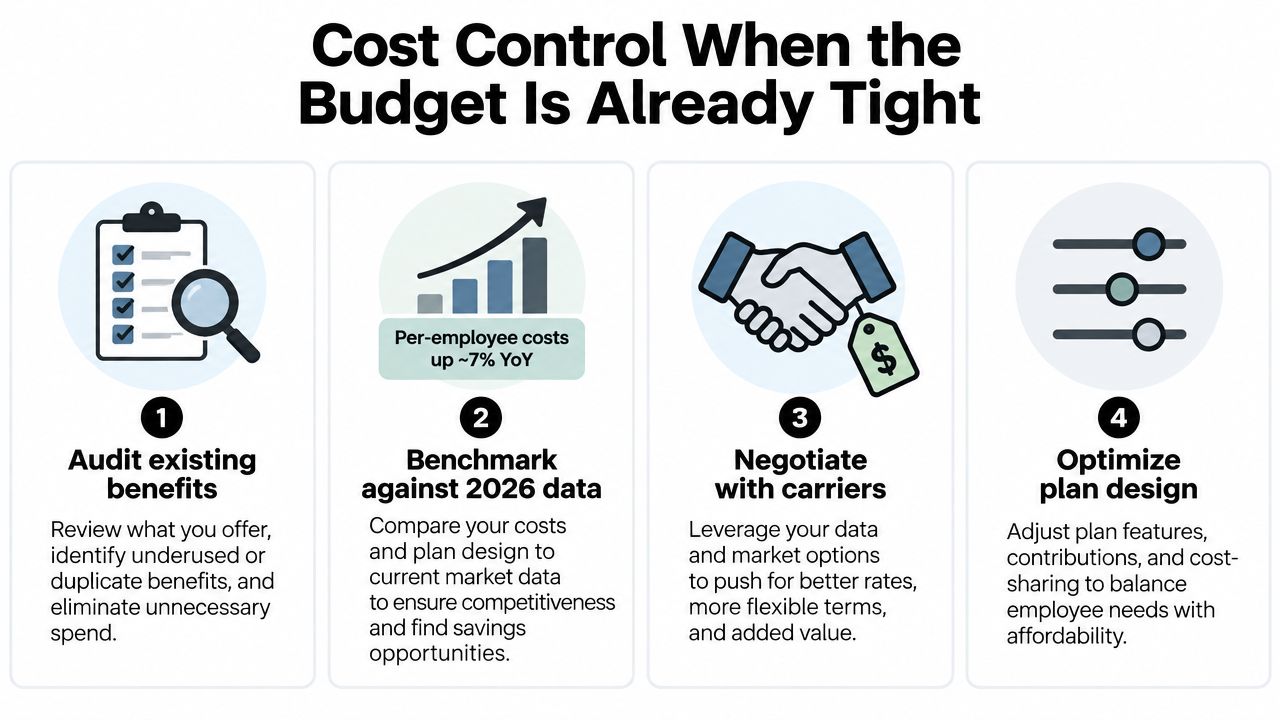
Start with a line-by-line review of enrolled employees, plan participation, employer contributions, payroll deductions, and carrier billing. Ask whether each plan has a clear purpose and whether employees understand the cost difference between options.
Useful design conversations may include:
- Plan count: Could two understandable plans serve employees better than three poorly explained choices?
- Cost sharing: Would a different deductible tier lower the employer's exposure while remaining acceptable to employees?
- Funding model: Could level-funded, captive, or another alternative arrangement fit the company's risk tolerance and eligibility profile?
- Negotiation: Can the broker review commissions, carrier terms, or pooling options available through a PEO?
These aren't automatic recommendations. A higher deductible can shift costs to employees. A self-funded or alternative-funded arrangement can create obligations and risk that a small company isn't equipped to manage. The decision should follow a review of enrollment, claims information, cash-flow tolerance, and administrative capacity.
Automate second, add perks last
A connected workflow can prevent overpayments, missed deductions, and time-consuming manual corrections. Review benefit cost per employee on a fixed cadence, tie each line to actual enrollment, and separate the cost of coverage from the cost of administering it.
For broader budget context, a recent benefits trends summary reports that 78% of organizations expect benefits costs to rise, while 19% are expanding benefits and 77% are keeping wellbeing offerings flat. The same source reports fully insured plans declining from 70% to 67%, self-insured plans rising from 27% to 29%, and employer-sponsored AI tools increasing from 16% to 33% in one year, as described in Software Advice's 2026 HR and people trends coverage. Treat those figures as market context, not as a reason to copy another employer's funding strategy.
A Practical 90-Day Rollout Checklist
A new benefits manager shouldn't inherit a folder of carrier PDFs and a reminder to “keep an eye on things.” Give the person a sequence, owners, and evidence of completion.
Days 1 to 30, clean the data
Start with the employee record. Remove duplicates, confirm employment status and locations, document eligibility rules, and identify employees whose elections, deductions, or carrier records disagree.
Then reconcile current payroll deductions against carrier rosters and invoices. Pull a 12-month claims history for renewal discussions where available and permitted, while protecting sensitive information and limiting access to people who need it.
Phase-one success measures: a current employee census, documented eligibility rules, a variance log with owners, and a calendar of recurring payroll and compliance checks.
Days 31 to 60, choose the operating model
Score fully in-house, broker-supported, platform-based, and PEO options against four workflows: enrollment, billing reconciliation, compliance, and employee support. Ask each provider who owns exceptions, how payroll integrates, how carrier files are confirmed, and what employees do when they need help.
Finalize the carrier and administration model only after reviewing the employee experience and the back-office workload. Store plan documents, summaries, notices, and service contacts where the next administrator can find them.
Phase-two success measures: a completed vendor scorecard, signed responsibilities matrix, validated plan setup, and an accessible document library.
Days 61 to 90, run the first cycle
Test enrollment in a staging environment before inviting employees. Launch the self-service portal, explain elections in plain language, and provide the required 14-day election window described in the referenced guidance. Monitor incomplete elections daily and resolve exceptions before the file deadline.
After the first payroll, reconcile deductions against the carrier bill within five business days. Confirm that the first carrier invoice contains no unresolved discrepancies, then archive the reconciliation evidence.
Phase-three success measures: 95% enrollment completion, zero discrepancies on the first carrier bill, and a documented compliance calendar for the year. Those targets turn a vague implementation into an operating test.
For a founder or HR lead, the rollout is complete when another trained person can follow the calendar, locate the employee record, understand the exception log, and explain what happens after the next hire, life event, payroll run, or termination.
Benely helps small and mid-sized employers centralize benefits enrollment, life-event changes, carrier communications, payroll connectivity, and compliance workflows in one employee platform. If your team needs to replace scattered spreadsheets and portal checks with a repeatable administration process, visit Benely to review the available approach.