The U.S. Securities and Exchange Commission's whistleblower program awarded nearly $600 million to 68 people in fiscal year 2023 for information that helped enforcement efforts. For a small business owner, that's a reminder that employee observations can have substantial value, especially when management hasn't created a credible way to hear and investigate them.
The benefits of a compliance program aren't limited to avoiding fines. A useful program helps your team catch errors, protect money, keep evidence organized, and respond consistently when someone raises a concern. The business question is whether those improvements justify the staff time, outside advice, and tools you pay for.
Table of Contents
- Six Benefits of a Compliance Program at a Glance
- How a Compliance Program Reduces Legal and Fraud Risk
- How Compliance Cuts Losses and Protects Profit
- Why Employees Trust Companies That Act on Reports
- Faster Audits and Cleaner Reporting Records
- Building a Right-Sized Program for a Small Business
- Start With a Free Benefits Compliance Review
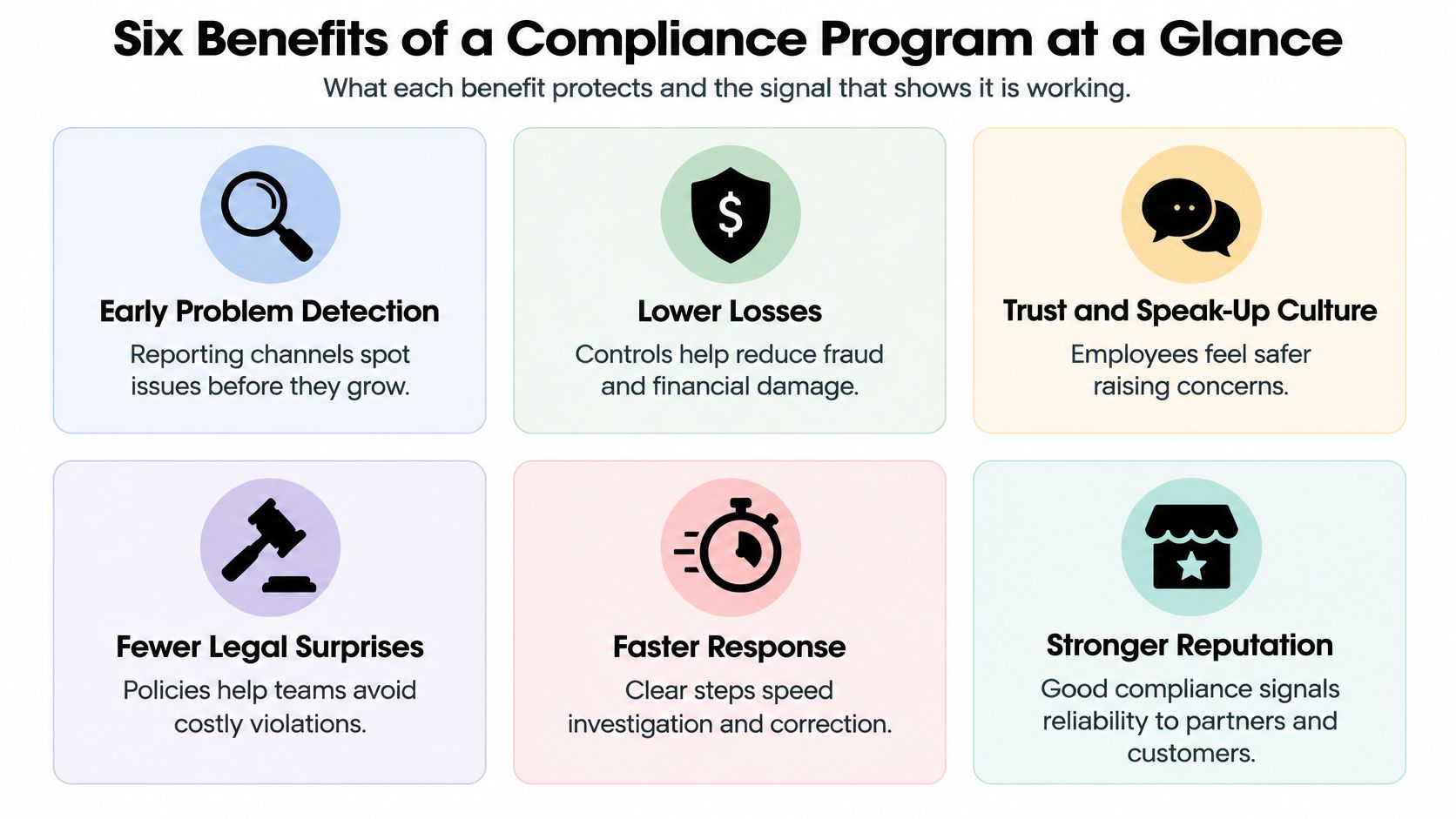
Six Benefits of a Compliance Program at a Glance
Benefits of a compliance program and the signal that shows each one is working
| Benefit | What It Protects | Signal It Is Working |
|---|---|---|
| Early problem detection | Fraud, misconduct and errors caught sooner | Share of concerns resolved within target days |
| Lower loss exposure | Money lost to fraud and misuse | Median loss and fraud duration trending down |
| Fewer safety disruptions | Lost work time and claims | Incident and injury counts falling |
| Employee trust | Willingness to speak up internally | Share of employees who report concerns through internal channels |
| Audit readiness | Time and cost of audits and filings | Days needed to produce evidence |
| Regulatory defensibility | Credibility with regulators, insurers and partners | Documented, timestamped responses to every concern |
Early problem detection protects your opportunity to intervene. Track resolution against a target appropriate to the concern's severity, but don't reward employees for closing cases before they've established what happened.
Lower loss exposure protects cash. Separate confirmed losses, recovered money, and estimated future losses avoided so your dashboard doesn't turn assumptions into savings.
Fewer safety disruptions protect employees and work schedules. Review incident counts alongside reporting activity, because a quiet incident log could reflect either safer work or reluctance to report hazards.
The visual below summarizes how these protections connect.
What the signals mean for an owner
Employee trust protects your access to information. Ask employees whether they raised concerns internally and whether they felt safe doing so. A rise in reports isn't automatically evidence of more misconduct; employees may finally believe someone will listen.
Audit readiness protects staff capacity. Time how long someone needs to retrieve a complete record, not merely locate a folder. An approval without its supporting reconciliation may still leave an auditor's question unanswered.
Regulatory defensibility protects the credibility of your response. A dated record of the concern, investigation, decision, and correction gives reviewers something concrete to assess. It doesn't guarantee favorable treatment or excuse a violation.
Practical rule: Measure whether people perform the control, not just whether the policy exists.
These benefits affect both the cost line and the risk line. You're looking for less rework, fewer losses, and less management time spent reconstructing events, while reducing the chance that an unresolved issue reaches the owner as a surprise.
Start by checking how quickly your company handles an internal report. You can usually establish that baseline from existing records without buying software, and it reveals whether responsibilities and handoffs are clear.
How a Compliance Program Reduces Legal and Fraud Risk
The Association of Certified Fraud Examiners' occupational-fraud detection findings identify tips as the leading detection method, accounting for approximately 31% of detected cases, while telephone hotlines alone account for about 30%. Those figures shouldn't be added together; they describe reporting-related detection measures, not separate shares of a combined total.
The practical lesson is that employees, vendors, and other stakeholders can notice misconduct before a scheduled review does. A program doesn't stop every problem. It gives those observations a route to someone who can investigate and act.
From a payroll concern to a documented correction
Say a payroll clerk spots duplicated bonus payments. The clerk isn't sure whether they're authorized adjustments and doesn't want to accuse a supervisor unfairly.
Through a confidential reporting route, the clerk submits the payment references. The compliance owner preserves the payroll export, checks approval records, and assigns a reviewer who wasn't involved in processing the bonuses. In this hypothetical case, the reviewer identifies an import error and stops its recurrence within the next pay cycle rather than waiting for the year-end audit.
The response needs connected controls:
- Confidential intake: Restrict access to the report and explain who may need to see it.
- Anti-retaliation protection: Prohibit adverse treatment for raising a concern in good faith, and investigate suspected retaliation separately.
- Documented investigation: Record the allegation, evidence examined, findings, and corrective action.
- Defined escalation: Specify when the owner, outside counsel, insurer, or another responsible party must become involved.
A payment error isn't necessarily fraud. Preserving that distinction helps investigators test facts rather than assume intent.
Apply the same process to everyday HR risks
For a small employer, useful reporting categories include payroll and benefits errors, employee-data misuse, discrimination or harassment concerns, and improper vendor billing. Each needs a suitable reviewer. An allegation against the person who normally receives reports must have an alternate route.
Training should teach employees what to flag and managers what to do next. Documind's resource on preventing legal risks through employee training provides context for connecting instruction to workplace decisions, rather than treating course completion as the outcome.
Use an employee benefits compliance checklist to turn benefits-related concerns into reviewable tasks. For example, an enrollment complaint should prompt a comparison of the employee's election, eligibility record, payroll deduction, and carrier confirmation.
A reporting channel is useful only when someone has the authority, independence, and time to act on what comes through it.
That's why reporting infrastructure belongs near the foundation of risk reduction. An observation sitting in an unattended inbox offers little protection.
How Compliance Cuts Losses and Protects Profit
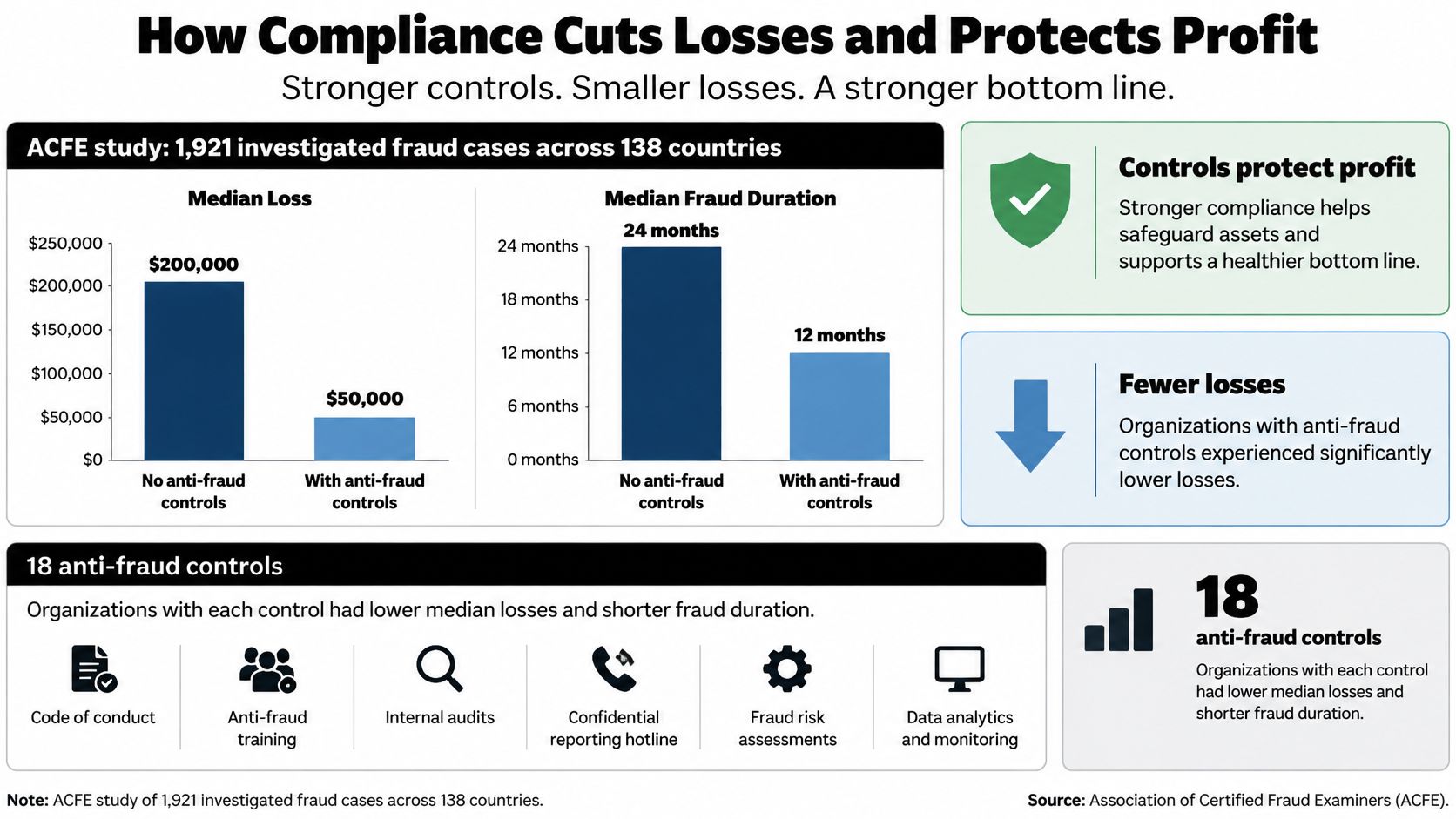
Surprise audits, financial-statement audits, reporting hotlines, and proactive data analysis were each associated with at least a 50% reduction in both fraud loss and fraud duration in the ACFE's 2024 Report to the Nations findings, which examined 1,921 investigated fraud cases across 138 countries and territories and found lower median losses and shorter duration for organizations with each of 18 examined controls.
That's strong support for active controls, but it isn't a promise that installing a hotline will halve your losses. The findings describe associations across investigated cases, not a guaranteed return for an individual employer.
The visual highlights the relationship between controls and financial exposure.
Match the control to the money at risk
Each control serves a different purpose. A surprise review tests transactions without allowing staff to prepare selected records. A financial-statement audit provides independent scrutiny within its scope, but shouldn't be treated as a check of every payment.
A reporting channel captures observations that transaction testing may miss. Proactive analysis helps a reviewer identify exceptions, such as duplicate bank details, unusual benefit deductions, or access changes outside an employee's role.
For an SMB, build a risk-ranked control stack:
- Independent reporting: Give concerns a route outside the implicated employee's management chain.
- Targeted transaction reviews: Examine vendor changes, unusual payments, and approval overrides.
- Payroll and benefits reconciliation: Compare employee eligibility, deductions, and carrier records.
- Exception analytics: Flag unexpected enrollment changes, duplicate payments, and unusual access for human review.
Earlier detection can limit the transactions affected and the opportunity to conceal them. The financial benefit may include money recovered, repeated errors prevented, and less time spent rebuilding records.
Count operational savings without inflating them
Safety belongs in the business case too. OSHA's guidance for employers states that investments in worker safety and health can reduce injuries and illnesses while producing significant improvements in productivity and profitability.
A hazard assessment, incident-reporting process, and corrective-action log give supervisors a repeatable way to address unsafe work. The potential return includes less lost work time, fewer claims-related tasks, and less disruption to staffing.
Keep confirmed savings separate from estimated exposure avoided. A corrected overpayment has a documented amount. A hypothetical fine that never occurred doesn't belong in the same category.
Review loss avoided per control quarterly, alongside the control's operating cost. Record the calculation, its assumptions, and whether the benefit came from recovery, prevention, or staff time released. Don't credit multiple controls with the full value of the same avoided loss.
Why Employees Trust Companies That Act on Reports
A warehouse supervisor sees a coworker's timesheet being altered. Before reporting it, the supervisor wonders whether the manager involved will find out, whether anything will change, and whether speaking up could cost them their job.
That hesitation is consequential: a 2025 global analysis discussed by Corporate Compliance Insights, covering 98 companies in 58 countries, found that half of employees who witness misconduct don't report it and 60% of reports go to people rather than anonymous channels; it also describes high-impact programs as twice as likely to analyze speak-up data and explains that, under the DOJ's 2025 Corporate Enforcement Policy, self-reporting within 120 days of an internal report may preserve a presumption of declination if other conditions are satisfied.
The human decision behind those findings is simple: will reporting lead to a fair response? The workplace setting matters because employees often raise concerns while doing ordinary work.

Make the response predictable
A hotline employees distrust is an expense, not a dependable control. Give managers a response protocol they can follow:
- Protect the reporter: Put non-retaliation commitments in writing and check in after the report.
- Train the recipient: Thank the employee, preserve their account, and route the concern promptly. A next-business-day handoff is a practical internal target.
- Offer alternatives: Provide an anonymous route and a direct route outside the immediate supervisor.
- Explain timing: Publish investigation targets, communicate delays, and tell the reporter when the matter closes.
- Apply standards consistently: Seniority shouldn't determine whether misconduct has consequences.
- State privacy limits: Don't promise anonymity when circumstances may reveal who reported.
Lighthouse Consultants' explanation of how whistleblower investigations expose corporate fraud offers useful context for separating an allegation from an evidence-based finding.
Prompt escalation also preserves management's ability to obtain legal advice about disclosure. A hotline doesn't guarantee immunity, and disclosure decisions require case-specific advice.
Ask every manager: Who receives a concern? When does the reporter hear back? What happened the last time someone spoke up? Unclear answers reveal where trust-building work should start.
Faster Audits and Cleaner Reporting Records
Auditors ask for evidence. Evidence is easier to retrieve when employees create it during routine work, with dates, approvals, and owners attached, rather than reconstructing it after a request arrives.
The DOJ's 2024 antitrust compliance guidance emphasizes program design, business integration, accessible resources, reporting mechanisms, training effectiveness, and periodic review. Although it addresses antitrust compliance, its distinction between a documented program and functioning controls is useful when organizing HR evidence.
Test the design and the actual work
Design effectiveness asks whether a control addresses the risk. If your concern is incorrect benefit deductions, a training attendance sheet won't establish that payroll agrees with employee elections.
Operating effectiveness asks whether the control ran consistently during the review period. A well-written reconciliation procedure isn't enough if no one completed or reviewed the reconciliation.
Say your benefits administrator compares HR records, payroll deductions, and carrier enrollment each month. The administrator records mismatches, assigns corrections, and retains reviewer approval. When an auditor asks how eligibility errors are handled, the team can produce the procedure and completed exception logs instead of searching disconnected emails.
Audit evidence to keep by requirement area
| Requirement Area | Evidence to Keep | Owner |
|---|---|---|
| Eligibility and enrollment | Carrier-to-payroll reconciliation reports | Benefits administrator |
| Payroll deductions | Timestamped approval and exception log | Payroll lead |
| Employee data access | Access review logs with dates | HR director |
| Training completion | Completion records by employee | HR manager |
| Concerns and investigations | Case log with dates and outcomes | Compliance owner |
| Required filings and notices | Dated submission and distribution records | HR manager |
Keep reporting records complete
Pay particular attention to eligibility, deductions, and required filings because they involve handoffs between systems or people. Identify the system of record, the reviewer, and the evidence needed to show completion.
Create a filing calendar that records the applicable requirement, due date, preparation owner, approval owner, and submission confirmation. For employee notices, retain the version distributed and evidence of distribution, not just a template saved in a folder.
Use the Form 5500 filing deadline guide when checking the plan's reporting calendar. Confirm applicability and deadlines for your circumstances before treating a calendar entry as settled.
Restrict investigation files and sensitive employee records to authorized users. Audit readiness doesn't mean giving everyone access to everything.
Evidence test: Could another authorized employee explain what happened using the retained record alone?
Track days needed to produce complete audit evidence before and after changing the process. Include correction time, since quickly delivering incomplete records isn't an improvement.
Building a Right-Sized Program for a Small Business
More policies don't automatically mean more protection. The U.S. Chamber of Commerce's small-business compliance spotlight reports that 42% of U.S. small businesses feel they spend too much time on compliance tasks and 67% believe smaller companies spend more per employee complying with regulations than larger competitors; its discussion also highlights Australian findings that 38% of small-business respondents felt confident they understood all their regulatory obligations, while 14% weren't confident at all.
The answer is a proportionate system, not a larger policy library. Start with obligations that could cause serious harm or recurring disruption, then give each an accountable owner.
A working session should connect each requirement to an actual task.

Establish a manageable minimum
The following is a practical starting specification for a company under a hundred employees, not a universal legal minimum. Adjust training frequency and other controls when applicable obligations or risks require more.
Minimum components of a right-sized compliance program
| Component | Purpose | Minimum for an SMB |
|---|---|---|
| Written code of conduct | Sets standards for behavior | Signed acknowledgment by each employee |
| Reporting channel | Surfaces concerns early | Two routes, one of them anonymous |
| Anti-retaliation policy | Protects people who report | Written and reviewed yearly |
| Training | Builds shared understanding | Role-based and repeated annually |
| Risk-ranked control register | Maps obligations to owners | Owner, frequency and evidence listed for each control |
| Metrics review | Shows whether the program works | Quarterly review of the KPIs below |
Rank obligations by impact and likelihood. For each control, list its owner, frequency, evidence location, escalation trigger, and remediation deadline. Automate exports, reminders, and approval capture where your existing systems support them.
If you're considering a co-employment arrangement, compare responsibilities carefully through the PEO and HR solutions overview. Document who performs each task and who verifies completion rather than assuming outsourcing removes the need for oversight.
Use the video as a discussion prompt while reviewing your current process.
Put a number on the return
Review time per compliance cycle, exception rates, repeat violations, incident-response time, audit findings, and management hours released for growth quarterly. The DOJ's corporate compliance evaluation framework specifically asks about measuring program effectiveness and the commercial value of compliance investments.
Estimate program cost as owner and staff hours multiplied by their loaded hourly costs, plus tools and outside support. Compare that with documented recoveries, reasonably supported losses avoided, and released management time. Don't count released salaried hours as cash savings unless spending falls; they're capacity you can redirect.
A practical opening ninety-day sequence is to map obligations, assign owners, implement a priority reconciliation, and review the results. Use your actual workload to set the pace.
Policies that create acknowledgments but don't improve decisions, evidence, or response are overhead. Keep the controls that address meaningful risks, simplify duplicated work, and revise anything employees routinely bypass.
Start With a Free Benefits Compliance Review
Take these actions this week to establish a baseline without trying to rebuild your entire HR operation.
- Rate your benefits process. Use our What's Your Benefits Score? tool to assess your current approach. Benely offers a free 30-page benefits guide when you complete the rating.
- Check the filing position. Gather submission confirmations, distribution records, and outstanding questions for ACA reporting, COBRA, and ERISA filings. Our compliance evaluation helps ensure these obligations are up-to-date and compliant.
- Choose a measurable outcome. Select a benefit from the opening table and establish its signal as a quarterly KPI. The share of concerns resolved within target days is a useful starting point if your case records are complete.
Our compliance experts can assist with ACA reporting and COBRA administration, so your team doesn't have to develop every specialty internally. Keep responsibility for reviewing results clear even when someone else performs the work.
A review should reveal the gap to close first, not imply that every gap needs immediate investment. Which of the six benefits can you measure today?
Benely offers a benefits-process assessment and compliance evaluation to help you identify where filings, records, or responsibilities need attention. Visit Benely to rate your current process and start a conversation about the first compliance gap your team should address.