
The question arrives in a Monday leadership meeting. Are we compliant? You say yes, then spend the rest of the week proving it, or discovering you can't.
Most compliance failures aren't hidden. They sit in files nobody has pulled in a year. A Form I-9 missing the Section 2 date. An exempt employee paid below the salary threshold. A state posting that expired when the paid leave law changed last spring. None of it is dramatic. It's the residue of three busy quarters and one person doing four jobs.
This HR compliance audit checklist is built for the audit you can run this week. Nine areas, each with the exact record to pull, the sample size to test, and the error auditors find most often in that area. Assign an owner, block two hours per item, and work it top to bottom.
The discipline is the same one a site team applies when it works through an ISO 45001 certification process: evidence collected as you go, not reconstructed the week before a visit. HR records work exactly the same way.
Start with what's already in the cabinet.
Table of Contents
- 1. Form I-9 Employment Eligibility Verification
- 2. Wage and Hour Classification and Recordkeeping (FLSA)
- 3. Equal Employment Opportunity and Anti-Discrimination Policy Review
- 4. Required Federal and State Workplace Postings
- 5. Affordable Care Act (ACA) Employer Reporting and Coverage Compliance
- 6. ERISA Plan Documentation, Summary Plan Description, and Form 5500 Filing
- 7. COBRA Continuation Coverage Administration
- 8. HIPAA Privacy and Security for Group Health Plans
- 9. OSHA Injury and Illness Recordkeeping
- Audit Coverage, Retention Periods, and Key Checks at a Glance
- Turn This Checklist into a Recurring Audit Calendar
1. Form I-9 Employment Eligibility Verification

Every new hire completes one on day one, and then nobody opens the file again until someone official asks for it. That's exactly why I-9 paperwork produces so many federal findings. It's a form completed once, quickly, by whoever happens to be at the front desk that morning.
The record to pull: every Form I-9 for current employees, plus the file of anyone who left in the past year. Retention runs three years after the hire date or one year after employment ends, whichever is later. The sample: every file for people hired in the last 12 months, then a random 25 files or 10% of the older ones, whichever is larger, with at least one file from each location.
Where the Errors Actually Sit
- Late Section 2: the employer's review has to happen within three business days of the start date. Missing or late completion is the most common finding on the entire form.
- Placeholder entries: "N/A," a slash, or a document title with no number tells a reviewer that whoever signed never looked at the document.
- Section 1 gaps: a missing attestation checkbox, or a blank document number where the employee selected a status that requires one.
- Inconsistent copies: photocopying documents for some employees and not others invites a document-abuse question you don't want to answer.
Practical rule: accept any valid document the employee chooses and never request a specific one. Asking for a green card when a driver's license and Social Security card would satisfy the form is a discrimination risk all by itself.
Say a staffing firm adds a quarterly I-9 sweep to onboarding. The missing dates surface in week three instead of during a buyer's due diligence. A multi-location retailer that moves to an electronic I-9 platform gets deadline reminders built into the workflow rather than a calendar entry someone ignores.
If your team is new to this, the walkthrough below covers the review step by step.
Two habits close most of the gap. Calendar every reverification date for work authorization that expires, and store I-9s apart from personnel files so access stays limited to the people who need it.
2. Wage and Hour Classification and Recordkeeping (FLSA)
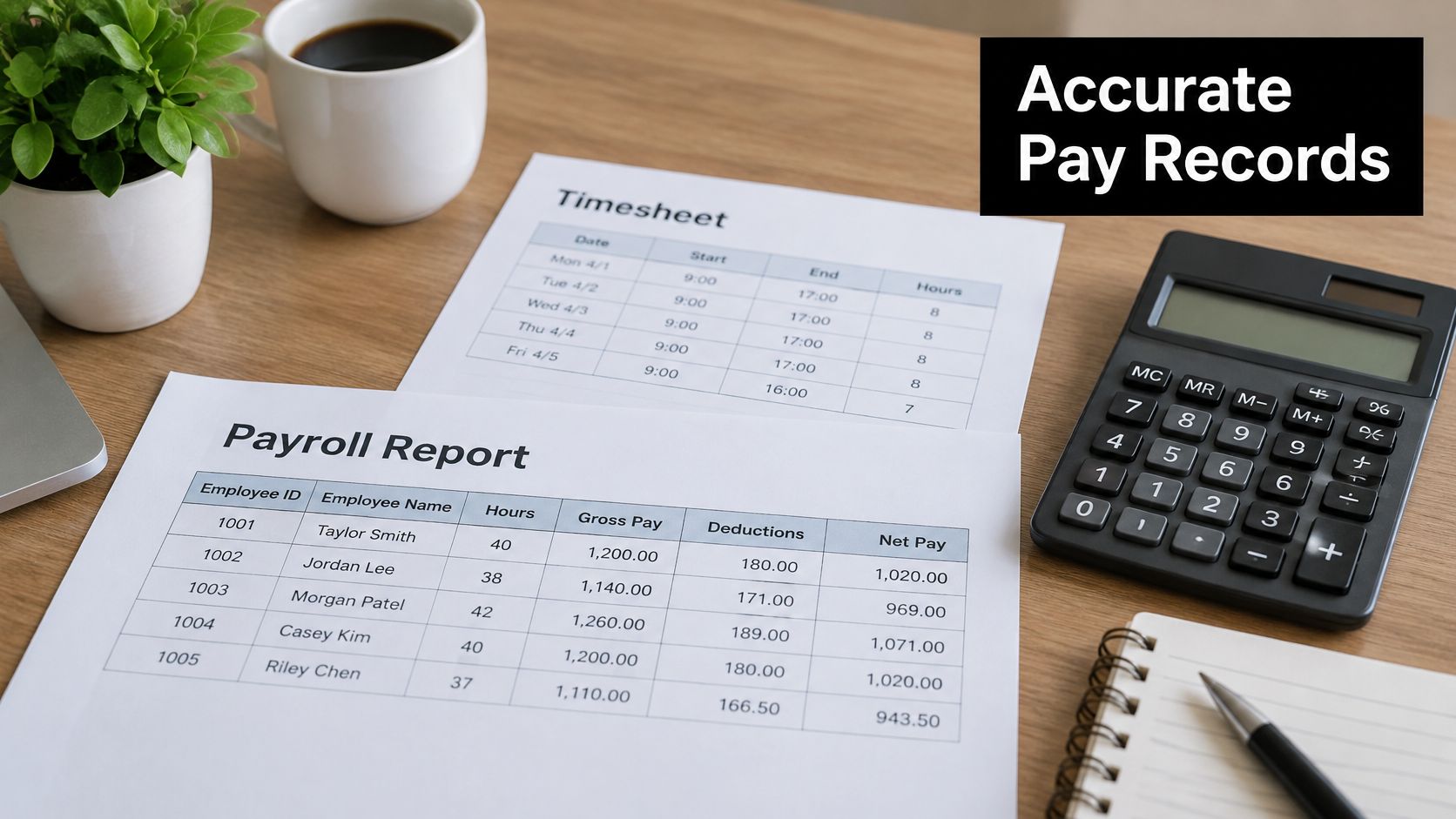
Start with the payroll register and trace paid hours back to the time record. A correct total can still hide unpaid work, unexplained punch edits, or the wrong overtime calculation.
Preserve payroll records, collective bargaining agreements, and sales and purchase records for at least three years, as specified in the Department of Labor's recordkeeping fact sheet. Check overtime calculations against the applicable FLSA requirements. Federal contractors should also check their separate personnel-record retention obligations rather than treating the FLSA schedule as the only requirement.
The record to pull: payroll registers, time and attendance records, and the written reasoning behind every exempt classification. The sample: one complete pay period per quarter for the past year for every non-exempt employee at your busiest location, plus every exempt employee's salary checked against the applicable threshold.
Classification Is a Two-Part Test
Check salary requirements, then actual duties. A job title does not establish an exemption. For an assistant manager who spends the shift on a register, compare the work performed with the applicable duties test instead of relying on the title.
Document the reasoning for every exempt role. Revisit it when responsibilities change.
For the sampled pay periods, compare original punches, edited punches, and paid hours. Look for rounding that consistently favors the employer, work performed before clock-in, and edits without an explanation. Check whether payroll applies the rules for the employee's work location rather than headquarters.
Correct classification errors and review the affected overtime. An internal correction still takes work, but leaving the issue unresolved can expose the employer to back wages, penalties, and legal fees.
If a punch is edited, record the reason and approver in the system the same day. An unexplained edit leaves no clear basis for the change.
Finally, check state minimum wage and daily overtime requirements wherever employees work. Keep the classification rationale with the audit records so the next review can test the decision, not reconstruct it.
3. Equal Employment Opportunity and Anti-Discrimination Policy Review
A termination file with no documented reason is the most expensive two-page gap in HR. The EEOC's recordkeeping requirements set the federal baseline: personnel and employment records for one year, involuntary-termination records for one year from the termination date, and payroll records relevant to the Age Discrimination in Employment Act for three years.
The record to pull: applications, interview notes, offers, promotion and pay decisions, accommodation requests, complaint logs, and termination files. The sample: every hire and separation from the last 12 months, capped at 15 files if volume runs high, plus every complaint with no exceptions.
Inconsistent Criteria, Not Bad Intent
One candidate gets a scorecard, the next gets a conversation, and six months later nobody can explain the difference. Fix the process rather than the file. One documented scorecard per role, the same questions per role, and a written business reason on every rejection and every termination.
Screening tools now belong in this section too. 84% of surveyed employers expected workplace policy or regulatory changes related to AI within the next 12 months, up from a substantially lower share in the prior year, with privacy, discrimination and bias, and state or local AI laws as the leading concerns, according to Littler's employer survey report.
Vendors don't absorb your liability. A reputable screening platform can still produce a disparate impact pattern in your applicant pool, and the evidence of how you checked rests with you.
A mid-sized manufacturer that breaks promotion data out by demographic group sometimes finds a gap that has nothing to do with intent and everything to do with who gets picked for stretch projects. Pay equity analysis belongs on the same calendar, run at least annually and under privilege where your counsel can arrange it.
4. Required Federal and State Workplace Postings
This is the cheapest audit on the list, and the one most often skipped.

The record to pull: a photograph of every physical posting location, your poster supplier's revision log, and delivery or acknowledgment records for remote staff. The sample: all of them. There's no reason to sample when a three-office company has three walls to check.
The federal set is stable. The EEO is the Law poster, the FLSA minimum wage notice, the FMLA notice, USERRA, and OSHA's safety notice belong where applicants and employees can see them. States revise constantly, and that's where failures cluster.
- A stale state poster: paid leave, pay transparency, and harassment prevention notices change after legislative sessions, and last year's version stays on the wall for another 12 months.
- A new location nobody checked: a satellite office or warehouse opened in March and got no posters at all.
- Remote staff with nothing delivered: a distributed workforce needs the notices delivered electronically, with acknowledgments tracked somewhere you can retrieve them.
- A posting treated as policy: a handbook entry isn't a substitute for the required notice.
Practical rule: review every posting each January and again after your state's legislative session ends. Photograph the wall on the same visit as your safety walkthrough.
A company with offices in three states that builds a location-by-location posting matrix stops guessing and stops re-litigating the same question every year.
5. Affordable Care Act (ACA) Employer Reporting and Coverage Compliance
Applicable large employers, generally those with 50 or more full-time equivalent employees, have to offer minimum essential coverage that is affordable and provides minimum value to full-time employees, or face employer shared responsibility payments. The coverage decision gets attention. The reporting behind it is where audits find trouble.
The record to pull: the measurement period policy, offer and eligibility tracking, affordability worksheets, and the draft Forms 1094-C and 1095-C. The sample: every full-time employee at the measurement date, plus 20 to 25 variable-hour files, because that's where classification errors hide.
Measurement Periods Come First
If you use the look-back method for variable-hour staff, the measurement and stability periods need to exist in a written policy before the plan year starts, not in an email thread reconstructed afterwards.
The recurring errors are code mismatches between the 1095-C and payroll, employee addresses that don't match the payroll system, and affordability calculated under the wrong safe harbor. Each one is fixable in an afternoon before filing and painful after. Say a growing company audits its 1095-C data a month early and finds several addresses that never matched payroll. The correction costs an hour. The penalty exposure for a complete and accurate filing failure is measured in days.
If the reporting mechanics are unfamiliar to whoever owns this file, this explanation of what ACA compliance requires covers the forms, the calendar, and the measurement rules in plain language.
A regional restaurant group that documents its look-back choice once a year stops rebuilding the decision every January, and the auditor gets a document instead of a memory.
6. ERISA Plan Documentation, Summary Plan Description, and Form 5500 Filing
Plan paperwork is where benefits compliance gets expensive.
The Department of Labor's 2023 audit quality study examined 307 plan audit reports and found that 12, or 4%, failed to comply with one or more ERISA reporting and disclosure requirements. A missed Form 5500 or an incomplete filing exposes the plan to substantial daily penalties, which turns a forgotten extension into a budget event.
The record to pull: the plan document with every amendment, the current summary plan description, summaries of material modifications, service provider fee disclosures, and the filed Form 5500 with its schedules. The sample: every plan you sponsor, which for most SMBs means the health plan, the 401(k), and possibly group life, plus 10 participants to verify SPD delivery.
The Version Problem
An SPD that describes last year's plan is the most common finding in this area. A carrier change, a copay change, or a new eligibility rule triggers a summary of material modifications and an updated SPD. Often the carrier file is updated and the plan document is never touched. The fix is procedural, not legal: one versioned repository, one named owner, and a rule that no carrier or plan change closes until the SPD and plan document match it.
SPD delivery is the other half of the finding. Pull those 10 participant files and look for proof each one received the current document, not just the version from hire date. A new hire packet proves nothing about the employee in year four.
Confirm distribution after every material change, review service provider fees annually and document that review in writing, and put Form 5500 deadlines and extension dates on a calendar that two people can see. A deadline one person tracks is a deadline one resignation erases.
A company that changes health carriers mid-year and issues a revised SPD with a summary of material modifications inside the required window has a clean file. A company that changes carriers and updates only the payroll deduction has a story. If whoever owns this file needs the plain-language version to circulate internally, this guide to what a summary plan description is covers what has to be in it and when it has to go out.
7. COBRA Continuation Coverage Administration
A separated employee calls six weeks after her last day, asking why she never received an election notice. That call is the audit.
Employers with 20 or more employees that sponsor group health plans owe qualified beneficiaries a general notice when coverage starts, an election notice after a qualifying event, and at least 60 days to elect coverage.
The record to pull: the general notice and its distribution proof, a qualifying event log, copies of election notices with proof of mailing, and premium payment history. The sample: every qualifying event from the last 12 months. Most SMBs have a handful, so sampling just adds risk.
The Clock, Not the Paperwork
Timing is where this breaks. The clock starts on the qualifying event date, not the day HR hears about it and not the day payroll closes the employee out. A termination, a reduction in hours, a divorce, and a dependent aging out of eligibility each start a separate timeline with a separate notice.
Reduction in hours is the one teams forget, because the person still shows up at work. If someone drops below the hours threshold, the qualifying event happened whether or not anyone filed paperwork.
Build the COBRA steps into the termination checklist itself. A separate process is a process someone skips during a busy week.
Get written confirmation from your third-party administrator on notice timing, and audit a sample of recent terminations every quarter against the event log. If you're unsure which events trigger which notice, this explainer on what COBRA continuation coverage is maps the triggers to the notices.
8. HIPAA Privacy and Security for Group Health Plans

An employer-sponsored group health plan is a covered entity. The moment claims data lands in an HR inbox, the employer side is handling protected health information for plan administration, and that comes with plan document language, access limits, and breach rules.
The record to pull: the plan document's HIPAA amendment, the access list for anyone who can see claims data, access logs, training records, and the breach response plan. The sample: everyone with access, which in a 60-person company is usually one or two people, plus 90 days of access logs.
Firewall Breaches Start with a Question
A manager asks HR whether an employee's absence is covered under a claim, and HR answers. One conversation puts the manager in possession of protected health information and breaks the firewall between benefits administration and employment decisions.
The fix is structural rather than cultural. Limit claims access to named individuals and review that list quarterly. Keep benefits inquiries with a designated benefits specialist who logs access. Train the team on the minimum necessary standard so nobody forwards a full explanation of benefits to answer a scheduling question. And confirm the plan document carries the required HIPAA language, because that amendment is what lets the employer receive PHI at all.
Document a breach response plan with clear escalation steps and named decision makers, and walk through it once a year with the people who'd make the call at 9pm.
9. OSHA Injury and Illness Recordkeeping
Check whether your establishment must maintain OSHA injury records before reviewing individual cases. Covered employers record work-related injuries and illnesses on the OSHA 300 log, post the Form 300A annual summary during the required window, and retain the records. Designated high-risk establishments also submit data electronically.
OSHA's enforcement statistics show 34,696 federal inspections in 2024. In South Africa, the Department of Employment and Labour reported inspecting 308,799 workplaces during the 2023/2024 reporting year and finding 74,858 non-compliant.
The record to pull: the 300 log, 300A summaries, electronic submission confirmations, and documentation supporting each first-aid versus medical-treatment decision. Check that summaries were posted, rather than merely prepared.
The sample: every recordable case within your retention period, plus a walkthrough of your highest-risk location. Compare each case's treatment and work restrictions with its log entry. A complete-looking log can still omit an injury reported to a supervisor.
Check for Missed Cases and Unposted Summaries
Prescription medication or restricted duty can make a work-related case recordable even when the employee calls the injury minor. Review the treatment documentation and light-duty decision rather than relying on the employee's description.
Practical rule: use the clinician's treatment documentation to assess recordability. Document the decision instead of guessing that treatment was only first aid.
Make the reporting channel clear. Remind supervisors that retaliation is a violation, and review injury patterns with the safety committee regularly. Repeated lifting injuries should prompt a review of lift assists and training, not just another completed log entry.
Audit Coverage, Retention Periods, and Key Checks at a Glance
Deadlines and retention rules are where audits usually fail. The fix is rarely complicated. You either kept the record or you did not, and the table below tells you which is which for all nine areas. Print it, tape it next to whoever owns compliance, and work down the rows one at a time.
| Item | Who It Applies To | Key Deadline or Retention Period | Primary Audit Check |
|---|---|---|---|
| Form I-9 Employment Eligibility Verification | U.S. employers hiring employees | Section 1 by first day; Section 2 within three business days; retain three years after hire or one year after employment ends, whichever is later | Check completion dates, acceptable documentation, retention, and required reverification |
| Wage and Hour Classification and Recordkeeping (FLSA) | Employers covered by the FLSA | Keep payroll records generally three years and time cards generally two years | Verify exempt classifications, overtime pay, and record retention |
| Equal Employment Opportunity and Anti-Discrimination Policy Review | Employers with 15 or more employees generally; coverage varies by law | Keep personnel and employment records for one year; if an employee is involuntarily terminated, retain the records for one year from the termination date; ADEA payroll records for three years | Review policies, complaint procedures, decision documentation, and manager training |
| Required Federal and State Workplace Postings | Employers subject to applicable federal, state, and local posting rules | Review postings regularly; requirements vary by location | Confirm required notices are current, visible, and accessible to remote employees where applicable |
| Affordable Care Act (ACA) Employer Reporting and Coverage Compliance | Applicable large employers, generally those with 50 or more full-time equivalent employees | Furnish Forms 1095-C to full-time employees by early March; file Forms 1094-C and 1095-C with the IRS by February 28 (paper) or March 31 (electronic) | Verify full-time status, coverage offers, affordability calculations, and form accuracy |
| ERISA Plan Documentation, Summary Plan Description, and Form 5500 Filing | Employers sponsoring ERISA retirement or welfare benefit plans | Form 5500 due the last day of the seventh month after plan year end (July 31 for calendar-year plans), extendable to October 15 | Check current plan documents, SPD distribution, amendments, and filing completion |
| COBRA Continuation Coverage Administration | Employers with 20 or more employees sponsoring group health plans | At least 60 days to elect coverage; continuation generally lasts up to 18 months for most qualifying events | Verify notice timing, election periods, and tracking records |
| HIPAA Privacy and Security for Group Health Plans | Employer-sponsored group health plans and employers handling PHI for plan administration | Retain required documentation for six years from creation or the date it was last in effect, whichever is later | Confirm authorized access, documented safeguards, plan document terms, and breach procedures |
| OSHA Injury and Illness Recordkeeping | Most private employers with 11 or more employees, subject to exemptions | Retain records for five years; post Form 300A February 1 through April 30 | Verify accurate injury logs, timely summary posting, and required electronic submissions |
Read the retention column as a floor, not a ceiling. When two periods could apply to the same file, follow the longer one, the way the I-9 row already does. When a termination, a complaint, or a lawsuit is in play, keep everything until counsel tells you otherwise, because the scheduled destruction date stops mattering the moment a dispute starts.
The check column is your sampling guide. For deadline-driven rows like I-9, COBRA, and the ACA forms, test the dates on a sample of files rather than trusting the process. For document-driven rows like ERISA and HIPAA, confirm the paperwork exists at all before you test whether it is current. Missing documents are the most common finding in both areas, and the cheapest to fix once you know they are gone.
Turn This Checklist into a Recurring Audit Calendar
A one-time review finds problems. A calendar prevents them.
Give each of the nine areas a named owner and a backup. Quarterly, pull I-9 files and COBRA notices, because both are deadline-driven and both can fail unnoticed. Every January, re-check postings for every location and re-read the state legislative changes that touch them. Twice a year, reconcile the ACA, ERISA, and HIPAA files against payroll. Once a year, run the full sweep and hand the findings to your CFO or COO with a dollar exposure figure attached to each line.
Many teams never get there. Only 16% of teams reviewed their employment policies more than once per year in 2025, and nearly one in five could not remember the last time they updated separation and hiring agreements, according to SixFifty's state of employment compliance report.
Cadence is also a benchmark you can measure against. SHRM's guidance on preparing for an internal wage and hour audit reports that 46% of HR professionals conduct internal wage audits on a regular, scheduled basis, while 33% conduct them only ad hoc or as needed.
Make the Findings Log Do the Work
A findings log with six columns is what turns a checklist into a control: the area, the gap, the owner, the legal exposure, the deadline, and the closure evidence. A finding closes when someone can produce the corrected document, not when someone says it's handled.
Then reset the clock on triggers rather than waiting for the annual cycle. Hiring in a new state, switching HRIS or payroll providers, acquiring a company, receiving a complaint, or a legislative change all invalidate part of the calendar you built in January. High-change areas like pay rates, worker classification, leave eligibility, remote work locations, and screening tools need a review after each of those events.
Executive sign-off keeps the work funded. A quarterly dashboard with audit coverage, open exceptions, median remediation age, repeat findings, and completion rate gives a founder or CFO something to act on without enterprise analytics.
If your team is short on bandwidth for the ACA, ERISA, or HIPAA work, Benely's certified HR experts can review those records with you and flag what's missing before an agency does.
Benely pairs a centralized benefits platform with certified HR experts who handle the compliance work that sits behind the checklist, from ACA reporting and COBRA notice timing to ERISA wrap documents and Form 5500 filings. You can rate your current benefits process and receive a free 30-page guide, then bring the findings you just collected to a team that runs this work every week. Visit Benely to see how the benefits and compliance pieces fit together.