
 Employee Benefits
 HR & Compliance
 Technology
 Wellness
 PEO Solutions

39% of private industry workers had access to an HSA in March 2024, up from 24% in March 2015, according to the U.S. Bureau of Labor Statistics, and that growth is exactly why HSA administration is no longer a side task. It now sits inside plan design, payroll, compliance, employee communication, and tax reporting, and if any one of those pieces slips, the whole program gets messy fast. For employers, the challenge isn't opening the account, it's keeping eligibility, deductions, employer funding, and reporting aligned all year long.
A lot of teams still talk about HSAs as if they were a simple payroll add-on. In practice, they behave more like a multi-party system, with HR checking eligibility, payroll timing deductions, benefits teams managing enrollment, and custodians handling the actual account experience. If you want a broader payroll operations lens that fits this kind of coordination, the founder's guide to payroll outsourcing is a useful companion read.
Table of Contents
- Why HSA Administration Demands Your Attention
- Selecting the Right HSA Custodian for Your Organization
- Setting Up Payroll Deductions and Employer Contributions
- Navigating Contribution Limits and Compliance Requirements
- Educating Employees About HSA Benefits and Limitations
- Troubleshooting Common HSA Administration Problems
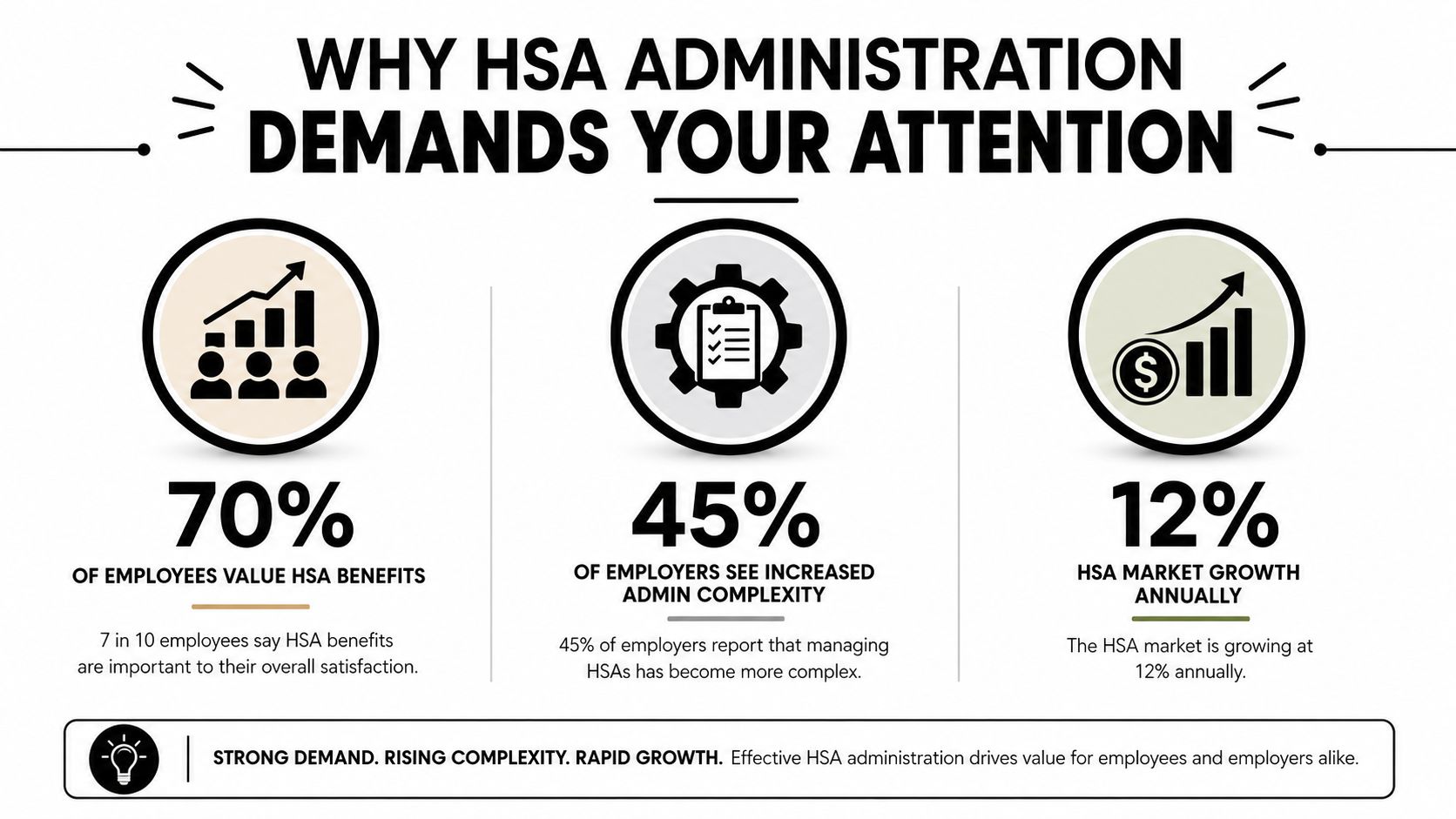
Why HSA Administration Demands Your Attention
The market has moved. AHIP reported 38.8 million people enrolled in HSA-eligible health plans as of January 1, 2024, up from 32.1 million in 2019, and those enrollees represented 17.9% of total commercial health plan enrollment. AHIP also found that 90% of HSA-eligible enrollees were in the large-group market, which tells you where the operational burden sits, inside employer benefits programs, not in a niche corner of the market. The same data showed 36% of enrollees were ages 25 to 44, a reminder that HSA administration affects working families and mid-career employees, not just a highly compensated subset. That market context comes from the U.S. Bureau of Labor Statistics and AHIP data summarized in the BLS factsheet on high-deductible plans and HSAs, which is the right place to anchor any employer conversation about scale and adoption. BLS factsheet on high-deductible plans and HSAs
The work is operational, not theoretical
Once an HSA program is in place, the admin load shows up in ordinary moments. A new hire picks the wrong medical plan in onboarding, payroll starts deductions before eligibility is confirmed, or a mid-year life event changes whether the employee can still contribute. None of those problems are exotic, but each one can create excess contributions or tax-reporting headaches if the workflow isn't tight.
Practical rule: If you can't describe who verifies eligibility, who stops contributions, and who reconciles W-2 reporting, the program is already under-controlled.
That's why employers outgrow “set it and forget it” thinking quickly. HSA administration touches plan design, employee education, payroll deductions, employer deposits, and year-end tax reporting all at once. The best-run programs use a defined handoff between HR, payroll, benefits leadership, and the custodian, because the failure point is usually not policy, it's coordination.
Selecting the Right HSA Custodian for Your Organization
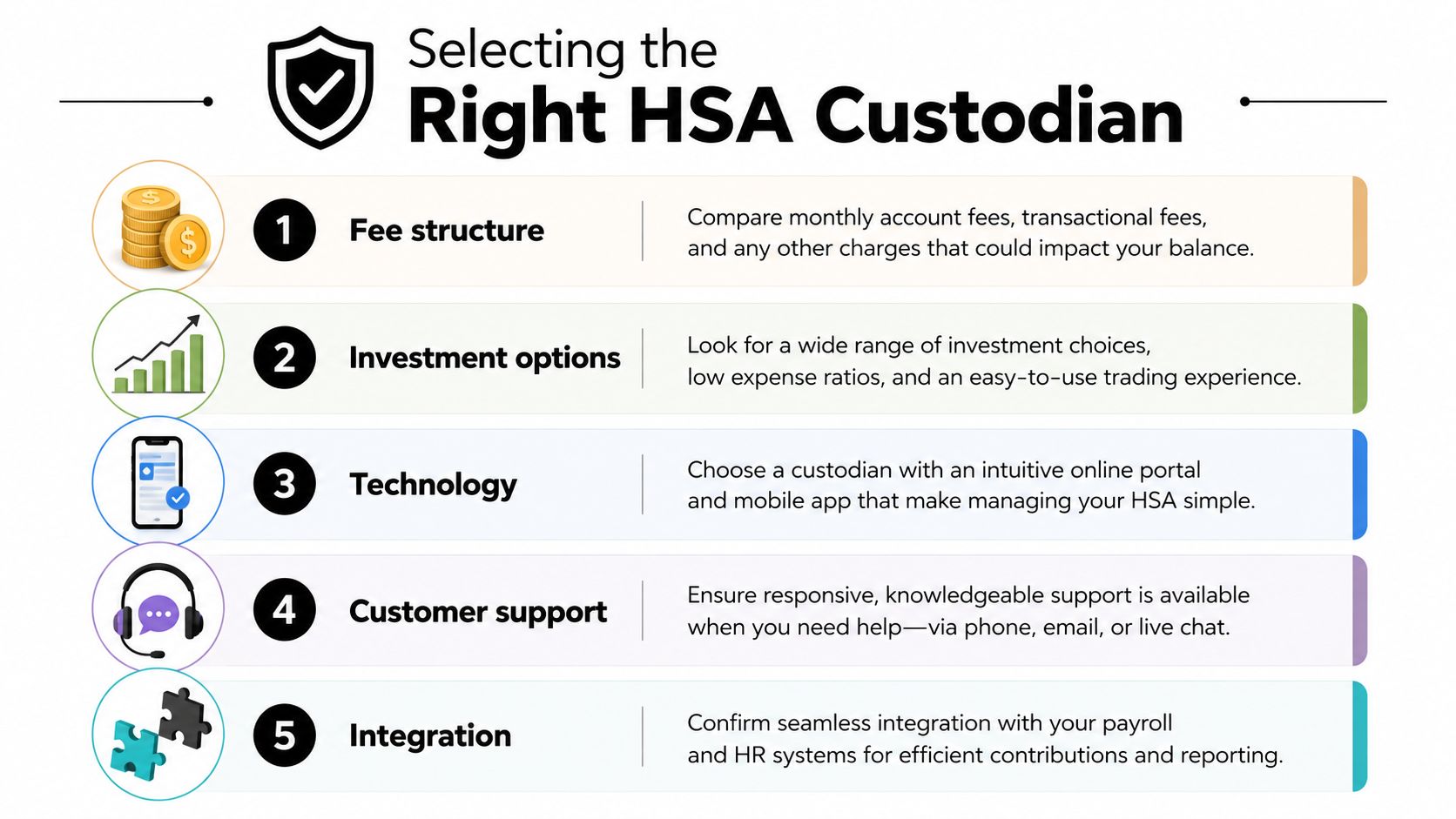
Custodian selection gets treated like a commodity purchase too often. That's a mistake, because the custodian shapes the employee experience, the quality of integrations, and how much friction your payroll and benefits team will absorb every pay cycle. One useful option to compare in the vendor shortlist phase is Benely's employee benefits administration outsourcing, especially if you're trying to align account setup with broader enrollment and compliance workflows.
Start with the fees your employees will actually feel
Ask who pays the maintenance fee, when it's charged, and whether the employer covers it for everyone or only for certain segments. Two vendors can look similar in a demo and still create very different outcomes once the statement cycle starts. The right question isn't just whether the fee exists, it's whether your policy makes employees feel like the account is usable or expensive.
Then test the day-to-day experience
Investment options matter for employees who plan to keep balances long term, but only if the platform makes them easy to understand and use. Mobile access, clean account dashboards, and straightforward claims or reimbursement flows matter just as much, because employees judge the program by what happens when they try to use it.
Integration and support are where bad vendors reveal themselves
Your benefits platform, payroll system, and custodian need to exchange clean data. If the vendor can't explain how eligibility status, contribution files, and account openings sync, assume your team will end up manually reconciling it later. Ask how quickly support responds when an eligibility file fails, what escalations look like, and whether they can handle high-touch employer groups without pushing the problem back onto HR.
If a vendor demo spends most of its time on marketing language and almost no time on file handling, payroll timing, and error resolution, keep looking.
A broker-recommended custodian can be a smart starting point when the broker knows your payroll and enrollment stack well. Independent shopping still makes sense when you need stronger service terms, better fee handling, or a better fit for your employee population. The deciding factor should be operational compatibility, not just brand familiarity.
Setting Up Payroll Deductions and Employer Contributions
A clean HSA payroll setup lives or dies on eligibility tracking. An employee has to be enrolled in an HSA-qualified high-deductible health plan and free of disqualifying coverage before contributions can start, and the employer has to stop contributions as soon as that status changes. The IRS explains that an HSA is a tax-exempt trust or custodial account established with a qualified trustee, contributions are made in cash, and unused amounts generally roll over year to year. IRS Publication 969
Build the workflow before the first deduction runs
The best setup starts with a documented eligibility check, then payroll deduction coding, then employer contribution rules, then a test run. Skip the verification step and you end up fixing money after it has already moved, which is harder than preventing the error up front. For a practical payroll reference that fits this kind of setup work, Bookkeeping and Accounting of Florida payroll tips is a solid operational resource.
- Verify eligibility first. Confirm HDHP enrollment and check for disqualifying coverage before any pre-tax election is activated.
- Match the deduction to payroll timing. Make sure the deduction amount, frequency, and start date line up with the employee's plan effective date.
- Coordinate the employer seed. If the company contributes, define whether it happens per pay period or as a lump sum, then route it through the same eligibility controls.
- Test and reconcile. Run a cycle test, compare payroll output to the custodian file, and confirm the employee sees the right amount in the HSA.
The employer contribution setup guide is useful if you are standardizing how company funding interacts with elections. Employer deposits count toward the employee's annual cap, so payroll and benefits cannot treat company dollars as separate from the employee's total HSA picture.
Mid-year changes need fast action
Marriage, divorce, Medicare enrollment, and plan changes can all affect eligibility during the year. The right process is to stop or adjust contributions as soon as the status change is confirmed and documented. That is where most programs get into trouble, because one missed file update can create an avoidable correction problem months later.
Eligibility also depends on the handoff between HR, payroll, and the HSA custodian. If those teams are not working from the same status data, deductions keep running after coverage changes and the correction falls back on payroll, HR, or the employee. A clear exception log, a regular file review, and one owner for status changes keep that workflow from drifting.
The employee side matters too. Someone who gains or loses coverage mid-year often assumes payroll will handle the change automatically, but that assumption is what creates overcontributions and cleanup work later. The practical fix is a short intake process for life events, a prompt update to payroll coding, and a documented stop date for any employer-funded deposits that no longer fit the person's status.
Navigating Contribution Limits and Compliance Requirements
The fastest way to create an HSA problem is to treat the annual limit as a year-end cleanup item. For 2026, the IRS contribution limit is $4,400 for self-only coverage and $8,750 for family coverage, with a $1,000 catch-up for age 55+ participants, and employer contributions count toward those caps. Fidelity's HSA contribution limit overview is a practical reference when you are translating those limits into payroll design and open enrollment materials.
| Coverage Type | Standard Limit | Age 55+ Catch-Up | Total Maximum |
|---|---|---|---|
| Self-only coverage | $4,400 | $1,000 | $5,400 |
| Family coverage | $8,750 | $1,000 | $9,750 |
Limits only work if eligibility is clean
The compliance issue goes beyond hitting the cap, it requires confirming the person stayed eligible for every contribution made. An employee cannot contribute while enrolled in Medicare or another disqualifying plan, and the employer has to stop contributions once that status changes. A standing monthly or payroll-cycle review reduces the chance that an outdated file keeps money flowing after eligibility has ended.
A smart small-business compliance mindset helps here, especially if HSA administration sits alongside other benefit obligations. The Kons Law small business guide is a helpful reminder that benefits controls work best when the company uses simple, repeatable checkpoints instead of informal judgment.
What usually goes wrong
Excess contributions usually come from one of three places. Payroll keeps deductions running after an employee loses eligibility. Employer deposits keep going after a status change. The employee's own deposits, combined with company funding, push the account over the limit faster than anyone expected.
When that happens, corrections have to run through payroll, the custodian, and tax reporting. The employer also has to reconcile amounts for W-2 Box 12 Code W, so the year-end process needs the same discipline as the front-end setup. In practice, the teams that handle this well keep a year-to-date contribution tracker visible to payroll and benefits staff, and they review it often enough to catch mismatches before tax season turns them into cleanup work.
Educating Employees About HSA Benefits and Limitations
HSA education works best when it's segmented, not generic. The same message won't land the same way for a younger employee choosing a first benefits package, a mid-career parent juggling claims, and a worker who already knows the deductible will be tight on household cash flow. Much of the public conversation focuses on tax advantages, but employers need to explain who the account helps, who may struggle with it, and what the rules are.

Explain the mechanics in plain language
Employees need to understand four things quickly, contributions, qualified expenses, investment options, and portability. The IRS notes that HSA funds generally roll over year to year, and the account stays with the individual if they change jobs, which makes the account more flexible than many workers expect. That portability point matters because it helps employees see the HSA as their account, not just a benefit tied to one employer.
The best communication avoids jargon around “triple tax advantage” unless the audience is already financially savvy. For many, the better explanation is direct, contributions can lower taxable income, the money can grow tax-free inside the account, and qualified withdrawals aren't taxed either. That still leaves the core limitation intact, the employee has to be in an HSA-eligible plan and able to afford the cost-sharing structure.
Match the message to the employee group
Lower-income employees need a different conversation from higher-income employees. For many households, the central issue isn't whether the HSA has good tax treatment, it's whether the deductible is manageable without delaying care. That's why segmented communication is more honest than selling the account as universally beneficial.
The best HSA-eligible items guide can help employees understand what counts as a qualified expense, which is often the part they remember least after open enrollment. Use it alongside live Q&A, short videos, and one-on-one counseling for employees who want help deciding whether to contribute or enroll.
Practical takeaway: Don't oversell the HSA to everyone. Explain where it helps, explain where it can strain cash flow, and let employees choose with open eyes.
Troubleshooting Common HSA Administration Problems
Most HSA problems are process problems, not account problems. A missed eligibility update, a payroll file error, or a custodian sync failure can create the kind of cleanup work that takes hours to unwind. The good news is that these issues are predictable, which means the fixes can be standardized.
Start with the most common failure points
If an employee loses eligibility mid-year, stop contributions immediately and document the date the change took effect. If payroll deducted too much, reverse or adjust through the payroll system and confirm the custodian records match the corrected amount. If the employee already exceeded a limit, isolate whether the excess came from the company, the employee, or both, then correct the source instead of just papering over the symptom.
Integration issues need a different response. When the custodian file doesn't match payroll or enrollment data, don't wait for the next scheduled transmission to fix it. Pull the current roster, compare it line by line against contribution records, and resolve the discrepancy before another payroll cycle repeats the same error.
Prevent the repeat problem
The cleanest programs use alerts for status changes, review contribution totals regularly, and assign clear ownership for each correction step. They also keep a short employee communication template ready for overcontribution or eligibility changes, because the employee usually needs to know what happened and what the company is doing next. That prevents confusion from turning into distrust.
Keep one owner for eligibility, one owner for payroll correction, and one owner for custodian follow-up. Shared responsibility without named ownership usually means nobody finishes the fix.
When a team builds those controls into the workflow, HSA administration stops feeling reactive. It becomes a repeatable benefits operation that can scale with hiring, plan changes, and year-end reporting without turning every exception into a fire drill.
Benely helps employers manage benefits administration, payroll coordination, and enrollment workflows in one connected system, which is exactly where HSA programs tend to break down. If you're tightening eligibility checks, contribution handling, and employee communication, visit Benely to see how a centralized benefits platform can support the process.