 Employee Benefits
 HR & Compliance
 Technology
 Wellness
 PEO Solutions
Compliance risk rarely appears while the business is still small and stable. It surfaces when hiring accelerates, benefits change, a remote worker moves to another state, payroll and HR records stop matching, or an employee takes leave or loses coverage. The operational burden is real: Statistics Canada's Survey of Regulatory Compliance Costs was distributed to more than 30,000 small and medium-sized businesses and more than 5,000 external service providers in one iteration to measure internal time, salary costs, and outsourced compliance effort. Statistics Canada explains the survey's purpose and benchmarking approach.
That's why a small business compliance checklist shouldn't be a once-a-year list of filings. It should connect the systems that produce compliance evidence every day, including hiring, payroll, benefits, employee communication, records, security, notices, audits, and renewals. Ipsos found that half of small businesses say compliance requirements make it harder to grow, so reducing duplicated work matters as much as identifying legal obligations. Read the Ipsos findings on compliance and small-business growth.
The 10 steps below focus on benefits administration and the connected HR workflows most likely to break during growth. Federal requirements provide the baseline, but state and local rules may expand obligations around leave, pay transparency, privacy, payroll, notices, and employee classification. Verify current requirements with the IRS business startup checklist, the U.S. Department of Labor, CMS, and the relevant state agencies before acting.
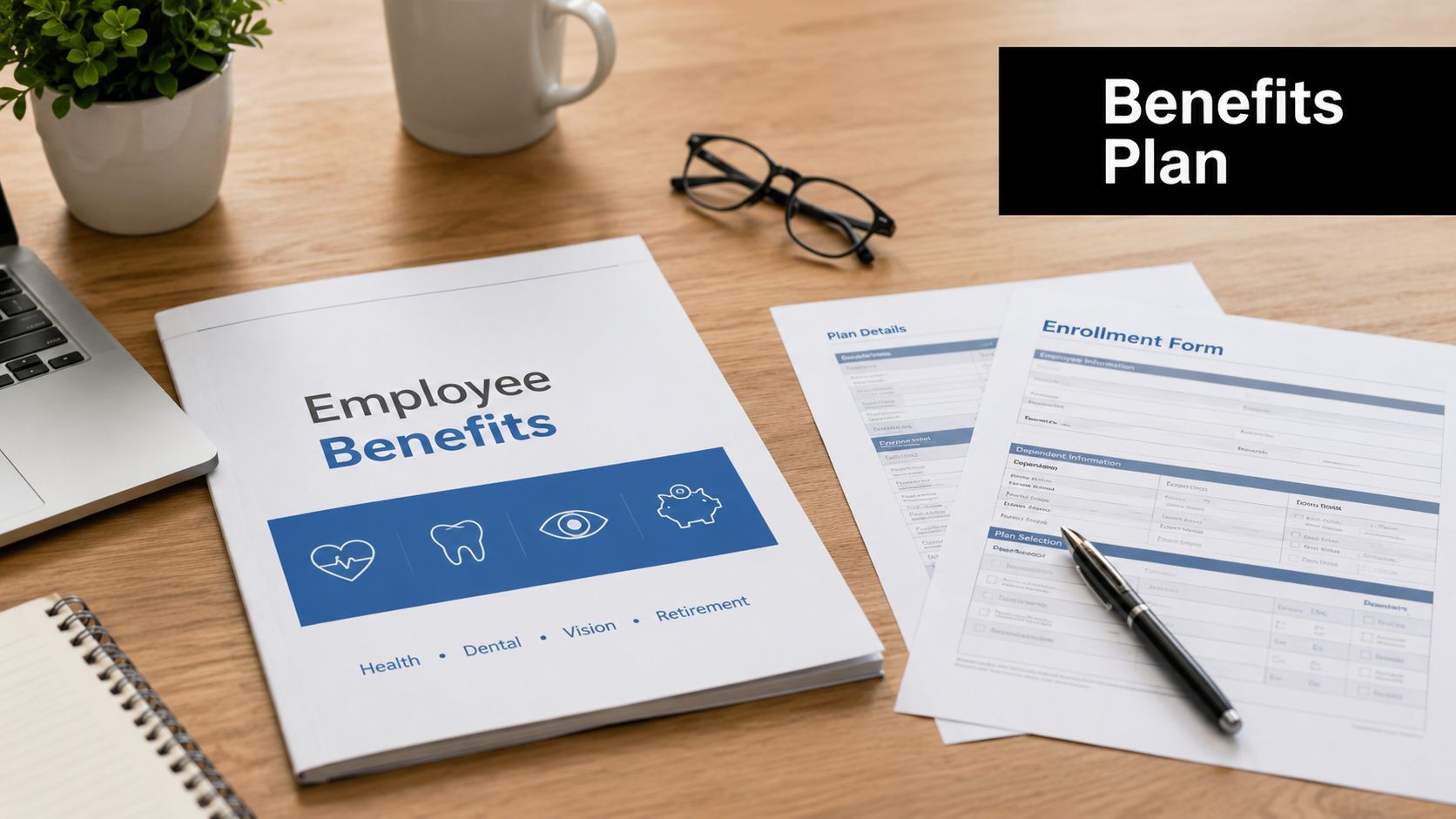
A centralized compliance calendar, controlled document repository, and named responsible owner will prevent many handoff failures. Benely can help teams compare benefits, coordinate enrollment, connect payroll and onboarding workflows, and manage recurring compliance administration from a more centralized platform.
Table of Contents
- 1. Establish and Document Your Employee Benefits Plan
- 2. Conduct Annual Compliance Audits
- 3. Implement Nondiscrimination Testing and Monitoring
- 4. Manage Open Enrollment Process and Documentation
- 5. Maintain COBRA Compliance and Administration
- 6. Establish Cafeteria Plan Administration
- 7. Implement ACA Compliance and Reporting
- 8. Develop and Implement Benefits Communication and Education Program
- 9. Create and Maintain Benefits Plan Records and Documentation
- 10. Align Benefits with Payroll and Onboarding Systems
- 10-Point Small Business Benefits Compliance Comparison
- Turn the Checklist Into a Repeatable Compliance Calendar
1. Establish and Document Your Employee Benefits Plan
A benefits plan becomes a compliance risk when employees, payroll, HR, and carriers rely on different versions of the truth. Start with a written description of every benefit, including eligibility, waiting periods, effective dates, employee contributions, dependent rules, enrollment events, and the documents employees should receive.
The IRS's business startup checklist includes selecting a business structure, choosing a tax year, applying for an Employer Identification Number when applicable, collecting Form I-9 and Form W-4 information from employees, and paying business taxes. The IRS checklist provides these operational starting points. Benefits documentation should follow the same discipline. Every plan decision needs an owner, an effective date, and an evidence artifact.
Build one controlled benefits record
A practical plan file should contain:
- Plan design: Record whether coverage is fully insured, self-funded, or administered through another arrangement.
- Eligibility rules: State who qualifies, when coverage begins, and how dependents are handled.
- Carrier materials: Store current documents from carriers such as Aetna, Kaiser, Anthem, Blue Shield, and UnitedHealthcare.
- Change history: Keep prior versions, approval notes, and the date each amendment took effect.
- Employee access: Give employees written access to plan documents and clear instructions for questions or elections.
A 50-person technology startup documenting a move from self-funded coverage to carrier-managed plans needs more than a signed broker proposal. It needs a record of the decision, the new plan terms, employee eligibility, payroll deduction changes, and employee communications. A growing manufacturer may instead need to resolve inconsistent eligibility windows for new hires.
Benely's centralized platform can help employers compare more than 4,000 health plans and keep selections, budgets, and eligibility information organized. Review plan documents annually, and reopen the file whenever a carrier, contribution, eligibility rule, or employee population changes.
2. Conduct Annual Compliance Audits
An annual audit should test whether the business administers the plan it says it has. That means comparing eligibility records with payroll, carrier invoices, employee elections, plan documents, notices, and claims procedures. A policy can be perfectly drafted and still fail in practice if the wrong employees are enrolled or deductions continue after coverage ends.
Schedule a formal review before the plan year closes, leaving time to correct errors and document the correction. The audit owner should invite the benefits administrator, payroll lead, HR owner, and finance representative. If the plan is complex, a qualified compliance professional can review areas the internal team may not recognize.
Test the workflow, not just the paperwork
Use a sample of employee records and trace each one from eligibility through enrollment and payroll. Look for:
- Eligibility mismatches: Compare hire dates, status changes, waiting periods, and effective dates.
- Contribution errors: Reconcile employee deductions to plan elections and carrier invoices.
- Document gaps: Confirm that current plan descriptions, amendments, summaries, and notices are available.
- Event handling: Review how the team handled marriage, birth, loss of coverage, leave, termination, and other changes.
- Corrective actions: Record the issue, affected process, decision-maker, correction date, and supporting evidence.
A 75-person manufacturing company might discover that an eligibility rule was applied incorrectly to a group of employees. The important response isn't to fix the records. The company should identify why the error occurred, determine whether payroll and carrier data also require correction, communicate appropriately, and add a control that prevents recurrence.
Benely's reporting and compliance tools can help gather enrollment and plan evidence for review. The platform won't replace legal judgment, but it can reduce the manual search across spreadsheets, inboxes, carrier portals, and payroll exports. Keep the completed audit, findings, approvals, and corrections together so the next reviewer can follow the history.
3. Implement Nondiscrimination Testing and Monitoring
Benefits should be available under rules that don't improperly favor highly compensated employees or exclude other employee groups. Nondiscrimination testing examines plan eligibility, contributions, participation, and benefit access. It's especially important for cafeteria plans, retirement arrangements, and benefit designs where employee categories receive different treatment.
Don't wait until the end of the plan year to discover a problem. Run preliminary testing during the year using current compensation, eligibility, election, and participation data. Early testing gives the benefits team time to adjust plan design, improve participation, or consult a specialist before a final result creates tax or administration complications.
Make the data testable
The testing process depends on records that payroll and benefits teams can reconcile. Maintain:
- Employee classifications: Identify which groups are eligible for each plan and why.
- Compensation data: Use consistent, current compensation records and document the source.
- Election history: Preserve elections, waivers, changes, and effective dates.
- Participation patterns: Compare enrollment and contribution behavior across eligible groups.
- Correction files: Keep the test result, decision, correction, approval, and implementation evidence together.
A 100-person firm that fails a 401(k) test may need to consider a safe harbor design or another plan adjustment. A startup with a Section 125 plan may need to revise eligibility or contribution rules so the arrangement operates as intended. Those decisions can affect employee experience, payroll, and cost, so they shouldn't be made from a single test report.
The trade-off is straightforward. Outsourcing testing adds a cost, but relying on an unreviewed spreadsheet creates uncertainty about definitions, data quality, and corrections. A compliance specialist can interpret the rules, while an internal owner verifies that the underlying employee and payroll data is complete. Document test results even when the plan passes. Evidence of a routine review is part of a mature compliance system.
4. Manage Open Enrollment Process and Documentation
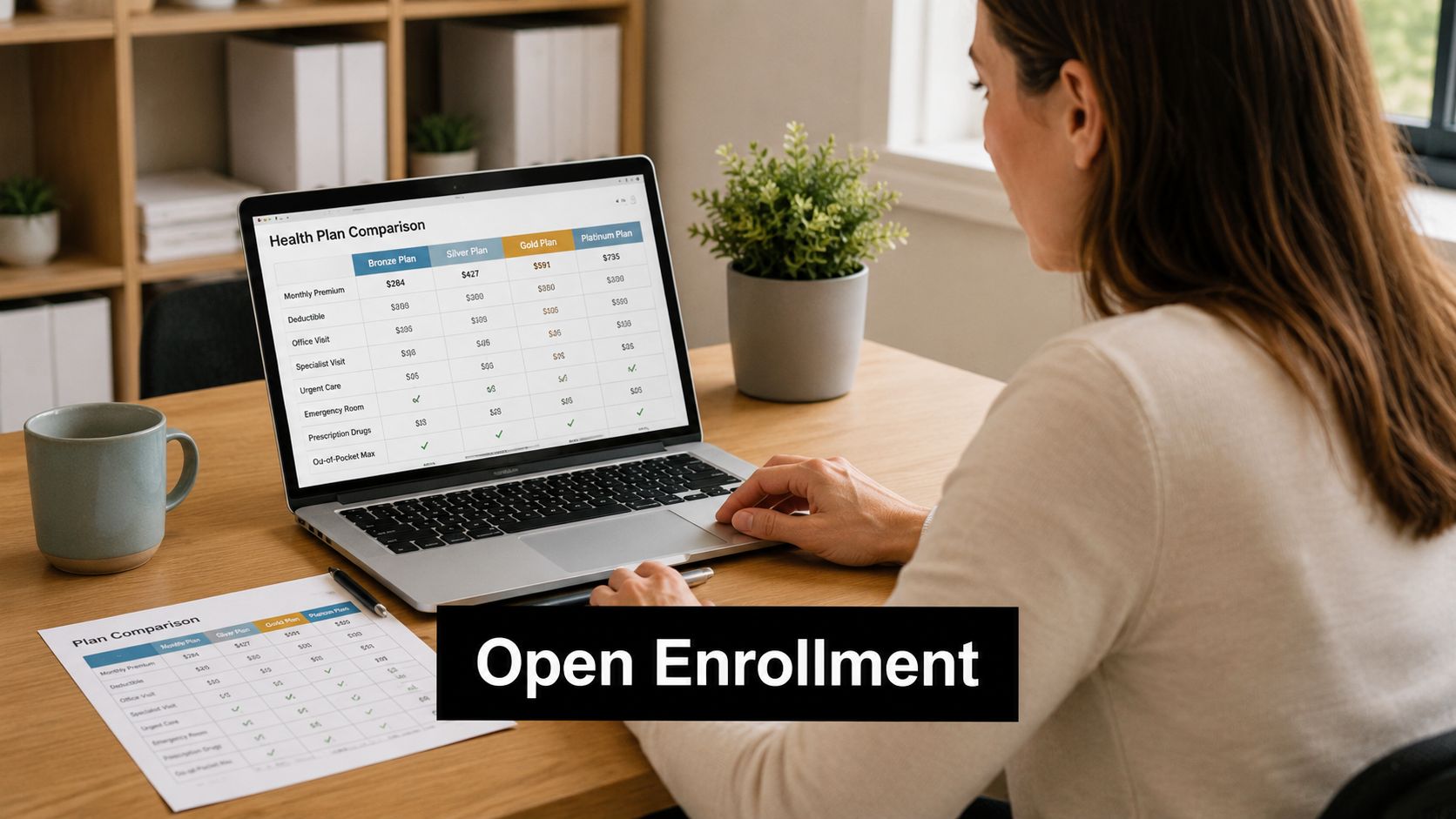
Open enrollment compresses many compliance-sensitive actions into a short operating window. Employees need understandable plan comparisons, accurate plan documents, clear start and end dates, and a reliable way to submit elections or waivers. HR needs an audit trail showing what was communicated, when employees acted, which elections were made, and when coverage became effective.
Start by assigning one owner to the enrollment calendar and separate owners to communications, carrier coordination, payroll setup, and employee support. Build a communication sequence that includes plan changes, Summary of Benefits and Coverage materials, decision support, reminders, and confirmation notices. State and plan-specific timing rules must be checked before the calendar is published.
Make every election traceable
A workable process includes:
- A published window: State the opening date, closing date, effective date, and late-election procedure.
- Plan comparisons: Explain premiums, deductibles, networks, contribution levels, and dependent coverage in plain language.
- Employee evidence: Retain elections, waivers, confirmations, special enrollment requests, and effective dates.
- Exception handling: Route marriage, birth, adoption, loss of coverage, and other qualifying events to a named owner.
- Payroll reconciliation: Confirm that deductions match the final elections before the first affected payroll.
Use Benely's open enrollment checklist for HR to organize the preparation, communication, tracking, and follow-up work. Benely's platform can automate reminders and show enrollment progress, while HR specialists can help answer employee questions.
A manual process may work for a small, stable workforce, but it becomes fragile when employees work remotely, plans change, or several carriers are involved. Automation improves consistency, but it doesn't make unclear plan design understandable. Have a human review confusing options, unusual elections, and special enrollment requests. Store the final enrollment report with the communication schedule and carrier confirmation.
5. Maintain COBRA Compliance and Administration
COBRA becomes a major workflow issue when a business reaches the applicable employee threshold and employees lose health coverage after a qualifying event. Employers generally subject to COBRA must identify events, send required notices, process elections, bill premiums, track payments, and terminate coverage correctly. That work touches HR, payroll, benefits, finance, and the carrier.
The Department of Labor's COBRA guidance should be checked alongside plan-specific requirements and professional advice. The process is highly time-sensitive, and a missed handoff can leave the business unable to show that it gave a former employee the required information.
Turn qualifying events into triggers
Create a workflow that begins when an employee's status changes, not when someone remembers to contact the benefits administrator. Include:
- Event identification: Notify the benefits owner when termination, reduced hours, divorce, death, or another relevant event occurs.
- Notice preparation: Use the current approved notice and confirm the recipient's address and coverage details.
- Election tracking: Record the notice date, election status, coverage choice, and any follow-up.
- Premium reconciliation: Match invoices and payments to the continuation coverage record.
- Termination controls: Document when coverage ends and why.
A 50-person firm that discovers missed notices shouldn't patch the issue with an informal email. It should investigate the event intake process, review affected records, consult qualified counsel or an administrator, and document the remediation.
Benely's guide to COBRA notice requirements can help HR teams structure the notice workflow. Outsourcing administration may reduce manual errors, but the employer still needs a clear internal process for reporting qualifying events. Keep a calendar alert, a responsible owner, and a backup owner for every case.
Practical rule: A termination checklist isn't complete until benefits status, notice delivery, premium handling, and evidence retention are all closed.
6. Establish Cafeteria Plan Administration
A Section 125 cafeteria plan lets eligible employees choose certain benefits using pre-tax salary reductions when the arrangement is properly established and administered. The tax treatment can benefit employees and employers, but it depends on a written plan document, valid elections, accurate payroll deductions, and applicable nondiscrimination testing.
The biggest operational mistake is treating payroll deductions as the plan. Payroll reflects the election. It doesn't create the governing terms, explain permitted changes, or establish how the employer handles events and corrections. Keep the formal plan document, employee communications, election records, and payroll configuration aligned.
Connect elections to payroll controls
A reliable administration process should include:
- Written terms: Document eligible benefits, election procedures, effective dates, and permitted changes.
- Election controls: Record when employees elect, waive, or change coverage and who approved an exception.
- Payroll mapping: Tie each benefit code to the correct deduction and tax treatment.
- Reconciliation: Compare elections, payroll deductions, carrier invoices, and account activity.
- Annual review: Test the plan where required and review whether the design still fits the workforce.
A 75-person firm introducing a Section 125 plan may need employee education before elections begin. A startup experiencing rapid growth may need to revise procedures so new hires don't receive inconsistent information. If an audit finds deduction errors, correct the data and document the root cause, not just the final adjustment.
The trade-off is between flexibility and control. More benefit choices can improve employee fit, but each choice adds eligibility, payroll, communication, and reconciliation work. Keep plan design understandable, use a controlled election process, and involve payroll before announcing changes. Benely can help connect benefits administration with payroll workflows, but the plan document and tax treatment should be reviewed with qualified advisers.
7. Implement ACA Compliance and Reporting
ACA obligations depend on workforce size, employee hours, coverage offers, plan structure, and the employer's reporting position. Businesses approaching the applicable large-employer threshold shouldn't wait for a year-end form to reveal that hours and coverage data weren't tracked consistently.
Maintain a monthly view of employee status and hours. Define how the business handles variable-hour employees, rehires, waiting periods, affordability analysis, coverage offers, and corrections. Employers may need Forms 1094-C and 1095-C, while self-insured arrangements may involve Forms 1094-B and 1095-B. Confirm the correct forms, filing method, and deadlines with the IRS and a qualified benefits or tax professional.
Build an evidence trail
Your ACA workflow should connect:
- Hours data: Capture payroll or time records used to determine full-time status.
- Coverage offers: Retain the offer, employee response, effective date, and applicable affordability information.
- Employee classifications: Record full-time, part-time, variable-hour, seasonal, and other relevant statuses.
- Form production: Reconcile forms to payroll, benefits, and employee records before delivery or filing.
- Corrections: Keep the original error, corrected information, approval, and submission evidence.
The federal thresholds matter. The IRS explanation of applicable large employer provisions should be reviewed as the workforce changes. A 55-person professional services firm, for example, may need to formalize tracking after realizing that its informal headcount process didn't capture full-time-equivalent calculations consistently.
Benely's ACA reporting requirements guide can help organize the information flow. Technology can reduce duplicate entry, but it can't fix missing hours, incorrect classifications, or an unclear ownership model. Assign the monthly review to a specific person and make payroll and benefits sign off before reporting is finalized.
8. Develop and Implement Benefits Communication and Education Program
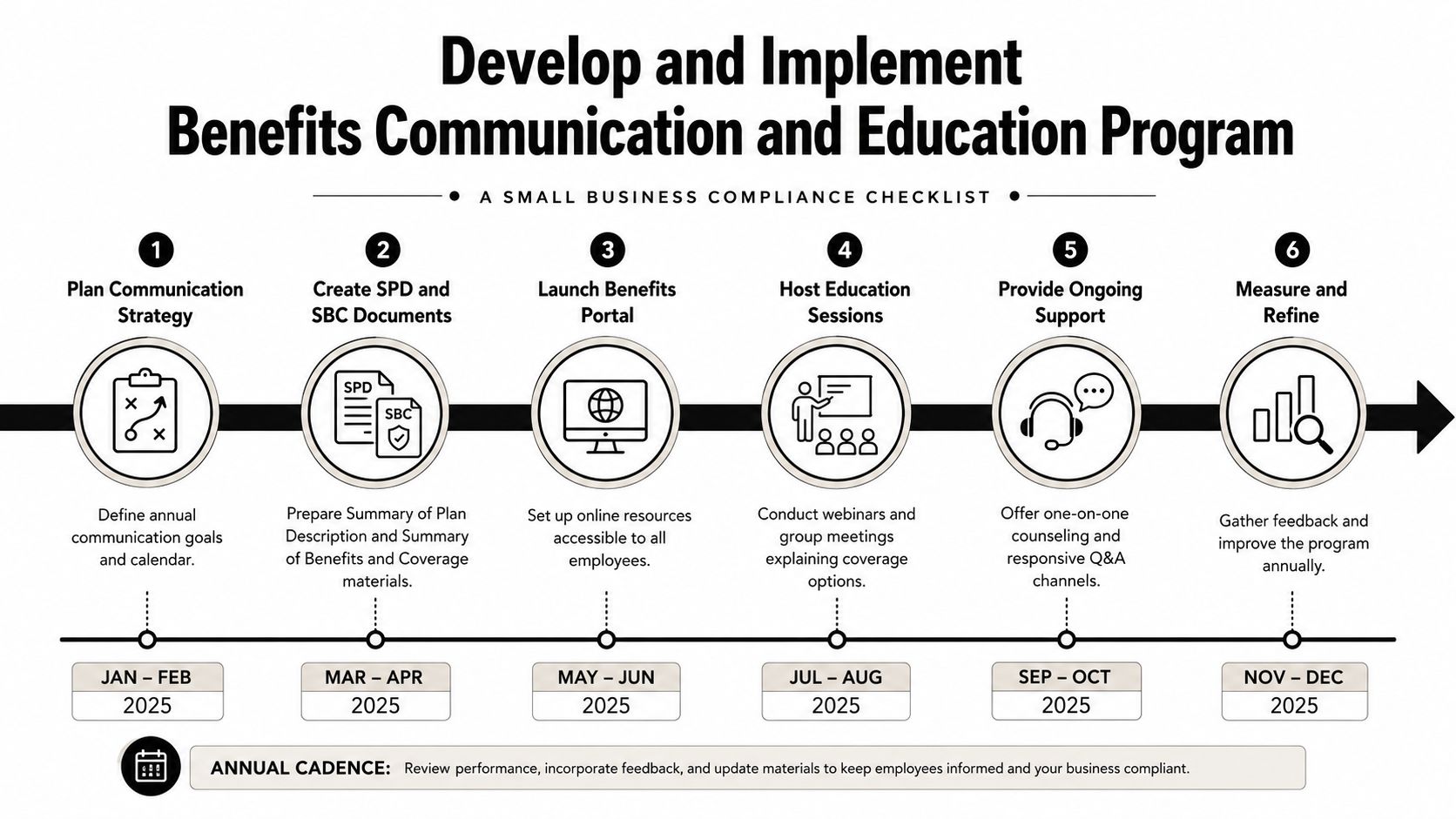
Employees can't make informed elections or use coverage correctly if the business sends dense documents without context. Benefits communication should explain what changed, what employees must do, where documents are stored, and whom they should contact. It also creates evidence that the company communicated plan terms and enrollment instructions.
Build a yearly calendar around hiring, open enrollment, plan changes, claims support, leave events, and renewal. Use email, meetings, an employee portal, video, printed materials, and one-on-one support where appropriate. Remote employees need the same access as employees working at a physical site.
Use a layered communication plan
- Plain-language summary: Explain the purpose of each plan and the action required.
- Official documents: Make SPDs, SBCs, notices, and carrier materials easy to find.
- Live education: Offer group sessions with time for questions and scenario-based explanations.
- Personal support: Give employees a route for private questions about dependents, deductions, or coverage.
- Completion tracking: Record delivery, acknowledgment, attendance, and unresolved questions.
A remote-first company may use short videos and virtual sessions, while a manufacturing business with varied shifts may need printed guides and repeated sessions. Translating or adapting materials can improve access for a diverse workforce, but the official plan documents must remain accurate and controlled.
The Department of Labor's summary plan description guidance explains why plan information must be provided to participants. Benely's employee platform can centralize benefits messages and documents, while HR specialists can support employee questions. Track unanswered questions as process signals. Repeated confusion about a deductible, eligibility rule, or payroll deduction usually means the communication needs improvement.
9. Create and Maintain Benefits Plan Records and Documentation
Records are the evidence behind every answer a business gives about benefits. Store plan documents, amendments, participant records, enrollment forms, waivers, notices, claims correspondence, carrier communications, audit reports, test results, and correction decisions in a controlled repository.
A shared drive with inconsistent names and unrestricted access creates two problems. People can't reliably find the right version, and sensitive employee information may be visible to people who don't need it. Use role-based access, logical folders, version history, and an activity record showing who changed or approved a document.
Create a usable evidence structure
Organize the repository by:
- Plan and year: Separate current documents from historical versions.
- Employee record: Keep enrollment, waiver, change, and notice evidence together.
- Carrier and vendor: Store contracts, invoices, correspondence, and service records.
- Audit and correction: Preserve findings, responses, approvals, and completed actions.
- Access and retention: Apply a documented retention policy and review permissions regularly.
A business facing a Department of Labor examination should be able to retrieve the governing plan document, employee election, applicable notice, payroll record, and communication history without reconstructing the file from email. The Department of Labor's reporting and disclosure resources provide a useful reference point for plan information and disclosures.
The right retention period depends on the document and applicable law, so don't adopt a universal period without professional review. Instead, identify the governing requirement, record the retention rule, and apply a legal hold when a dispute or investigation arises. Benely's connected platform can reduce scattered documentation, but someone still needs to own permissions, naming conventions, and periodic record reviews.
10. Align Benefits with Payroll and Onboarding Systems
Benefits compliance fails at the seams. A new hire may complete an election that never reaches payroll. A status change may update payroll but not the carrier. A termination may close payroll while leaving coverage active. Each mismatch creates employee confusion and forces HR to manually reconstruct what happened.
Map the full workflow from offer acceptance to eligibility, election, payroll deduction, carrier transmission, life-event change, leave, and termination. Identify which system is authoritative for each field. For example, the onboarding system may hold hire date and job status, the benefits platform may hold elections, and payroll may calculate deductions. Those systems need defined handoffs, not assumptions.
Reconcile the connected workflow
Run regular checks for:
- New hires: Confirm eligibility, election status, effective date, and first deduction.
- Status changes: Match employment status, hours, location, compensation, and benefit eligibility.
- Life events: Verify that approved changes reach payroll and carriers.
- Terminations: Confirm final deductions, coverage end dates, notices, and account closure.
- Payroll output: Compare deductions against current elections before payroll is finalized.
A growing company may discover that manual entry causes recurring deduction errors. An integrated platform can reduce duplicate data entry and create a clearer audit trail, but integration still needs testing. Use sample scenarios for a new hire, waived coverage, a dependent change, a leave, and a termination. Document the expected result and compare it to the actual output.
Benely connects benefits, onboarding, payroll coordination, and compliance administration in one employee benefits environment. That can be useful for founders, finance leaders, HR managers, and benefits administrators who need fewer disconnected spreadsheets. Keep a written reconciliation procedure and schedule periodic reviews, especially after changing payroll vendors, carriers, plan designs, or onboarding forms.
10-Point Small Business Benefits Compliance Comparison
| Item | 🔄 Implementation Complexity | 💡 Resource Requirements | 📊⭐ Expected Outcomes | ⚡ Key Advantages / Ideal Use Cases |
|---|---|---|---|---|
| Establish and Document Your Employee Benefits Plan | 🔄 Moderate, initial design + legal review; multi-carrier complexity | 💡 HR time, legal review, templates; platform support (Benely) | 📊⭐ Clear legal protection, consistent enrollment and eligibility | ⚡ Reduces admin burden; ideal for new or multi-carrier employers |
| Conduct Annual Compliance Audits | 🔄 Moderate–High, testing and corrective actions | 💡 Dedicated staff or external consultant; reporting tools | 📊⭐ Identify gaps, reduce penalty risk, improve operations | ⚡ Prevents violations; ideal for growing firms or those with past issues |
| Implement Nondiscrimination Testing and Monitoring | 🔄 High, complex calculations and classifications | 💡 Accurate payroll/comp data, analytics, outside expertise often needed | 📊⭐ Preserves tax-qualified status and fairness; avoids penalties | ⚡ Ensures equitable benefits; ideal for 401(k)/Section 125 plans with HCEs |
| Manage Open Enrollment Process and Documentation | 🔄 Moderate, communications, deadlines, exceptions | 💡 Communications resources, enrollment platform, HR support | 📊⭐ Higher enrollment accuracy, auditable records, improved satisfaction | ⚡ Faster, automated enrollments; ideal for annual enrollment periods and large staffs |
| Maintain COBRA Compliance and Administration | 🔄 High, strict timelines and notice rules | 💡 Tracking system, admin time or outsourced vendor, carrier coordination | 📊⭐ Legal compliance, reduced liability, continuity for eligible individuals | ⚡ Avoids per-day penalties; essential for employers with 20+ employees |
| Establish Cafeteria Plan Administration (Section 125) | 🔄 High, election rules, run-out, nondiscrimination testing | 💡 Payroll integration, written plan document, employee education | 📊⭐ Payroll tax savings, increased employee purchasing power | ⚡ Lowers FICA costs; ideal for employers offering FSAs and pre-tax options |
| Implement ACA Compliance and Reporting (1094/1095) | 🔄 High, FTE tracking, affordability, form filing | 💡 Time-tracking/payroll systems, reporting tools, ongoing monitoring | 📊⭐ Avoids employer mandate penalties; creates audit trail | ⚡ Prevents costly fines; must for employers ~50+ FTEs |
| Develop and Implement Benefits Communication & Education Program | 🔄 Low–Moderate, ongoing content and channels | 💡 Content creation, multiple channels, HR time; localization as needed | 📊⭐ Higher utilization, fewer disputes, better employee understanding | ⚡ Boosts participation and satisfaction; ideal for low-benefit-literacy workforces |
| Create and Maintain Benefits Plan Records and Documentation | 🔄 Moderate, retention policies and organization | 💡 Electronic filing, storage/security, ongoing maintenance | 📊⭐ Strong audit defense, fast regulatory response, smoother transitions | ⚡ Enables rapid compliance response; critical before audits or M&A |
| Align Benefits with Payroll and Onboarding Systems | 🔄 Moderate–High, integration, data mapping, testing | 💡 IT/webhooks, vendor coordination, migration/testing effort | 📊⭐ Fewer errors, accurate deductions, streamlined new-hire enrollment | ⚡ Eliminates manual entry; ideal for scaling companies and multi-system environments |
Turn the Checklist Into a Repeatable Compliance Calendar
The 10 steps become useful when each one has an owner, a due date, a trigger, and a retained artifact. A calendar entry that says “review benefits” is too vague. A stronger entry says who will compare employee elections to payroll deductions, which report they'll use, when the review is due, what exceptions require escalation, and where the completed reconciliation will be stored.
Start with a master register that covers the employee lifecycle. Include hiring, payroll, benefits, reporting, notices, audits, renewals, records, safety, leave, classification, privacy, and security. Current SMB guidance also highlights access controls, multifactor authentication, incident response, and employee security training as recurring operational duties, particularly when the business handles sensitive employee data or uses distributed systems. Review a practical small-business compliance checklist for benefits, privacy, and security workflows.
Assign priorities by workforce size
Headcount changes the order of work. The thresholds below are federal employment triggers, not a complete legal analysis, and state rules may apply sooner or differently. This employment-law threshold reference summarizes the federal employee counts.
- Fewer than 20 employees: Establish hiring, payroll, records, notices, safety, leave, worker classification, and insurance foundations. Make sure the business can complete required onboarding forms, maintain accurate payroll evidence, administer applicable leave, and protect employee data.
- Approaching 20 employees: Prepare for COBRA administration. Confirm whether the employer is subject to COBRA, select an administrator if needed, define qualifying-event reporting, and build notice and premium tracking.
- Approaching 50 full-time-equivalent employees: Begin ACA measurement, coverage-offer tracking, affordability review, and reporting preparation. Don't wait until the business crosses the threshold to discover that payroll and benefits systems store incompatible data.
- Larger small businesses: Formalize nondiscrimination testing, annual audits, payroll-benefits integration, employee communication reviews, state supplements, and documented corrective-action procedures.
Federal employment thresholds also create distinct triggers. Title VII generally applies at 15 or more employees, the Age Discrimination in Employment Act at 20 or more, the Family and Medical Leave Act at 50 or more, and EEO-1 reporting at 100 or more, as summarized in the referenced employment-law guidance. Confirm coverage and exceptions with the appropriate agency or counsel before relying on a threshold.
Use four lightweight templates
A good system doesn't require complicated software on day one. These templates can start in a controlled spreadsheet or HR platform:
Compliance calendar
- Obligation
- Governing agency or rule
- Federal, state, or local jurisdiction
- Trigger or frequency
- Due date
- Primary owner
- Backup owner
- Required evidence
- Status
- Escalation path
- Last reviewed date
New-hire file
- Offer and role details
- Worker classification decision
- Form I-9 and Form W-4 status
- State tax and required notices
- Handbook and policy acknowledgment
- Benefits eligibility date
- Election or waiver
- Payroll setup confirmation
- Security and access checklist
Benefits-change log
- Employee and event type
- Date reported
- Eligibility decision
- Required documents
- Approval owner
- Carrier update
- Payroll update
- Effective date
- Employee communication
- Final evidence location
Audit-correction register
- Finding
- Risk category
- Affected process or records
- Owner
- Root cause
- Corrective action
- Approval
- Completion date
- Verification method
- Supporting documents
Use reputable government guidance whenever a new rule affects the company. The SBA states that agencies must publish Small Entity Compliance Guides when rules have a significant economic impact on small businesses. The SBA's compliance-guide resource explains how small businesses can find those guides. For environmental issues, the EPA provides a specific voluntary disclosure mechanism. A U.S. small business has 21 days from discovering that a violation has occurred or may have occurred to disclose it in writing to the EPA, subject to the resource's conditions. Review the EPA small-business compliance page.
State and local rules may expand federal obligations, especially after a business hires remotely, enters a new jurisdiction, changes its benefits structure, stores sensitive employee information, or uses a new payroll or benefits vendor. The 2025 European SME policy report cited in the research materials found that SMEs spend seven per cent of working time complying with legal requirements, which reinforces the productivity value of reducing duplicate evidence collection. Read the European SME policy report referenced in the research772645_EN.pdf).
Make the calendar part of regular operations. Review new hires and terminations during payroll, benefits changes during carrier reconciliation, open enrollment during the renewal cycle, and audit findings during leadership review. A 2025 small-business survey reported that 25% of small businesses received compliance-related warnings, fines, or citations in 2025, which is a useful reminder that compliance activity is ongoing rather than limited to annual filing season. Review the survey index and its discussion of recurring compliance activity.
Benely can help centralize benefits comparison, employee elections, onboarding, payroll connections, compliance tracking, and HR support. Review the platform and services at Benely, then map the available workflows to your own register, owners, state requirements, and evidence standards.
Benely helps small businesses compare more than 4,000 health plans, automate enrollment, coordinate benefits with payroll and onboarding, and keep compliance administration organized. Visit Benely to review a centralized approach for benefits decisions, employee support, recurring documentation, and HR specialist guidance.