A group health plan is medical coverage an employer or organization sponsors for its workers and their dependents. It's governed mainly by ERISA, and employers commonly share the premium cost with employees.
That definition sounds simple until you're the founder or HR lead who has to choose a plan before the renewal deadline. You're comparing carrier networks, employee contributions, deductibles, eligibility rules, Medicare questions, and compliance paperwork, all while trying to explain the choices to people who just want to know what their paycheck deduction will be.
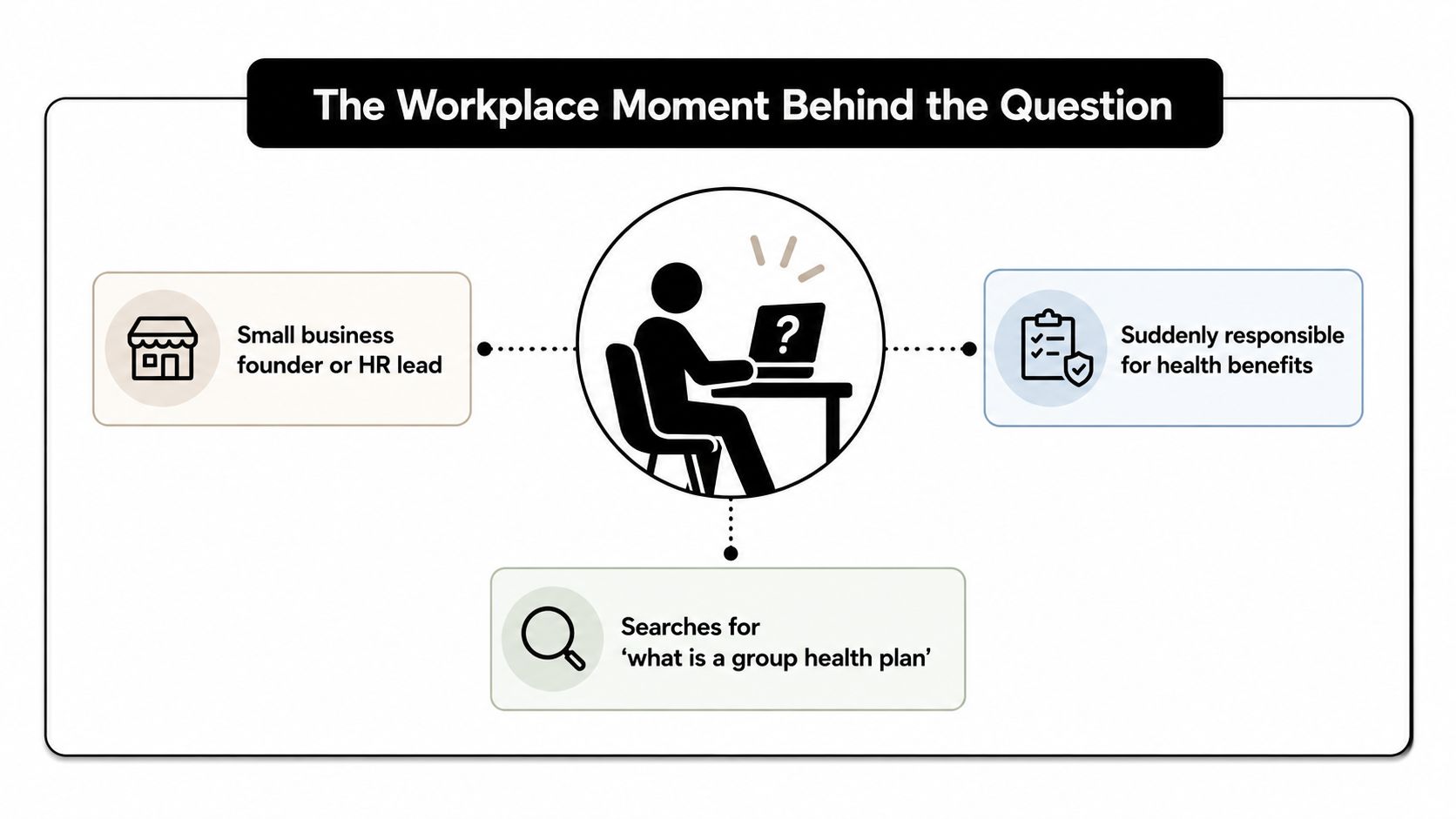
A useful answer to what is a group health plan needs to go beyond “insurance through work.” You need a working model of who sponsors the coverage, who can enroll, who carries the financial risk, how Medicare coordination works, and which rules follow the plan once it's in place.
Table of Contents
- The Workplace Moment Behind the Question
- The Legal Foundation ERISA Built
- The Main Flavors of Group Coverage
- Eligibility Enrollment and the 20-Employee Edge
- How Pricing and Cost-Sharing Work
- The Compliance Stack ACA ERISA HIPAA and COBRA
- Running a Plan Without Drowning in It
- Is a Group Health Plan Still the Right Move in 2026
The Workplace Moment Behind the Question
A growing business can reach this question in an ordinary workday. A founder who once handled payroll alone gets asked whether dependents are covered. A renewal notice arrives, an employee turns 65, or someone who leaves asks about continuing coverage. The definition soon becomes a set of decisions about eligibility, costs, and responsibility.
In plain English, a group health plan is a benefit arrangement through which an employer, union, association, or another employee organization provides medical care to employees or dependents. Coverage may come through an insurance carrier, a reimbursement arrangement, or another structure. Under federal definitions, the plan may be fully insured or self-insured, as described by the U.S. Department of Labor.
The employer usually sponsors or selects the arrangement, sets eligibility rules, and decides how much of the premium to contribute. Employees decide whether to enroll, which dependents to cover, and how much they can manage through payroll deductions and medical expenses.
The mental model to keep
A useful mental model frames group coverage around four connected parts:
- Sponsor: The employer or organization establishes or maintains the benefit.
- Covered people: Eligible employees and qualifying dependents receive access to medical care.
- Funding: The employer, employees, carrier, or claims arrangement pays costs under an agreed structure.
- Rules: Federal and state requirements govern documents, privacy, enrollment, reporting, and continuation rights.
The status-sensitive details often change the answer. Medicare coordination becomes relevant when an employee turns 65. COBRA rights can depend on whether the employer has 20 or more employees. A small employer may also face fewer group-market choices as that market continues to shrink, making funding and plan structure harder decisions.
Federal regulations generally treat a plan as a group health plan if it has 50 or more participants, or if an entity other than the employer that established and maintains it administers the plan. That threshold is separate from the COBRA employee-count test, but both show why the legal label affects administration beyond a simple insurance policy.
The Legal Foundation ERISA Built
An employer may offer medical coverage through an insurance carrier, reimburse eligible expenses, or fund claims directly with administrative support. Those arrangements can look different in practice, yet they may fall under the same federal benefits framework. The legal category depends on how the benefit is established and maintained, not on the name printed on an insurance card.
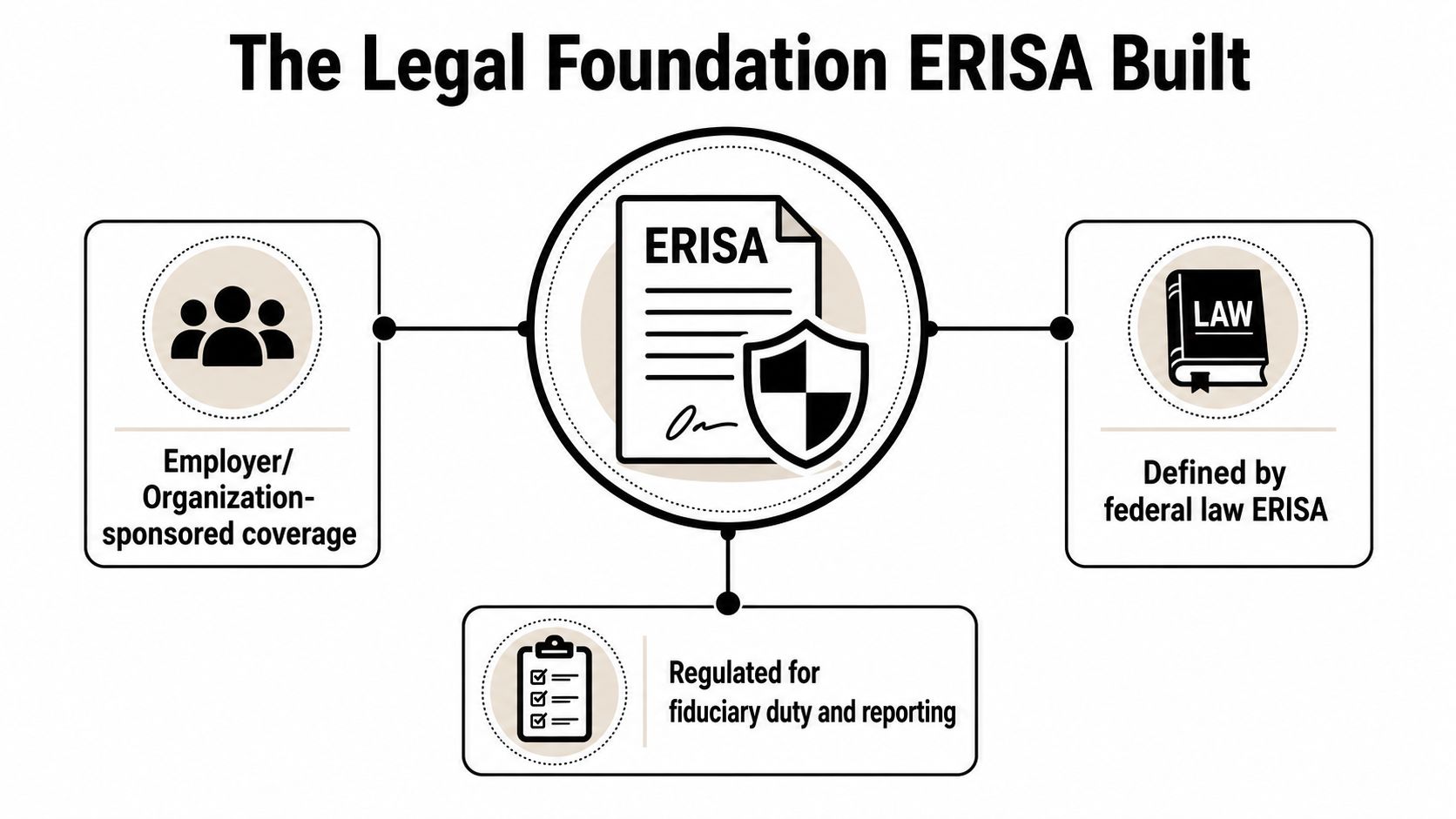
The central framework is ERISA, the Employee Retirement Income Security Act of 1974. ERISA set federal standards for private-sector employee benefit plans and remains a foundation for employer-sponsored health coverage. This group health plan legal overview) outlines how those plans are structured and regulated.
ERISA functions like a building code. An owner can choose the layout, finishes, and services, but the structure still has to meet required standards. An employer can select a carrier, set contributions, and design eligibility rules, while still needing plan documents, participant disclosures, fiduciary controls, and reporting processes.
What the legal status changes
The label group health plan affects the employer's administrative duties. A plan may involve an outside carrier, broker, or third-party administrator, but the sponsor still needs to understand who performs each function and where responsibility remains.
This matters at the edges of ordinary benefits administration. Medicare coordination can become relevant when an employee reaches 65. COBRA rights can depend on whether the employer has 20 or more employees. Smaller employers may also have fewer choices as the small-group market shrinks, which can affect funding decisions and plan design.
ERISA also operates alongside requirements under the Public Health Service Act. Employers therefore work with a layered set of rules rather than one standalone rulebook.
HIPAA separates the plan from the employer
HIPAA adds a privacy boundary. The group health plan is generally treated as its own covered entity, while the sponsoring employer is not automatically the covered entity merely because it offers the benefit. The employer may still have operational duties when its staff administers coverage or can access protected health information.
That separation calls for written plan documents, defined privacy and security responsibilities, and restricted access procedures. Human resources records and health information should not move through the same unrestricted channels.
For more context, this guide to what ERISA means for employer plans explains the relationship between ERISA and employer benefits. The practical point is clear: “group health plan” is a legal status, not just a marketing label. That status shapes the documents, controls, and reporting duties connected to the benefit.
The Main Flavors of Group Coverage
Once you understand the legal category, the next question is structure. Employers can provide group coverage in several ways, and the difference isn't merely the name on the insurance card. The structure determines who carries claims risk, how predictable the budget is, and how much administration the employer must oversee.
A fully insured plan is the familiar model. The employer pays a fixed premium to an insurance carrier, and the carrier pays covered claims under the policy. This can suit a 25-person professional services firm that values predictable invoices and doesn't want medical claims volatility on its books. You can review the mechanics in this explanation of what a fully insured health plan is.
A self-insured plan works differently. The employer pays claims directly, often using a third-party administrator to process claims and support enrollment. The employer keeps more responsibility for claim costs, although stop-loss coverage can protect against unusually large claims. This structure may fit a 500-person retailer with stronger cash reserves, more plan data, and the internal capacity to manage risk.
Level-funded plans combine features of both models. The employer pays a set monthly amount, while the underlying arrangement may include claims funding, administrative expenses, and stop-loss protection. The employer gets more predictable cash flow than a purely self-insured plan, but the details require careful review.
An Individual Coverage HRA, or ICHRA, changes the employee experience further. Instead of selecting one group policy for everyone, the employer provides a defined reimbursement arrangement for eligible individual coverage. Employees generally choose their own individual plans, while the employer sets the contribution framework and manages the applicable rules.
| Structure | Who Bears the Risk | Best Fit | Compliance Load |
|---|---|---|---|
| Fully insured | The carrier bears covered claims risk | Employers prioritizing predictability and simpler administration | Carrier and plan administration requirements |
| Self-insured | The employer funds claims, with possible stop-loss protection | Larger employers with risk tolerance and administrative capacity | More direct claims, privacy, reporting, and fiduciary oversight |
| Level-funded | Risk is shared through a structured funding and stop-loss arrangement | Employers seeking a hybrid approach | Requires close review of funding and renewal terms |
| ICHRA | Employees choose individual coverage, while the employer funds defined reimbursements | Employers seeking contribution control and employee choice | Individual coverage verification and HRA administration |
The small-group market is changing because some employers are moving toward level-funded plans, ICHRAs, or dropping coverage. In 2025, small-group membership declined 7.9%, or 626,953 members, according to market analysis of the individual and small-group segments. That doesn't make traditional group insurance obsolete. It does mean employers should compare structures instead of treating a fully insured plan as the automatic answer.
Eligibility Enrollment and the 20-Employee Edge
Eligibility rules decide who can enter the plan and when. Employers commonly define eligibility through employee classes, minimum work requirements, and waiting periods, but the design has to be applied consistently. If two employees are in the same class, the employer shouldn't offer different access without a defensible plan rule.
A sound enrollment process answers practical questions before an employee submits an election:
- Which employees qualify: The plan document should identify eligible classes and employment conditions.
- When coverage begins: The employer should state the waiting period and effective-date process clearly.
- Who counts as a dependent: The plan should explain dependent eligibility and required documentation.
- How changes work: Marriage, birth, loss of other coverage, and employment changes can affect enrollment rights.
- How elections are recorded: Payroll deductions, carrier enrollment, and employee confirmations should match.
The Medicare edge is where a basic definition often breaks down. The Social Security Administration explains that a group health plan is coverage offered by an employer, union, or association while a person is still working. It also notes that employers with 20 or more employees must offer the same health benefits to current workers and spouses age 65 and older as to younger employees.
A retirement-age employee example
Suppose a long-tenured employee turns 65 while still working. The employee asks whether to delay Medicare Part B because the company plan seems sufficient. The employer shouldn't answer with a casual yes or no.
The right framework starts with the employer's size under the applicable Medicare coordination rules, the employee's active-work status, the spouse's coverage position, and the specific plan terms. The employee should also confirm the decision with Medicare or Social Security before delaying enrollment, because the consequences can depend on facts outside the employer's benefits summary.
Practical rule: Don't treat age 65 as an automatic termination point for employer coverage. Ask whether the person is still actively working, whether the employer meets the applicable size rule, and how the plan coordinates with Medicare.
This is why “insurance through work” is incomplete. Group health plan status can affect retirement timing, spouse coverage, and Medicare decisions, so HR should route individual enrollment questions to qualified benefits or government resources rather than improvising.
How Pricing and Cost-Sharing Work
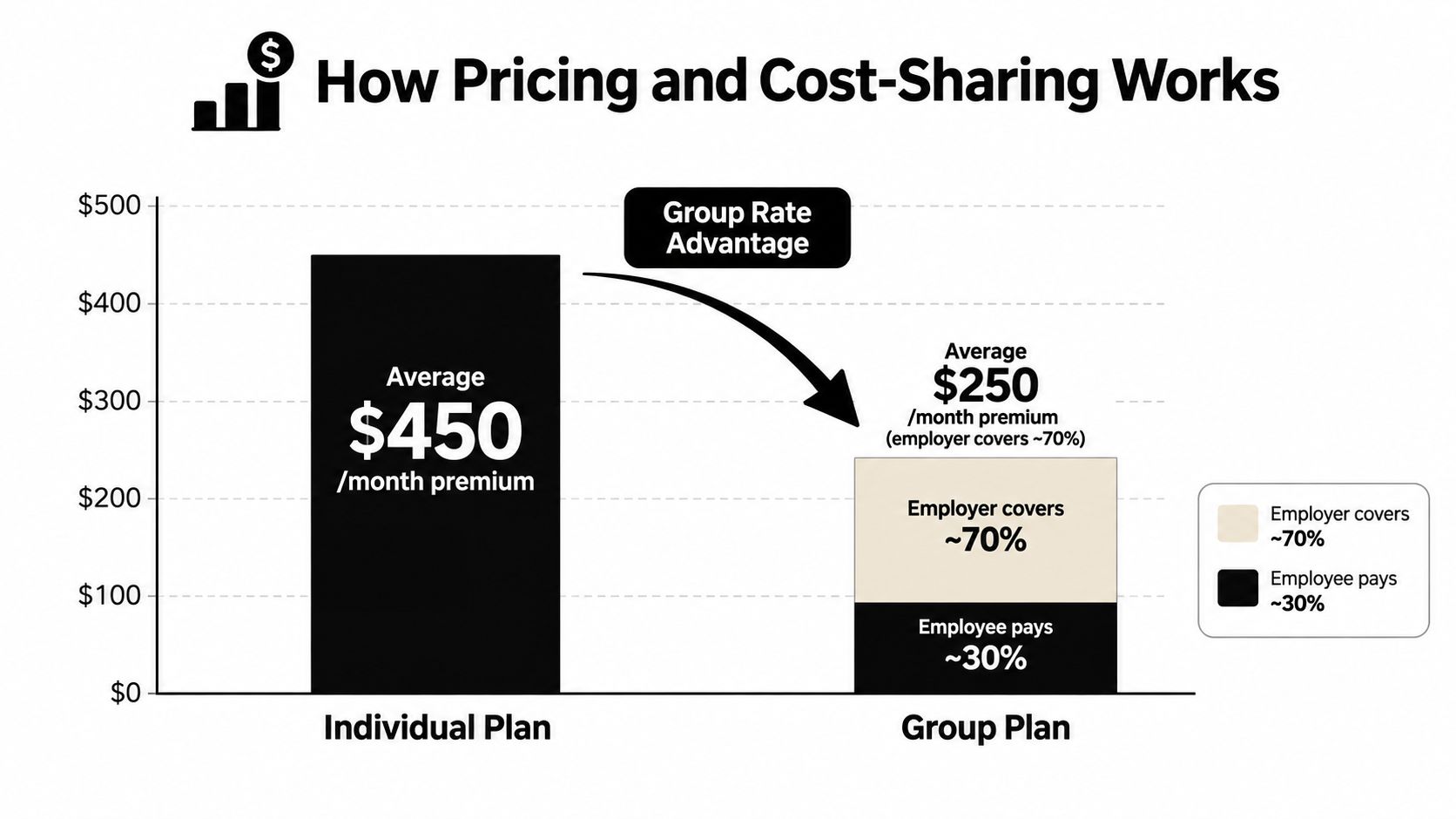
An employee can see a modest payroll deduction and still face substantial costs after a doctor's visit. A group plan's price has two layers: the premium that keeps coverage active and the cost sharing that applies when members receive care.
The employer may pay part of the premium, while employees pay the remainder through payroll deductions. The exact split depends on the employer's contribution policy, the coverage tier, and the plan design. Employer-benefits data report average annual group coverage costs of $9,325 for self-only coverage and $26,993 for family coverage in 2025, with employers paying about 84% of single coverage premiums and 74% of family premiums, according to the employer coverage data summarized by Westlaw's Practical Law resource). These are averages, not a prediction of an employer's renewal rate or an employee's deduction.
Premiums are only one line
A lower premium can come with higher costs when employees use medical care. Review each part together:
- Premium: The recurring amount required to keep coverage active.
- Deductible: What the member pays for covered services before the plan begins sharing many costs.
- Copay: A set amount for a covered service.
- Coinsurance: A percentage of the allowed cost paid by the member.
- Out-of-pocket maximum: The plan's limit on covered cost sharing under its terms.
For example, a hypothetical $9,000 annual single premium with an 80/20 employer-employee split would leave the employer paying $7,200 and the employee paying $1,800 before medical cost sharing. That example shows why HR should review payroll deductions alongside the deductible. It does not estimate total healthcare spending.
An HDHP paired with an HSA changes the trade-off. A plan might have a $7,000 premium, a $2,000 deductible, and an employer HSA contribution. The lower premium may reduce payroll cost, while the deductible and contribution shape what employees pay during treatment. Employees considering whether to use a health savings account should verify eligibility, tax treatment, contribution rules, and how the HSA works with the selected HDHP.
A sound comparison asks what coverage could cost an employee in a normal year and a high-use year. Compare the premium, payroll deduction, deductible, prescription costs, network limits, and out-of-pocket maximum as one package. That view distinguishes a plan with a low headline price from one employees can afford to use.
The Compliance Stack ACA ERISA HIPAA and COBRA
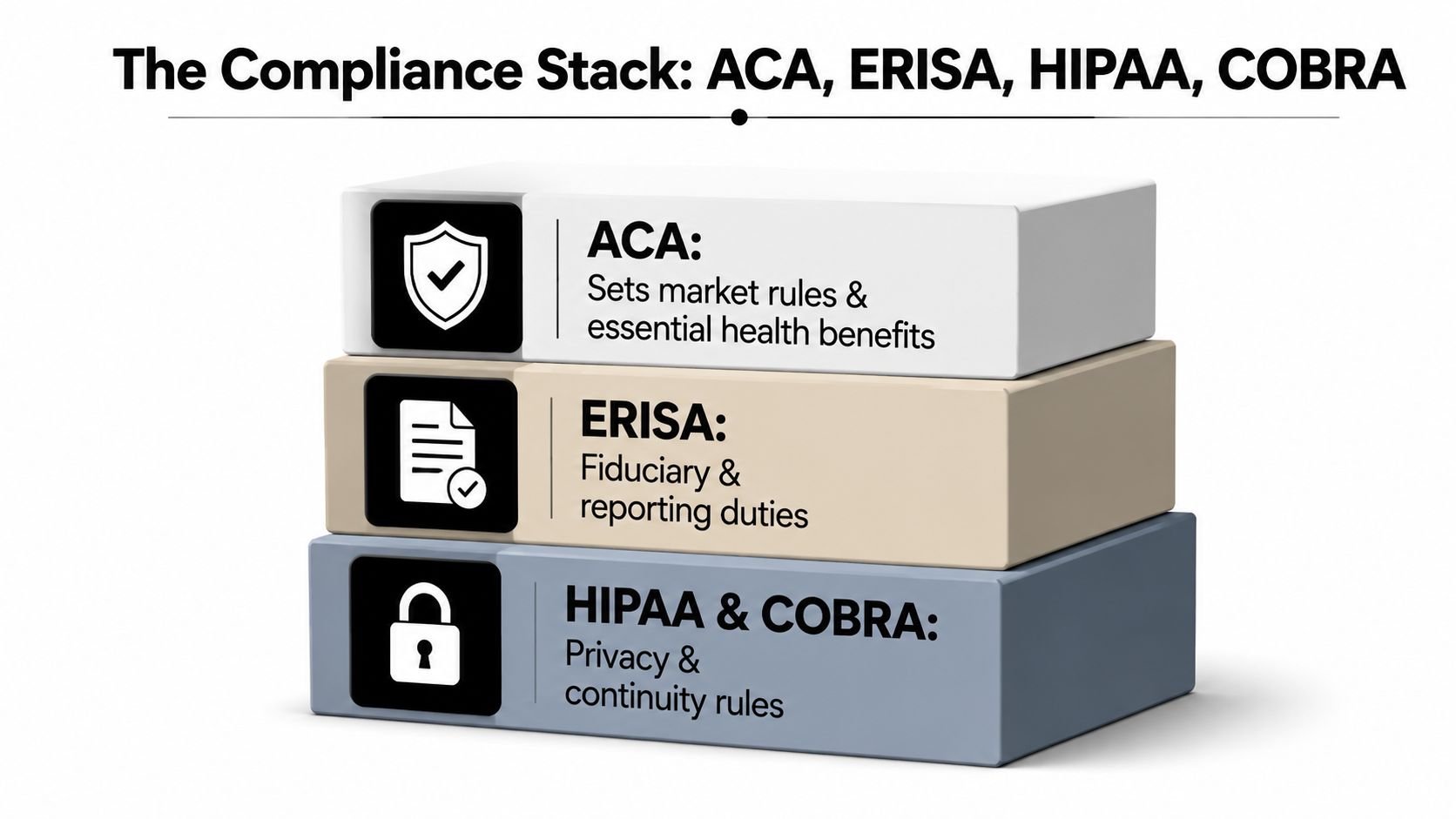
A group health plan doesn't come with one compliance obligation. It comes with a stack of rules that address different parts of the same benefit.
The Affordable Care Act shapes market requirements and coverage standards. ERISA supplies the private-sector benefit framework, including fiduciary and reporting duties. HIPAA governs how the plan handles protected health information and separates the plan's covered-entity role from the employer's sponsor role. COBRA addresses continuation coverage after qualifying events.
The COBRA threshold deserves special attention. Most private-sector group health plans must offer continuation coverage when the employer had at least 20 employees on more than 50% of its typical business days in the previous calendar year, according to the Department of Labor's COBRA employer guide. Full-time employees count as one employee, while part-time employees count as a fraction based on hours worked.
The documents that make the plan real
A sponsor should expect to maintain more than a carrier invoice:
- Plan document: The formal terms governing the benefit.
- Summary Plan Description: The participant-facing explanation of rights and coverage.
- Summary of material modifications: Notices describing significant changes to plan terms.
- Form 5500 filings: Required reporting where applicable.
The Department of Labor maintains a substantial federal dataset of employer-sponsored private-sector plans that file Form 5500. That infrastructure is a reminder that plan administration isn't only about selecting a policy. It also involves preserving records, delivering notices, and meeting reporting obligations.
Operational insight: Assign an owner to each layer. A carrier may support policy administration, but the employer still needs to know who handles eligibility, privacy access, notices, payroll reconciliation, and filings.
Running a Plan Without Drowning in It
At a 40-person company, open enrollment rarely stays inside one department. The HR lead starts by confirming eligibility and employee classes, then asks carriers or a broker for options. Finance models the employer budget and employee payroll deductions. Leadership reviews the plan design. Employees need clear comparisons, decision support, and a reliable way to submit elections.
The workflow usually includes:
- Define the population: Confirm eligible employees, dependents, classes, and effective dates.
- Compare options: Review networks, premiums, deductibles, prescription coverage, and renewal assumptions.
- Model the budget: Separate employer contributions from employee payroll deductions and potential cost-sharing exposure.
- Choose the design: Decide whether a traditional fully insured, self-insured, level-funded, or ICHRA structure fits the workforce.
- Communicate clearly: Give employees plan summaries and explain the trade-offs in plain language.
- Collect elections: Capture enrollments, waivers, dependent details, and required documentation.
- Reconcile systems: Sync elections with payroll, onboarding, carrier records, and compliance tasks.
A platform such as Benely can bring several of those steps into one workflow. Its site describes tools for comparing insurance plans, tracking enrollment progress, and connecting HR, payroll, and compliance systems, with support from certified specialists. The publisher also offers a free 30-page guide and benefits benchmark for employers that want a more structured way to review their current program.
The operational value comes from reducing handoffs. Without a connected process, the HR lead may manage carrier spreadsheets, employee emails, payroll reminders, calendar alerts, and separate compliance records. Every manual transfer creates another opportunity for a missed election, incorrect deduction, outdated eligibility record, or delayed notice.
The technology doesn't remove the employer's responsibilities. It can, however, give the benefits owner a visible workflow instead of a collection of disconnected files.
Is a Group Health Plan Still the Right Move in 2026
A traditional group plan may still be the right answer, but affordability alone shouldn't decide it. The better question is whether the structure matches the employer's headcount, cash flow tolerance, HR bandwidth, and workforce expectations.
Fully insured coverage generally offers a straightforward arrangement. The employer pays a carrier premium, employees receive access to the selected network, and the carrier bears covered claims risk. That simplicity can matter to a small employer with limited benefits expertise.
Self-insured and level-funded approaches can offer more customization and different financial mechanics, but they require greater comfort with risk, administration, and plan oversight. An ICHRA gives employees more individual plan choice while the employer manages a defined contribution arrangement. Each option changes the employee experience as well as the employer's workload.
A practical decision filter
Ask four questions before renewing:
- Headcount: Can the organization support the administrative and compliance demands of its chosen structure?
- Cash flow: Can the employer tolerate claims volatility, or does it need more predictable premium payments?
- HR capacity: Who will manage eligibility, enrollment, privacy controls, notices, and reporting?
- Employee expectations: Do workers value one shared network, broad choice, predictable payroll deductions, or a defined employer contribution?
Organizations considering an integrated benefits or co-employment model can also review Benely's PEO health insurance resource as part of a broader options review. The point isn't to select a structure because it's newer. It's to pressure-test the decision against the people, money, and operational capacity available.
Start by benchmarking your current program, rating the enrollment and compliance process, and identifying the cost employees face beyond the premium. Then use Benely's 30-page guide and benefits platform to turn the next group health plan decision into a measurable plan for recruiting, retention, and budget control.
Benely helps employers compare health plans, organize enrollment, connect benefits with payroll and compliance workflows, and access certified specialist support. Visit Benely to review your options and turn a complicated group health plan decision into a clearer next step.