 Employee Benefits
 HR & Compliance
 Technology
 Wellness
 PEO Solutions

You're closing open enrollment, the spreadsheet looks tidy, and then your broker asks a quiet question. Did anyone run Section 125 nondiscrimination testing this year? If you're like many first-time HR admins, you offered the same benefits menu to everyone and assumed that made the plan fair. That's a reasonable assumption, and it's exactly where small employers get tripped up.
Table of Contents
- What Section 125 Nondiscrimination Testing Really Means
- The Workforce Terms You Need Before You Test Anything
- The Eligibility Test in Plain English
- How the Benefits and Contributions Test Works
- The 25 Percent Key-Employee Concentration Test
- A Step-by-Step Testing Methodology You Can Actually Run
- What Happens When a Test Fails and How to Fix It
- Practical Takeaways for SMBs and Benefits Brokers
What Section 125 Nondiscrimination Testing Really Means
A founder we can picture has just added pretax premiums, a health FSA, and dependent care. The team is happy, payroll is deducting everything before tax, and then a year-end review shows the two owners and a few senior leaders are using far more of the tax benefit than everyone else. Nothing intentional happened. The workforce grew unevenly.
That's the gap testing is meant to catch. Section 125 of the Internal Revenue Code allows employees to choose qualified benefits pretax, but the favorable exclusion is lost when the plan discriminates in favor of highly compensated individuals or key employees, as set out in the Section 125 statute on cafeteria plans. Testing is the annual check-up that confirms that tax treatment is still earned.
The map below shows how the pieces connect before you get into any calculations.
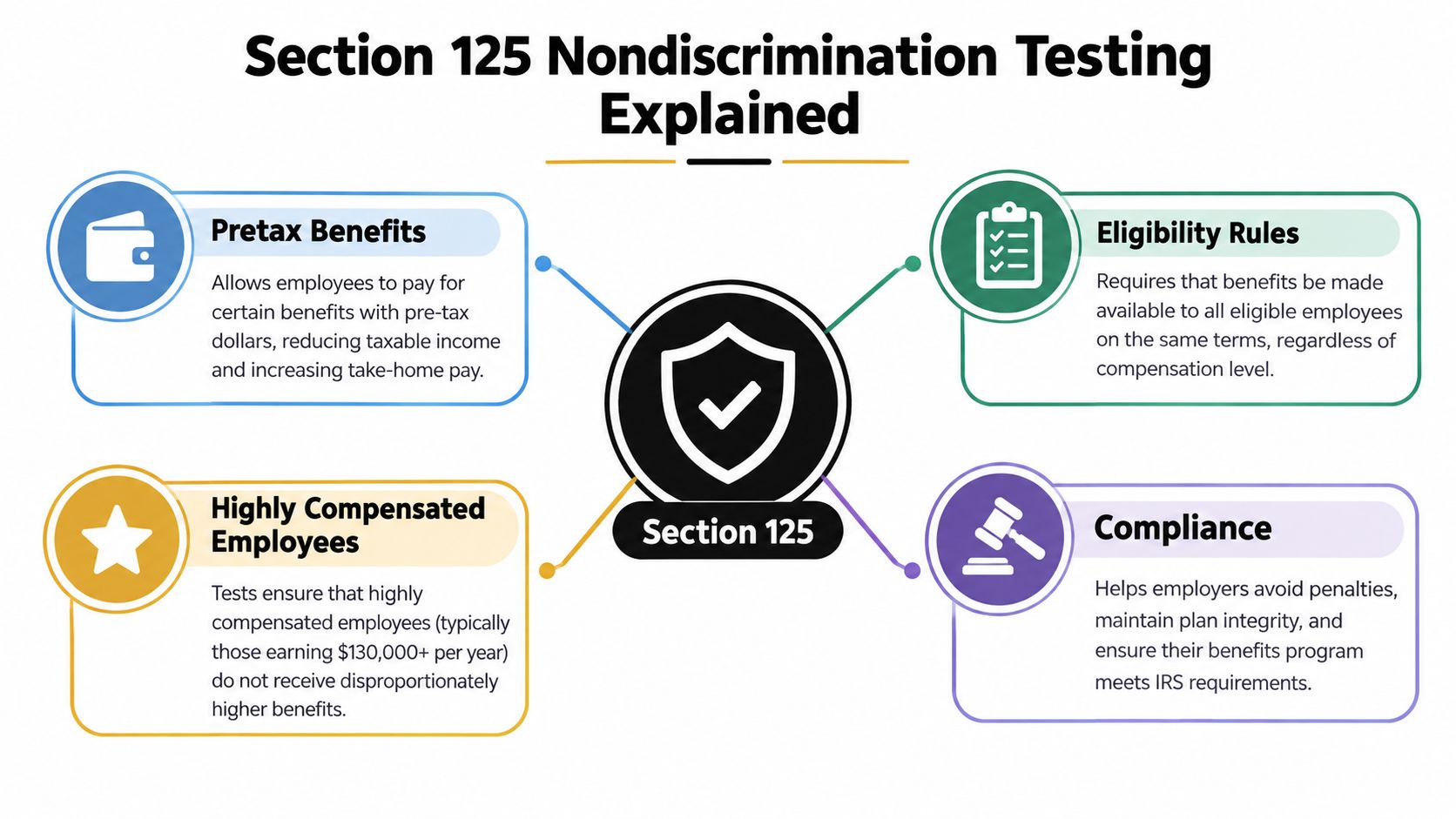
The IRS gives employees a valuable pretax break. In return, the plan can't quietly steer most of that value to owners and the highest paid people.
Why an Identical Menu Isn't Enough
Offering everyone the same enrollment form doesn't guarantee a fair result. Eligibility waiting periods, job classifications, employer contributions, and who elects family coverage can all tilt the outcome. You have to look at access, employer dollars, and relative benefit value together.
This tax concept of discrimination is narrower than workplace discrimination in employment law, and the two shouldn't be confused. If you need that broader context, employer defense guidance on discrimination from Lerner & Weiss APC is a useful companion for understanding how employers think about fair treatment beyond benefits taxation.
Think of Section 125 nondiscrimination testing as three linked questions, not one score. Can non-highly compensated employees get in, do they get comparable employer value once they're in, and are key employees taking too large a share overall? If any answer is no, you have work to do.
The Workforce Terms You Need Before You Test Anything
Put your roster on a whiteboard before you open a calculator. Every test compares groups, so if you label the groups wrong, every answer that follows is wrong too, no matter how neat your math looks.
A plan can satisfy one Section 125 test and still fail another, which makes understanding who counts as highly compensated versus key employee the single most important preparation step, a point reflected in Treasury guidance on cafeteria plan tax treatment. Those two labels overlap, but they aren't interchangeable.
The Three Labels That Drive Everything
- Highly compensated individual: Generally includes officers, certain owners, and employees above an applicable prior-year compensation threshold. Don't rely on job title alone, because ownership and prior-year pay matter.
- Key employee: Defined by reference to Section 416(i)(1) and generally covers certain officers and employees with substantial ownership interests. This group drives the separate concentration test.
- Testing population: The employee group you evaluate for the plan year, generally determined as of the last day of the plan year, with attention to non-excludable employees and certain former employees who worked during the year.
Ownership deserves special care in a founder-led company. A founder who owns a large stake and serves as an officer may be both highly compensated and key. A senior vice president with high prior-year pay but no meaningful ownership may be highly compensated without being key. A smaller owner with modest pay might land in a different category than you'd expect from their title.
Where Small Employers Misclassify People
Payroll data moves. Promotions, acquisitions, ownership changes, and incomplete prior-year records can make last year's labels stale. Spouses and dependents connected to owners can also complicate classification, which is why you shouldn't treat family relationships as a footnote.
Some plans also use an optional top-paid group approach that can affect who falls into the highly compensated pool. If you don't know whether that election applies to your plan, stop and confirm it before testing. Guessing here creates an auditable-looking result built on the wrong denominator.
Label each person once, document why, and keep the supporting fields together. That single workforce map feeds all three tests.
The Eligibility Test in Plain English
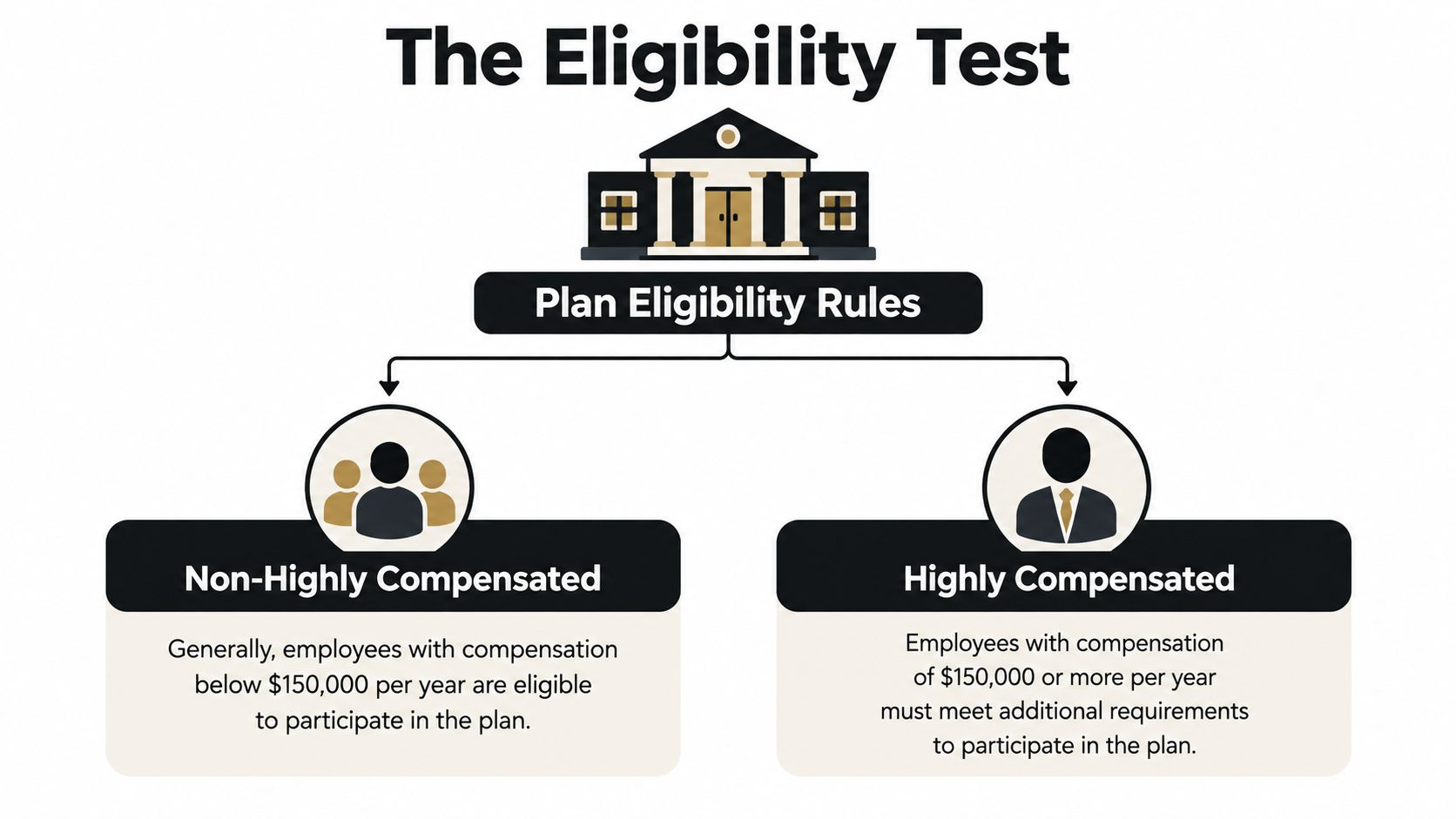
Think of eligibility like access to a building. The question isn't whether everyone chooses to walk through every door. It's whether non-highly compensated employees have a reasonable, real opportunity to get inside on terms that don't favor the highly compensated group.
The hierarchy below breaks that access question into the two groups you're comparing.
What You're Actually Checking
You're reviewing both the written rules and the actual eligible population. A plan document can sound neutral while its classifications, waiting periods, or hours thresholds leave a large share of lower-paid employees outside. That's why design and demographics have to be read together.
A reasonable classification should rest on legitimate, objective business criteria, not on a hand-picked list that happens to capture executives. Job category or location may be explainable. A category built around named individuals isn't the same thing, even if you give it a tidy label.
- Check waiting periods: A uniform waiting period for all new hires is easier to defend than faster entry for leadership roles.
- Check excluded classes: If part-time, hourly, or field employees are excluded, ask who those groups contain in real pay terms.
- Check actual eligibility: Compare how many people in each group can participate, not only how many enroll.
That last distinction confuses many admins. The eligibility test isn't primarily about who elects coverage. It's about who is allowed to participate under the plan's terms and whether that access pattern favors highly compensated individuals.
For example, a company that lets salaried headquarters staff enroll quickly but makes hourly warehouse staff wait much longer may create risk even if both groups eventually see the same benefits brochure. The brochure is identical. The doorway isn't.
Inspect those knobs in your plan document first. If access is skewed, later contribution math won't fix it.
How the Benefits and Contributions Test Works
Getting through the door is only half the fairness question. What the employer pays once employees are inside is the second test, and it's where well-meaning stipend designs often surprise people.
Imagine you give every employee the same chance to elect pretax benefits. Then leadership gets a richer employer-funded benefit on top, perhaps a larger HSA seed or an extra reimbursement that other employees can't access. The election form still looks equal. The employer value isn't.
Design Risk Versus Election Risk
Design-level risk lives in the contribution schedule itself. A formula that gives higher-paid employees more employer dollars, richer options, or broader availability can fail even before anyone enrolls. Review the schedule, not just the enrollment forms.
Election-level risk shows up in actual use. Qualified benefits and total benefits, or the employer contributions allocated to them, can't discriminate in favor of highly compensated participants. If highly compensated participants consistently receive more favorable benefit value, identical paperwork won't save the result.
One clear line helps here. Cafeteria-plan HSA contributions cannot be greater for higher-paid employees than for lower-paid employees, even when the pretax election mechanism itself is identical, as explained in IRS Publication 15-B on employer fringe benefit rules. Designs favoring lower-paid employees are treated differently, but richer funding for the higher-paid group is the problem to avoid.
- Review HSA funding: Check whether employer seeding varies by salary band, title, or coverage tier in a way that helps the prohibited group.
- Review dependent care and FSA support: Employer dollars tied to these benefits count in the fairness picture. If you're weighing contribution design, see guidance on whether employers can contribute to an FSA.
- Review executive-only extras: A leadership-only benefit offered through or alongside the plan deserves scrutiny, not an assumption that it's separate.
Remember that Section 125 testing doesn't replace rules for individual benefits. Self-funded medical coverage, dependent-care assistance, and HSA contributions can trigger additional requirements beyond the cafeteria plan itself. Test the plan and the benefit.
The 25 Percent Key-Employee Concentration Test
This third test feels different because it's a bright numerical line. It doesn't ask whether access looks reasonable in general. It asks whether key employees are receiving too large a slice of the total nontaxable benefit pie.
A cafeteria plan is treated as discriminating in favor of key employees when aggregate nontaxable benefits they receive exceed 25 percent of the aggregate nontaxable benefits provided to all employees under the plan, under the Section 125 concentration rule in the Internal Revenue Code. At or below that share, this test is satisfied. Above it, it isn't.
A Simple Slicing Example
Suppose, purely as an illustration, total nontaxable benefits for the year add up to a round amount. Add all key employees' benefits together, divide by that total, and compare the result with 25 percent. In a small company, a founder electing family coverage plus large pretax accounts can move that fraction fast, especially if few other employees participate.
That's why this test catches employers off guard. Contributions can look proportionate person by person, yet heavy elections by a small key group can still concentrate too much value at the top.
Key-Employee Concentration Test Outcomes
| Scenario | Key-Employee Benefits | Total Plan Benefits | Key-Employee Share | Result |
|---|---|---|---|---|
| Broad participation across the workforce | Lower share of total | Full plan total | At or below 25% | Pass |
| Owner-heavy elections with low staff uptake | Higher share of total | Full plan total | Above 25% | Fail |
| Midyear redesign reducing key pretax use | Reduced share of total | Full plan total | At or below 25% | Pass |
Whiteboard shortcut: Add key benefits, divide by all benefits, and ask one question. Is the answer more than one quarter?
Don't merge this with the earlier tests. Broad eligibility doesn't cure a concentration problem, and fair contributions don't waive the quarter limit. Each test must stand on its own.
A Step-by-Step Testing Methodology You Can Actually Run
You don't need a week to get organized. For many small employers, one focused afternoon can produce a clean census, labeled groups, and a first pass at all three tests, especially if payroll and ownership records are already in one place.
Start with the workflow visual, then work through the steps in order.
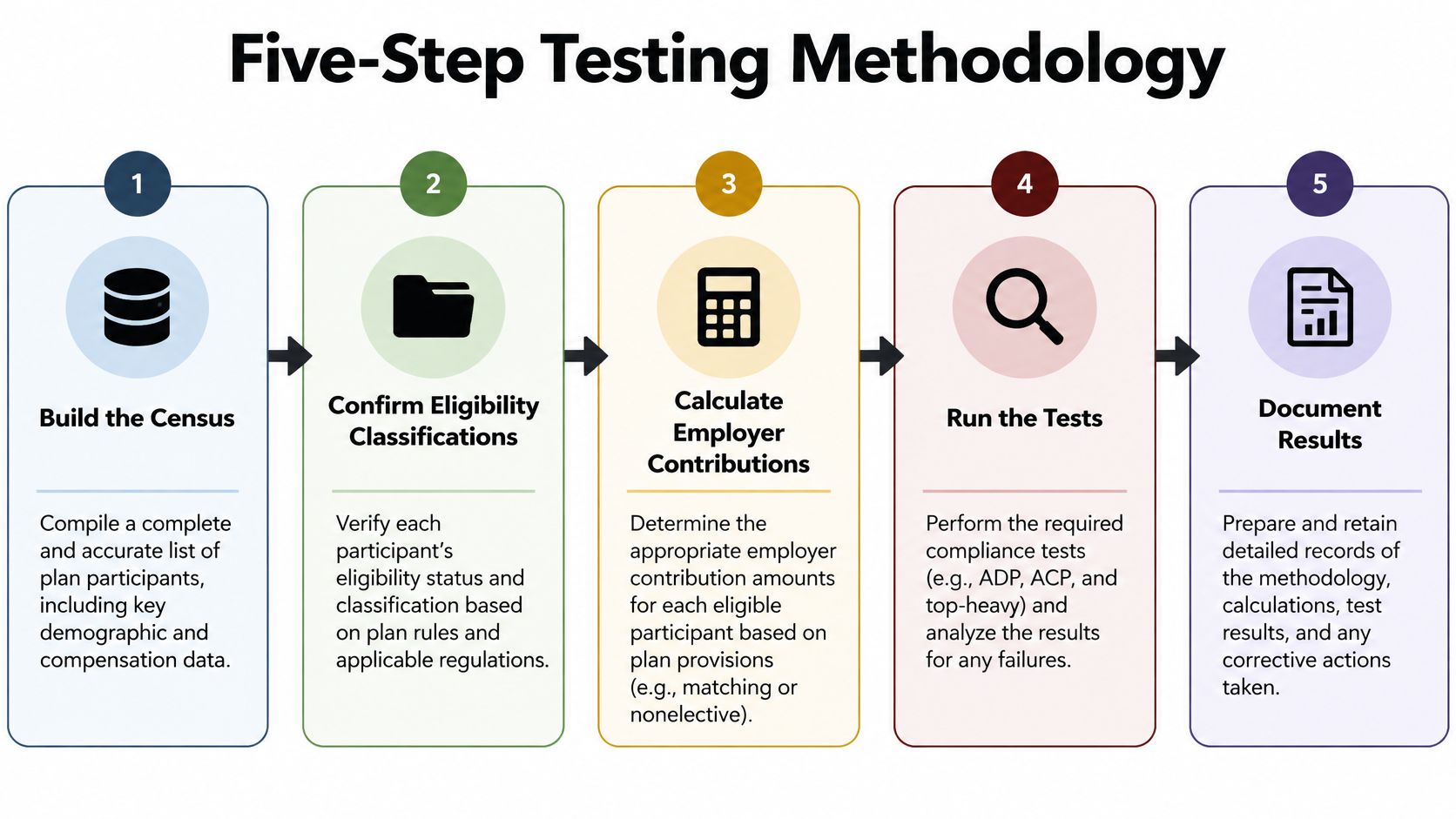
Five Steps in Order
- Build the census: Capture compensation, ownership, officer status, employment status, eligibility class, elections, and employer contributions for the testing population.
- Confirm classifications: Flag highly compensated individuals and key employees, reconcile ownership records with payroll, and note spouses or dependents who affect classification.
- Calculate employer contributions: Total employer dollars and qualified benefit value by person and by group, using design terms and actual elections.
- Run the three tests: Check eligibility, then benefits and contributions, then key-employee concentration. Don't stop after the first pass you like.
- Document results: Save the census, assumptions, calculations, and any corrections so another admin can reproduce the work. Ongoing flexible spending account administration support can help keep those records aligned during the year.
The short walkthrough below reinforces how those steps fit together in practice.
Run a projection before open enrollment or early in the plan year, then confirm results as the year closes. Workforce changes, new subsidies, and election shifts can alter an answer you thought was settled, so a single test done once and forgotten isn't a control.
What Happens When a Test Fails and How to Fix It
A failure isn't the end of your plan, but timing changes your options. The consequence is targeted, and understanding that target helps you explain the result calmly to leadership.

When a Section 125 plan fails, the favorable pretax exclusion generally does not apply to the discriminatory benefits received by highly compensated or key participants, who must include those amounts in gross income, as provided in the Section 125 failure consequence in the Internal Revenue Code. In plain terms, amounts that were treated as pretax become taxable compensation for the affected prohibited group.
Early Correction Versus Late Discovery
| Path | What You Can Change | Practical Effect |
|---|---|---|
| Before year-end | Eligibility terms, contribution practices, or key employee pretax use | Preserves room to redesign and document correction |
| After year-end | Tax reporting for affected participants | Discriminatory benefits are included in gross income |
| No review at all | Nothing until an audit or payroll review forces it | Reconstruction is harder and explanations are weaker |
Other employees generally aren't the ones who lose the exclusion because a plan favored the prohibited group. That's reassuring for the wider workforce, but it doesn't make the payroll correction painless for owners or executives.
Your best fix depends on which test failed. An eligibility problem may call for broadening access. A contributions problem may call for changing employer funding. A concentration problem may require key employees to reduce or restructure pretax elections through the plan.
Catch the imbalance while the plan year is still open whenever you can. After the year closes, you're mainly documenting a tax consequence that has already happened.
Practical Takeaways for SMBs and Benefits Brokers
Keep the decision flow on one page. First label your people correctly, then ask whether non-highly compensated employees can participate, then compare employer value, then check whether key employees stay within the permitted share. That order prevents the common mistake of running math before fixing classifications.
Your Monday Morning Checklist
- Maintain the census fields: Compensation, ownership, employment status, eligibility class, elections, and employer contributions should live in one reconciled file.
- Test before enrollment closes: A projection gives you time to adjust eligibility or contributions while changes still matter.
- Retest after major changes: Acquisitions, promotions, ownership shifts, and new employer subsidies can all move the result.
- Separate the tests: Passing eligibility doesn't prove contributions are fair, and neither result overrides the concentration limit.
- Document everything: Keep the final census, calculations, and corrections with your plan records. A broader employee benefits compliance checklist helps place this annual work alongside your other deadlines.
For brokers, the value isn't reciting three test names to a client. It's spotting the founder-heavy census, the executive subsidy, or the narrow eligibility class before those facts become taxable income. That operational follow-through is where a partner like Benely can fit into an SMB's routine, by helping teams connect census, payroll, enrollment, and compliance records instead of rebuilding them each year.
Section 125 nondiscrimination testing gets easier once you see it as workforce housekeeping, not a year-end mystery. Clean labels, current data, and early testing turn an intimidating IRS phrase into a repeatable annual habit.
If you'd like help building a clean census, reviewing your contribution formula, and running Section 125 nondiscrimination testing before year-end pressure hits, Benely can help you connect benefits administration, payroll data, and compliance follow-through in one workflow. Visit Benely to talk through your cafeteria plan, identify classification or concentration risks early, and set up a testing routine your HR team can repeat each plan year.