 Employee Benefits
 HR & Compliance
 Technology
 Wellness
 PEO Solutions

An employer can get two very different reactions to the same renewal proposal. A company with a mostly young workforce may see a lower-premium PPO as a practical way to control fixed costs. Another employer, with staff who regularly see specialists or manage chronic conditions, may find that same plan pushes too much expense onto employees when they need care. Neither choice is automatically right. The question is how the plan fits the workforce, the budget, and the provider access employees rely on.
Table of Contents
- Why the High vs Low PPO Decision Matters
- What High PPO and Low PPO Actually Mean
- Comparing Costs Beyond the Monthly Premium
- How Plan Design Shapes Employee Utilization
- Real-World Scenarios and Sample Calculations
- A Decision Checklist for Employers
- Next Steps for Plan Selection and Benchmarking
Why the High vs Low PPO Decision Matters
PPOs remain the most common plan design in U.S. employer-sponsored coverage. In 2023, 47% of covered workers were enrolled in a PPO, compared with 29% in a high-deductible health plan paired with a savings option, 13% in an HMO, and 10% in a POS plan, according to KFF's employer health benefits survey. Yet “high PPO” and “low PPO” aren't standardized national categories. Employers and brokers use the terms to describe relative generosity within the PPO options available to a group.
That distinction matters because the plan with the lower premium isn't necessarily the one that costs less overall. A higher deductible can mean employees pay more before the plan shares costs, while higher coinsurance can increase what they owe after the deductible. The impact depends on how often people use care, whether they can afford expenses early in the plan year, and whether the plan's network includes the providers they want.
Consider two hypothetical employers. One has a workforce with generally low expected medical use and employees who prioritize lower paycheck deductions. A leaner PPO might fit, provided the employer explains the deductible and employees can manage the potential costs. The other company has employees who depend on regular specialist care and want broad provider access. A richer PPO could better match those needs, even if it costs more in recurring premiums.
The practical question: Who bears the expense when employees need care, and can both the employer and its workforce absorb that risk?
The choice affects the employer's budget, but also satisfaction, recruitment, and the mix of employees who enroll in each plan. A fair comparison weighs premiums, deductibles, copays, coinsurance, out-of-pocket exposure, network access, and workforce risk together.
What High PPO and Low PPO Actually Mean
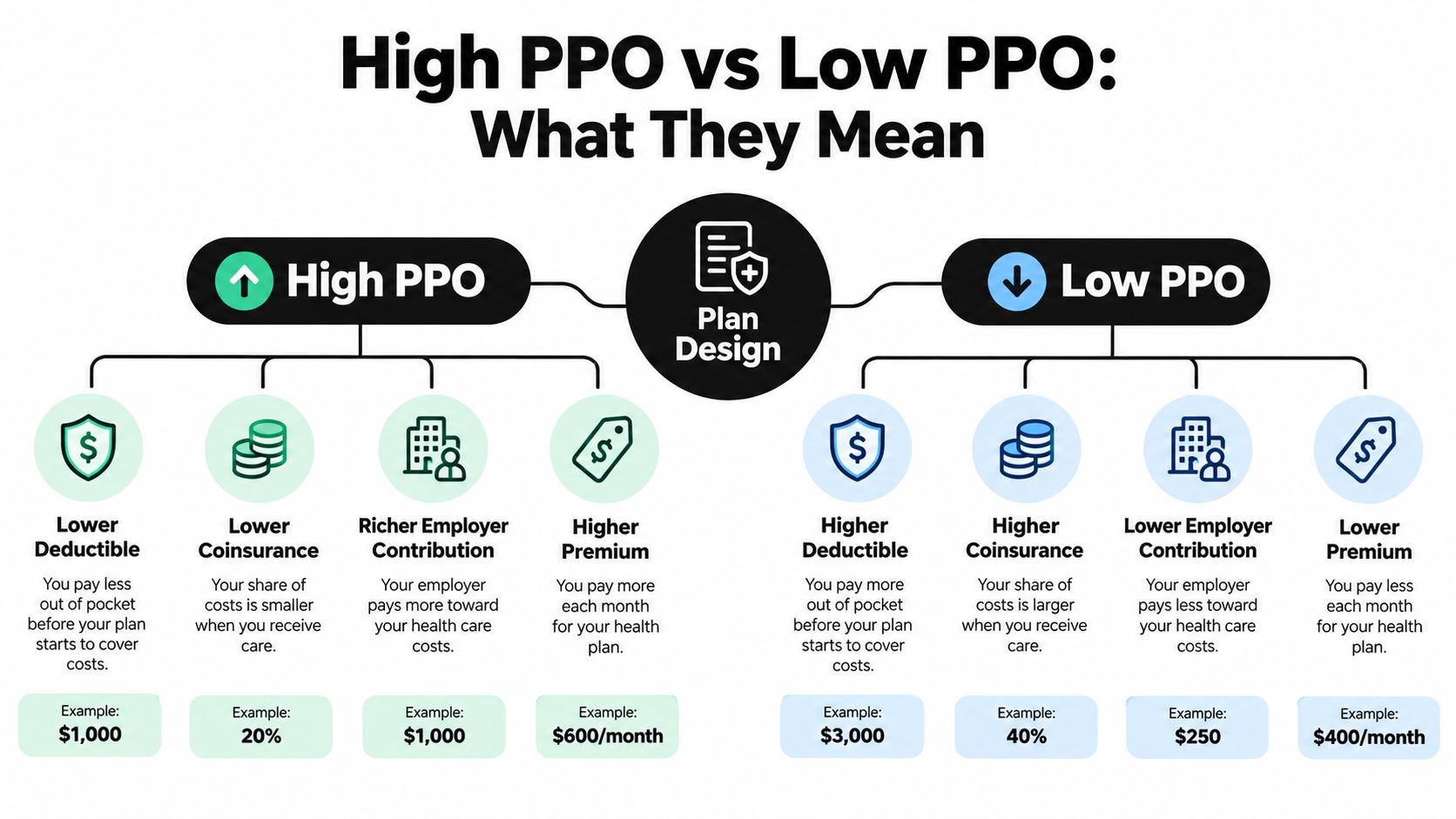
A high PPO generally has a lower deductible and lower coinsurance than a less generous PPO. The employer may also contribute more toward coverage. Those features reduce what an employee pays at the point of care, but the plan usually requires higher fixed premiums. In practical terms, more of the cost is paid steadily through premiums, whether an employee uses a lot of care or very little.
A low PPO usually has a higher deductible and more employee cost sharing in exchange for a lower premium. That can help control fixed spending, but leaves employees responsible for more of the early costs when they seek care. “High” and “low” describe relative plan generosity, not an official PPO classification or a guarantee about any single feature. One plan might have a relatively low deductible but still impose higher specialist copays, for example.
Read the cost-sharing details, not just the label
Start with the plan documents and compare each cost component:
- Premium: The recurring cost of coverage, split between the employer and employee.
- Deductible: What the member pays for covered services before the plan begins sharing certain costs.
- Copayment: A set amount for a covered service, if the plan uses one.
- Coinsurance: The member's share of an allowed cost after applicable deductible rules.
- Out-of-pocket maximum: The plan's limit on eligible member cost sharing, subject to the plan's terms.
The details can vary by service. Office visits, prescriptions, preventive care, and specialist appointments may follow different rules. Check whether each service is subject to the deductible or has a separate copay, and examine both in-network and out-of-network terms.
For a concrete illustration of how a deductible and coinsurance interact, CMS explains a deductible and coinsurance example. The useful takeaway for an employer is to compare the whole design. A PPO's label alone doesn't reveal how much an employee might owe for the care they use.
Comparing Costs Beyond the Monthly Premium
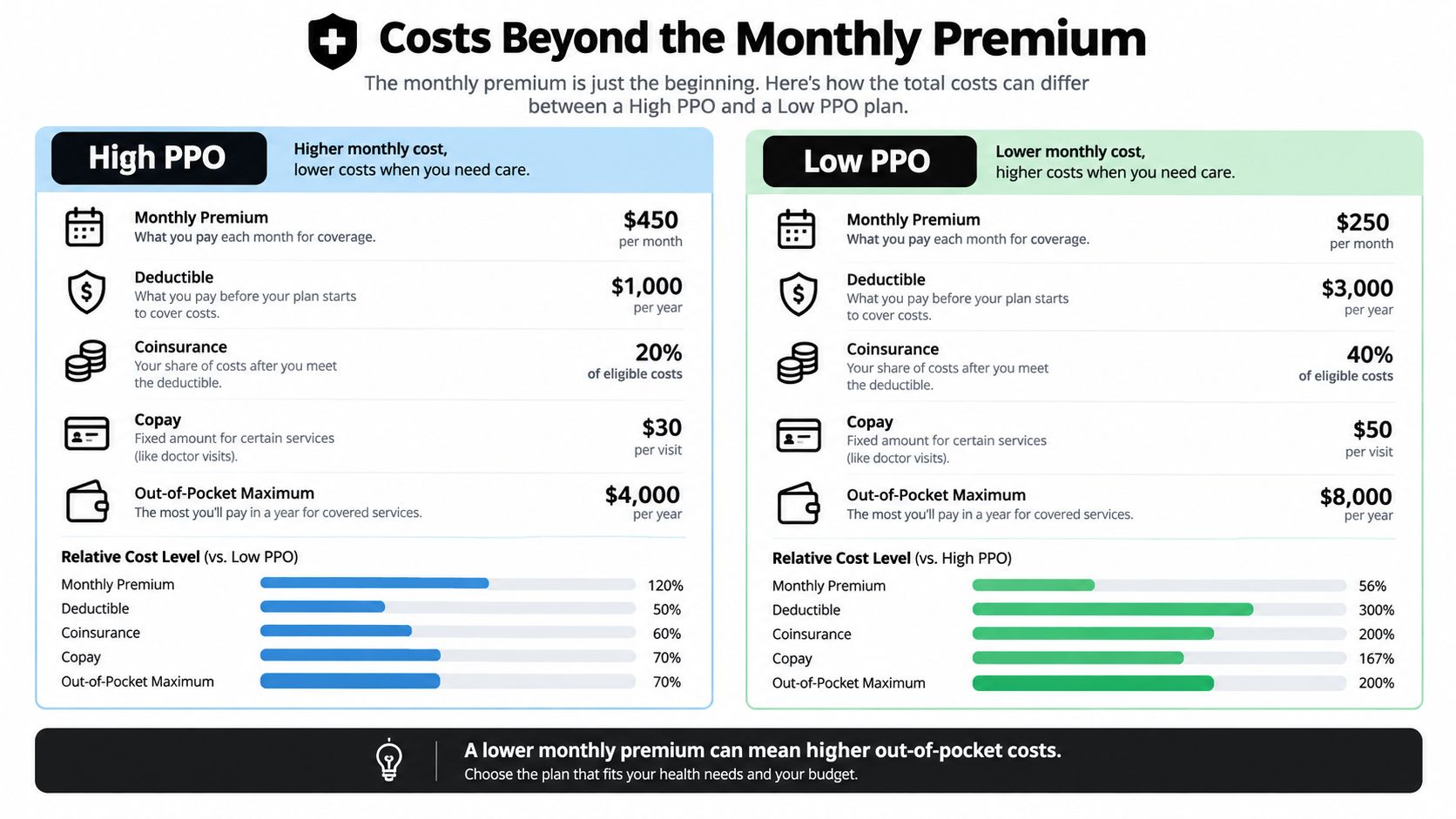
A premium-only comparison is an incomplete comparison. Employees who rarely use care may pay more under a richer plan because of higher premium contributions, even if they owe less when they do receive care. Employees with frequent or unpredictable care may value the lower deductible and cost sharing enough to make that ongoing premium worthwhile.
Use a side-by-side table to record the plan terms before modeling likely use. This keeps a lower premium from obscuring a deductible, coinsurance rate, or out-of-network limit that could materially change an employee's bill.
| Cost Component | High PPO | Low PPO |
|---|---|---|
| Premium | Usually higher, shifting more cost into recurring payments | Usually lower, reducing fixed premium cost |
| Deductible | Typically lower | Typically higher |
| Coinsurance | Typically lower member share | Typically higher member share |
| Copay | Check the schedule by service | Check whether more services are subject to the deductible |
| Out-of-pocket maximum | Review the plan limit and covered cost-sharing rules | Review the plan limit and potential exposure, especially out of network |
To estimate employee annual cost, add the employee's premium contributions, deductible spending, copays, coinsurance, and expected out-of-network liability. Keep that separate from employer premium spending, then compare both sides of the plan's cost. For each design, run low-use, expected-use, and high-cost scenarios instead of relying on one average employee.
The small-business context makes the exercise particularly important. KFF reported that, in 2023, the average deductible for single coverage was $2,434 at small firms, compared with $1,478 at large firms, as reported in the survey cited above. That source has already been linked in this article; the figures are a reminder that employees at smaller firms may face substantial deductible exposure.
Employers should also review whether the plan's out-of-network deductible and coinsurance are separate from in-network cost sharing. For a family budgeting for care beyond medical coverage, practical dental payment advice for parents can help explain how to think through dental insurance and payment options without confusing them with the medical plan's cost-sharing rules. For a closer explanation of plan cost terms, see this guide to coinsurance and deductibles.
A visual overview can help teams explain the trade-offs during enrollment:
How Plan Design Shapes Employee Utilization
Employee cost sharing affects more than the amount people pay. It can also influence whether and when they seek care. RAND's Health Insurance Experiment, conducted from 1971 through 1982, compared insurance designs ranging from free care to plans requiring members to pay 95% of expenses until reaching an income-related limit. Participants assigned to plans with greater cost sharing used fewer medical services and incurred lower spending than participants receiving free care. Reduced use affected both highly effective and less effective care, according to the RAND report on the experiment.
That finding makes a leaner PPO a utilization decision as well as a premium decision. Cost sharing may reduce some use, but it can also make employees hesitate over care they need. An employer shouldn't assume that lower claims spending means a plan is a better fit if employees struggle with early expenses or delay necessary appointments.
Enrollment mix can change the economics
Employees don't all value the same design equally. People who expect more medical care may prefer richer coverage, while healthier employees may pay closer attention to premiums. If an employer offers only a low-cost option, some employees may decide the coverage doesn't meet their needs. If the employer offers multiple options, employees may sort themselves into different plans based on expected use and their ability to manage cost sharing.
Research on employer plan selection illustrates why that matters. In one large-employer study, approximately 79% of the additional spending in the most generous plan compared with the least generous plan was attributed to adverse selection, rather than increased use caused by richer coverage, according to this analysis of employer plan selection. That result isn't a forecast for every small employer, but it highlights a risk: enrollment mix can affect the relative costs of plan options.
A low premium can hide a pool problem. If employees with higher expected needs disproportionately choose a richer option, the employer should evaluate the cost and enrollment mix of each plan, not just its advertised price.
Provider access also shapes the employee experience. PPOs generally allow members to see out-of-network clinicians without a referral, but at higher cost sharing. That flexibility can matter to employees who travel, see specialists, or rely on providers outside the local network. Employers can explain the difference between in-network and out-of-network care so employees understand that provider choice doesn't mean equal cost.
Real-World Scenarios and Sample Calculations
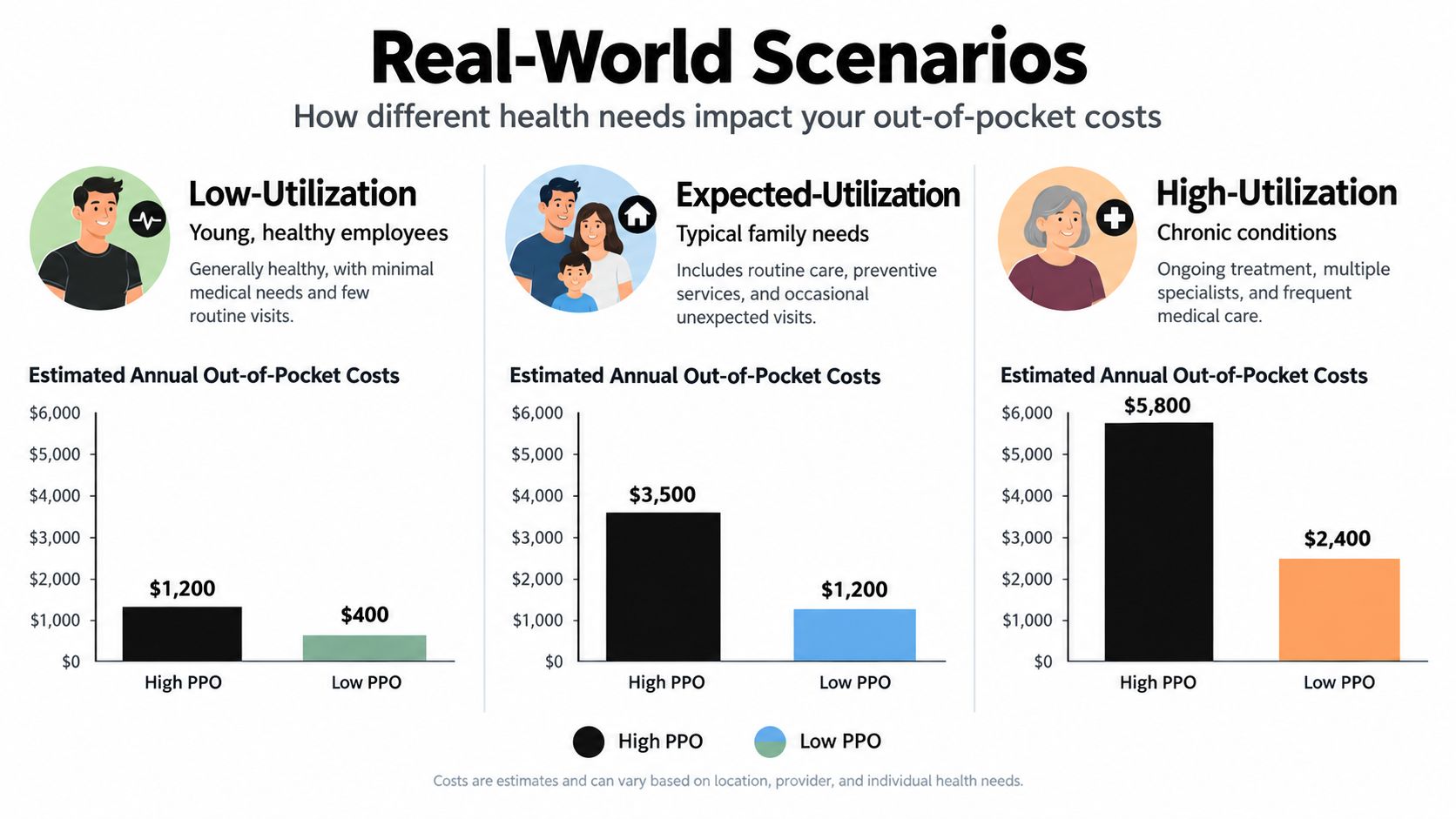
A useful comparison begins with employee profiles, not invented claims totals. Without actual plan premiums, cost-sharing terms, and allowed-claim estimates, specific dollar totals would create false precision. Employers can still run a meaningful calculation by entering their own plan figures into a consistent framework.
Low utilization
For an employee who expects few medical services, compare the additional premium contribution for the high PPO with the low PPO's likely deductible and copay costs. If the employee uses little care, the richer plan's higher recurring premium may outweigh the savings at the point of care. But the lower-premium plan only works well if the employee understands the deductible and can handle a larger bill if an unexpected need arises.
Calculation: employee premium contributions for the year, plus expected care-related cost sharing. Use the same expected services for both designs, then apply each plan's actual rules.
Expected utilization
For a family with routine appointments and some specialist care, list the services they expect and identify which are subject to the deductible, separate copays, or coinsurance. A high PPO may reduce some point-of-care costs, while the low PPO may retain an advantage on premiums. Don't treat the deductible as the entire bill: add the applicable copays and coinsurance, and account for whether care is in or out of network.
Calculation: annual employee premium contributions, plus the estimated deductible, service copays, coinsurance, and any anticipated out-of-network costs. Compare that total under each design.
High-cost or specialist-dependent care
For an employee with ongoing treatment or frequent specialist visits, examine the plan's cost-sharing rules service by service. A richer PPO can make expenses more predictable when care is frequent or difficult to forecast, although the premium is higher even for employees who use little care. PPOs generally don't require primary-care gatekeeping for specialist visits and permit out-of-network use without a referral, but members typically pay more for out-of-network care. KFF describes these employer plan characteristics in its overview of employer-sponsored coverage.
Calculation: compare the employee's premium contribution and expected cost sharing under both designs, then test the plan's out-of-pocket maximum and out-of-network terms against the expected care pattern. Keep employer premium costs separate from employee costs so the comparison shows who pays what.
The point isn't to guess a universal winner. It's to use the same utilization assumptions for each option, then let the actual plan documents determine the result.
A Decision Checklist for Employers
A useful plan review starts with workforce needs and ends with a clear explanation employees can act on. Before making a choice, answer these questions with the plan documents and enrollment data in front of you.
- Who is the plan intended to serve? Review the workforce's age distribution, dependent coverage needs, specialist use, and known patterns of recurring care. Use aggregated information and protect employee privacy.
- Can employees manage early-year expenses? A lower premium may still be difficult for workers who don't have savings available when a deductible applies. Consider whether employer-funded accounts or other support can make the cost-sharing design workable.
- Does the network match where people live and receive care? Check whether key hospitals, primary-care practices, and specialists are in network across employees' locations. A broad PPO design is less useful if the network doesn't include the providers employees rely on.
- What happens outside the network? Compare the out-of-network deductible, coinsurance, balance-billing exposure, and out-of-pocket maximum. The HealthCare.gov guide to comparing health plans explains why in-network and out-of-network costs can differ.
- Can employees understand the choice? Present paycheck contributions alongside deductibles, copays, coinsurance, and out-of-pocket exposure. Use examples tied to actual plan terms, not a generic “lower premium means cheaper” message.
Benchmark the full design
Compare the proposed options against the employer's current coverage and appropriate market benchmarks. Look at employee contributions as well as employer spending, and note where the plan's network or cost-sharing rules differ. A brief employee survey can clarify which providers and cost concerns matter most; an employee benefits survey template can provide a starting point for gathering structured feedback.
Then test whether an HSA-eligible design or an employer-funded account could help employees manage a higher deductible. Don't assume account funding solves every problem. Compare the available contribution, eligibility, plan rules, and employee cash-flow needs before deciding.
Next Steps for Plan Selection and Benchmarking
Start with the actual plan documents: premium rates, employee contribution schedules, benefit summaries, network information, and rules for in-network and out-of-network care. Put the options into one comparison so the employer can see fixed premium spending beside employee cost-sharing exposure. Then run low-use, expected-use, and high-cost scenarios using consistent assumptions for every plan.
Next, review whether the network is practical for the workforce. A PPO's flexibility has limited value if employees can't reach the providers they need at an affordable in-network cost. If you're considering multiple plan options, model how employees might choose among them and how that enrollment mix could affect renewal costs. The adverse-selection research cited earlier is a reason to ask the question, not a substitute for the employer's own experience and plan data.
An employer choosing a single plan should be explicit about the compromise: lower premiums can mean more employee exposure, while richer coverage can cost more even when employees use little care. If offering more than one option, provide clear comparisons and enrollment guidance so employees understand the trade-offs instead of choosing by premium alone.
Finally, involve a benefits partner when the terms, funding, or enrollment choices are difficult to compare. A broker or advisor can help benchmark options, model employer and employee costs, and explain plan mechanics during enrollment. Benely provides a platform for comparing health plans and managing benefits tasks, with HR specialists available to guide employers through plan selection and enrollment.
Visit Benely to compare PPO options and review how premiums, deductibles, employee contributions, and out-of-pocket exposure fit your workforce. Its benefits platform and HR specialists can help your team benchmark plans, model costs, and organize enrollment.