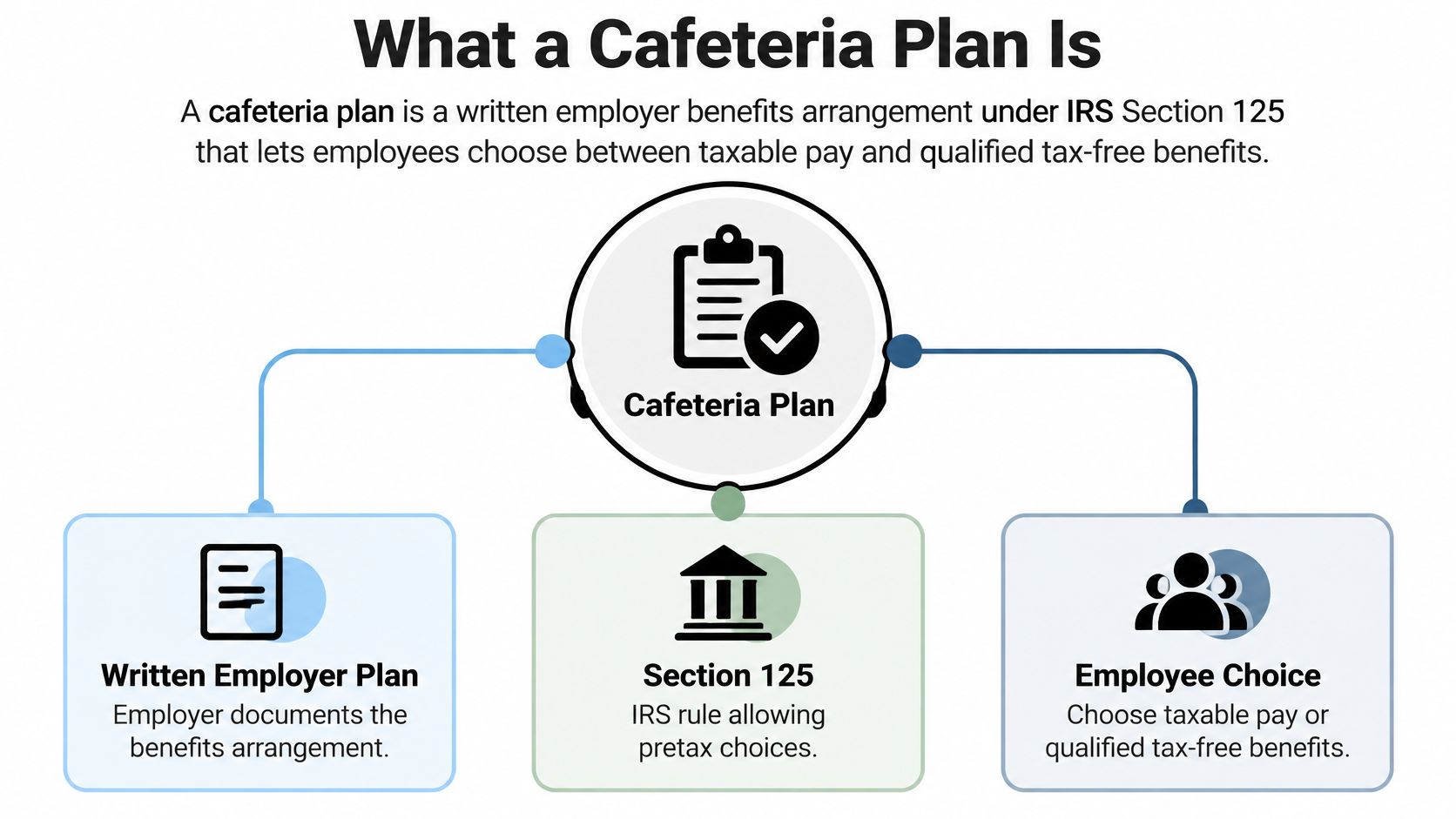
A cafeteria plan is a written employer benefits arrangement under IRS Section 125 that lets employees choose between taxable pay and qualified tax-free benefits.
You may already offer health insurance, and your payroll system may already have a pre-tax deduction setting. Then an employee asks to cancel an FSA election, your accountant asks for the plan document, and nobody knows who handles compliance testing. That's where understanding a cafeteria plan becomes more important than knowing which payroll box to check.
Table of Contents
- What a Cafeteria Plan Is
- Benefits Employees Can Choose From a Cafeteria Plan
- Common Cafeteria Plan Designs and Their Trade-offs
- How an Election Moves From Paycheck to Benefit
- A Worked Example of the Tax Savings
- Nondiscrimination Rules Your Plan Must Pass
- FSA Limits and When Elections Can Change
- Setting Up and Running a Plan at a Small Business
- Decide Whether a Cafeteria Plan Fits Your Business
What a Cafeteria Plan Is
Think of a cafeteria line. The employer stocks the menu and establishes the spending rules; employees select the available options that suit their households instead of receiving an identical package. Some arrangements include an employer-funded budget, while others primarily let employees redirect their own pay.
Say an employee, Maya, expects recurring prescription costs. She chooses a health flexible spending account, or health FSA, rather than taking all her compensation as taxable cash. Under a compliant arrangement, she redirects part of her pay into that benefit, and the qualifying amount isn't taxed as wages.
Congress established this framework through the Revenue Act of 1978, with Public Law 95-600 adding Section 125 on November 6, 1978, as documented in the United States Code. Its nondiscrimination principle means the plan can't favor highly compensated or key employees in eligibility, contributions, or benefits.
The arrangement connects the employer's documentation with the employee's choices:
The Plan Is the Framework, Not the Account
At the center is the written cafeteria plan. Its connected parts are employee elections, qualified benefits, the tax exclusion, and nondiscrimination controls. The FSA is a benefit offered through that framework, not another name for the entire arrangement.
That distinction matters when you buy insurance or activate payroll deductions. An insurance contract describes coverage. A payroll setting calculates deductions. Neither, by itself, establishes the employer's cafeteria-plan rules.
Practical test: If employees choose between taxable cash and a qualified tax-free benefit under a compliant written employer plan, you're looking at a cafeteria plan.
The employee's choice also doesn't mean the employer must offer every permissible benefit. You choose the menu, document it, and administer the choices consistently.
Benefits Employees Can Choose From a Cafeteria Plan
Common cafeteria plan benefits and how each is treated
| Benefit | Typical pre-tax use | Key limit or rule |
|---|---|---|
| Employee share of health premiums | Medical, dental, and vision premiums | Election generally stays fixed for the plan year unless a permitted change applies |
| Health flexible spending account | Copays, deductibles, and prescriptions | Salary-reduction cap and use-it-or-lose-it rules apply |
| Dependent care assistance | Eligible daycare and dependent elder care | Federal annual limit under IRC Section 129; document expenses and confirm the current limit |
| Health savings account contributions | Contributions to an eligible employee's HSA | Cafeteria-plan contributions are excluded from wages; the employee must be HSA-eligible |
| Group-term life insurance | Eligible coverage premiums | Coverage above $50,000 generally creates taxable imputed income for the coverage cost, not the full death benefit; nondiscrimination requirements apply |
Premium payments help employees who need ongoing insurance coverage. An FSA serves a different purpose: Maya can use it for eligible out-of-pocket costs even though she already has medical insurance.
Dependent care assistance helps employees pay eligible care expenses that enable them to work. It isn't another medical account, and not every payment to a relative or care provider qualifies. A clear dependent care benefits explanation helps employees distinguish care expenses from healthcare expenses.
An HSA requires its own eligibility review. Enrollment in a high-deductible health plan doesn't, by itself, settle every eligibility question, especially when an employee has other coverage. Group-term life insurance also needs separate payroll treatment; pre-tax benefits don't make every insurance-related amount tax-free.
Access Doesn't Equal Understanding
The Bureau of Labor Statistics benefits figures report that, in 2026, 14% of civilian workers had access to flexible benefits, including 11% of private-industry workers and 36% of state and local government workers; healthcare FSA access was 47% and 72%, respectively.
Those are access measures, not evidence that employees enrolled or understood their choices. Your enrollment materials should explain what each option pays for, who can use it, and what deadline applies.
A menu offering only cash isn't a cafeteria plan. Employees need at least one qualified, tax-excluded benefit to choose instead.
Common Cafeteria Plan Designs and Their Trade-offs
A premium-only plan, often called a POP, is the simplest starting point. Employees pay their share of eligible medical, dental, and vision premiums through pre-tax deductions. For example, a small employer can add this framework around its existing group coverage without introducing reimbursement claims.
A premium plan plus a health FSA adds an account for eligible out-of-pocket healthcare expenses. Maya can elect prescription money alongside her insurance coverage. The additional value comes with claims administration, spending deadlines, and possible forfeitures.
A full flex plan gives employees an employer credit to allocate across available benefits. One employee might direct the credit toward premiums, while another uses available options for dependent care or an HSA. Employers need more detailed communications and careful administration of credit allocation.
Compare Both Sides of the Decision
| Perspective | Main advantages | Main restrictions |
|---|---|---|
| Employer | Potential payroll-tax savings, a stronger recruiting offer, and benefits employees can tailor | Documentation, testing, administration, and tax consequences when requirements aren't met |
| Employee | Lower taxable wages and more control over eligible spending | Restricted election changes, possible FSA forfeitures, and taxable treatment when choosing cash |
Don't assume every tax-favored workplace benefit belongs in this menu. For example, a commuter benefits program operates under a separate tax framework.
Choose the design your team can administer reliably. A narrower menu with accurate deductions is more useful than a broad menu employees can't understand or HR can't maintain.
How an Election Moves From Paycheck to Benefit
The process begins before payroll calculates a deduction. This visual shows the main handoffs:
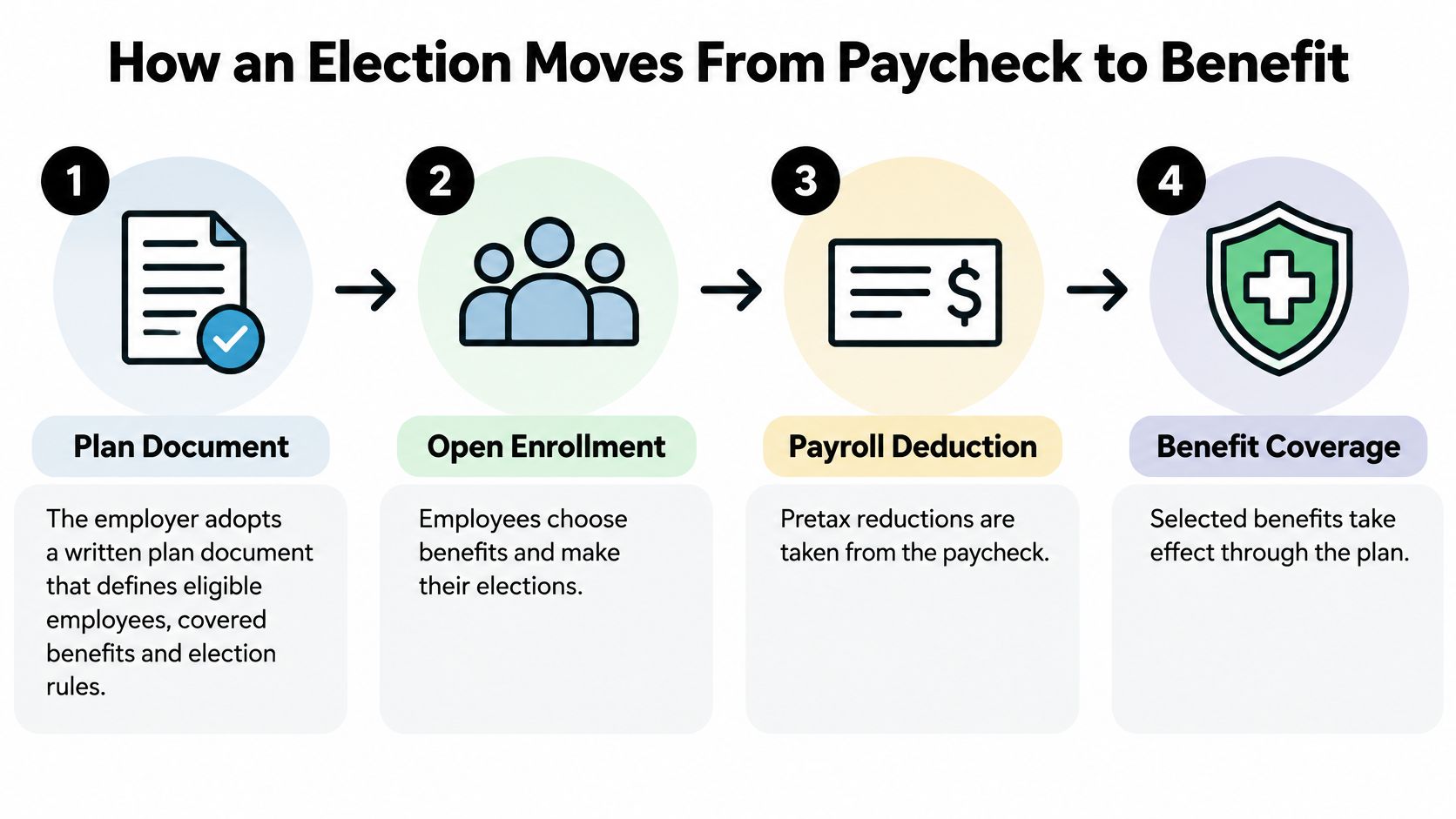
The IRS cafeteria-plan guidance explains the central mechanism: employees elect qualified benefits before compensation is constructively received, allowing qualifying amounts to be excluded from gross income.
Adopt the written plan. Define eligible employees, available benefits, and election procedures. An informal agreement with the payroll administrator doesn't replace this document.
Collect employee elections. During enrollment, Maya selects the benefits she wants and authorizes the corresponding salary reduction. Save the submitted election, not just the final spreadsheet total.
Apply the election prospectively. Establish it before the compensation it covers becomes available, following the applicable enrollment rules. Don't backdate an election to reclassify wages already received.
Configure each deduction. Payroll reduces the cash compensation paid by the scheduled benefit amount. Common mistakes include mismatched pay frequencies, incorrect start dates, and deductions continuing after an approved change.
Apply the correct tax treatment. Qualifying health FSA deductions generally reduce federal income-tax and FICA wages. Don't assume every benefit has identical exclusions.
Deliver the benefit. Send premium payments to the appropriate destination or process eligible FSA claims. A deduction without the corresponding coverage or account administration isn't a completed transaction.
Maintain the election. Keep the authorized amount in place unless a permitted change applies. Preserve the event documentation, approval, and effective date.
Check the Pay Stub Against the Election
Maya's pay stub should show her contractual gross earnings, a separately identified pre-tax benefit deduction, and lower applicable taxable wages. Employers shouldn't confuse reduced taxable gross with a reduction in her agreed salary.
Restaurant employers comparing systems can use AnchOps' guide to payroll tools for restaurant operators to evaluate payroll workflows, then verify how their chosen system handles benefit deductions and effective dates.
For another explanation of the benefits process, the following video offers a visual reference:
A Worked Example of the Tax Savings
Use Maya's paycheck to separate tax savings from money redirected into benefits. For this hypothetical illustration, assume a $60,000 annual salary, a $3,000 health FSA election, a flat 22% federal income-tax rate, 7.65% employee FICA, and no state tax. These are calculation assumptions, not a prediction of her actual tax return.
Tax effect of a $3,000 health FSA election on a $60,000 salary (illustrative)
| Line item | Without cafeteria plan | With cafeteria plan |
|---|---|---|
| Gross annual pay | $60,000 | $60,000 |
| Health FSA election | $0 | $3,000 |
| Taxable wages for federal income tax | $60,000 | $57,000 |
| Federal income tax at assumed flat rate | $13,200 | $12,540 |
| Employee FICA at assumed rate | $4,590 | $4,360.50 |
| Total tax | $17,790 | $16,900.50 |
| Annual tax difference | $0 baseline | $889.50 less tax |
Maya's gross salary doesn't change. Instead, the election reduces the wages used in this simplified tax calculation.
The federal income-tax difference is $660, and the employee FICA difference is $229.50. Together, those produce the illustrative $889.50 annual tax saving.
Compare Equal Healthcare Spending
Without the FSA, Maya pays her eligible healthcare bills from after-tax cash. With the FSA, she directs the elected amount toward those bills before the assumed taxes apply. She still spends $3,000 on healthcare; the benefit is the difference in taxes, not free healthcare or an additional salary payment.
Compare the same eligible expenses on both sides. Otherwise, you may mistake redirected spending for tax savings.
Actual results change with tax brackets, deductions, state treatment, wage levels, and eligible spending. A higher applicable income-tax rate increases the potential saving on the same qualifying election, while unused funds that are forfeited reduce its value.
Before enrolling, Maya should total predictable prescriptions, recurring copays, and planned eligible expenses. Choosing an amount she can reasonably use is more important than maximizing the election just because payroll permits it.
Nondiscrimination Rules Your Plan Must Pass
Offering everyone the same menu isn't enough. An employer can make identical benefits available yet structure eligibility or contributions in ways that favor highly compensated or key employees.
The cafeteria-plan statute establishes plan-level nondiscrimination requirements, while individual benefits have separate rules: self-insured medical reimbursement under Section 105(h), dependent-care assistance under Section 129(d), and group-term life insurance under Section 79(d).
That means passing a cafeteria-plan test doesn't automatically establish that every underlying benefit passes its own requirements. Your administrator needs to identify the tests applicable to the actual menu, rather than treating compliance as a single checkbox.
Where a Seemingly Fair Design Can Fail
Suppose an employer contributes more generously toward executives' benefits while other employees must fund most options themselves. Or eligibility rules exclude a substantial part of the workforce while preserving access for management. These arrangements need analysis even if the enrollment brochure looks uniform.
When testing fails, affected highly compensated or key employees can lose favorable tax treatment. Payroll may need corrections, reporting may change, and HR must explain why a previously excluded benefit is now taxable.
A simple cafeteria plan offers an alternative for eligible small employers that satisfy statutory eligibility, participation, and contribution conditions. Under the statute linked above, contribution approaches include a uniform employer contribution of at least 2% of compensation, or the applicable formula using the lesser of 6% of compensation or twice the employee's salary reduction, subject to the statutory conditions.
Don't interpret that alternative as permission to contribute any amount up to a ceiling. The formula establishes a required contribution standard, and the remaining conditions still matter.
Give Testing a Named Owner
- Test before enrollment decisions are finalized. Run the applicable annual tests or document the basis for using the small-employer safe harbor.
- Separate employee groups correctly. Review highly compensated and other employees using the applicable definitions.
- Inspect employer contributions. Look for executive-only enhancements or eligibility distinctions that need review.
- Keep the supporting file. Retain the census, assumptions, calculations, results, and corrective decisions.
A benefits administrator can perform calculations, but the employer still needs someone responsible for delivering complete employee information and acting on the results.
FSA Limits and When Elections Can Change
FSA rules that set when an election can change
| Rule | Limit or window | What it means for employees |
|---|---|---|
| Health FSA salary-reduction cap | $3,400 for plan years beginning in 2026 | Employees can't elect more through salary reduction |
| Carryover | Up to $660 for 2025, as listed by the IRS, if the plan allows it | Eligible unused funds move into the next plan year |
| Grace period | Ends by the 15th day of the third month after the plan year ends | Remaining funds can reimburse eligible expenses incurred during the grace period |
| Cash-out or conversion | Not permitted | Unused FSA funds can't become taxable pay or another benefit |
| Mid-year election change | A permitted event and plan provision are generally required | Changes are generally prospective; confirm the applicable effective-date rule |
IRS Publication 15-B states the $3,400 health FSA salary-reduction cap for plan years beginning in 2026, lists the $660 maximum carryover for 2025, and describes the grace-period deadline as the 15th day of the third calendar month following the plan year's end. The carryover figure is year-specific; don't substitute it for another year's limit.
Separate Spending Deadlines From Claim Deadlines
A carryover moves permitted unused funds forward. A grace period extends the period for incurring eligible expenses using the prior year's remaining balance. Without an applicable relief feature, unused amounts are generally subject to forfeiture.
A claim-submission deadline is different: it governs when employees must submit documentation. It doesn't necessarily extend the date on which they can incur an expense.
Enrollment warning: Tell employees both when they must incur expenses and when they must submit claims.
A Life Event Isn't an Automatic Refund
Marriage, divorce, a new baby, or gaining or losing other coverage may permit a corresponding change. The plan must allow it, and the event doesn't authorize every requested adjustment. Changes are generally prospective, although specific rules can provide exceptions, so don't promise a universal event-date effective date or refund of earlier deductions.
Suppose Maya chooses an ambitious FSA election in January and leaves in March. HR must check her coverage termination, eligible expense dates, claim-submission window, and any applicable continuation rights. She can't withdraw the remaining balance as cash.
State the carryover, grace-period, or forfeiture design clearly before enrollment closes. Employees need those rules before choosing an amount, not after discovering unused funds.
Setting Up and Running a Plan at a Small Business
Use a launch checklist that assigns each task to a person, not just a department.
- Confirm eligibility. Review the employer's structure, eligible participants, and whether the simple cafeteria-plan route is available.
- Draft the governing document. Identify covered employees, benefits, election procedures, and the plan year so administrators have a consistent operating reference.
- Schedule enrollment. Allow time to collect and validate elections before their effective dates.
- Configure payroll. Match deduction codes, tax treatment, amounts, and start dates to the authorized elections. Test a sample payroll before launch.
- Build the audit trail. Store elections, approved changes, supporting documents, and payroll records together with controlled access.
- Assign compliance review. Schedule testing or document the safe-harbor basis before enrollment decisions become final.
- Communicate FSA deadlines. Explain the chosen design and give employees separate expense-incurrence and claim-submission dates.
A careful setup includes checking the documents against the payroll configuration:

Choose Who Will Administer the Work
In-house administration gives HR direct control and may avoid an outside administration fee, but staff must handle deadlines, records, testing coordination, and employee questions. That workload doesn't disappear because the payroll system automates deductions.
A third-party administrator can take on contracted claims, testing, and reporting tasks for a fee. Define responsibilities in writing, including who approves changes and who reconciles payroll. Our FSA administration guide can help you identify the account-management work involved.
The mistake to avoid is activating deductions while leaving the written arrangement unfinished. A functioning setup has timely enrollment, payroll entries matching authorized elections, and employees who can identify their own deadlines.
Decide Whether a Cafeteria Plan Fits Your Business
Start with these questions:
- Employee value: Do enough eligible employees have benefit expenses to justify the administrative work?
- Qualified menu: Do you offer, or plan to offer, a qualifying benefit such as health coverage or an FSA?
- Payroll readiness: Can your system process deductions with accurate tax treatment and effective dates?
- Clear ownership: Will a named person maintain documentation and coordinate annual testing?
If most answers are yes, confirm the written plan, select any FSA carryover or grace-period approach, and put the compliance review on the calendar. If most answers are no, begin with the benefit menu and payroll capabilities rather than purchasing a complicated design.
Buy Support for the Difficult Work
Have a tax adviser or benefits attorney review the proposed arrangement against current IRS guidance, including Publication 15-B. An administrator's standard package still needs to match your workforce and the benefits you offer.
Our Benefits Advisors manage insurance programs from plan design through compliance paperwork. Our compliance experts can assist with COBRA/FSA administration, ACA reporting, HR support, ERISA wrap, and ERISA filing, while our Employee Platform lets users manage benefits and HR centrally.
The decision isn't whether pre-tax benefits sound attractive. It's whether your business can deliver them with reliable records, accurate payroll, and clear employee instructions. Prepare a benefit list, verify payroll readiness, and schedule the first compliance review before your next open enrollment.
Our Benefits Advisors can help connect your benefit design with enrollment administration and compliance paperwork. Visit Benely to discuss the benefits you want to offer, your payroll setup, and the review needed before launching a cafeteria plan.