34% of covered workers were in plans requiring at least a $2,000 general annual deductible for single coverage in 2025, a share that rose 77% over ten years, according to the KFF 2025 Employer Health Benefits Survey coverage. That shift is why high deductible health plan benefits need a harder look than the premium quote. Lower premiums help your budget, but employees feel the deductible first. For small and midsize employers, the design works only when HSA funding, payroll timing, and communication close that cash flow gap.
Table of Contents
- 2026 HDHP Benefits and Limits at a Glance
- How HDHPs Lower Premiums and Medical Spending
- How HSAs Work and How to Fund Them
- Pros and Cons for Employers and Employees
- Eligibility Rules That Trip Up Employers
- Affordability Risks for Lower-Paid Workers
- Decide Whether an HDHP Fits Your Group
- Sample Scenarios and FAQ for HR and Finance Teams
2026 HDHP Benefits and Limits at a Glance
Start with the 2026 thresholds before you compare carriers, networks, or premium savings. A plan that misses these tests is not an HSA qualified HDHP, and employees cannot make HSA contributions through it.
| Limit | Self-only coverage | Family coverage |
|---|---|---|
| Minimum HDHP deductible | $1,700 | $3,400 |
| Maximum in-network out-of-pocket | $8,500 | $17,000 |
| HSA contribution limit | $4,400 | $8,750 |
For 2026, the HealthCare.gov HDHP and HSA guidance states that an HSA qualified high-deductible health plan must have a minimum annual deductible of $1,700 for self-only coverage or $3,400 for family coverage, and its annual out-of-pocket limit for covered in-network benefits cannot exceed $8,500 or $17,000, respectively. Premiums do not count toward those out-of-pocket limits. Plans with networks generally calculate the limit using in-network deductibles and cost sharing only.
The Four Core Benefits
- Lower monthly premiums: The employee takes more upfront risk, so the premium is typically lower and frees budget for savings contributions.
- HSA tax advantages: Contributions are pre-tax, growth is tax-free, and withdrawals for qualified medical expenses are tax-free.
- First-dollar preventive care: Qualifying preventive services can be covered before the deductible, so employees shouldn't skip them because of cost.
- Employer cost control: Lower starting premiums and reduced routine claims can slow renewal growth, provided employees don't delay needed care.
The IRS sets these thresholds each year, so last year's compliant design can fail at renewal if the deductible or out-of-pocket maximum does not move with the new limits. I would check compliance before you model savings, not after you've presented the plan to leadership.
Run this check today. Put the quoted deductible and in-network out-of-pocket maximum beside the table above. If either number falls outside the 2026 range, stop and ask the carrier for a corrected design.
That simple test prevents the most expensive mistake in this category, which is promising employees an HSA that the underlying plan cannot legally support. It also gives finance a clean baseline. Once the plan qualifies, you can judge premium savings against the deductible exposure and the HSA contribution you are willing to fund.
How HDHPs Lower Premiums and Medical Spending
Say an employee needs an MRI and will pay the negotiated price until she meets her deductible. She checks two in-network imaging centers, finds a lower price across town, and books there. Multiply that behavior across routine labs, imaging, and nonurgent visits, and plan paid claims fall. Lower claims support lower premiums at renewal.

The evidence behind that mechanism is real, but it isn't clean. A RAND analysis of more than 800,000 people across 53 large employers found families entering HDHPs or consumer-directed plans spent approximately 14% less than comparable families in conventional plans during the first year, with the strongest effect when deductibles were at least $1,000. The same analysis found moderate reductions in mammography, cervical-cancer screening, colorectal-cancer screening, and childhood immunizations.
That second finding matters for your renewal story. Savings from skipped screenings are not the same as savings from smarter shopping. Delayed preventive care can become higher cost treatment later, and it undermines employee trust in the plan.
What to Track Beyond Total Claims
- Preventive-service completion rate: Track screenings and immunizations by eligibility group so a drop shows up early.
- Emergency-room use per 1,000 members: Watch whether members avoid primary care and then use urgent settings.
- Chronic-condition medication adherence: Check refill persistence for maintenance drugs employees need every month.
Price transparency tools only help if employees understand terms like deductible, coinsurance, and allowed amount before they book care. For teams with employees abroad, a guide to coinsurance for Spain's expats from Bsure Health Brokers shows how cost sharing language varies by market, which is a useful reminder to define every term in your own guide.
Use a simple illustration in finance discussions, then verify it against your claims. If 10 members each spend $600 less in a year, the group saves $6,000 before any premium effect. Don't present that as a forecast. Present it as a sensitivity test, and replace the $600 with your group's actual change in per-member spending after the first two quarters.
How HSAs Work and How to Fund Them
An Health Savings Account belongs to the employee, not the company. It moves with the employee when they change jobs, and unused money rolls over year after year. That ownership is the main reason employees treat an HSA differently from a flexible spending account they must rush to spend.
The tax benefit has three parts:
- Pre-tax contributions: Employee payroll contributions reduce taxable pay, and employer contributions add value without becoming wages.
- Tax-free growth: Interest and investment earnings are not taxed while they stay in the account.
- Tax-free withdrawals: Money used for qualified medical expenses comes out tax-free.
HSA, FSA and HRA Compared
| Feature | HSA | FSA | HRA |
|---|---|---|---|
| Who owns the account | Employee | Employer | Employer |
| Plan it pairs with | HDHP meeting IRS limits | Any health plan | Any health plan, set by employer |
| Unused funds | Roll over every year | Generally use-it-or-lose-it, with limited carryover or grace period | Rollover only if employer plan terms allow it |
| Portable if employee leaves | Yes | Generally no | Generally no |
Funding design decides whether employees enroll willingly or feel pushed into risk. You have four practical levers. First, seed the account with an employer deposit at the start of the plan year so money is available for January prescriptions. Second, offer employee payroll contributions through a cafeteria plan so saving is automatic. Third, remind members aged 55 and older about catch-up contributions. Fourth, choose between funding your contribution in full up front or spreading it across pay periods.
Front loading helps cash flow, but it raises a question if an employee leaves early in the year, because HSA money already deposited belongs to the employee. Per-pay-period funding matches your payroll cycle and reduces that exposure, but it leaves a smaller balance for early year bills. Model both patterns before open enrollment.
I recommend sizing the employer contribution to a meaningful fraction of the deductible. Make it large enough that a routine visit or prescription doesn't force an employee to choose between care and rent. Don't make it so large that employees never feel a price signal at all. Our guidance on employer contributions to a health savings account walks through that sizing decision.
Treat the contribution as a real cost in your comparison. Subtract total HSA funding from the premium reduction, then compare the net figure with your current plan. If the net saving disappears, the HDHP may still be worth offering as a choice, but it isn't a cost cutting move.
Pros and Cons for Employers and Employees
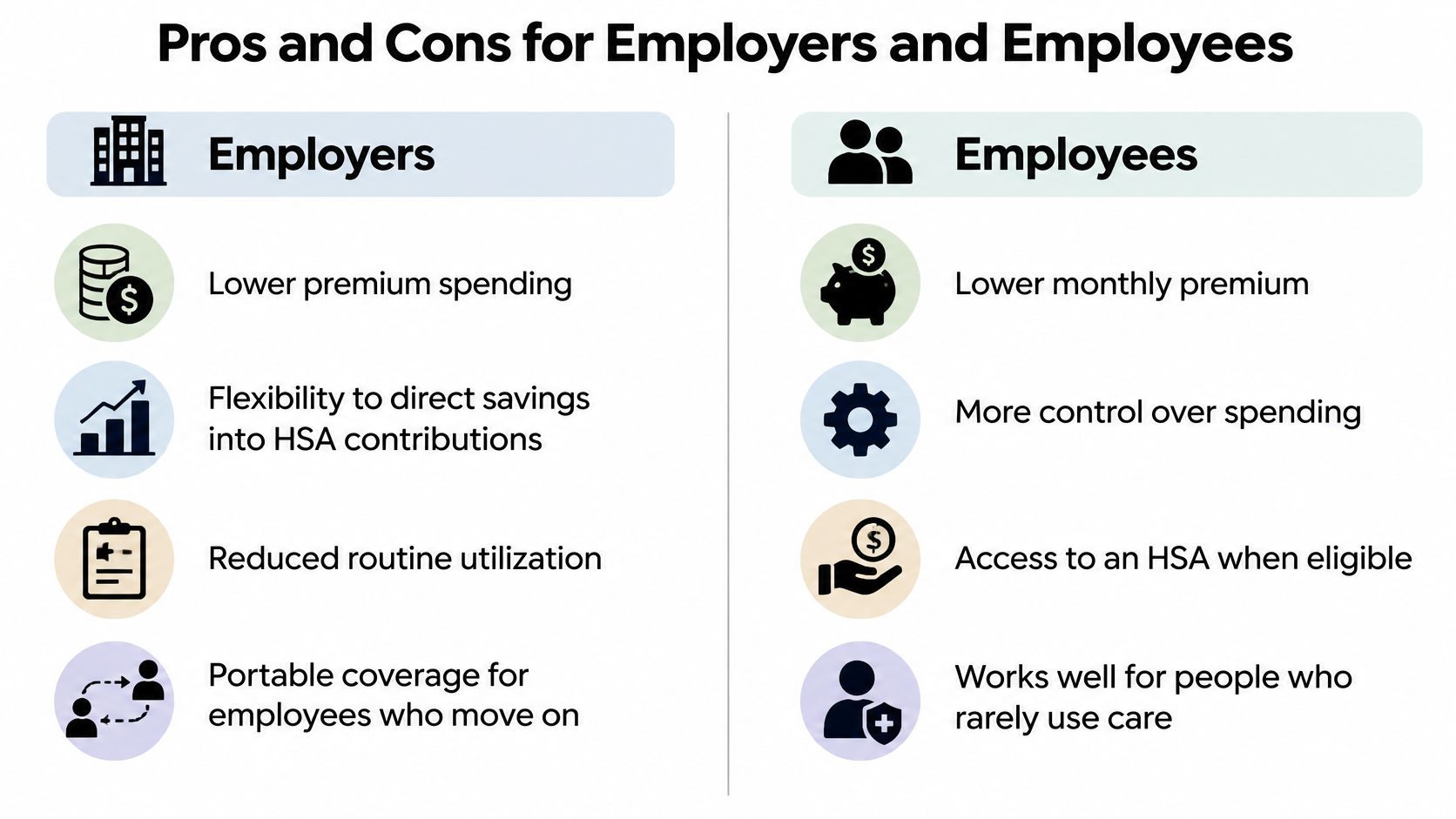
The trade-off is direct. You exchange premium dollars you pay every month for deductible dollars employees pay only when they use care. That exchange favors healthy, financially stable employees and penalizes people who need frequent treatment unless you fund the HSA well.
For Employers
- Lower premium spending: Premium savings create room in a fixed benefits budget.
- Flexibility with savings: You can redirect part of the saving into HSA contributions or other benefits.
- Reduced routine utilization: Members who pay first dollars tend to question low value visits.
- A portable account employees value: Workers keep the HSA, which makes the benefit feel personal rather than rented.
Against those gains, budget for upfront cost exposure, enrollment confusion, and extra communication work. HR will field questions about bills that employees expected insurance to pay immediately.
For Employees
- Lower monthly premiums: Take-home pay improves for people who use little care.
- Tax-free savings for medical costs: The HSA turns premium savings into a usable reserve.
- Control over spending decisions: Employees choose where to get routine care and when to spend account funds.
- Funds that stay with them: The balance remains theirs if they change jobs.
The downsides are paying the deductible before most services are covered, needing to compare prices, and facing greater risk with chronic conditions. KFF's Health Policy 101 on employer-sponsored insurance describes HSA-qualified HDHPs as plans that let employers and employees contribute to a tax-preferred savings account employees can use for cost sharing or save for future health expenses, while the statutory out-of-pocket maximum caps annual covered in-network spending.
When you're evaluating total compensation, Underdog.io's framing is useful because it forces you to price the whole package, not one line item. Apply that here. Judge premiums plus HSA funding plus deductible exposure plus maximum annual cost together.
My verdict: An HDHP works best when you fund the HSA and the workforce is generally healthy and financially stable. Offer it beside a richer option when your group is mixed.
Eligibility Rules That Trip Up Employers
HSA eligibility is an individual test, not a company level election. An employee can look enrolled on your census and still be ineligible to contribute. Run the checklist before payroll deductions begin.
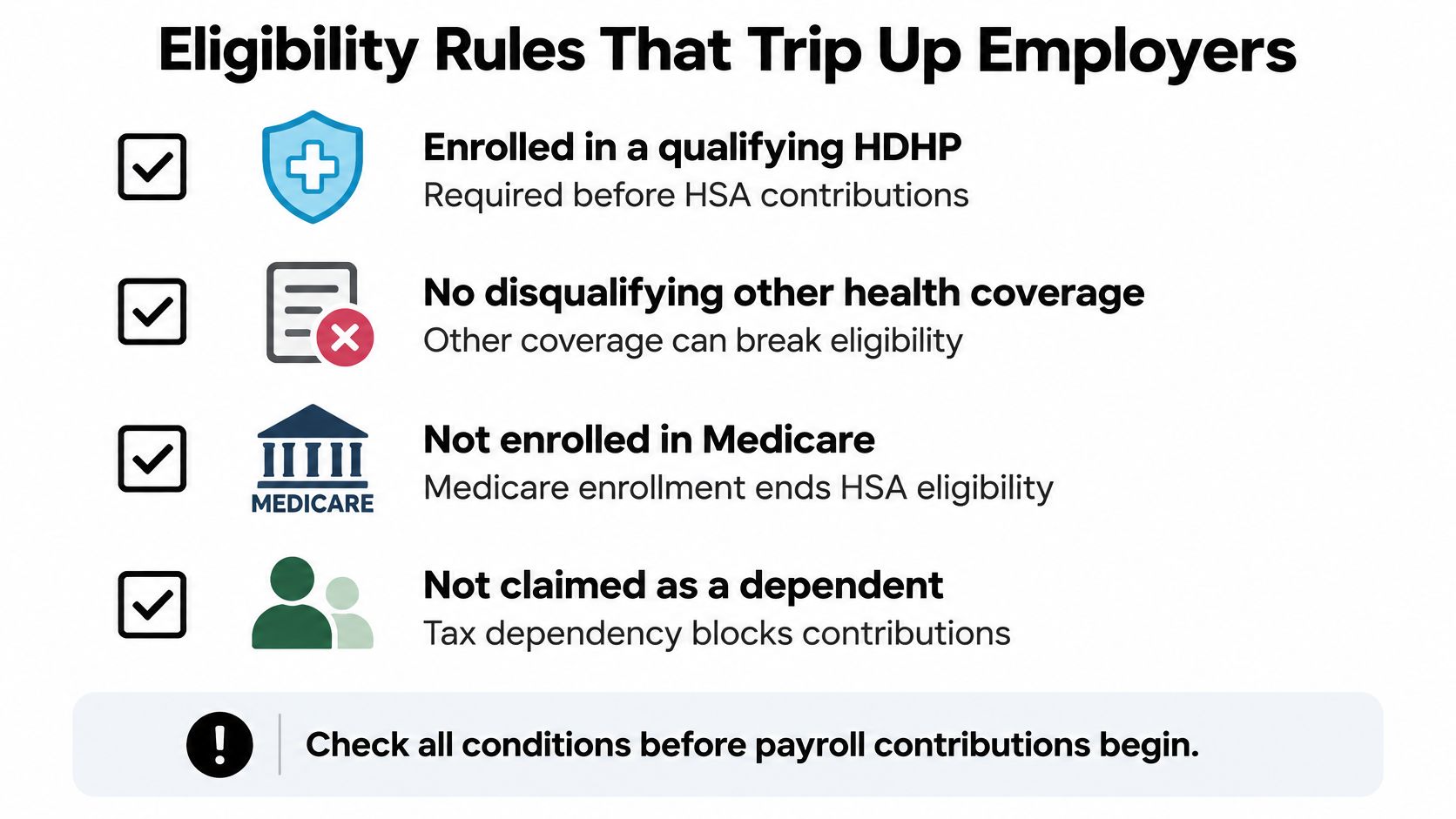
The Four-part Eligibility Checklist
- Enrolled in a qualifying HDHP: Coverage must meet IRS deductible and out-of-pocket rules.
- No disqualifying other health coverage: A spouse's general purpose FSA or non-HDHP coverage can break eligibility.
- Not enrolled in Medicare: Medicare enrollment ends HSA contribution eligibility.
- Not claimed as a dependent: An employee claimed on someone else's tax return cannot contribute.
Family deductible structure is the next trap. With an embedded deductible, each family member's spending counts toward an individual amount inside the family total, so one person can reach benefits sooner. With an aggregate deductible, the family must meet the full family total before the plan starts paying for anyone. Two plans with the same family deductible can produce very different bills for a child who needs surgery in February.
The calendar mismatch creates the quieter operational risk. IRS Publication 969 governs HSAs, and HSA contribution limits apply by calendar year even when your plan year does not, while deductible and out-of-pocket requirements apply when the new plan year begins. A July renewal can therefore place two plan years inside one HSA contribution year.
Say your plan renews July 1 with a higher deductible, but employees set HSA elections the prior January. Payroll must track contributions against one calendar limit while claims accumulate under a deductible that resets midyear. If HR communicates only the new deductible and forgets the contribution limit, employees can overcontribute by December.
Use three operational checks. Align payroll elections with renewal dates, track employer and employee contributions against the annual limit every month, and correct any excess contribution before the tax filing deadline. Our explainer on what qualifies as a high deductible health plan helps employees separate plan qualification from personal eligibility.
Close every renewal notice with three numbers employees can act on: the new deductible, the out-of-pocket maximum, and the HSA limit that applies for the calendar year. Put those numbers on one page, not scattered across a carrier booklet.
Affordability Risks for Lower-Paid Workers
A lower premium does not make a plan affordable. Affordability is what happens at the pharmacy counter in January, before the deductible is met and before the HSA balance has grown.
The access gap shows who gets help with that moment. The Congressional Research Service report on HSAs notes that in 2025 41% of U.S. workers had access to an HSA through an employer, but only 22% of service workers had access compared with 61% of management, business, and financial workers.
Use an illustrative case in leadership discussions. An employee earning $35,000 who faces a $3,000 hospital bill before insurance pays may delay follow-up care, even though her paycheck premium dropped. The premium saving is monthly and small. The bill is immediate and large.
Model Total Cost, Not Just Premium
Build low, medium, and high utilization scenarios for each wage band. Include employee premium, likely deductible spending, prescriptions, and your HSA contribution. Show the result per paycheck and per year, because employees budget by paycheck. Our guide to what an out-of-pocket maximum means gives employees the ceiling figure they need for worst case planning.
Then measure what happens after enrollment. Track participation, delayed care signals, and opt-outs by wage level, tenure, and family status. If lower-paid employees opt out at higher rates, your plan isn't controlling cost. It's shifting risk to the people least able to carry it.
You have practical protections to weigh. Weight a seed HSA contribution toward lower-paid staff, time contributions to paychecks so balances build predictably, offer a lower-deductible option beside the HDHP, and give employees a cost estimator they can use before booking care. I would not make an HDHP the only choice for a service heavy workforce unless the HSA seed is substantial.
Decide Whether an HDHP Fits Your Group
Start with fit by employee group, not with the carrier quote. The same design can be a raise for one group and a pay cut for another.
| Employee group | Likely fit | Main risk | Check first |
|---|---|---|---|
| Healthy, financially stable | Strong fit | Low upfront cost burden | HSA seed amount and payroll contribution |
| Chronic conditions or frequent prescriptions | Weak fit unless HSA funding is high | Drug and visit costs before deductible | Maintenance medication costs and out-of-pocket maximum |
| Lower-paid, service-heavy | Risky without support | Cash-flow strain and delayed care | Participation and opt-out rates by wage level |
| Mixed workforce | Offer HDHP alongside a PPO | Adverse selection toward the richer plan | Side-by-side cost for each scenario |
Five Decision Steps
- Pull current costs and an HDHP quote: Use the same census and contribution strategy for both.
- Model three utilization scenarios: Run each with and without an employer HSA contribution.
- Check each group against the fit table: Flag any group where total cost rises under medium utilization.
- Set the HSA seed and payroll contribution: Size the seed to a meaningful share of the deductible.
- Plan communication around one enrollment window: Show side-by-side cost by paycheck and publish a plain-language benefits guide.
Check every quoted design against the 2026 limits from the opening table before you present it to employees. A compliant plan with weak communication still fails, because employees judge the benefit by their first bill.
The video below is worth sharing with finance leaders who want the employee perspective before they approve a design.
Our Benefits Advisors manage a client's insurance program from plan design through to the compliance paperwork. Our open enrollment process includes group virtual and in-person presentations, one-on-one counseling, a customized benefits guide, customized benefits videos, and reconciling enrollments and submission. You can also rate your benefits process on our What's Your Benefits Score? tool and receive a free 30-page benefits guide.
Sample Scenarios and FAQ for HR and Finance Teams
How common are these plans? The 2024 SHRM Employee Benefits Survey release reported that 63% of organizations offered high-deductible health plans paired with an HSA, HRA, or FSA in 2024. The KFF 2025 Employer Health Benefits Survey provides context for CDC National Center for Health Statistics data showing 41.7% of privately insured people younger than 65 were enrolled in an HDHP in 2023.
Does an HDHP without an HSA still work? It remains an HDHP and can still carry a lower premium, but employees get no HSA tax benefit. Without account funding, the cash flow risk sits entirely with the employee.
Must the employer fund HSAs? No. Funding is voluntary, but it strongly affects adoption, especially among lower-paid and high-utilization employees.
Can a mid-year switcher contribute the full annual limit? Contributions are generally prorated by months of eligibility unless the last-month rule applies, and that rule carries a testing period. Confirm the employee's situation before payroll sets an election.
Should enrollment run in-house or with an advisor? Either works if your team can model total cost by group, explain family deductible structures, and reconcile payroll contributions monthly. If any of those tasks has no named owner, get help.
Say a 40-person firm has 12 service workers and 28 salaried staff. It offers an HDHP with an employer seed beside a PPO. Before choosing either as the default option, model the service workers' total annual cost at low, medium, and high utilization, including prescriptions in the first quarter. If medium utilization makes the HDHP more expensive for that group, keep the PPO prominent, raise the seed, or both. Don't let a company wide average hide a bad outcome for the lowest paid third of your workforce.
If you're weighing an HDHP for your group, we can model total cost by wage band and utilization level, verify quoted designs against IRS limits, and run enrollment with clear per-paycheck comparisons. Visit Benely to rate your current benefits process, get your free guide, and talk through whether an HSA funded HDHP fits your workforce.