 Employee Benefits
 HR & Compliance
 Technology
 Wellness
 PEO Solutions

In 2025, 25% of part-time civilian workers had access to employer-provided medical care benefits, compared with 89% of full-time workers, according to the U.S. Bureau of Labor Statistics. That gap changes the question small-business owners should ask. It's not just whether you offer benefits for part time employees, but whether the people you intend to cover can qualify, afford the deductions, and complete enrollment.
Table of Contents
- Why Part Time Employees Need Their Own Benefits Plan
- Legal Obligations That Apply to Part Time Staff
- Common Benefit Options and How to Prorate Them
- Eligibility Rules That Decide Who Gets Coverage
- Budgeting and Benchmarking Part Time Benefit Costs
- Comparing PEO and HR Tech Options for Enrollment
- Checklist and Next Steps for SMB HR Leaders
Why Part Time Employees Need Their Own Benefits Plan
A full-time benefits policy with a short exception for part-time staff leaves too much unexplained. Employees need to know which programs they can join, what the company pays, and what happens when their schedules change. Managers need answers they can apply consistently.
The access gap above gives employers a reason to take this seriously. A useful benefits package can help distinguish a part-time position from a similar job elsewhere, but an unclear promise can create disappointment instead. Treat recruiting and retention improvements as outcomes to measure, not returns you can assume.
A benefits conversation should begin with the employee's actual circumstances.

Design around the employment relationship
Consider a hypothetical employee who works a regular reduced schedule and expects to stay with your company. A policy designed only around full-time staff might overlook that person, even though you depend on their experience and availability.
Your policy shouldn't assume every part-time worker wants the same package. Ask employees which expenses or interruptions are hardest to manage, then compare those needs with what your business can sustain.
- Legal requirements: Identify the benefits and protections that apply before deciding what's discretionary.
- Budget fit: Separate employer spending from the amount employees must pay.
- Administration: Assign responsibility for eligibility decisions, invitations, deductions, and coverage confirmation.
Practical rule: A benefit isn't useful merely because it appears in the handbook. An intended participant needs a workable path from qualification to active coverage.
Give each leader a clear responsibility
For a founder, start with the employment promise: what can you reliably offer without changing the policy whenever cash flow tightens? For an HR manager, start with the eligibility process and the records needed to support each decision.
For a CFO, begin with the budgeting discussion and insist on separate views of employer cost and employee affordability. Those perspectives should meet in a written policy, not remain scattered across offer letters, payroll notes, and manager conversations.
The aim isn't to copy a larger employer's package. It's to create a deliberate arrangement that your team understands and your business can administer.
Legal Obligations That Apply to Part Time Staff
Part-time status isn't a universal exemption from employment obligations. Start with where the employee works, which law applies, and whether your business and the employee meet that law's tests.
Keep statutory protections separate from your company's optional benefits. A handbook label shouldn't substitute for checking the underlying requirements.
United States
Under the Family and Medical Leave Act eligibility rules, a part-time employee may qualify for job-protected leave when they have:
- Employment history: At least 12 months with the employer.
- Hours worked: At least 1,250 hours during the 12 months before leave begins.
- Worksite coverage: A location where the employer has at least 50 employees within 75 miles, alongside the applicable employer-coverage requirements.
The practical lesson is to check service and hours rather than reject a request because payroll lists someone as part-time. Also distinguish job protection from your paid-leave policy. They answer different questions.
For health coverage, use an ACA compliance overview to frame your discussion with an adviser. Ask whether your organization has employer obligations and how its hour-counting method applies to changing schedules.
United Kingdom
The UK government's part-time worker protections prohibit less favorable treatment solely because an employee works part time, unless the employer can objectively justify the difference. The protections cover areas including pay, pension opportunities, holidays, training, promotion, and relevant leave and pay.
Pro rata means proportionate to the working arrangement. For example, if a comparable full-time employee receives a £1,000 bonus, an employee working half as many hours should generally receive £500, as the same government guidance explains.
Australia
Under Australia's rules for permanent part-time employees, National Employment Standards minimum entitlements generally apply on a pro-rata basis. However, paid family and domestic violence leave is 10 days annually and isn't prorated.
Australian annual leave also needs continuing recordkeeping. It accrues from the first day, reflects ordinary hours, and unused balances roll over, according to Fair Work's small-business leave guidance.
Bring counsel a list of worksites, employee classifications, hours, existing plan documents, and proposed contribution rules. Ask which requirements are mandatory, which differences are permitted, and whether any benefit must be handled differently from your general prorating policy.
Common Benefit Options and How to Prorate Them
Prorating the employer's payment isn't the same as reducing the insurance coverage. Think of a premium as a bill shared between employer and employee. Changing who pays the bill doesn't necessarily change what the policy covers.
The federal government provides a useful model, though it isn't a rule for private employers. The Office of Personnel Management's part-time employment guidance explains that permanent federal part-time employees are eligible for core benefits on a prorated basis, including leave, retirement, and health and life insurance. Government health-premium contributions follow scheduled hours, so part-time employees generally pay a larger premium share.
Common Part Time Benefit Options Compared
The approaches below are design options to discuss with your broker and administrator, not universal eligibility rules.
| Benefit | Typical Part Time Approach | Cost Control Lever |
|---|---|---|
| Medical | Offer an eligible plan with an hours-based employer contribution | Adjust the subsidy within legal and plan limits |
| Dental and vision | Offer separately where plan terms permit | Decide whether employees pay the premium or share it |
| Retirement | Apply the plan's service and entry requirements | Budget employer contributions separately from employee deductions |
| Paid sick leave | Accrue leave with hours where applicable rules permit | Forecast paid absence and staffing coverage |
| Voluntary benefits | Let eligible employees elect additional coverage | Limit employer premium spending while budgeting administration |
Separate access from financial support
Consider a hypothetical employee working half the company's standard full-time schedule. If approved rules allow it, the employer might contribute half its usual subsidy while the employee receives the same selected medical plan.
That's prorating the contribution. It doesn't mean the employee receives half an insurance policy or half the covered services. It does mean the employee may need to cover more of the premium from a smaller paycheck.
By contrast, eligibility rules decide whether someone may participate at all. Don't use a contribution formula as a substitute for checking those rules.
Retirement deserves its own review. A Congressional Research Service analysis of part-time retirement access explains how SECURE Act and SECURE 2.0 provisions expanded plan access for certain long-term part-time employees. Have the administrator check applicable service requirements, entry dates, and matching provisions rather than applying the medical plan's criteria.
Offer employees a clear explanation of what they can join and what they must pay. Those are separate decisions, and both matter.
For each option, request an employer-cost estimate and a sample employee deduction. A plan that fits the company's contribution budget may still be difficult for employees to afford.
Eligibility Rules That Decide Who Gets Coverage
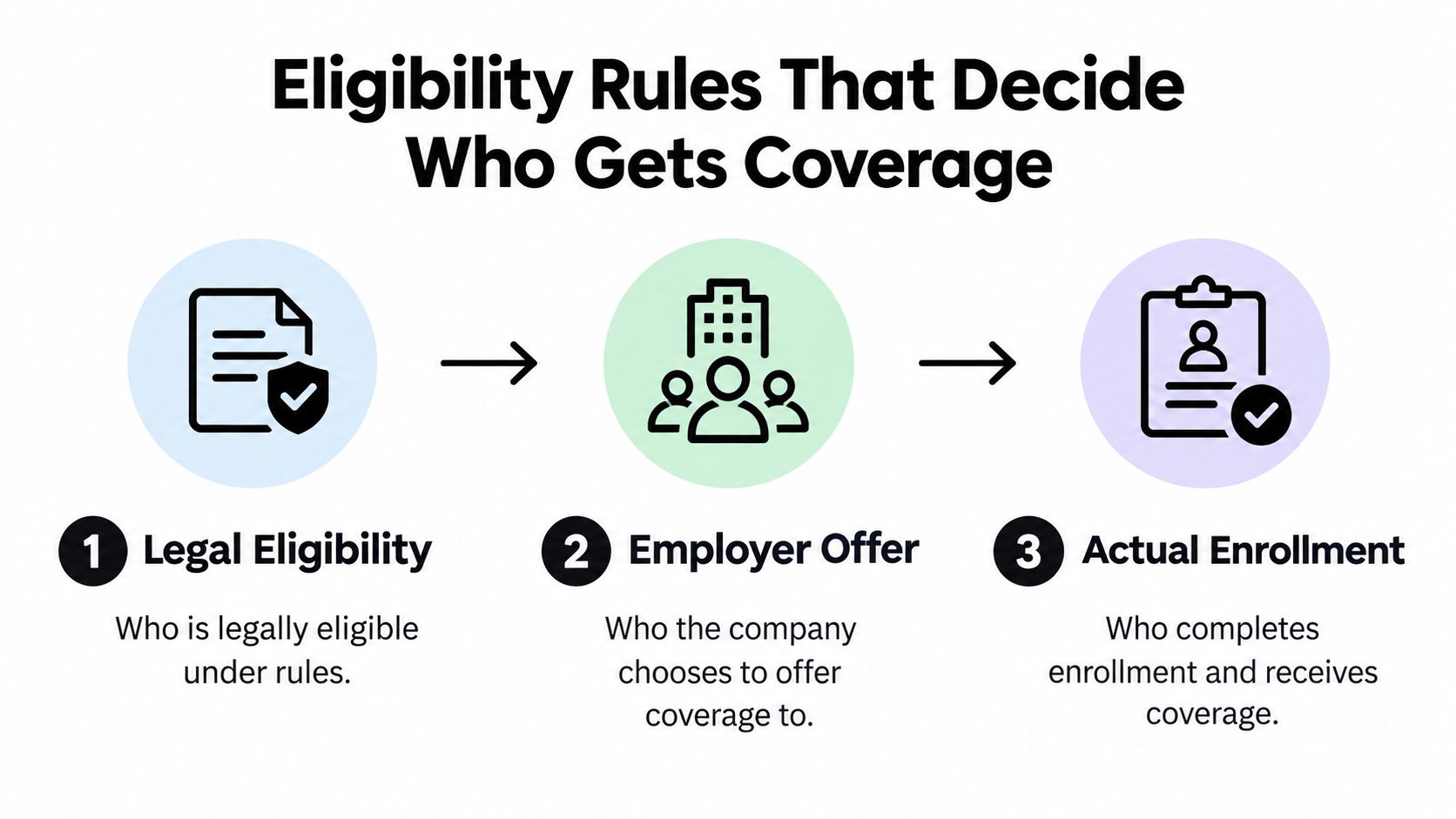
Treat enrollment like a gate with separate locks: the legal rules, the employer's plan terms, and the employee's completed election. A company-wide statement that benefits are available doesn't establish that every employee can enroll.
In 2025, 27% of large employers offering health benefits extended them to part-time workers, compared with 18% of small employers; the ACA generally defines full-time work as an average of at least 30 hours per week, as discussed in KFF's employer health benefits survey. Employer offer rates describe companies, not the share of individual workers who ultimately receive coverage.
The sequence below helps separate those questions.
Follow the employee through each check
Start with the applicable rules. Confirm how hours are measured for the benefit concerned. For variable-hour workers, use the approved method rather than treating a busy week or a quiet week as an automatic eligibility change.
Read the plan terms next. Check the eligible employee class, service requirements, waiting period, and permitted entry date. If someone doesn't qualify, record the specific reason and when their status should be reviewed.
Then test the employee experience. Show the payroll deduction before asking for an election. Check affordability with your adviser where legal standards apply, and separately ask whether the payment is practical for the employee.
Finally, confirm that the election reached the carrier and that the effective date matches the payroll setup. A submitted form isn't the same as confirmed active coverage.
Keep an audit trail that explains the outcome
Use a record that can answer an employee's question without reconstructing events from email.
- Hours evidence: Retain the records and measurement method used for the decision.
- Service dates: Record hire date, waiting-period completion, and the relevant entry date.
- Offer history: Save when the invitation and plan information were delivered.
- Employee decision: Distinguish enrollment, an affirmative decline, and no response.
- Coverage confirmation: Reconcile the carrier's record with the election and payroll deduction.
This process also answers a common source of confusion: an employer may offer part-time benefits while an individual remains outside a plan's permitted class, is still waiting for entry, or hasn't completed enrollment. Each outcome needs a different response, not a generic reminder to sign up.
Budgeting and Benchmarking Part Time Benefit Costs
Start your budget with access and participation, not just the insurance invoice. The NWLC's 2025 part-time worker fact sheet reports medical-insurance access of 27% for part-time workers versus 89% for full-time workers, and paid sick leave access of 55% versus 89%.
Don't combine those medical figures with the opening BLS figures as though they were an identical measurement. Keep the source and worker population attached to each benchmark. Use them to frame questions about your program, not to declare that your company must reproduce a national average.
Build a dashboard before choosing a plan
A useful internal comparison separates work status and benefit category. It should show where employees stop progressing, alongside what the employer spends.
| Measure | Question for the CFO |
|---|---|
| Access | Which employees can participate under the approved rules? |
| Enrollment | Which eligible employees actually elect coverage? |
| Employee premium share | What deduction must employees absorb? |
| Leave use | Does actual use match the staffing and pay forecast? |
| Turnover | How do departures differ by work status and participation? |
Use turnover as a prompt for investigation, not proof that benefits caused an employee to stay or leave. Exit feedback and employee conversations can help explain what the spreadsheet can't.
Work through a hypothetical budget
Suppose a company separates its workforce into part-time and full-time groups. The CFO sets a per-employee dollar allowance for each group using actual quotes and approved contribution rules, rather than assuming the same subsidy will work for both.
First, multiply each group's allowance by its expected participating headcount. Add administration costs and forecast paid-leave costs separately. Compare the allowances and the resulting employee deductions to understand the trade-off between employer savings and employee affordability.
Next, model a voluntary dental option. If employees pay its entire premium, don't add an employer premium subsidy to the forecast. Still include any quoted administration fee and the staff work needed to support deductions and reconcile enrollment.
Run a lower-enrollment and higher-enrollment version using your own assumptions. Label both as forecasts, then compare them with actual results after launch.
A practical guide to employer health-insurance costs can support those discussions. For quarterly review, bring the CFO approved allowances, participating headcount, actual invoices, administration spending, leave costs, and forecast differences, with an owner assigned to investigate each material exception.
Comparing PEO and HR Tech Options for Enrollment
Choose an enrollment method by testing a real employee scenario, not by counting dashboard features. Ask each provider to demonstrate a worker whose schedule changes, whose eligibility needs review, and whose deduction must reach payroll correctly.
A centralized interface should make those decisions easier to inspect.
Compare operating models
Use these distinctions as evaluation criteria. Actual responsibilities and fees depend on the provider agreement.
| Method | Control and cost visibility | Responsibility to clarify |
|---|---|---|
| Manual spreadsheets | Direct control, but staff must assemble cost and status reports | Who updates rules, checks records, and resolves discrepancies? |
| Standalone HR software | Configurable workflows, subject to the software's capabilities | Who maintains configuration and connects carrier and payroll records? |
| Broker-supported platform | Plan guidance alongside enrollment tools | Which tasks belong to the broker, platform, and employer? |
| PEO co-employment model | A different operating relationship with contracted services and charges | Which duties are shared, retained, or performed by the PEO? |
Don't assume software owns compliance because it calculates eligibility. Require a written responsibility map covering policy decisions, configuration, employee questions, carrier submissions, payroll corrections, and escalation.
Evaluate the platform and service together
Benely is an option among broker-supported platforms and PEO-shopping services. Its employee benefits enrollment software supports a centralized approach to plan comparison, budget setting, automated enrollment, and open-enrollment progress tracking.
Its offering includes comparison of more than 4,000 health plans from carriers such as Aetna, Kaiser, Anthem, Blue Shield, and UnitedHealthcare, alongside connected payroll, onboarding, and compliance tools, certified HR specialists, and PEO comparison services. Ask which plans and capabilities are available for your workforce rather than assuming every option fits every employee group.
This video provides another way to review the platform before a demonstration.
During evaluation, request evidence of the handoff between an approved election and the first correct deduction. Ask what happens when the carrier rejects a submission or payroll receives an outdated contribution amount.
Buying test: A demonstration should show who notices an exception, who fixes it, and how your team knows it's resolved.
Prefer the operating model your staff can supervise reliably. More automation is useful only when you understand the rules it applies and the exceptions people still need to handle.
Checklist and Next Steps for SMB HR Leaders
Use the next week to answer the questions below with yes, no, or needs verification. Don't treat an undocumented assumption as a completed task.
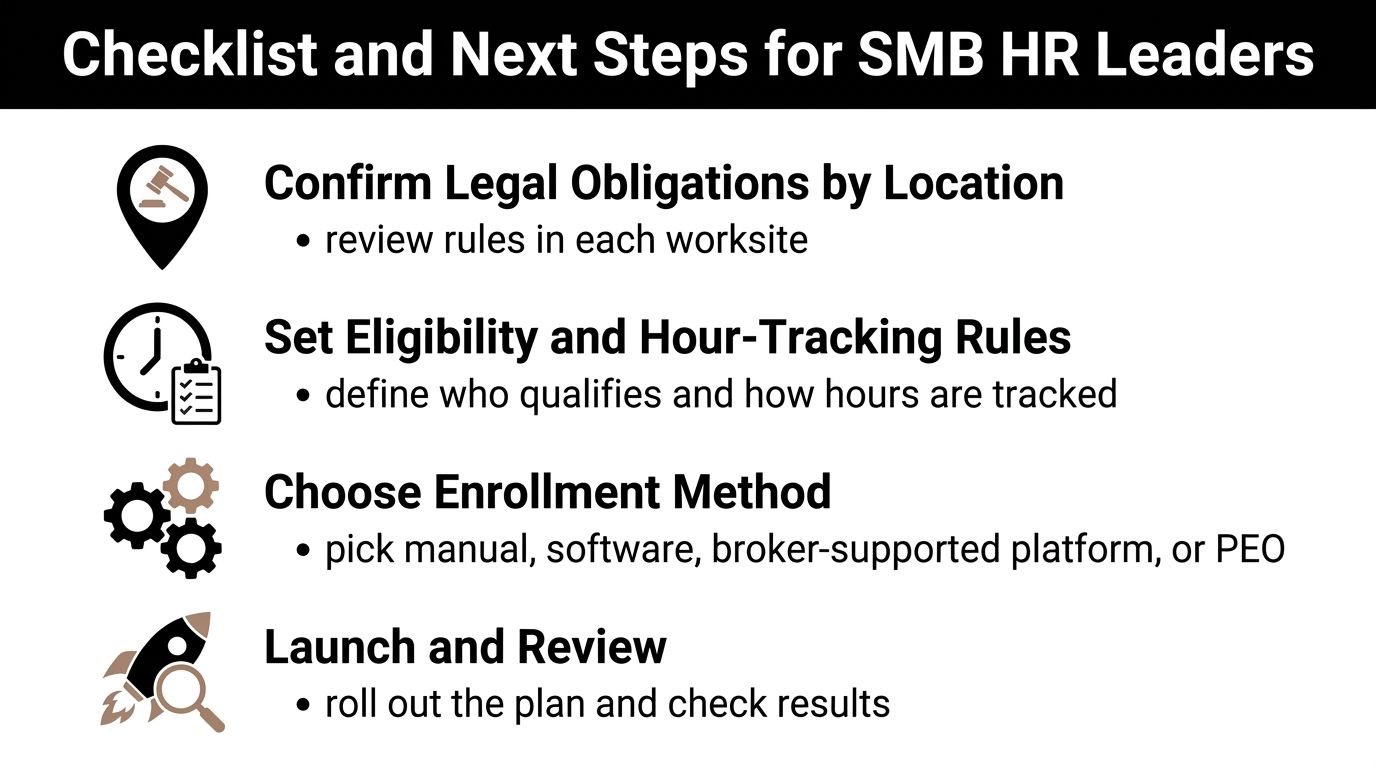
The checklist gives HR, finance, and operations a shared starting point.
Confirm the policy and budget
- Legal obligations by location: Has your adviser reviewed the requirements for each worksite and employee group?
- Eligibility and hour tracking: Can HR explain each decision using approved rules and retained records?
- Prorated budget: Has finance approved the contribution method and reviewed employee deductions against the access benchmarks?
For every unanswered question, assign an owner and a completion date. Keep proposed policy changes separate from confirmed legal requirements so managers don't announce an option before it's approved.
Test administration before launch
- Enrollment method: Have you selected a manual process, software, broker-supported platform, or PEO arrangement with clear responsibilities?
- Payroll connection: Can the administrator demonstrate that an election produces the correct deduction and effective date?
- Launch and review: Have you assigned responsibility for employee communication, carrier confirmation, invoice reconciliation, and exception handling?
Before announcing the program, run a sample employee through the whole process using your actual plan rules. Check that the explanation given to the employee matches what HR, payroll, and the carrier will do.
This month, bring the unresolved items to a benefits adviser or platform demonstration. Ask the provider to work through your part-time enrollment scenario, including the points where someone must make a judgment rather than click a button.
Benely offers benefits-plan comparison, budget-setting tools, enrollment administration, and HR guidance that can support a part-time benefits program. Visit Benely to ask how its platform would handle your team's eligibility rules, employee contributions, and payroll-connected enrollment.