Even after employers build cost-reduction measures into their benefit plans, total health benefit costs per employee were expected to climb by an average of 5.8% in 2025, according to Mercer's survey of more than 1,800 U.S. employers. In the same survey, employees were expected to keep paying roughly 21% of their health insurance premiums through paycheck deductions, unchanged from 2024. Those two numbers expose the trap built into how most companies handle benefits: holding your cost-sharing ratio steady doesn't protect your budget or your workforce when the underlying base rate grows year after year.
Treating the group health insurance renewal process as a quick round of rate haggling right before open enrollment is the fastest way to overpay or trigger employee backlash. A rate quote tells you what the carrier wants to charge next year, not why your spend jumped, whether one or two high-cost claims skewed your pricing, or whether a cheaper plan design will push families into deferring care.
A defensible renewal runs on a 90-to-120-day operational timeline. It pairs claims-concentration analysis with real employee affordability modeling, locks leadership into a signed one-page decision memo before legal notice deadlines hit, and ends only after a post-enrollment payroll audit confirms every deduction matches the carrier file.
Table of Contents
- Renewal Timeline From 120 Days Out to Open Enrollment
- How to Review Plan Performance Before You Compare Quotes
- Comparing Renewal Options Side by Side
- Setting the Renewal Budget and Employee Contribution Split
- Choose the Renewal Path and Record the Decision
- Communicating Changes and Completing Enrollment
Renewal Timeline From 120 Days Out to Open Enrollment
The single most expensive mistake I see HR and finance teams make is waiting for the carrier's renewal packet to hit their inbox before they start working. By the time a quote arrives, your eligibility records are often messy, competing carriers need clean data to underwrite alternatives, and leadership ends up rushing a six- or seven-figure decision in two weeks.

A technically sound renewal starts 90 to 120 days before your policy's effective date, following the nine-step preparation benchmark outlined alongside the KFF 2025 Employer Health Benefits Survey. Your very first deliverable isn't a spreadsheet of quotes. It's a locked census and eligibility file reconciled against payroll, because every carrier rate depends on the exact ages, tiers, locations, and dependent counts you submit.
| Window | Milestone | Owner | Output |
|---|---|---|---|
| 120 to 90 days out | Lock census and eligibility file; reconcile dependents, employment status, locations and payroll deductions | HR and payroll | Verified census file |
| 90 to 60 days out | Compare the renewal with at least two alternative plan designs or funding structures; model employer and employee contributions for each | HR, finance and broker | Side-by-side option model |
| 60 days out | Carrier renewal notice checkpoint for small-group coverage; review premium, benefit and cost-sharing changes and product availability | Carrier and administrator | Notice retained in renewal records |
| 45 to 30 days out | Complete governing-document and compliance review; approve the contribution strategy | Leadership and legal | Signed decision memo |
| 30 days out to open enrollment | Test the enrollment system; prepare employee communications and the side-by-side plan comparison | HR and broker | Tested enrollment workflow and communication pack |
| Open enrollment to effective date | Reconcile elections with carrier files; audit payroll deductions for the first two pay cycles | Benefits administrator | Matched carrier and payroll records |
Why Each Milestone Matters Before Open Enrollment
At 120 to 90 days out, pull your active payroll roster and compare it line by line with the carrier's current billing invoice. You'll almost always find terminated employees still being billed, newborns never added to the system, or remote staff listed under an old office ZIP code. Fix those mismatches now, because a carrier that quotes off a sloppy census can re-rate your group after enrollment closes.
Once the census is clean, request the full carrier renewal package at 90 to 60 days out. Don't settle for a cover email showing a percentage hike. Ask for the proposed rate change by coverage tier, plan-year claims or utilization reports where available, provider network revisions, prescription formulary updates, underwriting assumptions, and itemized administrative fees.
Compare that package against at least two alternative plan designs or funding structures, modeling total premium and cost distribution by coverage tier, employee class, and pay period. Check provider access for your heaviest-used local hospital systems and confirm whether any maintenance or specialty medications are moving to a higher formulary tier. A flat renewal rate hides a real cost increase if your carrier raised the out-of-pocket maximum or dropped a major clinic from the network.
The 60-Day Legal Notice Checkpoint
Under federal renewal-notice rules governed by the Public Health Service Act and implementing regulations, small-group insurers must generally deliver a written renewal notice to the plan sponsor at least 60 calendar days before the coverage renewal date, as detailed in the CMS Bulletin on Renewal and Discontinuation Notices. That rule covers both grandfathered and non-grandfathered small-group plans and requires carriers to use the form and delivery method specified by the U.S. Department of Health and Human Services.
Log the exact date the carrier notice arrives and save a copy in your compliance binder. Treating that 60-day notice as your starting gun is a losing play, because competing quotes, stop-loss underwriting, and plan-document updates take weeks to complete. By 45 to 30 days out, your legal review and leadership sign-off should be finished so you have a full month to build and test your enrollment portal before employees see a single rate sheet.
Timeline reality check: If your census is still unverified with 60 days left before the effective date, you've already lost your leverage to shop the market cleanly. Pause any debate over plan tweaks and lock the eligibility file first.
How to Review Plan Performance Before You Compare Quotes
A renewal quote tells you what the insurer wants next year, yet it never answers the question that drives smart underwriting decisions: what did your plan really cost over the past twelve months, and why? Jumping straight into competing bids without reviewing your own claims experience is like buying a new truck without checking why the old one burned through oil.
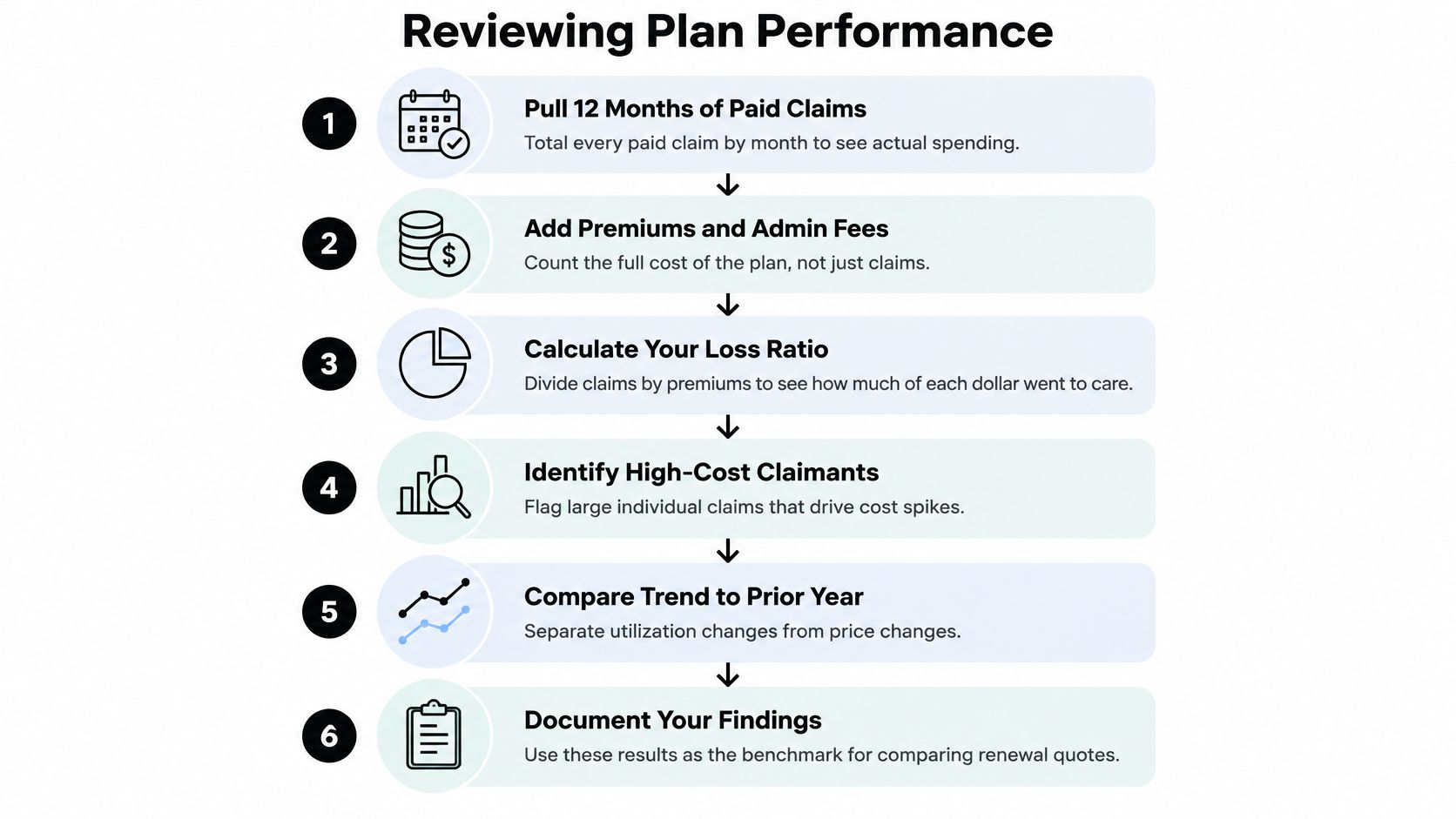
Work through your historical data in a strict sequence before you evaluate a single market quote:
- Pull 12 months of paid claims by month. Split the numbers by service type and separate medical spending from pharmacy spending. Annual totals hide timing spikes, such as a third-quarter surge in elective procedures or a fourth-quarter jump in specialty refills after employees hit their deductibles.
- Calculate your loss ratio by quarter. Add up total premiums paid (including administrative fees where itemized) and divide paid claims by total premiums. Quarterly loss ratios show whether utilization is climbing steadily or spiked during one isolated stretch.
- Measure claims concentration. Ask your broker or carrier for a de-identified large-claimant report flagging anyone who crossed a set dollar threshold, such as $25,000 or $50,000 in paid claims, and calculate what share of total spend those few members represent.
- Compare this year against the prior two plan years. You're looking for the difference between a temporary shock and a structural shift in your workforce's health profile.
- Break down utilization by clinical category. Look specifically at specialist visits, maternity care, behavioral health, emergency room usage, and high-cost prescription classes like GLP-1 therapies or biologics to see where employee demand is growing.
- Verify census alignment. Confirm that the employee and dependent counts sitting inside the carrier's underwriting model match the reconciled eligibility file you built in HR.
- Archive every worksheet in the renewal file. Those numbers become your audit baseline when leadership asks why you pushed back on the carrier's trend factor or decided to switch funding models.
Separating a One-Time Claims Shock From a Structural Trend
For small and midsize employers, pricing volatility rarely comes from everyone getting slightly sicker at once. It usually comes from one or two catastrophic cases, such as a premature birth, an oncology diagnosis, or an accident requiring inpatient surgery. That concentration carries real consequences: according to the KFF 2026 Employer Health Benefits Survey, 31% of employers that stopped offering health coverage within the previous five years said they did so after receiving a high renewal quote driven by high claims from a small number of enrollees.
Strict federal privacy rules mean you will never, and should never, see the names or medical records of individual high-cost claimants. Instead, request aggregated or de-identified large-claimant summaries from your carrier or broker that list diagnosis categories, paid-to-date totals, and whether treatment is ongoing or resolved. If a single completed surgical episode accounts for a quarter of your annual spend, that's a temporary shock rather than a permanent utilization trend.
When utilization data shows chronic cardiometabolic conditions or repeat specialty visits driving steady multi-year growth instead of a one-off accident, preventative risk management becomes part of your long-term cost strategy. Employers looking to help workers catch silent metabolic or cardiovascular markers before they escalate into inpatient claims can explore proactive wellness resources like biomarker testing from OneTwenty alongside their clinical care-navigation benefits.
Turning Performance Findings Into Action
Your claims review determines which lever to pull next. If your loss ratio is low and claims are flat across three years, you have strong evidence to push back on an aggressive renewal increase or test the open market.
If one or two large claimants drove a steep renewal quote for an otherwise healthy team, don't immediately slash benefits or switch carriers to chase the lowest headline premium. Request a formal claims review from the underwriter, ask for stop-loss quotes or level-funded projections that cap individual claim exposure, and explore multi-year rate-cap options. Weigh any carrier change against continuity of care for employees currently in active treatment, because forcing a mid-treatment doctor switch or raising deductibles too sharply can cause workers to defer necessary care and trigger bigger claims the following year.
Comparing Renewal Options Side by Side
Once your performance review is documented, put every realistic path onto a single sheet so finance and HR judge them on identical criteria. Comparing a carrier's renewal quote in isolation leads teams to chase the lowest monthly premium while missing hidden deductible jumps or network cuts.
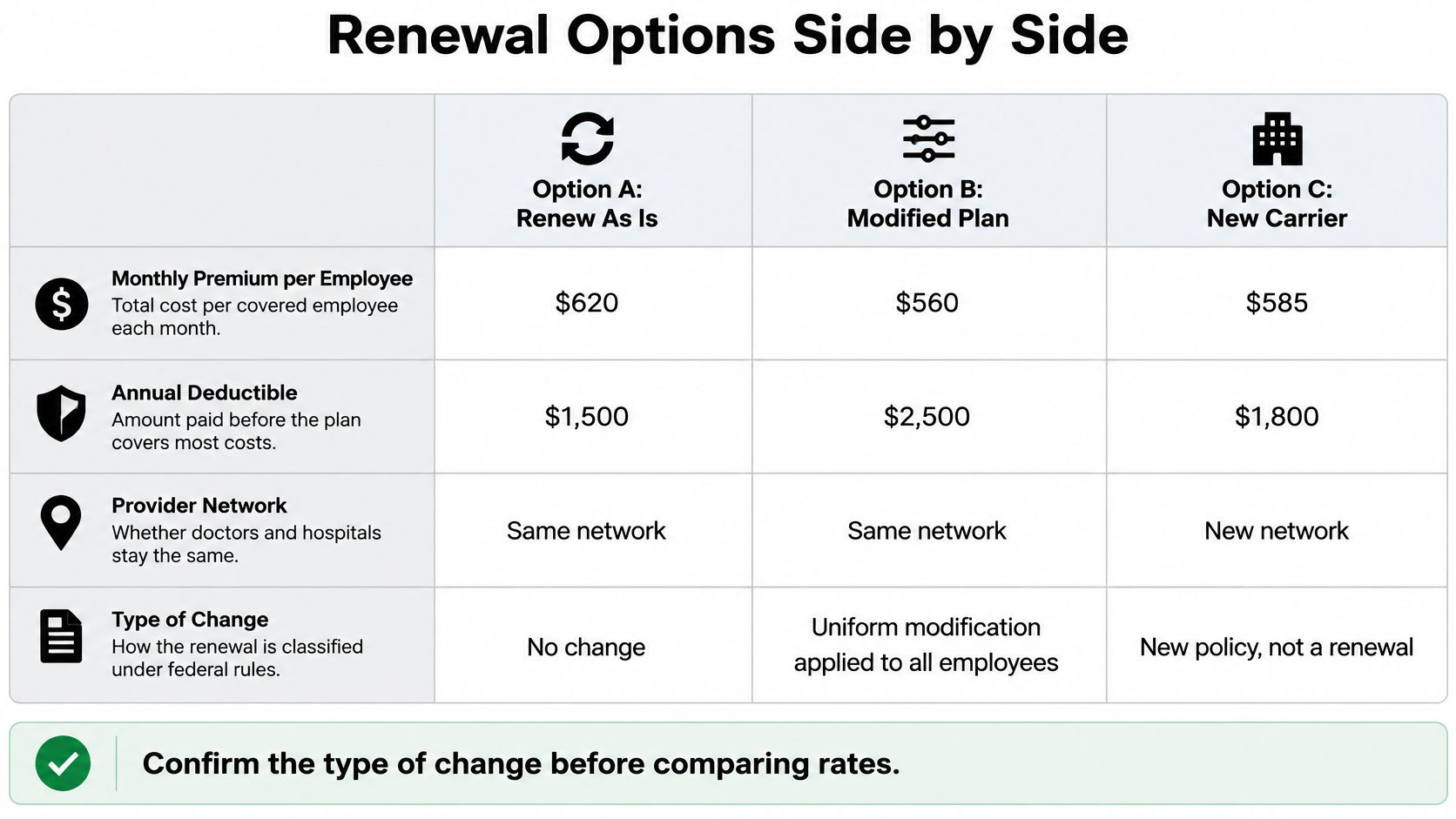
Use a structured comparison matrix to weigh employer spend against employee disruption before anyone makes a recommendation:
| Option | Employer cost effect | Employee impact | Disruption | Best when |
|---|---|---|---|---|
| Accept the renewal as quoted | Predictable spend at the new rate | Usually no change in plan design | None | The increase fits budget and claims are stable |
| Renegotiate with the current carrier | Possible smaller increase | Usually unchanged | Low | The quote is above benchmark and the carrier wants to keep the group |
| Redesign with higher deductible or cost-sharing | Lower premium, but higher contribution planning | Higher out-of-pocket exposure | Medium | The budget is fixed and employees can absorb added exposure |
| Change networks or formulary | Lower premium on narrower tiers, neutral on lateral swaps | Provider and drug access changes | Medium to high | Current network or drug coverage no longer works for staff |
| Bid out to competing carriers | Potentially lower premium | Possible network and carrier change | High | The quote gap is large and continuity risk is manageable |
| Replace product or discontinue coverage | Set by replacement carrier quote and plan tier | Full change of plan | High | The carrier notice shows the current product is discontinued |
| Move to a level-funded or self-funded arrangement | May lower premium or smooth renewals but adds stop-loss and cash-flow decisions | Usually unchanged if plan design stays the same | Medium | The group has stable claims and can absorb stop-loss and cash-flow risk |
Confirm What Kind of Renewal You Received
Before you score any option, read the carrier's written notice line by line to classify the contract action. Under federal guaranteed-renewability regulations outlined in updated CMS standard notice guidance, renewing an existing product with uniform modifications is legally distinct from discontinuing a product or terminating coverage because enrollees moved outside the service area. Essential notice content for employer groups includes the upcoming premium and any significant changes to coverage terms.
Preserve that notice as the start of your decision trail. Record whether the carrier is offering a true renewal or mapping your group into a replacement product, flag every benefit or network modification, and verify later that employee enrollment materials match the signed contract word for word.
A Worked Scenario and Clear Verdicts
Say a 60-person company receives an 8% renewal quote on its existing PPO plan. To keep the employer budget flat, the carrier offers a modified plan that raises the individual deductible by $1,000 in exchange for a lower monthly premium. On paper, the modified option looks like an easy win for finance.
When the HR team scores all three paths on employer cost, employee out-of-pocket exposure, drug access, and continuity of care, a different picture emerges. Five employees on the team manage chronic conditions with regular specialist visits and maintenance medications; raising the deductible shifts thousands of immediate dollars onto them while saving the company only a modest amount per paycheck. By putting the carrier's renewal next to a renegotiated offer and a competing market bid, leadership sees the exact trade-off before committing.
During our Evaluate step, we compare your current insurance plans with other market options to find the most cost-effective solutions. If you want a structured way to evaluate deductibles, copays, and network tiers across carriers, start with a dedicated framework to compare health insurance plans on identical fields.
The cheapest headline premium rarely equals the lowest-risk renewal. Shifting too much deductible exposure onto staff protects this year's spreadsheet while undermining retention and care access.
Apply three plain verdicts once the matrix is complete:
- Stay with the renewal as quoted or renegotiated when the rate increase fits your approved budget, claims history is stable, and keeping the same network protects staff in active care.
- Redesign the plan with higher cost-sharing only when your budget is strictly capped and payroll modeling proves employees can absorb the higher deductible, ideally softened by an HSA or HRA contribution.
- Go to market with competing carriers when the spread between your renewal quote and alternative bids is wide enough to justify administrative effort, and provider-disruption checks show your team's core doctors stay in network.
Setting the Renewal Budget and Employee Contribution Split
Setting a renewal budget starts with your current total health spend per employee, the carrier's proposed increase, and any realistic savings from plan adjustments. To keep your internal numbers grounded in actual market conditions, stack your renewal quote against multi-year employer benchmarks before you decide how much cost to absorb or share.
| Coverage and year | Average annual premium | Average worker contribution | Source |
|---|---|---|---|
| Single coverage, 2024 | $8,951 | Not reported | KFF 2024 survey |
| Single coverage, 2025 | $9,325 | $1,440 | KFF 2025 survey |
| Family coverage, 2024 | $25,572 | Not reported | KFF 2024 survey |
| Family coverage, 2025 | $26,993 | $6,850 | KFF 2025 survey |
| Family coverage, 2026 | $28,303 | $7,471 | KFF 2026 survey |
Those benchmarks tell a clear story about sustained upward pressure. In 2024, average annual employer-sponsored premiums stood at $8,951 for single coverage and $25,572 for family coverage, per the KFF 2024 Employer Health Benefits Survey. Between 2024 and 2025, family-plan premiums jumped by $1,408, or 6%, reaching an average of $26,993, according to the KFF Employer Health Benefits Survey series.
Over the same period, single coverage climbed 5% to $9,325 in 2025, nearly $3,000 higher than in 2016, while workers contributed an average of $1,440 toward single coverage and $6,850 toward family plans, as reported by KFF Health News. Cost pressure accelerated again for families: a subsequent KFF Health News report on employer-based health plan costs noted that total family premiums rose 5% to $28,303 in 2026 while workers paid an average of $7,471 annually toward family coverage, a 9% jump over the prior year. That same report cited Mercer findings showing average employer-sponsored health-benefit costs reached $17,496 per employee in 2025, with an average 6.7% increase projected for 2026.
Building a Per-Paycheck Contribution Model
Too many employers stop their budget work at a single percentage, such as paying 80% of employee-only coverage and 50% of dependent tiers. That hides what the deduction feels like on a biweekly pay stub. Build your budget model in five concrete steps:
- Assign the employer dollar share by coverage tier. Map out exact monthly employer contributions for employee-only, employee-plus-spouse, employee-plus-child(ren), and full family tiers.
- Convert annual employee cost into per-paycheck deductions. Divide each tier's annual employee contribution by your payroll frequency (24 for semimonthly, 26 for biweekly) so leadership sees the exact dollar hit per pay period.
- Duplicate the model across employee classes and plan options. Run the math for salaried, hourly, and part-time eligible groups under every renewal option on your shortlist, checking ACA affordability rules if you have 50 or more full-time equivalent employees.
- Build a high-utilization stress test. Add annual paycheck deductions plus the full individual or family deductible and typical prescription copays. A plan with a $60 lower monthly payroll deduction still hurts an employee if it adds $1,500 to their out-of-pocket exposure during a year with two specialist visits and an imaging scan.
- Hold a mid-year contingency reserve. Set aside budget buffer for headcount growth, new hires enrolling in family tiers, or mid-year qualifying life events like marriages and births.
Stress-Testing Family Coverage and Lower-Wage Affordability
Family coverage is where well-intentioned renewal strategies break down first. When average annual employee contributions for family plans exceed seven thousand dollars before a single doctor visit, adding another 8% or 10% to payroll deductions can force lower-wage workers to drop dependent coverage altogether or skip preventive care.
Before finalizing your split, segment the paycheck impact across income bands and compare total employee exposure under low, average, and high medical usage. Reviewing broader benchmarks on health insurance cost for employers helps HR and finance align contribution tiers with local talent competition. Write down the final contribution split and the rationale behind every tier adjustment before a single rate sheet is shared with employees.
Choose the Renewal Path and Record the Decision
Analysis without a deadline turns into endless spreadsheet tinkering. By 60 days before the effective date, leadership needs to select one definitive path: accept the renewal as quoted, renegotiate with the incumbent carrier, redesign the plan, shift to a level-funded or self-funded funding model, or bind coverage with a competing carrier.
Lock that choice into a one-page decision memo and have executive leadership sign it before the small-group notice checkpoint locks in the renewal terms. Putting the decision in writing prevents second-guessing during open enrollment and gives finance, HR, and legal a single source of truth.
Five Fields for Your Signed Decision Memo
Keep the memo concise enough for a CFO or founder to read in three minutes, covering five specific fields:
- Chosen renewal path and contract terms. Name the carrier, exact plan names, effective dates, and funding structure.
- Projected annual employer cost. Include total employer premium spend, any HSA or HRA seed contributions, and your budgeted contingency reserve.
- Employee contribution schedule by tier. Show monthly and per-paycheck employee deductions across single, spouse, child, and family tiers for each plan offered.
- Most affected employee segments. Explicitly call out who faces higher payroll deductions, higher deductibles, or network and formulary changes, such as family enrollees or employees in specific states.
- Why rejected alternatives were ruled out. One or two sentences per alternative explaining why you passed (for instance, a competing carrier's lower quote excluded the local children's hospital, or a high-deductible redesign failed your affordability stress test for hourly staff).
We shop, analyze, and personalize group benefits in simple steps, while your leadership team makes the final decision. Having that signed memo on file keeps everyone aligned when questions surface six months later.
Handling Discontinuation Notices and Assigning Owners
If the carrier's written notice reveals a product discontinuation, a significant reduction in benefits, or a service-area termination governed by section 2703 of the Public Health Service Act and 45 CFR 147.106 as outlined in HHS guaranteed-renewability notice guidance, trigger your alternative-carrier evaluation immediately. Confirm the exact termination date, required employee notice periods, and carrier enrollment cutoffs so there is zero gap in coverage.
Assign three explicit owners the day the decision memo is signed:
- HR owns the locked census, eligibility rules, dependent verification, and enrollment administration.
- Finance owns the approved renewal budget, payroll deduction setup, and post-renewal invoice reconciliation.
- Communications owns the standardized plan comparison chart, employee education sessions, and Q&A tracking.
Put two hard dates on the calendar immediately: a go/no-go readiness meeting at 30 days out to verify enrollment-system testing and communication drafts, and a final payroll audit covering the first two pay cycles after the effective date.
Communicating Changes and Completing Enrollment
Signing the carrier agreement feels like the finish line, yet communication and enrollment execution decide whether your renewal succeeds. You can negotiate a great rate and still watch employee satisfaction crater if workers don't understand what changed or why their paycheck looks different in January.
The gap between employer effort and employee clarity is stark. Research from SHRM on communicating and leveraging benefits found that 83% of organizations distributed online or paper enrollment materials and 70% held group communications with a representative, yet only 22% strongly agreed that their benefits communications were highly effective. Employees bear the fallout: 41% of surveyed workers called open enrollment extremely confusing, 49% described health-plan decisions as very stressful, and 20% often regretted the choices they made.
Throwing a 40-page carrier Summary of Benefits and Coverage into an email attachment won't fix that problem. High-performing benefits teams treat open enrollment as a controlled quality process built on four concrete pillars.
The Four-Part Communication and Enrollment Workflow
- Publish a plain-English decision calendar. Send employees exact dates for live Q&A sessions, portal opening, enrollment deadline, dependent-document cutoffs, and the exact paycheck date when new deductions take effect.
- Build a standardized side-by-side plan comparison. Display every plan option using identical fields: monthly and per-paycheck employee contribution, annual deductible, out-of-pocket maximum, primary care and specialist copays, emergency room cost, prescription drug tiers, HSA eligibility, and network geography.
- Pair written guides with live human support. Written PDFs work for reference, not complex family trade-offs. Our open enrollment process includes group virtual and in-person presentations, one-on-one counseling, a customized benefits guide, customized benefits videos, and reconciling enrollments and submission so employees can ask specific questions about their doctors and medications before clicking submit.
- Maintain a strict election audit trail. Require active electronic timestamps or signed forms for every election, waiver, dependent verification document, and late-change exception.
Before opening the portal to your workforce, run live test scenarios through your benefits administration platform. Test a single new hire, a family adding a spouse, an employee waiving coverage, and a mid-tier HSA election to confirm payroll codes calculate accurately. Following a structured open enrollment checklist for HR keeps every test case, compliance notice, and submission cutoff on track.
The Completion Audit That Closes the Renewal
Once the enrollment window shuts, the operational work enters its most critical phase. As part of open enrollment, we reconcile enrollments and handle their submission directly to the carriers, preventing the classic gap where an employee's portal election never reaches the insurer's eligibility feed.
Even with clean electronic feeds, never assume the handoff worked until you verify it against live money. Audit payroll deductions against carrier confirmation reports across at least the first two pay cycles of the new plan year, tracking six concrete operational metrics:
- Enrollment completion rate (percentage of eligible employees submitting active elections or documented waivers on time).
- Payroll and carrier error rate (mismatches in coverage tier, effective date, or per-paycheck deduction amount).
- Unresolved employee tickets still open after the effective date.
- Waiver percentage compared with prior years (a sudden spike signals an affordability breakdown).
- Dependent-document exceptions still awaiting marriage or birth verification.
- Average correction time from spotting a billing or eligibility discrepancy to confirming the carrier fix.
A group health insurance renewal isn't finished when leadership signs the contract. It's finished when your payroll register, carrier eligibility file, employee confirmation statements, and compliance binder match down to the penny.
Managing a disciplined 90-to-120-day renewal takes structured benchmarking, clean plan comparisons, and hands-on open enrollment execution across every pay cycle. Benely pairs benefits advisors and a centralized platform to evaluate more than 4,000 health plans from major carriers, streamline open enrollment communications and one-on-one counseling, and keep your payroll and compliance records aligned. Visit Benely to simplify your next group health insurance renewal from early census review through final reconciliation.