 Employee Benefits
 HR & Compliance
 Technology
 Wellness
 PEO Solutions

Nearly 4 in 10 small-business workers skipped or postponed care because they couldn't afford it, according to recent Urban Institute research on the small-business employee benefits gap. That fact changes the question founders should ask. It isn't enough to ask whether your company offers health insurance. You need to ask whether employees can afford to use it, understand it, and access care without excessive friction.
Health benefits for small business can attract candidates, support retention, and give employees meaningful financial protection. But a plan with an intimidating deductible, confusing enrollment process, or weak provider network may sit unused while your team postpones care. The practical objective is straightforward: choose coverage your business can sustain and your employees can use.
Table of Contents
- Why Health Benefits Matter More Than Ever for Small Businesses
- Understanding Your Health Plan Options
- What Really Drives Health Benefits Costs
- Legal Requirements and Tax Credits Explained
- The Hidden Gap Between Offering Benefits and Employees Using Them
- Streamlining Enrollment and Ongoing Administration
- Wellness and Retention Strategies That Deliver ROI
- Your Next Steps for Choosing and Implementing a Plan
Why Health Benefits Matter More Than Ever for Small Businesses
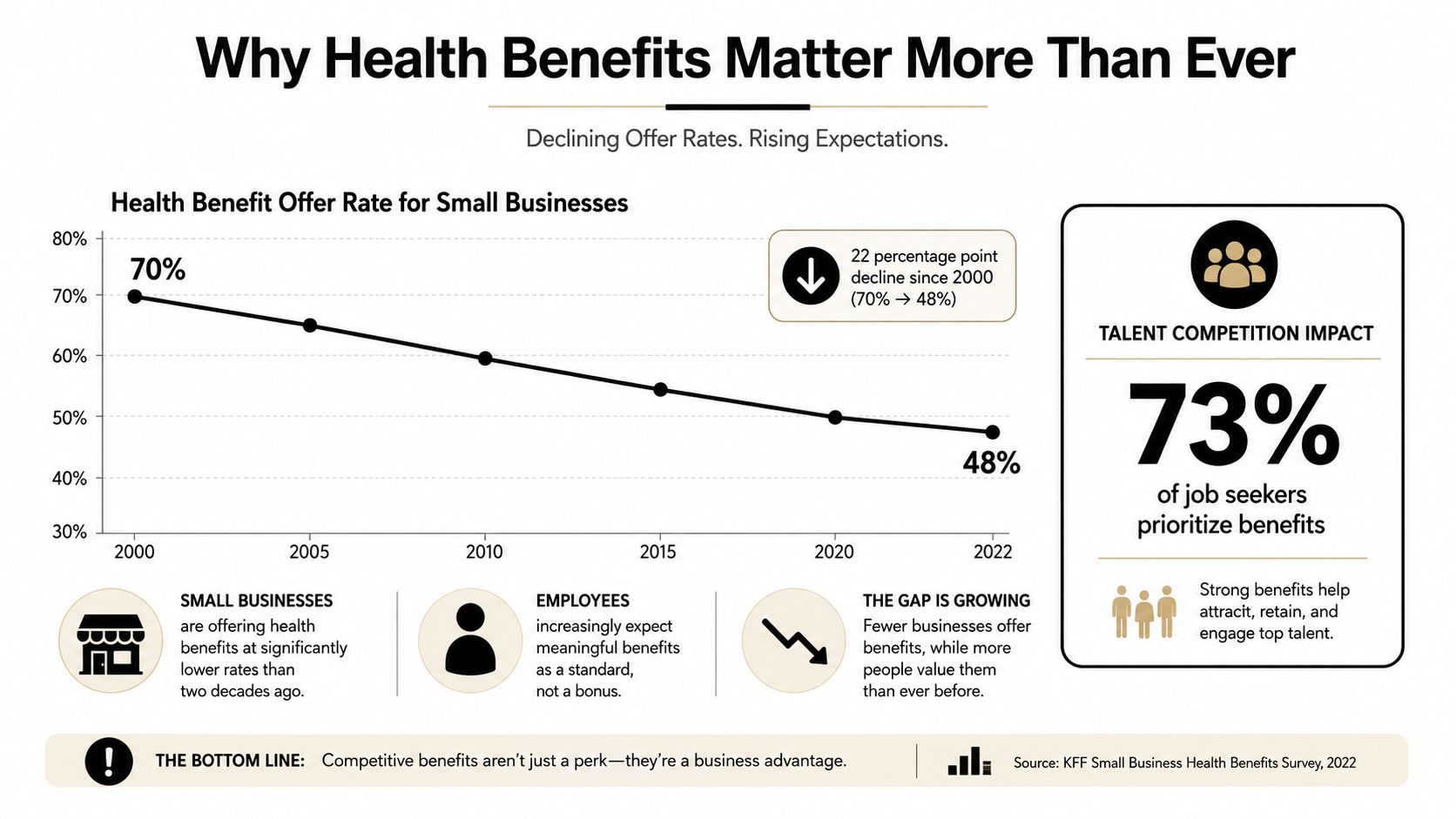
Small employers have been losing ground on health coverage for decades. Among U.S. employers with 25 to 99 workers, the share offering healthcare fell from 81% in 1996 to 77% in 2023. For employers with 10 to 24 workers, the rate dropped from 65% to 52%, while firms with fewer than 10 workers declined from 34% to 23%, according to HR Brew's analysis of the long-term coverage trend.
That decline has a direct competitive consequence. Larger employers are more likely to offer health coverage, so candidates comparing two otherwise similar jobs may see benefits as a practical signal of stability, not a decorative perk. A small company that offers nothing may have to compensate with higher cash pay, unusual flexibility, or a compelling mission. Those alternatives can help, but they don't replace protection for every employee.
The scale disadvantage is real
The coverage gap remains visible today. In 2025, 61% of firms with 10 or more workers offered health benefits to at least some employees. The rate was 59% among firms with 10 to 199 workers, compared with 97% among firms with 200 or more workers, according to the 2025 KFF Employer Health Benefits Survey.
Headcount matters even within the small-business category:
- 10 to 24 workers: 51% offered coverage.
- 25 to 49 workers: 64% offered coverage.
- 50 to 199 workers: 89% offered coverage.
These figures don't mean every small company needs to copy a large employer's benefits package. They do show that benefits capability becomes more common as firms grow, which gives established employers a recruiting advantage over smaller competitors.
Practical rule: If you can't match a large employer on salary, make your benefits easier to understand, more predictable, and more usable.
A modest, well-designed contribution can be more valuable than an expensive plan employees avoid using. Start with the workforce you have, identify the care barriers employees face, and build a sustainable package around those realities. Ignoring the gap leaves your company competing for talent with one hand tied behind its back.
Understanding Your Health Plan Options
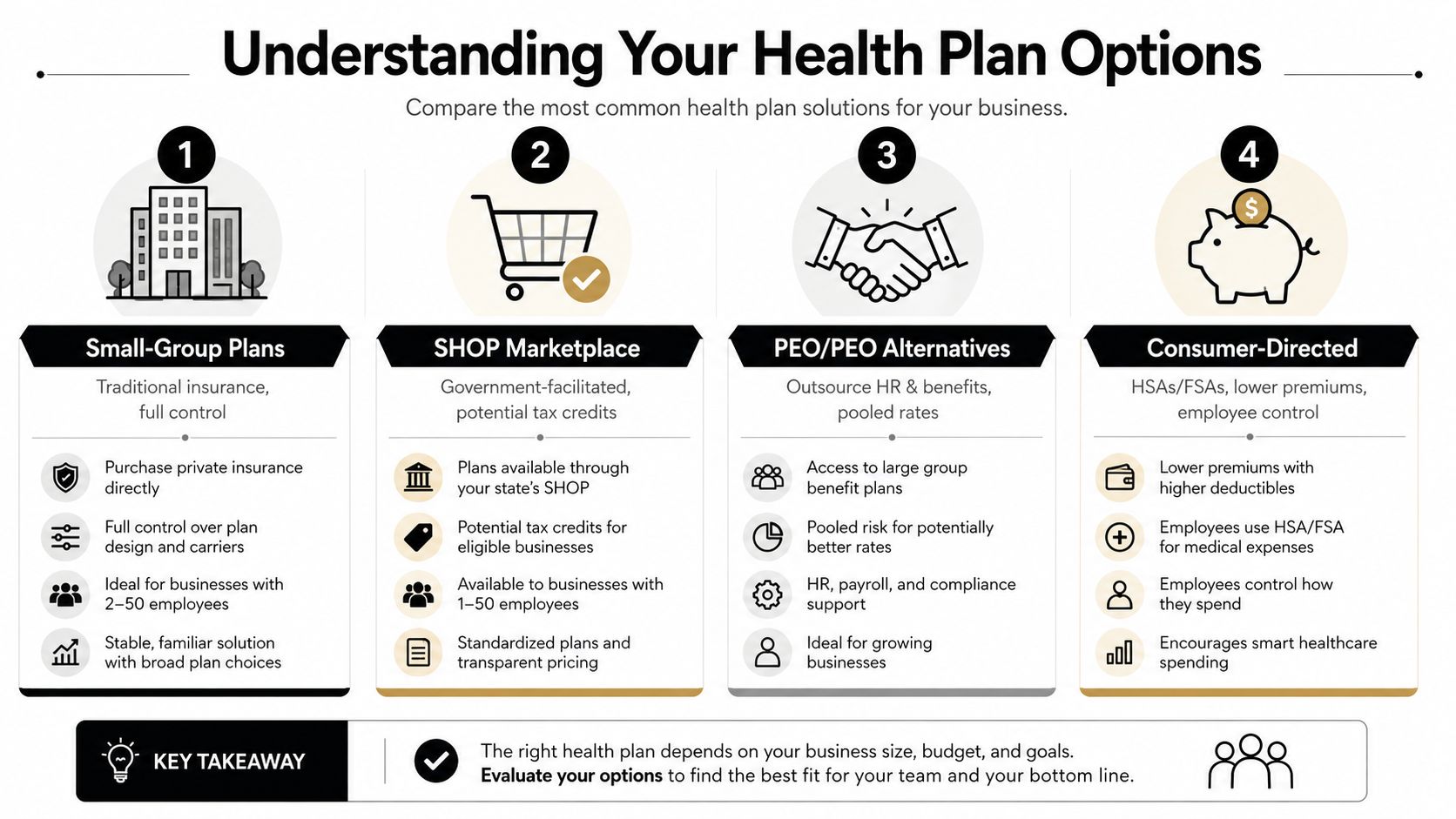
Small businesses have several ways to provide health benefits, and each solves a different problem. The right choice depends on headcount, budget predictability, employee preferences, and how much administration your team can handle.
Traditional small-group plans
A small-group plan gives the employer direct control over the carrier, network, plan design, and contribution approach. It fits companies that want a familiar insurance structure and are prepared to manage renewals, employee questions, participation rules, and required notices.
The trade-off is commitment. You select the available plans, and employees generally choose from that menu rather than shopping across the entire individual market. Premiums can also change at renewal, so your budget needs room for movement.
SHOP Marketplace coverage
The SHOP Marketplace is a government-facilitated route for eligible small employers. It can be useful when a company wants group coverage and may qualify for the Small Business Health Care Tax Credit. HealthCare.gov says eligible employers generally have 1 to 50 full-time equivalent employees, offer coverage to all full-time employees, enroll at least 70% of employees offered insurance, and maintain an office or work site in the state connected to the SHOP Marketplace used, as described by IRS guidance on the credit.
SHOP isn't automatically the cheapest route. Compare the available plans, contribution requirements, participation rules, and employee experience before choosing it.
PEOs and PEO alternatives
A professional employer organization, or PEO, can combine benefits administration with payroll, HR support, and a co-employment structure. This may suit a founder who wants to outsource substantial HR work rather than manage separate vendors.
PEO alternatives provide some of the same administrative support without necessarily using the same co-employment model. Ask who handles compliance, who controls plan decisions, how employee data moves between systems, and what happens if you leave the arrangement.
Consumer-directed options
HSAs and FSAs can pair with eligible plans and give employees a way to manage healthcare spending with tax advantages. They can support lower-premium plan designs, but they don't solve affordability by themselves. An employee with a high deductible may still avoid care if the company doesn't contribute enough or explain how the account works.
Use a simple comparison:
| Option | Usually fits | Main advantage | Main concern |
|---|---|---|---|
| Small-group plan | Employers wanting direct plan control | Familiar group coverage | Renewal and administration burden |
| SHOP Marketplace | Eligible firms seeking group coverage and possible credits | Structured marketplace access | Eligibility and participation rules |
| PEO or alternative | Teams needing broader HR support | Outsourced administration | Contract and operating-model complexity |
| HSA or FSA strategy | Employers managing premiums and employee choice | Consumer control and tax treatment | Employees may struggle with upfront costs |
Don't choose based on the label. Choose based on whether the arrangement gives your employees usable coverage and gives your company a budget it can maintain.
What Really Drives Health Benefits Costs
The premium quote is only the visible part of your benefits budget. Cost also reflects your workforce demographics, plan design, carrier network, employer contribution, participation, and renewal history. Some factors are outside your control, but founders can make better decisions by separating fixed constraints from adjustable choices.
Start with the employee experience. A plan with a lower premium may carry higher deductibles, narrower networks, or more cost-sharing. A richer plan may cost more upfront but reduce the likelihood that employees postpone primary care, prescriptions, or preventive services. The cheapest monthly invoice isn't necessarily the lowest total cost for the business if employees reject the benefit or leave for a competitor.
The levers you control
Plan design determines how costs are shared. Review the deductible, copays, coinsurance, out-of-pocket maximum, prescription tiers, and access to primary care. Don't compare premiums without comparing these features side by side.
The carrier network affects practical access. A plan can look attractive until employees discover that their doctors, hospitals, or specialists are out of network. Ask the carrier for a searchable provider directory and have employees test it before enrollment.
Your contribution strategy sets the employee's real price. Decide whether you'll contribute a fixed amount, a percentage, or different amounts by coverage tier if permitted. Then test the employee payroll deduction, not just the employer premium.
Renewal planning protects cash flow. Set a review date well before renewal and model what happens if the carrier changes rates or employees shift from individual to family coverage. You'll make better decisions with scenarios than with a single quote.
For a practical framework covering the variables that shape employer spending, review how health insurance costs for employers are calculated.
Budget discipline: Set the maximum annual amount your company can sustain before you compare plans. Otherwise, the most generous quote will quietly become the default.
Ask for a total-cost view that includes employer premiums, employee contributions, administrative fees, payroll handling, and the time your team will spend answering questions. A benefits plan is an operating expense, so evaluate it with the same discipline you apply to software, hiring, and facilities.
Legal Requirements and Tax Credits Explained
Many small-business owners assume the Affordable Care Act requires every employer to offer health insurance. It doesn't. Under the federal employer mandate, businesses generally aren't required to offer coverage if they have fewer than 50 full-time employees and full-time equivalents, according to HHS guidance on employer coverage obligations.
That exemption doesn't make benefits irrelevant. It gives smaller employers a choice, and that choice affects recruiting, retention, employee finances, and administrative responsibilities. State rules, employee classifications, tax treatment, and plan-specific requirements can still matter, so don't treat the federal threshold as a complete compliance review.
The Small Business Health Care Tax Credit
The IRS says a small employer may qualify for the Small Business Health Care Tax Credit if it has fewer than 25 full-time equivalent employees and pays at least 50% of the premium cost for each employee's single coverage. The maximum credit is up to 50% of employer premium contributions for for-profit employers and up to 35% for tax-exempt employers, as explained in the IRS overview of the Small Business Health Care Tax Credit.
Eligibility typically requires purchasing coverage through the SHOP Marketplace, unless an exception applies. The business must also satisfy the relevant employee, wage, contribution, and coverage conditions. Keep payroll records, enrollment documentation, invoices, and contribution calculations organized before filing.
Communication remains a compliance task
If you offer a health plan, employees need clear information about what it covers and what it costs. HealthCare.gov says employers must provide a standardized Summary of Benefits and Coverage, or SBC, as described in its small-business ACA guidance.
Build compliance into your enrollment calendar. Assign ownership for notices, eligibility tracking, payroll deductions, qualifying life events, and employee questions. A broker, benefits administrator, or HR specialist can help, but your company should still know who is accountable for each deadline.
The Hidden Gap Between Offering Benefits and Employees Using Them
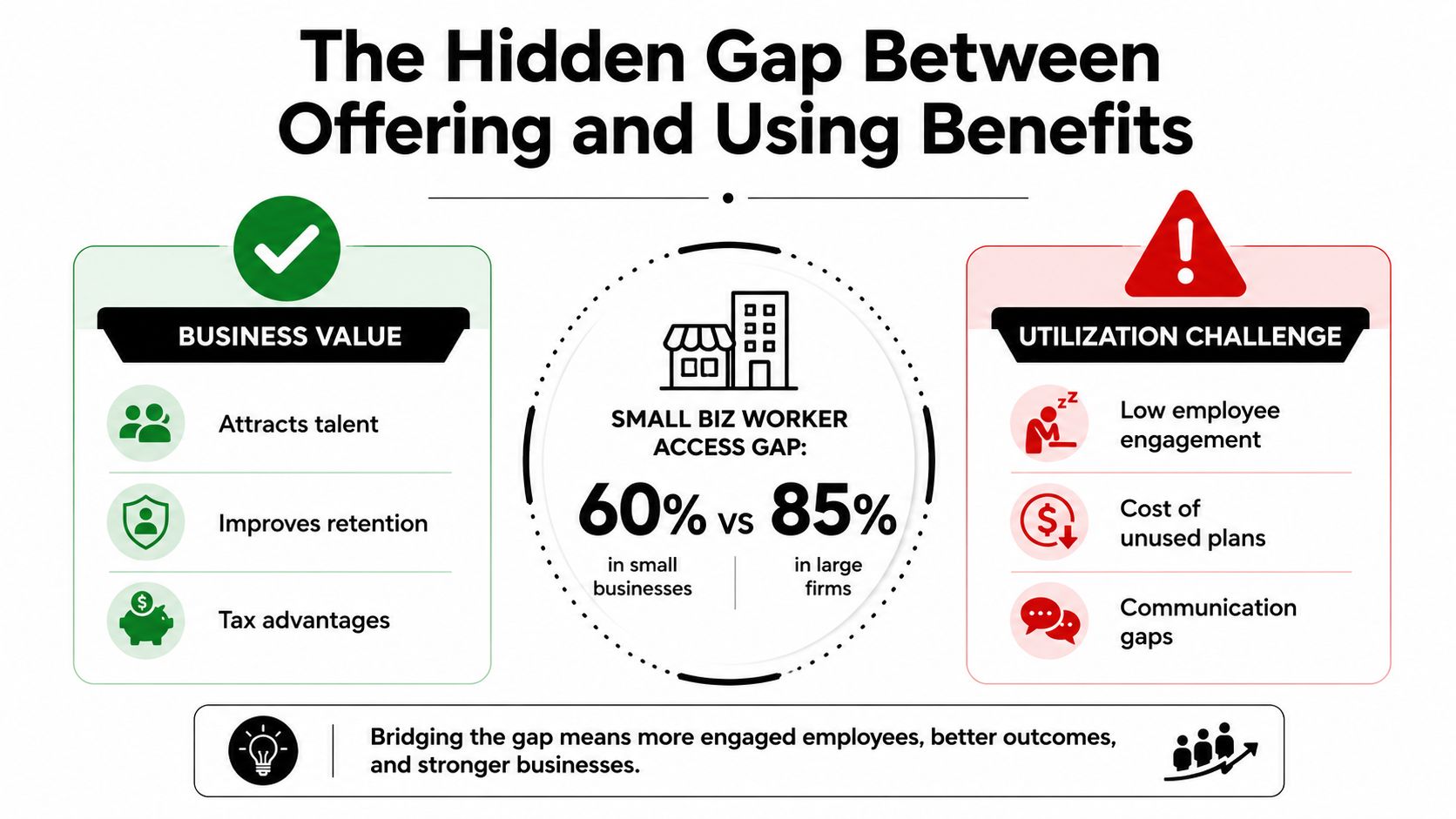
Offering coverage is only the first step. Employees judge the benefit by whether they can afford care, find the right provider, understand the bill, and get help when something goes wrong. Earlier research from the Urban Institute shows that workers at micro and small businesses have lower access to every employer-sponsored benefit measured than workers at medium and large businesses.
The gap is especially clear in supplemental coverage. Dental and vision access was 54% lower for workers at micro and small businesses. Disability and life insurance also showed a wide difference. The practical lesson is direct: a plan that exists on paper does not automatically improve health outcomes or retention.
Cost blocks usage
Affordability determines whether employees use coverage. The Urban Institute's research, cited earlier, found that 4 in 10 small-business workers skipped or postponed care in the previous year because they couldn't afford it. Only two-thirds had an annual checkup, and fewer than one-third completed recommended screenings.
A high-deductible plan fails its intended purpose when employees cannot manage the early costs. Before choosing one, review first-dollar primary-care access, prescription affordability, telehealth, preventive care, payment options, and the employee support available during a claim or bill dispute. A lower premium is not a savings if workers avoid care and the company loses productivity or retention.
Navigation is part of the benefit
Employees skip care when they cannot identify an in-network provider, determine whether authorization is required, or estimate the bill. Give every employee a short benefits guide with the carrier's member-service number, provider-search instructions, urgent-care options, pharmacy resources, and a clear escalation path.
Measure friction without invading privacy. Track enrollment completion, employee questions, benefits-page visits, claims-navigation themes, and recurring confusion. The goal is to remove avoidable obstacles so employees use the coverage the company pays for, receive care sooner, and see the benefit as a reason to stay.
Streamlining Enrollment and Ongoing Administration
A small company doesn't need a large HR department to run a credible benefits process. It needs clear ownership, a reliable calendar, accurate employee data, and a system that keeps plan information, elections, payroll, and compliance records aligned.
Build the process around five checkpoints
Confirm eligibility. Define eligible employee classes, waiting periods, effective dates, dependents, and qualifying life-event rules before presenting plans.
Set the budget. Decide the employer contribution and employee cost by coverage tier. Put the assumptions in writing so payroll and management use the same figures.
Compare plans consistently. Review premiums, deductibles, networks, prescriptions, out-of-pocket limits, and support services in one comparison sheet. Don't let a low premium hide a difficult employee experience.
Run enrollment with deadlines. Publish the decision date, employee education sessions, document requirements, and help contacts. Send reminders, then follow up directly with anyone who hasn't completed an election.
Audit after launch. Confirm deductions, effective dates, carrier files, dependent records, and ID-card delivery. Resolve discrepancies before the first payroll cycle after coverage begins.
A centralized platform can reduce duplicate entry and give employees one place to review plans, make elections, and add dependents. Benely is one option that combines plan comparison, budget setting, enrollment tracking, payroll and onboarding connectivity, and access to certified HR specialists. Evaluate it alongside other brokers, benefits platforms, and payroll-integrated tools.
Use a detailed open enrollment checklist for HR to assign owners and deadlines. The checklist should cover employee communications, eligibility audits, plan documents, payroll testing, and post-enrollment reconciliation.
Administrative standard: If an employee has to ask three people where to find a plan document, your process is too fragmented.
Keep a benefits calendar for the full year, not just open enrollment. Schedule renewal preparation, compliance reviews, employee feedback, payroll audits, and periodic navigation reminders. Consistency turns benefits from an annual scramble into a manageable operating process.
Wellness and Retention Strategies That Deliver ROI
Health benefits create retention value only when employees see them as useful. A wellness strategy shouldn't be a collection of flashy apps. It should connect directly to the barriers your team faces, such as delayed preventive care, confusing plan navigation, limited time for appointments, or poor awareness of available support.
Start with listening. Ask employees which parts of the plan they understand, which services they avoid because of cost, and where they struggle to find help. Keep the survey anonymous and focus on themes rather than personal medical details. Then choose one or two interventions that address the clearest problems.
Use practical interventions
A small employer might provide a benefits orientation during onboarding, host a short annual plan walkthrough, or give employees protected time to complete preventive appointments. Other options include reminders about in-network primary care, clear instructions for telehealth, assistance locating mental-health providers, or a simple explanation of HSA and FSA usage.
Communication should happen throughout the year. A single open-enrollment presentation won't help an employee who needs care months later. Use payroll messages, an employee portal, manager talking points, and short reminders tied to relevant seasons or life events.
For concrete ideas that can support employee engagement, review this resource on how to boost morale with wellness initiatives.
Measure business value carefully
Retention isn't created by one benefit in isolation. Employees weigh coverage alongside pay, flexibility, workload, management, career opportunity, and trust. Still, a thoughtful benefits program can strengthen the overall employment proposition when leaders communicate it clearly and make it usable.
Track operational indicators that your team can influence.
- Enrollment completion: Identify employees who need help before deadlines.
- Recurring questions: Rewrite confusing materials instead of answering the same issue repeatedly.
- Preventive-care awareness: Share access information without requesting private health details.
- Employee feedback: Ask whether the plan feels affordable and understandable.
- Retention conversations: Include benefits in stay interviews and exit feedback.
Avoid claiming savings you can't substantiate. Your first goal is better access and clearer employee decisions. Over time, that discipline gives you evidence for adjusting contributions, changing vendors, or expanding wellness support.
Your Next Steps for Choosing and Implementing a Plan
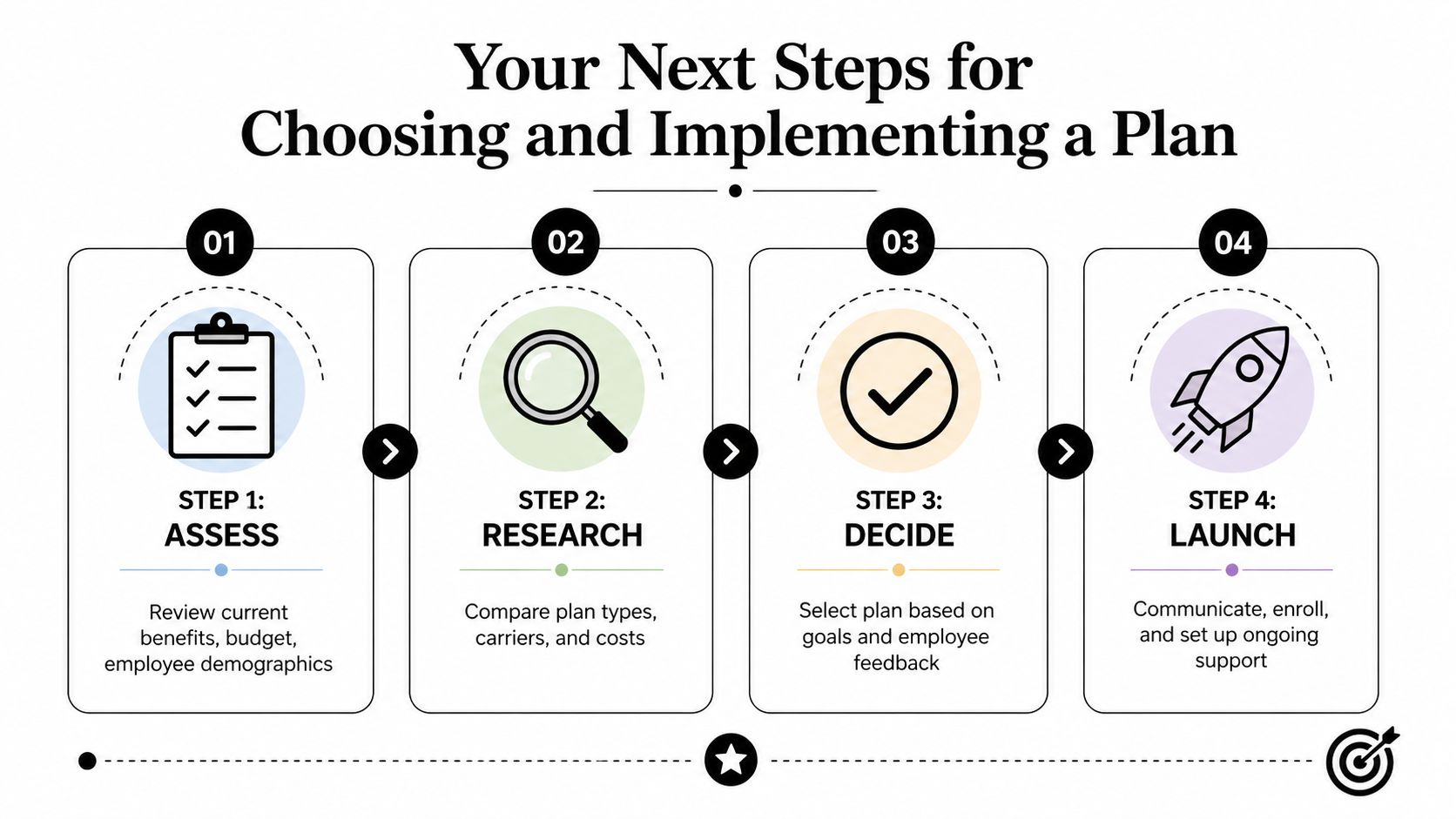
A workable benefits decision starts with facts, not a carrier brochure. Review your current offer, employee demographics, budget ceiling, payroll process, and the care barriers employees have reported. Then decide whether you need traditional group coverage, a marketplace route, a PEO arrangement, consumer-directed support, or another compliant structure.
Follow a four-step decision process
Assess. Document what you offer today, what the company can sustain, and where employees experience cost or navigation problems.
Research. Compare plans and platforms using the same criteria: employer cost, employee payroll deductions, deductibles, networks, prescriptions, administration, compliance support, and renewal approach.
Decide. Select the option that balances budget control with meaningful access. Share a plain-language comparison with employees before finalizing the choice.
Launch. Set deadlines, explain the plan repeatedly, test payroll deductions, confirm carrier enrollment, and provide ongoing support after coverage begins.
Use this guide to offering employee benefits to organize the implementation work. After launch, rate your process, collect employee feedback, and revisit the plan before renewal rather than waiting for a crisis.
The strongest health benefits for small business aren't necessarily the richest or most complicated. They're sustainable, understandable, and designed around the way employees seek care.
Benely helps small businesses compare health plans, set a benefits budget, manage enrollment, and connect benefits administration with payroll and onboarding. Visit Benely to evaluate your current process, explore your options, and get practical support from benefits and HR specialists.