A health insurance third party administrator handles eligibility, claims, and member service while the employer retains the medical-claims risk. Self-insured plans cover a substantial share of employees with employer-sponsored coverage, so this arrangement is a common alternative to carrier-funded coverage.
The administrator works like a control tower: it coordinates the work and keeps processes moving, while the employer funds the claims. That distinction matters when comparing costs. A quoted per-employee administrative fee is not the full price of a TPA arrangement, and claims history may not transfer to a new administrator unless the contract provides for it.
Founders and HR managers often consider self-funding after a fully insured renewal rises. The choice depends on cash flow, oversight, and whether someone on the team can review monthly claims reports. A lower administrative fee may still come with more responsibility for funding claims and monitoring costs.
Table of Contents
- What Health Insurance Third Party Administrators Actually Do
- How a TPA Compares with Carriers PEOs and Self Administration
- The Operating Work a TPA Performs Day to Day
- Where a TPA Fits or Fails for Smaller Employers
- The Fees and Incentives Hidden Past the PEPM Quote
- Claims Data Rights and Connections to Payroll Systems
- Decide on a TPA and Start a Benefits Review
What Health Insurance Third Party Administrators Actually Do

Say a 90-person distributor leaves a fully insured policy. The owner still writes the checks when someone has surgery. Someone else has to confirm who is covered, price the bill against the plan, pay the clinic, and answer the employee who can't read the explanation of benefits. That operating partner is the health insurance third party administrator.
The split is old. The first administrative-services-only contract, written in 1970 by Equitable Life Assurance Society for the 3M Company, separated claims processing and member services from insurance risk, so the employer could pay claims directly while outsourcing the work, as a CMS review of health care financing records. ERISA, enacted in 1974, set federal standards for employer plans and generally preempted state insurance rules for self-funded plans.
By 1977, commercial insurers held about 53% of the U.S. group health market, Blue Cross and Blue Shield held 38%, and self-administered, TPA-administered, and independent plans together represented 9%. In a 1984 CMS study, 51% of self-insured organizations hired a TPA, while 23% self-administered.
Those milestones made the TPA core infrastructure rather than an insurer. The employer keeps the claims risk. The administrator can run eligibility, networks, claims, payments, and reporting. How well that work is done shows up as speed, data you can use, compliance habits, and what an employee feels when a claim goes sideways. Infrastructure only helps if the company is ready to hold the risk.
How a TPA Compares with Carriers PEOs and Self Administration
| Model | Who holds claims risk | Who administers | Typical fit | Main rule set |
|---|---|---|---|---|
| Fully insured carrier | Insurance carrier | Carrier | Small groups wanting a predictable premium | State insurance law plus the policy |
| Carrier ASO | Employer | Carrier administrative arm | Self-funded groups that want a carrier network | ERISA for the plan; carrier contract for admin |
| Independent TPA | Employer | TPA, with separate stop-loss | Self-funded employers wanting unbundled admin | ERISA; TPA is not an automatic fiduciary |
| PEO | Often the PEO master plan, as the co-employment contract sets it | PEO | Very small employers wanting co-employment and bundled HR | Co-employment agreement and the PEO plan |
| Self-administration | Employer | Employer staff | Rare; only with real internal claims expertise | ERISA, with the employer doing the work |
Fully insured carrier. The carrier prices a premium, holds the claims risk, and usually administers the plan under state insurance law. You trade flexibility for a bill you can budget. A bad year is the carrier's problem, inside the policy.
Carrier ASO. Risk stays with the employer. Administration and the network stay with the carrier's administrative arm. You get a familiar brand and a broad doctor list, and you still fund the claims. The contract, not a state policy form, sets the service.
Independent TPA. The administrator does the operational work and doesn't insure the benefit. Stop-loss, bought separately, caps one catastrophic claimant or a bad aggregate year. This is the unbundled version of self-funded insurance, and it only works if you can read the reports.
PEO. This is a different bargain. The PEO co-employs your workers, often puts them on a master health plan, and bundles HR. It can suit a very small team that doesn't want its own plan document.
Self-administration. Your staff pays the claims. Almost no smaller company should attempt it. You'd need real claims expertise, appeal deadlines, and a payment operation that doesn't stall a hospital bill.
Scale tracks the choice. In 2024, 79% of covered workers at businesses with 200 or more employees were in self-insured plans, versus 20% at businesses with fewer than 200 employees, and in 2020, 84% of large firms self-insured their health plans, compared with 23% of small firms, according to an Arkansas Center for Health Improvement explainer. Self-insured plans are primarily governed under ERISA rather than state insurance law. The employer keeps the financial obligations and the fiduciary duties.
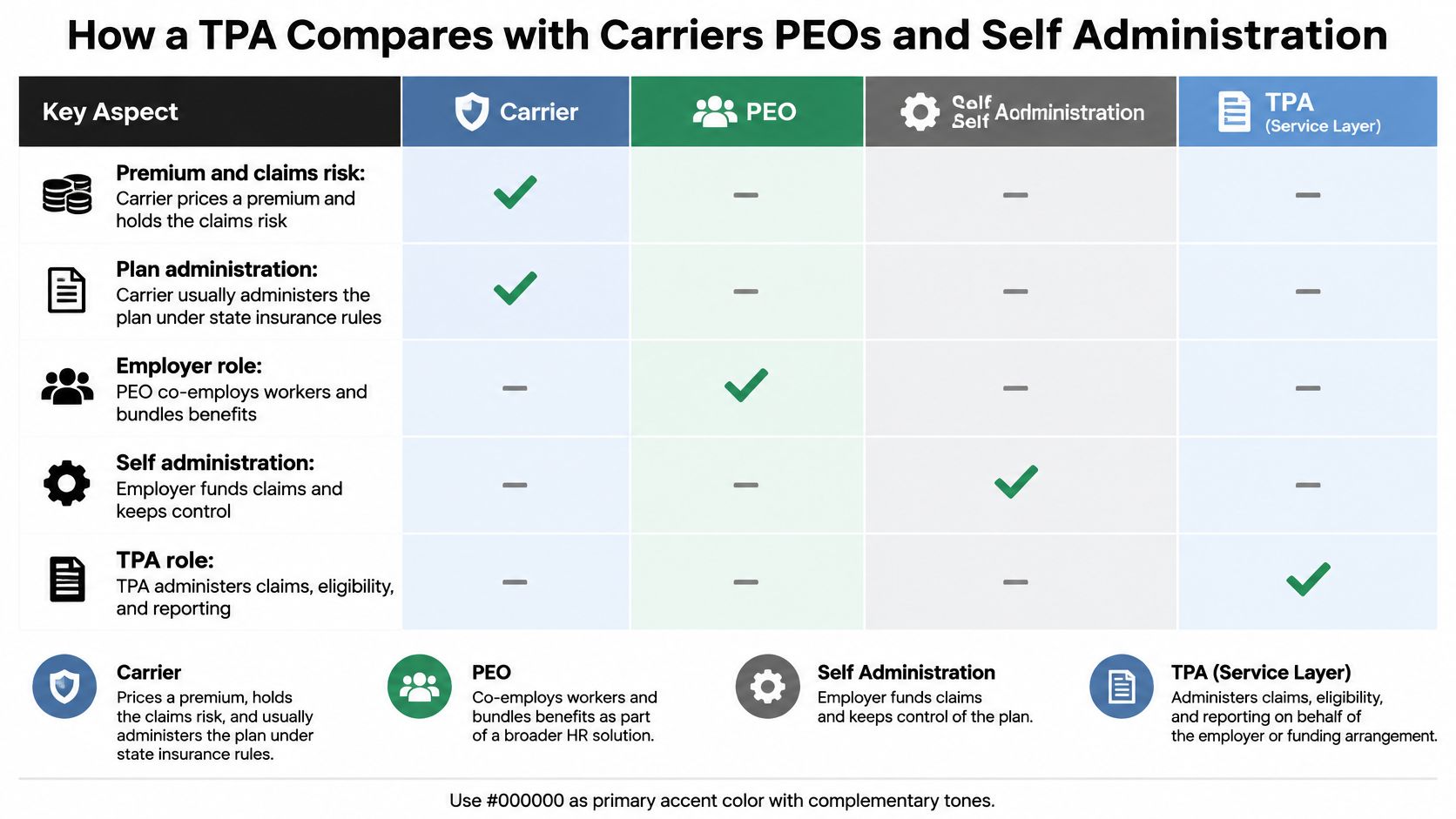
Routine administration doesn't automatically make the TPA an ERISA fiduciary. Discretion over plan management, plan assets, or benefit determinations can. Read any row the same way. Name who holds the risk, then name who sends the explanation of benefits.
A short walk-through of how those roles show up in a real plan meeting is here:
The Operating Work a TPA Performs Day to Day
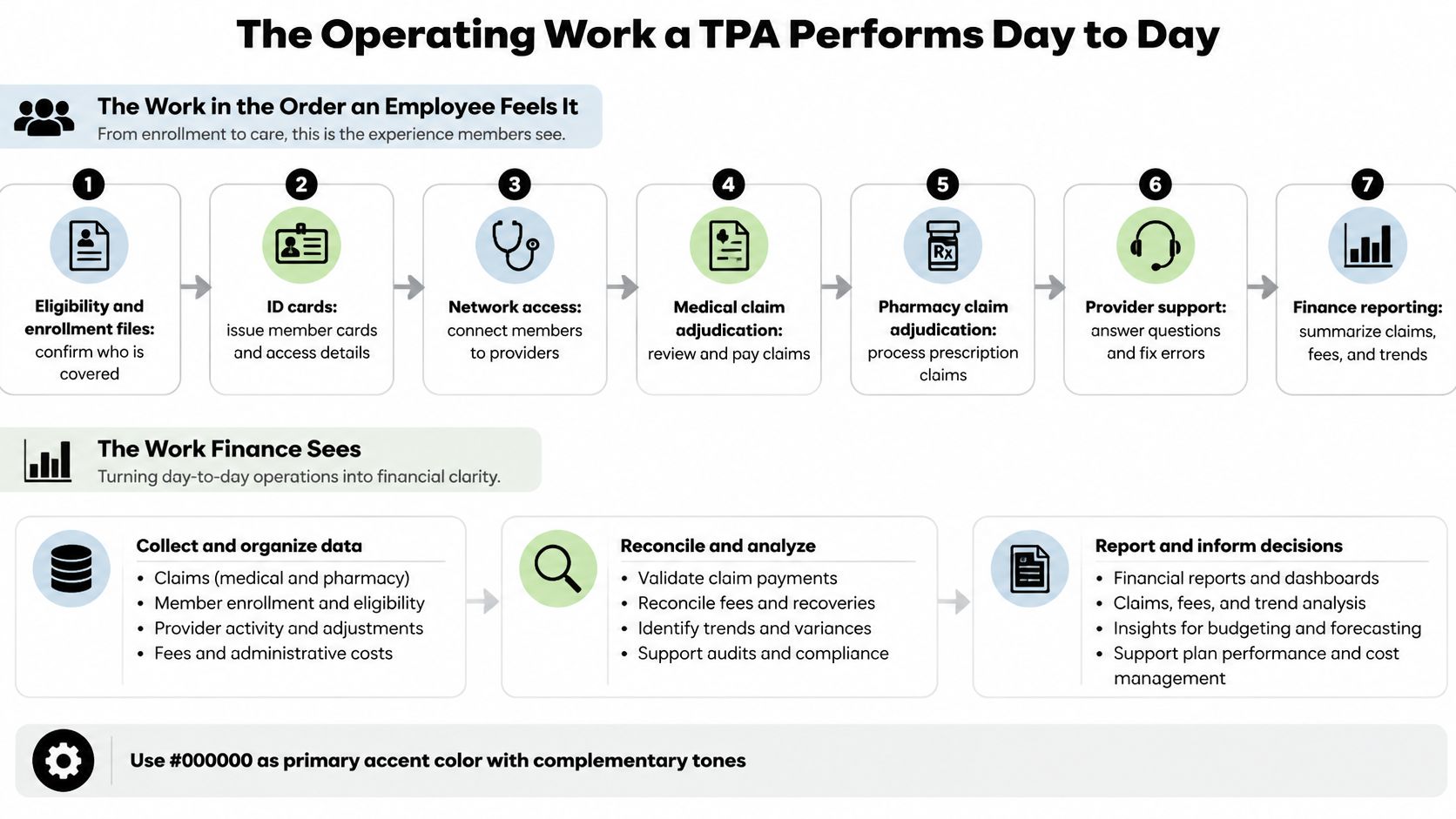
A TPA turns plan rules and employee information into everyday administration. The employee sees the result in a clinic or on a claim notice; the employer sees it in eligibility records and financial reports.
Eligibility and ID cards. Payroll records show who joined or left and which dependents are covered. The TPA uses that information to update eligibility and issue ID cards. If a termination date is wrong, a former employee may appear covered when seeking care, creating confusion and a surprise bill.
Networks and claims. Members use the provider network available under the plan. The TPA processes medical and pharmacy claims according to the plan's terms, arranges payment to providers, and sends members explanations of benefits. When a claim is denied, the appeal follows the plan's written procedures, not an informal assurance from HR. The U.S. Department of Labor's guidance on filing a health-benefit claim explains the claims and appeal process.
What finance sees. Reports can show utilization, high-cost claims, and when a claimant approaches the stop-loss attachment point. That notice gives the employer a chance to follow the plan's reporting process before a potential reimbursement issue becomes an end-of-year surprise.
Plan-design suggestions about deductibles, networks, or separate benefit arrangements are advice. The employer makes the final plan decision. A benefits platform can support the work by giving employees another route for questions beyond the claims line. For a separate look at digital support and claims modernization strategies for enterprise leaders, distinguish member service tools from the TPA's claim-adjudication role.
The compliance lane
ERISA governs many private-sector employee health plans, while state insurance rules may apply differently to self-funded plans. Plan procedures still need to explain how participants file claims and appeal adverse benefit decisions. The TPA administers claims within those procedures, while the plan sponsor remains accountable for the plan.
ERISA's claims rules apply to many private-sector employment plans. Government-sponsored plans and most church plans generally sit outside ERISA.
Some federal rules also assign a specific processing role to a TPA. Under the ACA preventive-services accommodation, an eligible organization with a self-insured plan may certify that it will not act as administrator or fund required contraceptive claims. That certification starts the TPA's duties under the Department of Labor's EBSA Form 700 guidance.
The service agreement should name each assigned duty, such as COBRA administration, appeal deadlines, subrogation, and regulatory filings. A quoted per-employee administrative fee is only one part of the arrangement. Claims-data access and transfer depend on what the contract provides, so the employer's rights to the data should be stated there too.
Where a TPA Fits or Fails for Smaller Employers
A 35-person professional firm. Claims have been calm, and nobody on staff is a benefits analyst. One large claimant can erase a year of hoped-for savings, and you still pay stop-loss premium plus TPA fees in a quiet year. Verdict: a fully insured plan, or a PEO master policy through a PEO and HR arrangement, is usually the calmer choice. The advantage you give up is plan-design flexibility. The risk you avoid is a cash hit you can't staff around. Growing teams in this spot often compare coverage options as your team grows before they unbundle anything.
A 160-person light manufacturer. There's two years of claims history, and a finance lead who will open the monthly file. An independent TPA plus specific and aggregate stop-loss can work if you model the attachment point, any lasered claimants, and run-out before you accept a quote. The advantage is direct claims visibility. The risk is fiduciary responsibility that a carrier used to absorb. If the laser on one known claimant is ugly, the quote isn't a savings story.
A 230-person distributor. The narrow network is the complaint, not the premium. A TPA or a carrier ASO can widen doctor access and show utilization. The employer still needs cash for a bad quarter, because the administrator doesn't insure the claims. The advantage is design room, including no state premium tax on the self-funded portion. The burden is vendor oversight: fees, turnaround, and file quality are now yours to watch.
| Factor | Type | What it means for a smaller employer |
|---|---|---|
| Plan-design flexibility | Advantage | The employer can adjust networks and carve-outs to fit its own workforce |
| Direct claims visibility | Advantage | A monthly claims file shows utilization and cost as they happen |
| No state premium tax on the self-funded portion | Advantage | Savings apply only to the self-funded share of the plan |
| Monthly cash-flow swings | Risk | The employer pays claims directly, so a bad quarter hits its cash |
| Fiduciary responsibility | Risk | The employer keeps plan duties that a fully insured carrier used to absorb |
| Vendor oversight | Risk | The employer must monitor the TPA's performance and fees itself |
If nobody on staff will open the monthly claims file, the company isn't ready for a TPA.
The Fees and Incentives Hidden Past the PEPM Quote
A per-employee-per-month (PEPM) quote is a starting point, not the full TPA price. Employers often compare that visible base fee because it fits neatly in a spreadsheet. Yet plan-sponsor interviews found other payments outside the base fee, including shared-savings fees on out-of-network claims, overpayment-recovery fees, retained network discounts, a-la-carte charges, and cross-plan offsets, as described in Health Affairs Scholar. The fee structure matters because it can reward particular ways of handling claims.
| Charge | How it is calculated | Incentive to watch |
|---|---|---|
| Base admin fee | Per employee per month | Easy to compare, but often incomplete |
| Shared savings | Percent of out-of-network savings versus billed charges | Rewards aggressive repricing |
| Overpayment recovery | Percent of dollars recovered | Rewards finding and recovering payments |
| Retained network discount | Spread kept between billed and allowed amounts | Can hide margin inside the network deal |
| A-la-carte fees | Flat charges for cards, COBRA, reports, or run-out | Raises the cost of extras and leaving |
| Cross-plan offset | Recovery of one overpayment from another payment | Can reduce payment to a different member's provider |
What each line does to behavior
A shared-savings fee pays more when out-of-network bills are repriced aggressively. That may reduce what the plan pays, but the savings calculation can compare a high billed charge with a much lower allowed amount. The member may then have questions or face friction over the balance.
An overpayment-recovery fee rewards the TPA for identifying and recovering money. That can help correct a genuine duplicate payment. If the fee encourages recovery work that should have been prevented during claim processing, however, the plan pays for a problem twice: once through the original error and again through the recovery fee.
A retained network discount means the TPA or an affiliate keeps part of the difference between the billed charge and the amount paid. A dashboard may show network “savings” without making that retained margin obvious.
A-la-carte charges can turn routine services into extra costs. ID cards, COBRA, custom reports, and run-out after termination may each carry a flat fee. A low PEPM can therefore become more expensive once those items are added, including when the employer leaves.
A cross-plan offset uses an overpayment tied to one claim to reduce a payment tied to another member. The plan may recover the amount, while a provider who treated someone else receives less than expected.
A three-move total
- Annualize PEPM using enrolled employees, not eligible employees, if the quote mixes those figures.
- Apply percentage fees to last year's out-of-network and recovery dollars.
- Add every a-la-carte charge, including run-out after termination.
Use the resulting total to compare proposals, then ask how each fee affects claim decisions. Request three contract clauses now: a complete compensation exhibit, disclosure or a ban on cross-plan offsets, and the right to audit payments to affiliates. The quoted admin fee is not the full price, and these terms clarify what sits beyond it.
Claims Data Rights and Connections to Payroll Systems
The quoted per-employee admin fee is only one part of a TPA's price. Claims data can carry another cost: if the contract does not promise access and transfer rights, your company may not keep the history when it changes administrators.
Before signing, specify whether you receive raw or de-identified claims extracts, the file layout, delivery timing after termination, audit rights, and who retains historical files. A dashboard is a view of the data, not a substitute for a usable file.
A 2026 congressional proposal described employers being denied raw claims data needed to verify plan costs. It would clarify that data generated by an employer-funded plan belongs to the plan and employer, rather than the administrator, according to the bill summary from Rep. Onder's office. The proposal is not settled law, so the contract still needs to spell out your rights. Some states run all-payer claims databases that self-funded employers may be able to join. Ask your TPA whether that option exists where you operate.
A plain scorecard
- Monthly electronic files: Set a delivery day and require a data file, rather than relying on a PDF someone sends when asked.
- Eligibility-to-claim matching: Confirm each claim can be matched to the person covered on the service date.
- Medical and pharmacy feeds: Check that both include the member, provider, service, diagnosis, payment, and coverage fields your team needs.
- Rejected-record rate: Require reports on failed records and name who corrects them, with a clear timeline.
- Encryption, access logs, and a named business associate: Make sure the privacy paperwork identifies each vendor that handles the file.
Payroll, in order
- Map payroll census fields to the TPA file, including hire dates, termination dates, and dependent dates.
- Set a daily or weekly file schedule and assign someone to clear errors before the next run.
- Align FSA or HSA vendors on the same member ID, so a card transaction matches the medical eligibility file.
- Confirm COBRA and ACA feeds use the same census. That reduces the risk of maintaining a separate spreadsheet list.
- Test a termination file before go-live. Use a recent leaver to check that coverage, COBRA, and claims history agree.
A benefits platform can work alongside the TPA: employees compare plans and track enrollment there, while the administrator processes claims. Confirm how information passes between the systems, and keep the data-access terms in the TPA contract.
Decide on a TPA and Start a Benefits Review
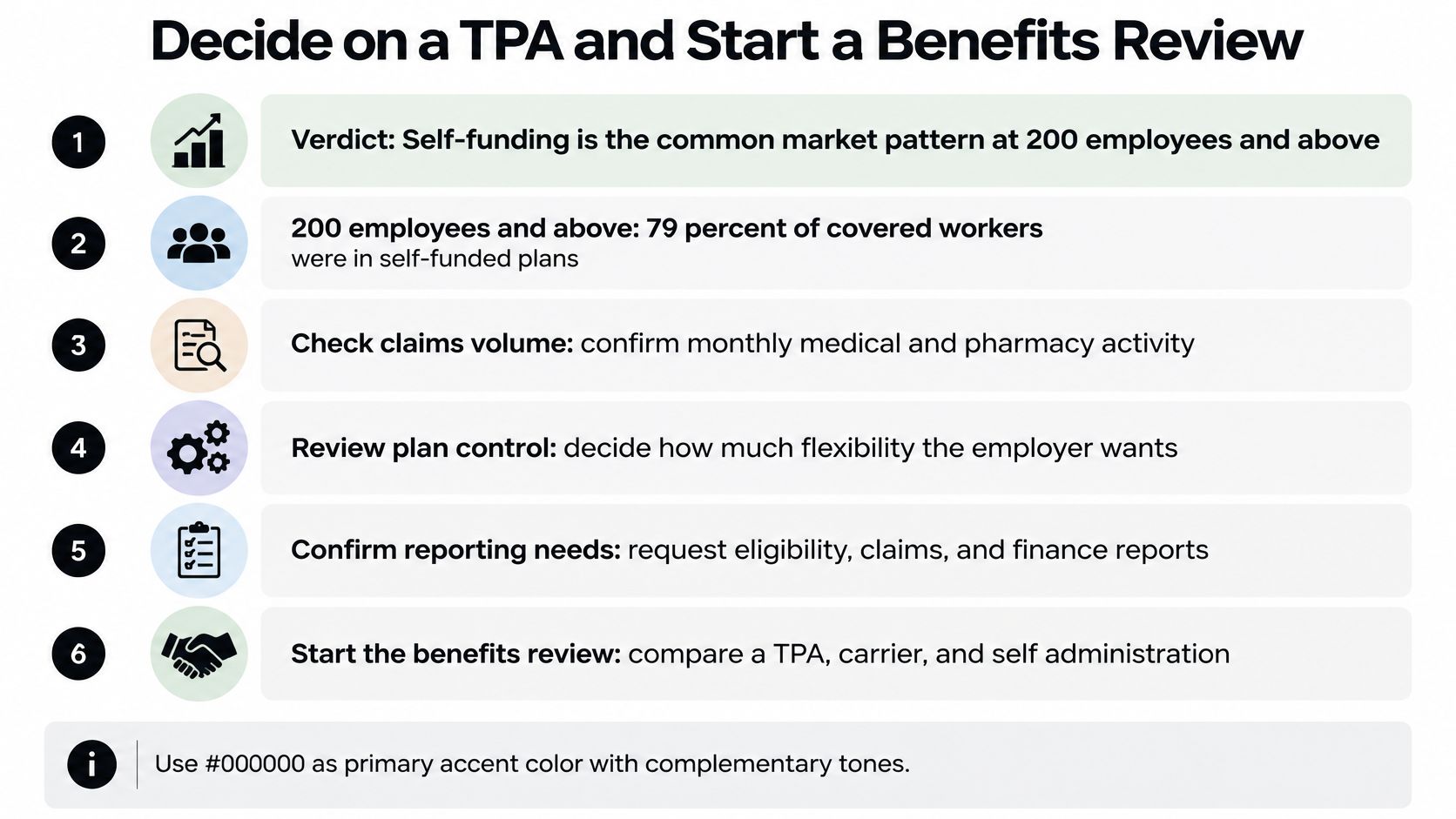
Self-funding is the common market pattern at 200 employees and above. Under that headcount, it's a minority pattern, and a TPA is a choice that needs a cash cushion plus a stop-loss model. A broker should model the attachment point and run-out before anyone commits. Between those sizes, treat a TPA as a project that needs two years of claims data and a data-portability clause before it becomes a real option.
Our compliance experts can assist with COBRA and FSA admin, ACA reporting, HR support, ERISA wrap documents, and ERISA filing, which is the paperwork a self-funded plan still owes even when a TPA pays the claims. The Automate step covers BenAdmin, HRIS and onboarding, payroll, time and attendance, and HSA, FSA, and commuter accounts, so the census isn't a side spreadsheet.
Week one
- Pull the current admin agreement and list every fee, including shared savings, recoveries, retained discounts, a-la-carte lines, and offsets.
- Ask who owns claims history, in what file format, and how fast it moves if you leave.
- Test the payroll census against the proposed TPA file layout, including a termination.
- Compare the resulting medical options with a benefits partner before any finalist meeting. Benely is a platform and brokerage resource for comparing health plans, coordinating enrollment, and connecting benefits administration with HR workflows, and our health insurance broker services are where that comparison starts. The platform lets you compare plans, track enrollment, and connect systems in one place. You still make the decision.
Request the compensation exhibit before the next TPA presentation. If it isn't in the room, you don't have a price yet.
If you're weighing a TPA against a fully insured renewal or a PEO, Benely shops and personalizes group benefits with you, from plan design through compliance paperwork, while you keep the final call. We can line up the admin fees, the stop-loss shape, and the enrollment path before you sit with a finalist. Visit Benely to start that review.