Your renewal quote is open, payroll has a different employee count than your enrollment platform, and your broker wants an eligibility census before submitting the application. You need to know whether your business qualifies, who must receive an offer, and how much the company has to pay.
Small group health plan requirements aren't a single under-50 rule. Market eligibility, the federal employer mandate, tax credits, and participation standards each ask a different question. Start by naming the requirement you're checking, then apply its employee-count method.
Table of Contents
- Who Counts as a Small Group Employer
- Which Employees Must Be Offered Coverage
- Contribution and Participation Rules to Meet
- Required Benefits and Plan Documents Explained
- Choosing Between SHOP, Off-Exchange and PEO Routes
- Annual Compliance Deadlines and Pre-Enrollment Checklist
- Frequently Asked Questions and Next Steps
Who Counts as a Small Group Employer
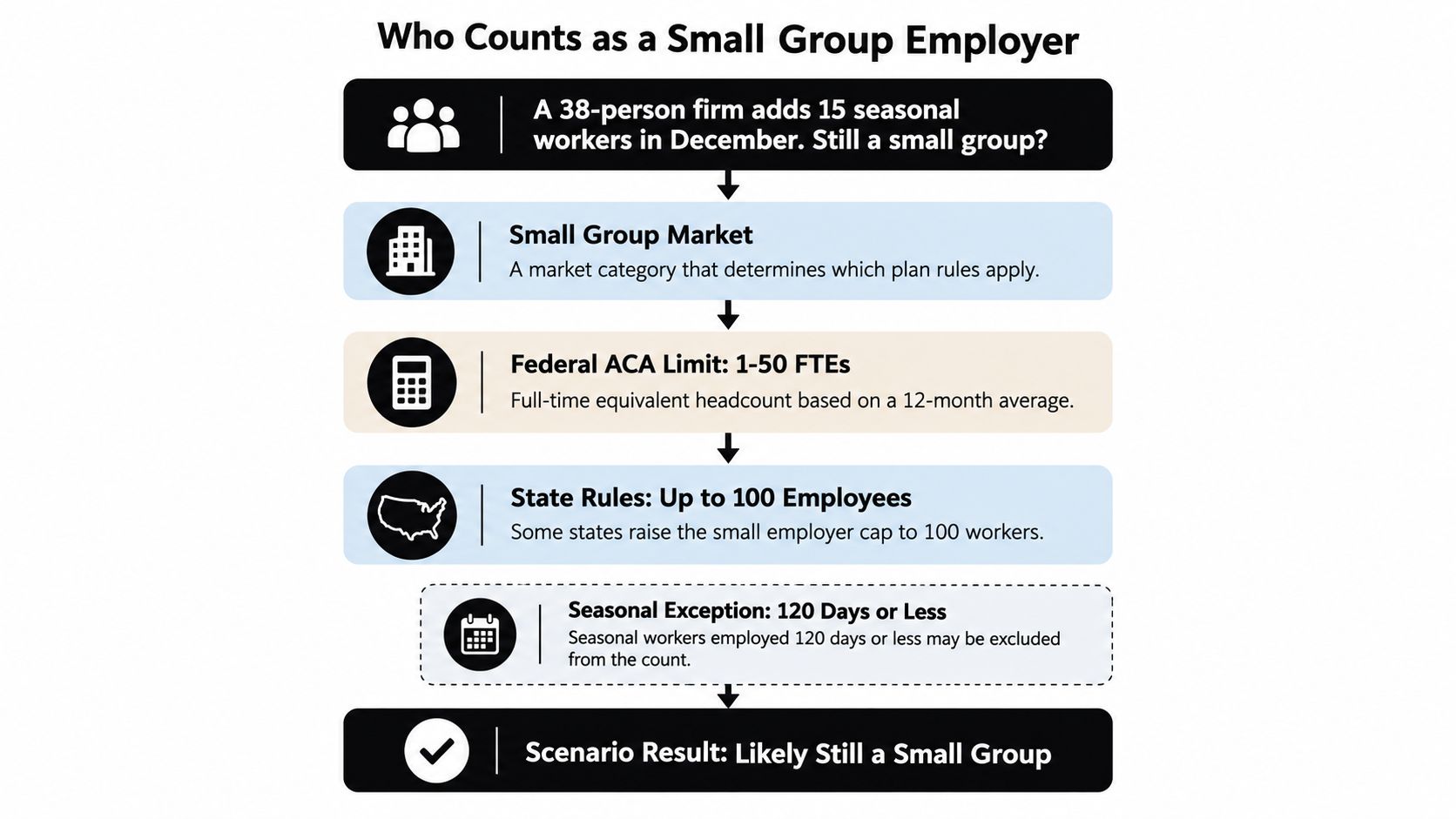
A 38-person firm adds 15 seasonal workers in December. That payroll snapshot alone does not determine whether the firm qualifies as a small employer. The answer depends on the requirement being checked, its employee-counting method, the averaging period, and how seasonal employees are treated.
Small group is an insurance market category, not a universal exemption from benefits obligations. The federal group health plan regulations generally describe small employers as averaging 2–50 employees during the preceding calendar year, while states may permit single-employee groups.
Size thresholds and what each one triggers
| Rule | Employer size | What it triggers |
|---|---|---|
| Federal small employer, general market | 2–50 employees, prior-year average | Small group market rules; some states allow single-employee groups |
| SHOP marketplace eligibility | Generally 1–50 FTEs, with some states allowing up to 100 | Access to SHOP small group plans |
| Small Business Health Care Tax Credit | Fewer than 25 FTEs | Federal tax credit if wage and contribution conditions are met |
| QSEHRA | Under 50 employees, no other group plan | Tax-advantaged reimbursement arrangement |
| ACA applicable large employer | 50 or more FTEs, prior-year average | Coverage-offer obligations, annual reporting, and possible penalties |
These thresholds work like separate gates. Meeting the small-group market definition does not automatically qualify a business for the tax credit, and access to small-group coverage does not settle whether the federal employer mandate applies. Identify the obligation first, then use the count and averaging period that belong to that rule.
Use this classification visual as a starting point. The applicable rule determines how to count.
Verify the state rule before renewal
States can change their small-group definitions, so an older eligibility worksheet may no longer reflect the current rule. Before renewal, confirm the effective definition with the carrier and state insurance regulator rather than assuming the business will keep the same market classification.
For a multistate employer, record the policy's issuing state alongside employee work locations. Ask the broker which jurisdiction governs market eligibility and which other state requirements need review. The policy's market classification and the employer's obligations can involve different rules.
Practical rule: Name the obligation first. Then count employees using that obligation's method and applicable averaging period.
For the seasonal-hiring scenario, keep payroll hours and employment dates rather than relying on a single month's headcount. A seasonal label alone does not establish an exclusion, and an exclusion under one rule does not automatically apply under another.
Which Employees Must Be Offered Coverage
Consider a restaurant with 60 workers: 42 full-time employees and 18 part-time employees. Those are hypothetical workforce figures, not enough information to determine its federal status. The part-time employees' combined hours and any related-company workforce still matter.
Separate the count used to classify the employer from the list of employees entitled to an offer. Part-time hours can contribute to employer-size calculations without making every part-time employee eligible for a mandatory offer.
According to HealthCare.gov's SHOP qualification guidance, participating employers generally must offer coverage to all full-time employees, usually those working at least 30 hours per week. Its SHOP guidance doesn't generally require offers to employees averaging below that level or to seasonal workers.
Employee categories and offer obligations
| Employee type | Offer required? | Notes |
|---|---|---|
| Full-time employee | Yes under applicable SHOP or ALE rules | Generally works 30 or more hours weekly, or 130 monthly for ACA purposes |
| Part-time, averaging under 30 hours | Not generally under SHOP; voluntary inclusion permitted | Hours are aggregated when measuring employer FTE status |
| Seasonal worker | Not generally under SHOP; assess ACA status separately | A seasonal label isn't a universal employer-mandate exclusion |
| Owner, owner's spouse, or family member | May be eligible, but not enough alone | SHOP requires a qualifying non-owner employee |
| Employee of a related company | Assess coverage through the employing entity | Common ownership may require combined employer-size calculations |
| Dependents | Included in ALE offer obligations | Not required to satisfy the stated small-business tax-credit conditions |
Build an offer list, not just a headcount
For ACA purposes, assess full-time status using the employer's applicable measurement method. Don't assume a worker is part-time because the job description says so, or seasonal because the position has an expected end date.
An applicable large employer must satisfy the substantial-offer standard for full-time employees and their dependents. In the hypothetical restaurant, offering to 40 of the 42 full-time employees would exceed a 95% offer standard, but that isn't permission to deliberately omit eligible employees. Other penalty exposure and plan obligations can remain.
For workers whose schedules fluctuate, use this explanation of part-time employee eligibility for health insurance to identify the questions your eligibility policy needs to answer.
Maintain a monthly census recording full-time hours, non-full-time hours, seasonal status, ownership relationships, and applicable exclusions. Keep the offer date and election outcome alongside each eligible employee so HR can explain how the final offer list was built.
Contribution and Participation Rules to Meet
A company offers coverage to 10 employees, and the plan requires 70% participation. That means 7 employees must enroll or have qualifying coverage elsewhere. For example, an employee covered through a spouse's plan or Medicare may count toward participation without joining the employer's plan.
Participation and employer contribution measure different things. Participation is about employees' coverage; contribution is the amount the employer pays toward premiums. Most small employers have no general federal minimum contribution, but state rules and carrier contract terms may set additional requirements.
Contribution and participation benchmarks for 2026
| Requirement | Federal figure | Applies to |
|---|---|---|
| SHOP participation | At least 70% of offered employees enroll or have qualifying coverage elsewhere | Most states; federal participation requirement waived November 15–December 15 |
| Tax-credit premium share | At least 50% of the full-time employee premium | Employers meeting tax-credit size and wage conditions |
| Tax-credit average wage | Approximately $65,000 or less per employee | Small Business Health Care Tax Credit only |
| Federal premium share for small employers | No general federal minimum | Most small employers, subject to other applicable requirements |
| ALE affordability threshold | Applicable IRS percentage for the coverage year | Applicable large employers |
| QSEHRA annual limit | $6,450 individual; $13,100 household | Eligible employers under 50 that don't offer another group plan |
For the small-business tax credit, eligibility generally requires fewer than 25 FTEs, average annual wages of approximately $65,000 or less, and an employer contribution of at least 50% toward full-time employee premiums, as explained in the HealthCare.gov guide to providing SHOP coverage. Meeting SHOP requirements alone does not establish eligibility for the credit.
Compare the arrangement, not only the premium
An applicable large employer (ALE) faces an affordability test, not a flat contribution rule. The test looks at the employee's required contribution for the lowest-cost employee-only option that provides minimum value, using the applicable IRS standard and any available safe harbor.
A QSEHRA works differently from group coverage: eligible employees obtain coverage, and the employer reimburses qualifying expenses under the arrangement's terms. For 2026, QSEHRA limits are $6,450 for individuals and $13,100 for households; confirm implementation details with your plan administrator before setting allowances.
Compare group coverage and reimbursement arrangements against the same practical questions:
- Compliance: Who checks eligibility, prepares notices, and maintains records?
- Employee choice: Can employees find suitable doctors and medications among the available options?
- Tax treatment: Are the arrangement and reimbursement procedures structured correctly?
- Administration: Who handles elections, substantiation, payroll deductions, and employee questions?
An employer's budget and an employee's cost are separate measures. Review both before approving the contribution strategy.
Required Benefits and Plan Documents Explained
An employee sees a high deductible and assumes every medical service must be paid out of pocket first. That isn't necessarily correct. Certain qualifying preventive services are generally covered without cost-sharing under ACA rules, subject to applicable network and service requirements.
Non-grandfathered small group plans must cover essential health benefits. Coverage in a category doesn't mean every service is unrestricted, every provider is in-network, or every prescription is covered on identical terms. Review the actual benefit schedule and exclusions.
The ten essential health benefit categories
| EHB category | Typical coverage |
|---|---|
| Ambulatory patient services | Doctor visits and outpatient care |
| Emergency services | Emergency room care and emergency treatment |
| Hospitalization | Inpatient stays and surgery |
| Maternity and newborn care | Prenatal care, delivery, and newborn care |
| Mental health and substance use disorder services | Counseling and inpatient or outpatient treatment |
| Prescription drugs | Outpatient medications |
| Rehabilitative and habilitative services | Physical, occupational, and speech therapy |
| Laboratory services | Diagnostic tests |
| Preventive and wellness services, chronic disease management | Screenings, immunizations, and disease management |
| Pediatric services, including oral and vision care | Children's dental and vision care |
The table describes categories, not a promise that every listed service has the same cost-sharing. Ask the carrier how pediatric dental coverage is satisfied and verify the plan's formulary, referral rules, and provider network.
Give employees documents they can rely on
The Department of Labor's plan-information guidance distinguishes the Summary Plan Description, which explains plan operations, from the Summary of Benefits and Coverage, which presents benefits, cost-sharing, limitations, and coverage conditions in a standardized format.
The SPD addresses eligibility, participation dates, claims procedures, and how the plan operates. An SBC isn't a substitute for it. This explanation of what a Summary Plan Description includes can help HR distinguish the documents during onboarding.
SBC delivery applies at application, renewal, special enrollment, and participant request. When plan terms change, participants may need a revised SPD or a Summary of Material Modifications, as applicable.
Say an enrollment platform displays a $2,000 deductible, while the carrier certificate displays $2,500. Those hypothetical amounts illustrate a document-control problem: an employee may elect coverage based on inaccurate information and challenge a later claim.
Assign a plan administrator to maintain a controlled document library. Version documents by plan year, check deductibles, out-of-pocket limits, networks, waiting periods, and eligibility classes against governing terms, and log delivery dates and recipients. Automation helps distribute documents, but someone must still verify their accuracy.
Choosing Between SHOP, Off-Exchange and PEO Routes
Start with two questions: Where does the policy sit, and who handles administration? A purchasing route changes the workflow, but it doesn't automatically remove the employer's legal responsibilities.
The HealthCare.gov SHOP overview describes access generally for employers with 1–50 FTEs, with some states extending eligibility to 100 employees. Confirm available carriers and enrollment procedures rather than assuming every employer enrolls through the same online platform.
Compare ownership, control, and exit terms
| Route | Policy and compliance responsibilities | Plan control, pricing, and exit considerations |
|---|---|---|
| SHOP | Employer obtains SHOP-qualified coverage; employer and issuer retain their respective duties | Select among available products; check renewal and termination terms |
| Off-exchange small group | Employer buys through a carrier or broker; administrative duties remain assigned by law and contract | Carrier product selection and state market rules govern available options |
| PEO co-employment | PEO may sponsor coverage; employer and PEO divide administrative tasks contractually | Access to the PEO's offerings and pricing structure; review termination and replacement coverage carefully |
A broker can guide plan selection without becoming the plan administrator. With a PEO, read the service agreement to identify who sends notices, files reports, answers claims questions, and supplies records when the relationship ends.
The representative interface below provides context for a benefits-administration discussion.
For employers with drivers working across locations, health coverage insights from Peak Transport offer useful industry context when discussing coverage access and workforce needs.
Choose based on headcount trajectory, employee work states, and desired plan-design control. Revisit the route at renewal when hiring plans or geographic reach change, and request a written exit plan before entering a co-employment arrangement.
Annual Compliance Deadlines and Pre-Enrollment Checklist
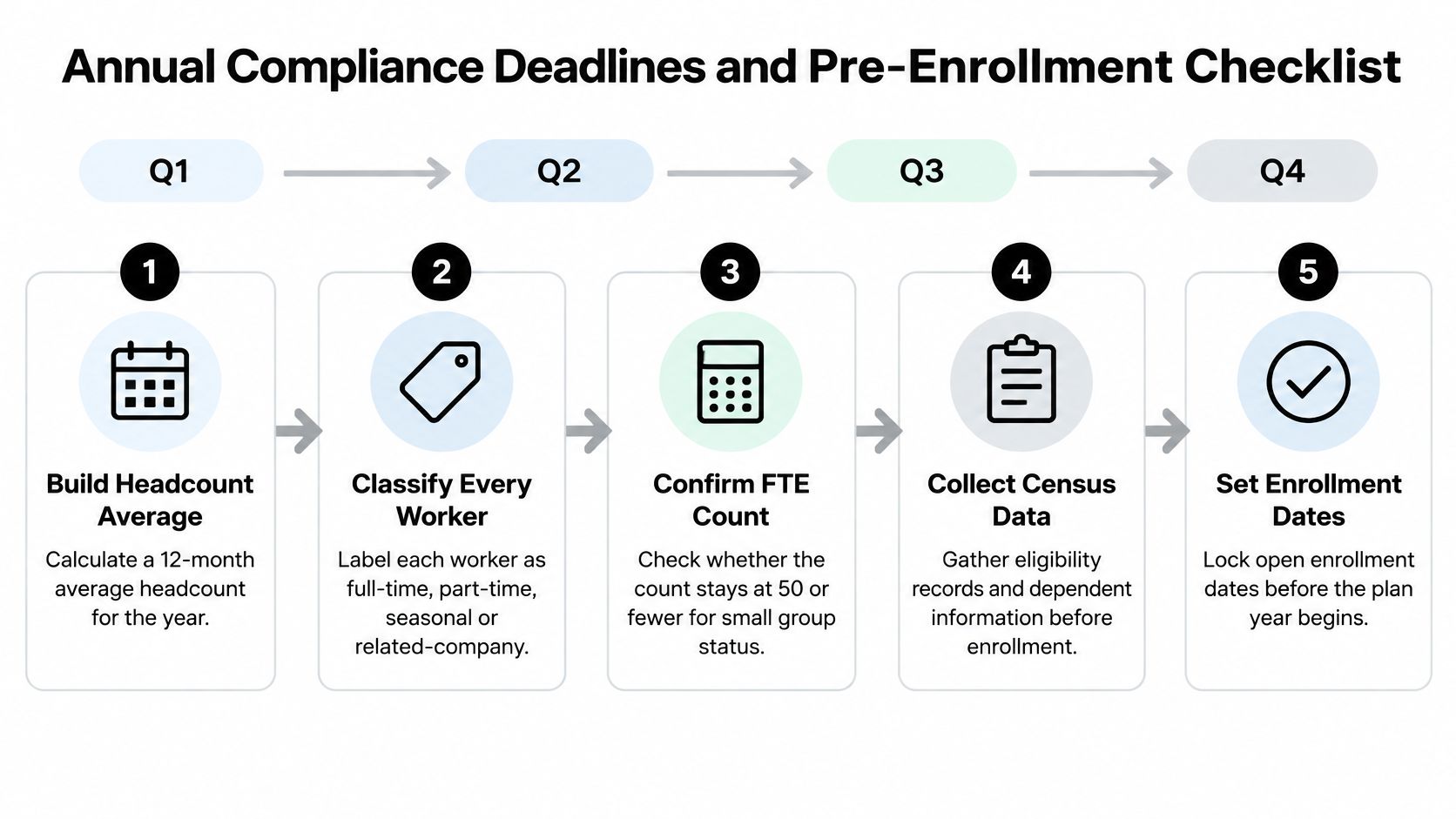
Treat compliance as a recurring payroll-and-benefits process, not a renewal-season scramble. Give each task an owner, a supporting record, and a completion date.
Use this visual to organize the workflow, while applying separate counting rules for market eligibility and ALE status.
Work through the annual cycle
Close the prior-year workforce calculation. The IRS ACA Information Center for Applicable Large Employers explains that ALE status generally follows a preceding-calendar-year average of at least 50 full-time employees, including full-time equivalents. Its full-time standard is generally 30 hours per week or 130 hours per month. Preserve payroll extracts, calculation methods, and any common-ownership analysis.
Assign the filing calendar early. Confirm whether Forms 1094-C and 1095-C apply, who prepares them, and who checks employee identifiers and coverage codes. Verify the current IRS filing and furnishing deadlines, electronic-filing requirements, and any weekend or holiday adjustments. Use an ACA reporting requirements checklist to coordinate HR, payroll, and your filing provider.
Reconcile workforce changes throughout the year. Match payroll hours to eligibility records monthly. Investigate employees appearing in payroll but not the enrollment system, and record employment dates, seasonal classifications, related-company relationships, and exclusions.
Check state market eligibility before requesting renewal proposals. Ask the broker to document the governing jurisdiction and current employee-count method. Don't reuse last year's classification without checking whether workforce size or state rules changed.
Validate offers and contribution design before enrollment. Build the full-time offer list, check dependent eligibility, and confirm minimum essential coverage, minimum value, and applicable affordability requirements. Document who approved the employee contribution schedule.
Calculate participation before submitting the application. In a hypothetical offer group of 20 employees, a 70% requirement means 14 must enroll or have qualifying coverage elsewhere. Collect acceptable waiver information rather than recording every non-enrollment as a rejection.
Schedule enrollment and disclosures together. Use the participation-waiver window when relevant, but don't mistake it for the only time an employer can obtain SHOP coverage. Deliver the SBC at the applicable enrollment triggers and update the SPD or material-modification notice when required.
Audit the completed enrollment. Compare employee elections, payroll deductions, carrier confirmations, and governing documents. Resolve discrepancies before employees need care, and retain delivery records and the final eligibility census.
A video can complement the checklist during an HR planning meeting, but current agency guidance should control filing decisions.
Understand the penalty calculation
HealthCare.gov's explanation of how the ACA affects businesses describes the 95% offer standard and the $2,000 annualized baseline penalty per full-time employee, indexed for later years, excluding the first 30 employees, when the applicable failure and Marketplace tax-credit conditions are met.
For a hypothetical ALE with 80 full-time employees that fails the offer standard and has a qualifying tax-credit recipient, the baseline arithmetic is (80 − 30) × $2,000 = $100,000 before indexing. That's an illustration, not a current penalty quote. Use the IRS-published indexed amount and applicable assessment rules for the year under review.
Frequently Asked Questions and Next Steps
Can an owner-only business use SHOP?
No. SHOP requires a qualifying employee who isn't the owner, the owner's spouse, or a family member. An owner's interest in buying business coverage doesn't establish employer eligibility by itself.
Confirm worker status before applying. Someone described as a contractor or business partner may not satisfy the employee requirement.
Does a small employer have to offer coverage?
A business below the federal ALE threshold generally doesn't have an ACA employer-mandate obligation. That doesn't settle state requirements, promises in employment agreements, or obligations that arise once the business establishes a plan.
Separate the decision to offer coverage from the duties involved in administering it. Voluntary sponsorship still requires accurate eligibility decisions and applicable disclosures.
What happens when headcount grows midyear?
A hiring surge doesn't automatically determine ALE status that day. The prior-calendar-year calculation generally establishes status for the current calendar year, subject to applicable rules and exceptions.
Review the trend while hiring, not after renewal. Give finance an early estimate of the administrative and contribution changes that may follow growth.
Are seasonal workers always exempt from coverage offers?
No blanket exemption applies across every health-plan rule. SHOP's treatment of seasonal employees shouldn't be used as a universal answer to ACA employer-mandate questions.
Evaluate actual hours, the applicable measurement method, and the governing plan terms. Keep the reasoning in the eligibility file rather than relying on a seasonal job title.
Before approval: Ask HR, payroll, and the broker to sign off on the same employee census, offer list, contribution schedule, and document set.
Before filing or enrolling, check HealthCare.gov for SHOP requirements, the IRS for employer reporting instructions, and the Department of Labor's Employee Benefits Security Administration for disclosure guidance. Choose the purchasing route, confirm applicable state rules, and resolve ownership of each administrative task before opening employee elections.
Benely offers benefits brokerage, plan comparison, enrollment tools, and HR support for employers evaluating small group coverage and PEO options. Visit Benely with your workforce census, renewal documents, and contribution budget to discuss coverage options and clarify who will manage eligibility, enrollment, and compliance tasks.