Your benefits portal shows two plans side by side, and the cheaper one is cheaper by a lot. It's also the one with a deductible in the thousands, a small "HSA-qualified" tag, and a column you don't fully understand.
Many people pick based on the premium alone. That's the one number that shows up in a paycheck, so it feels like the main cost. It isn't. The premium is what you pay to have the plan. The rest of the year is where the money moves, and the difference between a good decision and an expensive one usually comes down to when your bills arrive, not just how big the annual total is.
This walkthrough follows that money in order, from the first dollar you spend to the claim that lands months later, with the confusion points marked along the way.
Table of Contents
- The Deductible and Out-of-Pocket Maximum Explained
- Which Costs Count Toward the Deductible
- How an HSA Pairs With the Plan to Cut Your Tax Bill
- How HDHP and Traditional Plan Costs Compare
- Cash-Flow Risks for Lower-Income Workers and Chronic Care
- Enrollment and Claims From Start to Reimbursement
- How Employers Evaluate an HDHP Offer
- Confirm an HDHP Fits Your Budget Before Open Enrollment
The Deductible and Out-of-Pocket Maximum Explained
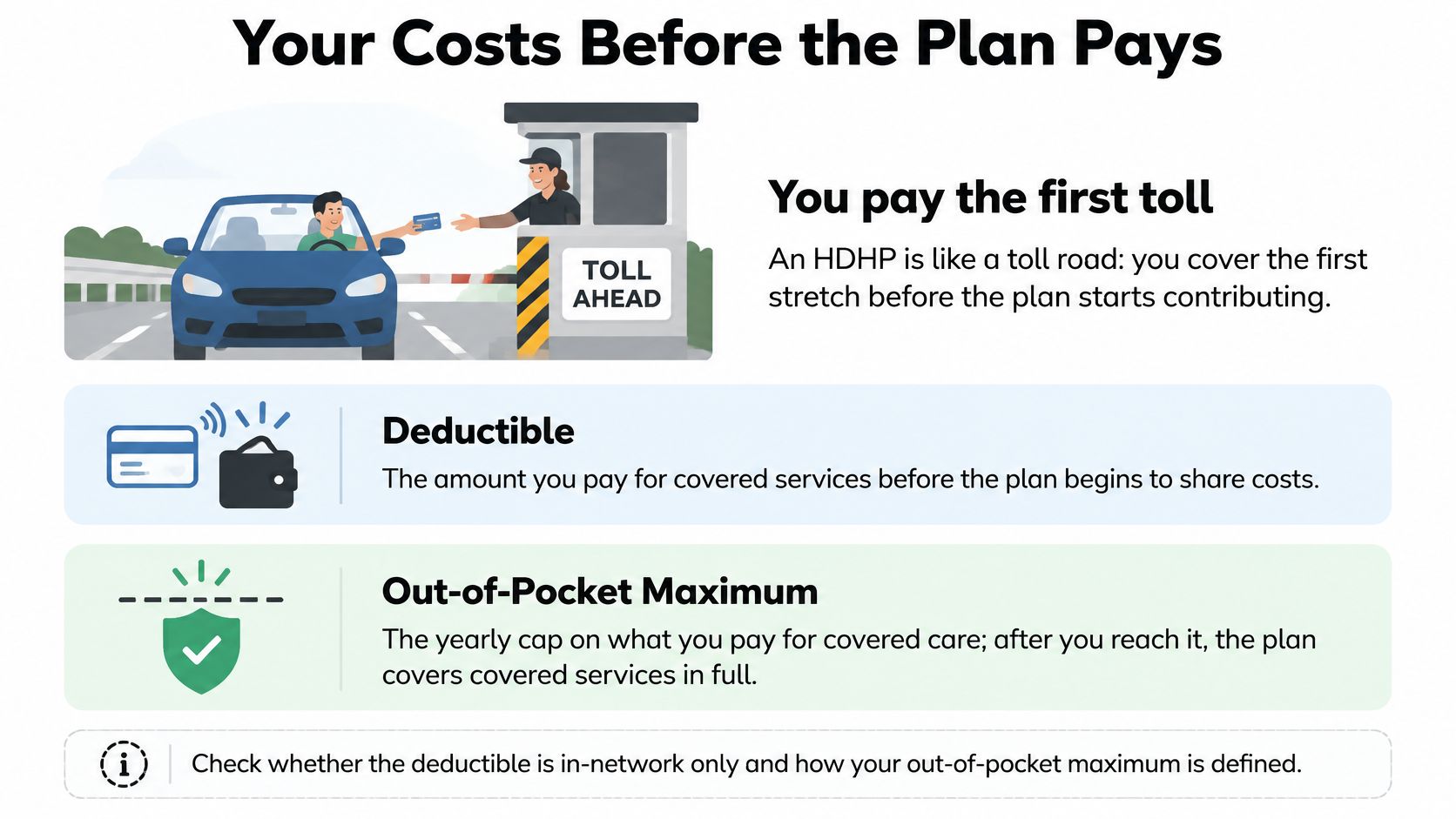
An HDHP behaves like a toll road. You pay the first stretch at the booth yourself, and once you've paid enough, the plan picks up most of the cost of the rest of the trip. Nearly every misunderstanding about these plans comes from not knowing where that booth sits on the road.
The deductible is the amount you pay for covered services each year before the plan begins paying for most eligible care. Preventive services, such as recommended screenings and checkups, are generally covered without you meeting the deductible first. That's why a March physical can cost nothing while a March visit for back pain does not.
Run the arithmetic on one bill
Say you need a $6,000 outpatient surgery. Your plan has a $1,700 deductible and 20% coinsurance. You pay the first $1,700. The plan then shares the remaining $4,300, and your 20% of that is $860. Your total is $2,560, and the insurer absorbs $3,440.
That's the entire mechanism, and it clears up the most common confusion: meeting the deductible doesn't end your spending, it just moves you to a smaller share of each bill. Coinsurance is that percentage. Copayments are flat dollar amounts, and plenty of plans use one for hospital care and the other for office visits.
The ceiling that makes the year finite
The out-of-pocket maximum is the most you'll pay for covered, in-network care in a plan year. The deductible counts toward it but cannot exceed it, and premiums never count. Once you reach the ceiling, the plan covers covered services in full for the rest of the year.
One detail trips people up: plans using provider networks generally calculate the limit using only in-network expenses, so an out-of-network bill can sit outside the cap entirely. Knowing what counts toward an out-of-pocket maximum before you pick a plan is worth more than the premium comparison.
Federal rules set a floor. For 2026, an HSA-qualified high-deductible health plan must have a minimum annual deductible of $1,700 for self-only coverage or $3,400 for family coverage, and its combined deductible and other in-network out-of-pocket expenses cannot exceed $8,500 for self-only coverage or $17,000 for family coverage, per IRS Publication 969.
| 2026 limit | Self-only coverage | Family coverage |
|---|---|---|
| Minimum annual deductible | $1,700 | $3,400 |
| Maximum out-of-pocket limit | $8,500 | $17,000 |
Those are minimums and maximums, not your plan's actual numbers. A plan can set a deductible well above the federal floor, so the figure printed on your own summary of benefits is the one to budget against.
Which Costs Count Toward the Deductible
Two plans can both advertise a $2,000 deductible and leave you with very different bills by June. The gap usually comes from which services are exposed to the deductible. The size matters less than the order in which bills arrive.
Preventive care usually sits in front of the deductible. Office visits for illness, labs, imaging, specialist care and surgery typically sit behind it. Prescription rules deserve their own check because a drug deductible can run in parallel with the medical one.
| Service | Counts toward deductible first? | What to check |
|---|---|---|
| Preventive screenings and checkups | No, generally | Covered in full in-network under ACA rules |
| Office visits for illness | Usually yes | Negotiated rate applies to the deductible |
| Lab tests and imaging | Usually yes | Ask for the negotiated price before the test |
| Prescription drugs | Often yes in HSA-qualified plans | Ask whether maintenance drugs sit on a preventive list or behind the deductible; a separate drug deductible can run alongside the medical one |
| Emergency room visit | Usually yes | Compare with urgent care costs in network |
| Specialist visits and surgery | Usually yes | Referral and prior authorization rules may apply |
Here's the piece almost nobody explains: the amount credited toward your deductible is the negotiated rate, not the sticker price on the hospital's website. A $4,000 list-price MRI might be $900 under your plan, and only the $900 counts. Ask the provider for the negotiated rate for the specific procedure code before you schedule. That single call is the highest-return five minutes in this whole process.
That timing is where a low premium can turn expensive. If your predictable care lands in February and March, you may pay the negotiated rate for visits, tests and prescriptions before the plan starts sharing costs. For a worker with tight cash flow, the practical barrier is often the first few bills of the year, not the annual maximum.
What the evidence says about timing
A VA-linked cohort of patients with inflammatory bowel disease found that HDHP enrollment increased annual out-of-pocket spending from $1,864 to $2,870 without changing total healthcare spending, and it affected the timing of colonoscopies, emergency visits and hospitalizations, according to VA Health Services Research and Development. People didn't get less care overall. They moved it around, delayed it, and sometimes let a flare escalate first.
Adults managing several chronic conditions face a higher risk of delaying care because of cost than adults with one condition. The more often a condition needs attention, the more chances the deductible has to turn a routine month into an expensive one.
So before you enroll, ask your benefits team four things: which expected services fall under the deductible, what copays apply after it's met, what the in-network rates look like for your recurring care, and what your worst-case year costs.
The question that matters: which of my predictable expenses does the deductible touch, and when in the year does that cash leave my account?
How an HSA Pairs With the Plan to Cut Your Tax Bill
A health savings account is not part of the insurance policy. It's a separate bank account you own, and it exists because the IRS allows one alongside an HSA-qualified HDHP. Three tax advantages stack: contributions reduce your taxable income, the balance grows without tax drag, and withdrawals are tax-free for qualified medical expenses.
Put a number on it. A $3,000 contribution at a 24% federal income tax bracket saves about $720 in federal income tax. Ignore payroll and state taxes for a moment and that alone can erase the gap between a cheap plan and a slightly better one.

The cash flow in order
- Contribute during the year, through payroll deduction or directly, so the money is there before you need it.
- Pay the bill yourself at the time of care, or let the account pay the provider if your HSA administrator supports it.
- Keep the receipt for anything you pay out of pocket.
- Reimburse yourself from the account whenever you like, this month or years later, as long as you have documentation.
- Leave the rest invested if you can afford to. Unused balances roll over year to year with no deadline, which is what makes the account double as long-term medical savings.
The IRS explains the same flow: people commonly pay expenses themselves until the deductible is reached and then request an HSA distribution, records must be retained, and the same expense can't also be claimed as an itemized deduction. Keep receipts in one folder, scanned and labeled by date, and don't double-dip.
The check before you count on the savings
Confirm the plan is HSA-qualified. Plenty of plans have high deductibles without meeting the IRS tests, and no qualifying plan means no account, no tax deduction, and no employer contribution. If you're an employer setting this up, how employer contributions to a health savings account work determines whether your staff can cover January care or wait until March for payroll to catch up.
How HDHP and Traditional Plan Costs Compare
Compare the two designs, and the premium stops being the deciding number. An HDHP shifts more initial medical spending to the enrollee in exchange for a generally lower monthly premium. A traditional plan asks for more each month and less at the point of care. Both are defensible. They're just built for different years.
| Criterion | HDHP with HSA | Traditional plan |
|---|---|---|
| Monthly premium | Generally lower | Generally higher |
| Annual deductible | At least $1,700 self-only, $3,400 family in 2026 | Set by plan, often lower |
| Out-of-pocket maximum | Up to $8,500 self-only, $17,000 family in 2026 | Set by plan, usually without the HSA-qualified caps |
| Preventive care | Generally covered before deductible | Generally covered in full in network |
| Tax-advantaged savings account | HSA available | Usually none |
According to HealthCare.gov's HDHP and HSA overview, the core trade-off is exactly this: lower recurring premiums paired with substantially higher exposure when someone needs care, with the out-of-pocket ceiling as the protection against unlimited covered expenses.
The break-even, step by step
- Subtract premiums. Take the traditional plan's annual premium and subtract the HDHP's annual premium.
- Estimate the extra cost-sharing. Add up what you'd pay toward the HDHP deductible and coinsurance in a typical year for your household.
- Net them out. If the HDHP saves $1,200 a year but expected extra cost-sharing is $1,500, the HDHP costs $300 more before taxes.
- Add the tax benefit. At $720 of federal income tax saved on a $3,000 HSA contribution in a 24% bracket, that $300 gap closes and the HDHP comes out slightly ahead.
That's the whole calculation, and it flips based on who's covered. Low expected use plus cash on hand usually favors the HDHP. Frequent prescriptions, standing specialist visits or a planned procedure often favor the traditional plan, especially when cash is tight.
Two more things move the answer without touching the deductible: whether the family deductible is embedded (one member can satisfy an individual amount) or aggregate (the full family amount comes first), and how the plan handles drugs and referrals. Comparing premium and deductible alone is how employers end up choosing a high premium, low deductible plan for a healthy team that would have done better with the cheaper one. Decide on your worst year, not your average one.
Cash-Flow Risks for Lower-Income Workers and Chronic Care
The lowest premium can create the highest practical barrier to care. That's the pattern the data shows, and it's the part of the HDHP conversation that gets skipped in favor of annual totals.

In a study published in JAMA Internal Medicine, 57% of lower-income families enrolled in HDHPs reported delaying or forgoing care because of cost, compared with 42% of higher-income families, with adjusted odds 1.81 times higher for the lower-income group. Same plan design. Very different experience.
The evidence is mixed, and pretending otherwise doesn't help anyone. Cost-sharing does reduce low-acuity emergency use and some unnecessary spending. It works as a blunt instrument, though, and it also suppresses high-value care for people managing chronic disease. A prescription refill doesn't check your account balance first.
Annual maximums get the attention because they're the biggest number on the page. For a household living paycheck to paycheck, the sharper question is when the costs land. A deductible equal to several weeks of take-home pay, due in full at the first hospital visit in February, functions like a locked door, even when the ceiling behind it is generous.
The liquidity test
Ask one question: could this household cover the deductible in the first month of the plan year, without borrowing or skipping care? If the answer is no, the annual math stops mattering. The plan year doesn't start in December. It starts in January, with the full deductible still sitting in front of you.
A few situations reliably catch people out:
- A midyear hire who joins in July faces the entire deductible with only half a year of paychecks left to spread it across.
- A deductible that resets every January means a family that drained savings to meet it in December starts over a few weeks later.
- Monthly prescriptions get paid twelve times whether or not the deductible is met, and insulin doesn't wait for a reimbursement.
- Invisible prices make planning impossible. If nobody can see the cost before treatment, nobody can budget around it.
Run this before you enroll: add up your worst-case in-network cost for the first 90 days of the plan year. If the household can't pay that figure without cutting care, a higher premium with a lower deductible may genuinely cost less in the end.
Enrollment and Claims From Start to Reimbursement
Once the plan is live, the process is more procedure than mystery. Almost every complaint traced back to a denied or misrouted claim starts with a step that got skipped in the first two weeks.
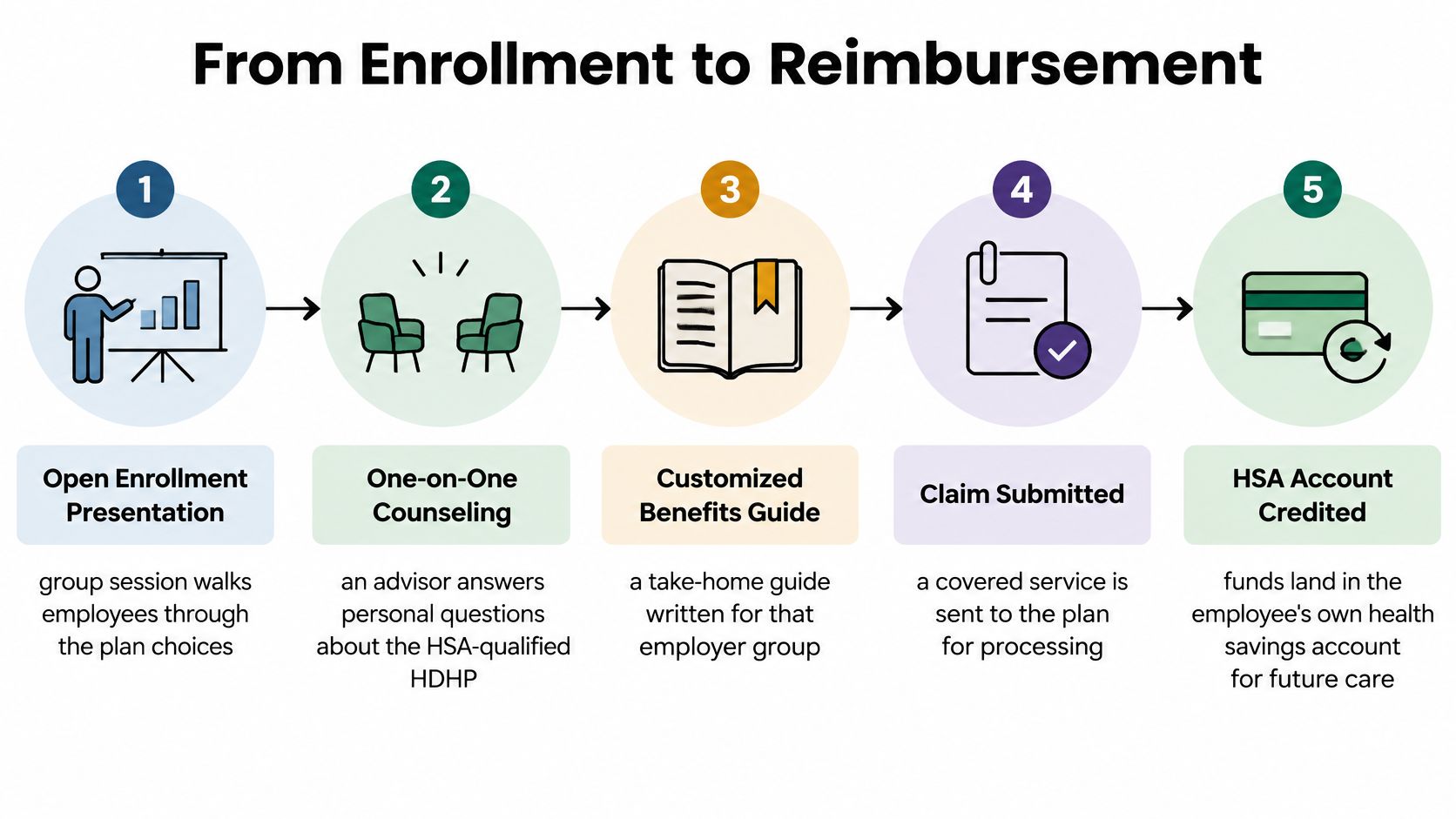
Open enrollment is the moment to ask questions, not the following February. A well-run process includes group virtual and in-person presentations, one-on-one counseling, a customized benefits guide and customized benefits videos from the Benely team, plus reconciliation of enrollments and submission, so what you chose is what the carrier received.
- Choose the HDHP and set your HSA contribution during the enrollment window. Pick the payroll amount deliberately, not the default.
- Confirm HSA qualification and network status. Verify the plan meets the IRS tests, then check that your doctors, your hospital and your pharmacy are in network.
- Get care and pay the negotiated amount until the deductible is met. Ask for the rate before the appointment, not after the bill.
- Read the Explanation of Benefits every time. It isn't a bill. It's the record of what was charged, what was allowed, and what you owe.
- Track your deductible and out-of-pocket totals in the plan portal monthly. Errors in accumulation are common and easy to fix early.
- Reimburse yourself from the HSA for qualified expenses, or let the account pay the provider if your administrator allows it.
- Escalate a bad claim. If something is denied or billed wrong, contact the benefits decision support team by phone, chat or email. They help with claims, and they see patterns you can't from one bill.
- Save the records. Receipts, EOBs and statements, in one folder, for tax purposes.
By the end of the first quarter you should have two things: a simple tracker showing how much of your deductible and out-of-pocket maximum you've used, and a folder of receipts that are reimbursable whenever you need the cash back.
How Employers Evaluate an HDHP Offer
If you're the one choosing and funding the plan, the test isn't the premium. It's whether your staff can pay their early bills without delaying care. Five checks get you there.
1. Write the premium difference in dollars. State it for one employee and separately for a family. Averages hide the family case, and the family case is where the pain lands.
2. Record the worst-case in-network exposure. An HSA-qualified plan in 2026 can require as much as $8,500 self-only or $17,000 for a family, and the deductible on the summary can sit well above the federal minimum. That ceiling is the number to put next to the payroll deduction.
3. Mark the family deductible as embedded or aggregate. Embedded lets one member satisfy an individual amount. Aggregate makes the whole family amount come first. Same premium, wildly different experience for a household with one sick child.
4. Check network depth, prior authorization and drug rules. Whether maintenance medications are exempt or sit on a separate drug deductible decides more January behavior than the deductible itself.
5. Set the employer contribution before anyone sees the options. A seed deposited at the start of the year covers January care for people without savings. Payroll contributions spread your cost across twelve months. Midyear hires need either a prorated seed or a written policy, decided in advance.
Sequencing rule: fund the account first, then present the plans. Employees who learn the deductible is already partly covered make a different decision than employees who find out in March.
This is the step where an independent comparison earns its keep. In the evaluation stage, Benely compares your current insurance plans with other market options to find the most cost-effective solutions, and the final decision stays with you. We shop, analyze and personalize group benefits in simple steps rather than pushing a single design. Weigh your premium savings against the chance that lower-paid staff delay care, and don't treat two HDHPs with the same premium as the same plan.
Confirm an HDHP Fits Your Budget Before Open Enrollment
Run one household through a full year before you commit. A family enrolls in a 2026 HSA-qualified HDHP with a $3,400 deductible, 20% coinsurance and a $17,000 out-of-pocket ceiling. The traditional plan they passed up costs $1,200 more per year in premium.
The quiet year. Only recommended checkups happen. Preventive visits are generally covered before the deductible, so the family pays nothing toward it and keeps the $1,200 premium savings. A $3,000 HSA contribution at a 24% federal bracket saves roughly $720 in federal income tax on top. The HDHP wins clearly, which is exactly why healthy households like it.
The surgery year. One person needs a $6,000 procedure in February. The household pays the $3,400 deductible plus 20% of the remaining $2,600, which is $520, for a total of $3,920. That cash is due early, months before the ceiling matters and long before the premium savings have accumulated. The ceiling protects against catastrophe, not against February.
The four moving parts stack in a fixed order: premium out of every paycheck, then the deductible, then coinsurance on the bills after that, then the ceiling that ends the exposure. The first is predictable. The second and third arrive when someone gets sick, which is never on schedule. A plan that looks cheaper on a spreadsheet can be the more expensive one for a worker who would have to charge a February bill to a credit card or postpone the procedure entirely.
The practical rule: pick the HDHP only when a bill in that $3,920 range is affordable from savings, or when you can pay out of pocket and reimburse yourself from the HSA once payroll contributions build the balance. Subtracting whatever sits in the HSA from the deductible tells you the cash you need on hand early in the year. Confirm the plan meets the IRS tests for an HSA, meaning the minimum deductible and the out-of-pocket cap, keep receipts for qualified doctor, dental and hospital costs, and don't claim the same bill as an itemized deduction.
Through Benely you can set a budget, compare and enroll in more than 4,000 plans. If you want a second opinion before you commit, rate your benefits process on our "What's Your Benefits Score?" tool and we'll send you a free 30-page benefits guide.
Benely's benefits decision support team answers benefits questions by phone, chat or email and helps with claims, so the choice you make in November still holds up when the first bill arrives. Start by comparing your options and setting a budget at Benely.