
You're staring at renewal quotes that jumped again, and a group plan that half your team barely uses. Payroll is tight, two people work out of state, and someone just asked whether a health reimbursement arrangement would be simpler than another carrier quote. QSEHRA vs ICHRA is the choice in front of you, and the wrong one either blocks a Marketplace subsidy or leaves money on the table.
Both arrangements reimburse individual coverage instead of buying a traditional group policy. They are not interchangeable. One is a capped, uniform benefit for a qualifying small employer. The other is a class-based allowance with room to differ by pay, location, or job type. The decision also turns on whether people will enroll, and on whether your allowance knocks them off a premium tax credit.
Table of Contents
- QSEHRA vs ICHRA Side by Side
- Contribution Limits and Allowance Design
- Affordability Math Behind Premium Tax Credits
- Why Employee Adoption Stalls and What It Costs
- Which Arrangement Fits Each Business Situation
- Confirm Your Fit and Take the Next Step
QSEHRA vs ICHRA Side by Side
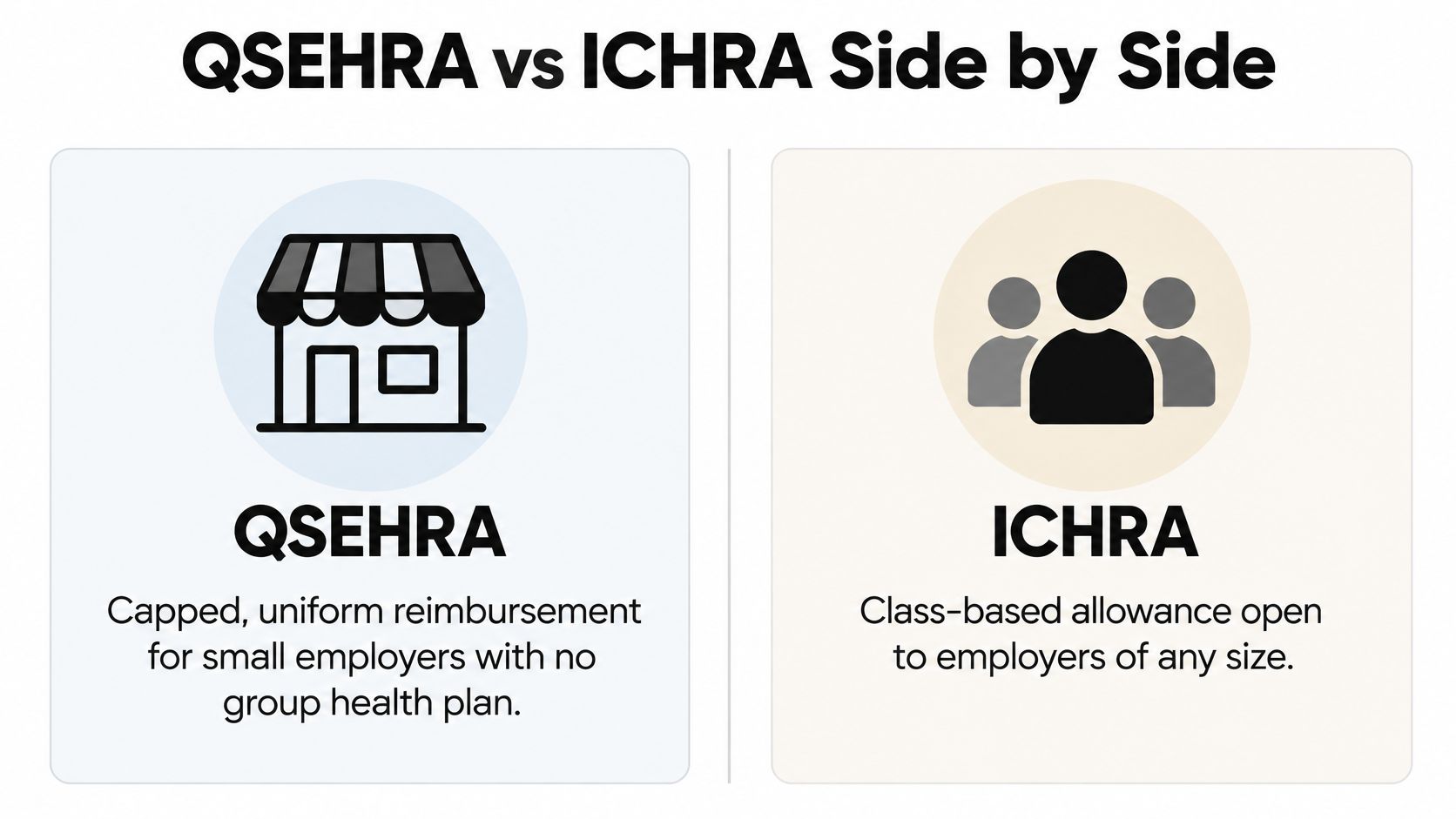
QSEHRA is a capped, uniform reimbursement arrangement for small employers that offer no group health plan. ICHRA is a class-based allowance open to employers of any size, with no federal annual ceiling on what you reimburse.
| Criterion | QSEHRA | ICHRA |
|---|---|---|
| Employer size | Generally fewer than 50 full-time and full-time equivalent employees | Any employer size |
| Group health plan | Employer cannot offer one, including SHOP coverage or a health FSA | Cannot be offered to employees who are also offered a group plan |
| Annual contribution | Capped by an IRS-indexed amount | No federal annual ceiling |
| Terms across employees | Same terms for all eligible full-time employees | Same terms within each employee class; classes may receive different amounts |
| Permitted variation | Age and number of covered individuals | Employee class, geography, employment status, age and dependents |
| Coverage reimbursed | Individual-market coverage | Individual-market coverage, including Medicare |
| Opt-out | Uniform offer to eligible employees, without a matching annual opt-out | Employees generally may opt out annually |
| Affordability benchmark | Second-lowest-cost Silver self-only plan | Lowest-cost Silver self-only plan |
The Congressional Research Service draws the structural line at eligibility and contribution control. A QSEHRA is generally limited to employers with fewer than 50 full-time-equivalent employees that do not offer a group health plan, and its annual reimbursement sits under an IRS-indexed statutory cap. An ICHRA can be offered by employers of any size, has no federal annual contribution ceiling, and can set different allowances by permitted employee classes, geographic area, or employment status.
Both arrangements reimburse individual-market coverage, never group premiums. The last two rows of the table are where the decision happens, and most comparisons bury them. Opt-out rights shape adoption: an ICHRA allowance that employees decline leaves them uninsured and your program underused, while a QSEHRA offer is uniform to every eligible employee by design. The affordability benchmark row decides the subsidy question. Because each arrangement is tested against a different Silver plan, the same allowance can leave an employee eligible for a premium tax credit under one structure and locked out of it under the other.
Run the eligibility check before you budget
The IRS QSEHRA guidance limits QSEHRA to small employers that generally had fewer than 50 full-time employees and full-time equivalents in the prior calendar year. You also cannot offer a group health plan, including SHOP coverage or a health FSA, and you must use the same terms for eligible full-time employees. Amounts may vary only for age and the number of covered individuals.
- Count full-time employees and full-time equivalents for the prior calendar year.
- Confirm you offer no group health plan, SHOP plan, or health FSA.
- List people you may exclude: certain employees under age 25, part-time or seasonal workers, some union employees, and certain nonresident aliens.
- Mark anyone already offered group coverage. An ICHRA has to stay out of that group.
Eligible employees generally must receive the QSEHRA after no more than a 90-day waiting period.
Practical rule: If every eligible employee should get the same amount, check QSEHRA first. If amounts must differ by class, ICHRA is the likely route.
Confirm the indexed QSEHRA cap for the current year before you lock a budget. That figure moves, and last year's maximum is not this year's maximum.
Contribution Limits and Allowance Design
A QSEHRA dollar amount starts from a ceiling. The annual reimbursement is capped by an IRS-indexed limit that changes each year, so pull the current figure before you promise a monthly number. Inside that cap, the only permitted differences are the employee's age and how many people the reimbursement covers. You cannot build a higher tier for your Denver office or a lower one for hourly staff.
An ICHRA has no matching federal annual ceiling. That is what lets you set a different allowance by permitted class: full-time versus part-time, salaried versus hourly, or geographic tiers where local individual premiums are not the same. Amounts may also rise for older workers or employees with more dependents. Participants must substantiate individual coverage, and they generally may opt out each year, so the allowance you publish is not the allowance you will pay.
Class design is the compliance work people skip. A class that is too small, or a split that tracks pay in a way the rules do not allow, can undo the whole arrangement. Read the class and notice rules on our health reimbursement arrangement rules page before you publish amounts.
A four-step allowance build
- Define classes with permitted criteria only. Job type, hours, and work location are the usual splits. A class built around who you like is not a class.
- Price each class against local individual-market premiums, not against what the group plan used to cost.
- Check class-size and nondiscrimination rules before open enrollment, not after the first complaint.
- Test each allowance against the affordability threshold in the next section. A generous number can be the one that costs an employee a subsidy.
Illustrative example, not a recommendation. Say Class A, your in-office full-time staff, gets $300 a month. Class B, remote staff in a higher-premium rating area, gets $500 a month. Over a year that is $3,600 versus $6,000 before anyone opts out or fails to substantiate coverage. The $200 gap is the point of ICHRA. It is also the number you have to defend under the class rules, and the number that changes each person's net premium.
If your headcount is still under the QSEHRA size test and everyone can live with one formula, the cap is a feature. It stops a well-meant raise in the allowance from blowing the budget. If two offices face very different Silver premiums, one formula usually underpays one group and overpays the other.
Affordability Math Behind Premium Tax Credits
Two employees can receive the same $400 allowance and land on opposite sides of a Marketplace subsidy. Affordability is the switch that decides which one keeps the premium tax credit. For 2025, CMS treats an ICHRA as affordable when the premium for the lowest-cost Silver self-only plan, minus the monthly allowance, comes to no more than 9.02% of one-twelfth of household income. CMS measures a QSEHRA against the second-lowest-cost Silver self-only plan. Confirm the percentage for the plan year you are modeling, because it is indexed and 9.02% is the 2025 figure.
If the arrangement is affordable, the employee generally cannot claim the premium tax credit for that coverage period. If it is unaffordable, the employee may keep eligibility, subject to the applicable rules. Headline reimbursement size is the wrong scoreboard. The net premium left after the allowance is what each worker feels in a paycheck.
What 9.02% allows in 2025
The ceiling below is 9.02% of monthly household income. It is the most the employee can still owe for the benchmark Silver plan, after the allowance, while the ICHRA counts as affordable.
| Annual household income | Monthly income | Affordable net premium ceiling (9.02%) |
|---|---|---|
| $40,000 | $3,333 | $301 |
| $60,000 | $5,000 | $451 |
| $80,000 | $6,667 | $601 |
| $100,000 | $8,333 | $752 |
A $40,000 household can still owe about $301 a month for the benchmark plan and have the ICHRA count as affordable. A $100,000 household can owe about $752. If the benchmark Silver premium runs $900 and your allowance is $400, that leaves $500 owed, which is affordable for the higher earner and unaffordable for the lower one. Rating area shifts the benchmark premium, household income shifts the ceiling, and both feed the same test.
Model each income band
- Pull the benchmark Silver premium for each employee's rating area. ICHRA uses the lowest-cost Silver self-only plan. QSEHRA uses the second-lowest-cost Silver self-only plan.
- Subtract the proposed monthly allowance.
- Compare what is left with the affordability percentage of monthly household income.
- Repeat for each income band on your payroll, because a company-wide average hides the people sitting closest to the line.
You will rarely know an employee's household income, and collecting tax returns to guess is not worth the trouble. HiredBySkill's salary calculator turns posted pay bands into monthly figures you can drop into the 9.02% test, then stress-test a spouse's wages on top.
The household-income phase-out of the premium tax credit is set by IRS guidance for the current year, and the thresholds can shift between plan years. Run employees near the cutoff against the rules that apply to the year you are funding. An allowance that looks modest can still eliminate a credit someone was counting on, or sit just under the line and preserve it.
Judge the allowance by the net premium people face each month. The ACA compliance overview lines this test up with the rest of your employer obligations before you lock amounts.
Why Employee Adoption Stalls and What It Costs
A defined allowance plus “pick any plan” does not automatically produce a better benefit. KFF reported in 2025 that ICHRAs, promoted as a way for workers to buy ACA Marketplace or other individual coverage, had not taken off. That finding cuts against the assumption that choice is better than a group plan.

What stalls people
On the employee side, the work is real. They compare plans they have never seen, discover the clinic down the street is out of network, and then learn a medication sits on a different formulary. The allowance also interacts with subsidies, and Marketplace deadlines are not the same as your old group-plan window. A busy parent will often stick with last year's plan, or skip enrollment, when the packet feels like a second job.
On your side, the quiet costs are notices, eligibility classes, affordability testing, and substantiation that each person has individual coverage. Miss one of those and the “simple reimbursement” turns into cleanup during tax season.
The HRA Council's 2025 Growth Trends report found ICHRA adoption rose 34% among applicable large employers with more than 50 full-time employees from 2024 to 2025. That is growth at scale. It does not tell you whether a 12-person shop will see the same uptake. Large employers have HR staff to walk people through networks. You might have a shared inbox.
Track net value, not just the premium
- Participation rate: Count who substantiated coverage, not who was eligible on paper.
- Decision time: Ask how long a typical employee spent choosing a plan. If it is an evening plus a weekend, your support plan is too thin.
- Local plan count: A metro area with many Silver plans is a different product from a rural rating area with two.
- Support hours: Log the hours you, or a broker, spend each enrollment cycle on calls about networks and drug lists.
An unused allowance is not free. The hiring cost breakdown from TekRecruiter is a useful way to price what happens when a recruit compares your offer with a competitor's group plan and walks. Low participation is a retention cost, not only an administrative one. If you want a baseline for how peers handle enrollment friction, start with employee benefits survey benchmarks.
The lowest administrative cost or the most flexible design may not minimize total benefits friction.
I would not pick an arrangement on contribution level and payroll savings alone. Add participation, decision effort, local plan availability, and support hours to the scorecard before you call it a win.
Which Arrangement Fits Each Business Situation
The table below is a starting verdict. Subsidy position and a PEO relationship can still flip it.
| Situation | Likely fit | Why it fits |
|---|---|---|
| Fewer than 50 full-time equivalents, no group plan, same amount for all staff | QSEHRA | Uniform terms and capped amounts keep administration simple |
| Fewer than 50 full-time equivalents, no group plan, pay or location varies widely | ICHRA | Employee classes allow different allowances |
| 50 or more full-time equivalents | ICHRA | QSEHRA is not available, and ICHRA has no federal ceiling |
| Group plan offered to most or all staff | Keep the group plan | QSEHRA is barred, and ICHRA cannot reach employees who also get group coverage |
| Remote workers across several states | ICHRA | Geographic classes can set allowances to local premiums |
| Many employees near the subsidy cutoff | ICHRA, modeled first | The affordability test decides whether employees keep premium tax credits |
Two tie-breakers
Subsidy cutoff. If a large share of your staff sits near the income level where premium tax credits phase out, model the allowance before you fall in love with a class design. An ICHRA that tests as affordable can remove the credit. A smaller allowance that stays unaffordable can leave the credit in place and still help with the premium. That is a benefits decision, not a branding one.
A PEO in the middle. If payroll or benefits already run through a professional employer organization, plan design may not be fully yours. We partner with all the major PEO providers in the country, and the practical step is to ask that provider which arrangement the co-employment contract allows before you announce a class schedule to staff.
Can you mix the two?
No, not for the same employees. An employer cannot offer a QSEHRA alongside a group plan. An ICHRA cannot be offered to employees who are also offered traditional group coverage. You can keep a group plan for one permitted class and an ICHRA for a different class, subject to the class rules. You cannot hand the same person both, and you cannot bolt a QSEHRA onto a group plan “just for the hourly team.”
Use this short test when the table feels close:
- Write down your group coverage status, including any SHOP plan or health FSA.
- Count employees and the classes they fall into.
- Decide whether one reimbursement amount has to fit everyone.
- Check how many households are sensitive to the subsidy cutoff.
Treat the verdict as a starting point to confirm with an advisor and against current IRS and CMS guidance. It is not a determination letter.
Confirm Your Fit and Take the Next Step
Put six facts on one page before you choose. Prior-year full-time equivalent count. Group plan status, including any SHOP plan or health FSA. The employee classes you intend to use. The proposed allowance for each class. Affordability results for each income band. Any PEO or state constraint that limits what you can offer.
IRS guidance is the source for who may offer a QSEHRA, the uniform-terms rule, and how an ICHRA must be offered inside a class. CMS affordability rules are the source for the Silver-plan test and the year's percentage. KFF's 2025 analysis is the reminder that ICHRA uptake is not automatic, so build support time into the plan instead of assuming enrollment will fill itself.
Move from notes to a decision
- Write the allowance design on paper, class by class, with the annual QSEHRA cap checked if that is the path.
- Run the affordability test for each income band, using the right Silver benchmark for the arrangement you picked.
- Confirm eligibility against current IRS.gov and CMS.gov guidance, including notices and substantiation.
- Bring the plan to an advisor who can carry implementation and the compliance paperwork.
Our Benefits Advisors manage a client's insurance program from plan design through to the compliance paperwork, which is the step where class definitions and affordability results usually need a second set of eyes. You can start that conversation at benely.com.
A short walkthrough of how individual coverage reimbursement is explained to employees:
Choose QSEHRA for a uniform benefit at a qualifying small employer, and ICHRA when classes, locations, or pay bands need different allowances.
Benely helps small and mid-sized employers compare individual and group options, set a reimbursement budget, and keep enrollment and compliance in one place. If you are weighing QSEHRA against ICHRA, a benefits advisor can pressure-test your headcount, classes, and affordability math before you announce an allowance. Visit Benely to start that review with your current census and renewal date.