

A broker of record is the insurance broker a business formally designates in writing to represent and service its policies with its carriers. That single designation decides who your carrier calls, who can pull your claims history, and who sits across the table when your renewal lands.
It's an administrative document with operational consequences. Get it wrong, or never update it, and the broker your HR team emails every week may not be the broker your carrier recognizes.
Most of the confusion around a broker of record comes from tangling three separate things: who represents you, what your policy covers, and how your broker gets paid. The letter controls only the first. Plan terms and rates live in the policy, and compensation lives in an arrangement the carrier administers. Keep those three apart and the term stops being mysterious.
This guide defines it, shows what the role covers day to day, walks through how the letter gets appointed and changed, compares the broker with an insurance agent, and hands you the checklist a plan fiduciary should run before signing anything.
Table of Contents
- What Is a Broker of Record?
- What a Broker of Record Does for Your Business
- How a Business Appoints a Broker of Record
- Broker of Record vs Insurance Agent
- Real-World Broker of Record Scenarios
- How Brokers Are Paid and What Fiduciaries Should Verify
- How to Change Your Broker of Record Without Disrupting Coverage
- Appoint or Change Your Broker With Confidence
What Is a Broker of Record?
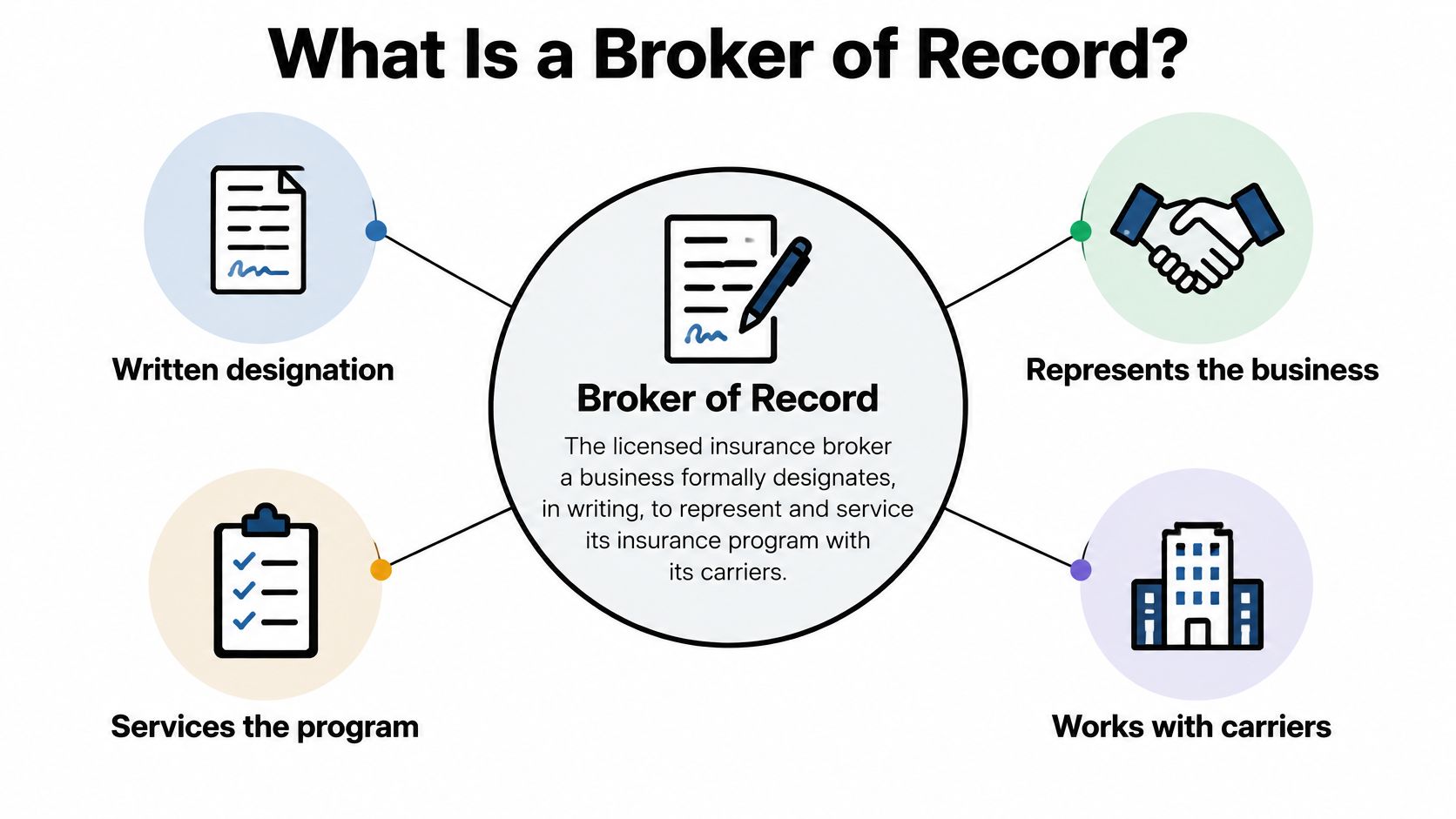
Broker of record: the licensed insurance broker a business formally designates, in writing, to represent and service its insurance program with its carriers.
The designation exists because carriers need one answer to a simple question: who speaks for this employer? A carrier will take servicing instructions, renewal submissions, and claims escalations from one broker per policy per line of coverage. The broker of record is that named party.
In 2024, 95.8% of 58,346 U.S. employers with at least 100 people on their main health plan named at least one broker in their Form 5500 filings, according to Eleos Life's analysis of Department of Labor filings. Read the scope carefully, because it's narrower than it sounds. That figure counts employers that named a broker on a federal plan filing, not the number of broker of record letters in circulation. What it does tell you is that paying a broker to run a benefits program is the standard arrangement once a company reaches real headcount, not a boutique choice.
The authorized representative analogy
Think about a business bank account. The account owner can add an authorized representative who may call the bank, request statements, and handle day-to-day matters. The money still belongs to the business, and the owner still answers for how it's used.
A broker of record letter works the same way. It tells the carrier who is allowed to act on the account. It does not transfer ownership of anything, and it does not move your fiduciary duties onto the broker. If your company sponsors an ERISA-covered health plan, the plan sponsor stays responsible for selecting and monitoring service providers, prudently, with documentation.
One more scope note. The same concept applies to property, liability, and workers' compensation coverage, but this guide stays on employee benefits and group health, where the letters show up most often and cause the most confusion.
What the designation actually controls
Three practical things hinge on that signed page:
- Who may communicate with the carriers. Your account manager, your claims escalator, and the person copied on renewal correspondence.
- Who services the account day to day. Eligibility questions, billing discrepancies, ID card problems, and mid-year plan changes.
- Who is the point of contact at renewal. The broker who receives the rate package and prepares your options.
Everything else, from deductibles to employee premiums, stays where the policy put it. That's the whole point of separating representation from coverage.
What a Broker of Record Does for Your Business
The designation is only worth the work it puts under one accountable name. Strip away the paperwork and a broker of record is a service relationship with a single owner, so you're never forwarding the same claim question to three different inboxes.
A capable broker sits between your workforce data and the carrier market. Say a 60-person manufacturer with a heavy technician population sees a renewal increase that lands above what comparable groups are paying. The broker pulls the census, checks the plan's utilization against the market, prices two alternative designs, and brings you three scenarios with the tradeoffs spelled out. That's one afternoon of your time instead of six weeks of carrier emails.
The responsibility splits into six areas, and it helps to know which ones you're buying.
| Responsibility | What the broker does | What it means for the employer |
|---|---|---|
| Plan design and needs analysis | Translates headcount, budget and workforce needs into plan structures | Options matched to budget and talent goals |
| Market access and quoting | Requests quotes across carriers and plan types | Comparable options without contacting each carrier |
| Negotiation and renewal strategy | Benchmarks rates and negotiates terms at renewal | Renewals entered with data and alternatives |
| Enrollment and onboarding | Coordinates eligibility, enrollments and employee communications | Less HR time on paperwork during onboarding and open enrollment |
| Employee support and claims advocacy | Answers employee questions and escalates claim or billing issues | A knowledgeable contact for employees and fewer escalations for HR |
| Compliance support | Helps with ACA reporting, COBRA, ERISA wrap documents and filings | Lower risk of missed filings and penalties |
Where the broker's job ends and yours begins
The broker advises, quotes, and administers. You decide. Final plan selections, contribution strategy, and funding are the employer's call, and so is fiduciary responsibility for an ERISA-covered plan. No letter moves that.
That division matters when a claim goes sideways. A mispriced hospital bill should reach the broker's claims team before it reaches your CFO, and it should arrive with the plan document already cited. A strong broker can tell you which plan provision applies and what the carrier has agreed to do about it.
The test of a strong broker of record
Judge the relationship the way you'd judge an in-house hire. Does the broker know your industry's cost drivers? Do they call before renewal season, or only during it? Can they answer an employee's question about a prior authorization without three follow-ups?
A good broker of record behaves like an extension of the HR team. A weak one behaves like a policy seller who reappears every twelve months with a rate sheet.
How a Business Appoints a Broker of Record
The instrument is simple. A broker of record letter is a signed written statement naming a specific broker or agent as the insured's representative to an insurer, and it changes which point of contact the carrier recognizes. New York's Department of Financial Services frames it as an industry business practice rather than a statutory creation, states that no state law or regulation prescribes how the letters must be filed or requires a particular notification procedure, and clarifies that signing one does not create a license, an insurer appointment, or new coverage.
That last point is where people go wrong. Signing the letter doesn't make a broker qualified, doesn't make the carrier approve them, and doesn't alter a single plan term.
The sequence below moves a designation from intent to carrier file.
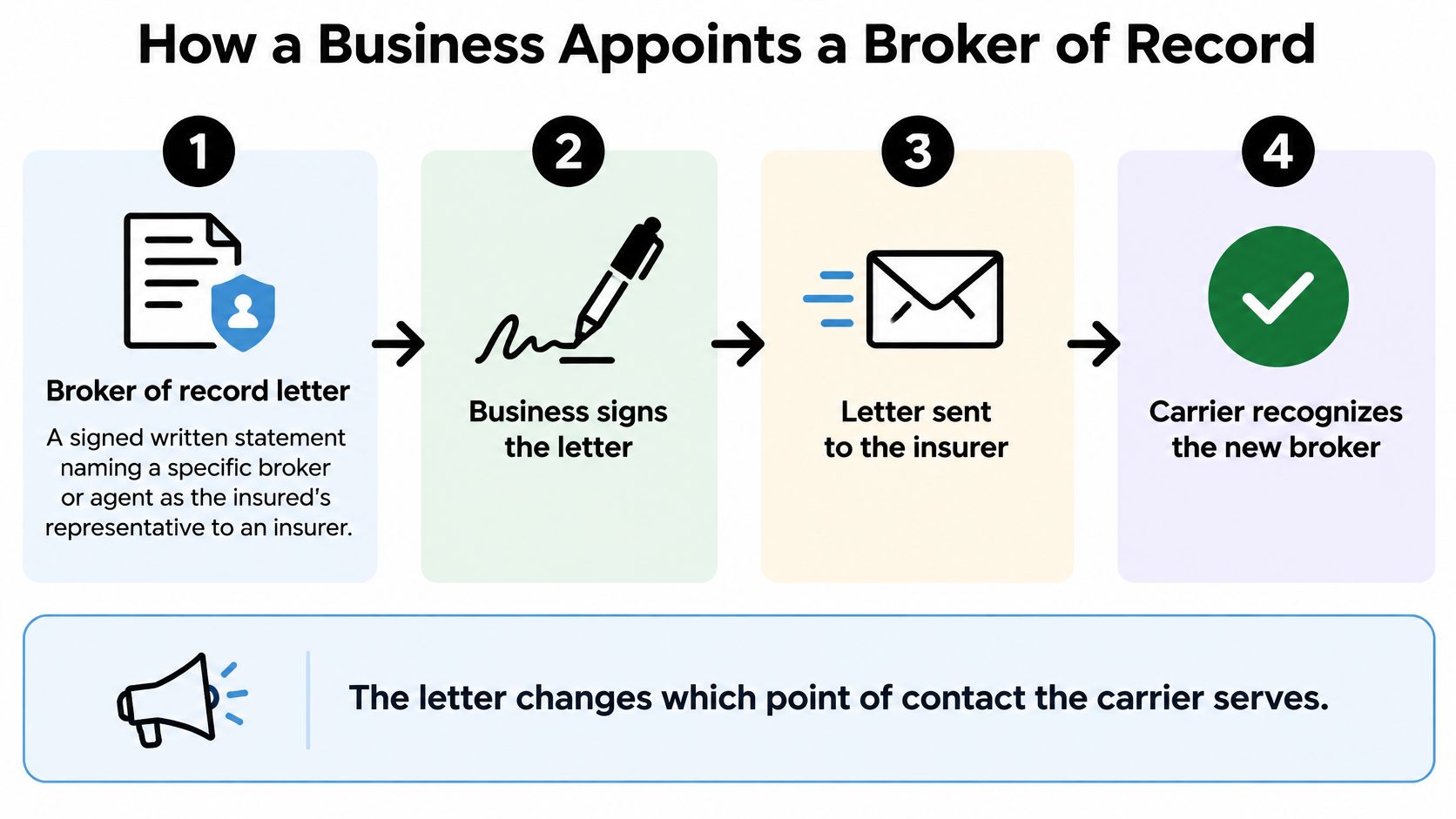
- Select the broker and agree the scope in writing. Name the carriers and lines covered, the services included, and who owns each task during the transition.
- Verify the broker's license. Check the state license lookup for the individual and the agency. A letter naming an unlicensed producer won't be honored.
- Complete the carrier's own form. Most carriers publish a broker of record form; where they don't, a short letter on your letterhead works. It must be signed by someone with authority to bind the company, not whoever happens to sit closest to the printer.
- Submit it the way the carrier asks and confirm acceptance in writing. Get the acknowledgment and the effective date back in an email you archive.
- Calendar the handoff. Note the effective date, the renewal alignment, and the date you expect data (census, claims history, current plan documents) to transfer.
Before you sign: check the carrier's procedure and your existing broker agreement, because the two can impose obligations the letter itself doesn't mention.
That caution covers the outgoing broker. Whether they must be notified depends on the contracts among you, the broker, and the insurer, not on a universal statutory rule.
A short walkthrough of the sequence is worth watching once, because the handoff timing trips up more employers than the form does.
Broker of Record vs Insurance Agent
Both roles carry the word producer on a licensing record, which is exactly why they get blurred. They answer to different parties. The broker of record is the insured's representative, named by the employer's letter. An insurance agent is the insurer's representative, named by a carrier appointment.
| Aspect | Broker of record | Insurance agent |
|---|---|---|
| Who they represent | The insured (the employer) | The insurer (the carrier) |
| How the relationship starts | Employer signs a broker of record letter naming the broker | Carrier appoints the producer and files a notice of appointment |
| Appointment timing | No universal statutory filing rule; carriers set their own process | Model act: notice of appointment filed within 15 days after the contract or first application, whichever comes first |
| Compensation | Commission usually embedded in the premium and paid by the carrier | Commission from the insurer represented |
| Primary duty | Service the employer's interests across policies | Sell and service that insurer's products |
| Typical role in group benefits | Advises on plan design, renewal, compliance and employee support | Distributes a specific carrier's plans |
The distinction has hard compliance edges. Under the National Association of Insurance Commissioners' Producer Licensing Model Act, an insurer that appoints a producer as its agent must file a notice of appointment within 15 days after the agency contract is executed or the first insurance application is submitted, whichever happens first. If the producer doesn't receive acknowledgment within 30 days after that first application, the model language says they must stop acting for that insurer until the acknowledgment or the agency contract arrives.
NAIC guidance also separates the two roles cleanly: appointment requirements generally apply to producers acting as insurer agents, while a broker representing the insured may not need the same appointment. Your letter doesn't erase licensing or appointment duties when the producer is also acting as an agent.
The verification habit
Two checks cover most of the risk. First, confirm the broker holds an active license in your state and works under an agency that does. Second, where a producer is acting as an agent for a carrier, confirm the carrier completed the appointment.
If you're comparing advisory firms, these questions for employee benefit consulting firms are worth asking before you sign anything, because license status and service scope tell you more than a pitch deck does.
Real-World Broker of Record Scenarios
The same document behaves differently depending on how many carriers you run. Three situations show the range.
The first-time hire. A 45-person software company has never had a benefits broker. The founder has been forwarding carrier emails to whoever was free. She signs one broker of record letter naming a single advisor, and that broker consolidates quotes for the upcoming medical renewal and takes over the eligibility questions landing in her inbox. One letter, one relationship, immediately simpler.
The split arrangement. A 70-person distribution company likes its medical broker but has a long-standing relationship with a separate firm for dental and vision. It names one broker for medical and keeps the other for dental and vision, using separate letters, because each carrier recognizes only the broker named in the document it received. The employer's paperwork now matches its actual preferences instead of forcing a choice it didn't want to make.
The cleanup. A 120-person firm has accumulated three brokers across medical, ancillary lines, and a legacy life policy nobody has reviewed in years. Leadership signs one letter per carrier naming a single servicing broker, then moves plan comparison, enrollment, and employee questions onto one shared platform so the advisor relationship and the tools line up with each other.
The pattern across all three: the designation is carrier-specific and line-specific. It should mirror the service relationship you actually want, not the one that grew by accident.
That's the part generic definitions skip. There's no single national filing that covers every policy you hold.
Ask yourself this
Does my current paperwork match who I call when something goes wrong? Start with the carrier portals and your plan documents to see which broker is listed on each policy. Most employers find at least one line where the named broker hasn't been involved in years.
Open enrollment is where the mismatch gets expensive, because that's when enrollment support, employee questions, and carrier coordination all compress into a few weeks. The broker's role during open enrollment is a useful test of whether the firm named on your paperwork can carry that load.
How Brokers Are Paid and What Fiduciaries Should Verify
Here's the question that rarely gets answered directly: if you never write a check to your broker, who pays them? In group benefits, the commission is typically embedded in the premium and paid by the carrier, and it moves with the servicing relationship. A broker of record change often leaves your premium identical at first, because the same dollars now flow to a different firm.
That changes how you should read a promise of savings. Switching isn't automatically a cost-cutting move. Value shows up in plan design, negotiation, administration, and how well employees use the plan, not in a lower invoice on day one.
For ERISA-covered group health plans, the U.S. Department of Labor requires covered brokers and consultants to disclose direct and indirect compensation and potential conflicts before a plan enters into, renews, or extends an arrangement. That turns a broker of record decision into a fiduciary one.
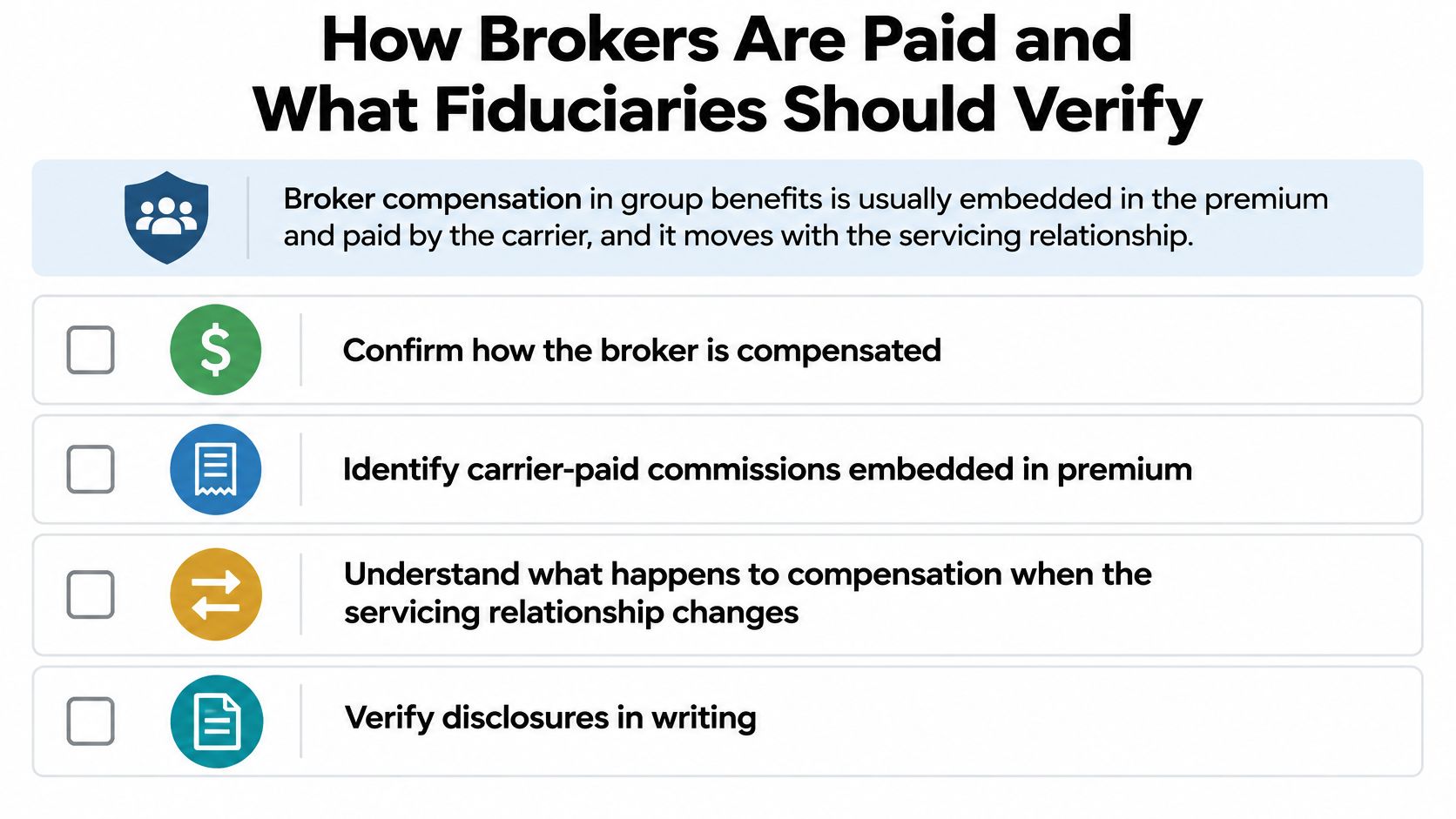
A five-step due-diligence checklist
- Request the written compensation disclosure. Cover commissions, direct fees, and indirect payments such as revenue sharing or override arrangements.
- Get the service scope in writing. Plan design support, renewal marketing, enrollment help, claims advocacy, compliance filings. Name what's included and what isn't.
- Compare the things that drive outcomes. Carrier access, renewal strategy, technology, and compliance support matter more than a single rate quote.
- Document your selection rationale. A short memo recording what you compared and why you chose is your evidence of a prudent process.
- Measure promised savings against total employer cost. Not against commission, which was never on your invoice in the first place.
Fiduciary note: you keep responsibility for selecting and monitoring the broker, so the disclosure belongs in your file before the designation is signed, not after.
Teams that also carry workers' compensation should look at how payroll classes drive that premium alongside the benefits spend, and this walkthrough of calculating workers' compensation explains the classification math. It's the same discipline: know what you're paying for and who sets the number.
If the mechanics of commission are still fuzzy, how insurance brokers get paid goes deeper on embedded commissions, fee-based arrangements, and what changes at renewal.
How to Change Your Broker of Record Without Disrupting Coverage
Start with the myth that costs employers the most: that switching brokers means switching plans. A broker of record letter tells the carrier which broker may service your existing policy. It doesn't cancel the policy, trigger underwriting, change plan terms, or require employees to re-enroll, as this breakdown of the broker of record letter makes clear. Your deductible, your network, and your employees' ID cards stay exactly where they are.
What does move is the administrative relationship, and that's not always one letter and done. If you run medical with one carrier and dental, vision, and life with others, expect a separate letter for each carrier and each line, with its own acceptance process and effective date.
Here's the sequence that keeps a switch clean.
- Read the outgoing broker agreement. Look for notice periods, termination language, and any clause about commissions after the relationship ends.
- Pick your timing. Aligning to renewal gives the incoming broker room to shop the market and prepare options. Mid-year works too when service has broken down and you need help now.
- Sign a new letter per carrier and line. One document per relationship, each naming the specific broker you want.
- Submit each one and confirm acceptance in writing. Ask for the acceptance and the effective date in an email you keep with your plan documents.
- Hand off the data. Census, claims history, current plan documents, billing contacts, and a list of open issues.
- Confirm the commission transfer at the carrier level. Don't assume the carrier moved the compensation just because the servicing changed.
A carrier can also reject a letter as incomplete, or receive two competing letters close together. When that happens, the carrier's written acceptance plus your signed authority determine which broker it recognizes. Resolve the conflict before any effective date you care about, in writing.
| Question | What typically happens | What to confirm first |
|---|---|---|
| Does coverage continue? | Yes, the policy stays in force on existing terms | Effective date of the new letter |
| Do employees re-enroll? | No re-enrollment is triggered by the change itself | Any separate platform migration or open enrollment |
| Does underwriting re-price the plan? | No, the change does not trigger underwriting | Renewal timing and rate guarantees |
| Is one letter enough? | Often not; each carrier or line may need its own letter | Which carriers and lines the new broker will service |
| Who handles unresolved claims? | Depends on transition agreements | Written handoff of open claims and compliance items |
The part the letter doesn't cover
A broker of record letter is a carrier-facing appointment, not a service contract. Scope, transition responsibilities, data access, and termination terms need to be agreed with the incoming broker directly, in writing, before you sign the letter that names them.
Appoint or Change Your Broker With Confidence
A broker of record is the written designation that decides who services your policies and who your carriers recognize. Changing it is an administrative act, so it should follow a service decision rather than stand in for one.
Five actions turn that into a process:
- Audit what's on file. Pull each carrier's record and list which broker is named on each policy and line.
- Judge on service, not price alone. Responsiveness, compliance support, and renewal outcomes tell you more than a quote sheet.
- Review the compensation disclosure and service scope before you decide, not after.
- Sequence the letters carrier by carrier, timed to renewal where you can manage it.
- Check the scorecard after one renewal cycle. Did the promised service levels hold?
Benely's benefits advisors manage a client's insurance program from plan design through to the compliance paperwork, which is exactly the span a broker of record switch is meant to change.
When you're weighing whether a new designation would beat your current setup, Benely puts plan comparison, enrollment automation, and compliance support on one platform so the service you're buying is easy to see before you sign anything. You can compare plans from major carriers, set a budget, and see how enrollment and filings would be handled. Start there, then decide whether the letter is worth signing.