The most misleading ERISA advice is to start and finish with Form 5500. A filing exemption can spare an employer an annual report without removing the work employees depend on: accurate plan documents, timely notices, properly handled contributions, and a usable claims process.
A practical ERISA compliance checklist separates paperwork, notices, deposits, and proof. That makes it useful during an actual plan year, when HR is handling leave requests, payroll changes, carrier renewals, and employees who need answers.
Table of Contents
- What Small Fully Insured Plans Still Owe
- ERISA Deadlines Owners and Proof
- How to Run the Four-Stage Review
- Sample Language for Plan Files
- Deposits Carrier Bills and Vendor Oversight
- Penalties and How to Correct Late Work
- Start the 90-Day ERISA File
What Small Fully Insured Plans Still Owe
Small and fully insured doesn't mean there's no ERISA work. A fully insured health plan with fewer than 100 participants may qualify for an annual-report exemption, but that conclusion doesn't close the compliance file. Eligibility for the exemption needs its own documented review.
Say a 55-person manufacturer finishes open enrollment. An employee on leave asks for the summary plan description, and HR finds three PDFs: an old benefits booklet, a carrier certificate, and an unsigned wrap document. None matches both the insurance contract and payroll's eligibility settings.
The immediate problem isn't whether the company files an annual report. It's whether the employee can obtain an accurate explanation of the plan and exercise their rights.
A plan-document review starts with the documents employees receive.

Separate the exemption decision from participant duties
The Department of Labor's fiduciary investigation guidance addresses participant disclosures, document availability, claims procedures, and answering written document requests within 30 days. Those controls require more than a carrier's assurance that the policy is active.
Keep the governing plan document, current summary plan description (SPD), amendments, and applicable insurance contracts together. Compare eligibility, benefit terms, and claims instructions before distributing anything. A benefits overview may help employees choose coverage, but it shouldn't automatically be treated as the SPD.
Assign responsibility before filing work begins
Give each responsibility a person's name, not just a department:
- Plan administrator: Confirms applicable obligations and authorizes required actions.
- Document custodian: Maintains approved versions and handles document requests.
- Notice owner: Coordinates delivery and preserves evidence of distribution.
- Escalation owner: Resolves conflicting documents, system settings, and vendor answers.
One person may perform several roles. The important point is that everyone knows who acts when an employee asks a question or HR finds a mismatch.
Practical rule: A vendor's agreement to perform a task isn't proof that the task was completed.
A carrier may produce coverage materials. A broker may help assemble a wrap document. Payroll may transmit deductions, and a third-party administrator may administer claims. HR still needs a reliable way to confirm which document was approved, who received it, and what happened when something failed.
For the manufacturer, preserve the employee's request, identify the controlling documents, obtain approval for the response, and investigate the eligibility mismatch separately. Don't send whichever PDF is easiest to find.
ERISA Deadlines Owners and Proof
July 31 is the standard Form 5500 deadline for a calendar-year plan, because the annual report is generally due on the last day of the seventh month after plan-year end, according to the IRS Form 5500 filing guidance. First confirm whether the plan must file, then assign preparation, review, signature, and submission responsibilities.
The IRS reporting and disclosure guide describes the Form 5558 extension of up to 2½ months and electronic filing through EFAST2. File the extension on or before the original due date; it changes the filing timetable, not the underlying obligation.
ERISA compliance checklist by deadline and owner
Use this as an assignment sheet for a calendar-year plan. Replace each role with a named person and calculate event-triggered dates when the triggering event occurs.
| Obligation | Deadline | Owner | Proof |
|---|---|---|---|
| Form 5500 annual report | Last day of the seventh month after plan-year end, generally July 31 for a calendar year | Plan administrator | EFAST2 acceptance and workpapers |
| Form 5558 extension | Filed on or before the original due date; adds up to 2½ months | Plan administrator | Filed Form 5558 |
| Summary plan description | Generally within 90 days of becoming a participant, then redistributed as required | Plan administrator, supported by notice owner | Distribution log and version in force |
| Summary of material modifications | Generally 210 days after the end of the plan year in which the change was adopted | Plan administrator | Amendment log and delivery record |
| Summary annual report | Where required, within two months after the Form 5500 due date or extended due date | Plan administrator | SAR delivery log |
| SBC at renewal | Generally no later than 30 days before the new plan or policy year | Employer with the carrier | Dated delivery file |
| SBC if the policy is late | As soon as practicable, no later than seven business days after receipt of the policy, certificate, contract, or written renewal confirmation, whichever arrives first | Employer with the carrier | Date received and date sent |
| SBC for special enrollees | No later than the SPD due date, generally 90 days after enrollment | Plan administrator | Enrollment file and delivery record |
| Written document request | Within 30 days | Document custodian | Request-and-response tracker |
| Participant contribution deposit | As soon as amounts can be segregated; test the seven-business-day small-plan checkpoint where applicable | Payroll owner and fiduciary | Payroll-to-trust reconciliation |
The DOL's SPD and modification guidance sets the general 210-day material-modification distribution deadline and identifies the summary annual report as a participant communication summarizing annual financial information. Don't confuse filing Form 5500 with delivering the SAR.
For health coverage, the federal SBC regulation supplies the renewal, late-policy, and special-enrollment timing rules reflected in the table. Ask the carrier to confirm both its delivery responsibility and the evidence it will provide.
Save completion evidence, not reminders
A calendar entry proves someone scheduled work. It doesn't prove participants received a notice or that the government accepted a filing.
Before submission, reconcile participant counts and financial information to source records. Validate eligibility for the short-form return rather than assuming a small plan qualifies. Keep the accepted filing, schedules, extension evidence, and signed review checklist together.
Use our Form 5500 filing deadline guide when organizing the preparation workflow. The plan administrator should still review exceptions and verify EFAST2 acceptance rather than relying only on a preparer's sent email.
How to Run the Four-Stage Review
Run the review against the plan's actual operations, not just a questionnaire. The Department of Labor's Form 5500-SF instructions include diagnostic questions about documents, claims procedures, participant rights, and contribution handling; the checklist isn't an exhaustive legal audit.
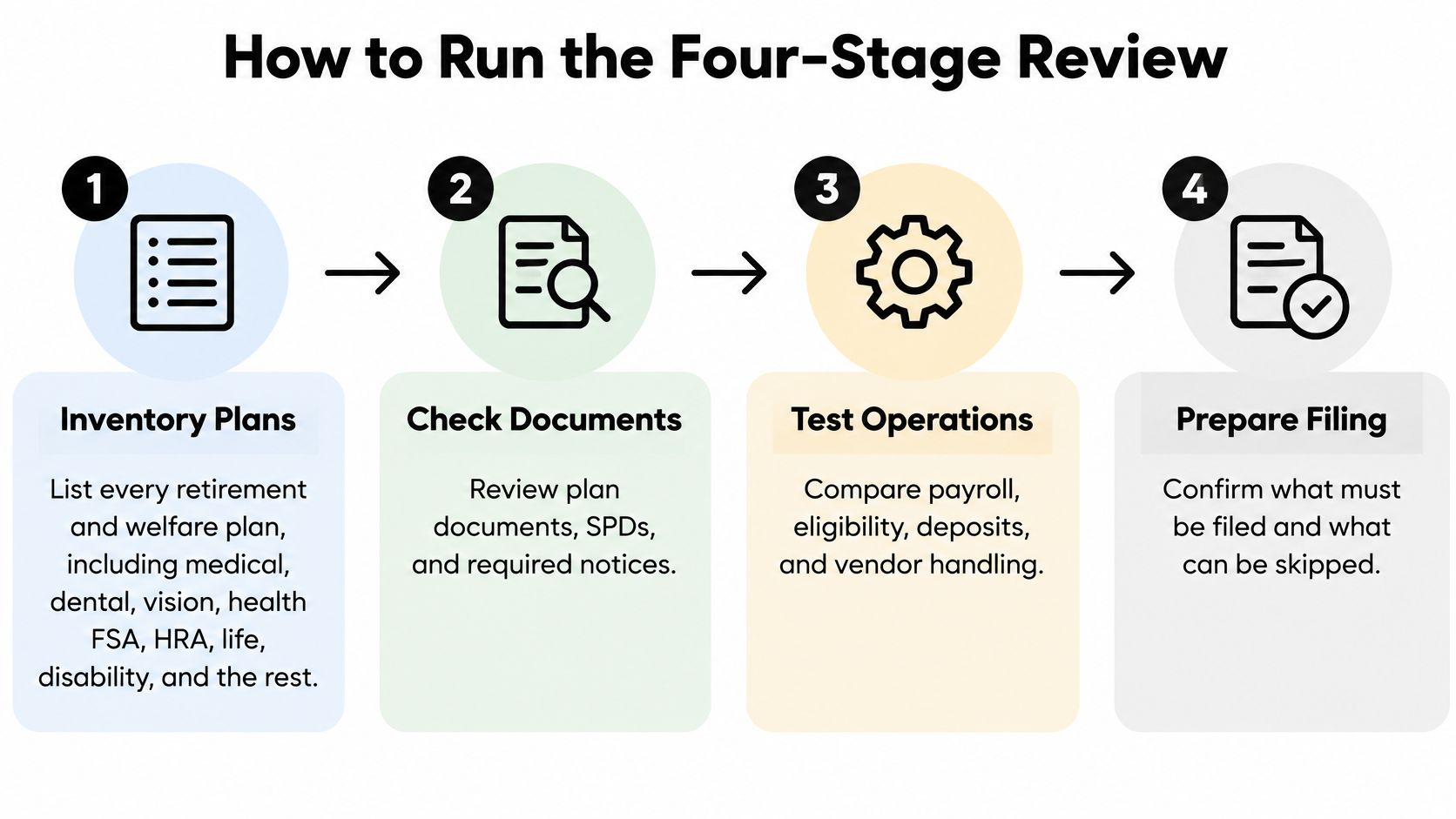
Use this workflow to organize the work, while treating filing preparation as the result of checking the plan rather than the starting point.
Inventory and reconcile
Inventory every plan. List medical, dental, vision, health FSA, HRA, life, disability, and retirement arrangements, including the 401(k). Record the plan administrator, fiduciaries, service providers, funding arrangement, and any exemption being relied on. The resulting inventory should identify the arrangement being reviewed, not merely the carrier selling it.
Compare documents with operations. Put the signed plan document, applicable wrap document, trust or insurance contract, SPD, and amendments beside payroll and enrollment settings. Check eligibility categories, waiting periods, contribution formulas, and effective dates. Record differences in a reconciliation worksheet.
Suppose the plan document grants eligibility after a waiting period, but the HRIS uses a different effective-date rule. That's a potential benefits error affecting real people, not a formatting correction. Preserve the configuration history and identify affected employees before changing the setting.
Test and close
Test participant protections. Follow a document request, claim, appeal, contribution, and benefit payment through the relevant process. Confirm that written procedures are followed, document access works, applicable fidelity-bond coverage is in place, and retirement-plan fiduciaries review investment prudence and diversification. Save the transaction or case evidence behind each conclusion.
Document correction and retesting. Give each gap an owner, a completion date, required closure evidence, and an annual retest date. Confirm filing requirements after the underlying records have been reconciled. A corrected spreadsheet alone doesn't establish that an affected participant received the proper benefit or notice.
A completed review should leave another person able to reproduce the conclusion without relying on the reviewer's memory.
Build a controlled evidence folder containing signed documents, distribution records, contribution reconciliations, fiduciary minutes, vendor reviews, participant inquiries, and correction approvals. Restrict access to sensitive participant information and separate working drafts from approved records.
For employers coordinating international HR controls, HR Management 365's resource on planning an HR audit in Europe offers an adjacent planning reference. Keep jurisdiction-specific legal reviews separate: ERISA governs applicable U.S. benefit plans, not every benefit arrangement worldwide.
Use the video as a discussion prompt for the people responsible for plan administration, then record the decisions that apply to your own plans.
Sample Language for Plan Files
File notes should establish what happened, who acted, and where the supporting record lives. They shouldn't declare compliance merely because someone filled in a template.
Adapt the following language with the plan administrator and counsel. Use the applicable dates from the plan's approved calendar, and don't claim timely delivery until the evidence supports it.
Fill-in language to adapt
- Amendment log entry: Amendment adopted on [date] changes [benefit or eligibility term]; the approved participant communication is due on [applicable deadline], and adoption approval and delivery evidence are stored at [file location].
- Document request response: We received your written request on [date]; enclosed are [requested documents], including the current summary plan description dated [version date].
- SBC renewal note: The Summary of Benefits and Coverage for the [plan year] was delivered on [date] through [delivery method]; the recipient record and document version are stored at [file location].
- Deposit exception note: Participant contributions for [pay date] were remitted on [date]; the attached payroll-to-trustee reconciliation identifies a variance of [amount], assigned to [name] for correction by [date].
- Claims acknowledgment: Your claim was received on [date]; the applicable claims and appeals procedure appears in Section [section] of [document name and version], and your claim reference is [reference].
Keep the evidence beside the wording
Save the amendment entry with the approved amendment, not just the meeting agenda. Store a document-response note with the original request and the actual attachments sent. A delivery statement without the recipient file or transmission record leaves the reviewer guessing.
Our explanation of what a summary plan description contains can help HR distinguish an SPD from an enrollment brochure before identifying attachments.
File discipline: Describe the evidence you have, not the conclusion you hope it proves.
Have the fiduciary or counsel approve final language where legal conclusions, disputed benefits, or corrections are involved. An acknowledgment also shouldn't replace a required claim determination or promise an outcome before the responsible decision-maker reviews the claim.
Deposits Carrier Bills and Vendor Oversight
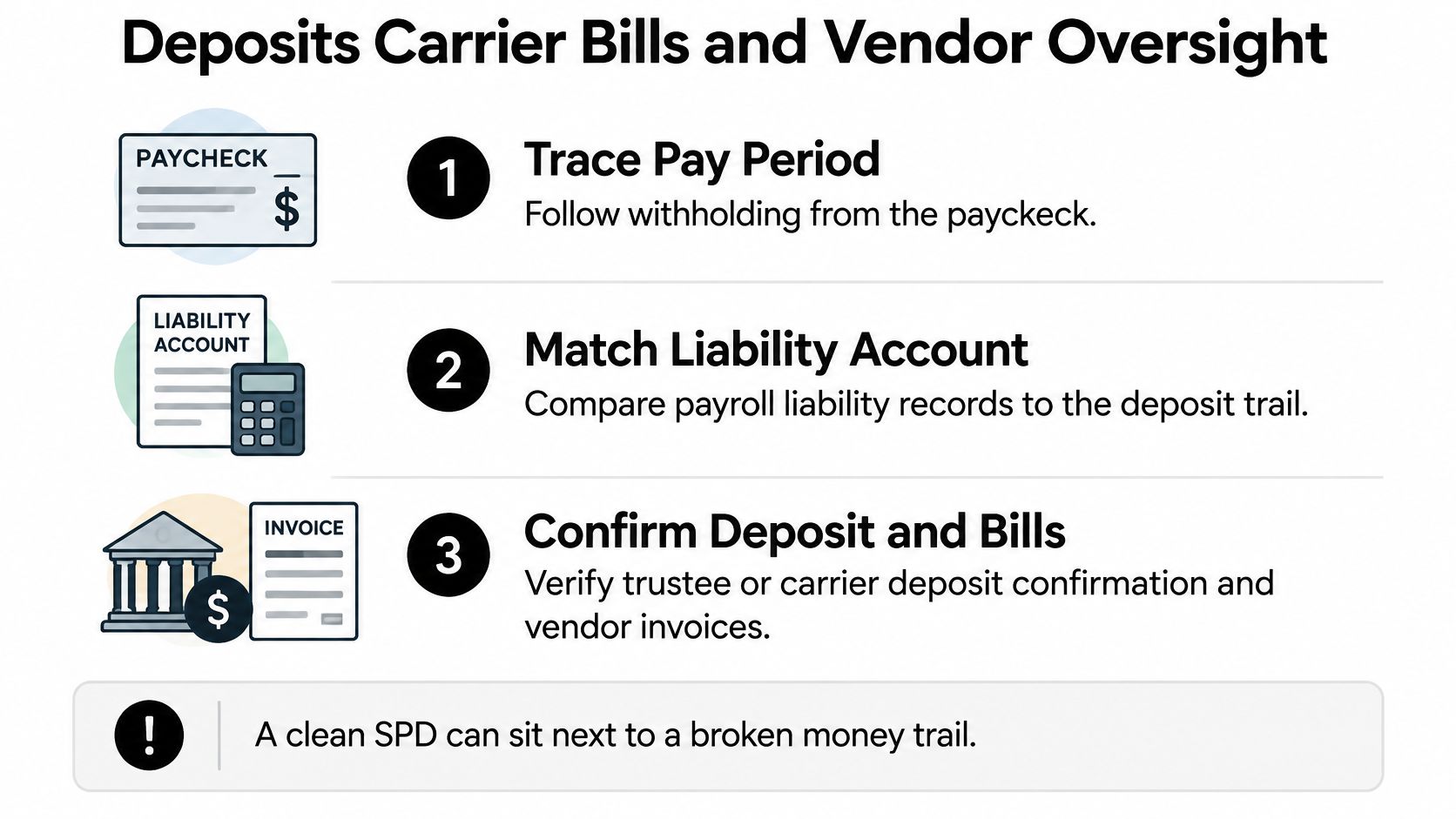
A clean SPD can sit next to a broken money trail. Start with a paycheck showing an employee deduction, then follow that amount into the payroll liability account and through to the trustee or carrier's receipt.
A payroll status marked processed isn't the same as a confirmed deposit. Compare withholding, transmission, receipt, and allocation records, and investigate any gap rather than clearing the item because the liability account eventually reached zero.
Use the transaction trail to organize the review.
Follow the paycheck and the invoice
For a small retirement plan, apply the applicable deposit checkpoint from the calendar, but don't treat it as permission to hold employee money. Have the fiduciary review whether the actual process remits contributions promptly and whether exceptions require correction.
Then reconcile the carrier invoice against enrollment for the same coverage month. Match covered employees and dependents, coverage tiers, waivers, effective dates, and retroactive changes. Keep explanations for adjustments instead of accepting an unexplained credit on a later invoice.
Say a terminated employee remains on the bill while a new hire never appears. Paying the invoice doesn't solve either problem: HR needs confirmation of the correct coverage status, payroll needs the correct deductions, and the carrier needs an accepted correction.
Keep payment accuracy and coverage accuracy separate in the reconciliation. An invoice can add up correctly while listing the wrong people.
Ask vendors questions that produce records
The DOL fiduciary advisor asks whether fiduciaries considered multiple provider candidates, evaluated reasonable fees, documented selection, monitored providers, identified conflicts, and maintained fidelity bonds for people handling plan assets. Turn those questions into a vendor-review file.
- Selection: Preserve proposals, comparison criteria, and the reason for choosing the provider.
- Fees: Record the services included, excluded charges, and the basis for finding compensation reasonable.
- Conflicts: Ask about financial relationships and document how disclosed conflicts were evaluated.
- Monitoring: Track missed transmissions, unresolved claims issues, service failures, and corrective commitments.
- Bonding: Confirm which people handle plan funds and whether applicable coverage matches their responsibilities.
Assign a named reviewer to quarterly exceptions. For a manageable internal test, sample five employees each quarter across different situations, such as a new hire, termination, leave, coverage change, and unchanged enrollment. This is a suggested control, not a legal sampling standard.
Compare each selected employee's election, payroll deduction, carrier enrollment, and relevant payment record. Write down both matches and exceptions so the file shows what was tested.
Connected systems reduce rekeying, but a person still needs to inspect rejected files and incomplete changes. Don't wait for the annual-report preparer to discover a recurring payroll transmission problem.
Penalties and How to Correct Late Work
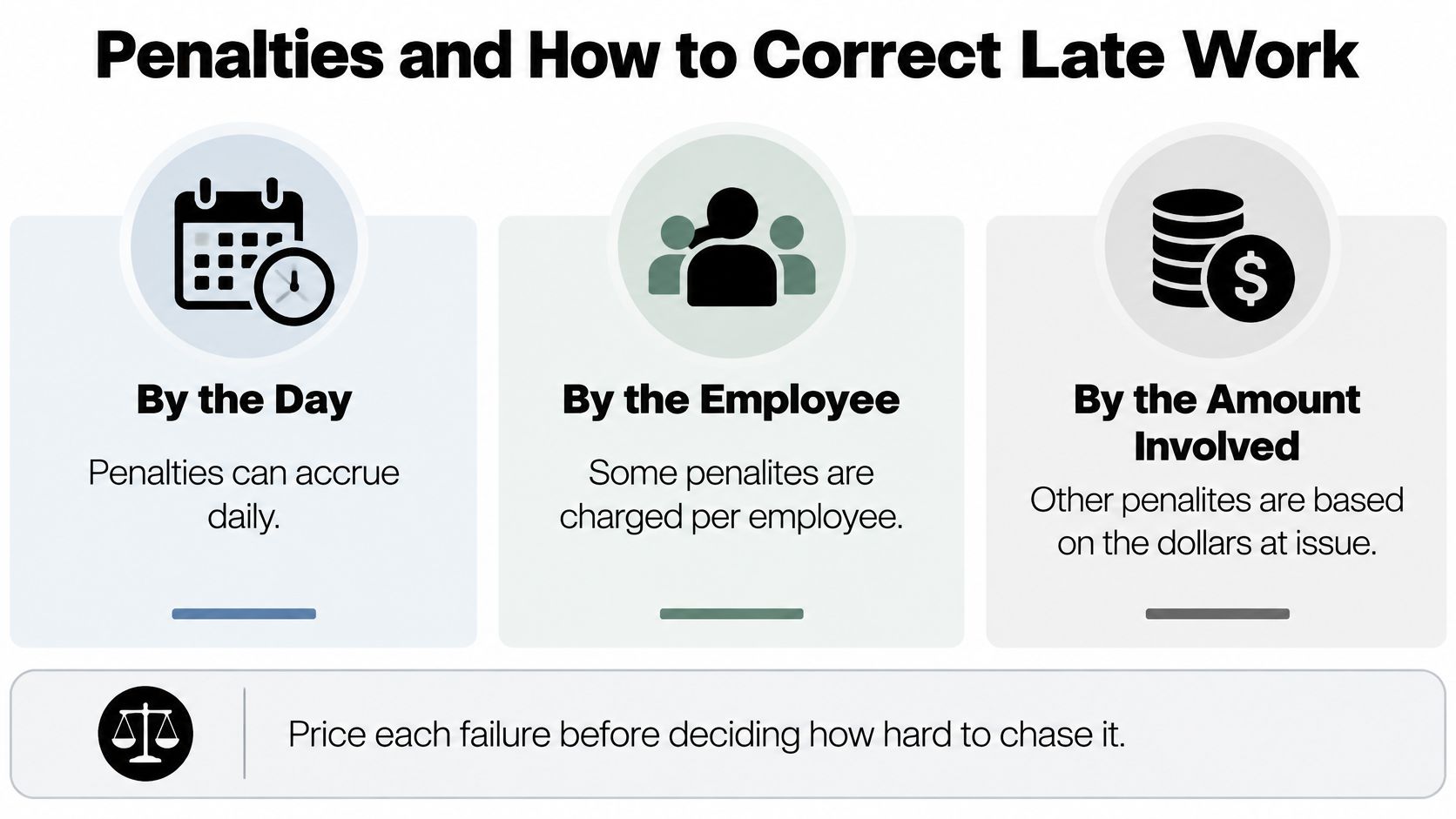
Identify the applicable exposure while beginning correction. Some failures accrue by day, others by employee or transaction amount, so HR should escalate unresolved problems promptly rather than waiting for renewal.
The DOL civil-penalty guidance lists the DOL amounts below, including inflation-adjusted limits effective for assessments after January 15, 2024, and the ERISA Section 502(i) prohibited-transaction framework. The DOL's annual-report instructions also identify the separate IRS filing penalty of $250 per day, capped at $150,000, for applicable returns.
ERISA penalty amounts and the first fix
These are source-specific penalty figures, not a claim that every listed limit is the current inflation-adjusted amount. Confirm the applicable assessment rules before calculating exposure.
| Failure | Who assesses it | Amount | First fix |
|---|---|---|---|
| Late or missing Form 5500 return | IRS | $250 per day, capped at $150,000 per plan year | File the return; evaluate DFVCP eligibility and applicable IRS relief |
| Failure to file a complete annual report | DOL | Up to $2,670 per day | File a complete report and save acceptance |
| Other specified disclosure failures | DOL | Up to $2,112 per day | Send the missing notice and log delivery |
| Failure to furnish certain reports or keep required records | DOL | Up to $37 per employee | Restore the record and send the report |
| Prohibited transaction affecting a health or welfare plan or nonqualified pension plan | DOL under ERISA 502(i) | 5% of the amount involved, potentially rising to 100% if not corrected within 90 days | Obtain advice promptly, correct within the applicable window, and document correction |
Use the categories to distinguish the exposures.
Apply a consistent correction sequence
- Stop the ongoing error. Address delayed deposits and incorrect enrollment without destroying the records needed to investigate.
- Measure the affected period. Reconcile payroll, enrollment, and carrier records to identify affected people and transactions.
- Evaluate voluntary filing relief. For eligible late annual reports, consider the DOL's Delinquent Filer Voluntary Compliance Program before waiting for an enforcement notice. EBSA received 20,009 annual reports through DFVCP in fiscal year 2024, according to its annual monetary-results fact sheet.
- Escalate prohibited transactions immediately. Counsel should determine the applicable correction, timing, and potential additional obligations.
- Preserve the closure file. Keep submissions, acceptance, calculations, correspondence, and truthful reasonable-cause documentation.
Don't assume voluntary-program eligibility resolves every related tax or fiduciary issue. Likewise, a bond isn't a substitute for correction; our explanation of what an ERISA bond covers helps distinguish that protection from administrative compliance.
Start the 90-Day ERISA File
Use a 90-day implementation window to make the checklist repeatable. This is an internal project schedule, not an extension of any legal deadline.
Start with a shared, access-controlled folder and a task register. Each task should show the responsible person, due date, supporting records, reviewer, and completion evidence. Keep unresolved questions visible instead of burying them in email.
This week and this month
This week, confirm the administrator, custodian, notice owner, and escalation contact. Assemble the current SPD, governing plan documents, applicable wrap document, insurance certificate, and amendments, then mark drafts clearly.
This month, load applicable obligations into the shared calendar. Set preparation reminders early enough for a reviewer to resolve discrepancies before signature or distribution.
- Calendar evidence: Attach the approved notice or filing instructions to the task.
- Completion evidence: Require a delivery record, acceptance, or reconciliation before closing it.
- Exception evidence: Record who approved the resolution and whether a participant correction remains open.
Reserve legal-review capacity for unclear plan language, exemption decisions, and correction questions. Coto & Waddington, Attorneys at Law's resource on budgeting for small business legal support provides useful context for treating legal advice as a planned expense rather than an emergency purchase.
Automate repeatable records, retain human decisions
This quarter, complete the employee-level reconciliation sample and close each mismatch with a dated note. Choose automation based on the proof you need: enrollment status, deductions, notice dates, rejected transmissions, and open-enrollment progress.
At Benely, our connected payroll, onboarding, and benefits administration support can help organize those recurring activities. Our compliance experts can assist with COBRA/FSA administration, ACA reporting, HR support, ERISA wraps, and ERISA filing; our compliance evaluation helps ensure ACA reporting, COBRA, and ERISA filings are up-to-date and compliant.
Software doesn't sign a fiduciary decision or evaluate a vendor's explanation. Assign those judgments to a person and retain their approval. Compare service responsibilities against your actual file before renewal, including who prepares documents, who distributes them, and who saves proof.
For a broader process check, our What's Your Benefits Score? tool offers a free 30-page benefits guide when you rate your benefits process. Use the assessment to identify administrative gaps, not as a legal compliance certification.
By the end of this week, be able to locate the accepted Form 5500, where filing is required; the SPD version in force; and last quarter's deposit reconciliation. If a record is missing, assign its recovery or correction rather than checking the obligation complete.
Benely offers compliance evaluation and support with ERISA wraps and filings, alongside benefits and HR administration. Visit Benely to review where your ERISA compliance checklist needs clearer ownership, better documentation, or more reliable recurring proof.