Benefits cost employers $13.58 per hour for private-industry workers in June 2025, equal to 29.8% of total compensation, according to the Bureau of Labor Statistics June 2025 benefits cost release. That figure changes how you should shop. You're not buying a single perk, you're funding nearly a third of pay through time off, insurance, retirement, extra pay, and legally required programs.
The types of employee benefits make sense only when you separate them into budget buckets and ask a harder question for each one. Can employees enroll, understand the rules, and afford their share without skipping care or ignoring the plan?
Table of Contents
- Five Benefit Buckets and What They Cost
- Medical Dental and Vision Plans
- Retirement Savings and 2026 Limits
- Paid Time Off and Protected Leave
- Voluntary Ancillary and Wellness Perks
- Compliance Duties Behind the Menu
- How SMBs Budget a Usable Package
- Pick the Mix and Run Enrollment
Five Benefit Buckets and What They Cost
Think of benefits as a cabinet with five drawers. If you stuff wellness apps, tuition help, and dental cleanings into the health drawer, you'll never know what you're spending on medical risk, paid time away, or retirement readiness.
Wages and salaries averaged $32.07 per hour, or 70.2% of total compensation, in that same June 2025 snapshot. Benefits made up the rest, and the split matters because each drawer moves for a different reason. Medical premiums react to plan design and use of care. Paid leave reacts to headcount, accrual rules, and absence. Retirement cost reacts to your match formula and who joins.
The Five Drawers in Order
Private-industry benefit costs by type, June 2025
| Benefit bucket | What it includes | Cost per hour |
|---|---|---|
| Paid leave | Vacation, holidays, sick leave, personal leave | $3.44 |
| Insurance | Health, life, short- and long-term disability | $3.44 |
| Legally required | Social Security, Medicare, unemployment insurance, workers' compensation | $3.31 |
| Supplemental pay | Overtime premiums, shift differentials, nonproduction bonuses | $1.84 |
| Retirement and savings | Defined contribution and defined benefit plans | $1.54 |
Paid leave and insurance tie at the top, which surprises many small employers. They expect health insurance to dominate everything, then discover that vacation, holidays, sick days, and personal leave carry a similar hourly weight. Both need a budget line, a policy, and an owner.
Legally required benefits sit close behind. You don't choose whether to fund Social Security, Medicare, unemployment insurance, and workers' compensation in the way you choose a dental carrier. You forecast them from wages and state rules, then you make sure payroll gets them right every pay period.
Where the Rest of the Menu Fits
Supplemental pay covers money on top of regular hours, such as overtime premiums, shift differentials, and nonproduction bonuses. Retirement and savings covers 401(k) style defined contribution plans, defined benefit pensions, and profit sharing. Those five drawers hold the core types of employee benefits, even when vendor brochures use different names.
Some familiar items are design choices inside or beside a drawer, not separate budget categories. Dental and vision sit on the insurance side as add ons to the medical base. Flexible spending accounts, health savings accounts, and dependent care accounts change how employees pay for eligible costs. Voluntary products, wellness programs, education assistance, and commuter help widen the menu, but they don't replace the core drawers.
Budget rule: Split next year's benefits budget by drawer before you talk to carriers. If you can't say which drawer a cost belongs in, you can't explain why it went up.
FMLA needs special care in this map. It's a legal floor for job protected leave, not a paid leave benefit by itself, so it belongs with your legally required planning even though employees experience it as time away from work.
A PEO co-employment arrangement isn't a sixth drawer either. It's a delivery model that can bundle payroll, benefits, and some compliance work, while you still fund the underlying plans and employ the people day to day. Price the drawers first, then decide who administers them.
Medical Dental and Vision Plans
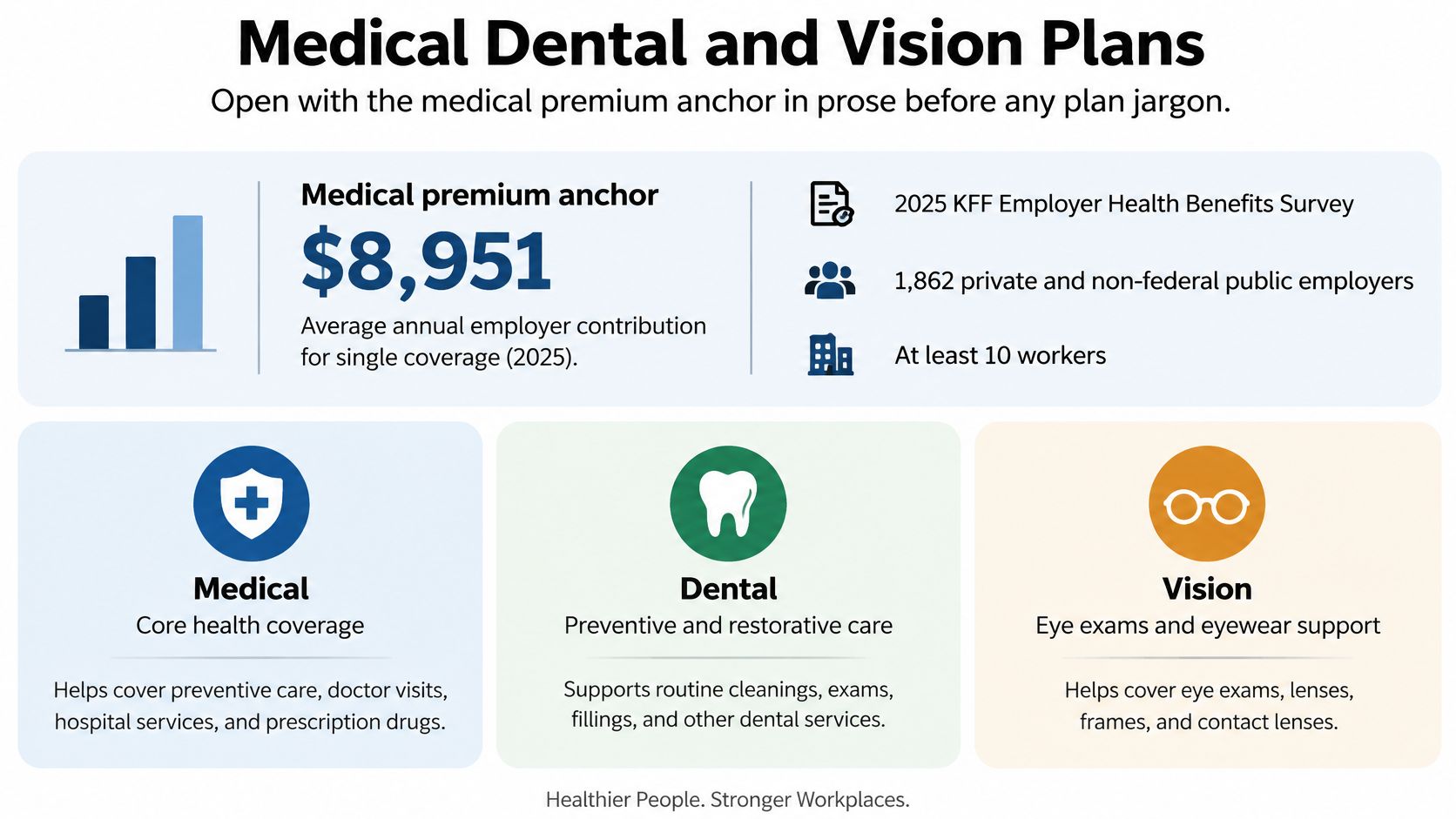
Start with the premium, not the plan nickname. The KFF 2025 Employer Health Benefits Survey analyzed 1,862 randomly selected private and nonfederal public employers with at least 10 workers and put average individual coverage at $9,325 a year, with workers contributing approximately $1,440. Family coverage averaged $26,993, up 6%, with workers paying $6,850 through payroll deductions and employers covering approximately $20,143, or about 75%.
That split explains a common budgeting mistake. A modest employee deduction can hide a large employer bill, and a plan that looks affordable for single coverage can become unusable when an employee adds a spouse or children. Budget the total premium first, then decide the paycheck share by tier.
The visual below separates the three coverages employees usually see together at enrollment.
Three Medical Shapes SMBs Actually Shop
- Richer PPO coverage: Lower deductibles and broader choice help you recruit against larger local employers, but higher premiums can strain both your budget and family paychecks.
- HDHP paired with an HSA: Premiums are usually lower and pre-tax account dollars can pay qualified care, yet the design fails if your employer HSA seed is too small and people delay treatment.
- Defined employer contribution: You set a dollar allowance and employees buy up or down within it, which controls your cost but requires clear side by side paycheck comparisons.
Check the IRS HDHP thresholds before open enrollment each year because the qualifying rules move. Don't copy last year's deductible into a new brochure and assume the HSA still works. Ask the carrier to confirm the plan and account pairing in writing.
Prescription design deserves the same plain language treatment. Employees who are comparing drug tiers on their own can start with understanding GLP-1 insurance coverage from Weight Method, then bring specific formulary questions to enrollment counseling. That sequence keeps a costly drug question from turning into a guess about the whole medical plan.
This short video helps employees hear the basic trade off between premium, deductible, and network before they choose.
Dental and vision work differently from medical. Dental usually covers preventive cleanings at little or no cost, with coinsurance on basic and major work and an annual maximum you should state plainly. Vision usually covers an exam plus a frame or contact allowance.
Both are relatively inexpensive and highly visible at hire. Employees remember a covered cleaning or new glasses more readily than a benefit they may never claim, so present the frequency, allowance, and network limits in one short paragraph rather than burying them in carrier PDFs.
Retirement Savings and 2026 Limits
Retirement is deferred pay, not a decorative perk. In a defined contribution plan, usually a 401(k), the eventual account balance depends on contributions and investment results. In a defined benefit pension, the employer promises a formula based benefit, which is why that design is now rare at small firms that can't absorb the funding and administration risk.
For 2026, the IRS 401(k) and profit sharing plan contribution limits set the employee elective deferral limit at $24,500 for most 401(k), 403(b), governmental 457 plans, and the federal Thrift Savings Plan, up from $23,500 in 2025. Employees age 50 or older can generally contribute up to $32,500 including the standard catch-up. A separate higher catch-up rule allows certain participants ages 60 through 63 to contribute up to $83,250 in total annual additions when applicable plan and compensation rules are satisfied.
2026 retirement contribution ceilings
| Limit | Who it affects | 2026 amount |
|---|---|---|
| Employee elective deferral | Most 401(k), 403(b), governmental 457, and TSP participants | $24,500 |
| Standard catch-up included | Employees age 50 or older | $32,500 total |
| Higher catch-up total | Certain participants ages 60 through 63 when rules are met | Up to $83,250 |
| Annual additions before catch-up | Employee plus employer money and forfeitures | Lesser of 100% of pay or $72,000 |
Turn the Limits into a Match People Understand
The annual additions cap covers employee deferrals, employer matching contributions, employer nonelective contributions, and forfeiture allocations. Most SMB employees won't approach that ceiling, but your payroll and recordkeeper still need to apply it correctly for highly paid staff and owner employees.
Say you match 100% of the first 3% of pay. An employee earning $60,000 who defers 3% puts in $1,800 and receives another $1,800 from the company. An employee who defers nothing receives no match, which is why the match formula is also a participation tool.
Profit sharing adds a flexible employer only layer when cash flow allows. You can keep the regular match predictable for budgeting, then decide on a profit sharing contribution after you know the year's results, subject to your plan document and testing rules.
Publish three facts together every year: the IRS deferral limit, your exact match formula, and the vesting schedule. Employees shouldn't need three documents to answer how much free money they're leaving behind.
Payroll integration decides whether the plan gets used without constant HR cleanup. Deferral changes, loan repayments if your plan allows loans, match calculations, and eligibility dates should flow from the same employee record. Automatic enrollment, where your plan permits it, also reduces the friction of a form employees intend to complete later.
End every enrollment meeting with a worked paycheck example at two or three deferral rates. Show take home pay, employee contribution, and company match side by side. That one page teaches more than a fund list because it answers the affordability question employees ask first.
Paid Time Off and Protected Leave
Paid time off and job protected leave aren't the same thing. Paid time off is compensation for not working, while protected leave is a right to be away and return to a job, and it may be unpaid. Mixing those ideas in one handbook paragraph creates payroll errors and angry surprises.
In March 2025, the Bureau of Labor Statistics employee benefits release reported that 80% of private-industry workers had access to paid vacation leave, 81% had access to paid holidays, and 81% had access to paid sick leave. Access to paid family and medical leave was substantially lower at 49%, while 51% had access to paid personal leave. Those figures measure access, not days granted or days used.
Build a PTO Policy Employees Can Predict
A workable SMB starting point is accrued vacation, a published holiday calendar, and either a separate sick bank or one combined PTO bank. For example, a policy might grant 10 to 15 vacation days in the early years of service, then increase with tenure. State the accrual rate per pay period so a new hire can calculate a summer trip without emailing HR.
A single PTO bank is simpler to administer and gives employees privacy about why they're out. The trade off is real, though. Some people save every hour for vacation and come to work sick, which spreads illness and defeats the purpose of sick time.
Bright line: If the day is paid, say who pays it, how it accrues, and whether it carries over. If the day is only job protected, say that plainly before an employee needs it.
FMLA is the federal floor under this design. It generally provides eligible employees of covered employers with up to 12 workweeks of unpaid, job-protected leave for qualifying family and medical reasons, and group health benefits must continue under the same conditions while employees generally remain responsible for their normal premium contributions. Covered private employers generally have 50 or more employees, and employee eligibility has separate service and hours tests.
For a practical walk through coverage, eligibility, and health plan continuation, use this complete guide to U.S. family and medical leave rules for 2026 before you rewrite your handbook. Check state paid leave programs too, because a state benefit can sit on top of the federal unpaid floor and change payroll coding.
Close the policy with administration details employees and managers will need. Name the accrual cap, carryover limit, payout rule at termination where state law allows a choice, request notice period, and the person who tracks intermittent leave. Put the holiday calendar and the leave request form in the same place as the policy, not in a manager's inbox.
Voluntary Ancillary and Wellness Perks
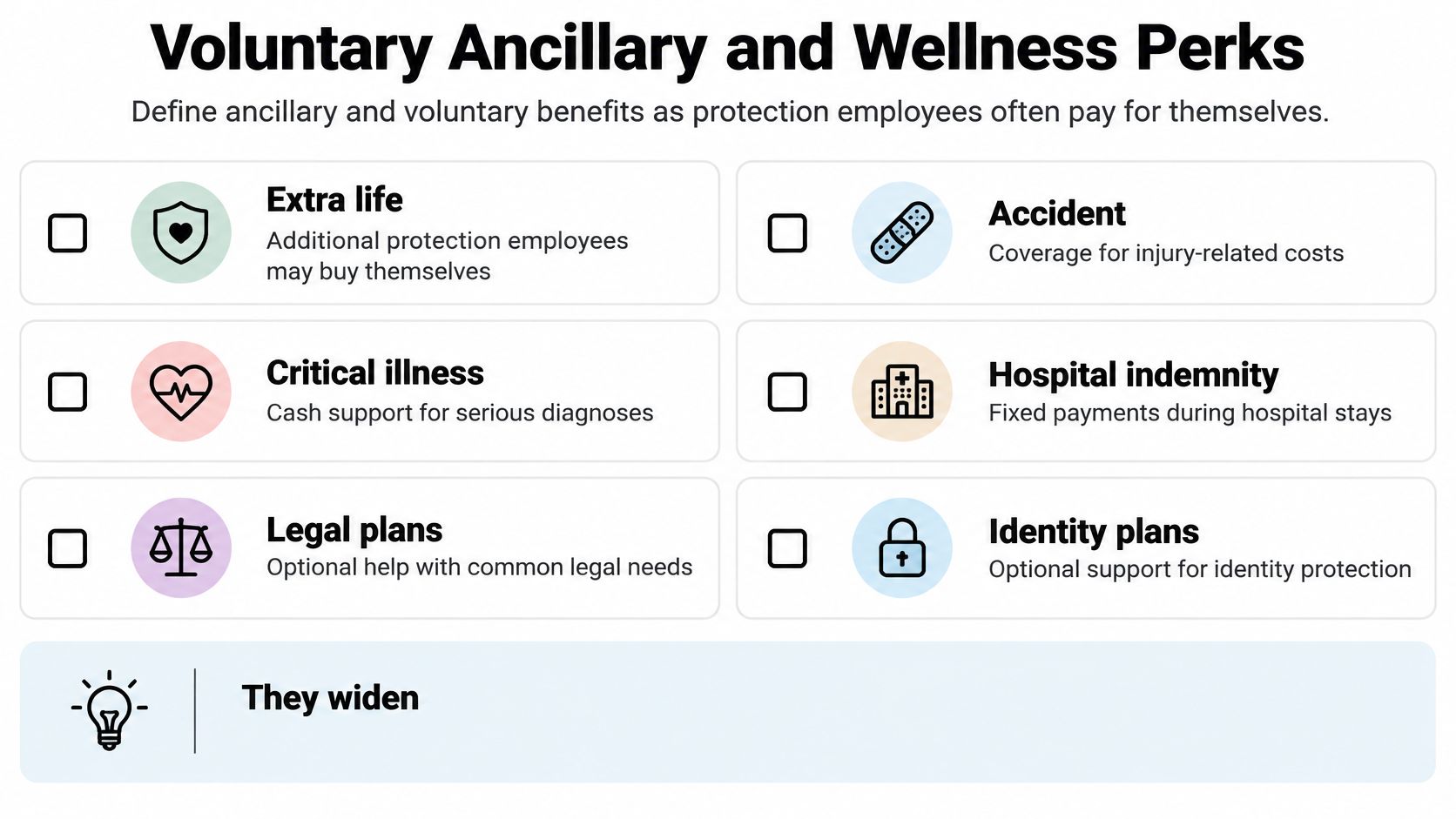
A longer perk list isn't a better package. Ancillary and voluntary benefits are protection employees often pay for themselves through payroll deductions, including extra life insurance, accident, critical illness, hospital indemnity, and sometimes legal or identity plans. They widen the menu at low employer premium cost, but a deduction nobody understands isn't a benefit.
The checklist below shows the common voluntary categories employees may choose to buy.
Flexible accounts need equally direct explanations. An FSA suits predictable medical or dependent care spending, an HSA works only with a qualifying HDHP, and commuter benefits help only where transit or paid parking is a real cost. If employees can't estimate their likely spending, they'll either underfund the account or avoid it.
Judge Emerging Benefits by Use, Not Buzz
SHRM's 2025 Employee Benefits Survey takeaways found that 23% of employers offered GLP-1 coverage for type 2 diabetes and/or weight management, while only 13% offered elder-care referral services. Wellness programs with resources fell to 39% of employers in 2025, down from 53% in 2021. A visible drug benefit can receive more attention than caregiving help, and a wellness program can exist without meaningful participation.
Before you add anything new, run a six point gate:
- Name the problem: State the workforce issue in one sentence, such as missed work for elder care searches.
- Estimate use: Count who's eligible and who would realistically enroll in the first year.
- Check evidence: Look for clinical or productivity support, not vendor testimonials alone.
- Test parity: Compare access across pay bands, shifts, and locations.
- Set privacy rules: Define what employee level data you will and won't receive.
- Pick a review date: Decide when you'll renew, redesign, or end it.
Reject or redesign anything that fails two of those tests. For practical program design, this overview of wellness initiatives that engage employees from Lola is useful background, and our guide to employee wellness incentive programs helps you connect incentives to participation you can measure. Benely offers wellness programs aimed at improving employee health and productivity, but the gate still comes first.
Education assistance and student loan help belong in the same category of targeted tools. Offer them when turnover data shows early career flight or a hard to fill credential, not because a competitor added a logo to its careers page. Cap the benefit, name eligible programs, and review completion and retention after the first cohort.
Compliance Duties Behind the Menu
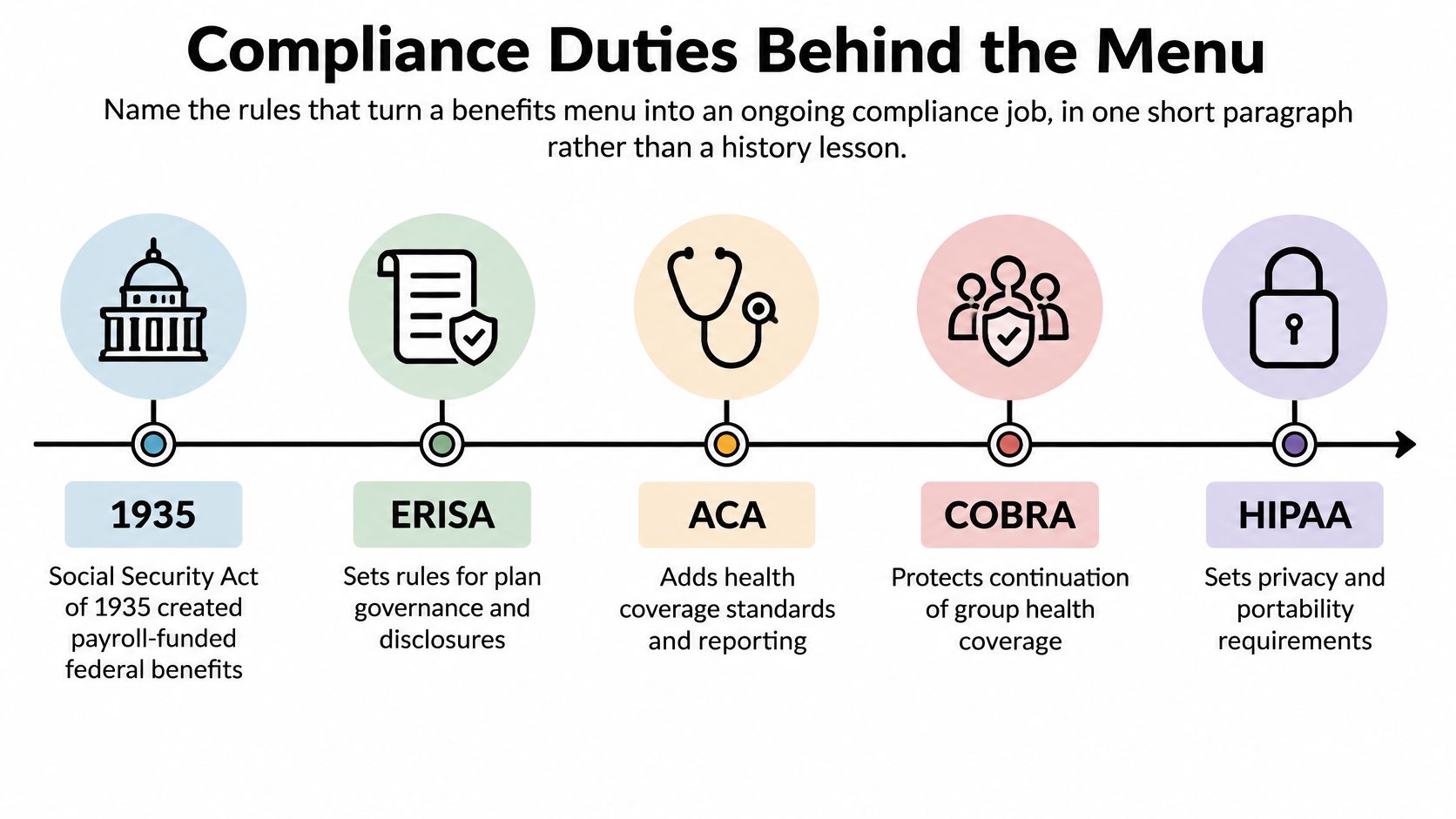
Four legal milestones explain most of the compliance work behind the menu. The Department of Labor ERISA timeline notes that the Social Security Act of 1935 established federal benefits funded through payroll taxes, and ERISA was signed in September 1974 with minimum standards for private-sector retirement, health, and other welfare benefit plans. COBRA, enacted in 1985, created limited continuation rights for health coverage, while HIPAA, enacted in 1996, added rules for portability and security.
The timeline below places those duties in the order employers usually meet them.
Four Operating Duties for a Small Employer
- Disclose and file: Give required plan disclosures, keep plan documents current, and use an ERISA wrap if you have multiple welfare plans.
- Run COBRA correctly: Send notices on time and bill continuation premiums accurately, or hire an administrator who does.
- Track ACA duties: If you're an applicable large employer, manage the employer mandate, measurement periods, and reporting.
- Apply eligibility consistently: Waiting periods and employee classifications in practice must match what your documents and filings say.
Fiduciary duty is the principle underneath those tasks. The person choosing vendors and plan features must act for participants, document the decision, and monitor fees and service. A carrier bonus or a familiar broker relationship isn't a participant centered reason.
Use this employee benefits compliance checklist to assign each duty to a named owner and date. Workers' compensation and unemployment insurance stay in the legally required bucket and vary by state, so confirm state rules for every work location.
A polished benefits guide that misses a COBRA notice is still a broken program.
Point employees and managers to Department of Labor and IRS primary sources for legal tests rather than vendor blogs. Vendor material can explain a product, but the statute and agency guidance decide whether your process complies.
How SMBs Budget a Usable Package
A benefit can be offered on paper and still be unusable at the kitchen table. KFF reported that average employer-sponsored family coverage reached $26,993 in 2025 while workers paid $6,850 annually through payroll contributions in its 2025 family premium release. In California, 35% of workers at firms with 10 to 199 employees were in plans with family contributions exceeding half of the premium, versus 5% at large firms.
That's the affordability test for the types of employee benefits you choose. Compare single and family tiers separately, including deductible and out of pocket maximum, not just the premium. A lower paid employee covering dependents can face a completely different plan from a highly paid employee covering only themselves.
The budget visual below separates costs that move for different reasons.
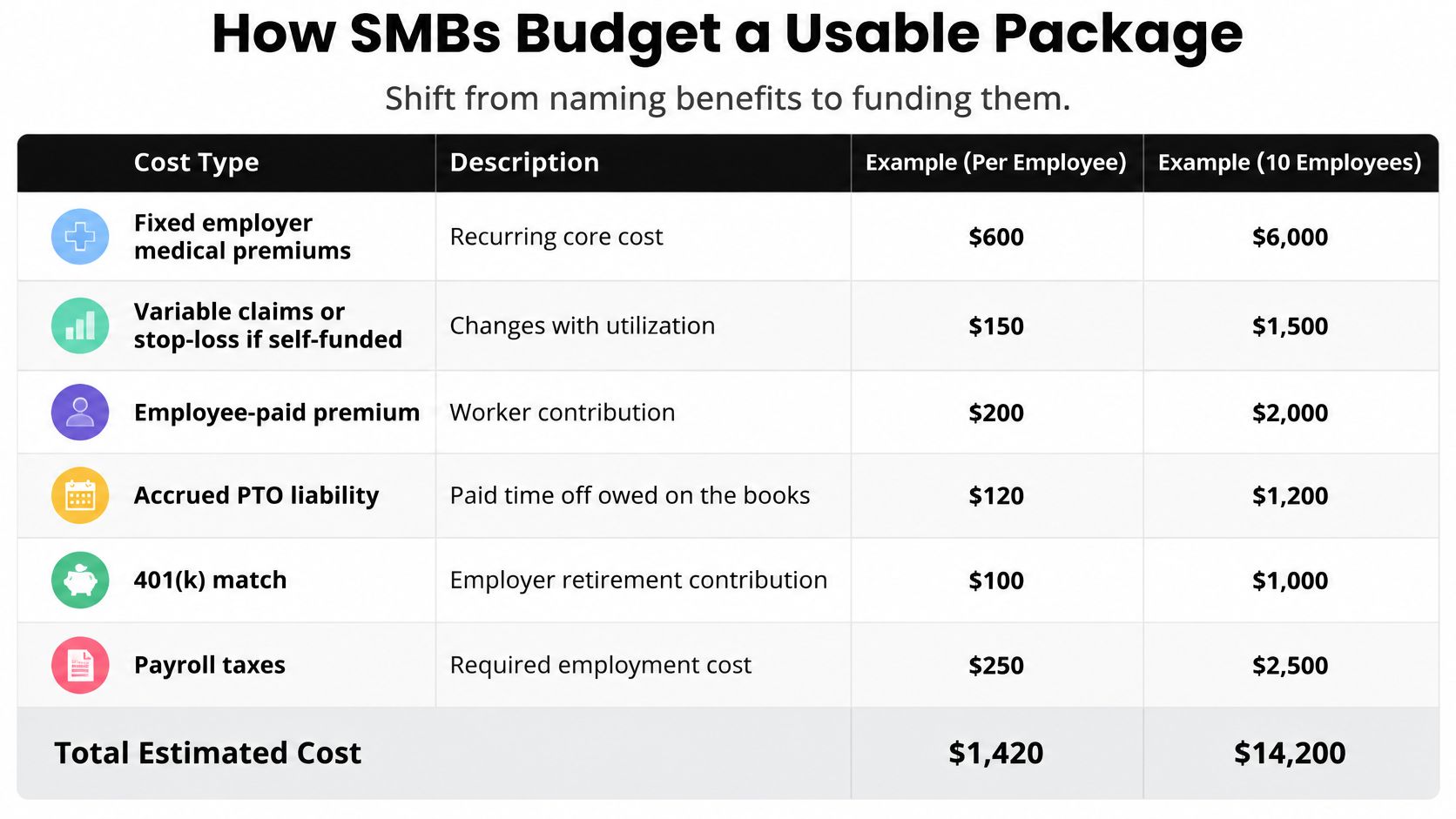
Build a Six Line Ledger
- Fixed employer medical premiums: The recurring amount owed whether employees use care or not.
- Variable claims or stop-loss: The exposure that changes with utilization if you're self-funded.
- Employee-paid premium: The paycheck share that decides whether families enroll.
- Accrued PTO liability: Earned time off sitting on your books.
- Retirement match: The cost created by your formula, eligibility, and participation.
- Statutory payroll costs: Wage based taxes and insurance you must fund.
Don't manage that ledger with one benefits per employee average. Medical use, absence behavior, match participation, and wage based taxes move independently, so one blended number hides the lever you need to pull. Track participation too, because offering a retirement plan that few people join signals a match, eligibility, or communication problem rather than a successful benefit.
Scenario test one change at a time. Compare a higher deductible plus an employer HSA seed against richer first dollar coverage, holding headcount and tier mix constant. Then look at the family paycheck under each option before you celebrate a premium saving.
Budget-first designs for small employers
| Design | Best when | Employer cost driver | Watch-out |
|---|---|---|---|
| Richer low-deductible medical | Recruiting against large local employers | High fixed premium | Family paycheck share can still be unaffordable |
| HDHP plus employer HSA seed | Workforce can fund a deductible | Premium savings versus seed amount | Seed too small leaves people avoiding care |
| Tiered or defined contribution | Mixed household incomes | A set dollar allowance | Underfunding the family tier |
| Employee-paid voluntary and ancillary | Cash is tight but protection gaps are clear | Little or no premium | Low take-up if communication is weak |
| PEO co-employment | Admin headcount cannot run payroll and compliance | PEO fee plus insured rates | Less control of plan and service |
A PEO can bundle payroll, benefits, and some compliance, but don't sign on a bundled quote alone. Ask for the PEO fee, plan network, employer and employee premium by tier, and who owns day to day employee service. If the vendor can't unbundle those answers, you can't compare it with running benefits yourself.
Pick the Mix and Run Enrollment
You can turn the menu into a working package this quarter with five decisions. Keep the sequence tight, because adding optional products before the core is funded creates a brochure employees admire and a paycheck they can't accept.
- Freeze the must-haves: Fund medical, legally required costs, and a written PTO rule first.
- Add retirement with mechanics: Choose the match formula, vesting, eligibility, and payroll feed together, in language you can explain in one minute.
- Gate the add ons: Add dental, vision, disability, and voluntary plans only when they solve a named problem for a countable group.
- Model the paycheck: Price single and family tiers for your lowest pay band and reject any tier most employees can't pay.
- Run one enrollment window: Use a short custom guide, a live or virtual meeting, and one to one help for employees covering dependents.
Reconcile elections to payroll before the effective date. Check names, tiers, dependents, deduction amounts, HSA or FSA elections, and retirement deferrals against carrier confirmations. Catching a wrong family tier before the first payroll is administration, catching it three months later is a trust problem.
Measure participation by plan and pay band 30 days after enrollment, then again at renewal. Low medical take up in the family tier points to affordability, low retirement participation points to match communication or eligibility friction, and low voluntary enrollment usually means employees didn't understand what they were buying.
Where Outside Help Fits
Benely shops, analyzes and personalizes group benefits in simple steps, and the client makes the final decision. Its Employee Benefits solution lets employers manage benefits from A to Z, including side by side comparisons that show what each plan costs from an employee's paycheck. Benely also offers a free benefits score, where a business rates its benefits process and receives a free 30-page benefits guide.
Pick one design from the budget table, set a review date 12 months out, and stop adding perks until participation numbers justify them. A smaller package that employees join, understand, and can afford will do more for retention than a long list of types of employee benefits that only looks generous.
Ready to price the five buckets against real single and family paycheck costs? Benely can shop and personalize group benefits, set up enrollment, and show employees clear side by side comparisons while you keep the final decision. Visit us to rate your benefits process, get your free benefits score and 30-page guide, and build a package your team can use.