The ACA is the 2010 federal health law that sets employer coverage duties, Marketplace rules, and consumer protections, with employer responsibility generally starting at the 50-employee test.
You're hiring, payroll is growing, and your HR manager wants to know whether next year's benefits budget needs to change. The answer doesn't come from today's headcount alone. You need to establish which workers count, whether your coverage offer meets the rules, and whether your reporting records can prove it.
Table of Contents
- What Is the ACA and Why Employers Care
- How to Count Toward the 50-Employee Line
- The Coverage Tests Behind Employer Responsibility
- Forms 1094 and 1095 and Penalty Triggers
- When Employees Can Still Use the Marketplace
- Four Employer Situations and the Practical Result
- Set Your 2026 ACA Compliance Priorities
What Is the ACA and Why Employers Care

At a renewal meeting, the premium quote lands, a manager asks whether the offer is “affordable,” and the founder realizes the answer is arithmetic, not slogans. The Affordable Care Act, formally the Patient Protection and Affordable Care Act, became federal law on March 23, 2010, enacted by the 111th Congress and signed by President Barack Obama, according to Britannica's account of the law's passage.
For an employer, the ACA works less like a history chapter and more like three linked calculations. A prior-year full-time equivalent count can place the company near the employer-responsibility line. The self-only 9.96% affordability test can decide whether the lowest-cost employee-only option clears the offer math. Marketplace subsidy eligibility can still matter when an offer fails that math.
What employees encounter when buying coverage
The law also shaped the individual coverage people compare on the health insurance Marketplaces, where individuals and families buy private plans, often with federal financial assistance.
Regulated plans generally cannot deny coverage or charge more because of a preexisting condition. The law eliminated lifetime dollar limits on the benefits it requires plans to cover. Required categories include prescription drugs, preventive services, maternity care, mental-health treatment, and substance-use treatment.
The ACA also extended Medicaid eligibility to more low-income adults, and a 2012 Supreme Court ruling left states free to decide whether to expand the program.
Why a founder needs more than a definition
Say your company hires someone who previously bought Marketplace coverage. They need an accurate benefits offer, not just an assurance that the company has insurance.
Your team also needs usable records. Resources such as healthcare document automation with Matil can inform how you organize document workflows, but automation does not replace a sound eligibility decision.
The employer questions stay practical: Must we offer coverage, how strong must that offer be, and when can a worker still use the Marketplace?
How to Count Toward the 50-Employee Line
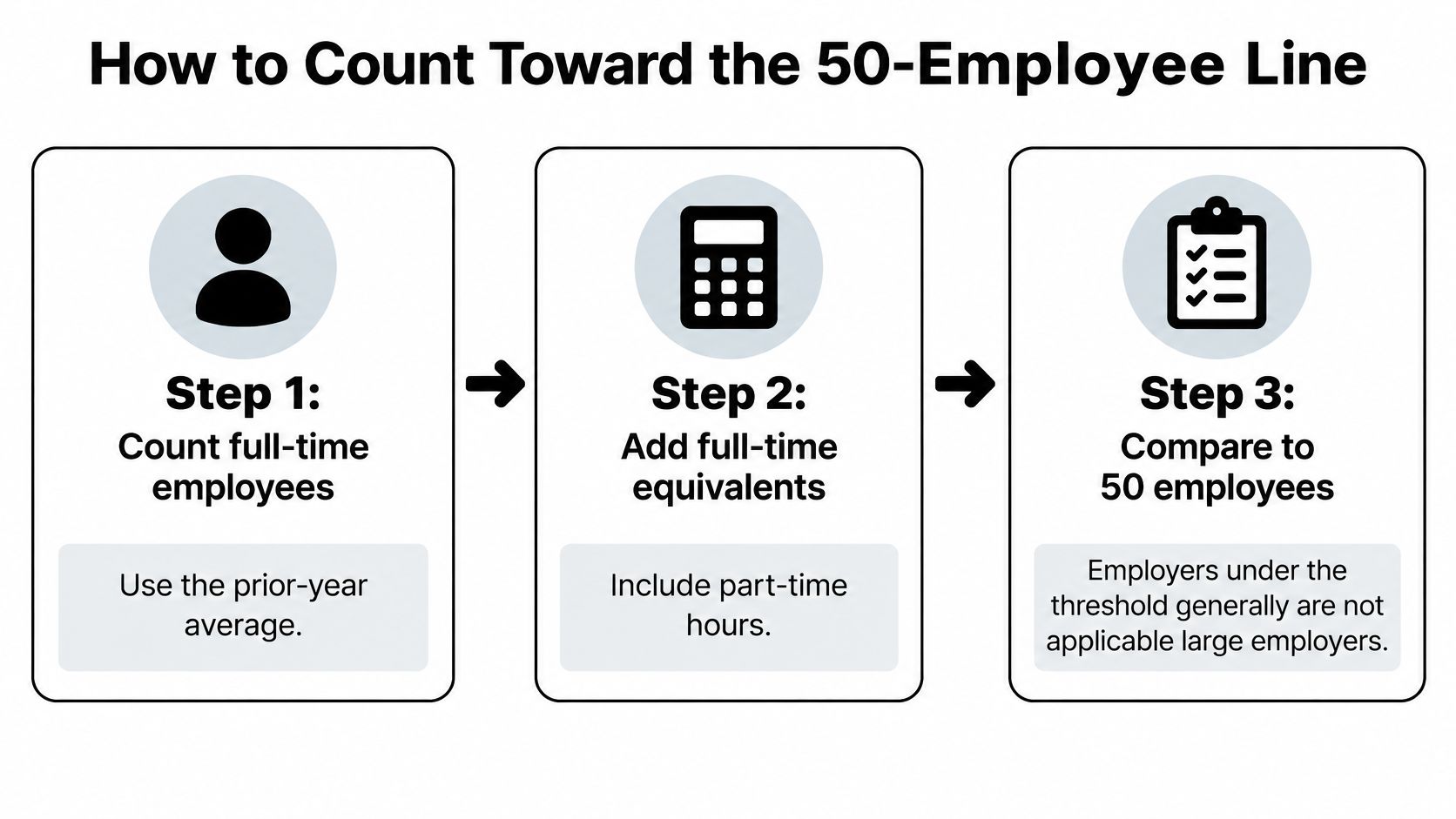
The ACA doesn't require every small business to offer health insurance. The IRS employer guidance distinguishes employers with fewer than 50 full-time employees, including full-time equivalents, from applicable large employers, using the prior-year average, not only today's headcount.
That distinction matters when your workforce includes part-time employees or fluctuates with customer demand. A payroll roster answers who works for you now. An ACA workforce calculation answers a different question.
Use this workflow to keep those tasks separate.
Build the count from payroll records
- Establish the employer group. Identify the legal entities and ownership relationships before calculating workforce size. Related companies can require a combined analysis rather than separate headcounts.
- Identify full-time employees. Apply the ACA's full-time classification rules to hours records, rather than relying on job titles or your handbook's benefits labels.
- Calculate full-time equivalents. Include the relevant part-time hours in the workforce calculation. Don't assume that excluding someone from your company plan excludes their hours from ALE analysis.
- Calculate the prior-year average. Review the complete measurement year, documenting fluctuations instead of selecting a convenient payroll date.
For a hypothetical monthly calculation, suppose a business has 35 full-time employees and 1,200 countable part-time hours. Dividing those hours by 120 produces 10 equivalents, for a monthly total of 45; with 2,400 countable part-time hours, the equivalent count becomes 20, and the total becomes 55.
Those are worked-example inputs, not a determination of any particular employer's status. The annual result comes from the applicable monthly calculations, not the busiest month alone.
Review exceptions before declaring an exemption
Seasonal staffing, a newly established business, and common ownership deserve specific review. A seasonal increase isn't automatically the same as sustained workforce growth, and a startup shouldn't treat months before it existed as ordinary operating months.
Practical rule: Keep the workforce-size calculation separate from the decision about which individual employees must receive an offer.
That distinction is especially important when reviewing part-time employee eligibility for health insurance. Part-time hours can affect employer status without making every part-time employee eligible under the employer mandate.
Employers below the ALE threshold may still use the Small Business Health Options Program, or SHOP, and potentially qualify for small-business tax benefits. Offering coverage also brings plan-administration and notice responsibilities.
For an accompanying explanation, use this video alongside your payroll review.
Compute the prior-year average before assuming you're exempt. Being outside the employer mandate doesn't mean having no ACA-related obligations.
The Coverage Tests Behind Employer Responsibility
Employer ACA exposure reduces to three numbers: the prior-year full-time-equivalent average, the share of costs the plan is designed to pay, and the premium each employee is asked to contribute. Each test below measures one of those numbers, and a pass on one says nothing about the rest.
2026 employer coverage tests at a glance
| Test | 2026 standard | Who it affects | What fails it |
|---|---|---|---|
| Applicable large employer | Prior-year average of at least 50 full-time employees plus full-time equivalents | The organization, including related companies counted together | Treating today's headcount as the only test |
| Minimum essential coverage offer | Qualifying coverage offered to full-time employees and dependents | Full-time employees of an ALE | No offer, or dependents omitted, when a full-time employee gets a premium tax credit |
| Minimum value | Plan pays at least 60% of allowed costs and includes substantial physician and inpatient hospital care | The job-based plan being offered | A thin plan under 60% or one missing substantial hospital or physician coverage |
| Affordability | Employee self-only premium does not exceed 9.96% of annual household income | Full-time employees evaluating the offer | An employee share above the standard, even if the employer's net cost looks low |
| ICHRA or CHOICE arrangement | After reimbursement, self-only lowest-cost Silver costs under 9.96% of one-twelfth of annual household income | Employers funding individual coverage | An unaffordable arrangement, which an eligible employee must decline to take a premium tax credit |
The first row establishes employer status. The remaining rows apply after that status is set, which is how a company can be an ALE, make every required offer, and still owe a payment because one employee's contribution ran too high.
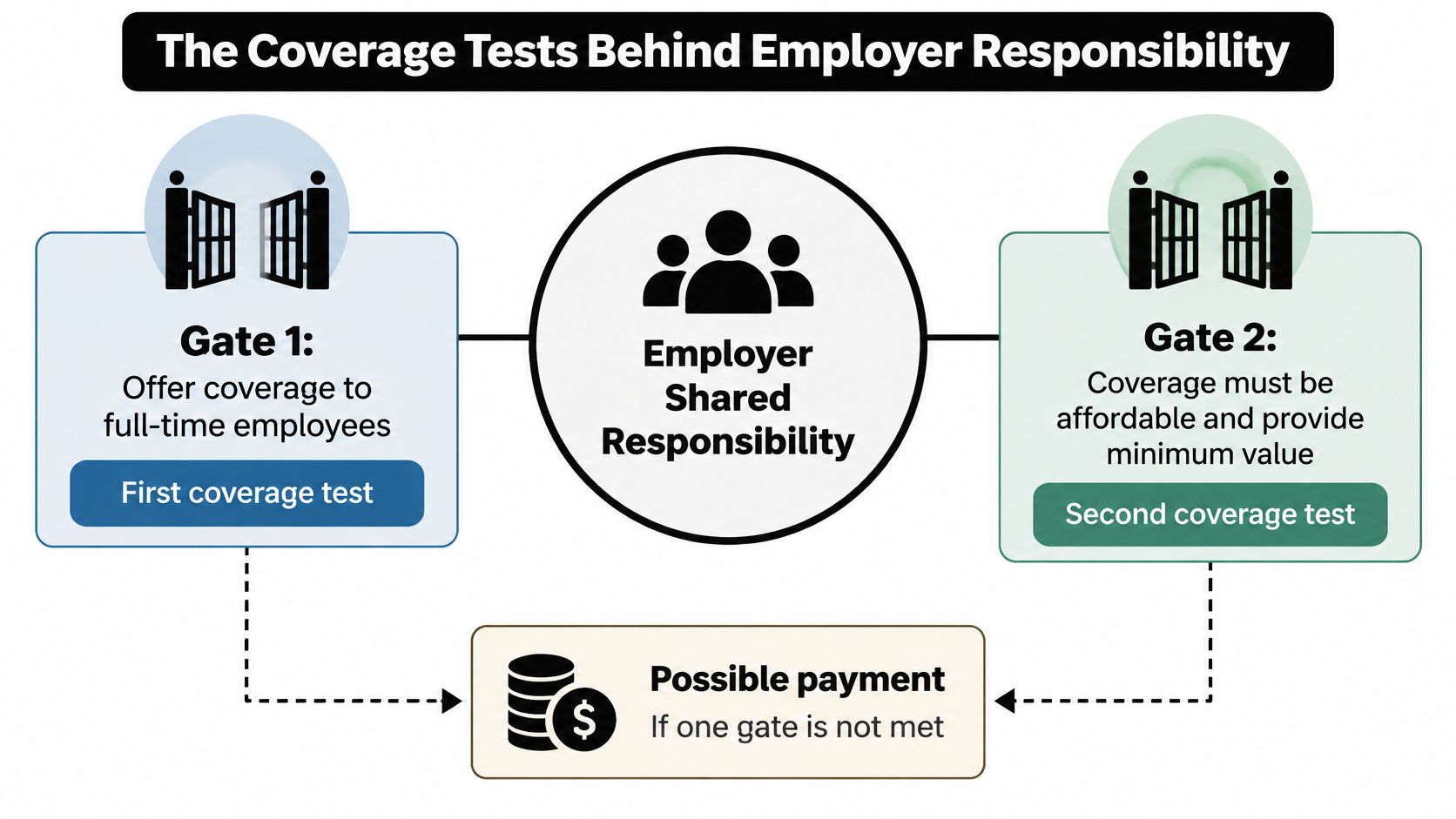
Gate one is a qualifying coverage offer
Under CMS's ACA basics training, an ALE may incur an employer shared-responsibility payment when it fails to offer qualifying coverage to full-time employees and dependents and at least one full-time employee obtains Marketplace coverage with an advance premium tax credit.
Two details in that definition do the work: the offer has to reach dependents, and the payment trigger requires an actual employee receiving subsidized Marketplace coverage.
Minimum essential coverage, or MEC, is the qualifying-coverage standard. A plan can clear it and still be unaffordable, which is why the second gate exists. Gate one asks whether coverage exists; gate two asks whether it is worth taking.
A waiver also isn't a substitute for an offer. Records should establish what the employee could have accepted before showing that they declined it.
The diagram separates the offer requirement from the quality and cost tests.
Gate two is minimum value and affordability
Minimum value means the plan is designed to pay at least 60% of total allowed benefit costs for a standard population, with substantial physician and inpatient-hospital coverage, per CMS's ACA basics training. That is a plan-design measure, not a promise that the insurer pays that share of any one employee's actual bill. Regulators test the cost-sharing formula on paper, not the outcome for a specific claimant.
For 2026, CMS's affordability guidance identifies affordable employer coverage as a self-only employee premium that doesn't exceed 9.96% of annual household income.
Household income is the legal measure, and employers rarely know it. IRS affordability safe harbors provide employer testing and documentation methods, not a different definition of household income.
A CFO can therefore approve a low employer contribution while leaving an employee with an unaffordable offer. Evaluate the employee's required contribution, not just the employer's budget.
Individual-coverage arrangements need separate calculations
For the arrangement described by HealthCare.gov's employer-help guidance, the 2026 CHOICE affordability test compares the employee's monthly self-only lowest-cost Silver premium after reimbursement with 9.96% of one-twelfth of annual household income, and the premium must be less than that amount. Dividing annual household income by twelve converts a yearly standard into a monthly ceiling the reimbursement has to meet.
If the arrangement is affordable, declining it generally doesn't restore premium tax credit eligibility. If it's unaffordable, an eligible employee must decline it to choose the credit instead.
Close the review with an audit file connecting workforce math, full-time status, employee-level affordability results, dependent-offer indicators, and enrollment or waiver timestamps to payroll. If a penalty letter arrives, that file is the difference between reconstructing the year and defending it.
Forms 1094 and 1095 and Penalty Triggers
A clean filing season can still hide an offer problem. The forms prove what was reported; the payment analysis tests whether the prior-year headcount, the offer, and the affordability math held up when an employee used the Marketplace.
ACA information returns employers touch
| Form | Who is responsible | What it reports | Gap if missing |
|---|---|---|---|
| Form 1095-C | Applicable large employer, furnished to each full-time employee | Offer made, employee share of the lowest-cost self-only minimum-value premium, and the safe-harbor code on line 16 | Employee cannot verify the offer, and IRS data may not match payroll |
| Form 1094-C | Applicable large employer | Transmittal and employer-level information accompanying C-series returns | IRS lacks the corresponding employer summary |
| Form 1095-B | Generally the insurer, or a responsible self-insured coverage provider | Enrollment in minimum essential coverage | Coverage enrollment cannot be verified from the expected return |
Information reporting and shared-responsibility payments are different issues. A filing error concerns whether required information was reported correctly. A coverage failure concerns the offer an employee received and that employee's later Marketplace tax-credit eligibility. Correcting a return improves the record; it does not make an inadequate offer adequate after the fact.
Assign ownership before forms are prepared
ALEs use Form 1094-C as the IRS transmittal and Form 1095-C to report employee-level offer information. Most ALEs must file electronically, so payroll, HR, and the reporting vendor need one agreed process before submission. Treat it like closing the books: eligibility changes, contribution amounts, and waivers have to match the same month before the return is locked.
Insurers generally provide Form 1095-B for coverage enrollment. A small employer with a self-insured plan may have B-series duties even when it is not an ALE, so employer size alone does not settle the filing question.
Use the following controls:
- Assign a reporting owner. Name who approves eligibility data, contribution amounts, and final returns.
- Reconcile monthly records. Compare offers and enrollment against payroll changes, including hires, terminations, leaves, and status changes.
- Preserve coding decisions. Record why a safe-harbor or other applicable code was selected, including the code used on line 16.
- Track corrections. Keep the original record, the correction, and the reason for changing it.
For a practical reporting review, use our ACA reporting requirements guide. Teams that keep a separate procedures wiki can organize evidence, ownership, and version control with compliance documentation best practices.
Recognize the separate payment triggers
The no-offer payment can apply when an employer fails to offer MEC to at least 95% of full-time employees and their dependents, and a full-time employee receives a Marketplace premium tax credit. One missed group can matter more than a dozen formatting errors.
The other payment can apply employee by employee when an offer is unaffordable or fails minimum value and that employee receives the credit. An insurance contract existing somewhere in the benefits stack is not enough; the question is what this employee was offered, at what self-only cost, and with what result.
A completed filing is evidence of what you reported, not proof that every underlying coverage decision was correct.
The IRS assesses shared-responsibility payments after reconciling information returns with Marketplace information. It is not a check written during open enrollment. Payment amounts are set and adjusted annually, so confirm current figures and filing procedures in IRS guidance instead of budgeting around an old penalty quotation.
When Employees Can Still Use the Marketplace
Marketplace enrollment and Marketplace financial assistance are separate decisions. An employee can compare individual coverage without necessarily qualifying for help paying for it.
According to CMS's premium tax credit and cost-sharing reduction overview, a worker generally can't receive advance premium tax credits or cost-sharing reductions when offered employer coverage that's both affordable and provides minimum value. Enrollment in employer coverage can independently block eligibility.
Explain the offer before discussing subsidies
An employee may assume that declining the company plan makes them eligible for a credit. HR should correct that assumption without promising a personal tax outcome.
Provide the employee with the actual self-only premium, the plan's minimum-value status, and the relevant dependent-coverage information. Model employee-only cost separately from family cost rather than treating a family payroll deduction as the employee's self-only contribution.
- Document your method. Keep the employer's affordability methodology with the contribution schedule.
- Explain dependent costs separately. Don't imply that the employee's affordability result automatically settles every family member's eligibility.
- Coordinate reimbursement arrangements. Employees generally can't use an employer-funded HRA and a premium tax credit for the same coverage.
Our comparison of private versus public health insurance can help employees understand coverage categories before they compare specific plans. The Marketplace is a purchasing channel for private insurance, not another name for Medicaid.
Match the decision to the enrollment calendar
HealthCare.gov's enrollment answers describe the standard November 1 through January 15 open enrollment period, including the following coverage-start windows.
Marketplace enrollment windows employees ask about
| Enrollment window | Who can use it | Coverage generally starts |
|---|---|---|
| November 1 through December 15 | Anyone eligible for Marketplace coverage during open enrollment | January 1 |
| December 16 through January 15 | Anyone eligible who enrolls in the second half of open enrollment | February 1 |
| After January 15 | People qualifying for a special enrollment period, such as loss of coverage, a move, marriage, or a birth | Under the effective-date rule for the qualifying event |
Employees should confirm the effective date before cancelling existing coverage. A job change and an insurance start date don't necessarily line up automatically.
Keep income estimates current
The credit is based on estimated household income and household size, explains HealthCare.gov's premium tax credit guidance. A raise or smaller household can lead to repayment of advance credits, while lower income or a larger household can increase the final credit.
HR can explain the company's offer accurately. Employees still need to update their Marketplace applications when their household circumstances change.
Four Employer Situations and the Practical Result
The same ACA framework produces different next steps for a founder, a growing employer, a finance team, and an employee. Treat each situation as a decision, not a reason to send everyone the same benefits email.
A startup without an employer mandate
Say a hypothetical 30-person startup has no related companies and a workforce history that confirms it's below the ALE threshold. It doesn't need to create a C-series reporting process solely because it has hired employees, but its team still needs reliable coverage information.
The Marketplace isn't a marginal option: CMS reported 24.17 million plan selections for 2025, including 3.94 million new consumers, compared with 21.4 million selections the prior year.
Practical result: Explain individual enrollment opportunities and decide deliberately whether to offer employer benefits. Don't confuse freedom from the mandate with a complete benefits strategy.
A growing company with variable-hour workers
Consider a hypothetical employer with 40 full-time staff and a substantial variable-hour workforce. Its leadership sees a small company, but the equivalent calculation may establish ALE status for the following year.
The HR manager should reconcile hours before finalizing the benefits budget. Waiting until forms are due leaves little room to correct an offer process that should already have been operating.
Practical result: Connect workforce forecasting to coverage planning and reporting ownership, rather than treating each as an independent annual project.
A CFO focused only on employer cost
A CFO lowers the employer contribution to protect cash flow. The plan remains available, but the employee's required share fails the applicable affordability test.
If an affected full-time employee receives a Marketplace credit, the employer may face employee-specific shared-responsibility exposure. The apparent savings therefore need to be evaluated alongside compliance risk and the employee's actual premium burden.
Budget check: Compare the proposed employer savings with the employee contribution before approving the renewal.
Practical result: Finance and HR should approve the contribution schedule together, with the affordability result attached.
An employee who declines the company plan
An employee prefers a Marketplace plan and declines an affordable, minimum-value employer offer. That preference doesn't itself establish eligibility for a premium tax credit.
Dependent needs, household circumstances, part-time status, and job changes require their own review. A waiver records the employee's choice, not a determination that subsidized coverage is available.
We gave OBEY Clothing access to live certified HR professionals and ACA support experts, and OBEY achieved ACA compliance. Practical result: Give employees accurate offer information and give HR access to qualified support when a decision requires more than a standard enrollment explanation.
Set Your 2026 ACA Compliance Priorities
Make ACA compliance a recurring payroll-and-benefits review, not a filing-season rescue project. The founder should approve resources, finance should own contribution assumptions, and HR should maintain the employee-level evidence.
Use this quarterly checklist to schedule the work before enrollment decisions become difficult to change.
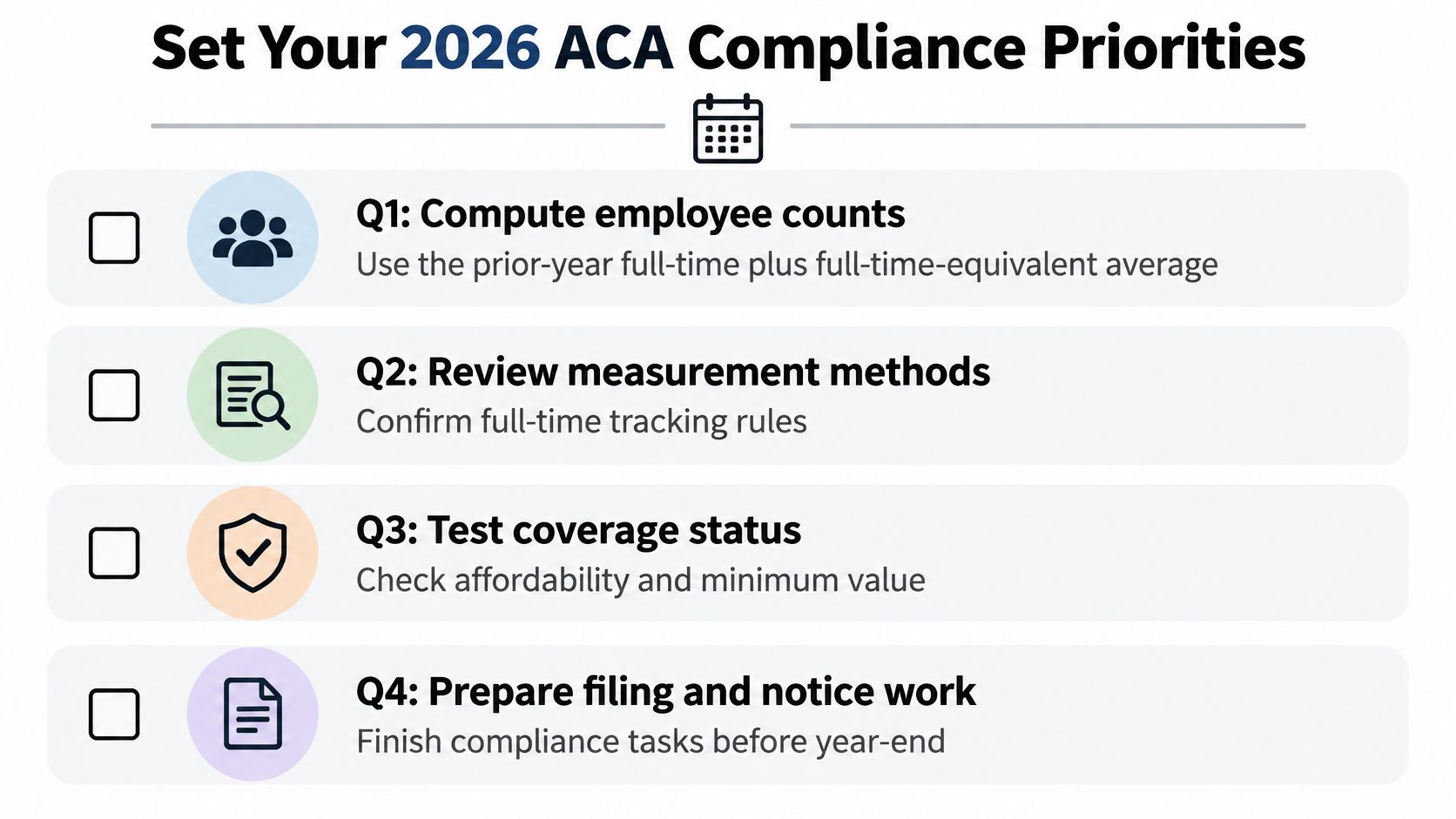
Give each quarter a defined output
- Early-year workforce review. Complete the prior-year full-time and full-time-equivalent calculation, including relevant related entities. Use the IRS as the primary authority for employer status, and retain the underlying payroll export.
- Confirm the offer population. If you're an ALE, reconcile the people who should receive an offer with the actual eligibility file. Investigate missing dependent offers rather than assuming the carrier enrollment file proves compliance.
- Review measurement methods. Map variable-hour employees to the applicable measurement and stability periods. Document who monitors changes and who resolves disputed hours.
- Test renewal contributions. Evaluate the lowest-cost self-only minimum-value option before approving payroll deductions. Use CMS guidance for the coverage tests and record the employer's affordability methodology.
- Put reporting on the payroll calendar. Assign responsibility for C-series returns, employee furnishing, codes, electronic submission, and corrections. Confirm current IRS procedures before committing to a vendor timetable.
- Prepare employee explanations. Tell employees what the offer is designed to meet and what information they'll need when evaluating other coverage. Use HealthCare.gov for Marketplace enrollment and subsidy coordination.
- Choose the smaller-employer path deliberately. If you're not an ALE, focus on the benefits decision, SHOP evaluation, any remaining plan responsibilities, and clear Marketplace enrollment communication.
Our compliance evaluation helps ensure clients' ACA reporting, COBRA, and ERISA filings are up-to-date and compliant. Bring the workforce calculation, contribution schedule, and reporting ownership list to that review so unresolved questions become assigned actions.
Confirm ALE status before open enrollment, not after a notice arrives.
Benely offers a compliance evaluation to help keep ACA reporting, COBRA, and ERISA filings up-to-date and compliant. Our compliance experts can also assist with COBRA/FSA administration, HR support, ERISA wrap, and ERISA filing. Visit Benely to review your workforce calculation, coverage offer, and reporting process before your next enrollment cycle.