 Employee Benefits
 HR & Compliance
 Technology
 Wellness
 PEO Solutions
You've hired steadily, added a few variable-hour employees, and now your payroll report shows a workforce that's close to 50 people. Your finance lead says you're still a small employer because fewer than 50 employees work full time. Your operations manager isn't so sure, especially after seasonal staff and a second related entity are included.
That uncertainty is exactly where ACA problems begin. ACA compliance for small employers depends on a carefully calculated annual average, not a quick year-end headcount. The right benefits decision also depends on whether you're below the mandate threshold, approaching it, or voluntarily offering coverage through SHOP, a QSEHRA, or a traditional group plan.
Table of Contents
- Understanding the 50-Employee Threshold
- Calculating Full-Time Equivalents Accurately
- Choosing the Right Coverage Strategy
- Maximizing the Small Business Health Care Tax Credit
- Navigating Reporting and Recordkeeping Duties
- Avoiding Costly Penalties and Common Myths
- Your Step-by-Step ACA Compliance Checklist
Understanding the 50-Employee Threshold
The Affordable Care Act's employer compliance framework uses the Applicable Large Employer, or ALE, threshold. An organization generally becomes an ALE when it averaged at least 50 full-time employees, including full-time equivalents, during the preceding calendar year, as explained by the IRS employer shared-responsibility guidance.
That definition creates an important distinction. The question isn't, “How many people are on payroll today?” The question is whether your business's prior-year monthly workforce calculation reached the threshold. A company can finish the year with fewer than 50 employees and still have a complicated workforce history that requires careful review.

What changes when you're below the threshold
A small employer with fewer than 50 full-time employees and full-time equivalents on average during the preceding calendar year generally isn't subject to the federal employer shared-responsibility mandate. That means the business generally won't face the federal ACA employer-mandate payment merely because it declines to offer health insurance.
That flexibility is useful, but it isn't a blanket exemption from healthcare administration. You may still need to handle employee notices, plan documents, Marketplace-related communications, state insurance requirements, and the rules attached to whichever benefit structure you choose. State obligations can also differ from federal requirements, so a federal exemption shouldn't be treated as a complete compliance clearance.
Companies that meet the ALE threshold generally face two separate coverage tests. They must offer minimum essential coverage to at least 95% of full-time employees and their dependents, and the offer must be affordable and provide minimum value. They also generally take on annual information reporting about offers of coverage and employee eligibility.
Why founders should track headcount monthly
The most dangerous approach is waiting until December to ask whether the business is “small.” Hiring patterns, overtime, seasonal work, unpaid leave, and changing schedules can affect the monthly calculation. Your HR team should maintain a monthly record of full-time employees, part-time hours, seasonal status, and any related companies under common ownership.
For a practical explanation of the point at which benefits obligations can change, review when a company has to offer benefits. Use that information as a planning prompt, not as a substitute for reviewing your actual payroll records and ownership structure.
Practical rule: Treat the 50-employee threshold as a year-round forecasting issue. If your company is getting close, build the benefits and reporting plan before the threshold becomes a surprise.
The IRS states that the employer shared-responsibility provisions generally first became effective in 2015. For a growing startup, the key lesson is simple: being below the threshold today doesn't guarantee that you'll remain below it next year.
Calculating Full-Time Equivalents Accurately
A company with 42 individually full-time employees may still be an ALE after part-time hours are converted into full-time equivalents. That's the hidden trap. The ACA counts workforce capacity, not just the number of employees whose job titles say “full time.”
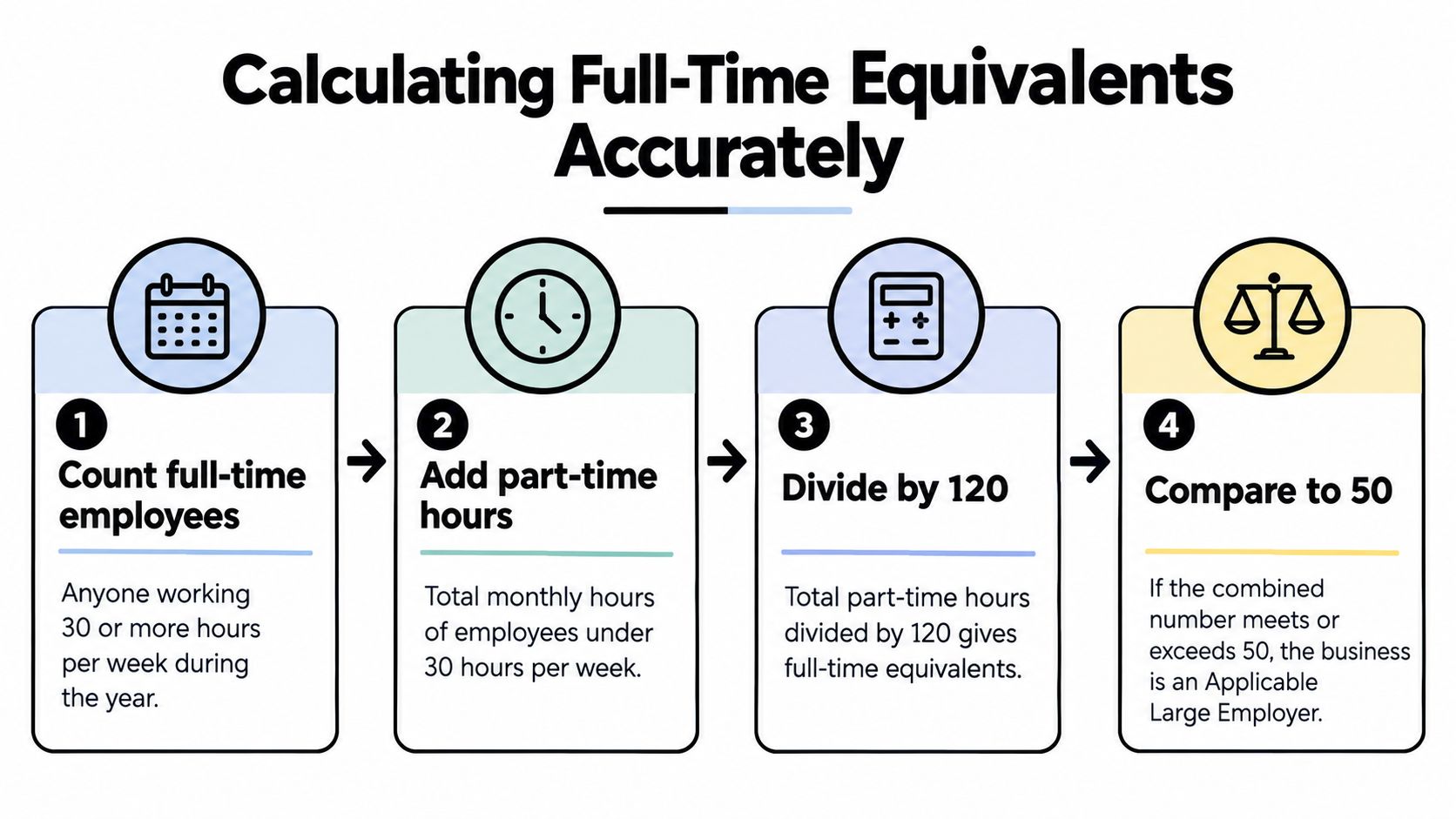
For ACA purposes, a full-time employee generally averages at least 30 hours of service per week or 130 hours in a calendar month. The employer then adds full-time employees and full-time-equivalent employees for each month of the prior year and divides the annual total by 12, following the IRS method for determining ALE status.
Use the monthly calculation, not a snapshot
The monthly process has three working parts:
- Count full-time employees. Include each employee who meets the weekly or monthly full-time standard for that month.
- Add part-time hours. Total the hours worked by employees who aren't counted individually as full time. For the FTE conversion, the commonly used monthly divisor is 120 hours.
- Combine and average. Add the individual full-time employee count to the part-time FTE result for each month, then average the monthly totals across the prior calendar year.
For example, if part-time employees collectively work 1,200 hours in a month, those hours represent 10 FTEs under the 120-hour conversion. That figure is added to the number of individual full-time employees for that month. The result isn't a statement that 10 specific people became full-time employees. It's a workforce-counting value used to determine ALE status.
Seasonal hiring deserves separate attention. A retailer may look safely below the threshold during quiet months, then add a large group of seasonal workers during a busy period. Don't assume seasonal status automatically removes the issue. Preserve start dates, end dates, schedules, and the facts supporting any seasonal-worker treatment.
Review related entities before making a decision
Ownership structures create another serious risk. Businesses under common ownership may need to aggregate employees across entities when determining ALE status. A startup with a parent company, operating subsidiaries, or shared-service entities can't assume each payroll is evaluated in isolation.
The same concern applies to franchise-like structures and staffing arrangements. Ask whether workers are employed by the company, supplied through a staffing agency, or connected to another business in a way that affects the calculation. Have counsel or a qualified benefits adviser review the arrangement when the answer isn't obvious.
Don't let a clean year-end headcount conceal a messy monthly average. The calculation should be reproducible from payroll records, schedules, and ownership documents.
Build a spreadsheet or system report that shows, for every month, individual full-time employees, part-time hours, converted FTEs, seasonal workers, and related-company totals. Have someone outside payroll review the calculation before the annual benefits strategy is finalized. That small control can prevent a major classification error.
Choosing the Right Coverage Strategy
Once your workforce calculation is clear, choose the benefits structure based on budget, employee needs, administrative capacity, and growth trajectory. “Under 50” gives you flexibility, but it doesn't make every option interchangeable.
The three main paths are SHOP coverage, a QSEHRA, and a traditional group health plan. Each solves a different problem.
| Feature | SHOP Marketplace | QSEHRA | Traditional Group Plan |
|---|---|---|---|
| Basic structure | Employer-sponsored group coverage through the small-business marketplace | Employer reimbursement arrangement for individual-market coverage | Employer-sponsored coverage purchased through a carrier or broker |
| Best fit | Employers seeking group coverage and possible tax-credit eligibility | Employers that don't offer a group plan and want a defined reimbursement budget | Employers competing for talent with a conventional benefits package |
| Employee choice | Choice depends on the available SHOP plan design | Employees generally select their own individual-market coverage | Choice depends on the carrier and plan lineup |
| Employer budget | Based on the selected plan and contribution strategy | Employer sets reimbursement within applicable limits | Based on plan selection, contribution level, and renewal terms |
| Main compliance concern | Offer and participation rules must be followed | Must be structured formally, with eligibility, notice, and Marketplace coordination | Plan documents, enrollment, payroll deductions, and renewal administration |
SHOP is useful when you want group coverage
The federal SHOP Marketplace is generally designed for businesses with 1 to 50 FTE employees, although some states permit participation by businesses with up to 100 employees, according to SHOP Marketplace eligibility guidance. Employers generally need to offer coverage to all full-time employees, while they generally don't have to offer it to part-time employees averaging fewer than 30 hours per week or to seasonal workers.
SHOP deserves a close look when you may qualify for the small-business health care tax credit or when your employees strongly prefer a traditional group plan. It may be less attractive when your workforce has widely different plan preferences or when a fixed employer budget matters more than a single group menu.
QSEHRA creates a defined reimbursement budget
A QSEHRA is available to certain small employers that don't offer a group health plan. The arrangement generally must be available on the same terms to eligible full-time employees, and the employer generally can't offer a group health plan such as SHOP coverage or a flexible spending account.
For 2026, the annual QSEHRA limit is $6,450 for employee-only coverage and $13,100 for employee-and-family coverage. The corresponding monthly maximums are $537.50 and $1,091.66, as stated in Healthcare.gov's QSEHRA guidance.
QSEHRA can work well for a company that wants predictable spending without taking responsibility for selecting one group plan. It requires disciplined notices, eligibility administration, reimbursement documentation, and coordination with employees' Marketplace subsidy eligibility. Informal premium payments aren't a substitute.
Traditional group plans may support recruiting
A conventional group plan can offer a familiar employee experience and may be easier to explain during recruiting. It can also create renewal exposure, contribution pressure, and more administration than a defined reimbursement approach.
If you're comparing carrier networks, contribution levels, and enrollment responsibilities, working with a broker for group health can help you evaluate the market and the operational requirements. For a broader comparison of plan structures, review small-business health insurance options.
My recommendation is to choose the structure you can administer consistently. A theoretically inexpensive arrangement becomes expensive when payroll, notices, employee eligibility, and reimbursement records are handled informally.
Maximizing the Small Business Health Care Tax Credit
A company can qualify for the small-business health care tax credit on paper and still lose the benefit through an inaccurate FTE calculation, an incomplete contribution review, or the wrong coverage choice. Treat the credit as a planning input, not as an automatic discount.
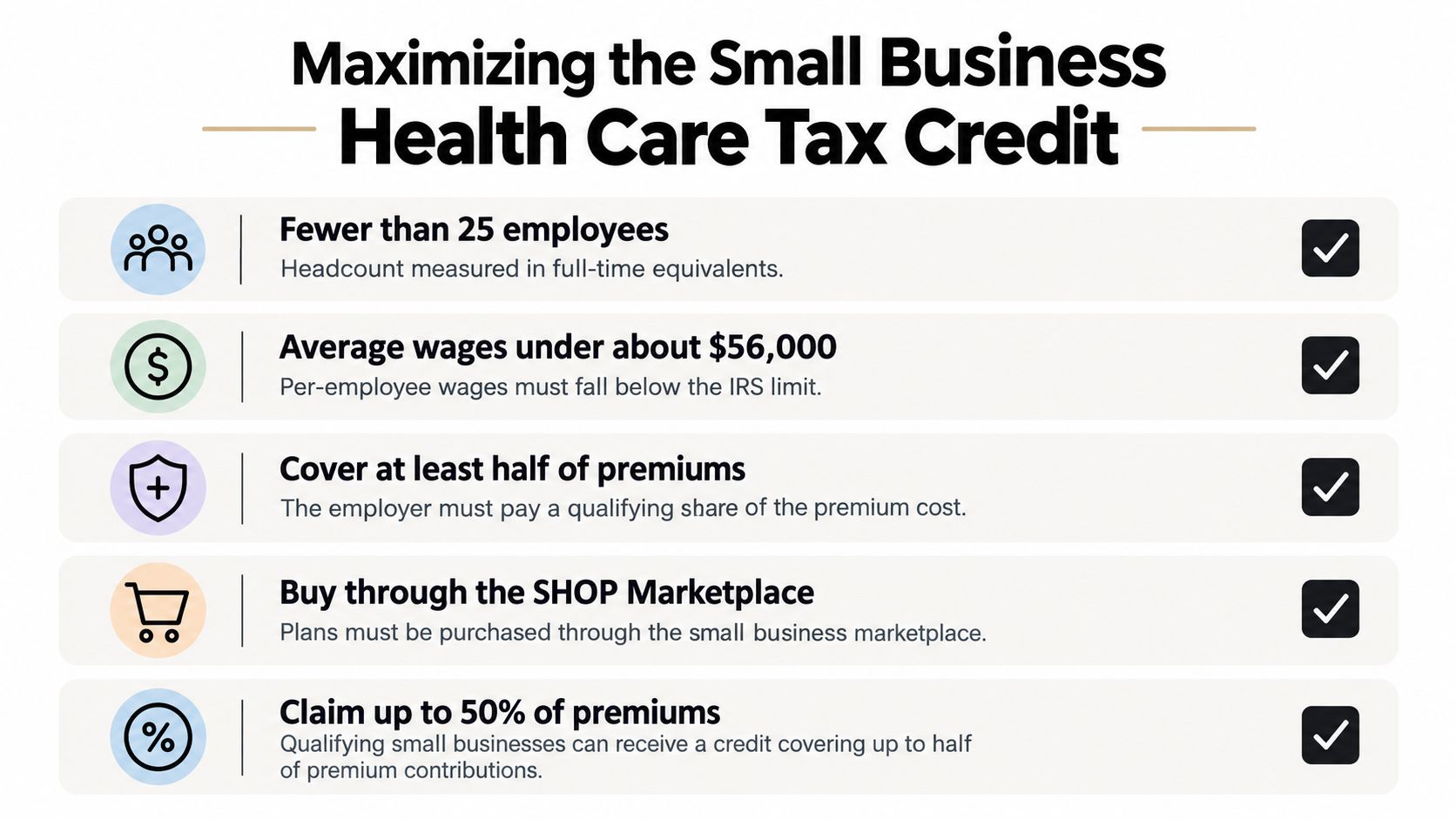
The employer generally must have fewer than 25 FTEs, average wages below an inflation-adjusted threshold, pay at least 50% of employee-only premiums, and use qualifying SHOP coverage. The credit is generally available for no more than two consecutive taxable years, according to KFF's summary of the small-business health care tax credit.
Confirm eligibility before choosing the plan
Run the eligibility test before selecting coverage. Have your accountant and benefits adviser review the same payroll and plan data:
- Workforce size: Calculate FTEs under the ACA method, including part-time hours, rather than relying on the number of people on payroll. This matters when the company is approaching the 50-employee threshold, even though that threshold is separate from the credit's smaller-employer test.
- Average wages: Compare average wages with the applicable inflation-adjusted threshold for the relevant tax year.
- Employer contribution: Confirm that the company pays at least the required share of employee-only premiums.
- SHOP coverage: Verify that the selected coverage meets the applicable SHOP rules.
- Credit timing: Check whether the business has already claimed the credit and whether the current year falls within the available period.
A qualifying SHOP plan may lower the initial cost, but the credit should not decide the entire benefits strategy. Compare it with QSEHRA and a traditional group plan based on administration, employee choice, recruiting needs, and the budget after the credit ends. QSEHRA may offer predictable spending, while a group plan may provide a more familiar benefit. Neither structure should be chosen solely to chase a tax benefit.
Model the net cost, not the headline premium
Build a decision model that includes the gross employer premium, employee contribution, expected tax credit, payroll administration, broker fees if applicable, and the cost of changing plans later. Keep employee Marketplace subsidies separate from the company's calculation. Employer coverage can affect an employee's individual-market financial assistance, so do not promise a particular subsidy outcome.
Founders often focus on the first-year premium and overlook the transition cost after the credit period ends. Model the post-credit budget before committing to SHOP coverage, especially if the company may grow toward the 50-employee threshold.
A tax credit should improve a sound benefits strategy, not rescue an unsustainable one.
Use the infographic as an initial screening tool, then have a tax professional validate the credit on the company's actual return. Benefits staff can assemble payroll and plan data, but tax-credit treatment belongs in the tax review.
Navigating Reporting and Recordkeeping Duties
A small employer can be exempt from the federal employer mandate and still need organized benefits records. Employees may question eligibility, payroll may need to verify deductions, and a change in ownership can alter the workforce analysis. If you can't reconstruct how a decision was made, you're managing risk by memory.
Start with a monthly workforce file. Store payroll hours, full-time classifications, variable-hour status, seasonal dates, leave information, and related-company details in one controlled location. Don't rely on a spreadsheet that only one payroll administrator understands.
Build an audit trail that follows the employee
For every employee who is eligible for coverage, retain:
- Eligibility evidence: The date the employee became eligible, the applicable waiting-period information, and the hours or status supporting the decision.
- Offer records: The coverage offered, the employee-only premium, the effective date, and whether the employee accepted or waived coverage.
- Payroll support: Deductions, employer contributions, changes in scheduled hours, and corrections made after enrollment.
- Employee communications: Notices, enrollment instructions, waiver records, and acknowledgments where your process uses them.
- Monthly status: A record showing whether the employee was full time, offered coverage, enrolled, waived coverage, or experienced a status change.
If you're an ALE, the information-reporting process generally includes Forms 1094-C and 1095-C. The forms require monthly coverage and eligibility information, so reconstructing the year from scattered email messages is a poor strategy. The IRS instructions for Forms 1094-C and 1095-C explain the reporting framework and the affordability information employers need to evaluate.
Document affordability decisions carefully
For plan years beginning in 2026, the employee contribution for the lowest-cost self-only option generally can't exceed 9.96% of household income. Because employers usually don't know household income, the IRS permits affordability safe harbors based on Form W-2 wages, rate of pay, or the federal poverty level.
Test the lowest-cost employee-only premium, not the richer plan an employee selects. Review affordability by month, particularly after wage changes, unpaid leave, or reductions in scheduled hours. Keep the selected safe harbor, premium rate, eligibility code, and monthly offer status together so payroll and benefits data tell the same story.
For a small employer, the practical standard is simple: another qualified person should be able to open the file and understand the eligibility, offer, contribution, and reporting decision without interviewing the person who created it. ACA reporting requirements provide a useful checklist for organizing that process.
Avoiding Costly Penalties and Common Myths
A startup can cross the ACA line without hiring 50 full-time people. A few employees with variable schedules, combined with part-time hours, may produce enough full-time equivalents to change the company's obligations. Treating the headcount as a simple employee count is a costly mistake.
Myth one, informal reimbursement is good enough
An employer cannot casually reimburse individual-market premiums and call the arrangement a benefit plan. Reimbursement must use a compliant structure, such as a formal QSEHRA, with defined eligibility rules, required notices, documented payments, and coordination with Marketplace coverage.
The risk extends beyond missing paperwork. An informal arrangement can create tax issues, affect employee subsidies, and expose the company to benefit-plan violations. If individual coverage is the preferred option, set up the QSEHRA before making payments and have a qualified adviser review the design.
Myth two, below 50 means no ACA responsibilities
Staying below the ALE threshold generally avoids the federal employer shared-responsibility payment for not offering coverage. It does not remove state requirements, employee notices, plan administration duties, or the rules attached to a voluntary benefit.
The coverage strategy also creates trade-offs. SHOP may suit a company that wants traditional group coverage and may qualify for the small-business tax credit. A QSEHRA can provide predictable contributions without selecting a group plan, but it requires disciplined administration and employee communication. A traditional group plan may offer stronger recruiting value, while exposing the employer to renewal increases and contribution decisions. Compare those costs before the workforce approaches the threshold.
Myth three, last year's premium is a reliable budget
Premiums can change enough to disrupt a benefits budget. KFF reported that preliminary 2026 filings indicated a median 11% premium increase for ACA-compliant small-business plans in its analysis of ACA premium filings. The renewal result for your company may differ, but the budget should include a higher-cost scenario.

Before open enrollment, compare SHOP, QSEHRA, and group-plan costs, including employer contributions and employee-only premiums. If the company may become an ALE, have a benefits professional review affordability before payroll changes the contribution.
Your Step-by-Step ACA Compliance Checklist
Treat compliance as an operating process, not an annual form-filing exercise. Assign one owner, establish a monthly review date, and keep the supporting records where payroll, finance, and HR can access the same information.
Start with the workforce
- Export monthly payroll data. Capture hours, employment status, start dates, termination dates, leave, and seasonal classifications.
- Calculate individual full-time employees. Apply the ACA service-hour standard consistently.
- Convert part-time hours into FTEs. Use the applicable monthly calculation and preserve the underlying hours.
- Review related companies. Ask counsel or a qualified adviser whether common ownership requires aggregation.
- Average the monthly totals. Determine whether the prior-year average places the business below or at the ALE threshold.
Don't wait for a year-end report to identify a likely transition. If the company is approaching the threshold, forecast hiring, seasonal staffing, and schedule changes so finance can reserve funds for coverage and administration.
Select and document the benefits model
Next, compare the viable options:
- No employer coverage: Appropriate only if the company understands the employee-relations impact and has checked applicable obligations.
- SHOP coverage: Useful when group coverage and potential tax-credit eligibility justify the contribution and administration.
- QSEHRA: Appropriate when the employer wants a defined reimbursement budget and won't offer a group health plan.
- Traditional group coverage: Appropriate when the company needs a conventional recruiting benefit and can manage renewal exposure.
Write down why the company selected the arrangement, how much it will contribute, who is eligible, and which vendor or adviser owns administration. A part-time HR coordinator or virtual assistant for small business can help maintain calendars, collect documents, and organize employee communications, but a qualified benefits or tax adviser should make the compliance determination.
Operate the plan throughout the year
Create a monthly control that compares payroll eligibility with enrollment records. Review new hires, terminations, schedule changes, leave, premium changes, and waived coverage. Send required notices on time, document employee elections, and correct payroll discrepancies promptly.
If the business reaches ALE status, prepare for the coverage tests and annual reporting rather than waiting until forms are due. For plan years beginning in 2026, test affordability using an appropriate safe harbor and the lowest-cost self-only option. Keep the calculation and supporting payroll data together.
Finally, schedule a year-end review with payroll, finance, HR, and your adviser. Confirm the workforce average, related-company treatment, coverage offers, employee contributions, and reporting data. That review gives leadership a defensible record and a clearer budget for the next hiring cycle.
Benely helps growing companies compare health plans, set benefits budgets, automate enrollment, connect benefits administration with payroll, and organize ACA reporting workflows as their workforce changes. Visit Benely to evaluate a benefits strategy that fits your current headcount and prepares you for the next threshold.