A benefits calendar can look orderly on paper and still create a difficult year for HR. Payroll is preparing for the new civil year, finance is closing budgets, employees are asking when their deductibles reset, and the medical plan is renewing on a date that falls nowhere near January. The problem isn't usually one complicated rule. It's the friction created when several valid timelines operate at once.
The practical question in calendar year vs plan year decisions is therefore broader than “When does coverage start?” HR leaders need to know which date controls deductibles, out-of-pocket maximums, elections, reporting, payroll deductions, employee communications, and carrier negotiations.
| Benefits issue | Calendar year | Non-calendar plan year |
|---|---|---|
| Coverage cycle | January 1 through December 31 | A 12-month period set by the employer's plan documents |
| Deductible reset | January 1 | The plan renewal date |
| Open enrollment | Often grouped with year-end work | Can be scheduled around the employer's renewal cycle |
| Payroll coordination | Naturally fits the civil calendar | Requires deliberate coordination with payroll |
| Reporting workload | More closely aligned with calendar-based processes | May require parallel tracking across plan and calendar years |
| Strategic advantage | Familiar and easier to explain | Can move renewal work away from the year-end rush |
Table of Contents
- Defining the Core Benefits Timelines
- How Reset Dates Impact Deductibles and Out-of-Pocket Costs
- Navigating ACA Compliance and Reporting Friction
- Aligning Payroll, Budgeting, and Open Enrollment
- The Strategic Case for Off-Cycle Renewals
- Executing a Plan Year Migration Successfully
- Simplifying Benefits Administration with Modern Partners
Defining the Core Benefits Timelines
Consider an HR director whose company renews medical coverage on July 1. In October, the team is already thinking about the next budget. In December, payroll is handling year-end work and employees are asking about their tax documents. In May, the broker is negotiating renewal terms, the carrier is issuing new plan materials, and employees are trying to understand what will change in the summer.
Nothing is necessarily wrong with that arrangement. The company is just operating on two annual clocks. The civil calendar governs one set of administrative activities, while the benefits plan follows its own anniversary date.
A calendar year runs from January 1 through December 31. In benefits administration, that structure is intuitive because the reset date is familiar to employees, finance teams, and payroll departments. Some benefit designs reset deductibles and annual limits at the beginning of each new calendar year.
A plan year is different. In U.S. group health coverage, it is legally defined as a 12-month period, and it may begin on any day of the year rather than January 1. Once established, it generally remains in effect for that plan unless it changes for a valid business purpose, as described in the Cornell Law definition of plan year.
The date in the plan document controls
An employer might use July 1, October 1, or another anniversary date for its group health plan. That date can align benefits negotiations with a company's broader operating cycle, or it can preserve a renewal arrangement that has worked well with the carrier and broker.
The important point is that a plan year isn't just another name for a calendar year. A calendar-year plan is a specific type of plan year that runs from January 1 through December 31. A non-calendar plan year still covers twelve months, but its reset and renewal milestones follow the date established in the plan documents.
That distinction affects the questions employees ask HR. “When does my coverage renew?” may have a different answer from “When does my deductible reset?” Some plans align those dates. Others use different rules for different benefits, which is where communication problems begin.
Practical rule: Before changing a renewal date, create a one-page calendar showing every reset, election, reporting, payroll, and communication milestone. If the dates don't fit on one page, the process isn't ready for employees.
How Reset Dates Impact Deductibles and Out-of-Pocket Costs
Employees usually feel the calendar choice most sharply through cost sharing. A person who has already paid toward a deductible wants to know whether that progress remains in place when the calendar changes, when the plan renews, or when a new benefit period begins.
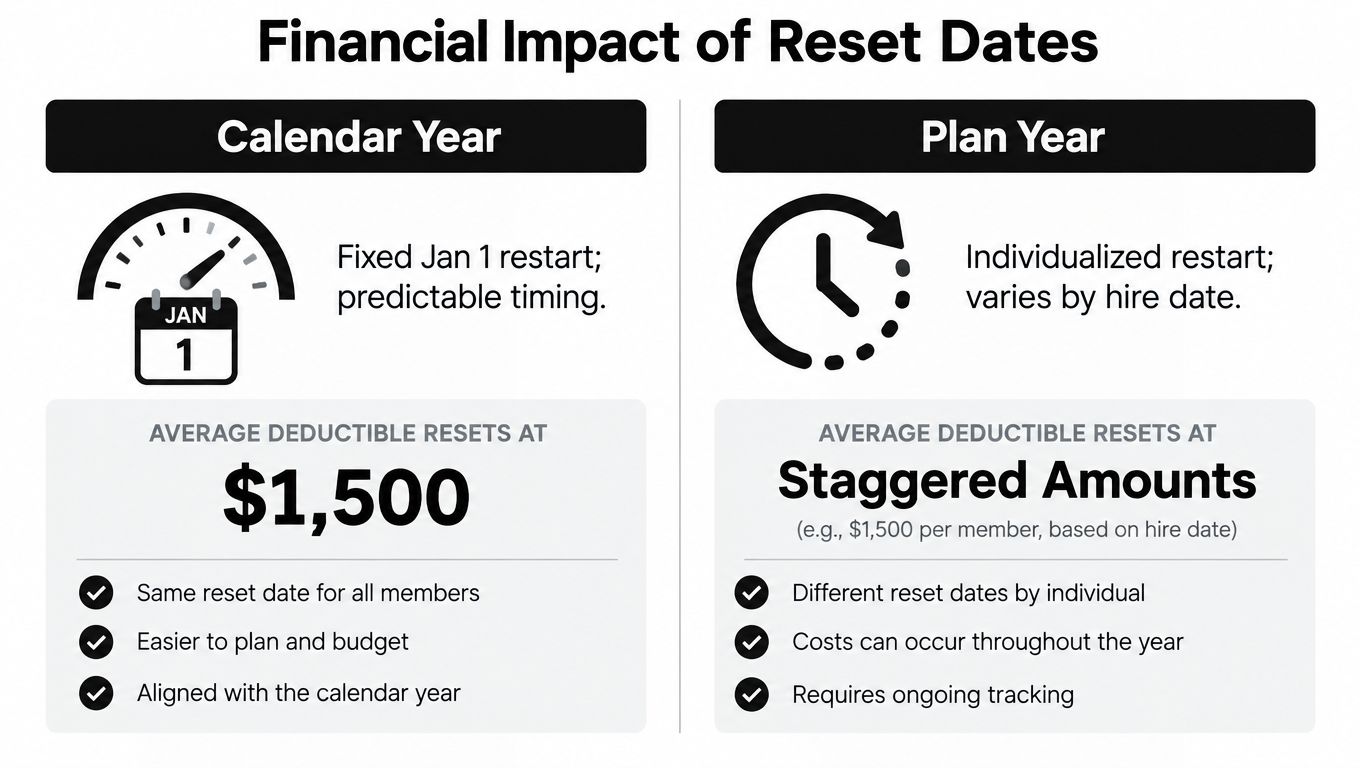
The technical distinction is straightforward. Under a calendar-year design, the deductible resets every January 1. Under a plan-year design, it resets on the plan renewal date, which could be May 1 or July 1. The deductible reset explanation from LegalClarity describes that difference directly.
The employee experience is not symmetrical
Suppose an employee reaches the deductible late in the year under a calendar-year plan. That employee may have only a short period to benefit from having met the deductible before the plan starts a new cycle on January 1. The accumulated spending doesn't automatically carry into the next calendar-year deductible cycle.
With a July 1 plan-year reset, the same employee's spending progress remains relevant until the plan renewal date. That can change the timing of care and the employee's perception of the plan, particularly for people managing recurring treatment or planned procedures. HR shouldn't advise employees to make medical decisions solely around a deductible, but HR should explain the reset date clearly so employees can discuss timing with their providers.
Out-of-pocket maximums generally follow the plan's defined benefit cycle as well. When the reset occurs, employees need to understand whether their progress toward that limit has ended and which expenses count under the new cycle. The plan document and Summary of Benefits and Coverage should govern the explanation.
| Benefit component | Calendar year, January 1 reset | Non-calendar plan year, such as July 1 reset |
|---|---|---|
| Deductible | Accumulation starts over on January 1 | Accumulation starts over on the renewal date |
| Out-of-pocket maximum | Progress is measured within the calendar-year cycle | Progress is measured within the plan-year cycle |
| Employee budgeting | Easier to remember and forecast | Requires attention to the employer's anniversary date |
| Claims communication | Year-end reminders are familiar | Reminders must be timed to the renewal date |
| Cost-sharing questions | Often concentrated around January | Can arise during a different quarter of the year |
HSA and FSA conversations need separate treatment
Don't assume every account follows the medical plan's reset date. HSA contribution rules, FSA elections, carryover provisions, grace periods, and year-end processing can have their own requirements. A benefits team should confirm the governing documents rather than telling employees that every account resets when the medical deductible resets.
For a plan-year employer arrangement, enrollment, renewals, deductibles, out-of-pocket maximums, and FSA election windows may synchronize to the plan's anniversary rather than automatically to January 1, according to guidance on plan years and calendar years from BASUSA. That makes a benefits calendar essential.
Explain the cycle in plain language:
- State the reset date: Put the exact date in enrollment materials and employee reminders.
- Separate the components: Identify the deductible, out-of-pocket maximum, FSA, HSA, dental, and vision rules independently.
- Show the employee where to verify: Point to the plan document, benefits portal, carrier materials, or HR contact.
- Avoid medical advice: Explain administrative timing, then direct clinical and treatment decisions to the employee and provider.
For a plain-language explanation of how cost sharing works, HR teams can also use Benely's guide to coinsurance and deductibles. The strongest communication doesn't merely announce a renewal date. It tells employees what changes, what doesn't, and where to confirm their individual balance.
Navigating ACA Compliance and Reporting Friction
A group plan that renews in July can work well for an employer, but it creates a second administrative rhythm. Benefits administration follows the plan year, while ACA reporting, tax records, and individual coverage rules require a calendar-year view. The friction appears when those cycles are maintained in separate systems without a clear reconciliation process.
For Marketplace and individual health coverage, the Affordable Care Act uses a calendar-year structure. Coverage ends on December 31 and the new year begins on January 1, as explained in the overview of non-calendar-year coverage and ACA enrollment rules. Employer group plans can instead use a non-calendar plan year, subject to the governing documents and applicable rules.
Employees may compare a July employer renewal with Marketplace coverage that changes in January. HR must explain those dates without implying that every benefit, account, or reporting obligation resets at the same time. The employer may administer medical coverage from July through June while still preserving accurate records for every month of the calendar year.
Reporting requires a calendar-year view
For Applicable Large Employers, Forms 1094-C and 1095-C require a month-by-month review of offers of coverage and enrollment information. A July renewal does not permit the reporting process to follow only July-to-June records. The team must retain the full calendar-year history, document changes during the year, and keep employee and dependent information consistent across payroll, enrollment, and carrier systems.
Mixed reset cycles create practical errors. Open enrollment may use one effective date, payroll deductions another, and the carrier's eligibility file a third. A retroactive hire, termination, or qualifying event can then appear differently in each system. Reporting work becomes a reconciliation exercise rather than a final filing check.
Plan documents also need to state the governing plan year clearly. If they do not, HR should obtain guidance from the plan administrator, carrier, benefits counsel, or applicable agency before assuming that a familiar renewal pattern controls. “We have always renewed in summer” does not establish the legal or administrative timing.
Compliance insight: An off-cycle renewal is workable when the employer maintains a calendar-year reporting layer alongside the plan-year administration layer.
Build controls instead of relying on memory
A practical process should include:
- Monthly eligibility review: Reconcile hires, terminations, waiting periods, and qualifying events across payroll and enrollment records.
- Effective-date audit: Confirm that medical, dental, vision, FSA, and other elections begin when the documents and elections require.
- Calendar-year reporting file: Preserve the information needed for ACA reporting even when coverage renews during the year.
- Document control: Keep the plan document, Summary Plan Description, carrier contract, and employee notices in one controlled location.
- Exception log: Record corrections, retroactive changes, and unresolved discrepancies before year-end filing.
Employers managing several regulatory workflows can evaluate tools that help scale compliance across frameworks. Shared deadlines, ownership, and audit trails reduce the risk that one department applies a plan-year date while another applies a calendar-year rule. Technology cannot determine which plan year governs, but it can make mismatches visible sooner.
HR teams can also use this ACA reporting requirements guide for employer plans as a focused checklist. The operating goal is straightforward: keep plan-year administration accurate, preserve a complete calendar-year record, and assign responsibility for resolving exceptions before reporting deadlines.
Aligning Payroll, Budgeting, and Open Enrollment
A September medical renewal can create January deductions for one account, September changes for another, and a budget approved the previous December. Employees then ask why their benefits do not reset together. The friction usually comes from mixed administrative cycles, not from the renewal date itself.
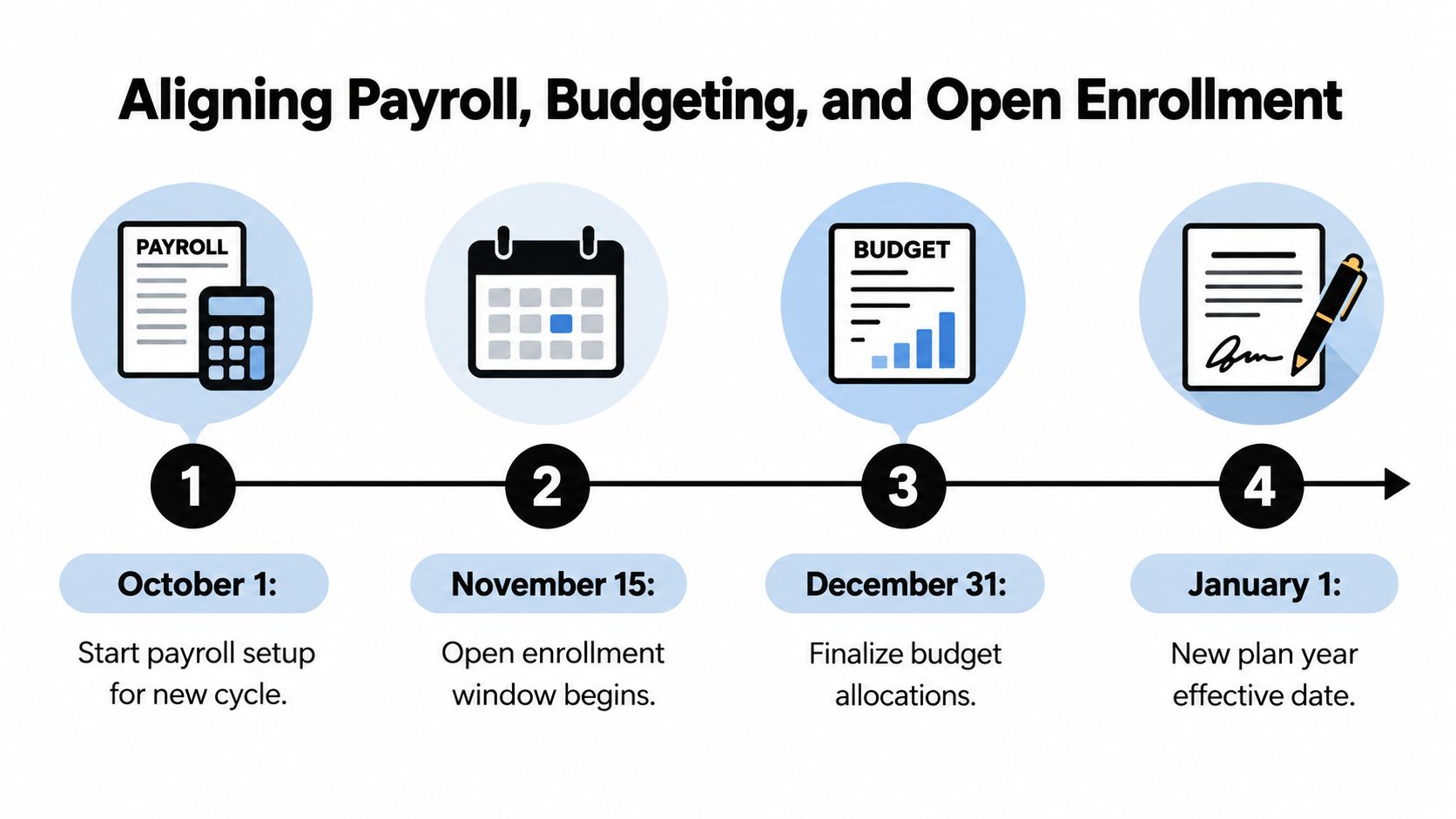
Payroll, finance, FSA administration, carrier renewal, and employee education may each operate on different deadlines. HR needs one coordinated operating calendar that shows how those deadlines interact, who owns each task, and which document controls the date.
Enrollments, renewals, deductibles, out-of-pocket maximums, and FSA election windows can follow the plan anniversary rather than January 1. Confirm each date against the governing plan document, carrier rules, and payroll setup before communicating it to employees.
Use a master calendar with owners
Start with the effective date and work backward. Assign one accountable owner to payroll configuration, carrier files, employee notices, election approval, invoice review, and budget updates. Include a backup owner for deadlines that fall during holidays or peak payroll periods.
A practical calendar includes:
- Renewal preparation: Gather claims experience, participation information, current contributions, and plan design priorities before approaching carriers.
- Budget modeling: Show the executive team how employer contributions, employee deductions, and renewal changes affect each relevant fiscal period.
- Open enrollment design: Schedule communications early enough for employee questions, corrections, and late submissions before the effective date.
- Payroll testing: Test deductions, effective dates, pretax treatment, new hires, terminations, and dependent changes before the first affected payroll.
- Post-launch reconciliation: Compare the election file, payroll deductions, carrier enrollment, and invoice after the new cycle begins.
This calendar also exposes whether a renewal date creates a year-end bottleneck. An off-cycle date can spread the workload, but it still requires protected time for testing and employee education.
Keep employee messages date-specific
Employees do not need every administrative dependency explained. They do need clear answers to four questions:
- When does the new plan start?
- When does the deductible reset?
- Which accounts or annual limits use a different date?
- What action must the employee take, and by when?
Use a short FAQ, a benefits portal banner, and targeted reminders for employees with incomplete elections. The open enrollment checklist for HR can organize these tasks while keeping departments aligned on the same deadlines.
Moving a renewal away from year-end changes the workload rather than removing it. HR should reserve time for communication, payroll testing, correction handling, and invoice review before the new cycle starts.
The Strategic Case for Off-Cycle Renewals
Calendar-year alignment feels simpler because employees recognize January 1 and finance teams often plan around the civil calendar. That familiarity has real value. It doesn't prove that a January renewal is the best operating choice.
An off-cycle renewal can give an employer room to separate benefits negotiations from year-end close, annual budgeting, and the heavy employee communication period. A July or October renewal may fit a company's fiscal planning, hiring cycle, or existing carrier relationship better than a January reset.
The strategic question is not “Which date looks cleanest?” It is “Which date gives this employer the best balance of cost control, compliance discipline, employee clarity, and internal capacity?”
When a custom cycle may work better
A non-calendar plan year can be sensible when:
- The renewal fits the business cycle: The company has more leadership and HR capacity during the selected renewal period.
- The broker relationship benefits from timing: The team can give renewal negotiations more attention outside the busiest year-end period.
- The workforce has predictable seasonal patterns: Benefits education and enrollment can occur when employees are more available.
- The employer wants to separate decisions: Finance can complete one planning process while HR handles a later benefits renewal.
- The current arrangement is stable: The company already has reliable processes, clear documents, and accurate system integrations.
These advantages are operational, not automatic pricing guarantees. An off-cycle date may improve negotiating conditions or internal attention, but the employer still needs to compare carrier proposals, plan design, participation, and total cost.
When calendar alignment earns its keep
A calendar-year plan may be preferable when employees struggle with the existing reset date, payroll and finance systems are heavily calendar-based, or the organization has limited administrative capacity. It can also make employee education more intuitive because the deductible and annual benefit cycle start when many employees already expect a new year to begin.
Changing an established plan year isn't a casual cleanup project. Legal definitions emphasize that a plan year generally remains in effect unless changed for a valid business purpose, as reflected in the Cornell Law treatment of plan-year changes. The employer should document the reason, review the plan documents, and confirm the transition with its broker, carrier, counsel, and administrators.
Decision test: Switch to January 1 only when the reduction in confusion and administrative effort outweighs the disruption required to get there.
Executing a Plan Year Migration Successfully
Moving from a non-calendar plan year to a calendar year requires more than changing a date in the benefits platform. If the existing cycle ends on a date other than December 31, the employer may need a short plan year, a transitional coverage period of less than twelve months that bridges the old renewal date and the new January 1 effective date.
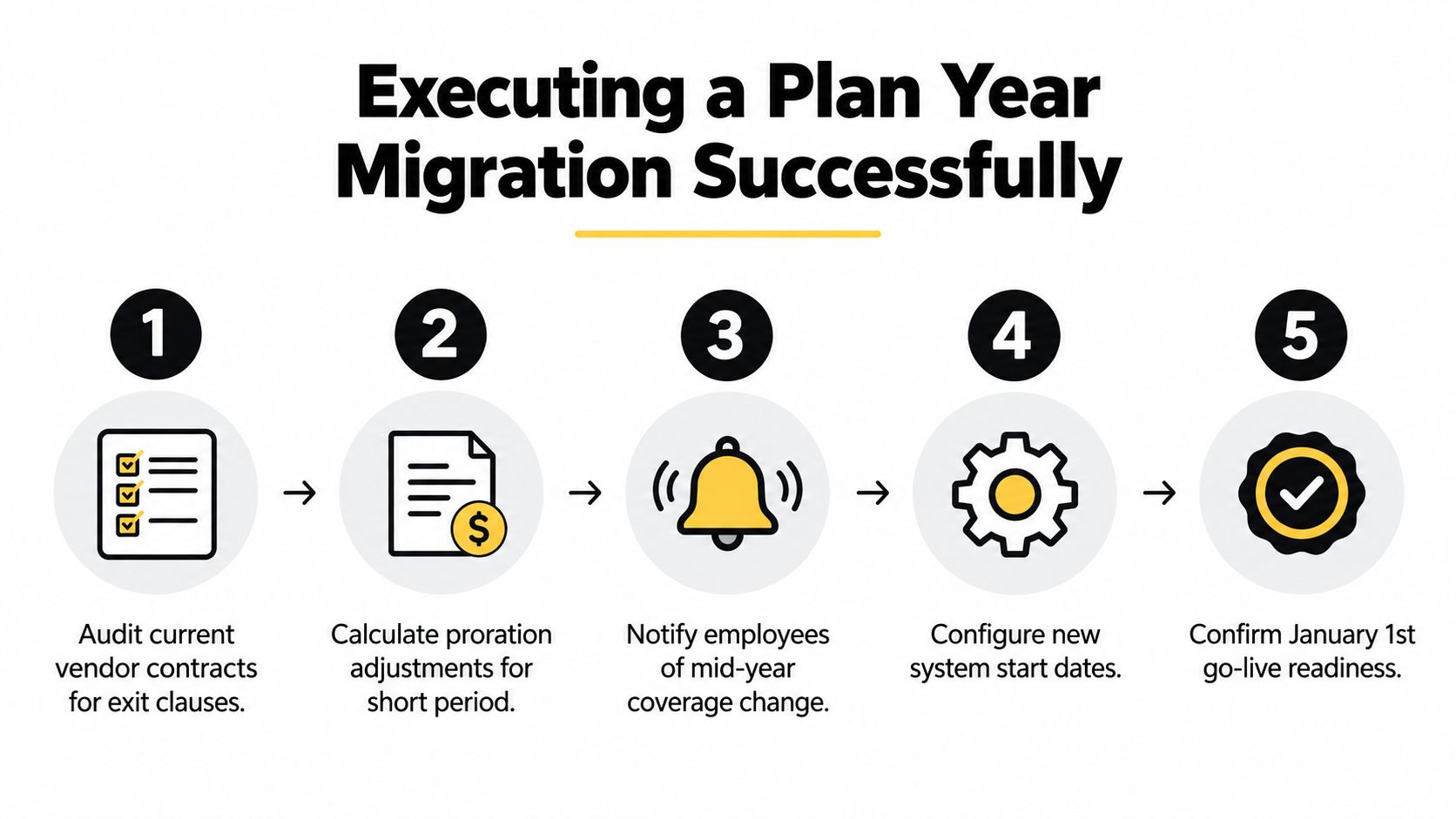
The transition should begin with a written project plan. It must show the old plan year, the bridge period, the new effective date, the deductible and out-of-pocket rules during the transition, payroll changes, employee communications, carrier approvals, and reporting responsibilities.
Map the transition before announcing it
Use this sequence:
- Confirm the business purpose: Document why the employer is changing the plan year and obtain the necessary approvals.
- Review governing documents: Check the plan document, Summary Plan Description, insurance certificates, amendments, and carrier contracts for timing and notice requirements.
- Model the short period: Determine how premiums, employer contributions, employee deductions, deductibles, out-of-pocket maximums, FSA elections, and account administration will operate during the bridge.
- Obtain carrier and vendor confirmation: Ask the medical carrier, FSA administrator, payroll provider, enrollment platform, and broker to confirm their effective-date capabilities in writing.
- Update employee materials: Explain the temporary period, the new January 1 cycle, reset rules, election deadlines, and any changes to payroll deductions.
- Test the systems: Run sample records for new hires, terminations, dependents, qualifying events, waivers, and employees with mid-period changes.
- Reconcile after launch: Compare payroll, carrier enrollment, invoices, employee elections, and account balances once the new cycle is active.
The short plan year deserves special attention because employees may assume that a temporary period follows the old rules or the new rules. The employer should state exactly how deductibles and out-of-pocket limits work during the bridge and whether an employee's accumulated progress carries forward. Those answers depend on the plan design and carrier terms.
Don't treat payroll as a final step
Payroll should participate before the migration is announced. Pre-tax deduction schedules, contribution amounts, effective dates, arrears, and correction procedures all need testing. A benefits team that waits until the final payroll file can discover errors after employees have already received incorrect deductions.
Employee communication should use examples without promising a particular financial result. Show the old renewal date, the temporary coverage period, and the first full calendar-year period. Tell employees where to find the controlling plan materials and whom to contact with an individual claim question.
A migration succeeds when the new date is legally supported, operationally tested, and understandable to the people using the plan. A cleaner calendar isn't worth a preventable coverage or payroll error.
Simplifying Benefits Administration with Modern Partners
The right choice depends on the employer's actual operating conditions. Stay with a custom plan year when it supports renewal strategy, workforce timing, or administrative capacity and the company can maintain strong calendar-year reporting controls. Consider calendar-year alignment when the current cycle confuses employees, creates repeated reconciliation problems, or imposes more manual work than the organization can reliably absorb.
The decision should begin with an audit, not a preference. Ask:
- Which date controls each deductible and out-of-pocket maximum?
- Which accounts use separate election or reset rules?
- Can payroll apply effective dates without manual corrections?
- Can the company produce accurate calendar-year records?
- Does the renewal date give the broker and internal team enough attention?
- What would a migration disrupt for employees, vendors, and finance?
- Is there a documented business purpose for changing an established plan year?
Put one owner over the whole timeline
Many benefits problems arise because no one owns the relationship between systems. The carrier owns enrollment data, payroll owns deductions, finance owns forecasting, and HR owns employee communication. Each team may perform its task correctly while the combined process still produces conflicting dates.
A modern benefits administration partner can help centralize plan rules, effective dates, employee and employer contributions, qualifying-event handling, enrollment tracking, payroll connectivity, and compliance workflows. The value comes from giving HR one operational view of the cycle rather than asking staff to reconcile disconnected files manually.
Benely is one option for employers evaluating that model. Its platform supports benefits selection, enrollment administration, payroll connectivity, compliance workflows, and guidance from certified HR specialists, which can help teams manage a plan year that doesn't match January 1.

The practical goal isn't to make every benefits date identical. It's to make every date visible, documented, tested, and easy for employees to understand. Once HR can see the full calendar, the employer can decide whether January 1 creates genuine value or merely creates a familiar-looking administrative burden.
If your company is managing a non-calendar renewal, mixed reset dates, or a possible move to January 1, visit Benely to review benefits administration, enrollment, payroll connectivity, and compliance support in one place. Ask its team to map your current plan year against your payroll and reporting calendar so you can choose the structure that reduces friction rather than just moving it.