
 Employee Benefits
 HR & Compliance
 Technology
 Wellness
 PEO Solutions

Offering behavioral health benefits doesn't prove employees can use them. A benefit can appear prominently in a summary plan description while employees still face confusing eligibility rules, empty provider directories, long waits, unaffordable out-of-network care, or uncertainty about whether asking for help could affect their reputation at work.
That gap matters more for small and mid-sized employers. Lean HR teams have less time to explain the benefit, smaller local networks can limit choice, and managers may lack the training to respond appropriately when an employee is struggling. The right question isn't “Do we offer behavioral health coverage?” It's “Can an employee find appropriate care quickly, understand the cost, and continue treatment without unnecessary friction?”
Table of Contents
- The Real Behavioral Health Problem for Smaller Employers
- What Behavioral Health Benefits Actually Include
- Plan Design Options That Fit Different Budgets
- Parity and Compliance Without the Jargon
- How to Choose Vendors You Will Not Regret
- A 75-Employee Company Putting It All Together
- KPIs That Prove the Benefit Is Working
- Your First 30 Days With a Better Behavioral Health Strategy
The Real Behavioral Health Problem for Smaller Employers
The popular advice is to add an EAP, publish the phone number, and consider the problem solved. That approach confuses availability with access. An employee may technically have counseling, psychiatry, substance use treatment, and crisis support, yet still fail to receive care because the first available appointment is too far away, the provider directory is outdated, or the employee doesn't know which door to use.
Large-employer survey data shows why employers should examine actual use, not just plan design. In the 2025 EBRI Employer Mental Health Survey, 97% of surveyed large-employer plans offered mental health services, while only 22% of employers tracked whether employees were using mental health care. The offering is widespread. Measurement is not.
Smaller employers face a sharper version of the same problem. HR may consist of one generalist who manages benefits, payroll coordination, leave administration, and employee relations. A carrier may list therapists across a broad service area, but that directory doesn't tell an employee whether a clinician is accepting new patients, offers evening appointments, speaks their preferred language, or treats the specific issue involved.
Why an EAP alone isn't enough
EAPs can provide a useful first step, especially for short-term counseling, work-life referrals, legal questions, and financial guidance. Employers should also give employees practical instructions on how EAPs support your team, including what happens after the initial call and when the EAP refers someone to ongoing clinical care.
The failure comes when the EAP becomes a dead end. If it offers brief counseling but doesn't connect employees to an in-network therapist, psychiatrist, intensive outpatient program, or substance use specialist, employees must restart the search themselves. That handoff is where many access strategies break down.
Practical rule: Treat every benefit as a pathway, not a line item. The pathway should lead from awareness to appointment, treatment, follow-up, and escalation when necessary.
A strong SMB strategy therefore judges every decision by four questions:
- Can employees find care? Measure appointment availability, network depth, and language access.
- Can employees afford care? Review deductibles, copays, coinsurance, and out-of-network exposure.
- Can employees understand care? Make eligibility, confidentiality, referrals, and crisis options easy to explain.
- Can the employer see what needs fixing? Require utilization, access, denial, and handoff reporting.
The practical playbook is not an enterprise-sized expansion of every possible benefit. It's a focused effort to remove the obstacles employees encounter between “I need help” and “I'm now receiving appropriate care.”
What Behavioral Health Benefits Actually Include
Behavioral health benefits cover services that help employees manage mental health conditions, substance use, emotional distress, and related behaviors that affect daily functioning. A credible plan should offer more than a counseling hotline. It should provide multiple entry points and a clear route to more intensive care.
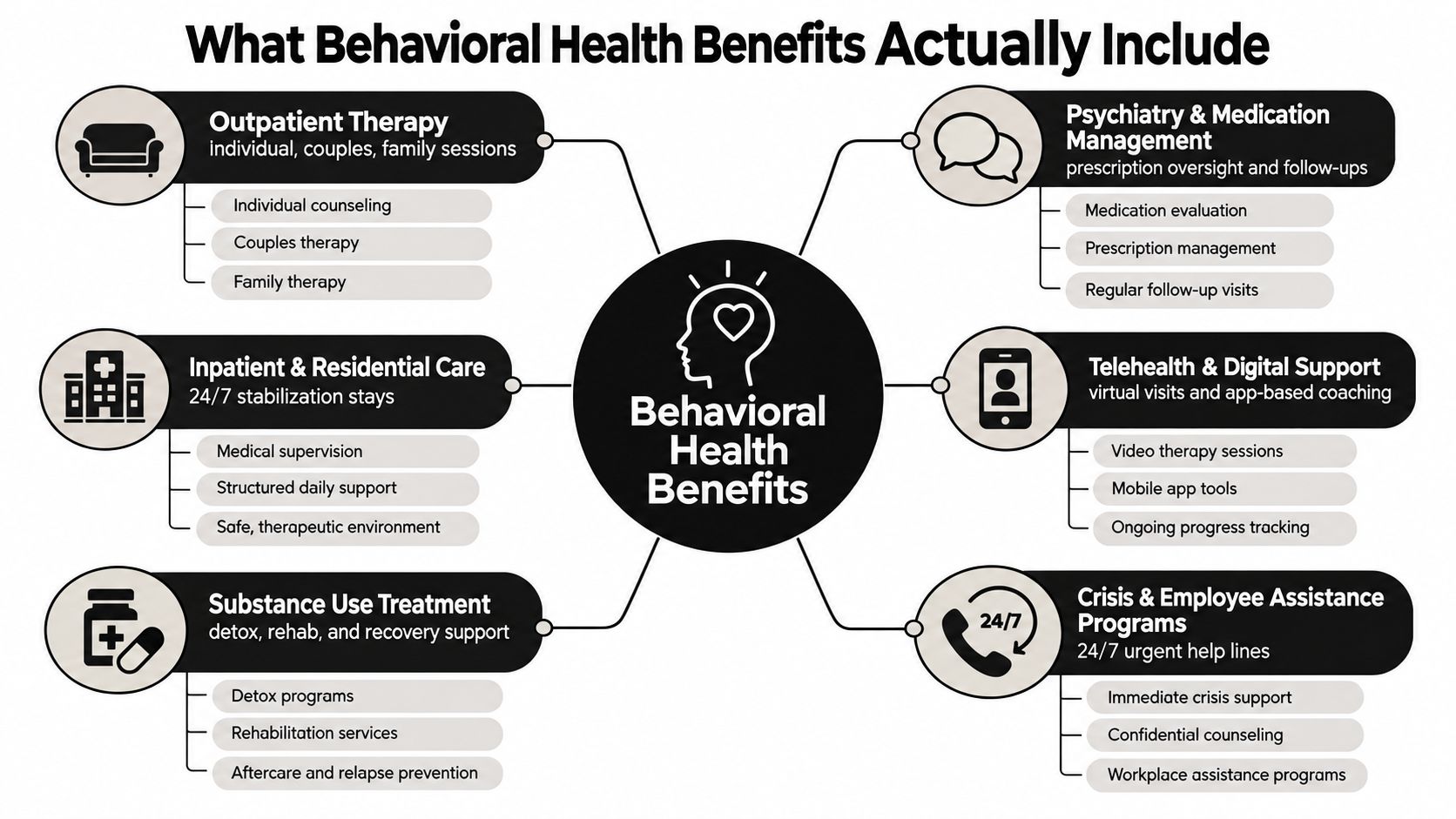
Six service categories to evaluate
Outpatient therapy covers individual, couples, and family sessions with licensed clinicians. Ask whether employees can use both in-network and out-of-network providers, whether out-of-network claims are reimbursed, and whether the network includes clinicians near each worksite.
Psychiatry and medication management provide evaluation, prescribing, medication reviews, and follow-up care. Employees often need a psychiatrist or psychiatric nurse practitioner rather than a therapist, so a plan that advertises therapy access but lacks prescribers creates a predictable bottleneck.
Inpatient and residential care support employees who need structured stabilization, continuous supervision, or treatment away from home. Review coverage for inpatient psychiatric care, residential treatment, partial hospitalization, and intensive outpatient programs. These levels of care shouldn't be hidden behind unclear authorization rules.
Telehealth and digital support can include video therapy, text-based coaching, self-guided programs, virtual psychiatry, and urgent support lines. Digital care expands reach, but it isn't automatically accessible. Confirm how employees escalate to in-person treatment when digital care isn't enough.
Substance use treatment should include the full continuum, including detoxification, residential care, intensive outpatient treatment, medication-assisted treatment where clinically appropriate, and recovery support. The EBRI survey found a meaningful difference between broad mental health coverage and substance use coverage, with 97% of surveyed large-employer plans offering mental health services but 67% covering substance use treatment. See the survey findings before assuming the two categories are equally covered.
Crisis and employee assistance programs provide urgent telephone support, short-term counseling, referrals, and work-life resources. Ask about crisis escalation, supervisor consultation, and the number of counseling sessions available for each issue.
Autism and applied behavior analysis services may also matter for employees and dependents. Buyers should ask specifically about ABA, developmental evaluations, caregiver support, and neurodiversity-affirming care rather than accepting a generic “autism coverage” label.
Employees dealing with burnout or workplace distress may also need targeted clinical support. A resource such as work related stress therapy from Uptown Psychology can help HR leaders understand the kinds of concerns employees may bring to a provider, but the employer's plan still needs to determine eligibility, network status, and referral pathways.
Plan Design Options That Fit Different Budgets
There isn't one correct architecture for every employer. The best design balances predictable cost, clinical breadth, administrative capacity, and the speed at which employees can reach care.
| Design Option | How It Works | Typical Cost Impact | Best For |
|---|---|---|---|
| Fully insured medical plan | The carrier assumes claims risk and administers medical and behavioral health coverage together | More predictable budget, with less direct claims risk | Employers that value simplicity and have limited benefits staff |
| Self-funded plan | The employer pays claims and contracts for administration, usually with stop-loss protection | Greater exposure to claims volatility, with more control over plan design | Employers with stronger reporting needs and the capacity to manage claims risk |
| Level-funded hybrid | A fixed monthly payment combines administrative fees, expected claims, and stop-loss protection | More predictable than pure self-funding, with potential underwriting constraints | Employers seeking flexibility without taking full claims exposure |
| Traditional PPO or POS | Employees use a broad medical network with copays or coinsurance for care | Often richer and easier to explain, but premiums may be higher | Workforces that need local providers and predictable office-visit costs |
| HDHP with HSA | Employees take on more upfront medical cost while the employer pairs the plan with an HSA | Lower premium is possible, but cost barriers can reduce behavioral health use | Employers with strong communication and carefully reviewed pre-deductible rules |
| Behavioral health carve-out | A separate vendor manages therapy, psychiatry, EAP, or specialty care | Adds vendor and integration complexity, but may improve specialty access | Employers whose medical carrier has weak behavioral health networks |
| Embedded digital therapy | A digital provider sits inside or alongside the medical plan | Usually creates a separate vendor expense or bundled arrangement | Distributed workforces that need convenient virtual entry points |
Make the plan's cost-sharing usable
Copays are usually easier for employees to understand than coinsurance. If office-based behavioral health care is subject to a deductible while other comparable care has a simple copay, employees may delay treatment even when the plan is technically compliant.
High-deductible plan sponsors should ask whether behavioral health services qualify for pre-deductible coverage under the applicable HSA rules. They should also examine whether a digital vendor is a genuine access solution or merely a separate app employees must remember to download.
Buy-up options can work when a workforce has varied needs, but don't use them to hide weak base coverage. The base plan should provide a credible route to therapy, psychiatry, crisis care, and substance use treatment. A buy-up can add convenience, broader virtual access, or enhanced navigation.
Buyer's test: If an employee needs care tonight, can the plan explain exactly where they should start, what they'll pay, and how they'll reach a higher level of care if needed?
Integration matters as much as the insurance structure. An EAP that doesn't share a warm handoff with the medical carrier may duplicate intake. A carve-out that cannot exchange eligibility files may create access failures after a new hire enrolls. Require a single employee-facing path whenever possible, even if multiple vendors operate behind it.
Parity and Compliance Without the Jargon
Parity is a floor, not proof that employees can use behavioral health care. The Mental Health Parity and Addiction Equity Act, or MHPAEA, is a federal law from 2008. It requires group health plans and insurers that offer mental health or substance use disorder benefits to cover them at a comparable level to medical and surgical benefits. The Medicaid parity overview explains protections involving copays, coinsurance, deductibles, visit limits, authorization rules, and medical-necessity standards.
Parity does not require a plan to add behavioral health coverage. It applies once the plan offers mental health or substance use disorder benefits. Those benefits must then follow comparable rules within each classification where medical or surgical benefits are offered. The federal regulation provides the detailed framework.
Use a practical compliance checklist
- Compare financial requirements. Review deductibles, copays, coinsurance, and out-of-pocket treatment across comparable medical and behavioral health categories.
- Review quantitative limits. Check for separate visit caps, day limits, annual limits, or dollar limits that do not apply to comparable medical care.
- Investigate nonquantitative limits. Examine prior authorization, concurrent review, step therapy, medical-necessity criteria, provider admission standards, and network management.
- Measure real access. Track denials, authorization outcomes, out-of-network use, appointment delays, and reimbursement patterns where data is available. Employees asking does insurance cover online psychiatry need clear answers about parity for virtual visits and any separate limits.
- Preserve records. Organize plan documents, vendor policies, claims information, denials, and comparative analyses for review.
The 2024 final MHPAEA rules put stronger emphasis on nonquantitative treatment limitations and the comparative analyses supporting them. Legal and enforcement requirements can change, and state rules may add obligations. Ask the carrier and benefits counsel what documentation is currently required. The Commonwealth Fund discussion of parity enforcement shows why a carrier's general compliance assurance is not enough.
For a plain-English explanation, review Benely's mental health parity guide. Then put the requirements in the vendor contract. Require parity compliance language, access reporting, cooperation with comparative-analysis requests, and prompt delivery of claims and denial data.
Employees in treatment may also raise accommodation questions under the ADA. Serious conditions can overlap with FMLA eligibility, leave administration, and disability claims. HR should coordinate these processes without asking managers to diagnose employees or disclose unnecessary clinical information.
How to Choose Vendors You Will Not Regret
Vendor selection should begin with the failure you're trying to fix. Don't buy a polished platform before identifying whether the underlying issue is poor awareness, weak local networks, long psychiatric waits, fragmented EAP referrals, or missing specialty care.
Start with three buying decisions
The EAP. Ask whether utilization is measured per eligible employee or per caller. Confirm the number and credentials of clinicians answering calls, whether supervisor consultation is included, and whether the EAP can make a warm handoff into the medical or behavioral health network. Ask what happens when the employee needs ongoing therapy rather than short-term counseling.
The telehealth partner. Request average time to first appointment, the percentage of clinicians treated as in-network, pediatric availability, Spanish-language coverage, and escalation procedures for in-person care. Compare per-employee-per-month pricing with per-visit pricing, but don't let a cheaper structure distract from access performance.
The network or specialty partner. Ask how many accepting therapists serve each worksite, how long employees wait, and whether the network includes ABA, eating disorder treatment, intensive outpatient programs, residential care, and substance use specialists. Require the vendor to explain how it handles an employee who cannot find an appropriate clinician.
| Criteria | EAP | Telehealth Platform | Network Partner |
|---|---|---|---|
| First appointment | Ask for a service-level commitment and reporting method | Request average and urgent-access timelines | Review appointment availability by location |
| Clinical scope | Short-term counseling, referrals, and supervisor support | Therapy, psychiatry, coaching, and escalation | Therapy, psychiatry, specialty, and higher-acuity care |
| Integration | Warm handoff to medical and leave resources | Eligibility, SSO, and carrier coordination | Claims, referrals, and out-of-network support |
| Equity | Language, accessibility, and dependent support | Pediatric, language, and accessibility options | Local provider depth and culturally responsive care |
| Accountability | Utilization reporting and issue-resolution data | Engagement, wait-time, and escalation reports | Network adequacy, denials, and appointment data |
Use references from employers of similar size and workforce mix. Put access service levels, reporting deadlines, parity language, and remedies for missed commitments in the master agreement. A vendor that refuses to measure its contribution is not a measurement partner.
For a broader review of employee wellness vendors and related services, consult employee wellness companies. The decision still belongs to the employer, and it should be based on verified access performance rather than a demonstration account.
A 75-Employee Company Putting It All Together
Consider a hypothetical regional manufacturing company with 75 employees, a limited benefits budget, and rising concern about stress-related absence. The employer doesn't need to replace a functioning medical plan immediately. It needs to connect the existing pieces and remove the points where employees lose momentum.
The HR director keeps the fully insured medical plan, negotiates a stronger EAP with six free counseling sessions per issue, adds a behavioral health app at roughly $8 per employee per month, and contracts with a dedicated network that has at least three in-network therapists within 20 miles of each site. The company also uses ADP for single sign-on so employees don't have to search through several portals.
Those figures are planning assumptions for an illustrative scenario, not a reported case study or promised result. The employer should validate affordability, network adequacy, eligibility, and contract terms before adopting the design.
Make the launch visible and safe
The company launches during an October open-enrollment period with a 15-minute all-hands explanation. The HR director demonstrates the first step an employee takes, explains confidentiality, and clarifies when the EAP refers someone to ongoing care.
Managers receive a short toolkit. It tells them how to recognize a possible concern, offer resources, and avoid diagnosing an employee. Posters in break rooms reinforce the message, while a QR code on the payroll stub opens the resource page directly.
The measurement plan separates awareness from care. HR tracks portal visits, EAP contacts, therapy appointments, wait times, referrals, and employee questions. The company doesn't treat higher use as proof that the program worked, or lower use as proof that employees are healthy. It checks whether people can move from the first contact to appropriate care.
After twelve months, the company reviews whether utilization changed, whether EAP referrals reached clinical providers, whether appointment delays narrowed, and whether short-term disability days associated with anxiety or depression changed. It also asks employees what prevented use. Those findings determine whether the next investment belongs in communication, network depth, psychiatry, specialty treatment, or cost-sharing.
KPIs That Prove the Benefit Is Working
A behavioral health dashboard should answer three questions: Are employees using the benefit? Are they receiving appropriate care? Is the investment affecting cost or workforce stability?
Don't publish a target range just because another employer uses it. Establish a baseline, then set an internal improvement target tied to the access problem you identified.
| Category | KPI | Target Range for SMB | Data Source | Owner |
|---|---|---|---|---|
| Utilization | Eligible-employee engagement | Improve against baseline | EAP and vendor reports | Benefits lead |
| Utilization | Average sessions per user | Monitor for continuity, not volume alone | EAP and claims data | Benefits lead |
| Access | Time to first appointment | Reduce against baseline | Network and telehealth reports | Carrier manager |
| Access | Telehealth and in-person mix | Match employee needs and clinical suitability | Vendor and claims data | HR operations |
| Clinical | PHQ-9 and GAD-7 change where collected lawfully | Track direction and completion | Clinical vendor reports | Clinical partner |
| Clinical | Treatment adherence | Review follow-up and drop-off patterns | Claims and care-management data | Carrier |
| Resolution | EAP issue-resolution rate | Improve against baseline | EAP report | EAP account manager |
| Financial | Cost per member per month | Compare with prior periods | Claims and invoice data | CFO or finance lead |
| Workforce | Unscheduled absence days | Compare with internal baseline | Payroll and leave systems | HR |
| Workforce | Turnover among high-utilizers | Review only in aggregated, privacy-protective form | HRIS and claims data | HR and legal |
The systematic review and meta-analysis of occupational digital mental health interventions found statistically significant improvements in psychological well-being and work effectiveness across 21 randomized trials, with an effect size of g = 0.37 for well-being and g = 0.25 for work effectiveness. A separate employer-focused analysis covering 42,148 participants across 19 studies reported a pooled ROI of 2.3 and net savings of $159 per member per month. Those findings support measurement, but they aren't a guarantee for any individual employer.
Review operational metrics monthly and clinical and financial metrics quarterly. Limit access to identifiable information, use aggregated reporting, and avoid asking HR to interpret clinical scores. Utilization without appointment, outcome, and cost context tells you very little.
For more ideas on connecting wellness measurement to financial outcomes, see how to boost the ROI of your employee wellness programs. The goal is not to maximize clicks. It's to find and remove the barriers that stop employees from receiving useful care.
Your First 30 Days With a Better Behavioral Health Strategy
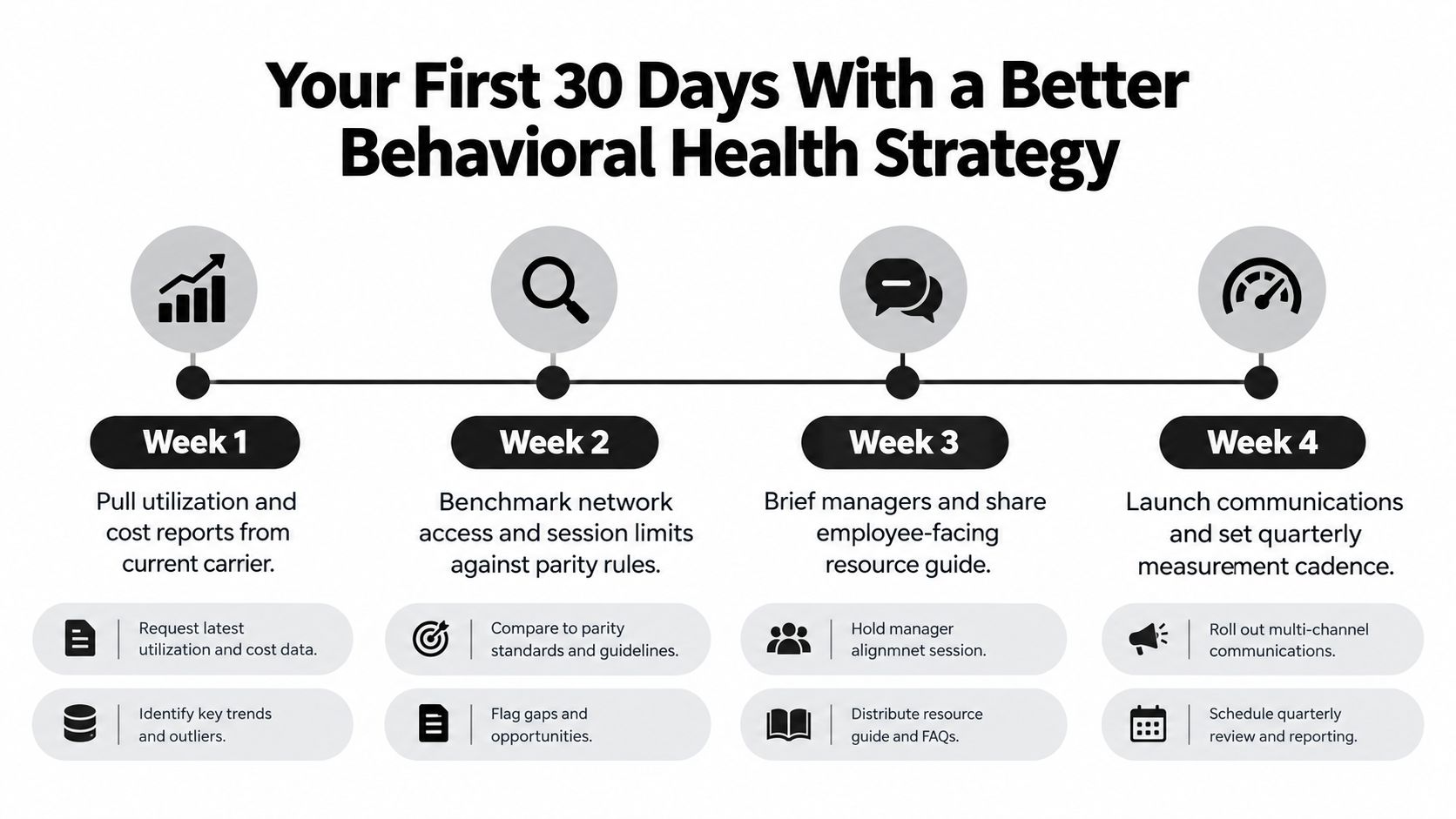
Treat the first month as a measurement project, not a rushed coverage expansion.
Week one: Pull behavioral health utilization, claims, denial, and cost reports from the medical carrier and EAP. Survey employees about awareness, confidentiality concerns, appointment availability, cost, language, and preferred access methods.
Week two: Choose one primary objective, such as faster appointments, stronger EAP-to-clinical handoffs, higher awareness, or better specialty access. Shortlist two or three vendors that address that specific weakness.
Week three: Negotiate access service levels, reporting obligations, escalation procedures, integration, eligibility feeds, and parity cooperation. Align the benefit with payroll, wellness, leave, and employee-support systems.
Week four: Launch a focused communication campaign. Give managers a referral script, give employees one clear starting point, and schedule the first 90-day review before launch day.
The review should compare the baseline with awareness, contact, appointment, referral, denial, and satisfaction data. If employees know about the benefit but can't book care, improve the network. If they book care but abandon treatment, investigate cost, continuity, and clinical fit. If nobody knows where to start, fix communication before buying another platform.
The economic case is substantial. Depression and anxiety cost the global economy about $1 trillion annually in lost productivity, and WHO-referenced analysis cited by PwC estimates roughly 12 billion productive days are lost; the same analysis reports about $4 in improved health and productivity for every $1 invested in scaled-up treatment for common mental disorders (PwC analysis). Workplace interventions can also produce up to €13.62 in net annual economic benefit per €1 invested, while a Deloitte analysis cited by the EU OSHwiki review reports about £5 returned per £1 spent on measures to improve worker mental health (EU OSHwiki review).
The conclusion for SMB leaders is direct. Buy access, not just coverage. Measure whether employees can use the benefit, and make every renewal decision from that evidence.
Use Benely to compare health plans, set benefits budgets, automate enrollment, connect benefits with payroll and compliance workflows, and get support from certified HR specialists. Visit Benely to evaluate a behavioral health strategy built around access, utilization, and measurable workforce outcomes.