 Employee Benefits
 HR & Compliance
 Technology
 Wellness
 PEO Solutions
In 2025, 67% of covered U.S. workers were enrolled in self-funded health plans, according to the Kaiser Family Foundation employer benefits survey. That figure changes the conversation for every founder and CFO comparing fully insured vs self funded coverage. Self-funding isn't an exotic strategy reserved for giant corporations, but it also isn't automatically cheaper or safer for a growing business.
The right decision depends on four realities: how claims are paid, who carries risk, how cash moves through the business, and who handles compliance. Level-funded and hybrid designs now give smaller employers a middle path, but the wrong structure can turn a manageable benefits budget into a cash-flow problem.
Table of Contents
- What Fully Insured and Self Funded Plans Actually Mean
- How the Two Models Handle Cost, Risk, and Cash Flow
- Side-by-Side Comparison of the Funding Models
- Stop Loss, Level Funding, and the New SMB Middle Ground
- Two SMB Scenarios That Show the Trade-offs in Practice
- Compliance and Administrative Burden You Should Plan For
- Which Funding Model Fits Your Company Right Now
- Common Questions About Choosing Between the Models
What Fully Insured and Self Funded Plans Actually Mean
A fully insured health plan is the traditional arrangement. Your company pays a fixed premium to an insurance carrier, and the carrier pays covered claims. The insurer prices the plan, absorbs the difference between projected and actual utilization, administers the policy, and handles much of the required reporting.
A self-funded plan works differently. The employer funds employee claims from a dedicated account, usually hires a third-party administrator to process those claims, and buys stop-loss coverage to limit exposure to unusually large individual or group losses. The employer keeps more direct responsibility, but also gains more visibility into what the benefits program costs.
For a plain-language explanation of the insured structure, see Benely's guide to what a fully insured health plan means. The key distinction is simple: fully insured coverage transfers claims risk to the carrier, while self-funding retains routine claims risk with the employer.
Use four questions before comparing quotes
What drives the cost? Fully insured pricing includes the carrier's expected claims, administration, margin, and applicable state charges. Self-funded pricing separates expected claims from administrative services and stop-loss costs.
Who absorbs a bad claims year? The carrier does under a fully insured policy. The employer does under a self-funded plan, except for losses protected by stop-loss terms.
Can the business handle uneven cash flow? Fully insured premiums are easier to budget month by month. Self-funded claims can move sharply with utilization, even when annual expectations look reasonable.
Who owns compliance work? A carrier handles much of the operational burden in a fully insured arrangement. A self-funded sponsor still needs a disciplined process for plan documents, filings, vendors, and participant communications.
The KFF figure is a useful market signal, not a recommendation for every SMB. In the same survey, 27% of covered workers at firms with 10 to 199 employees were in self-funded plans, compared with 80% at larger firms. Scale helps, but headcount alone doesn't decide the question. Workforce stability, reserves, demographics, claims history, and administrative capacity matter just as much.
How the Two Models Handle Cost, Risk, and Cash Flow
The monthly premium comparison is where many benefits reviews go wrong. A fully insured premium is predictable, but it bundles several costs together. A self-funded arrangement looks more variable because it exposes the employer to claims, yet it also separates the claims account from administrative and risk-transfer charges.
Cost has several layers
Under fully insured coverage, the carrier sets the premium for the policy period. That payment generally includes anticipated medical claims, underwriting assumptions, carrier administration, margin, state premium taxes, and state-mandated benefits. The employer gets budget stability, but it doesn't receive a direct refund when claims run below the carrier's expectations.
A self-funded employer typically pays four distinct categories:
- Routine claims: Medical expenses are paid from the employer's claims fund.
- Administration: A third-party administrator handles eligibility, claims processing, customer service, and related operations.
- Stop-loss: The employer buys protection against claims above specified attachment points.
- Compliance and plan operations: The sponsor remains responsible for governance, reporting coordination, notices, and vendor oversight.
This separation gives the employer more information and flexibility. It doesn't eliminate cost. It changes who controls and carries each component. Benely's overview of self-funded insurance provides a useful comparison of the funding structures and their operating differences.
The DOL distinction that changes the answer
The U.S. Department of Labor's large-plan report shows why plan counts can mislead. For statistical year 2023, 53.5% of 59,783 large health plans were fully insured, 38.8% were self-insured, and 7.6% were mixed-funded. By plan count, fully insured arrangements were more common.
Participant weighting reverses that picture. In the large-plan market, self-insured and mixed-funded arrangements covered 81.1% of participants in 2019, while fully insured plans covered 19.0%. Large employers enroll many more people per plan, so the worker-level result reflects where most employees receive coverage.
Cash flow is the practical dividing line. Fully insured employers send the same scheduled premium regardless of monthly utilization. Self-funded employers must maintain a claims fund, monitor payments, and prepare for fluctuations. That fund may earn interest while awaiting claims payment, but the employer can't treat it as ordinary operating cash.
The KFF 2023 employer survey also places self-funding in the broader market context, with 65% of covered workers enrolled in self-funded plans in 2023. The choice is mainstream, but mainstream doesn't mean universally suitable.
Side-by-Side Comparison of the Funding Models
The table below is the fastest way to identify where each model fits. It compares the structure a CFO actually manages, not just the label printed on the renewal proposal.
Fully Insured vs Self Funded at a Glance
| Dimension | Fully Insured | Self Funded |
|---|---|---|
| Cost structure | Fixed premium paid to a carrier, including claims expectations, administration, carrier margin, and applicable state charges | Employer-funded claims plus administrator fees, stop-loss premiums, and plan operating costs |
| Risk bearer | Insurance carrier | Employer for routine claims, with stop-loss protection for covered excess losses |
| Cash flow profile | Predictable scheduled premium payments | Claims-driven cash flow with expected costs and possible volatility |
| Regulatory regime | State insurance rules plus applicable federal requirements | Primarily ERISA and federal requirements for private employer plans |
| Reporting burden | Carrier commonly handles much of the policy administration and reporting support | Employer or its vendors coordinate plan reporting, filings, notices, and compliance |
| Plan design flexibility | Limited to carrier offerings and state-regulated policy terms | Greater ability to customize plan design, subject to federal requirements and plan terms |
| Best-fit company profile | Employers prioritizing simplicity, stable budgeting, and limited HR administration | Employers with suitable reserves, stable enrollment, tolerance for claims variability, and the capacity to manage vendors |
The regulatory difference is material. The KFF employer survey analysis explains that ERISA generally exempts self-funded private employer plans from most state insurance laws, including reserve requirements, mandated benefits, premium taxes, and many consumer protections. That can create design flexibility and reduce fixed loading, while fully insured plans offer a cleaner operating model with fewer direct funding decisions.
The biggest differentiator employers miss: fully insured plans are priced for the carrier's assessment of your risk, while self-funded plans expose you to your actual claims experience. Headcount matters, but demographics, enrollment stability, and claim patterns often matter more.
A self-funded plan can perform well when the workforce's actual utilization is favorable. It can also perform badly when one severe claim or an unexpectedly costly year exceeds the employer's available capacity. A fully insured plan can look expensive after a quiet year, but that premium bought a transfer of risk and a simpler budget.
Stop Loss, Level Funding, and the New SMB Middle Ground
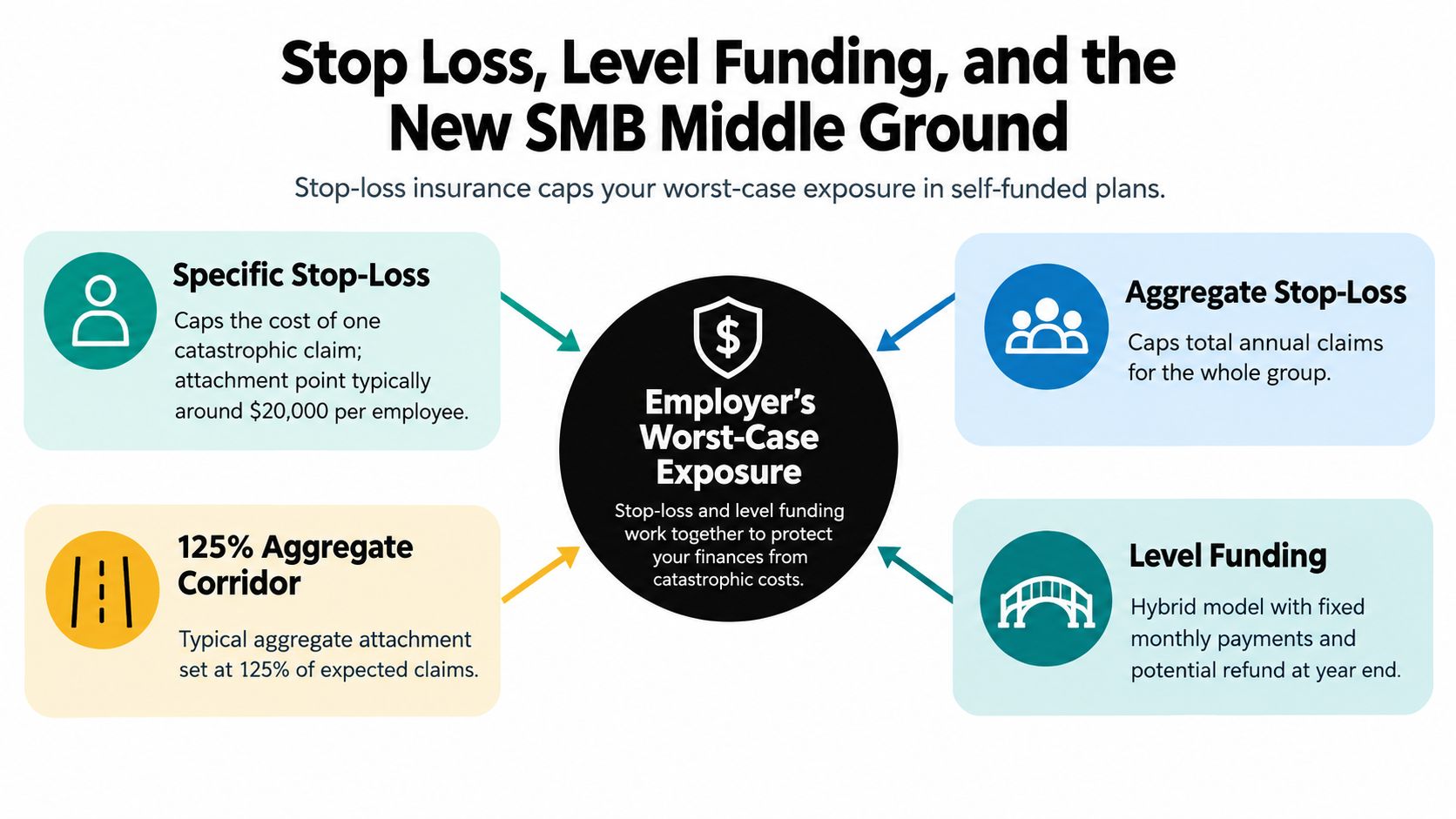
Self-funding isn't a single leap from fixed premiums to unlimited exposure. Stop-loss insurance creates a ceiling around defined claim risk, and level funding packages expected claims, administration, and stop-loss into a more predictable monthly payment.
Specific stop-loss protects against one person's unusually high eligible claims. Aggregate stop-loss addresses the group as a whole and reimburses the employer only after total annual claims exceed the policy's aggregate attachment point. The District of Columbia guidance on self-funded stop-loss arrangements explains that aggregate coverage applies after total claims exceed the annual attachment point for the policy year.
Read the attachment points, not just the brochure
The specific attachment point determines when protection begins for an individual claimant. The aggregate attachment point determines how much total claims activity the employer must absorb before aggregate reimbursement begins. Those numbers reshape volatility, but they don't make the employer's first-dollar claims risk disappear.
A level-funded plan takes the middle position. The employer pays a fixed monthly amount, while the underlying structure uses a claims component and stop-loss protection. If claims run low, the contract may provide a refund or credit, depending on its terms. If claims run high, the stop-loss layer can limit the employer's covered exposure.
ERISA generally preempts state insurance laws for self-funded private employer plans. That can let sponsors avoid many state-mandated benefits and premium taxes that apply to fully insured policies, although federal requirements still apply. The Benely explanation of stop-loss insurance is a useful starting point before reviewing attachment points with a broker.
Level funding has changed the SMB discussion because it combines a fixed billing experience with some of the transparency and flexibility associated with self-funding. It can be viable below the traditional large-employer threshold, including for businesses below 200 employees, but suitability still depends on underwriting, contract terms, reserves, and workforce risk. Don't approve a level-funded quote until you understand what happens to unused claims dollars, how renewals are calculated, and whether high-risk claims are excluded or limited.
Two SMB Scenarios That Show the Trade-offs in Practice
Consider a 75-employee professional services firm in Ohio. Its workforce is relatively stable, the company has consistent enrollment, and leadership wants more transparency than a carrier renewal provides. The firm is willing to review claims reports and give HR a defined role in vendor management.
A level-funded design can be a sensible recommendation in that situation. The employer gets a fixed monthly bill, access to a self-funded claims structure, and stop-loss protection. If the group has a favorable claims year, the contract may return or credit unused funds. The decision still requires a review of the actual quote, attachment points, exclusions, network, and renewal methodology. No responsible broker should promise savings before seeing those terms.
Now compare a 30-employee retailer in Florida. Its cash reserves are limited, staffing changes frequently, and the owner doesn't want the administrative work associated with an administrator, claims oversight, and federal reporting. Even if a self-funded quote appears attractive, the operational fit is poor.
Fully insured coverage is the better recommendation for that retailer. The carrier absorbs claims volatility, the monthly budget is easier to forecast, and the owner avoids taking direct responsibility for claims funding. A higher premium can be rational when the alternative is a cash shock or a compliance process the company can't reliably execute.
Side-by-Side 75-Life Professional Firm vs 30-Life Retailer
| Metric | 75-Life Firm | 30-Life Retailer |
|---|---|---|
| Workforce profile | Stable professional workforce | More variable retail staffing |
| Primary concern | Transparency and control over benefits spending | Predictable cash flow and low administrative burden |
| Reserve posture | More capacity for managed claims variability | Limited capacity for unexpected claims |
| Administrative appetite | Willing to coordinate with a TPA and benefits advisor | Owner prefers carrier-managed administration |
| Starting recommendation | Evaluate level-funded coverage and carefully modeled stop-loss | Stay fully insured unless reserves and HR capacity change |
| Main risk to avoid | Choosing a contract without understanding renewal or reimbursement terms | Taking on claims exposure the business can't fund |
The lesson isn't that 75 employees automatically means level-funded, or that 30 employees automatically means fully insured. The same headcount can produce different recommendations because risk tolerance and operating discipline are part of the benefits plan.
Compliance and Administrative Burden You Should Plan For
Self-funding doesn't remove compliance. It changes the party responsible for coordinating it. Before switching, assign ownership for plan documents, eligibility data, vendor files, participant notices, claims administration, and annual filings.
Applicable large employers, generally those with 50 or more full-time employees measured in the prior calendar year, must offer affordable, minimum-value coverage to full-time employees working 30 or more hours per week under the ACA rules described in this self-funded plan guidance. Self-funding doesn't eliminate that employer mandate.
Build the filing calendar before renewal
A self-funded sponsor may need to coordinate:
- Form 5500: Required for plans meeting the applicable participant threshold, including plans with 100 or more participants.
- Forms 1094-C and 1095-C: Relevant to applicable large employers reporting offers of coverage and enrollment.
- PCORI fee reporting: The plan sponsor generally coordinates the fee through Form 720.
- Forms 1094-B and 1095-B: The cited coverage reporting guidance states that self-funded plans with fewer than 50 full-time employees still have annual 1094-B and 1095-B filing requirements.
That last item surprises many owners. A small self-funded group may avoid the applicable-large-employer forms, but it doesn't escape all federal coverage reporting. Vendor support can reduce the workload, but the employer remains accountable for accurate information.
State insurance mandates generally don't apply in the same way to an ERISA self-funded plan. Federal mental-health parity requirements, ACA requirements, Section 125 administration, fiduciary duties, nondiscrimination rules, and plan disclosure obligations still matter. A useful companion resource on the key areas of HR compliance can help teams map benefits obligations alongside broader HR processes.
Administration also has a real price. Third-party administrative services may add per-employee fees and implementation costs, so compare the complete annual budget, not just the expected claims line. Ask for a written responsibility matrix showing which party prepares each filing, who reviews eligibility, and who responds when a participant challenges a claim.
Which Funding Model Fits Your Company Right Now
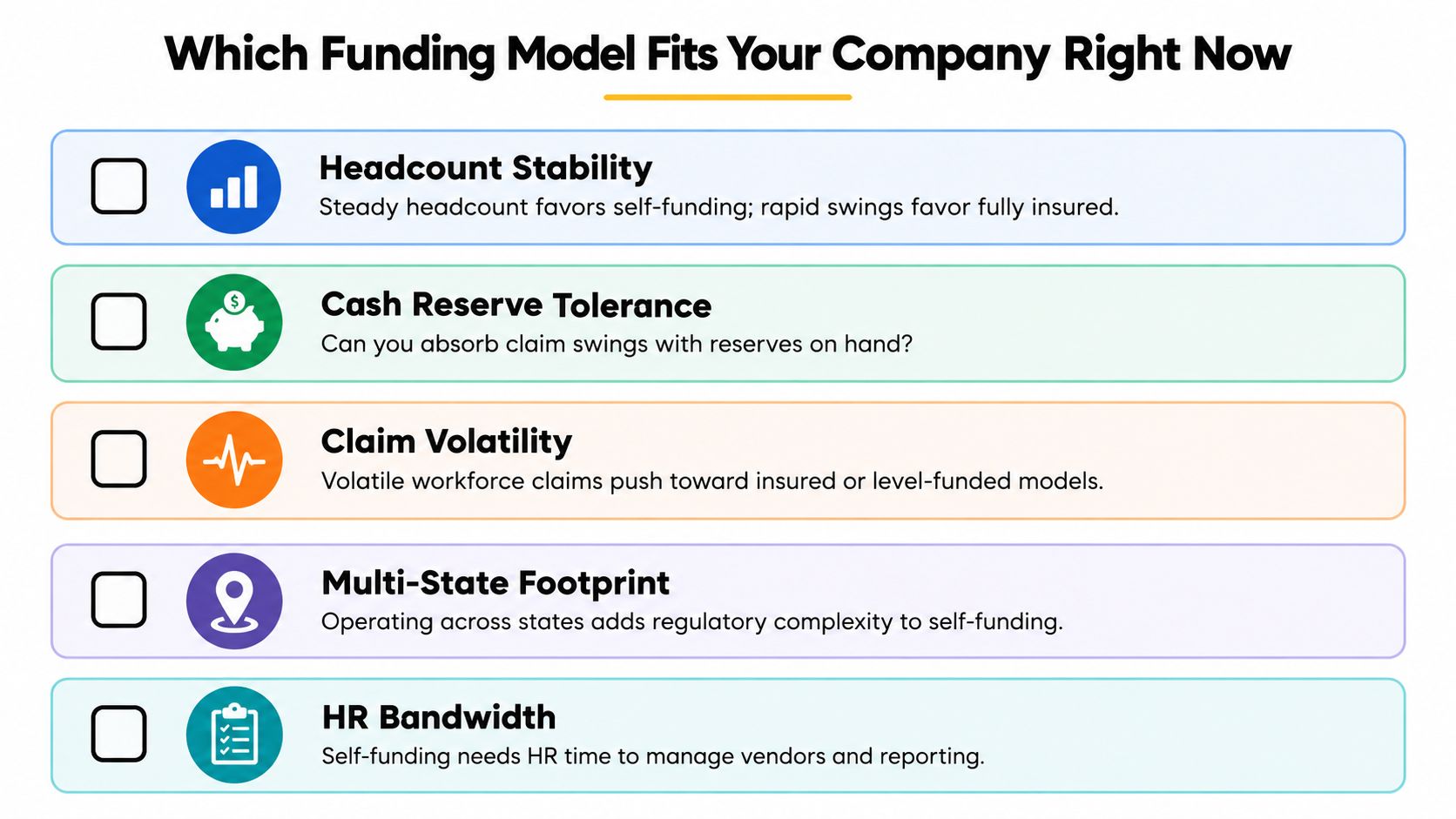
Use a short decision screen before asking a broker to model alternatives. The purpose isn't to replace underwriting. It's to eliminate structures your company can't operate safely.
Five questions deserve a direct answer
Headcount stability. Stable enrollment makes claims projections and stop-loss pricing easier to evaluate. Rapid hiring, seasonal work, or frequent turnover favors a structure with less direct claims exposure.
Cash reserve tolerance. Can the company fund expected claims and withstand timing differences without borrowing from payroll or operating expenses? If the answer is no, don't choose a design that depends on optimistic claims timing.
Claim volatility. Review available historical claims information and look for recurring high-cost conditions, concentration among a small number of members, or sharp changes in enrollment. A healthy average can still hide unacceptable individual risk.
Multi-state footprint. Multiple states can make employee communications, vendor oversight, and plan administration more demanding. ERISA preemption helps with many state insurance rules, but it doesn't make every operational issue disappear.
HR bandwidth. Self-funding requires someone to manage the TPA, stop-loss carrier, enrollment data, reporting calendar, and employee questions. If no one owns those tasks, the theoretical savings aren't worth the execution risk.
Match the structure to the constraint
- Stay fully insured when reserves are thin, enrollment is unstable, leadership wants minimal administration, or the company can't tolerate claim-driven cash movement.
- Evaluate level funding when the company wants a fixed monthly payment but has enough workforce stability and data to consider a self-funded structure. This is often the most practical starting point for smaller employers, including groups under 50 employees, but the contract must be reviewed carefully.
- Consider fully self-funded coverage with specific stop-loss when the company has strong reserves, stable enrollment, reliable claims analysis, and internal or outsourced benefits expertise.
My rule is direct: headcount opens the conversation, claims history determines the economics, and cash position determines whether the company can live with the result. A CFO should be able to select a starting lane in one meeting, then ask for a detailed model only for that lane and one safer alternative.
Common Questions About Choosing Between the Models
Does stop-loss make a self-funded plan fully insured?
No. Stop-loss reimburses the employer under defined conditions after claims exceed an attachment point. It protects the employer's finances, but it doesn't transfer responsibility for ordinary covered claims to an insurance carrier.
The Self-Insurance Institute of America analysis notes that courts have held that purchasing stop-loss doesn't destroy a plan's self-funded status. The legal distinction focuses on who assumes the underlying insurance risk, not whether the employer buys reinsurance protection.
Do state mandates disappear completely?
No. ERISA generally preempts many state insurance laws for private employer self-funded plans, including many state benefit mandates and premium taxes. Federal requirements still apply, and the plan must follow its own governing documents.
Some states also regulate stop-loss availability. The cited SIIA material notes that New York restricts stop-loss issuance for smaller groups, including a rule covering employers with 50 or fewer employees. Check the stop-loss contract and state rules before treating a level-funded or self-funded quote as available.
What happens to unused money in level funding?
The answer depends on the contract. Many level-funded arrangements provide a refund or credit when claims run below the amount allocated to expected claims, administration, and protection. Ask whether the payment is automatic, conditional, applied at renewal, or subject to an underwriting adjustment.
Which ACA form applies?
Applicable large employers generally use Forms 1094-C and 1095-C for employer mandate reporting. Smaller self-funded groups may still need Forms 1094-B and 1095-B, as the cited guidance explains. Have the administrator confirm the filing responsibility in writing, because outsourcing preparation doesn't necessarily transfer the sponsor's accountability.
Benely can help employers compare health plan options, organize enrollment, automate benefits workflows, and connect benefits administration with payroll and compliance processes. Visit Benely to evaluate fully insured, level-funded, and self-funded paths with a benefits team before your next renewal.