 Employee Benefits
 HR & Compliance
 Technology
 Wellness
 PEO Solutions
A founder calls you after losing a senior engineer to a larger competitor. The salary wasn't better. The job title wasn't dramatically different. The deciding factor was a clearer health plan, a retirement match, and confidence that the company knew how to support the employee's family.
That conversation happens because employer benefit plans are no longer a back-office expense. They're part of the total rewards strategy employees use to judge whether a company is serious, stable, and worth joining. For a small or mid-sized business, the challenge isn't copying the benefits menu of a much larger employer. It's choosing benefits people can afford, understand, and use.
Table of Contents
- Why Employer Benefit Plans Matter More Than Ever for SMBs
- The Main Categories of Employer Benefit Plans Explained
- Health Plans, HSAs, and FSAs in Practice
- Regulatory Considerations Every Employer Should Know
- Voluntary Benefits and the PEO Alternative
- The Hidden Benefits Gap Employers Often Overlook
- Choosing the Right Mix for Your Organization
Why Employer Benefit Plans Matter More Than Ever for SMBs
A 45-person company has little room for hiring mistakes. When a senior engineer leaves, the founder loses technical context, project momentum, and recruiting time. The replacement may cost more than expected, but the larger problem is the gap between departure and productivity.
The founder in this scenario insists the company pays competitively. That may be true on a salary spreadsheet. Employees, however, compare the whole package. A competitor with more purchasing power may offer a lower deductible, a better employer contribution, a retirement match, or simpler access to care. If the employee can't tell what your plan covers, the value of your spending disappears during the comparison.
Three business risks sit behind every benefits decision
Retention risk comes first. Employees often tolerate a demanding role when they believe the company supports their health, finances, and family responsibilities. Confusing enrollment, unpredictable costs, or weak communication can turn a reasonable plan into a reason to leave.
Recruiting ceiling is the second constraint. An SMB can't always match the brand recognition, salary bands, or benefits budget of an employer three times its size. It can compete by making its total rewards package coherent and easy to understand. Candidates don't need every possible perk. They need a credible explanation of what they receive and what it will cost them.
The cost of a bad hire goes beyond the recruiting invoice. Managers lose time, customers experience delays, and existing employees absorb the workload. Benefits won't prevent every bad hire, but a poorly designed or poorly explained package narrows the candidate pool before interviews begin.
Spending isn't the same as value
Employer-sponsored coverage has deep roots in American employment. American Express established the first private pension plan in 1875, and the Granite Cutters Union created an early worker health plan in 1877. During World War II, wage controls encouraged employers to compete through nonwage compensation, helping health insurance, retirement plans, and paid leave become standard workplace benefits, as SHRM's history of employee benefits explains.
The modern lesson is practical: benefits only create recruiting and retention value when employees understand them. Before changing carriers or adding another perk, find out whether employees can explain their current deductible, know where to get care, and understand the accounts available to them. Plan selection matters. Benefit literacy determines whether the plan delivers.
The Main Categories of Employer Benefit Plans Explained
Think of employer benefit plans as a three-tier cake. The bottom tier protects the company and its workers through legal obligations. The middle tier provides the core health and financial infrastructure employees expect. The top tier adds flexibility and personal value, but it shouldn't distract from weak foundations.
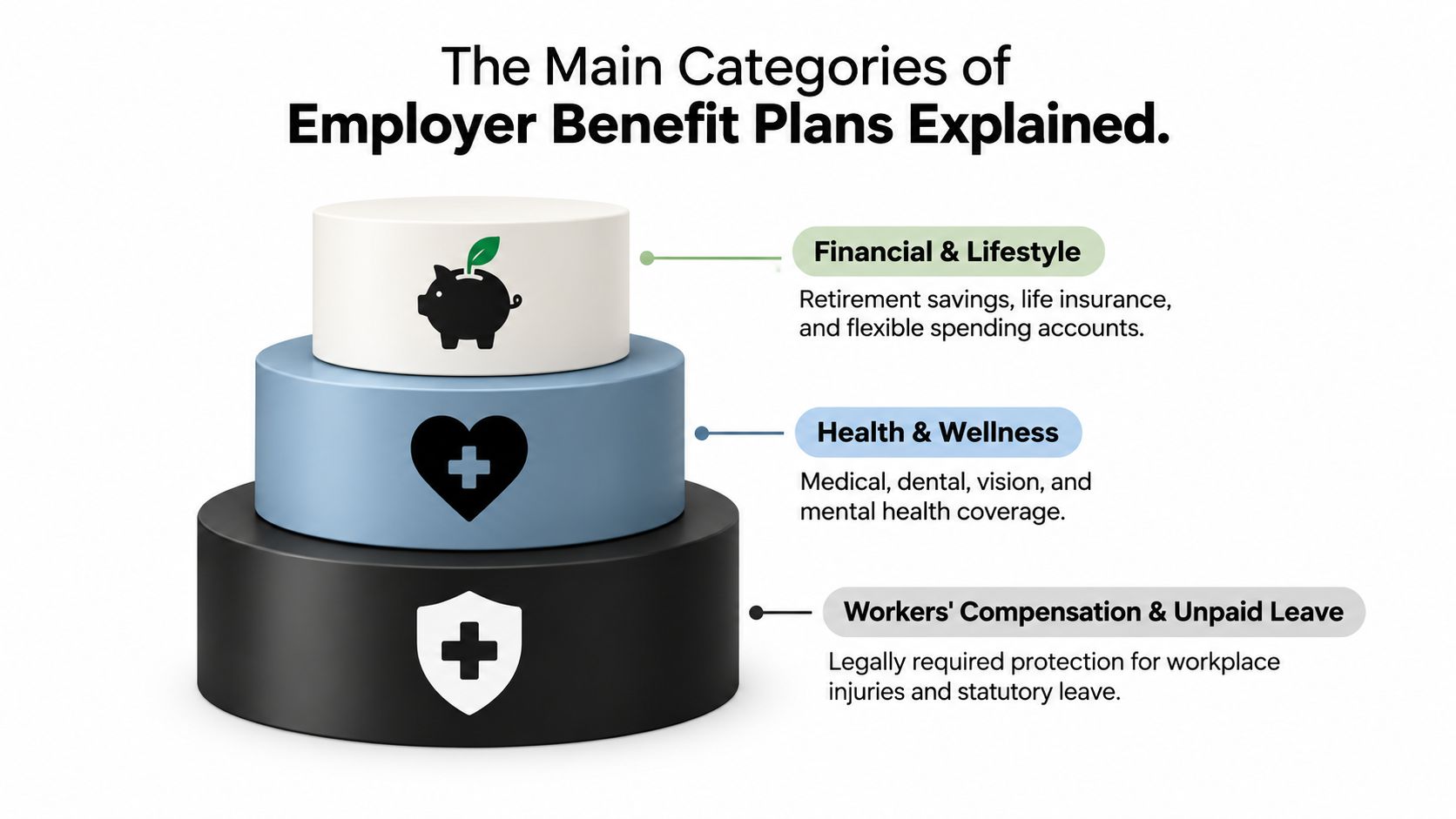
The bottom tier is the compliance floor
This tier includes workers' compensation and legally protected leave, including unpaid FMLA leave where applicable. These benefits aren't optional menu items. They create the minimum protection an employer must manage, document, and communicate.
A 30-person professional services firm may rely on workers' compensation coverage, required leave administration, payroll controls, and a clear employee handbook. A 75-person manufacturer has the same basic obligations, but workplace injury procedures and absence tracking may carry greater operational importance because employees work around physical hazards.
The bottom tier also includes the administrative discipline behind the plans. A benefit that exists on paper but isn't administered correctly still creates risk.
The middle tier carries the employee experience
The middle layer includes medical, dental, and vision coverage, along with tax-advantaged accounts such as HSAs and FSAs. Mental health access often belongs in this practical core because employees experience it as part of everyday healthcare, not as a decorative perk.
The professional services firm might offer a medical plan, dental and vision coverage, an FSA, and a retirement plan. The manufacturer might add a richer employee assistance program, stronger communication around injury care, and an HSA-compatible plan for workers who prefer lower payroll deductions.
This tier deserves the largest design effort because it affects payroll, household budgets, care decisions, and perceived employer support.
The top tier should solve real employee problems
Voluntary and lifestyle benefits can include life insurance, disability coverage, accident insurance, pet coverage, legal services, identity theft protection, and wellness programs. They can strengthen a package when employees have a clear need and the enrollment process is simple.
They can also create clutter. Stacking every available category forces employees to sort through options they may never use while making core coverage harder to understand. A company with young, distributed employees may prioritize disability and mental health support. A company with established families may find dependent coverage and supplemental life insurance more relevant.
A layered approach keeps decisions honest. Build the legal foundation, make core health coverage usable, then add voluntary options only where employee need justifies the complexity.
Health Plans, HSAs, and FSAs in Practice
Health plan selection usually comes down to a trade-off between predictable payroll deductions and exposure when someone needs care. A traditional PPO generally offers broader flexibility and more predictable access costs, while an HMO may emphasize network coordination. A high-deductible health plan can reduce premiums but shifts more early spending responsibility to the employee. An FSA arrangement can help employees pay eligible expenses with pre-tax dollars, but it requires careful communication and account management.
Don't compare plans by premium alone. Compare the employee contribution, deductible, coinsurance, out-of-pocket maximum, provider network, prescription structure, and employer account funding together.
Actuarial value gives the comparison a common language
Actuarial value, or AV, estimates the share of covered healthcare costs a plan pays on average. Federal guidance uses metal-tier targets of 60% for bronze, 70% for silver, 80% for gold, and 90% for platinum, as explained by HHS guidance on actuarial value.
That doesn't mean every employee's bills will split according to the percentage. A person who uses little care may pay mostly premiums. Someone with major medical needs may reach the plan's out-of-pocket limit. AV is useful because it lets an employer compare the overall richness of designs before negotiating price.
Federal analysis found that the average in-network AV for employer-sponsored plans in 2021 was 0.842, meaning plans paid about 84.2% of covered charges on average. Another HHS analysis estimated that about 98% of enrollees were in plans meeting or exceeding the 60% minimum-value floor, according to the Department of Labor actuarial value analysis. The decision for most employers isn't whether to clear the legal floor. It's how to balance richness, employee contributions, and out-of-pocket exposure.
Compare the structure before you compare the quote
| Plan Type | Typical Monthly Premium (Employee) | Typical Deductible | Employer HSA Contribution | Best Fit For |
|---|---|---|---|---|
| Traditional PPO | Varies by carrier and contribution strategy | Varies by plan | Not applicable | Employees who value provider flexibility and predictable access |
| HMO | Varies by carrier and contribution strategy | Varies by plan | Not applicable | Workforces comfortable using a defined local network |
| HDHP with HSA | Often lower than a richer traditional plan | Higher than a traditional plan | Employer-selected contribution | Employees who can manage early expenses and value HSA savings |
| FSA-only or limited-purpose FSA | Depends on the paired medical plan | Depends on the paired medical plan | Not applicable | Employees seeking pre-tax reimbursement for eligible expenses |
The table uses qualitative comparisons because premiums and deductibles depend on location, carrier, census, network, and plan design. For HSA education and employer account strategy, employers can review Benely's HSA guidance for employers.
HSAs can offer tax advantages when paired with an eligible high-deductible plan, and account balances can remain available for future eligible expenses. FSAs can be useful for predictable healthcare spending, but employees need clear guidance on deadlines, eligible expenses, and applicable carryover or forfeiture rules. An employer shouldn't offer an HDHP and assume the lower payroll deduction solves the affordability problem. If employees can't cover early costs, an employer HSA contribution may be the difference between a smart design and a frustrating one.
FSA and HSA coordination also requires care. A general-purpose FSA can interfere with HSA eligibility, while a limited-purpose FSA may be compatible in the right circumstances. Have the broker and plan administrator validate the arrangement before enrollment.
Regulatory Considerations Every Employer Should Know
Compliance starts with identifying which rules apply to the organization, the plan, and each employee class. It doesn't end with selecting a carrier. A benefits strategy that looks affordable can become expensive if payroll classifications, notices, eligibility records, or plan documents are wrong.
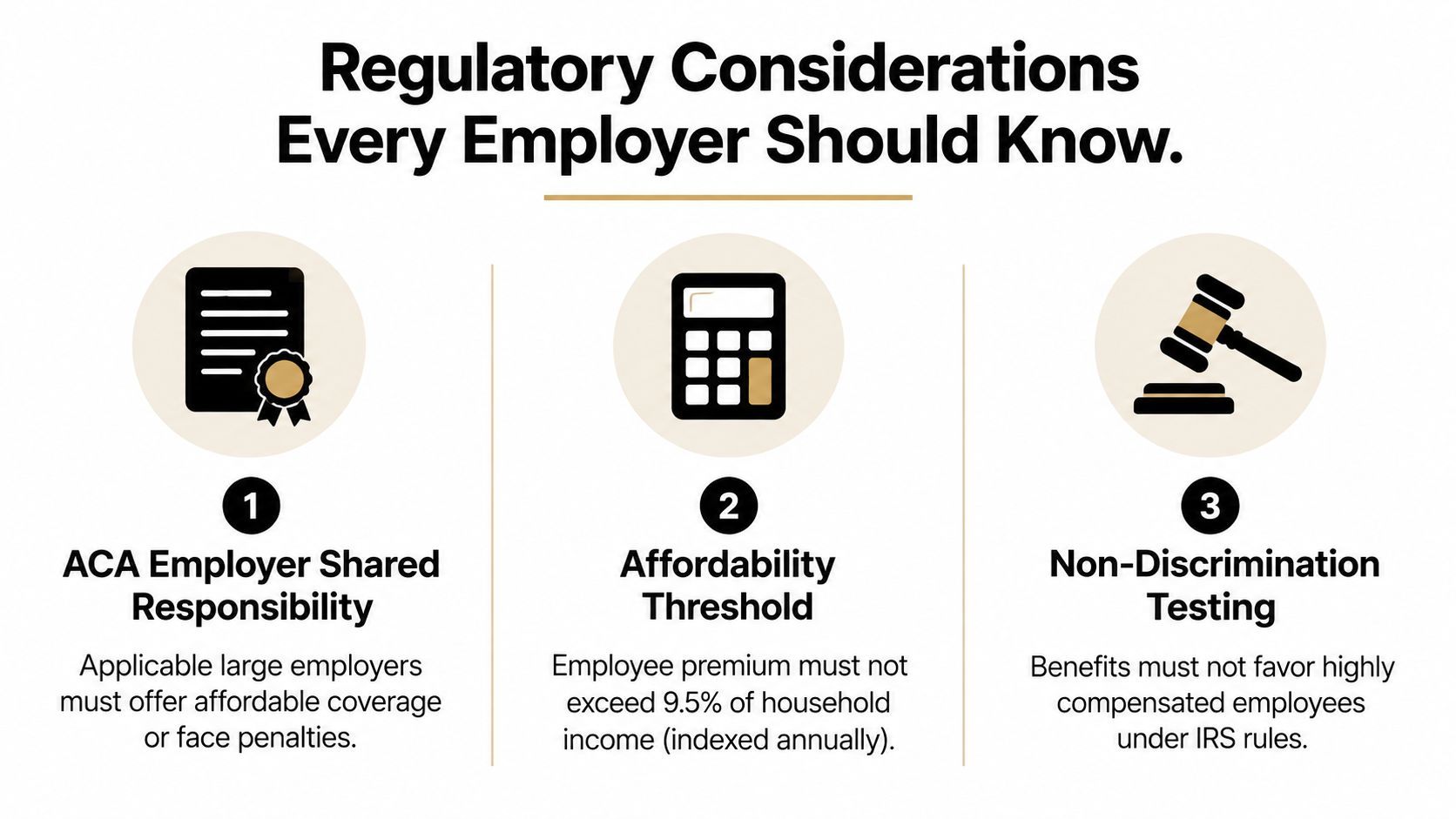
Start with employee counts and hours
Under ACA rules, employers with 50 or more full-time equivalent employees are generally subject to the employer mandate. The ACA defines a full-time employee as someone working 30 hours per week or 130 hours per month, according to this employee benefits eligibility guide.
That threshold requires an operational response. Use payroll reporting to flag variable-hour employees, review measurement periods, and reconcile eligibility before an offer is made or coverage ends. Don't let a spreadsheet maintained by one busy HR generalist carry the entire process.
The affordability requirement is indexed and depends on the applicable safe harbor and employee contribution calculation. Minimum value testing also matters, because a plan can be broad without meeting the relevant coverage standard. Your broker and benefits counsel should verify the design rather than relying on a carrier label.
SHOP can matter for smaller employers
The ACA created the Small Business Health Options Program, generally for businesses with 1 to 50 full-time and full-time equivalent employees. SHOP coverage is generally the only way to qualify for the Small Business Health Care Tax Credit, and employers using SHOP must offer coverage to all eligible employees when they become eligible, according to Healthcare.gov's small-business guidance.
Small-group rules also constrain pricing. Federal rules require an essential health benefits framework, and premiums can generally vary only by age, geographic area, family size, and tobacco use. States may add mandates and rating limits, which makes state-by-state design materially different, as explained by the Congressional Budget Office's small-business health insurance analysis.
Treat documents as operating tools
ERISA documentation, summary plan descriptions, notices, nondiscrimination testing, and annual filings all need ownership. Employers should maintain a compliance calendar, record delivery dates, and confirm that plan documents match the benefits employees receive.
Practical rule: Put the payroll flag, filing reminders, eligibility audit, and annual carrier review on named owners' calendars. If nobody owns the task, the company owns the risk.
For a plain-language overview of ERISA responsibilities, employers can use this ERISA guide for benefit plan sponsors. A broker can coordinate much of the work, but the employer still needs to supervise the process and retain evidence that required actions occurred.
Voluntary Benefits and the PEO Alternative
Voluntary benefits and PEO arrangements solve different problems. Voluntary benefits expand the menu with limited employer spending. A PEO changes the operating model by combining administration, payroll, benefits access, and sometimes workers' compensation under a co-employment structure.
Voluntary coverage preserves employer control
Supplemental life, disability, accident, critical illness, hospital indemnity, pet, legal, and identity theft plans can address needs that a medical plan doesn't cover. Employees often pay most or all of the premium, which can make these options attractive to a budget-conscious employer.
The drawback is enrollment. Employees won't value an option they don't recognize, can't explain, or find difficult to elect. Voluntary benefits work best when the employer identifies a specific gap, explains the payroll deduction, and avoids presenting a long list during an already confusing open enrollment.
A broader employee support strategy should also address workload and workplace conditions. Employers evaluating sustainable workplace strategies can connect benefit choices to prevention, manager behavior, and the daily causes of burnout rather than treating wellness as a standalone perk.
PEOs trade flexibility for administrative leverage
A PEO may help a small employer access broader benefit arrangements and shift payroll, HR administration, and some compliance work to a specialized provider. That can suit a team with limited internal HR capacity, a distributed workforce, or an employer expanding into new states.
The trade-offs are material. Co-employment changes the relationship among the business, employees, and provider. Contracts can limit flexibility, switching costs may be meaningful, and fee structures can be difficult to compare if administrative charges, workers' compensation, payroll, and benefits are bundled.
| Dimension | Voluntary Benefits | PEO Arrangement |
|---|---|---|
| Employer cost | Usually limited when employees pay premiums | Bundled fees and service charges require detailed review |
| Administrative burden | Employer still manages core HR and benefits workflows | Provider may handle substantial administration |
| Employee choice | Employees elect selected supplemental options | Access depends on the PEO's platform and offering |
| Flexibility | Employer keeps its own operating model | Co-employment can affect control and portability |
| Best fit | Employers adding targeted protection | Employers needing broader HR infrastructure or multi-state support |
Teams under 25 employees may prefer targeted voluntary coverage if their internal processes are manageable. A growing company with complex payroll, multiple states, or no dedicated HR operator may get more value from a PEO. Employers should compare total cost, contract terms, renewal treatment, data access, and exit procedures before signing.
For a practical explanation of the operating model, review how a PEO works. The right question isn't whether PEOs are good or bad. It's whether the administrative relief justifies the loss of flexibility for this particular company.
The Hidden Benefits Gap Employers Often Overlook
Many employers respond to dissatisfaction by adding another benefit. That reaction is often backwards. If employees don't understand the current medical plan, skip HSA contributions, ignore EAP access, or pay out of pocket for covered preventive care, a richer menu may increase cost without improving employee experience.
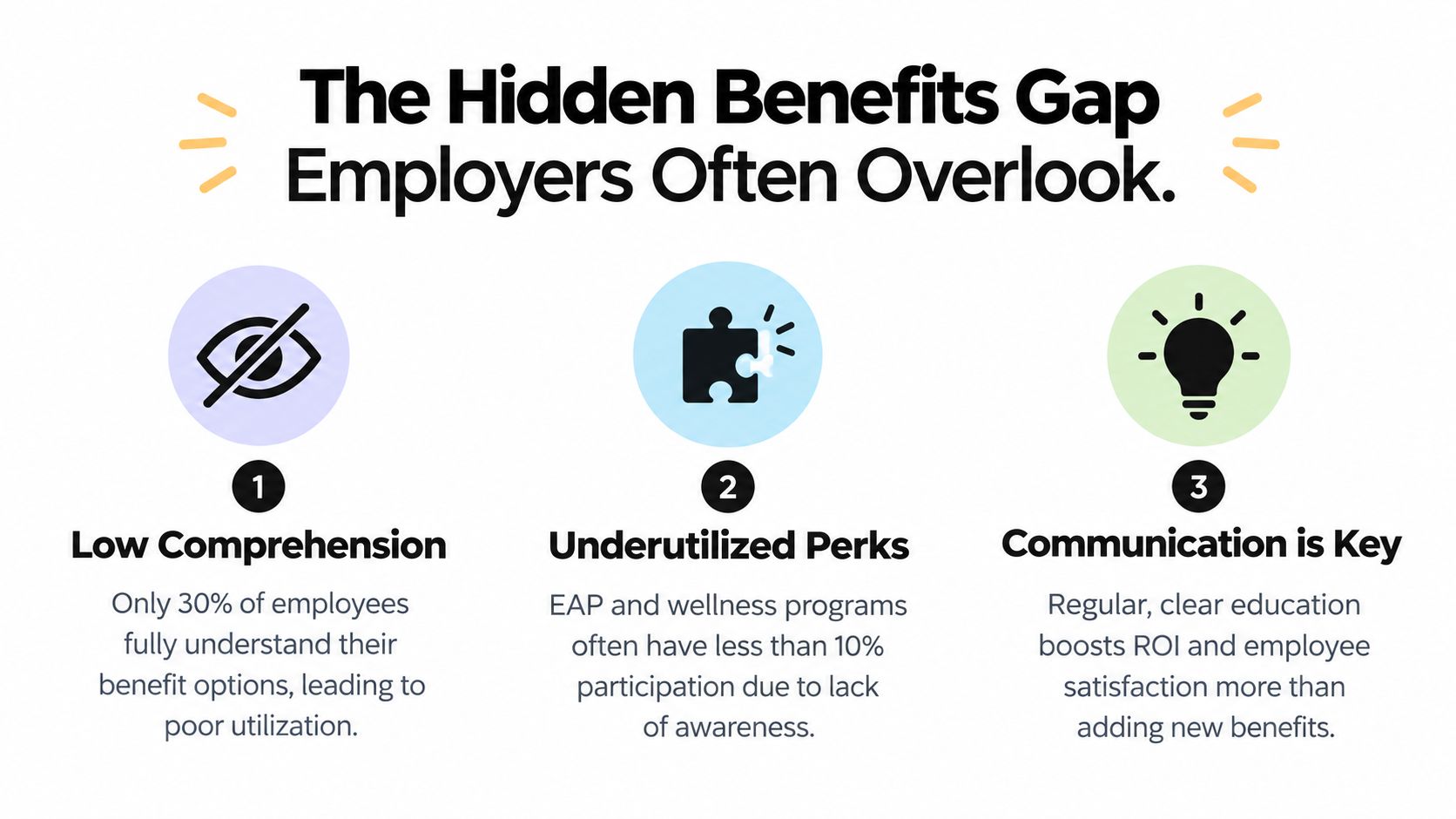
The comprehension problem has a measurable business cost
A recent 2026 report found that employee experience of communication effectiveness trails employer perception by 20%, while only 35% of employers offer structured financial wellbeing programs, according to NFP's benefits communication report. The gap matters because employers may believe they communicate well while employees still don't know how to use the plans.
Unused benefits carry real consequences. An employee who skips HSA contributions loses access to a tax-advantaged savings tool. An employee who forfeits an FSA balance receives less value from the plan. Someone who pays cash for a service already covered under the plan effectively pays twice, once through premiums and again at the point of care.
Make education part of administration
High-performing SMBs don't leave education to a single enrollment email. They build repeated, practical contact into the benefits calendar:
- Annual benefits fairs: Bring carriers, administrators, and HR into one employee-facing session.
- Personal enrollment meetings: Give employees a chance to discuss household scenarios privately.
- Plain-language summaries: Explain deductibles, networks, accounts, and claims without carrier jargon.
- Mid-year reminders: Prompt employees to revisit preventive care, account contributions, and available support.
- Manager training: Give managers approved answers to common questions and a clear escalation path.
Managers shouldn't become benefits experts. They should know where to direct an employee who asks about a deductible, an EAP, a dependent eligibility rule, or a claim problem.
The cheapest benefits improvement is often the one that helps employees use what the company already pays for.
Measure comprehension with short pulse surveys and recurring employee questions. If the same question appears every enrollment cycle, the communication failed, not the employee.
Choosing the Right Mix for Your Organization
The right employer benefit plans depend on workforce needs, cash flow, hiring goals, and administrative capacity. Start with an audit, not a carrier presentation.
Build the decision around evidence
Map the employee census, locations, job categories, dependents, turnover patterns, and current utilization. Then separate must-have coverage from nice-to-have options. A medical plan, retirement contribution, and disability protection may belong in the first group. Pet insurance or identity theft coverage may be useful, but they shouldn't displace a core need.
Calculate total rewards spending as a share of payroll and model the employer contribution under different enrollment scenarios. Protect the margin by setting a contribution policy before employees choose among plans. The policy should explain what the company funds, what employees pay for dependents, and how the organization will handle future renewals.
Pressure-test each option with four questions:
- Will employees use it?
- Can employees explain it?
- Can the company administer it accurately?
- Does it support recruiting or retention better than an alternative use of the budget?
Match the design to the workforce
A smaller professional services team may value predictable medical access, a retirement match, and simple enrollment. A manufacturer may need stronger injury processes, disability coverage, and communication around care navigation. A distributed workforce may need a plan that works across locations rather than a narrow network that looks inexpensive but frustrates employees outside one region.
For a company comparing carriers, administration platforms, and PEOs, Benely provides benefits brokerage and HR workflows that let employers compare health plans, set budgets, manage enrollment, and connect benefits with payroll, onboarding, and compliance processes. Use the same evaluation standard for any provider: check data access, support quality, implementation ownership, renewal transparency, and employee usability.
Use a 30, 60, and 90-day operating plan
Days 1 to 30: Interview brokers, collect current plan documents, map the census, review employee questions, and run a short pulse survey.
Days 31 to 60: Issue an RFP, compare plan designs using employee cost and employer contribution scenarios, validate compliance requirements, and identify the communication gaps that must be fixed before enrollment.
Days 61 to 90: Select the plan, finalize documents, prepare plain-language materials, schedule enrollment meetings, train managers, and connect payroll and benefits records.
The strongest package isn't the one a competitor happens to offer. It's the one your workforce can afford, understand, and use without needing HR to decode every decision.
If your benefits program is hard to compare, harder to administer, or poorly understood by employees, Benely can help you evaluate plans, set budgets, automate enrollment, and connect benefits with payroll and compliance workflows. Visit Benely to turn your employer benefit plans into a clearer total rewards strategy instead of another annual renewal scramble.