
Your renewal is sitting in your inbox, payroll needs next year's deductions, and employees want to know whether they can keep their doctors. You don't need another spreadsheet of premiums. You need someone to explain the trade-offs, handle the work they've promised to handle, and leave you with a decision you can defend.
A good group health insurance broker does that. The wrong one delivers quotes, collects a signature, and leaves your HR team to untangle everything afterward. Choose for the full benefits lifecycle, not just the renewal presentation.
Table of Contents
- What a Group Health Insurance Broker Actually Does
- Choosing Between a Broker, an Agent or a PEO
- How Brokers Get Paid and What to Expect
- How to Evaluate and Select a Broker, Step by Step
- Questions to Ask and Red Flags to Avoid
- Integrating Enrollment, Payroll and Benefits Platforms
- Sample Use Cases and ROI for Founders, HR Managers and Finance Leaders
- Confirm Broker Fit and Choose Your Next Step
What a Group Health Insurance Broker Actually Does
Say your company has 40 employees and receives a hypothetical 14% renewal increase. The carrier's explanation is vague, your finance lead wants alternatives, and HR doesn't have time to check every employee's doctors against competing networks.
A group health insurance broker is an independent intermediary working for the employer, rather than selling only one carrier's products. The broker shops available coverage, analyzes the renewal, and translates network and plan-design differences into choices your team can understand.

The stakes extend beyond purchasing: KFF's employer-sponsored insurance overview reports that 60.0% of people under age 65, approximately 165.6 million individuals, had employment-sponsored insurance in 2025. Employees and their dependents rely on employers' decisions for access to care.
Broker services split by plan stage
| Plan stage | What the broker typically does | What the employer still decides |
|---|---|---|
| Plan shopping | Compares carriers, networks and plan tiers against budget | Chooses the plan and contribution levels |
| Renewal | Benchmarks the renewal rate and negotiates with carriers | Accepts or rejects the renewal offer |
| Enrollment | Runs group sessions, one-on-one counseling and reconciles elections | Sets the enrollment window and eligibility rules within applicable requirements |
| Compliance | Coordinates ACA reporting, COBRA and plan document filings | Approves filings and keeps official records |
| Ongoing support | Answers employee questions and handles mid-year changes | Owns payroll deductions and final policy decisions |
Treat this table as a scope discussion, not a guarantee that every broker includes every service. Put the actual division of work in the service agreement, including any outside administrator's responsibilities.
For the hypothetical renewal, the broker should first explain what changed, then compare realistic alternatives, and finally show the employer and employee consequences. A lower premium isn't a complete recommendation if employees lose access to their preferred hospital.
At Benely, we shop, analyze and personalize group benefits in simple steps. The client makes the final decision.
Think of a broker as a travel agent for benefits who knows many airlines. They explain routes, restrictions and costs, but you still choose the flight.
Before delegating a task, ask:
- Time: Who can reliably complete it?
- Error risk: Who must correct a mistake, and who bears its consequences?
- Carrier knowledge: Who understands the applicable carrier rules best?
Choosing Between a Broker, an Agent or a PEO
A broker, a carrier agent and a professional employer organization solve different problems. Start with how much carrier choice you want and how much employment administration you intend to outsource.
Broker, agent and PEO compared
| Factor | Group broker | Carrier agent | PEO |
|---|---|---|---|
| Who they work for | Employer | Carrier | Employer, under co-employment |
| Carrier choice | Several carriers | One carrier's products | Usually the PEO's own plan pool |
| Plan design control | High | Limited | Limited to PEO options |
| Payroll and HR services | Usually not included | Not included | Included |
| Best fit | Companies wanting carrier choice and custom design | Companies with a preferred carrier | Companies outsourcing HR and payroll |
A group broker makes sense when you want competing carrier proposals and control over the benefit structure. That control means selecting among available plan designs, setting contribution strategies, and deciding how much choice to give employees. It doesn't mean a small employer can rewrite an insurer's contract.
A carrier agent can be a practical choice when one insurer already meets your network and service needs. The limitation is the comparison: an agent selling that insurer's products won't provide the same cross-carrier analysis. Don't mistake a detailed presentation of one carrier's options for a market review.
A PEO bundles benefits with payroll and HR services through a co-employment arrangement. Your company generally retains day-to-day management of employees, while the PEO assumes specified employment administration responsibilities under its agreement. The arrangement changes how employer responsibilities are allocated for payroll, tax and other purposes, so review the contract rather than assuming the PEO becomes the employer for everything.
Choose the operating model first. A benefits quote can look attractive while committing you to an HR arrangement you don't actually want.
Match the model to your company
- Choose a broker when carrier choice, contribution flexibility and a customized recommendation matter most.
- Choose an agent when you've deliberately selected a carrier and want a straightforward purchasing relationship.
- Choose a PEO when outsourcing payroll and HR matters more than controlling the available benefit menu.
Some brokers also shop PEO solutions, so you don't have to evaluate these paths separately. Compare the PEO's full employment-services package against a broker-supported plan plus your existing payroll and HR arrangements.
For a quick self-test, write down how many carriers you need to compare. Then identify whether someone inside your company can run payroll and enrollment, not merely supervise another vendor.
How Brokers Get Paid and What to Expect
Broker fee models and what to check
| Fee model | How it works | Who usually pays | What to confirm |
|---|---|---|---|
| Carrier commission | Carrier pays the broker a percentage of premium | Carrier, built into the rate | Commission levels by carrier, in writing |
| Flat fee | Fixed annual or monthly fee | Employer | Whether enrollment support and renewals are included |
| Percentage of premium | Fee calculated as a share of total premium | Employer | Whether the fee rises with premiums without extra work |
| Per-employee fee | Charge for each enrolled employee | Employer | How the fee changes as headcount grows |
| Hybrid | Carrier commission plus an employer fee | Both | A written breakdown of both payments |
| PEO bundled fee | Per-employee fee covering HR, payroll and benefits | Employer | Total cost compared with a broker plus separate payroll |
Carrier-paid doesn't mean cost-free. Commission is commonly built into the premium rather than appearing as a separate employer invoice. Confirm the actual arrangement because carrier compensation doesn't always follow the same formula.
A flat fee is easier to see, but visibility alone doesn't make it better value. A proposal can exclude employee counseling, implementation or renewal work, leaving you to buy those services separately. Our explanation of how insurance brokers get paid gives you a framework for reading the compensation disclosure.
Test the quote against the full budget
According to KFF's 2025 Employer Health Benefits Survey, average annual premiums were $9,325 for single coverage and $26,993 for family coverage, while employees contributed an average of 16% and 26%, respectively, with average dollar contributions of $1,440 and $6,850. These are national benchmarks, not a promise about your group's pricing.
KFF has conducted its annual Employer Health Benefits Survey since 1999, providing a long-running reference for employer coverage costs and practices, as described in its 2024 annual survey.
Compare your proposed employer share with those benchmarks, then examine local networks, workforce needs and dependent coverage. Don't calculate a contribution from a rounded percentage and assume it must match the separately reported dollar average.
Ask for total annual employer cost, including employer premium contributions, direct brokerage fees, platform charges, administration and implementation expenses. Don't add a built-in commission again as though it were a separate invoice.
Before signing, get written answers to:
- Carrier payments: What compensation does each carrier pay?
- Direct charges: What do we pay, and which services are excluded?
- Renewal changes: Can compensation increase automatically when premiums rise?
How to Evaluate and Select a Broker, Step by Step
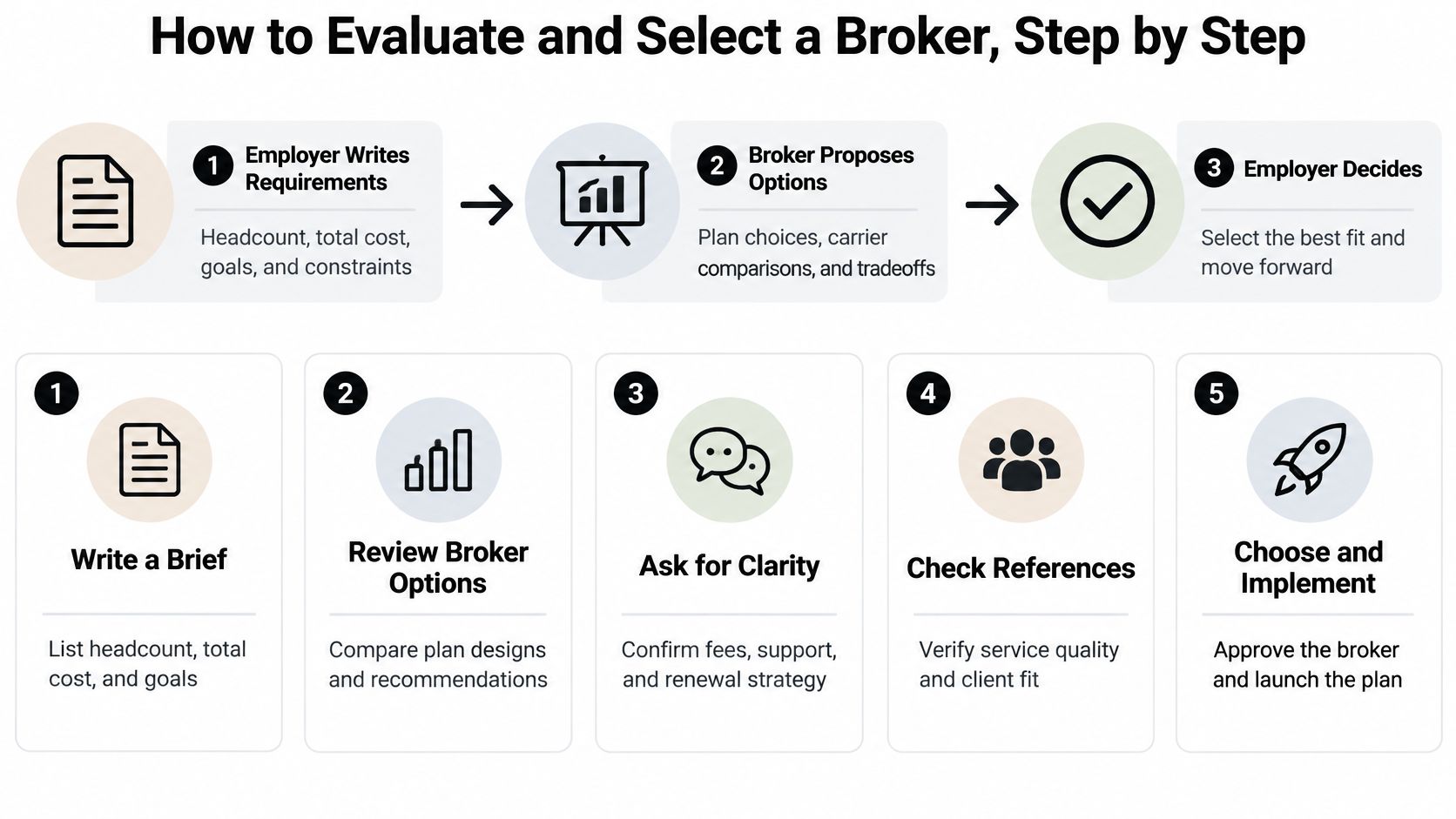
You write the requirements. The broker proposes options. You decide. Keeping that order prevents a polished sales presentation from defining your benefits strategy for you.
Build a comparable shortlist
Write the employer brief. Include headcount, employee locations, total employer budget, target employee contribution, carrier preferences and renewal date. Check marketplace eligibility early: CMS's SHOP guidance says SHOP generally serves employers with 1–50 full-time-equivalent employees, with some states extending eligibility to 100, and generally requires a primary business address in the purchasing state and at least one common-law employee. Eligibility review keeps the broker from building recommendations around an unavailable purchasing route.
Verify licensing and carrier appointments. Check the broker's license through your state insurance department and confirm its relationships with proposed carriers. You need to know who can place coverage, not just discuss it.
Request written proposals from three to five brokers. Give each the same requirements and questions. Require a named account contact and a comparable quote built on the same carrier, census and budget assumptions; identify any carrier the broker cannot quote.
Compare total annual cost. Apply the compensation checks in How Brokers Get Paid and What to Expect, rather than comparing premium alone. Use a shared spreadsheet with separate columns for employer contributions, employee deductions, fees and retained administrative work.
A useful health insurance plan comparison also separates network access and employee cost-sharing from the employer's budget. Otherwise, a cheaper proposal can appear equivalent when it isn't.
Verify delivery before signing
Interview the finalists. Use the interview questions below to test how each team handles routine work and failures. Ask who will perform the work after the salesperson leaves.
Check two relevant references. Favor employers with similar headcount and industry. Ask about enrollment corrections, employee support and whether promised renewal analysis arrived when needed.
Read the service agreement. Confirm scope, responsibility for errors, data access, termination provisions and transition assistance. Resolve ambiguous responsibilities before an employee needs help.
Choose, sign and document the reasons. Keep the proposal, compensation disclosure, service commitments and decision record together. That gives your team a practical baseline for judging delivery at the next renewal.
Questions to Ask and Red Flags to Avoid
The most revealing broker questions concern what happens after enrollment. A strong quote won't help much if nobody takes responsibility when an employee's coverage fails to activate.
In survey findings covered by The American Journal of Managed Care, 18% of surveyed businesses said the administrative burden was too high to provide coverage and 15% didn't know how to begin; among small businesses not offering coverage, 77% said a broker recommendation would make them more likely to adopt an ICHRA. Trusted guidance matters, but it needs an operational service model behind it.
Broker interview questions and warning signs
| Question to ask | Strong answer | Red flag |
|---|---|---|
| Who is accountable if an enrollment error leaves an employee uncovered? | Named role, written responsibility and a correction timeline | Vague answer or an unsupported claim that the carrier handles it |
| How many carriers and plans do you quote for groups our size? | Several carriers and a side-by-side comparison | Only one carrier offered without a clear explanation |
| What happens after enrollment is complete? | Named service team, mid-year change process and renewal review | No defined service after signing |
| Who owns our employee and claims data at exit? | Employer retains its records and receives permitted exports, with claims-data restrictions explained | Data held with no export rights or unexplained restrictions |
| How do you support employees with questions? | Scheduled sessions, direct contact and a written guide | Support limited to a general inbox |
| Can you provide references with similar headcount and industry? | Two or more references offered | Refusal or no comparable references |
| Are you licensed in our state and appointed with the carriers you propose? | License details and carrier list provided | Vague answer or reluctance to share details |
Ask these questions in order and score each answer as documented, incomplete or unacceptable. Request the compensation disclosure before the interview so you can spend the conversation testing service delivery rather than reconstructing fees.
Be precise about data. Employer enrollment records aren't the same as identifiable employee claims information, and a broker shouldn't promise unrestricted access to information your company isn't entitled to receive.
Disqualification rule: Reject a broker that won't accept written service accountability or explain your rights to retrieve employer records, regardless of price.
For close finalists, ask them to walk through a missed enrollment scenario: who receives the alert, contacts the carrier, updates payroll and tells the employee what happens next? Record the answer alongside the score, not just your impression of the meeting.
Integrating Enrollment, Payroll and Benefits Platforms
Map the systems before discussing integrations: HR information system, benefits portal, carrier feeds and payroll. Employee eligibility should originate in a defined source, elections should reach the carrier, and confirmed deductions should reach payroll with an effective date.
A clean workflow reconciles payroll deductions with carrier invoices and processes eligibility changes within the intended pay cycle. Employees should also see what each option will cost from their paycheck before submitting an election.
Follow the data through enrollment
For a hypothetical company with 40 employees and different carrier renewal dates, ask the broker to pursue aligned anniversaries rather than accepting repeated enrollment exercises. For Xsolla, we worked with carriers to align anniversary dates so employees could decide on healthcare once per year, with side-by-side online comparisons showing paycheck costs.
Our open enrollment process includes group virtual and in-person presentations, one-on-one counseling, a customized benefits guide, customized benefits videos, and enrollment reconciliation and submission. Evaluate employee benefits enrollment software against those actual handoffs, not just the employee-facing screen.
For broader workflow planning, LeaveWizard's UK small business HR software guide offers a useful perspective on connecting employee management and payroll. Treat it as a systems-planning resource, not guidance on U.S. benefits law.
Assign compliance ownership
Use this checklist to turn system connections into accountable administration:
- Name each owner. Assign responsibility for every feed, rejected record, payroll correction and carrier confirmation.
- Deliver the SPD. The Department of Labor's ERISA disclosure guidance generally requires a Summary Plan Description within 90 days after coverage begins, with an initial deadline of 120 days when a plan first becomes subject to ERISA reporting and disclosure rules; it also generally requires a Summary of Material Modifications within 210 days after the end of the plan year in which a change takes effect, and notice of a material reduction in covered services or benefits within 60 days.
- Track delivery, not just preparation. Assign separate calendar tasks for the SPD, modifications and material-reduction notices, retaining evidence of distribution.
- Reconcile before submission. Compare elections, effective dates and deductions, then confirm carrier acceptance rather than treating a transmitted file as completed enrollment.
Our compliance evaluation helps ensure clients' ACA reporting, COBRA and ERISA filings are up-to-date and compliant. The employer still needs named internal owners and official records.
Sample Use Cases and ROI for Founders, HR Managers and Finance Leaders
A founder sees renewal costs rising faster than payroll and wants a plan employees will actually use. Buying the lowest-premium option may satisfy the budget spreadsheet while leaving employees unwilling to enroll.

Founders need an affordability decision
An eHealth survey of small and midsize employers found that 89% of those sponsoring group coverage worried they wouldn't be able to afford it within three years, while 42% called providing coverage a “big burden”; among small businesses not offering coverage, 55% were unaware ICHRAs were available, and 85% said they'd be more likely to adopt one if it guaranteed comparable network quality and choice.
The founder's question is therefore broader than whether the company can afford the premium. Can employees afford their share, and does the network support the benefit you're promising candidates?
An Individual Coverage Health Reimbursement Arrangement, or ICHRA, deserves evaluation when a defined employer reimbursement budget could fit better than group coverage. Don't assume comparable networks or easier employee decisions. Have the broker compare actual individual-market options, employee costs and administration before recommending a change.
HR and finance need different evidence
For HR managers, log time spent on enrollment, corrections and employee questions before and after appointing a broker. Separate work the broker eliminated from work that merely moved into a different portal. Keep an error log showing the cause, owner and resolution.
For finance leaders, model three contribution scenarios: protect employee-only affordability, increase dependent support, and hold the overall employer budget fixed. For each, show expected enrollment assumptions, employer spending and employee paycheck deductions.
The lowest premium isn't the best value if the resulting employee contribution makes the benefit unattractive or unusable.
Don't promise a return from projected participation. Track what employees choose and compare it with the assumptions behind the recommendation.
At every renewal, review:
- Enrollment rate: Enrolled eligible employees against eligible employees.
- Administrative hours: Internal time spent per enrollment cycle.
- Renewal performance: Proposed increases against a documented, comparable benchmark.
- Cost per enrolled employee: Employer benefit spending, including fees, divided by enrolled employees.
- Enrollment errors: Corrections per cycle, including unresolved coverage problems.
Confirm Broker Fit and Choose Your Next Step
Choose a broker only after you've settled the cost and service model, tested the team's accountability, and confirmed how enrollment will connect with payroll. A competitive quote without a workable implementation plan isn't ready for approval.
This week, pull your current renewal and write the employer brief: headcount, locations, budget, contribution goals and renewal date. Send it to three brokers with the same proposal requirements and request a named service contact.
Keep a decision record
- Compare equivalent proposals. Separate premium, fees, employee impact and work your team retains.
- Apply the disqualification rule. Record each broker's score and reject unresolved accountability or data-access problems.
- Save the evidence. Keep the brief, scorecard and signed scope together for the next renewal.
At Benely, our platform lets you compare insurance plans, track enrollment progress and connect systems in one place. That makes it easier to organize the comparison without handing over the decision.
Your broker should narrow the options and explain the consequences, not make the final call for you. Choose the team whose recommendation you understand and whose responsibilities you can verify in writing.
Benely helps employers set a budget, compare and enroll in more than 4,000 plans, and manage enrollment progress in one place. Visit Benely with your current renewal and employer brief to start a group health insurance comparison that includes both coverage costs and the work required after enrollment.