The popular advice is that a big life change lets you change your health insurance. That's incomplete, and it can send an employee toward the wrong deadline. A qualifying life event creates an enrollment opportunity only when the event meets the rules for the coverage the employee wants to join.
For an HR manager, the useful questions aren't just whether someone got married, moved, or changed jobs. They're what changed in eligibility, coverage, or household status, which plan is involved, and when the request is due. Employer plans and the Marketplace run on different clocks, and submitting an election doesn't necessarily mean coverage is ready to use.
Table of Contents
- What a Qualifying Life Event Actually Changes
- Employer and Marketplace Enrollment Windows Compared
- Proof to Collect for Each Common Event
- When Coverage Starts After the Election
- Life Changes That Do Not Open Enrollment
- What to Do in the First Week
- Lock the Election Before the Window Closes
What a Qualifying Life Event Actually Changes
Think of annual open enrollment as a scheduled train. Special enrollment is an extra stop the plan must make when someone meets a protected enrollment condition, not whenever someone wants a different ticket.
Say an employee declined your company's health plan because they had coverage through a spouse. The spouse then leaves their job, and that coverage ends. Your employee's job hasn't changed, but their coverage has. That's the change HR needs to evaluate.

Federal rights and plan procedures
Under the Health Insurance Portability and Accountability Act, or HIPAA, eligible employees and dependents have special-enrollment rights after specified events, including loss of eligibility for other coverage, loss of an employer contribution toward that coverage, marriage, birth, adoption, or placement for adoption; the request generally must be made within 30 days, according to the Department of Labor's special-enrollment guidance. That guidance also distinguishes effective dates: marriage and coverage-loss enrollment generally starts the following month, while birth, adoption, and placement coverage reaches back to the event date.
The federal right establishes when a plan must offer special enrollment. The plan document explains the plan's administration, including eligibility definitions, submission procedures, and any more generous provisions. An internal HR checklist should implement those rules, not substitute for them.
Eligibility test: Identify who may be covered, what coverage or household condition changed, and which plan the person is asking to join.
These protections apply outside annual enrollment, so HR needs a year-round intake process. The Department of Labor guidance also requires a description of special-enrollment rights when people are offered the opportunity to enroll. Don't leave employees to discover the procedure only after something happens.
A useful notice tells employees where to report a change, how to submit an election, and whom to contact when the situation doesn't fit the standard form.
Employer and Marketplace Enrollment Windows Compared
Enrollment windows by event and coverage source
| Event | Employer plan window | Marketplace window | When coverage can start |
|---|---|---|---|
| Loss of other qualifying coverage | Generally 30 days after the loss | Generally 60 days before or after the loss | Employer coverage generally starts the month after enrollment; Marketplace coverage generally starts the month after selection, coordinated with a future coverage loss |
| Marriage | Generally 30 days after marriage | Generally 60 days around marriage, subject to eligibility conditions | Following month; Marketplace coverage can start the next month if selected by month end |
| Birth | Generally 30 days after birth | Generally 60 days around the event, with enrollment available afterward | Retroactive to the birth date |
| Adoption or placement for adoption | Generally 30 days after the event | Generally 60 days around the event, with enrollment available afterward | Retroactive to the adoption or placement date |
| Loss of Medicaid or CHIP | 60 days to request enrollment under the applicable protections | 90 days after the loss | The selected plan's effective-date rule applies, with required verification completed |
| Divorce or legal separation | If it causes qualifying coverage loss; follow the plan document | If it causes health coverage loss, use the loss-of-coverage window | Based on coverage loss and the applicable election rule, not the decree alone |
| Permanent move | Not a core HIPAA special-enrollment event by itself | Generally 60 days when the move meets Marketplace eligibility conditions | Often the month after Marketplace plan selection |
The employer-plan 30-day rule and the 60-day employment-based enrollment protection associated with Medicaid or Children's Health Insurance Program (CHIP) loss are described in the Department of Labor's employer Marketplace notice. For Marketplace coverage, HealthCare.gov's qualifying-event list describes the usual 60-day periods, including advance enrollment for expected coverage loss, and the 90-day post-loss period for Medicaid or CHIP.
Choose the destination plan first
Read the table by the coverage someone wants to enter, not just the coverage they're leaving. An employee losing a spouse's insurance might investigate your employer plan and Marketplace coverage at the same time. Those are separate applications with separate deadlines.
Don't assume every Marketplace event offers identical advance enrollment. A planned coverage termination is different from an unexpected birth, and a move must meet the Marketplace's conditions. Likewise, marriage doesn't mean an applicant can ignore other Marketplace eligibility requirements.
For HR, the decisive record is the qualifying event or coverage-loss date. The date an employee mentions the situation is a separate administrative record. Receiving notice late doesn't move the original event forward.
Configure event-specific procedures
The Department of Labor's special-enrollment glossary describes the 30-day federal minimum for ordinary HIPAA events; plan provisions and other applicable requirements may affect administration. Configure the actual rule for each event rather than applying a generic benefits-change deadline.
Record the event date, notice-received date, and calculated deadline together. Assign someone to confirm the calculation when the situation involves overlapping coverage sources.
Keep these year-round cases separate from the annual campaign in your open enrollment checklist for HR. A special-enrollment request shouldn't sit in a queue labeled for the next annual renewal.
Proof to Collect for Each Common Event
An employee can describe a qualifying change accurately and still lack a document the receiving plan can verify. Start with the evidence that establishes the change, then check whether the receiving plan requires a particular format.
Documents that prove a qualifying change
| Event | Document to keep | Who produces it | Date that must match |
|---|---|---|---|
| Loss of employer, spouse, or COBRA coverage | Termination letter or carrier notice showing the last coverage day | Employer, carrier, or COBRA administrator | Official last coverage day, including its relationship to the Marketplace review window |
| Birth | Birth record or hospital record | Parent supplies it; hospital or vital-records office issues it | Child's date of birth |
| Adoption or foster placement | Adoption decree or placement agreement | Court or placing agency | Adoption or placement date |
| Marriage | Marriage certificate | Couple supplies it; issuing authority produces it | Marriage date |
| Medicaid or CHIP loss | State termination or denial notice establishing the coverage decision | State agency | Official coverage end date, where coverage is ending |
| Marketplace plan already selected | Eligibility evidence requested by the exchange | Applicant submits records from the appropriate issuer | Deadline stated in the eligibility notice, with verification completed before coverage can be used |
Make coverage-loss evidence consistent
CMS resumed verification for Marketplace applicants using the loss-of-Minimum Essential Coverage pathway on May 16, 2025; applicants may need to establish that coverage ended within the prior 60 days or will end within the following 60 days, and the pathway generally requires prior qualifying coverage, according to CMS's SEP verification scenarios.
That makes the termination record especially important. A last day worked isn't necessarily the last day insured. Ask the former employer, carrier, or administrator for a document that identifies the coverage end date explicitly.
Check the document against the HR information system, carrier record, and any payroll record used to explain coverage. If the dates conflict, resolve the discrepancy with the record owner instead of choosing whichever date makes enrollment easier.
Documentation control: Preserve the original evidence, record who reviewed it, and explain any corrected dates. Don't silently overwrite a disputed termination date.
Handle missing proof without false reassurance
Send a precise request: what's missing, who can issue it, and how the employee should submit it securely. If review could leave a coverage gap, say that plainly. Don't promise immediate access to care while eligibility remains unresolved.
For organizing an internal evidence checklist and review log, the compliance documentation templates from VideoLearningAI can provide a starting point. Adapt any template to the plan's actual requirements rather than treating it as an insurance eligibility standard.
Restrict sensitive family and health records to authorized benefits staff. Keep employer-plan documentation and Marketplace verification tasks distinct, even when both arise from the same employee report.
When Coverage Starts After the Election
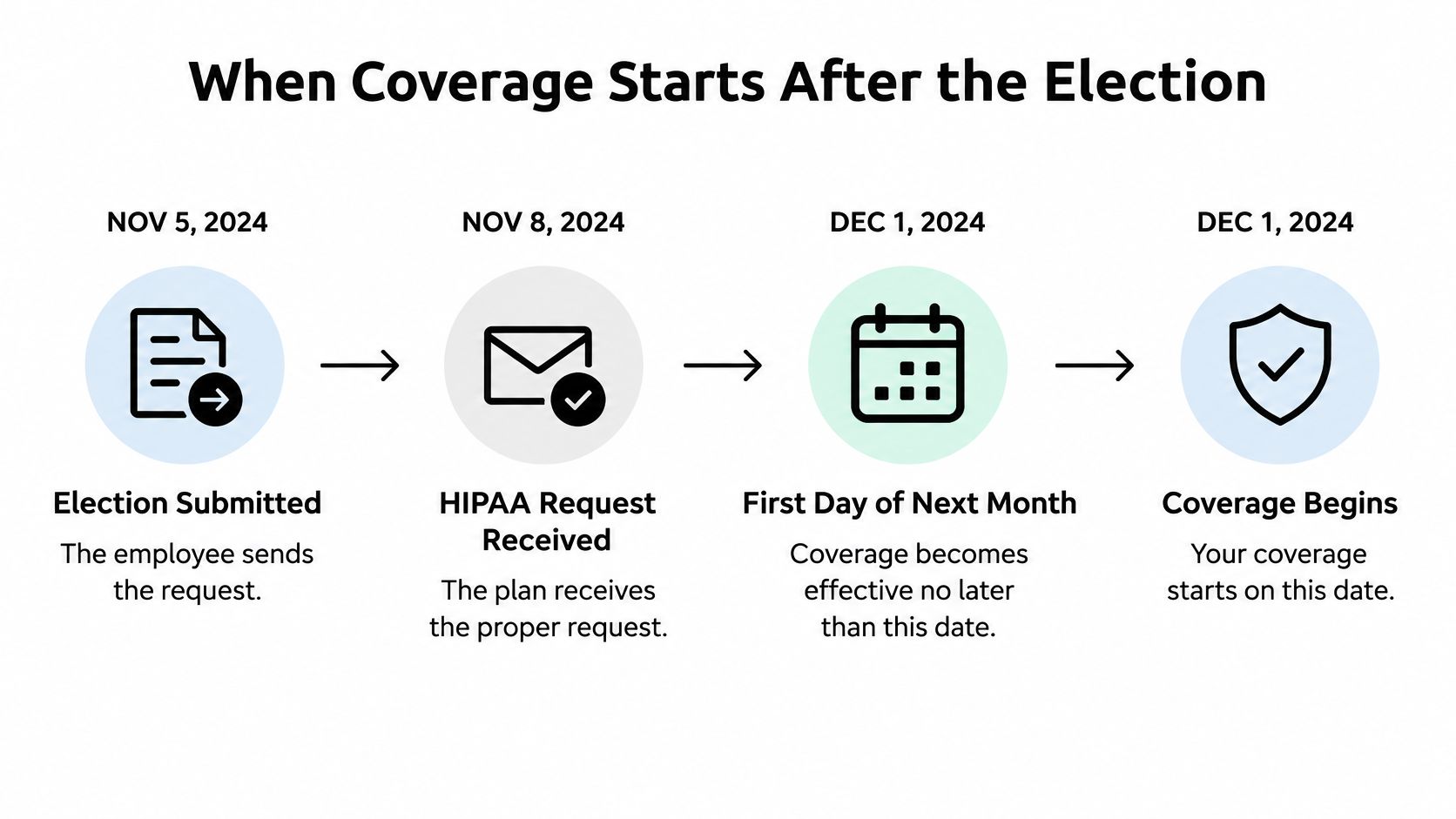
Election submitted, request received, and coverage effective describe different points in the process. An employee may finish a portal form without the plan having everything needed to process the request.
For employer coverage, the proper request and the applicable event determine the start date. For Marketplace coverage, selection timing and required verification also matter. Don't tell an employee they're covered just because an application screen says submitted.
Separate an effective date from permission to use coverage
For Marketplace enrollment, HealthCare.gov's Special Enrollment Period guidance explains that birth, adoption, or foster placement can allow coverage from the event date, marriage coverage can start the first day of the following month when selected by month end, and requested eligibility evidence may be due within 30 days after plan selection, with verification completed before coverage can be used.
Retroactive coverage is particularly easy to misunderstand. A start date that reaches back to a child's birth doesn't mean the employee should skip the enrollment request or assume the dependent record is already correct. HR still needs to process the election and confirm the carrier's record.
Similarly, a marriage election awaiting review isn't a reason to promise that a spouse can use a new insurance card immediately. Communicate the expected start date and the outstanding review separately.
Keep the dates in separate fields
A benefits file should make these milestones visible:
- Event date: When the qualifying household change occurred or prior coverage ended.
- Notice-received date: When HR learned about the event.
- Application or election date: When the employee submitted the request; preserve the plan-receipt timestamp too.
- Documentation deadline: When requested evidence must arrive.
- Coverage-effective date: When the confirmed enrollment begins.
If the Marketplace application and plan selection occur separately, preserve both timestamps. A single status field labeled pending can't explain whether the employee still needs to choose a plan, upload proof, or wait for confirmation.
Send reminders before the applicable boundary and flag unresolved evidence for human review. Written updates should identify the current status, the next owner, and the expected effective date without presenting an estimate as a guarantee.
Payroll should use the confirmed effective date to apply the new deduction tier. If coverage is retroactive, review the corresponding payroll adjustment rather than treating the processing date as the coverage start.
Life Changes That Do Not Open Enrollment
The most common false assumption is that any major personal change allows any midyear health-plan change. A divorce, relocation, or job transition needs an eligibility analysis, not an automatic approval.
Divorce or legal separation alone doesn't create a Marketplace enrollment opportunity when health coverage continues, as explained in CMS's Special Enrollment Period verification overview. Ask whether coverage ended and obtain the relevant coverage record, not just the decree.
The life event is not the operational trigger. The resulting change in eligibility, coverage, or household status is.
Changes that need a closer look
Voluntarily dropping coverage because the premium feels expensive isn't the same as losing eligibility. Don't label the cancellation a qualifying coverage loss without checking the applicable rule.
Wanting a lower deductible or a different network isn't itself a HIPAA special-enrollment event. An employee's preference also doesn't require an employer to offer a plan that isn't part of its benefits program.
Moving home doesn't automatically authorize an employer-plan switch. Marketplace moving eligibility requires its own review, including whether the move changes available coverage options.
Reduced hours or a spouse's job change may affect coverage, but the employment change alone doesn't establish the enrollment right. A COBRA offer also needs separate consideration; use the COBRA continuation coverage explanation to distinguish continuation options from a new election.
Late reports need review, not a reset
An employee reporting an event late doesn't restart the enrollment clock. Check the plan's actual window, any applicable exception, and whether another enrollment right exists before deciding that the next open enrollment is the only remaining route.
Permissible midyear changes under a cafeteria plan require a separate review. Don't assume that a payroll election rule and a health-plan special-enrollment right are interchangeable.
What to Do in the First Week
Start an internal response process when the employee reports the change. That's your service clock, not a replacement for the legal clock tied to the event or coverage loss.
The first acknowledgment should name the person handling the case and tell the employee what to submit next. Avoid sending a generic benefits brochure when the employee needs a specific action.
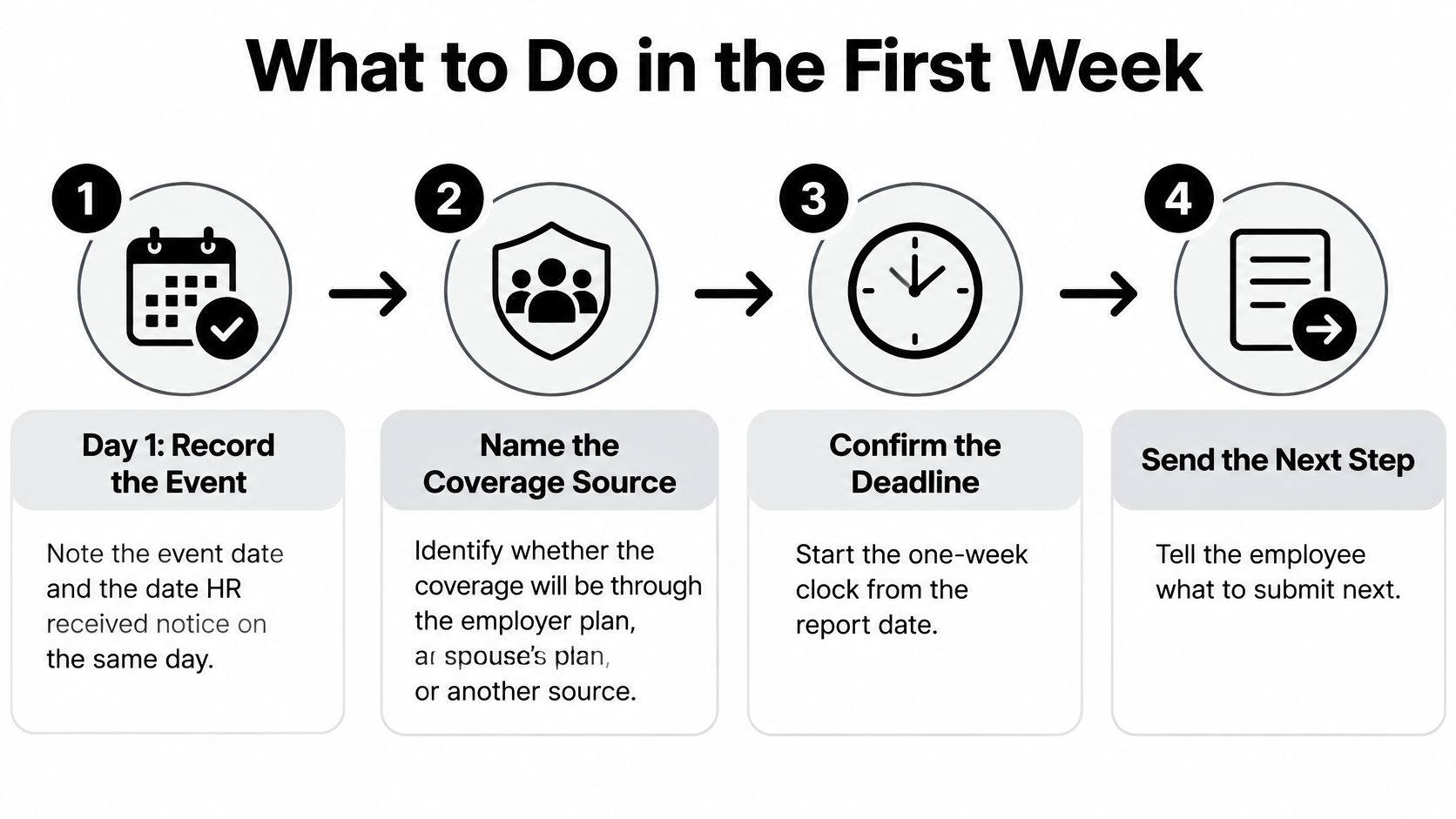
HR actions and their failure points
Record the event and notice dates immediately. Preserve the employee's original message and create a case record. Failure point: treating the report date as the event date can produce the wrong deadline.
Name the coverage source and destination. Identify the employer plan, spouse's plan, Medicaid or CHIP, COBRA, or Marketplace coverage involved. Failure point: using the right event with the wrong enrollment rules.
Confirm the deadline and assign reminders. Check the governing plan material and applicable enrollment guidance, then schedule follow-up before the final day. Failure point: a reminder on the deadline leaves no practical time to fix missing information.
Request only relevant proof. Explain which record establishes the change and provide a restricted submission method. Failure point: collecting unnecessary health or family information increases exposure without resolving eligibility.
Validate the individual's enrollment rights. Confirm eligibility and, where applicable, that the person previously declined coverage under the relevant conditions. Failure point: approving an employee-reported change without checking who can enroll.
Process and reconcile the election. Timestamp the request, confirm the effective date, update dependents, align deductions, and verify carrier submission and acceptance. Failure point: a completed HR record can still differ from the carrier's file.
Explain related coverage routes in writing. If Marketplace or COBRA options matter, identify them without implying the employer election resolves every gap. Failure point: an employee may stop pursuing another option based on an incomplete assurance.
Use employee benefits enrollment software to support a visible queue, assigned owners, and document status rather than relying on scattered email threads. As part of open enrollment, we reconcile enrollments and handle their submission. That same distinction between collecting an election and confirming its submission belongs in a sound year-round operating checklist.
Employee actions and their failure points
Keep your own date record. Note when the event occurred and when you notified HR. Failure point: neither party can resolve a timing dispute from memory.
Identify the coverage you're losing or gaining. Ask which deadline applies to the plan you want. Failure point: assuming every coverage option follows the same schedule.
Gather matching evidence. Obtain the termination notice, birth record, decree, certificate, or state notice requested. Failure point: submitting a document that describes the event but omits the decisive date.
Submit the election and request written confirmation. Ask for the expected effective date and any outstanding requirements. Failure point: mistaking an inquiry for an enrollment election.
Avoid prematurely canceling active coverage. Confirm the replacement start date before requesting a voluntary cancellation. Failure point: creating a gap that the new plan won't automatically fill.
Lock the Election Before the Window Closes
The decision is practical: complete a valid election while the applicable window remains open, or establish the next available enrollment route without promising an unauthorized switch. An urgent employee request deserves prompt handling, but urgency doesn't replace eligibility.
If the window appears closed, verify the calculation, plan provisions, and any applicable exception before issuing a final answer. If no enrollment right remains, give the employee a clear explanation and calendar the next opportunity. Don't leave the case marked pending indefinitely.
Close the case with evidence
Before calling an election complete, make sure the file contains:
- Employee confirmation: The selected coverage, covered dependents, expected effective date, and payroll deduction information.
- Employer confirmation: The submission record, carrier response, and resolution of any discrepancies.
- Related notices: Any necessary explanation of Marketplace or COBRA options.
- Named ownership: Who will resolve outstanding documentation or an unconfirmed carrier record.
A shared calendar entry should point to the case owner, not expose private family details. The useful closing image is a calendar with a clearly marked deadline and an accountable person, not a stack of unread plan brochures.
For a second review of enrollment procedures, ACA reporting, COBRA, or ERISA filings, our compliance evaluation helps check that those responsibilities are up-to-date. Bring the actual notices, plan provisions, and unresolved questions so the review can focus on the decision that needs to be made.
We help employers review benefits administration and compliance, and we offer a free 30-page benefits guide when you rate your process through our “What's Your Benefits Score?” tool. Visit Benely to evaluate your process and identify where qualifying life event intake, deadline tracking, or enrollment follow-through needs attention.