 Employee Benefits
 HR & Compliance
 Technology
 Wellness
 PEO Solutions
A founder hires a few more people, adds several part-time specialists, and assumes health insurance can wait until the company becomes much larger. Then finance asks whether the business has crossed a federal threshold, an employee requests coverage for a new dependent, and payroll needs answers about deductions, eligibility, and reporting. That's where health insurance requirements for small business become more than a yes-or-no question.
For most employers, the practical answer depends on full-time-equivalent headcount, workforce composition, whether coverage is offered, plan design, and state rules. A company may be free to decline group insurance under federal law and still face important administration duties once it offers a plan. The safest approach is to treat benefits as an operating system for growth, not a last-minute perk.
Table of Contents
- Defining the Federal Employer Mandate Threshold
- Understanding Minimum Value and Affordability Tests
- Hidden Obligations for Voluntarily Insured Small Firms
- Modeling Premium Costs and Employee Contributions
- Leveraging the SHOP Marketplace and Tax Credits
- Building an Annual Compliance and Reporting Timeline
- Simplifying Administration with a Modern Benefits Partner
Defining the Federal Employer Mandate Threshold
The federal threshold isn't based on the number of people appearing on payroll. The Affordable Care Act looks at whether an employer is an Applicable Large Employer, or ALE, based on its average workforce during the preceding calendar year. An ALE generally has at least 50 full-time employees, including full-time-equivalent employees, according to the IRS explanation of employer shared-responsibility provisions.
A full-time employee generally works at least 30 hours per week or 130 hours per month. Part-time workers count differently. Their hours are combined and converted into FTEs, which means a company with fewer than 50 people can still approach the threshold through a mix of full-time, part-time, seasonal, and variable-hour labor.
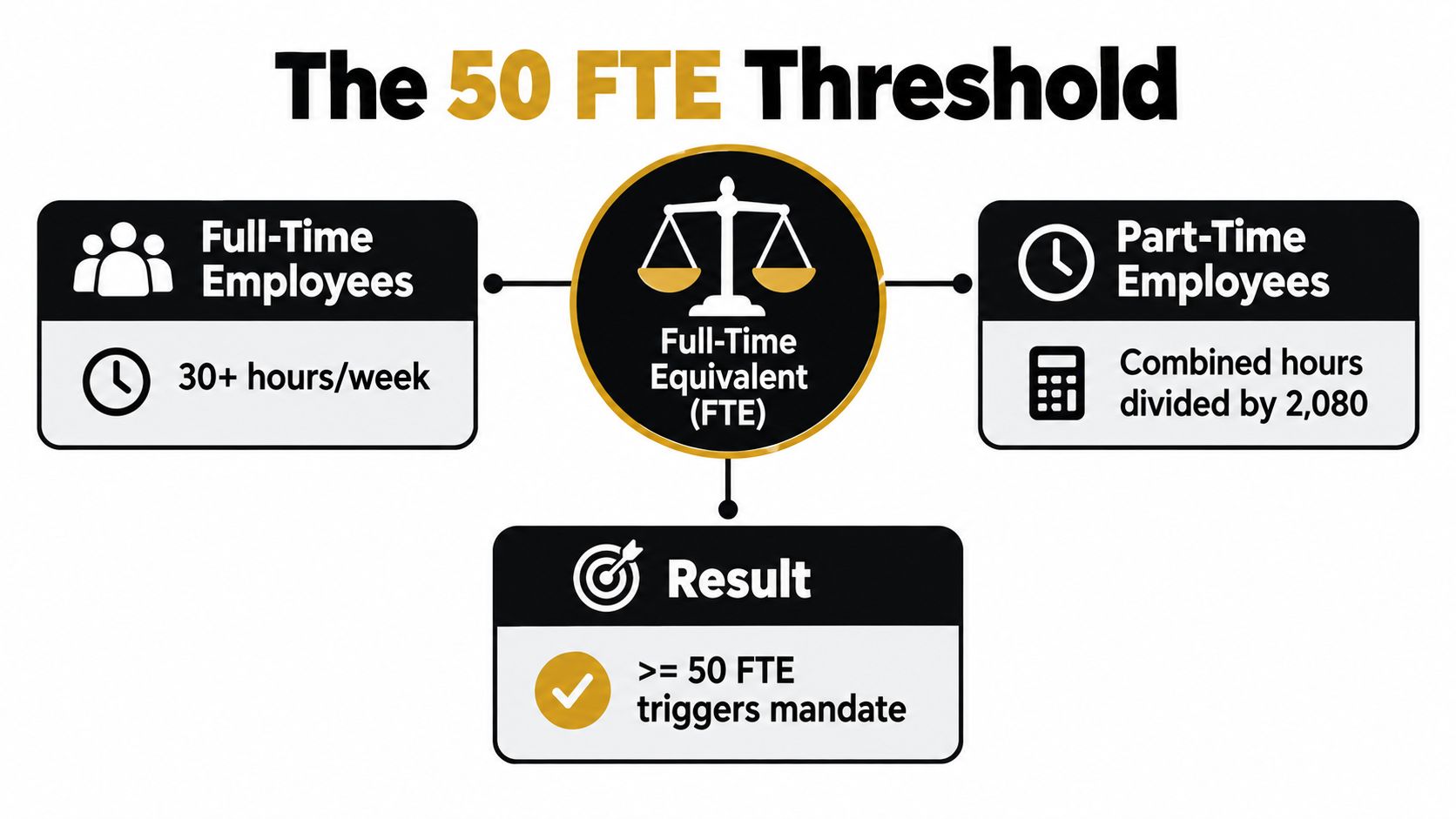
How the calculation changes as you grow
Start with the employees who meet the full-time standard. Then add the FTE value of qualifying part-time hours. A practical example is two employees working roughly half-time, which generally combine to one FTE. The exact monthly records matter, so payroll data should show hours by employee rather than relying on a year-end estimate.
Seasonal staffing creates another complication. A business may look large during a temporary busy period and smaller for the rest of the year, so the annual average and applicable seasonal rules need to be reviewed rather than judged from one unusually busy month.
Practical rule: Track monthly hours before your company approaches the threshold. Reconstructing eligibility after a growth surge is harder than maintaining the records as employees are hired.
Once an employer qualifies as an ALE, it must offer minimum essential coverage to at least 95% of full-time employees and their dependents, or it may owe an employer shared-responsibility payment if at least one full-time employee receives a premium tax credit through the Marketplace. That changes benefits administration from voluntary planning into a federally regulated pay-or-play obligation.
This is why headcount forecasting belongs in finance and HR planning. A hiring plan that includes part-time or variable-hour roles can affect future benefits compliance, not just payroll expense. Founders who want to build and scale digital health operations can also review Ekipa AI's healthcare resources for broader operational context, but the employer threshold itself should be validated against IRS guidance.
Understanding Minimum Value and Affordability Tests
Crossing the ALE threshold doesn't mean any health plan will satisfy the employer mandate. The offer must meet two separate tests: minimum value and affordability.
Minimum value generally means the plan covers at least 60% of expected health-care costs. Affordability concerns what the employee must pay for the required coverage. For 2025, the employee contribution couldn't exceed 9.02% of household income, as described by Healthcare.gov's SHOP Marketplace guidance.
Start with the plan design
Minimum value is a plan-level question. A plan with a low monthly premium may still expose employees to deductibles and cost sharing that make it unsuitable for the statutory test. Review the carrier's actuarial documentation and confirm that the selected plan meets the applicable minimum-value standard before enrollment begins.
The concept of actuarial value is useful here because it describes the portion of expected covered medical spending paid by the plan rather than by employees. Employers that need a plain-language explanation can use this resource on actuarial value in health insurance while comparing plan documents.
Prove affordability without knowing household income
Employers usually don't know an employee's total household income, and they shouldn't need to collect private financial details to administer the test. Instead, the IRS provides affordability safe-harbor methods that let an employer test the required employee contribution using information available to the business.
Common approaches include:
- W-2 safe harbor: Compare the employee's required contribution with the wages reported on Form W-2.
- Rate-of-pay safe harbor: Use the employee's hourly rate or monthly salary to calculate the permitted contribution.
- Federal poverty line safe harbor: Use the applicable federal poverty line amount for a single individual to establish the maximum contribution.
The safe harbor must be applied consistently and documented. Payroll should retain the contribution formula, employee classification, effective dates, and any changes in hours or compensation that affect the calculation.
A common failure is setting premiums once during open enrollment and never retesting them. A raise, reduction in hours, new plan year, or change in employee-only pricing can alter the result. Affordability should therefore sit inside the payroll and benefits review process, not in a forgotten spreadsheet owned by one administrator.
Hidden Obligations for Voluntarily Insured Small Firms
Being below the federal ALE threshold doesn't create a compliance vacuum. A small employer can generally choose whether to offer health insurance, but once it offers coverage, the business takes on operational duties involving eligibility, notices, enrollment, payroll, and plan administration.
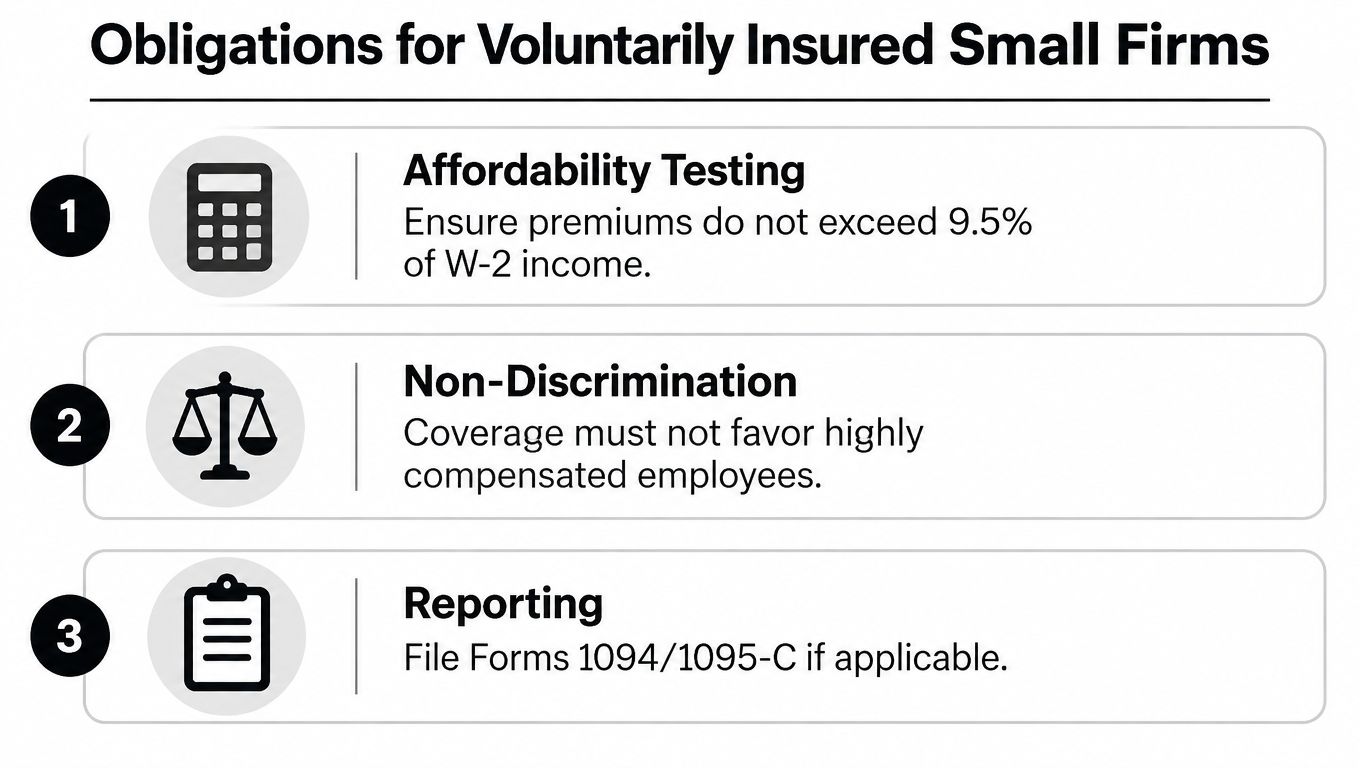
Voluntary doesn't mean informal
The first question is employee classification. Written eligibility rules should identify which employees qualify, how waiting periods work, and how the company treats variable-hour or seasonal workers. The business also needs a process for special enrollment events, such as marriage, birth, adoption, or loss of other coverage.
Plan documents and employee notices matter as well. Depending on the arrangement, employers may need to address ERISA documentation, Summary Plan Description requirements, Summary of Benefits and Coverage delivery, and nondiscrimination considerations. The exact obligations depend on the plan structure, funding method, and workforce.
State rules can change the answer
Federal law is only one layer. COBRA or state continuation coverage rules may apply depending on employer size, plan type, and location. States can also impose insurance requirements, paid-leave rules, and notice obligations that don't mirror federal standards.
That makes a multistate workforce especially challenging. An employee in one state may have continuation rights or mandated benefits that differ from those available to a colleague elsewhere. Before rolling out a plan, an employer should confirm state requirements with its broker or benefits counsel. For additional practical reading, teams can browse employer responsibilities articles from Select Insurance Group, Inc.
The operational lesson is straightforward:
- Document eligibility: Put employee classes, waiting periods, and effective dates in writing.
- Control enrollment: Use a consistent process for new hires, qualifying events, and special enrollment.
- Audit payroll: Reconcile deductions against carrier invoices every pay period or billing cycle.
- Review state rules: Confirm continuation, insurance, leave, and notice obligations for every work location.
A voluntary benefit becomes risky when the company promises one thing in an offer letter, administers another rule in payroll, and sends a third message through the carrier portal. Consistency is the actual compliance control.
Modeling Premium Costs and Employee Contributions
A health plan should be modeled as a shared-cost system, not selected by looking at the headline premium. The employer needs to understand three separate figures: total premium, employer contribution, and employee payroll deduction.
KFF reported 2025 average annual employer-plan premiums of $9,325 for single coverage and $26,993 for family coverage in its annual employer health benefits survey. Those averages aren't a quote for any particular company, but they show why family coverage can materially change a benefits budget.
Small employers also face a different contribution pattern. Among firms with fewer than 200 employees, covered workers contributed an average 36% of family premiums, compared with 23% at larger firms. Only 18% of small firms offered coverage to part-time workers in 2025, according to KFF reporting on employer coverage costs.
Compare the contribution split
| Metric | Small Firms (<200 EEs) | Large Firms (200+ EEs) |
|---|---|---|
| Average employee share of family premiums | 36% | 23% |
| Part-time coverage offer rate | 18% | Not provided in the cited data |
The table illustrates a retention trade-off. Reducing the employer contribution protects cash flow, but shifting family costs to employees can make the benefit feel weak to parents and employees covering dependents. A plan that looks affordable to the company may create recruitment friction when candidates compare total compensation.
Model three employee groups
Build at least three scenarios before choosing a carrier or plan tier:
- Employee-only: This is usually the clearest baseline for employer cost and affordability testing.
- Employee-plus-dependent: This reveals the cost of covering one dependent without committing to the full family tier.
- Family: This shows the maximum exposure and the payroll deduction employees may face.
Then separate full-time and part-time eligibility. Don't promise broad access unless the budget supports it and the written eligibility rules can be administered consistently. Compare employer spend, employee deductions, expected participation, plan value, and payroll impact together.
The approach that doesn't work is choosing the cheapest premium and leaving employees to absorb the difference. A more durable strategy sets a transparent contribution philosophy, tests it against actual workforce demographics, and revisits it before each renewal.
Leveraging the SHOP Marketplace and Tax Credits
For a qualifying small employer, the federal Small Business Health Care Tax Credit can materially change the economics of offering coverage. The credit can cover up to 50% of premiums paid by eligible taxable small employers with fewer than 25 FTE employees, provided the employer pays at least 50% of the premium cost for employee-only coverage, according to the IRS tax credit guidance.
Eligibility isn't determined by headcount alone. Part-time employees count fractionally when calculating FTEs, and the employer must also satisfy the applicable average-wage limit. The credit phases down as the employer approaches the employee or wage limits, so a company should model eligibility rather than assume it will remain available indefinitely.
What qualifying employers should verify
- FTE count: Include fractional part-time workers in the calculation.
- Average wages: Confirm that the business remains within the inflation-adjusted wage limit.
- Employer contribution: Pay at least half of employee-only premium costs using a uniform contribution percentage for enrolled employees.
- Marketplace connection: Use SHOP coverage or satisfy the applicable limited exception.
- Tax treatment: Coordinate the claim with the company's tax professional and retain supporting records.
SHOP can also provide a structured route for small-group coverage, although state rules and plan availability vary. The administrative value matters as much as the potential credit. A qualified broker can help confirm whether the proposed contribution design, employee classes, and enrollment method align with the credit requirements before the employer commits.
The credit isn't a reason to choose a poor-fit plan. If the plan creates unaffordable dependent costs, weak provider access, or excessive administration, the tax benefit may not compensate for the employee-relations problems. Use the credit as an input to the decision, then compare total cost and workforce value.
Building an Annual Compliance and Reporting Timeline
Benefits compliance works best as a recurring calendar. The business should assign an owner for each task, preserve evidence of completion, and reconcile carrier, payroll, and employee records throughout the year.
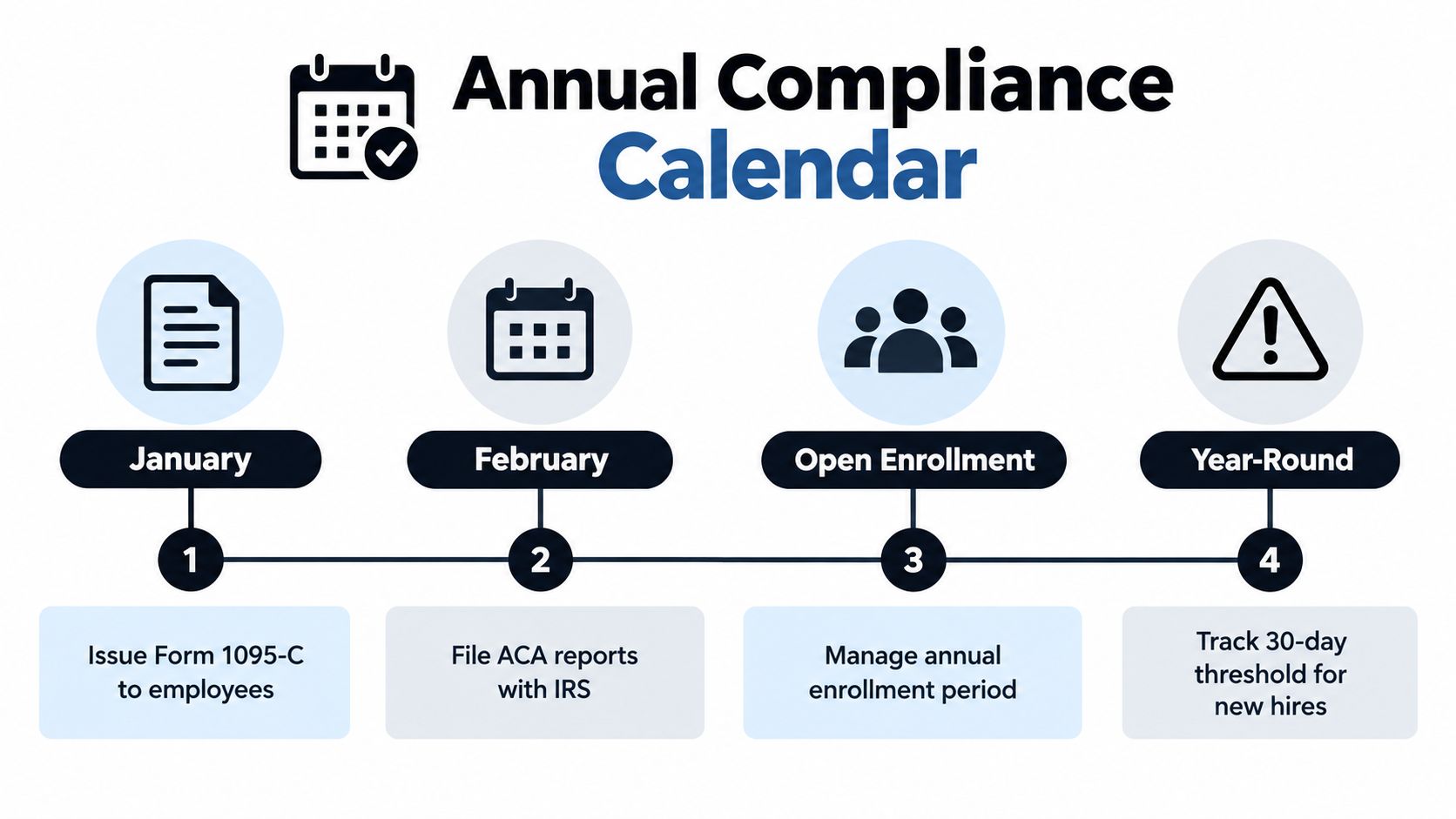
A workable operating rhythm
January: Confirm plan-year elections, employee eligibility, payroll deductions, and required employee forms. ALEs should prepare applicable ACA reporting data, while smaller employers should review whether their funding arrangement creates separate reporting duties.
February: Complete applicable IRS filings and resolve discrepancies between payroll records and carrier enrollment. The exact filing deadlines depend on the reporting year and filing method, so use current IRS instructions rather than an old calendar.
Before open enrollment: Request renewal terms, compare plan designs, test employer contributions, and confirm that employee-only pricing supports the affordability method being used. Distribute required Summary of Benefits and Coverage documents within the required timing.
During open enrollment: Track elections, waivers, dependents, effective dates, and employee questions. Send the final enrollment file to the carrier and test payroll deductions before the first affected payroll.
Year-round: Record new-hire dates, waiting periods, qualifying events, special enrollment requests, status changes, and monthly hours. Employees crossing a full-time threshold should trigger a review rather than an informal payroll adjustment.
For a focused reference on filing duties, review ACA reporting requirements and confirm current deadlines with the IRS or benefits adviser.
The following video can supplement the written checklist:
Accuracy matters because late or incorrect reporting can create avoidable follow-up work and potential penalties. Keep an audit folder containing employee eligibility records, affordability calculations, plan documents, notices, carrier invoices, payroll reconciliations, and filing confirmations. A clean file lets the company answer questions quickly when employees, carriers, auditors, or regulators ask how a decision was made.
Simplifying Administration with a Modern Benefits Partner
Spreadsheets can support a small team at the beginning, but they become fragile when hiring accelerates, employees work in multiple states, and plan costs change. The same file rarely handles FTE measurement, affordability testing, carrier billing, employee elections, payroll deductions, and reporting with equal reliability.
A modern benefits partner can consolidate those activities into a controlled workflow. The useful capabilities are practical: comparing group plans and reimbursement arrangements, tracking enrollment, connecting deductions to payroll, maintaining employee records, and creating reminders for renewals and compliance reviews. The employer still owns the decisions, but the process becomes easier to audit.

Choose support that matches your operating model
A traditional group plan may fit a stable workforce that values a common network. An HRA may fit an employer that wants to set a defined budget while allowing employees to select individual coverage. A PEO may make sense for a company evaluating co-employment, payroll integration, and broader HR administration. None of these choices removes the need for careful eligibility and compliance work.
Benely is one option for employers that want a centralized benefits workflow, including plan comparison, enrollment tracking, payroll connectivity, and compliance support. Its health insurance broker services can be evaluated alongside a local broker, carrier-direct process, or PEO model.
State context also deserves attention. A Connecticut employer, for example, should review resources designed to help it stay compliant as a Connecticut business rather than assuming a federal overview answers every local question.
The practical standard is simple: choose a process that records who is eligible, what the company offered, what employees elected, how much each party paid, and which deadlines were completed. That documentation protects the business while giving employees a clearer benefits experience.
Benely helps growing companies compare health plans, structure employer contributions, manage enrollment, connect benefits with payroll, and organize ACA-related administration. Visit Benely to evaluate a benefits workflow that fits your headcount, budget, and growth plans.