 Employee Benefits
 HR & Compliance
 Technology
 Wellness
 PEO Solutions
In 2025, the average employer-sponsored premium was $9,325 for single coverage and $26,993 for family coverage, while workers paid 16% and 26% respectively. The right plan is the one that fits the employer budget without making care unaffordable when employees need it.
Most benefits guides tell you to start with the premium. That advice is convenient, familiar, and often wrong. The cheapest employer invoice can produce the most expensive employee experience when deductibles, coinsurance, prescription costs, and payroll deductions push care out of reach.
If you're a small or midsized business, choose benefits as a workforce investment, not a shopping exercise. Audit who you employ, model realistic medical needs, score plans against weighted criteria, and measure whether people understand and use the coverage after enrollment. A plan that looks efficient in a spreadsheet but frustrates families, chronic-care users, or lower-paid employees will cost you in trust and retention.
Table of Contents
- Why the Lowest Premium Is Usually the Wrong Choice
- Auditing Your Workforce Before Looking at Any Plan
- Building a Weighted Plan-Selection Model That Actually Works
- Comparing Self-Insured, Fully Insured, and PEO Options
- Turning Plan Selection Into Enrollment Adoption and Retention
- Benchmarking Annual Performance and Running Renewal Analysis
- A Practical Week-by-Week Plan for Choosing and Launching Employee Benefits
Why the Lowest Premium Is Usually the Wrong Choice
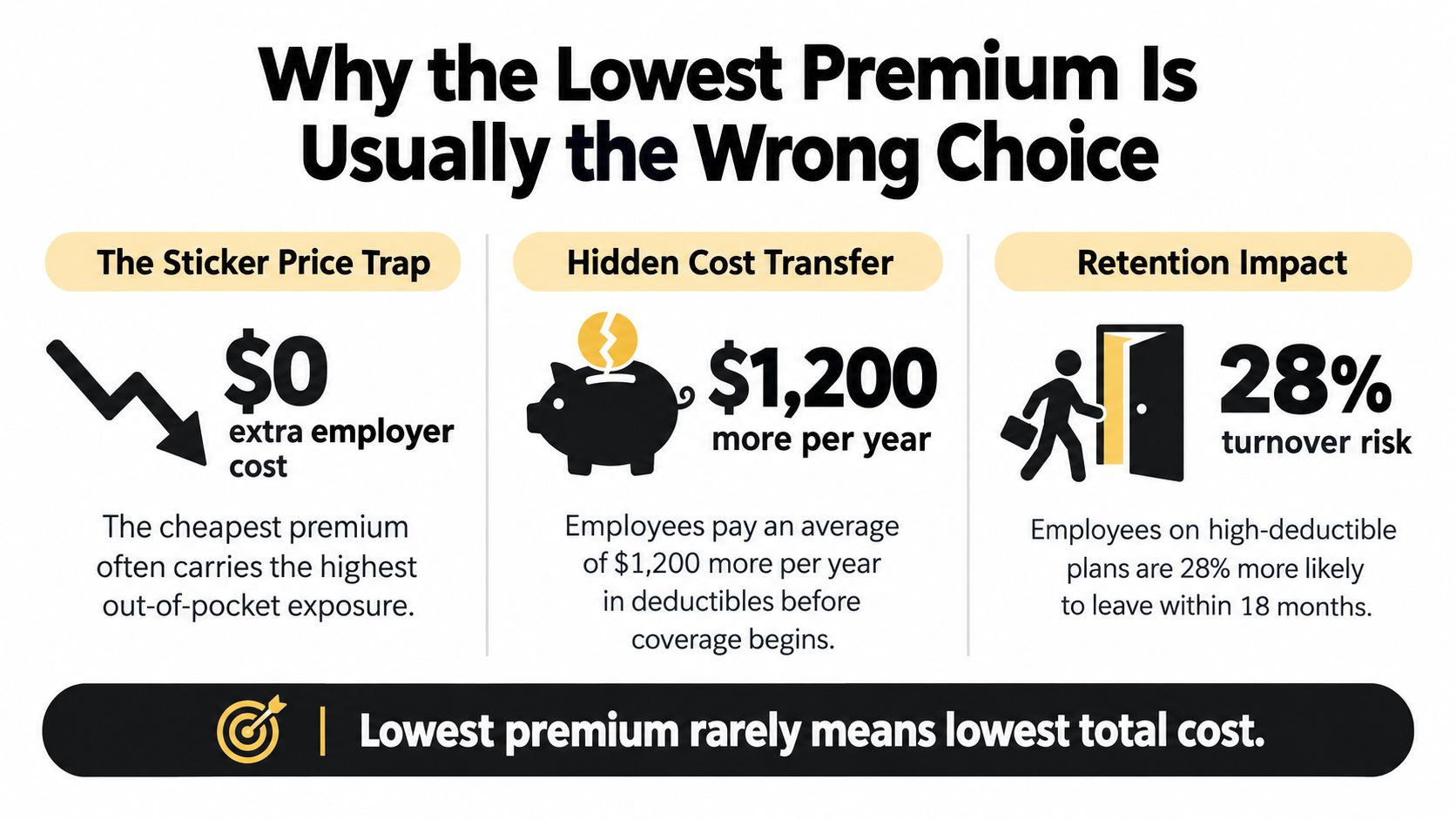
The lowest premium doesn't automatically mean the lowest cost. It may only mean the employer has transferred more of the bill to employees through a higher deductible, larger coinsurance share, narrower network, less generous prescription coverage, or higher payroll deductions.
In 2025, employees paid an average of $1,440 for single coverage and $6,850 for family coverage, equal to 16% and 26% of the respective premiums, according to KFF's 2025 employer health benefits survey. Those figures describe only the premium contribution. Employees can also face substantial costs when they use care.
Price care at the point of use
A plan with a modest monthly deduction can look attractive until an employee needs recurring prescriptions, specialist visits, an emergency-room visit, pregnancy care, behavioral-health treatment, or dependent care. At that point, the relevant question isn't “What does the employer pay each month?” It's “How much cash must this household produce before the plan becomes useful?”
Review each option across the full cost path:
- Payroll deduction: What comes out of each paycheck for single, employee-plus-one, and family coverage?
- Deductible exposure: How much must an employee pay before the plan begins sharing costs?
- Coinsurance and copayments: Are costs predictable, or do they rise with the price of care?
- Prescription tiers: Does a recurring medication fall into a manageable tier or create repeated financial friction?
- Out-of-pocket maximum: What is the household's worst-case exposure for covered care?
Practical rule: Never approve a plan from the employer premium alone. Price the plan for the people who will use it.
A useful comparison should show both the employer's annual spend and the employee's likely annual exposure. This analysis of high-premium, low-deductible plan design is a useful reference point when you're testing whether richer coverage could produce better practical value.
The right question isn't whether you can save on the invoice. It's whether the savings justify the financial pressure placed on employees who need care. If the answer depends on people avoiding doctors, delaying treatment, or skipping prescriptions, the plan isn't efficient. It's merely shifting the expense.
Auditing Your Workforce Before Looking at Any Plan
Don't open a carrier presentation until you know who the plan must serve. A benefits package for a full-time office workforce won't automatically work for hourly employees, seasonal staff, remote workers in multiple states, or lower-paid families.
Start with a workforce profile that a founder, finance lead, and HR owner can understand in one meeting. Map employment status, hours, locations, dependents, tenure, compensation bands, and expected enrollment. Then document which groups qualify under current eligibility rules and which groups are likely to participate.
Build the audience map
Use payroll and HR records rather than assumptions. Ask:
- Who is eligible: Which full-time, part-time, seasonal, and newly hired employees can enroll?
- Who needs coverage: How many employees are likely to cover dependents, and where do they live?
- Who faces recurring costs: Which workforce segments may need ongoing prescriptions, specialist care, or behavioral-health support?
- Where do employees work: Do provider networks serve every office, remote location, and commuting area?
- What can the business administer: Can the team manage multiple eligibility classes, contribution tiers, and life-event changes?
The U.S. Bureau of Labor Statistics data for March 2024 shows why this audit matters. Medical benefits were available to 87% of full-time private-industry workers but only 26% of part-time workers, while participation rates were 65% and 45%, respectively.
That gap isn't a minor administrative detail. If your workforce includes many part-time employees, a package built around full-time assumptions may create low access, low participation, and a benefits experience that feels disconnected from the people you're trying to support.
Separate eligibility from value
An employee can technically qualify for a benefit and still find it unusable. Check contribution affordability by pay level, dependent cost, waiting periods, network availability, and enrollment timing. Also review dental, vision, retirement, and voluntary benefits separately. Access isn't uniform across benefit categories, so don't assume medical coverage answers the wider benefits need.
Create a one-page profile with four columns: employee group, eligibility, likely needs, and affordability risk. Include at least full-time employees, part-time employees, employees with dependents, lower-paid employees, and workers in different locations.
That document becomes your filter. A carrier option that works for one group but leaves another exposed needs a contribution or plan-design solution before it reaches the final comparison.
Building a Weighted Plan-Selection Model That Actually Works
Premium should be one input, not the decision. A defensible model scores each plan against the outcomes your business cares about, then tests how the ranking changes under different utilization patterns.
RAND's review found that employers primarily relied on cost, plan reputation, and provider-network breadth, while concluding that structural differences and quality measures should be explicit in plan evaluation. See the RAND review of employer health-plan selection for the underlying framework.
Normalize the options
Put every plan into the same worksheet. Record:
- Employer premium: Annual employer cost by coverage tier.
- Employee premium: Payroll deductions for each enrollment category.
- Cost sharing: Deductible, copayments, coinsurance, and out-of-pocket maximum.
- Prescription coverage: Tiers, recurring medication exposure, and specialty-drug rules.
- Network breadth: Primary-care, specialist, hospital, behavioral-health, and geographic access.
- Quality indicators: Available measures that help distinguish structurally different plans.
- Operational fit: Enrollment workflow, payroll compatibility, support, and reporting.
Assign a strategic weight to each criterion. A cash-constrained startup may weight budget predictability heavily. An employer competing for experienced workers may give greater weight to network breadth, predictable cost sharing, and employee experience. The weights should reflect your workforce audit, not a vendor's sales deck.
Run three utilization scenarios
Calculate expected annual total cost of care as employer or employee premium plus expected member cost sharing. Then run separate low-, expected-, and high-utilization scenarios.
- Low utilization: Routine preventive care and limited prescriptions.
- Expected utilization: Regular primary care, common prescriptions, and occasional specialist services.
- High utilization: Chronic treatment, pregnancy, emergency care, behavioral-health treatment, or significant dependent needs.
Also calculate maximum exposure as premium plus the out-of-pocket limit. That figure won't predict what every employee pays, but it shows whether a high-use household could face a financial shock.
Validate the worksheet with a representative employee sample. Include chronic-care users, families, low-wage workers, and employees in different geographies. Protect privacy by reviewing scenarios and aggregate patterns, not individual medical details.
A lower premium is a cost advantage only if it doesn't create an unacceptable access or affordability problem.
The winning plan may not rank first in any single column. It should produce a credible balance of employer sustainability, employee affordability, network access, and administrative reliability.
Comparing Self-Insured, Fully Insured, and PEO Options
The funding model changes who carries risk, how predictable the budget is, and how much administration lands on your team. Don't choose a structure because another company uses it. Choose it because it matches your cash reserves, risk tolerance, compliance capacity, and growth plans.
A fully insured plan offers a defined premium to the carrier. The employer gets stronger budget predictability, while the carrier carries claims risk. The trade-off is that renewal pricing, network terms, and plan changes remain important sources of uncertainty.
Self-insurance gives the employer more direct exposure to claims. It can offer flexibility and a closer connection between plan design and claims experience, but it demands stronger governance, careful risk protection, and reliable administration. Compliance responsibilities don't disappear because a third party handles part of the workflow.
A PEO uses a co-employment structure that can combine payroll, onboarding, compliance, and benefits administration. It may give a smaller employer access to a larger purchasing pool or a more structured operating model. The cost is reduced control over certain processes, contractual complexity, and the need to scrutinize the PEO's carrier relationships, service model, technology, and exit terms.
Benefits delivery models at a glance
| Model | Budget Predictability | Compliance Burden | Administrative Workload |
|---|---|---|---|
| Fully insured | Generally clearer fixed premium structure | Employer still manages eligibility, notices, and plan administration | Moderate |
| Self-insured | More exposure to claims variability | Higher governance and compliance coordination needs | High |
| PEO co-employment | May consolidate costs and administration through the PEO structure | Shared responsibilities require careful contract review | Lower internal workload, with less direct control |
Health coverage matters to employees as well as finance. SHRM's 2024 employee-benefits survey found that 88% of employers rated health-related benefits as very important or extremely important to their workforce.
If you're evaluating a platform or broker, ask for side-by-side plan comparisons, contribution modeling, payroll integration, enrollment automation, compliance support, reporting, and access to qualified specialists. Benely's self-funded insurance overview is one reference for exploring that model.
The right delivery structure should reduce friction without hiding the economics. Demand a clear explanation of who pays, who decides, who handles employee questions, and what happens when your headcount or geography changes.
Turning Plan Selection Into Enrollment Adoption and Retention
Enrollment isn't the finish line. It's the handoff from plan design to employee experience, and many employers stop paying attention precisely when employees need help making the plan work.
A benefits program should answer practical questions throughout the year: How do I find an in-network therapist? What will this prescription cost? Does my dependent qualify? Where do I go after an emergency? If employees can't answer those questions, the coverage may exist on paper while delivering little confidence in practice.

Measure use, not just enrollment
Track activation, completion, support contacts, time to find in-network care, unresolved requests, and aggregate utilization patterns. Segment results by pay level, location, age band, family status, and plan choice where lawful and privacy-protective. A high enrollment rate can hide confusion, poor network access, or a large group that selected the wrong option.
Recent research reports that 87% of employees want more financial-wellbeing support, 55% seek caregiving support, and 38% of employed Americans worry about the cost of finding optimal mental-health support. Concern was 45% among employees of color compared with 35% among White employees, according to the Benefitfocus State of Employee Benefits Report.
That doesn't mean you should buy every point solution. It means communication and navigation deserve budget. Plain-language plan summaries, decision support, reminders after enrollment, and help for life events often matter more than adding another obscure perk.
Make communication part of the benefit
Use multiple formats for remote, hourly, and office-based workers. Hold live sessions, provide short examples, publish a searchable benefits guide, and send reminders when employees are likely to need care. Include practical scenarios rather than repeating plan terminology.
Wellness support can complement medical coverage when it connects to real employee needs. A resource on wellness programs for businesses can help you evaluate options without treating wellness as a substitute for affordable core coverage.
Your enrollment platform should support accurate elections, payroll deductions, employee education, and reporting. Use a practical open-enrollment checklist for HR to assign ownership and prevent the familiar scramble where HR answers the same questions repeatedly.
Adoption standard: If employees can't explain how to use the benefit, the employer hasn't finished delivering it.
Benchmarking Annual Performance and Running Renewal Analysis
Renewal should be a controlled review, not a carrier announcement that arrives with a new invoice. Establish a baseline before enrollment, set success thresholds, then compare actual results against those thresholds after enrollment closes.
Track employer and employee premium contributions, enrollment by plan, participation, turnover, absence, and employee-support volume. Add completion rates, network disruption, unresolved questions, and changes in plan selection. Survey responses matter, but satisfaction alone won't show whether employees completed enrollment or found care.
KFF's employer survey reports that only 8% of firms said enrollees use health-plan cost information a great deal, while 41% reported somewhat use, as shown in the KFF employer health benefits survey series. That difference supports a straightforward conclusion: decision support must continue after the enrollment deadline.
Set thresholds before renewal
Choose the measures that will trigger action. For example, define acceptable total benefits spend, target participation, tolerable employee contribution growth, enrollment completion, support volume, and network disruption. Don't wait until renewal to decide what counts as a bad outcome.
After enrollment, run a variance analysis:
- Budget variance: Compare planned and actual employer and employee contributions.
- Participation variance: Identify which groups enrolled, declined, or failed to complete elections.
- Affordability variance: Look for pressure among lower-paid employees, families, and high-use groups.
- Operational variance: Review support contacts, corrections, payroll issues, and unresolved requests.
- Retention variance: Compare turnover and absence patterns with your internal baseline.
Segment the results. A strong average can conceal an affordability problem for one location or pay band. If the plan saves the employer money but creates a sharp rise in employee support requests, delayed care concerns, or unwanted selection behavior, the renewal decision needs more than a premium comparison.
Repeat the review whenever headcount, geography, carrier networks, or contribution strategy changes. Annual discipline keeps benefits aligned with the business instead of locking the company into last year's assumptions.
A Practical Week-by-Week Plan for Choosing and Launching Employee Benefits
A small HR team doesn't need a complicated transformation program. It needs clear owners, a short decision calendar, and visible deliverables.
Week one is the workforce audit. The founder or HR owner maps eligibility, employee classifications, dependents, locations, payroll constraints, and likely utilization. Finance confirms the total benefits budget and the acceptable employee contribution approach. The deliverable is a workforce profile and a list of affordability risks.
Weeks two and three are for plan research and quotes. Collect comparable options from carriers, brokers, or a PEO. Normalize premiums, deductibles, cost sharing, networks, prescriptions, out-of-pocket limits, and administrative requirements. Score the plans using the weighted model, then test low-, expected-, and high-utilization scenarios.
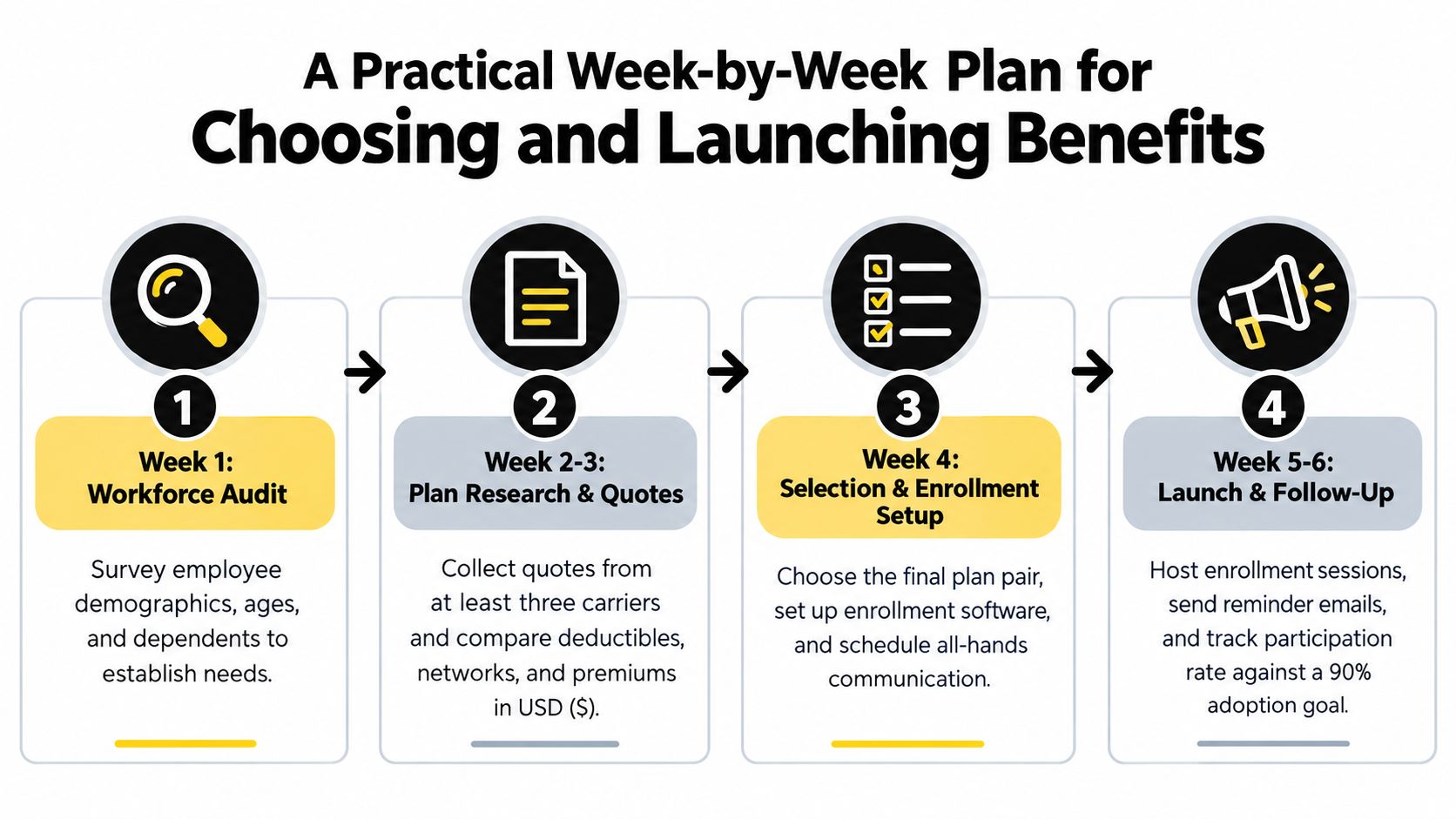
Week four is selection and enrollment setup. Leadership approves the plan and contribution structure. HR checks eligibility rules, payroll deductions, employee communications, provider directories, and support ownership. Set up enrollment before announcing the decision, then schedule live education for every workforce group.
Weeks five and six are launch and follow-up. Run enrollment sessions, send reminders, monitor completion, and resolve individual questions quickly. After enrollment, check activation, support volume, election errors, and network questions. Don't declare success because the deadline passed.
For a growing company, the framework may produce three different answers for three workforce segments. Full-time professionals may value broad networks and predictable cost sharing. Part-time employees may need a clearer eligibility and contribution policy. Lower-paid employees with families may prefer a plan whose payroll deduction and point-of-care exposure are manageable, even if the employer premium isn't the lowest.
A centralized platform can reduce manual comparison and enrollment work. Benely provides access to more than 4,000 health plans, budget setting, enrollment automation, open-enrollment tracking, benchmarking, and certified HR specialist guidance, according to its platform description.
Start this week by exporting your workforce roster, separating employee groups, and listing the costs employees face when they use care. That single worksheet will tell you more than a stack of generic carrier brochures.
Use Benely to compare employee benefits options, set a budget, automate enrollment, track progress, and benchmark your program with specialist support. Visit the platform before renewal, bring your workforce profile and utilization scenarios, and make the next benefits decision on total employee value rather than the cheapest invoice.