
For tax year 2025, HSA contributions can be made through April 15, 2026, and filing an extension does not extend that date. That single fact drives most advice on this topic, and it's also where most advice stops too early.
The popular version sounds reassuring. You missed December, so top up the account before you file and you're done. That framing treats the HSA contribution deadline as a calendar problem when it's really two problems at once. Money has to arrive on time, and the person receiving it has to have been eligible for the months the contribution is meant to cover, with total deposits from every source staying inside the limit.
A timely deposit that ignores a plan change, a second employer's contributions, or a Medicare enrollment isn't a save. It's a correction waiting to happen. Walk through the date first, then test eligibility and the aggregate total before anyone sends another dollar.
Table of Contents
- What the HSA Contribution Deadline Means
- Current and Prior Tax Year Deadlines at a Glance
- Catch-Up Contributions and the Last-Month Rule
- Employer and Employee Steps to Contribute on Time
- Eligibility and Aggregate Limits to Check First
- Excess Contributions and Filing Extension Pitfalls
- Choosing a System to Track HSA Deadlines
- Quick Compliance Checklist for Benefits and Finance Teams
What the HSA Contribution Deadline Means
For U.S. taxpayers, the deadline isn't December 31. Contributions for a tax year may be made during that calendar year and through the federal income tax return filing deadline for the following year, normally April 15, provided the taxpayer files without an extension, as IRS Publication 969 explains for health savings accounts. That's the working definition HR and finance teams should use.
Applied to tax year 2025, that creates an effective window of approximately 15.5 months, from January 1, 2025 through April 15, 2026. The extra months after year end are useful. An employee who underfunded the account during the year, or an HR director reviewing year end benefit elections in January, still has room to act before the return is filed.

Where the Window Helps and Where It Misleads
The extended window works best as a reconciliation period, not as an invitation to guess. Payroll records for the year are final, employer deposits are known, and an employee can compare what landed in the account against what was intended. If there's a shortfall and eligibility checks out, a prior year contribution before the deadline closes the gap cleanly.
It misleads when teams treat those extra months as free time with no conditions attached. The taxpayer still has to meet HSA eligibility requirements for the applicable period, and contributions from the employee, the employer, and any other source together can't exceed the annual statutory limit. The date governs timing only. It doesn't create eligibility that wasn't there during the year.
Practical rule: April 15 answers when money can arrive. It never answers whether the money should arrive, or how much.
The Extension Detail People Get Wrong
The deadline is the tax return due date without extensions, not the extended filing deadline. Filing an extension generally doesn't extend the time to make HSA contributions, even though it extends the time to submit the return itself. Employees conflate those two dates constantly, because both live on the same tax calendar and both get discussed in the same breath each spring.
That distinction matters for communication timing. If your benefits team sends one reminder tied to tax season, tie it to the unextended due date and say plainly that an extension doesn't buy more contribution time. Someone who files an extension in April and plans a contribution for May has already missed the window, and no amount of good intent reopens it.
There's one more mechanic to lock in early. A contribution made after December 31 needs to be clearly designated for the prior tax year with the HSA administrator. Without that designation, the administrator may credit it to the current year instead, which undoes the entire point of using the extended window. The deposit, the eligibility, and the year designation all have to line up for the contribution to do what the employee thinks it does.
Current and Prior Tax Year Deadlines at a Glance
Most deadline questions that reach an HR director aren't conceptual. They're specific. An employee wants to know whether a February deposit can still count for last year, or whether a contribution made during open enrollment season belongs to this year or next. A simple reference table answers those questions faster than a paragraph of explanation, and it gives payroll and benefits a shared vocabulary.
The table below separates the three situations that cover nearly every inquiry. Read it by finding when the money is being contributed and which tax year it's meant for, then check the condition column before assuming the contribution is settled. The condition column is where the main work sits.
| Contribution Period | Deadline | Key Condition |
|---|---|---|
| During the calendar year, for that same tax year | December 31 of that year for payroll timing, with the contribution window continuing into the following spring | Confirm qualifying coverage and track deposits from all sources as they occur |
| After December 31, designated for the prior tax year | The federal return due date without extensions, normally April 15 | Designate the prior tax year clearly with the HSA administrator so the deposit isn't credited to the current year |
| After December 31, intended for the new tax year | The following year's return due date without extensions | Confirm eligibility for the new year's months rather than relying on last year's coverage status |
Reading the Table the Way Payroll Does
Payroll contributions follow the pay calendar, so a deposit withheld from a December paycheck normally belongs to that calendar year's activity even if it settles days later. Direct contributions an employee makes from a bank account follow the designation instead. That's the practical split benefits teams manage. One stream is driven by pay dates, the other by what the employee tells the administrator.
The middle row causes the most confusion in January through April. During those months, two tax years are open at once. An employee can contribute for the prior year or the current year, and the administrator can't read intent. If the employee doesn't designate the year, the default crediting may not match the plan, and the employee discovers the mismatch only when preparing the return.
Pairing the Calendar With the Limits
Dates only make sense next to amounts. For 2026, the federal limits are $4,400 for self-only coverage and $8,750 for family coverage, per the IRS Form 8889 instructions on contribution limits and eligibility. Those figures cap the combined total from employee, employer, and other sources for the year, not each source separately.
- Self-only coverage: Every deposit for the year counts against the single self-only ceiling, whoever sent it.
- Family coverage: The higher ceiling applies only while the coverage category supports it for the relevant months.
- Mixed situations: A midyear coverage change means the limit calculation follows the months in each category, not the category held on the day of the deposit.
Keep this table where employees look during tax season, inside the benefits portal or the year end reminder, rather than buried in a plan document. The goal is that an employee can locate a contribution, name its governing deadline, and state its condition in under a minute. When that works, most spring questions answer themselves before they reach your inbox.
Catch-Up Contributions and the Last-Month Rule
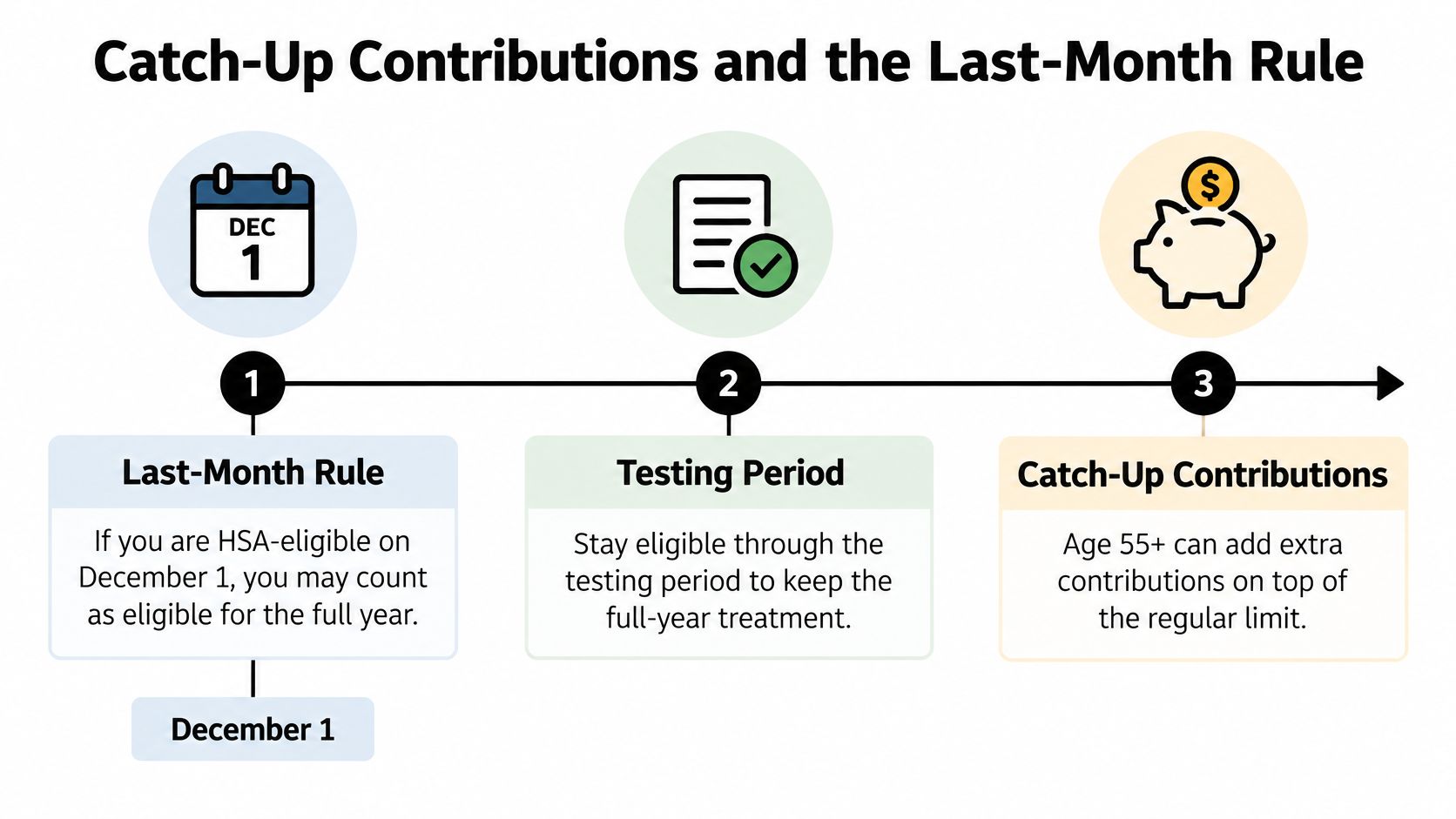
The last-month rule is the point where the calendar stops being simple. Under the normal approach, how much someone can contribute tracks the months they held qualifying coverage. The last-month rule offers an alternative. An individual who is an eligible individual on December 1 can be treated as though they had qualifying coverage for the entire tax year, as described in the IRS Publication 969 guidance on the last-month rule.
The infographic below lays out how that rule, its testing period, and catch-up contributions fit together on one timeline.
That treatment suits a real situation. Someone starts a job late in the year, enrolls in qualifying coverage, and wants to fund the account fully rather than prorate for a short eligibility window. The rule permits that. What it doesn't do is make the contribution permanent the moment it lands.
The Testing Period Is the Price of the Rule
Using the last-month rule triggers a testing period. The individual must remain eligible through the last day of the 12th month following the last month of the tax year. For a calendar year taxpayer using the rule for 2025, the testing period runs from December 1, 2025 through December 31, 2026. Map those dates onto the employee's actual coverage before anyone relies on full year treatment.
Walk through it in steps. First, confirm eligibility on December 1 of the tax year. Second, calculate how much of the intended contribution depends on the rule rather than on months of actual coverage. Third, ask what could change during the testing period, a job move, a plan change at renewal, or enrollment in other coverage. Fourth, decide whether the full amount still makes sense given that exposure.
If eligibility is lost during the testing period, the additional contributions attributable to the rule can become taxable. That's the trade-off employees rarely hear when the rule is pitched as a year end opportunity. The contribution was timely and properly designated, and it still reverses because the following year's coverage didn't hold.
A last-month rule contribution is a commitment about next year's coverage, not just a decision about this year's taxes.
Where Catch-Up Contributions Fit
Catch-up contributions sit inside the same overall calculation rather than beside it. When you reconcile an account, include any catch-up amount alongside employer deposits and regular individual deposits before concluding there's room left under the applicable limit. Treating catch-up money as separate from the reckoning is how accounts drift over the line without anyone noticing a single oversized deposit.
The short video below walks through how these contribution rules interact in a benefits setting, which is useful background before you brief managers on year end questions.
For HR teams, the communication point is narrow but important. Don't present the last-month rule as a bonus. Present it as an election with a twelve month tail, and name the end date of the testing period in the same sentence as the contribution opportunity. Employees who understand the tail make calmer decisions in December, and they're far less likely to call you the following autumn asking why part of last year's contribution turned taxable.
Employer and Employee Steps to Contribute on Time
Employer deposits and employee direct contributions look identical once they're inside the account, but they get there on different schedules and through different hands. Employer money typically moves through payroll on set pay dates, decided by the plan design and the employer's funding pattern. Employee money can move through payroll deductions too, or arrive as a direct deposit the employee initiates at any point, including during the prior year window in the spring.
That difference in timing is exactly why reconciliation matters. Each stream counts toward the same annual limit, yet no single person naturally sees both streams at once. Payroll sees what it sent. The employee sees what they sent. The administrator sees the total but doesn't know which tax year a spring deposit was meant for unless someone says so.
A Sequence Both Parties Can Follow
- Confirm the coverage category. Establish whether self-only or family coverage applies, and for which months, before discussing amounts.
- Confirm eligibility months. Check qualifying coverage and other eligibility requirements month by month for the year in question.
- Record every employer deposit. Pull the actual payroll record of employer funding rather than the amount the plan design promised.
- Decide the individual deposit. Only after the first three steps should the employee size a direct contribution against the remaining room.
- Designate the tax year. For any deposit made after December 31, state the intended tax year to the administrator in writing and keep the confirmation.
That order isn't bureaucratic. Each step constrains the next. Sizing a deposit before confirming eligibility months produces a number built on sand, and designating the year at the end, as a clerical afterthought, is how deposits land in the wrong year. Reviewing how employer funding into employee health savings accounts interacts with individual deposits helps benefits teams see where their own process hands off to the employee.
Reconcile payroll and direct contributions before the tax filing deadline rather than assuming a provider's year end balance reflects the allowable tax deduction. A balance is a snapshot of money in the account. It says nothing about whether every dollar was allowable, which year each dollar belongs to, or whether withdrawals during the year changed the picture.
Making the Process Repeatable for HR
The teams that handle this well run the same short playbook every year. They schedule the reconciliation for January, send designation instructions with the first reminder instead of the last, and give employees a single named contact for eligibility questions. Documenting that playbook so a new HR coordinator can run it unaided is worth the effort, and tools such as Trupeer for HR teams can help turn a walkthrough of your payroll and benefits screens into a guide employees and new administrators can follow step by step.
Employers also set the tone. A funding reminder that says only "contribute by April 15" pushes employees toward speed. A reminder that includes the coverage check and the designation step pushes them toward accuracy. The second message takes one extra paragraph to write and prevents most of the correction work that otherwise lands in the following quarter, when options are narrower and nobody's records are fresh.
Eligibility and Aggregate Limits to Check First
Here's the assumption worth discarding. April 15 is not a universal safe harbor. Getting money into the account before the deadline settles timing and nothing else. Eligibility is determined by whether the contributor held qualifying high-deductible health plan coverage and met the other requirements for the relevant months, and understanding what counts as qualifying high-deductible coverage is the first check, not an optional refinement.
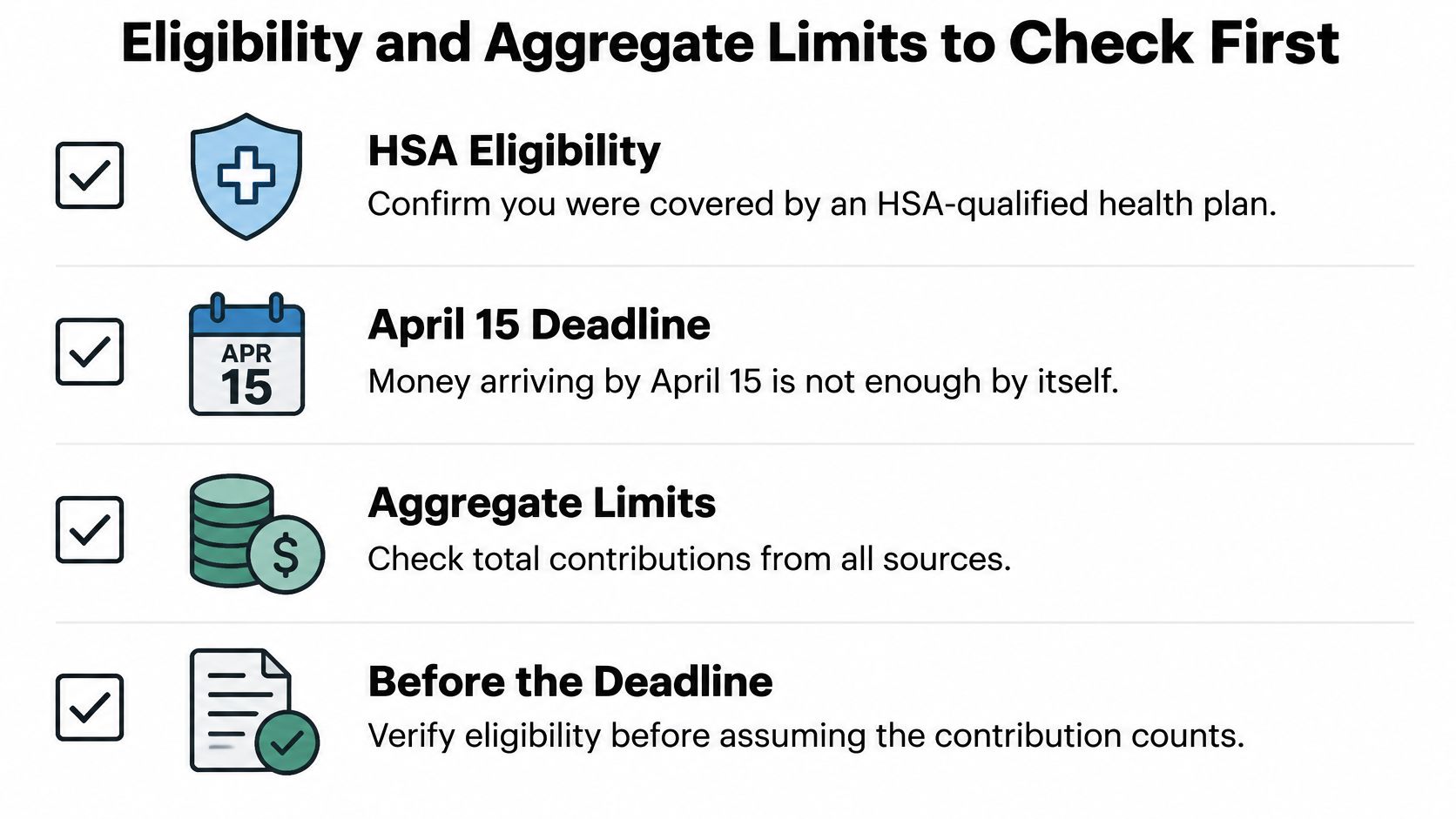
The checklist graphic below summarizes the four checks to run before any late top-up.
Consider how a contribution can be timely and still harmful. An employee changes plans midyear to coverage that doesn't qualify, then tops up the account the following spring out of habit. Another enrolls in disqualifying coverage through a spouse. Another becomes covered by Medicare. In each case the deposit may arrive well before April 15, properly designated, and still create a tax problem because the eligibility underneath it ended months earlier.
The Aggregate Limit Nobody Sees in Full
The annual maximum applies to contributions from all sources combined. Employee payroll deductions, employer deposits, direct contributions, and money contributed through another employer earlier in the year all land in the same bucket. A midyear job changer is the classic exposure. The new employer sees a fresh account and a standard election. The prior employer's contributions are invisible unless the employee reports them.
A blanket employer reminder does quiet damage. "Top up by April 15" encourages employees to aim for the annual maximum without checking coverage status or prior contributions made elsewhere. The employee follows instructions in good faith and overshoots a limit that was already partly consumed somewhere the current payroll system can't see.
Employees also get tripped up on the spending side when they assume eligibility questions ended at contribution. What the account can pay for is its own set of rules, and everyday items sit in grey areas, which is why resources like shoe reimbursement guidance for active adults exist for people testing whether a purchase qualifies. Contribution eligibility and spending eligibility are separate gates, and passing one says nothing about the other.
The Checklist to Run Before Any Top-Up
- Coverage status by month: Confirm qualifying coverage for each month the contribution is meant to cover, not just coverage held today.
- Disqualifying coverage: Ask about enrollment in other coverage or Medicare during the period, including coverage through a spouse.
- Contributions from every source: Add employer deposits, payroll deductions, direct deposits, and any amounts contributed through a previous employer.
- Remaining room: Size the top-up against what's left under the applicable limit after that full tally, then designate the tax year if the deposit falls after December 31.
Run that sequence and the deadline becomes what it should be, the last step in a verified process rather than the trigger for a rushed one. The employees who get hurt by this deadline rarely missed the date. They hit the date with a contribution their coverage history couldn't support.
Excess Contributions and Filing Extension Pitfalls
Excess contributions rarely come from one reckless deposit. They accumulate. An employer seed lands in January. Payroll deductions run all year on an election made during a busy open enrollment. The employee adds a direct deposit in March of the following year, sized against the annual limit as if the account were empty. No single step looked wrong. The total is what's wrong.
The cost of leaving that total uncorrected is concrete. IRS guidance states that contributions above the applicable limit generally must be withdrawn to avoid an additional 6% tax on the excess amount, as the IRS guidance on excess HSA contributions and withdrawal describes. Correction means identifying the excess, working with the administrator to remove it properly, and doing so within the correction window rather than letting it sit while the tax applies.
How the Excess Calculation Actually Works
Finding an excess isn't a matter of comparing the account balance to a single number. The calculation has to account for the coverage category, the months of eligibility, employer deposits, individual deposits, and any catch-up contribution. Change any one input and the allowable total moves. An employee who was eligible for only part of the year may have an excess even though deposits never reached the headline annual limit for their coverage category.
That's why early detection beats correction. A January reconciliation, run while the prior year window is still open, gives the employee and the administrator room to fix a problem with time to spare. The same discovery made during tax preparation, days before the deadline, turns a routine withdrawal into a scramble across payroll, the administrator, and a tax preparer who has forty other returns in progress.
The Extension Trap, Up Close
Picture the common version. An employee files an extension in April, intending to sort out taxes over the summer, and assumes the HSA decision can wait too. It can't. The contribution deadline is the return due date without extensions, so the extension that legitimately postpones filing does nothing for contributions. A deposit made in June for the prior tax year isn't late by a little. It isn't a prior year contribution anymore.
The calendar distinction to repeat: An extension moves your filing date. It does not move your contribution date.
Employers can defuse this trap with one honest sentence in every spring communication. State the contribution deadline, state that filing an extension doesn't change it, and state whom to contact with eligibility questions before contributing. Employees don't fall into this pitfall because they're careless. They fall in because nobody told them the two deadlines diverge, and the tax calendar makes them look identical.
Choosing a System to Track HSA Deadlines
Every organization tracks these deadlines somehow. The choice is between three approaches that differ mainly in how much of the verification work they carry for you.
Manual tracking means spreadsheets and calendar reminders. It costs nothing to start and works for a very small, stable workforce where one person knows every employee's coverage situation. Its weakness shows up at exactly the wrong moments. A spreadsheet records what someone typed into it, so a midyear plan change or a second employer's contributions never appear unless someone remembers to add them. The coverage status check lives in someone's head.

Payroll-linked tracking records employer deposits automatically as payroll runs. That removes transcription errors for the employer stream and gives finance a reliable funding record. It still leaves gaps. Direct employee contributions made outside payroll don't appear, eligibility months aren't validated against enrollment data, and the system flags a problem only if someone built a report and scheduled a human to read it before the deadline rather than after.
What a Connected Platform Adds
A connected benefits platform brings enrollment, payroll, and compliance data into one place, so the three questions this deadline depends on can be answered from connected records. Who holds qualifying coverage, and since when. What has been contributed across sources the employer controls. Which employees are approaching the limit or the deadline with unresolved items.
Evaluate any option, including an integrated employee benefits management platform, against the criteria the deadline itself imposes:
- Coverage status visibility: Can you see eligibility by month from enrollment records, or are you reconstructing it from emails each January?
- Aggregate contribution view: Does the system total employer and employee payroll amounts in one report you'd trust during reconciliation?
- Reminder timing: Do alerts fire early enough to correct a problem inside the prior year window, with the designation step included?
- Shared workflow: Can HR, payroll, and finance work from the same records, an idea explored further in the context of connecting departments through shared workflows, instead of reconciling three versions of the truth?
The strongest setups pair that kind of centralized platform with connected payroll, onboarding, and compliance tools, plus certified HR specialists employees can reach when an eligibility question doesn't fit a help article. Technology catches the arithmetic. A knowledgeable person handles the employee whose spouse changed jobs in October and wants to know what that means for a March top-up.
Match the approach to complexity, not headcount alone. A small team with frequent plan changes and midyear hires may need connected tracking sooner than a larger, stable workforce on a single plan. Count your eligibility events per year. That's the workload your system has to absorb.
Quick Compliance Checklist for Benefits and Finance Teams
Process explanations help once. A short verification checklist helps every year, because it can be run the same way at each deadline by whoever holds the benefits role at the time. Use the items below as a recurring control each January through April, and keep the completed version with your payroll records.
Run These Checks Every Cycle
- Governing tax year: For each contribution in the January to April window, confirm which tax year it's designated for and that the administrator's record matches.
- Eligibility by month: Verify qualifying coverage and eligibility for each relevant month, including any testing period for employees who relied on the last-month rule.
- Aggregate total: Add employer deposits and individual contributions together and compare the sum against the applicable annual limit for the coverage category.
- Reconciliation before the deadline: Match payroll records against administrator records and direct deposits early enough to correct discrepancies inside the window.
- Prior year designation: Confirm every post-December contribution meant for the prior year is designated that way with the administrator, in writing.
- Extension messaging: Verify employee communications state that a filing extension doesn't extend contribution time, with a named contact for questions.
Two habits make the checklist work. First, run it on a fixed schedule rather than when someone asks a question. The prior year window rewards teams that start in January, because corrections and designations are still available. Second, assign each item an owner across benefits and finance. Eligibility sits naturally with HR, deposit records with payroll, and the final reconciliation needs both signatures before anyone calls the cycle closed.
Treat the checklist as a control, not a reminder. A control gets completed, dated, and filed. A reminder gets read and forgotten.
If running this list exposes scattered records, invisible contribution streams, or eligibility data living in inboxes, that's useful information about your current system rather than a failure of effort. The practical next step is to review your HSA contribution process against each item above, note where the evidence for a check doesn't exist in one place, and decide whether a more connected approach to enrollment, payroll, and compliance would close those gaps before the next deadline arrives.
If your checklist run exposed scattered records or eligibility data spread across inboxes, Benely can help you bring enrollment, connected payroll, onboarding, and compliance into one centralized platform supported by certified HR specialists. That combination makes the next HSA contribution deadline a routine reconciliation instead of a spring scramble. Visit Benely to see how a connected benefits process would look for your team.