 Employee Benefits
 HR & Compliance
 Technology
 Wellness
 PEO Solutions
A Woburn HR lead discovers that a remote sales hire working from New Hampshire still needs a Massachusetts coverage review because her payroll is taxed in Massachusetts. The plan looks generous on the benefits summary, the carrier calls it suitable, and nobody on the team has checked whether it satisfies the state's minimum creditable coverage standard.
That's how MCC problems begin. Employers often treat “creditable coverage” as one federal checkbox, but Massachusetts creates a separate state test, while Medicare Part D creates another federal test focused specifically on prescription drugs. A national plan can pass one and fail the other.
Table of Contents
- What Minimum Creditable Coverage Actually Means
- The Two Universes of Creditable Coverage
- How Massachusetts MCC Sets the Standard
- Where Plans Quietly Fail the MCC Test
- Federal Part D Creditable Coverage Rules
- How Employers Verify Coverage Each Year
- Managing MCC With or Without Outside Help
- Putting It All Together and Common Questions
What Minimum Creditable Coverage Actually Means
Minimum creditable coverage, or MCC, is a regulatory floor for plan design. It tells an employer what a health plan must cover and how much financial exposure it can leave with the employee. It isn't a recommendation, a carrier marketing label, or a synonym for having an insurance card.
Massachusetts formally defined MCC in 956 CMR 5.00, with final standards issued in October 2008 and effective January 1, 2009. The rule connects MCC to the state's individual coverage mandate under M.G.L. c. 111M, § 2, so residents need qualifying coverage to avoid a state penalty. The state regulation requires core services and a broad range of benefits, including physician services, inpatient acute care, day surgery, diagnostic imaging, emergency services, maternity and newborn care, mental health and substance-use services, prescription drugs, and radiation therapy or chemotherapy. Employers can review the Massachusetts minimum creditable coverage regulation for the governing framework.
MCC differs from minimum essential coverage under the ACA. Minimum essential coverage addresses whether a person has a recognized form of health coverage. MCC asks whether that coverage is sufficiently protective financially. ACA coverage status is about whether coverage exists, while MCC is about what the coverage delivers.
Who sets the bar
Three authorities can shape the answer:
- State individual mandates: Massachusetts and other mandate states define minimum benefit and cost-sharing requirements for residents.
- Federal Medicare Part D rules: The federal government evaluates whether prescription drug coverage is actuarially comparable to standard Part D coverage.
- Plan sponsors: Employers with self-funded plans must understand and document their own plan design rather than assuming a carrier has handled every obligation.
A plan's result is binary. It either meets the applicable standard or it doesn't. A Massachusetts employee with nonqualifying coverage may face state tax consequences, while a Medicare-eligible employee without creditable drug coverage can face a later Part D late-enrollment consequence.
For employers building a benefits process, the practical starting point is to understand the difference between employer-sponsored health coverage, state MCC, and federal drug-creditability rules. They overlap, but they aren't interchangeable.
The Two Universes of Creditable Coverage
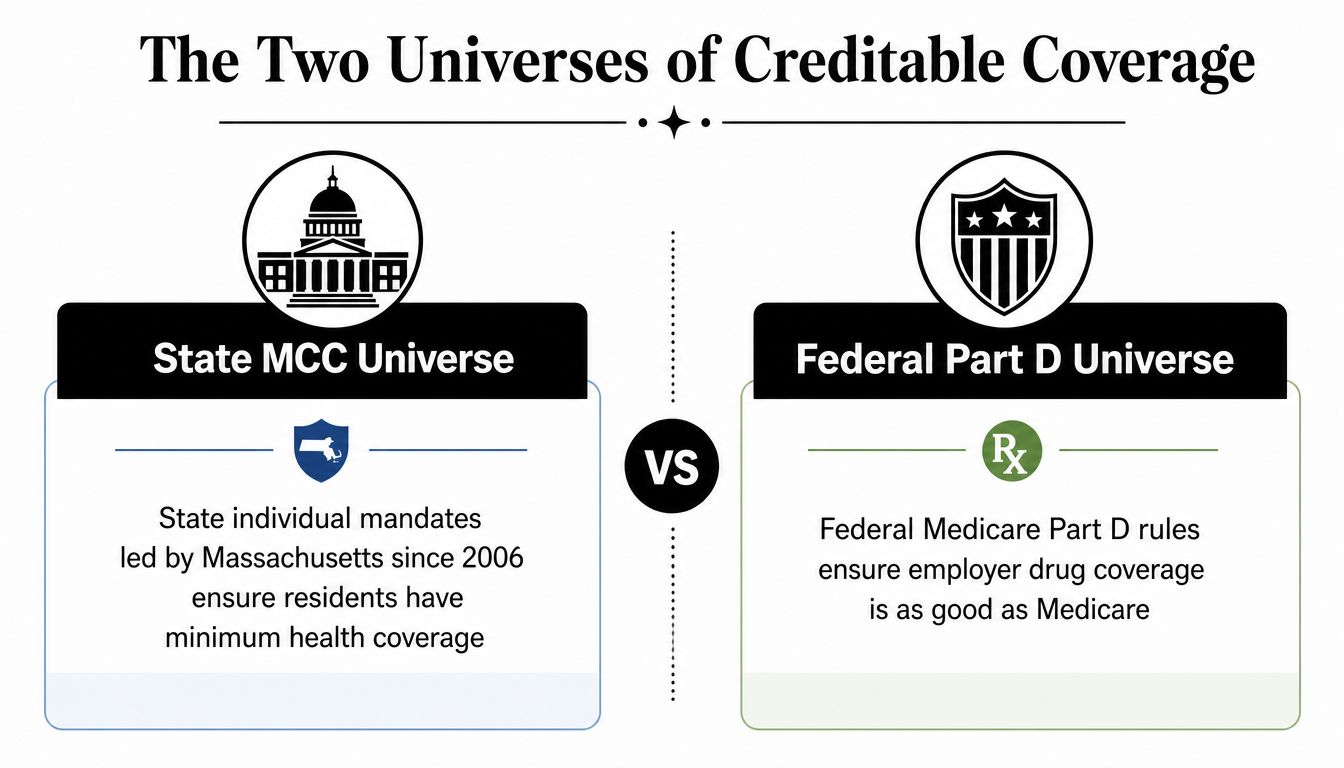
The word creditable appears in two major compliance systems, and that creates avoidable confusion.
The first universe is the state individual mandate system. Massachusetts is the foundational example. Its MCC rules define the minimum services and cost-sharing structure a plan must provide so a resident can satisfy the state coverage requirement. New Jersey, California, Rhode Island, and the District of Columbia also operate individual mandate frameworks, although their rules and thresholds differ. A state test is concerned with the resident's overall health coverage, not just the prescription benefit.
The second universe is federal Medicare Part D creditable coverage. That test asks whether an employer's or retiree plan's prescription drug benefit has an actuarial value at least equal to standard Medicare Part D coverage. Under the federal rule, the comparison uses generally accepted actuarial principles and CMS guidance. Employers must evaluate the drug benefit, not the plan's overall medical richness. The federal Medicare Part D regulation explains the actuarial-equivalence framework.
Where employers get caught
A single group health plan may need to satisfy both universes. Massachusetts residents need state-compliant coverage, and Medicare-eligible employees or dependents need a determination about the plan's prescription drug status.
The tests diverge in three important ways:
- Subject matter: State MCC covers medical services, prescriptions, maternity care, behavioral health, hospital care, and cost-sharing. Part D creditability focuses on expected prescription drug spending.
- Timing: Massachusetts thresholds can change by plan year. Federal disclosures follow Medicare Part D reporting and participant-notice schedules.
- Documentation: A Massachusetts plan may require state forms such as Form 1099-HC. A Part D plan sponsor must determine and disclose whether prescription coverage is creditable.
A plan can therefore pass the federal Part D test and fail Massachusetts MCC because its medical deductible is too high or its covered services are too narrow. The reverse can also happen. Treating one approval as proof of the other is the mistake.
How Massachusetts MCC Sets the Standard
Massachusetts is the most useful working model for multi-state employers because its rules combine covered services, preventive care, prescription access, deductibles, and out-of-pocket exposure.
A qualifying plan must cover broad medical categories, including ambulatory patient services, diagnostic imaging and screening, emergency services, hospitalization, maternity and newborn care, medical and surgical care, mental health and substance-use treatment, prescription drugs, and radiation therapy or chemotherapy. The state also expects preventive doctor visits without a deductible. A plan that pays only a fixed hospital amount, or that leaves the employee exposed to most medical charges, doesn't pass because it has an insurance contract.
The numbers that drive plan review
For 2025, Massachusetts guidance sets the in-network deductible limit at $2,950 for individual coverage and $5,900 for family coverage. Separate prescription drug deductibles are capped at $360 for an individual and $720 for a family, while annual out-of-pocket maximums are $9,200 for self-only coverage and $18,400 for family coverage when deductibles or coinsurance apply to core services. These figures are documented in the 2025 Massachusetts Schedule HC instructions.
For 2026, the deductible limits rise to $3,200 individual and $6,400 family, and separate prescription drug deductibles rise to $400 individual and $800 family. The 2026 out-of-pocket maximums increase to $10,150 individual and $20,300 family, applying to plan years beginning on or after January 1, 2026, according to Massachusetts 2026 MCC guidance.
| Coverage Tier | 2025 Threshold | 2026 Threshold |
|---|---|---|
| Individual deductible | $2,950 | $3,200 |
| Family deductible | $5,900 | $6,400 |
| Individual prescription drug deductible | $360 | $400 |
| Family prescription drug deductible | $720 | $800 |
| Individual out-of-pocket maximum | $9,200 | $10,150 |
| Family out-of-pocket maximum | $18,400 | $20,300 |
Employers should also check how the deductible is applied, whether prescription coverage has a separate structure, and whether the plan covers the required service categories. Don't rely on the word “Gold,” “PPO,” or “HSA-qualified” as a compliance conclusion. Those labels describe plan positioning, not Massachusetts MCC approval.
Broker rule: Review the actual certificate, SBC, prescription schedule, and carrier MCC determination before enrollment opens. The summary page is not enough.
Where Plans Quietly Fail the MCC Test
A 12-person professional services firm had a plan that looked reasonable in every recruiting conversation. It covered office visits, hospital care, preventive services, and prescriptions. The medical deductible was $7,000, and an integrated prescription carve-out imposed a $1,500 annual prescription cap.
That design failed Massachusetts MCC review. The prescription cap was the decisive problem, and the medical deductible created a second concern under the state's limits. The firm later considered a plan with a $250 deductible, which had a much stronger chance of satisfying the state's cost-sharing structure, assuming the rest of the benefit design also met the required service and drug rules.
The lesson isn't that every high-deductible plan fails. The lesson is that the plan's payment architecture matters as much as its covered-service list.
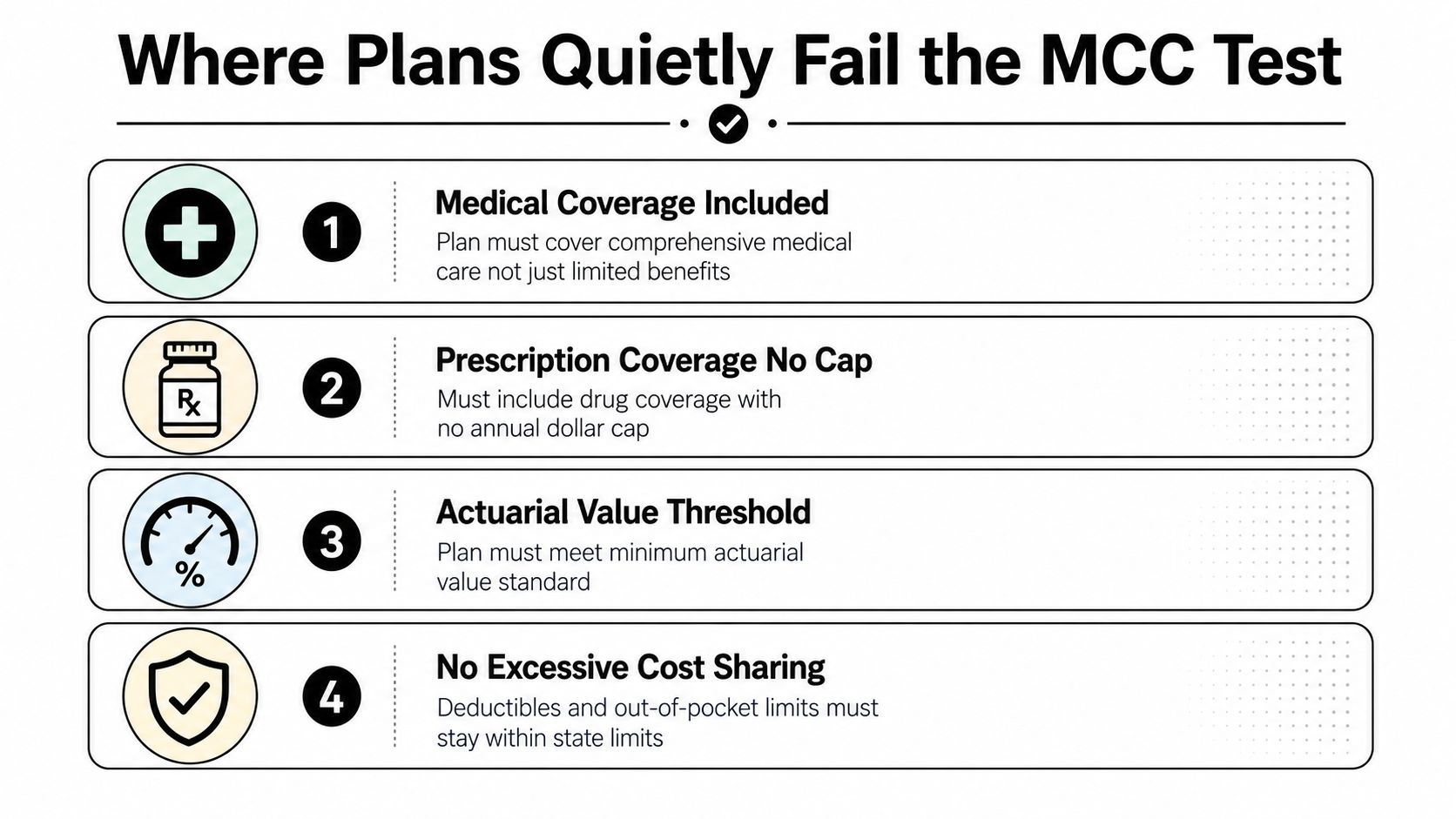
Four failure points
- Medical coverage: A limited-benefit policy or fixed hospital indemnity arrangement can't substitute for medical coverage.
- Prescription design: A prescription benefit with an annual dollar cap can disqualify the plan. Review formularies, carve-outs, specialty-drug treatment, and separate deductibles.
- Actuarial value: The plan must meet the applicable state standard. A broad network doesn't prove that the plan pays enough of expected costs.
- Cost sharing: Deductibles, coinsurance, copays, and aggregation rules all affect the employee's exposure.
Employers also get tripped up by the assumption that an HSA-qualified HDHP is automatically creditable. It may pass, but only if its medical portion, prescription structure, and financial limits satisfy the relevant state requirements. HSA compatibility and MCC are separate analyses.
A lapse creates another administrative question. Massachusetts allows a lapse of up to three consecutive months without penalty, and a taxpayer with MCC for at least 15 days in a month can receive Form 1099-HC documenting coverage, as summarized in this guidance on lapses in insurance coverage.
Federal Part D Creditable Coverage Rules
Federal Part D creditable coverage protects Medicare-eligible participants from a different problem. If an employee or dependent later enrolls in Part D after having noncreditable prescription coverage, the person may face a late-enrollment consequence. The employer must determine whether the drug benefit is at least actuarially equivalent to standard Part D coverage.
The formal test compares expected prescription claims under the employer plan with the expected value of standard Medicare Part D coverage. Premium price alone doesn't answer the question. Claims assumptions, generic and brand mix, specialty drugs, deductibles, formularies, pharmacy access, and benefit limits all matter.
The 2026 and 2027 transition
CMS is changing the simplified determination path. For calendar year 2026, non-RDS plans can use either the existing simplified method or the revised method. Starting in 2027, the revised simplified determination becomes the only simplified path.
The revised standard requires reasonable access to retail pharmacies and reasonable coverage for brand-name, generic, and biological products. The plan must also be designed to pay at least 72% of average prescription drug expenses for 2026 and 73% for 2027, with later updates issued through CMS guidance. The CMS-related transition analysis explains why employers should retest plans that previously relied on the older methodology.
For 2026, employers may still have a choice of simplified methods. That doesn't mean they should postpone review. A narrow formulary, specialty-drug carve-out, or outdated actuarial memo can turn a previously comfortable determination into a compliance problem.
| Compliance Action | Deadline | Owner | Penalty if Missed |
|---|---|---|---|
| Determine creditable or noncreditable status | Before annual notices and plan-year reporting | Plan administrator | Employees may receive incomplete information about Part D enrollment decisions |
| Submit the CMS disclosure | Within 60 days of the plan year beginning | Plan administrator | Missing federal disclosure obligation |
| Send participant notice | Before October 15 annually, and when status changes | Plan administrator | Employees may lack timely information about Part D rights |
| Retain supporting analysis | Each plan year | Employer or plan administrator | Weak audit trail and difficult correction process |
The plan administrator, not the broker, owns the disclosure obligation. Employers should keep the determination, supporting carrier materials, and any actuarial analysis on file. The annual notice also needs to reach Medicare-eligible active employees, retirees, spouses, and dependents who are covered by the plan.
How Employers Verify Coverage Each Year
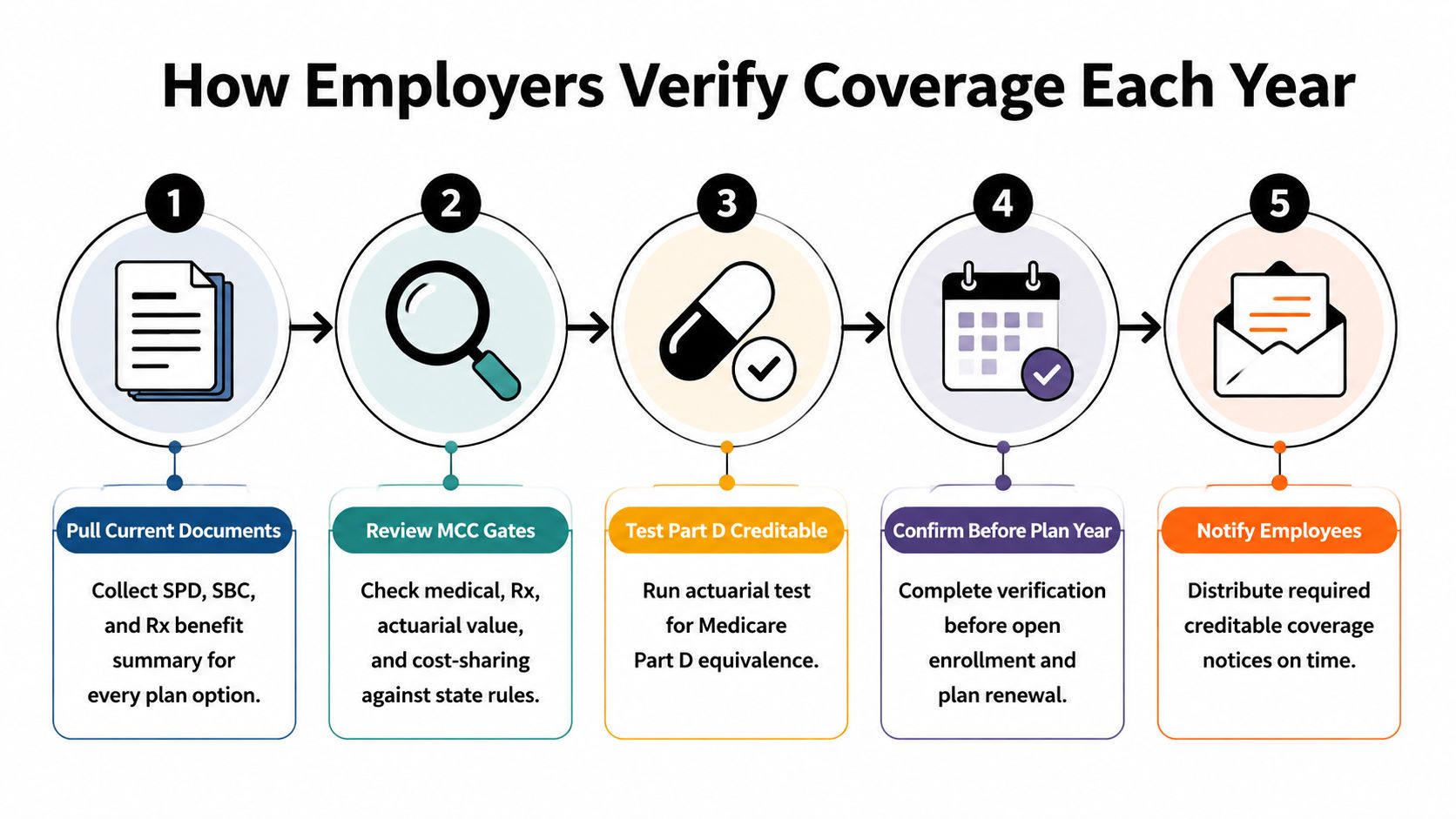
Start with documents, not assumptions. Pull the current Summary Plan Description, Summary of Benefits and Coverage, prescription drug benefit summary, certificate of coverage, carrier MCC statement, and any actuarial memorandum for every option. Include fully insured, self-funded, level-funded, HRA, and MEC wrap arrangements.
Run the review in a fixed order
- Map the population. List each employee's work and residence state. A remote employee can create a Massachusetts review even when the employee doesn't work from the Massachusetts office.
- Review state gates. For Massachusetts, compare covered services, deductible limits, prescription structure, and out-of-pocket maximums with the upcoming plan-year standards.
- Test prescription creditability. Ask the carrier for its determination. If it doesn't provide one, use an available simplified method or obtain an actuarial review under the federal rules.
- Record the result. Maintain a spreadsheet with the plan name, state test, federal test, methodology, result, supporting vendor or actuary, and review date.
- Set notices and filing reminders. Assign an owner before open enrollment, not after employee questions arrive.
For Massachusetts plans, Form 1099-HC goes to the primary subscriber no later than January 31 of the following year. Employers also need to reconcile the information submitted to the state and the employee distribution process. The form can be mailed or delivered electronically with consent. Review the current Massachusetts Form 1099-HC requirements before building the calendar.
The state's annual tax guidance also matters. A taxpayer with MCC for at least 15 days in a month can receive documentation on Form 1099-HC. Don't let payroll, the carrier, and the benefits administrator maintain separate employee-status files with no reconciliation.
A clear Summary Plan Description process helps because the SPD is one of the documents needed to verify what the plan promises. Use the current version, not a prior-year copy saved in an old benefits folder.
Managing MCC With or Without Outside Help
In-house administration can work for a small employer with one carrier, one plan, and employees concentrated in one MCC state. It requires someone to pull the SBC and prescription documents, request carrier determinations, review Massachusetts Schedule HC materials, track Form 1099-HC distribution, and retain evidence for the plan year.
That sounds manageable until a renewal changes the deductible, a remote hire moves across state lines, or a carrier supplies a new prescription design without a clear creditability statement. The hidden cost isn't just staff time. A failed MCC determination can expose an uninsured adult to a Massachusetts state penalty of $219 in 2025, indexed annually, according to Massachusetts MCC penalty guidance. A Medicare Part D late-enrollment penalty can add 1% of the national base beneficiary premium for every uncovered month, as described in the federal framework cited earlier.
Decision principle: If your team can't prove which test it ran, who approved it, and when the notice went out, the process isn't under control.
| Factor | In-House HR Lead | Broker / Benefits Platform |
|---|---|---|
| Plan review | HR gathers SBC, SPD, prescription documents, and carrier materials | Broker or platform coordinates document collection |
| State changes | HR monitors each employee state and threshold update | External partner tracks applicable jurisdiction changes |
| Federal drug test | Employer owns the determination and recordkeeping | Partner helps coordinate carrier or actuarial support |
| Notice calendar | HR creates and follows reminders | Partner supports deadline management and distribution |
| Audit support | Evidence sits across email, payroll, and shared drives | Documentation is consolidated in a compliance record |
| Cost structure | Lower direct expense, higher internal time and error exposure | Small-group outsourcing can run roughly $2,000 to $8,000 annually, depending on scope, as discussed in this MCC outsourcing analysis |
My recommendation is direct. Use the in-house route only when you have a single MCC state and a single carrier. Multi-state employers, self-funded plans, and companies with remote employees should weigh the outsourcing cost against the risk of missed thresholds, incomplete notices, and an unprovable audit file.
A benefits platform can centralize plan documents, employee locations, renewal dates, and notice tasks. Benely offers employee benefits administration, health plan comparison and enrollment, payroll connectivity, and compliance support, making it one option for employers that want state and federal benefits work managed in a connected workflow.
Putting It All Together and Common Questions
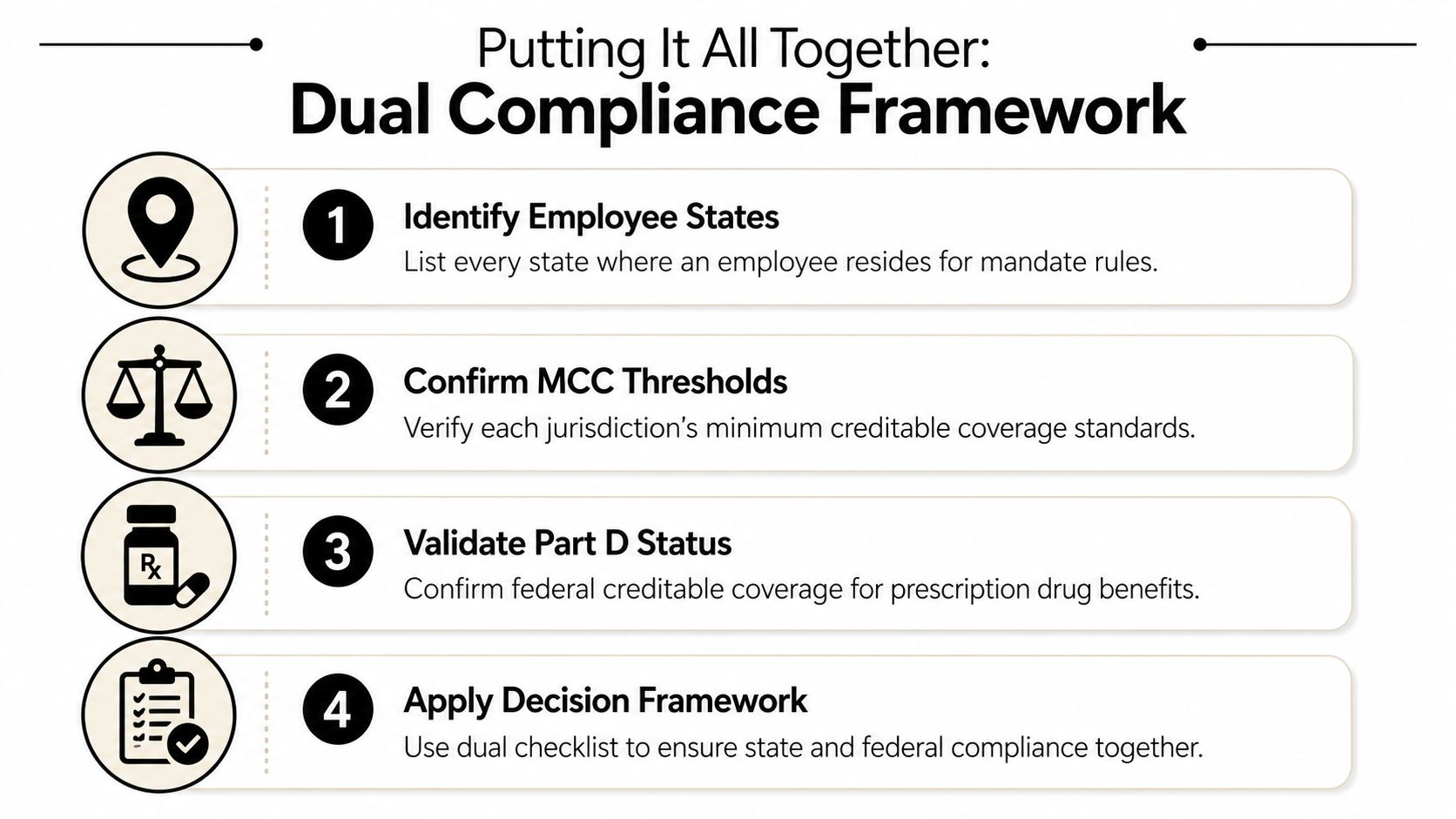
Treat minimum creditable coverage as a dual compliance review, not one form.
- Identify employee states. Record where every employee resides and determine which state mandate rules may apply.
- Confirm state thresholds. Use Massachusetts as the detailed template, then review the separate rules for New Jersey, California, Rhode Island, the District of Columbia, and any other applicable jurisdiction.
- Validate Part D status. Test prescription coverage for Medicare-eligible employees, retirees, spouses, and dependents.
- Document and notify. Timestamp the review, retain the supporting documents, and distribute required notices before the relevant deadline.
Massachusetts deserves special attention because its rules combine benefit categories with detailed cost-sharing limits. The 2026 thresholds are already higher than the 2025 limits, so copying last year's review into this year's binder is a poor control.
Common questions
Do fully insured and self-funded plans face the same Massachusetts MCC test?
Yes, Massachusetts applies the MCC standard to the coverage, although federal Part D documentation and carrier support can vary by funding arrangement.
What happens if an employee buys coverage through the exchange?
The employee may satisfy the applicable individual coverage requirement through qualifying individual coverage, but the employer still needs to manage its own plan documentation and reporting duties.
Can an HSA-qualified HDHP meet MCC?
Usually, but only when its deductible, medical benefits, prescription structure, and overall cost-sharing design fit the applicable state requirements. HSA qualification alone isn't proof.
When is the Form 1099-HC deadline?
The form must reach employees by January 31 of the following calendar year, subject to the applicable Massachusetts reporting process.
Verify the current thresholds and notice dates before your next plan-year binder goes to the printer.
Benely helps employers compare and enroll in health plans while connecting benefits administration with payroll, onboarding, and compliance workflows. Visit Benely to organize your Massachusetts MCC and federal Part D review before renewal and open enrollment deadlines arrive.