
Employer-sponsored family coverage averaged $25,572 a year in 2024, up 7% in twelve months, according to KFF's employer health benefits survey series. Most founders respond to a number like that by asking a broker for a cheaper quote. That's the wrong first move.
The number that decides whether your benefits package recruits anyone isn't the employer's monthly bill. It's what comes out of one employee's paycheck, in one household, before that person meets a deductible. A plan can look cheap to the company and feel unusable to a single parent covering two kids.
Brokers get judged on the premium, but the premium is one of five numbers that decide whether a plan works. The others are the paycheck deduction, the deductible and out-of-pocket maximum, the employer contribution formula, and the headcount rules that decide which products you're even allowed to buy.
Table of Contents
- What Small Employers Pay and Why a Broker Exists
- Household Affordability Beyond the Headline Premium
- Broker Agent PEO and Allowance Side by Side
- How Brokers Are Paid and Which Rules They Track
- Tax Credit and Headcount Checks Before You Buy
- Questions to Vet a Small Group Broker
- Start a Benefits Review With Benely
What Small Employers Pay and Why a Broker Exists
A 16-person marketing agency opens its renewal packet and the owner reads one line: the company's share. It's the number the budget cares about, and it's the least informative number in the envelope.
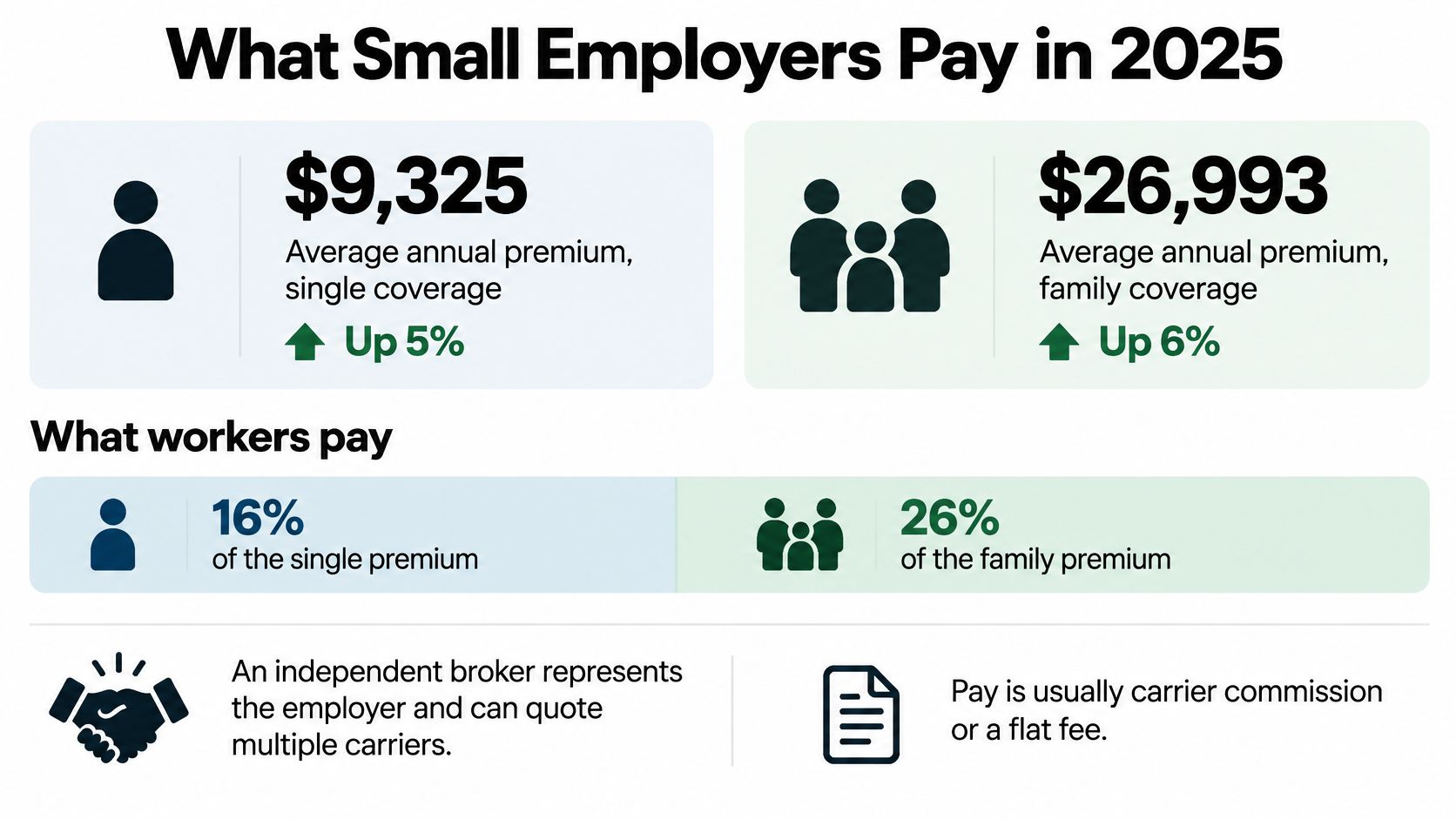
In 2025, average annual employer-sponsored premiums in the United States reached $9,325 for single coverage and $26,993 for family coverage, up 5% and 6% over the prior year, with workers paying an average of 16% of the single premium and 26% of the family premium, according to the KFF 2025 Employer Health Benefits Survey. Translate that into a paycheck and the picture sharpens: on a biweekly payroll, the average worker share comes to roughly $57 per check for single coverage and roughly $270 for family coverage, before anyone meets a deductible.
Keep these benchmarks in front of you before you compare a single plan.
| Measure | Figure | Comparison |
|---|---|---|
| Average annual single premium | $9,325 | Up 5% year over year |
| Average annual family premium | $26,993 | Up 6% year over year |
| Typical worker share of single premium | 16% | Employer funds the balance |
| Typical worker share of family premium | 26% | Employer funds the balance |
| Firms with 10-24 employees offering coverage | 51% | 97% of firms with 200 or more employees offer coverage |
| Firms with at least 10 employees offering coverage to some workers | 61% | KFF's 2025 sample starts at firms with 10 or more employees |
| Employer pays 100% of the single premium | 29% of covered workers at small firms | 7% of covered workers at large firms |
| Worker pays $12,000 or more toward the family premium | 28% of covered workers at firms with 10-199 employees | Less common pattern at large firms |
The Gap Is Scale, Not Indifference
Coverage thins out fast as headcount drops. The same survey found that 61% of firms with at least 10 employees offered health benefits to at least some workers. By size, 51% of firms with 10-24 employees offered coverage, against 97% of firms with 200 or more. Small firms dominate the sample itself: 61% of firms with 10 or more workers had fewer than 25 employees, yet those firms employed only 10% of workers.
A broker's job resembles a scouting guide more than a store cashier. A cashier rings up whatever sits on one store's shelf. A guide knows which carriers will write a group your size, what the full route costs, and which shelves are empty this quarter. Small employers have neither the purchasing scale nor an in-house benefits desk, so the guide work is the deliverable.
Contribution habits split sharply by size too. KFF reported that 29% of covered workers at small firms were in plans where the employer paid the entire single-coverage premium, compared with 7% at large firms. Family coverage is where the weight shows: 28% of covered workers at firms with 10-199 employees contributed at least $12,000 a year toward family premiums.
Read the offer-rate data carefully. KFF changed the sample for offer rates in 2025 to firms with 10 or more employees, so this year's percentage shouldn't be stacked against older published rates as if it were a trend.
Five Things You Should Be Able to Expect From a Broker
- A census, not a summary. Employee counts, ZIP codes, ages, dependents, your contribution budget, and the two or three doctors your team won't switch. Quotes built on a rough headcount come back wrong.
- More than one carrier on the same design. Same deductible, same network type, same copays, so the comparison is clear.
- A paycheck number for three households. Employee-only, employee-plus-child, and family, in dollars per pay period, not percentages of premium.
- Enrollment handled, including the messy part. Meetings, one-on-one help, and reconciled carrier files after the window closes.
- A renewal calendar with dates and owners. Renewal, open enrollment, COBRA and state continuation notices, and ACA filings on one page.
If you want to see how the comparison step works before you call anyone, Benely's walkthrough of affordable health insurance for businesses shows the multi-carrier approach in practice.
Household Affordability Beyond the Headline Premium
Ranking plans by the employer's monthly bill is the most expensive habit in small-group benefits. It answers the question your budget committee asks and ignores the question that decides enrollment.
At U.S. establishments with fewer than 50 workers, employers contributed an average of $528.84 a month for single coverage and $1,232.59 for family coverage in March 2024, while employees contributed $170.92 and $751.45, according to the Bureau of Labor Statistics. Access and enrollment are different things: about 56% of those workers had access to medical care benefits and 33% participated, which works out to roughly 60% take-up among workers who were offered coverage.
That participation gap is where most budget models break.

Three Households, Not One Company Average
Build the cost sheet three times, because your staff doesn't live in one average.
- Employee-only. The single contribution, annualized. A routine-care year with a couple of primary care visits and a generic prescription is the honest baseline.
- Employee-plus-child. Priced between single and family, and this is the tier where many small-firm parents feel the plan most. Daycare-age kids generate visits; the deductible is what they remember.
- Family. The employee share annualizes to about $9,017 a year out of the paycheck before a single deductible, copay, or out-of-pocket maximum is met.
For each household, ask the broker for expected annual spending in three scenarios: a routine year, a specialist year, and one major medical event. Same three columns, three households, one page.
Employers know this is raw. In KFF's 2025 survey, 16% of employers said employees' concern about cost sharing was high and 29% said it was moderate, and small firms generally leave workers with a heavier cost burden than large firms do.
Rule of thumb: a plan with the lowest employer premium can be the worst offer on the table for your lowest-paid staff, particularly when the family deductible is large relative to their pay.
Lowering the employer share shrinks budget exposure per enrolled employee. It also raises paycheck deductions, suppresses take-up, and converts a recruiting tool into a compliance obligation nobody values.
Broker Agent PEO and Allowance Side by Side
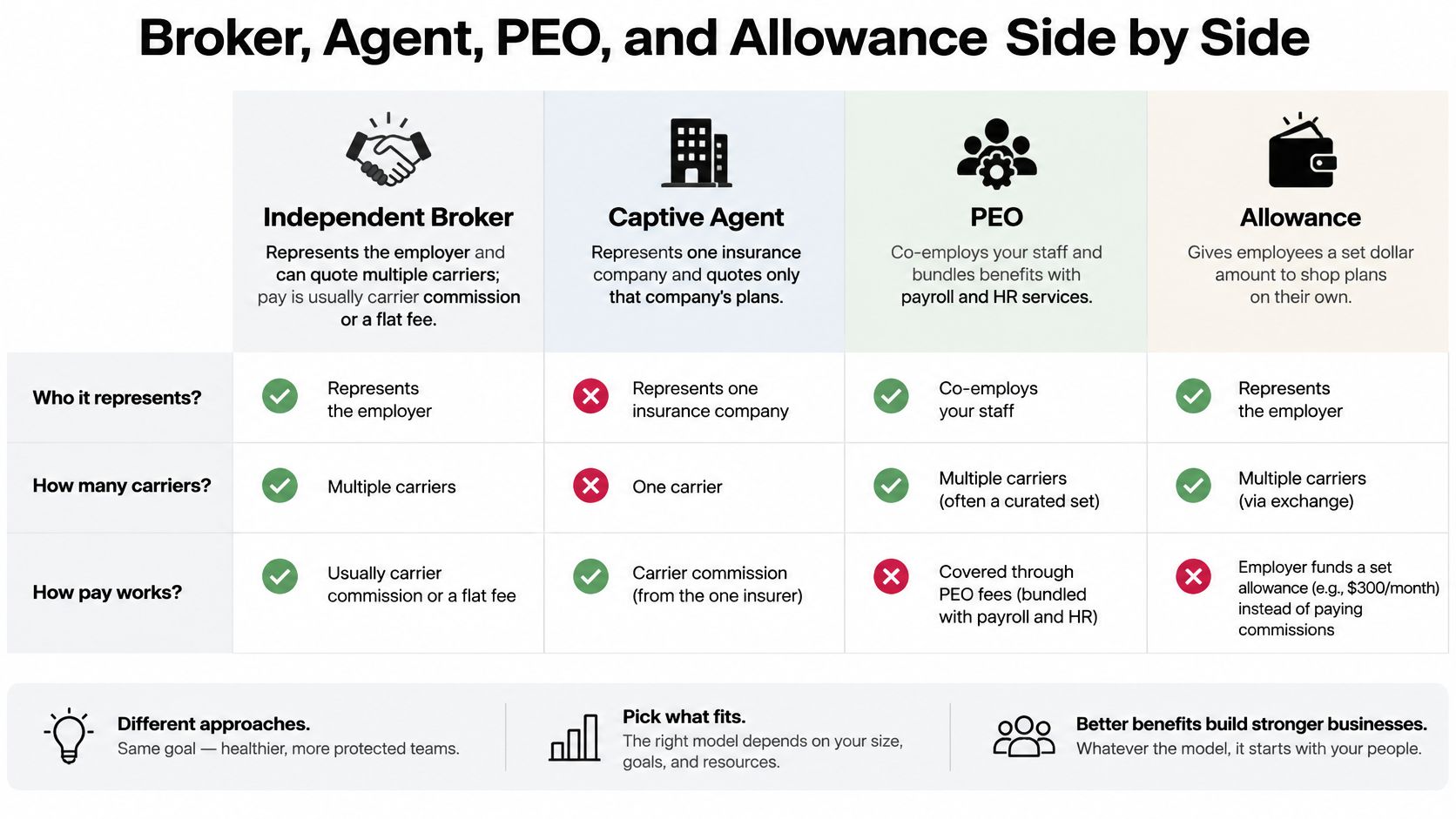
Four models get pitched to small employers in the same conversation, and buyers treat them as flavors of one thing. They aren't. Each answers a different question: who works for whom, and who absorbs the risk when the math goes wrong.
| Model | Works for | How money moves | Choose it when | Main risk |
|---|---|---|---|---|
| Independent broker | The employer | Carrier commission and/or a disclosed fee | You need several carriers compared on one budget | Undisclosed pay that steers the quote |
| Captive agent | One insurance company | That carrier's commission | You have already chosen that carrier | No real market comparison |
| PEO | Co-employed workforce | Bundled PEO fee covering benefits and HR services | You want payroll, HR, and benefits in one place | Higher all-in cost and shared employer control |
| Defined contribution or ICHRA | Employees buying with an allowance | Fixed employer allowance | You want a capped, predictable benefits budget | Uneven individual prices and extra compliance work |
An independent broker represents you and can quote several carriers. Pay is usually carrier commission or a disclosed fee, and you make the final plan choice. The risk is narrow but real: pay that never gets disclosed can decide which quotes reach your desk.
A captive agent represents one insurer. That works when you have already decided the carrier is right, and it is a poor fit when you haven't seen the market at all. If your renewal is stable and you know the plan you want, a captive agent or buying direct can be enough, and you may not need a broker at all.
A PEO places your staff into a co-employment arrangement, so benefits, payroll, and some HR arrive in one bundled fee. It can be the right answer for a thin team with no HR person. Price the all-in fee against a standalone quote before signing, because you are also sharing employer control.
A defined contribution or ICHRA gives each employee a fixed dollar allowance to buy coverage. The budget becomes predictable. The trade-off is that individual pricing follows the person, so an older employee or one covering a family can land on a worse deal than the group plan gave them, even while your budget looks better on paper.
Here's the comparison with the sales language stripped out.
When an Allowance Beats a Group Plan
Demand is clearly moving. In eHealth's survey of U.S. small and midsize business owners and managers, most employers sponsoring group coverage said they worried they could not afford it within a few years, and a majority favored a fixed employer contribution employees could use to buy their own coverage. The company sells individual coverage, so read the result as directional and weigh it against your own renewal math.
An allowance tends to win when headcount is stable, the budget stays fixed at renewal, and the workforce can realistically shop individual prices. It tends to lose when the team skews older or higher-need, when participation rules and tax treatment add admin you don't have, or when employees would rather not shop at all. Before choosing, compare the allowance against what your family-tier employees would pay on their own, because a capped employer budget can hide an uncapped employee bill.
The question isn't whether you can use an allowance. It's whether it beats a group plan once employee affordability, administrative workload, compliance, and the age mix of your staff are all inside the comparison.
Three verdicts instead of a universal winner. If you need several carriers judged against one budget, use an independent broker. If you already know the carrier, a captive agent or direct purchase is enough. If payroll, HR, and benefits need to live in one place, price a PEO.
How Brokers Are Paid and Which Rules They Track
Broker pay shapes which plan gets recommended, so ask for it before you compare premiums. Small-group brokers are usually paid in one of three ways: a carrier commission inside the premium, a fee the employer pays, or a hybrid. Because employee paycheck deductions come out of the same plan design, a recommendation that costs the employer a little more can still cost a lower-paid household a lot more.
Ask three questions and write down the answers:
- What is the dollar amount? Ask for a figure per carrier and per plan, rather than a percentage or “standard.”
- Does pay differ across the options shown? If one option pays the broker more, you should know that before you choose.
- Is any employer fee credited against commission? Otherwise you may be paying twice for the same advice.
Keep tax deductibility out of this comparison; a page about lowering capital gains with broker commissions answers a different question, so the fee quote still has to stand on its own. For the insurance side, Benely's breakdown of how insurance brokers get paid maps commission, fee, and hybrid models in more detail.
The Headcount Rules That Change What You Can Buy
| Rule | Count that matters | What it triggers | Common miss |
|---|---|---|---|
| Applicable large employer | 50 full-time plus full-time-equivalent employees, prior-year monthly average | ACA reporting and possible shared-responsibility duties | Using today's headcount only |
| SHOP eligibility | Generally 50 or fewer employees; some states up to 100; exactly 50 can use SHOP | Small-group Marketplace purchase | Assuming every state stops at 50 |
| Federal COBRA | At least 20 employees on a typical business day in the prior year | Continuation coverage offers | Ignoring state mini-COBRA under 20 |
The 50-employee ACA test comes from the IRS employer shared responsibility guidance: count full-time employees plus full-time equivalents for each month of the prior calendar year, add the months, divide by 12. SHOP generally serves employers with 50 or fewer employees, some states extend it toward 100, and an employer with exactly 50 can use it. Federal COBRA generally applies when an employer had at least 20 employees on a typical business day in the preceding year, and the Treasury regulation confirms that smaller plans fall outside it, though a state continuation law may still bind you.
Now the edge case. Say a 22-person firm adds six seasonal workers in July. Current payroll says 28, which sounds like a different regulatory world. It is not, because both the ACA and COBRA tests look backward at a monthly or typical-day average. That is why the broker should ask for headcount by month, split into full-time, part-time, and variable-hour, rather than a snapshot from your payroll provider.
Tax Credit and Headcount Checks Before You Buy
The Small Business Health Care Tax Credit is the most over-promised line item in small-group benefits. It's a real credit, and many employers who assume they qualify never collect a dollar of it.
The IRS conditions for the credit are specific: generally fewer than 25 full-time-equivalent employees, average annual wages below an inflation-adjusted threshold, at least 50% of the employee-only premium paid by the employer, and a qualified plan purchased through SHOP. Eligible for-profit employers can claim up to 50% of premiums paid, tax-exempt employers up to 35%, on a sliding scale that pays most under 10 FTEs and lower wages. It generally runs for two consecutive taxable years.
The Six-Step Eligibility File
- Count full-time employees separately from FTEs. Exclude dependents and owners per the instructions. The IRS notes that 48 employees working half-time can equal 24 FTEs for credit purposes, per its ACA tax provisions for small employers, so a part-time-heavy payroll can still qualify.
- Compute average annual wages. HealthCare.gov's SHOP guidance puts the wage threshold at about $65,000 or less, indexed.
- Confirm the contribution hits 50% of employee-only coverage for each eligible employee. Paying half of family coverage does not substitute for the employee-only test.
- Confirm a SHOP offer reached all full-time employees. Inconsistent offers fail the test even when the numbers pass.
- Estimate the credit on the sliding scale and stop after two consecutive years. Model year three at full cost so nobody is surprised.
- Keep the worksheet with the quote. Finance needs to defend the projected net cost, not just the gross premium.
Here's where it collapses. A firm with 22 FTEs and average wages of $52,000 clears both thresholds and still gets nothing if it pays 40% of the employee-only premium, or if coverage skips two full-time staff because they're newer. The eligibility file catches that in an afternoon. A promised savings figure catches it at audit.
Participation is the other half of the calculation, and small group health insurance participation requirements explains how carriers and the marketplace count it.
Questions to Vet a Small Group Broker
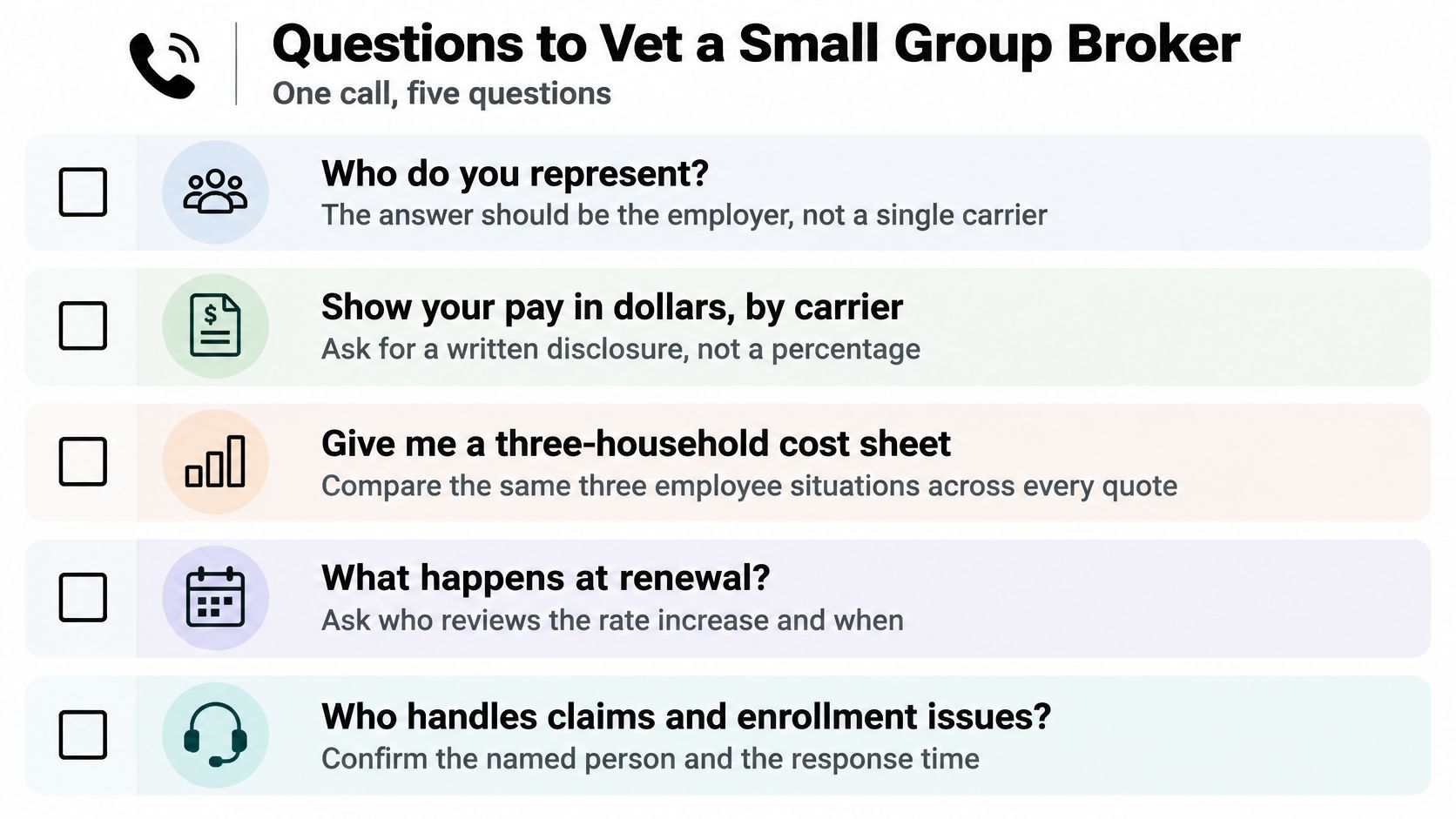
One call, five questions, and one page of documents. That's enough to separate a guide from a cashier.
- Who do you represent, and what do you earn on this quote? Listen for "you" and a dollar figure by carrier. A written disclosure beats a confident answer.
- Which carriers did you quote, and which did you drop? A broker who can name the two markets that declined your group is doing real work.
- Show me the three-household cost sheet. Employee-only, employee-plus-child, and family, each with premium, deductible, and out-of-pocket maximum. One blended company average isn't an answer.
- What headcount did you use for SHOP, ALE, COBRA, and state continuation? Then ask to see the monthly numbers behind it.
- Who runs enrollment and who reconciles the carrier file? Get a name for group meetings, one-on-one help, the benefits guide, and post-enrollment cleanup.
- What happens at renewal if rates jump? Ask for the options in advance, including whether a PEO or an allowance quote is worth pricing as a comparison.
- Give me two references from employers my size. Similar headcount, similar workforce mix.
Red flags cluster: a single-carrier pitch with no pay disclosure, a tax-credit promise with no FTE and wage math behind it, and a proposal that never shows the family paycheck deduction. Each one has a document that would disprove it. Ask for the document.
Green flags sound boring. A side-by-side an employee can actually read, a named person who owns compliance, and a renewal calendar with dates already on it.
Put these on one page and take the call.
Keep the pay disclosure, the household sheet, and the headcount test filed with the signed proposal. When the renewal arrives eleven months later, those three documents tell you whether the broker's advice held.
Start a Benefits Review With Benely
If you need several carriers compared against a fixed budget, hire an independent broker and demand the household sheet and pay disclosure before anything is quoted. If the gap is payroll plus HR under co-employment, price a PEO against that broker quote rather than instead of it. If a capped allowance is the only goal, test defined contribution against the same three households before you leave a group plan.
For teams that want the broker work and the administration in one place, Benely's Benefits Advisors manage a program from plan design through the compliance paperwork, and its compliance specialists assist with COBRA and FSA administration, ACA reporting, HR support, and ERISA wrap and filing. A free benefits score is a practical first step: the business rates its current process and receives a free 30-page benefits guide.
Small companies feel this most when they're growing. As Adam M., founder and CEO of Knockaround, put it: "As a fast-growing small business, we were finding it difficult to keep up with our health insurance needs. That's where Benely came to the rescue. They got all of our plans set up and explained all the details along the way."
Bring last year's renewal, your contribution split, and a headcount separated into full-time and part-time, and the quote can be checked against the credit and continuation tests before you sign anything.
Benely compares plans across every major carrier, runs enrollment, and handles the compliance work that continues long after the plan is chosen. If you're weighing a broker change, a PEO, or an allowance, bring your renewal and your headcount to Benely and get the numbers side by side before you decide.