
 Employee Benefits
 HR & Compliance
 Technology
 Wellness
 PEO Solutions

Renewal is approaching, premiums are difficult to predict, and your team is staring at plan designs that seem to differ in every important detail. A founder may want to buy directly from a carrier to keep control, while an HR manager may wonder whether outside guidance would prevent an expensive mistake. The question, “Should I use a health insurance broker?”, usually appears when time, budget, employee expectations, and compliance responsibilities collide.
The answer depends less on whether brokers are generally useful and more on whether a particular broker will improve your decisions. A broker might reduce the work involved in comparing carriers, explain how networks and cost-sharing operate, and help employees enroll. But you should also examine market access, compensation, licensing, data protections, consent procedures, and support after enrollment.

Table of Contents
- Introduction Is a Broker Right for Your Business Right Now
- What a Health Insurance Broker Actually Does for Employers
- Pros and Cons of Using a Health Insurance Broker
- How Brokers Get Paid and What It Costs You
- Comparing Your Options Beyond a Traditional Broker
- Key Questions to Ask Before You Choose a Broker Partner
- Next Steps to Decide and Move Forward With Confidence
Introduction Is a Broker Right for Your Business Right Now
Your company has grown, but benefits decisions still sit with one founder or a small HR team. Employees want clearer choices, leadership wants predictable spending, and the plan must support hiring and retention. Buying directly from one insurer may seem faster. It can also leave your team comparing plan designs, checking provider networks, organizing enrollment, and answering questions without outside support.
A broker can handle much of that workload. The better test, however, is decision quality, not speed. Quick enrollment has little value if the plan excludes preferred doctors, creates confusing employee costs, or adds administrative work your team cannot maintain. A slower review may produce a better fit. On the other hand, a company with experienced benefits staff, reliable comparison tools, and enough time may manage the process without a traditional broker.
The small-business market makes this choice relevant to many employers. The Congressional Budget Office reported that enrollment in health insurance plans offered by small businesses increased from 16.9 million people in 2014 to 18.6 million in 2024, in material summarized by the Employee Benefit Research Institute. Benefits affect payroll planning, employee trust, and how candidates judge the company's total offer.
A useful decision screen has four parts:
- Complexity: Are you comparing several carriers, plan types, funding approaches, or eligibility rules?
- Capacity: Can your team manage quotes, employee education, enrollment records, and renewals alongside its other work?
- Risk: Do you have controls for consent, identity verification, data handling, and requests to change a plan?
- Transparency: Will the broker explain carrier access, compensation, commissions, and any limits on the choices presented?
- Value: Will the broker improve the decision, or only complete enrollment sooner?
Consent controls deserve special attention. A broker may collect sensitive employee information or submit enrollment changes, so your company should know who can authorize each action and how that authorization is recorded.
This guide examines the broker's role, its advantages and limits, compensation, alternatives, and questions for evaluating a partner. The goal is to match the process to your company's resources and tolerance for administrative risk, whether that leads to a broker, a direct purchase, or another service model.
What a Health Insurance Broker Actually Does for Employers
For a founder handling hiring, payroll, and benefits, choosing a health plan can feel like selecting equipment from a catalog written in another language. A broker works as both a personal shopper plus benefits concierge. The shopper helps sort available products and identify suitable choices. The concierge stays involved after purchase, helping answer questions and coordinate service. The exact support depends on the firm and your agreement.
The process usually begins with questions about your workforce, budget, contribution approach, preferred doctors or hospitals, employee locations, and priorities such as predictable costs or broad provider access. The broker then requests and organizes quotes, compares plan designs, and points out differences that a monthly premium alone will not show.
The Kaiser Family Foundation survey found that 68% of small businesses reported using a broker to buy their health policy, compared with 36% of people buying on their own. The same survey describes brokers as helping gather quotes, explain coverage options, and provide ongoing service. Employers therefore may use a broker as an operating resource, rather than only as a sales contact.
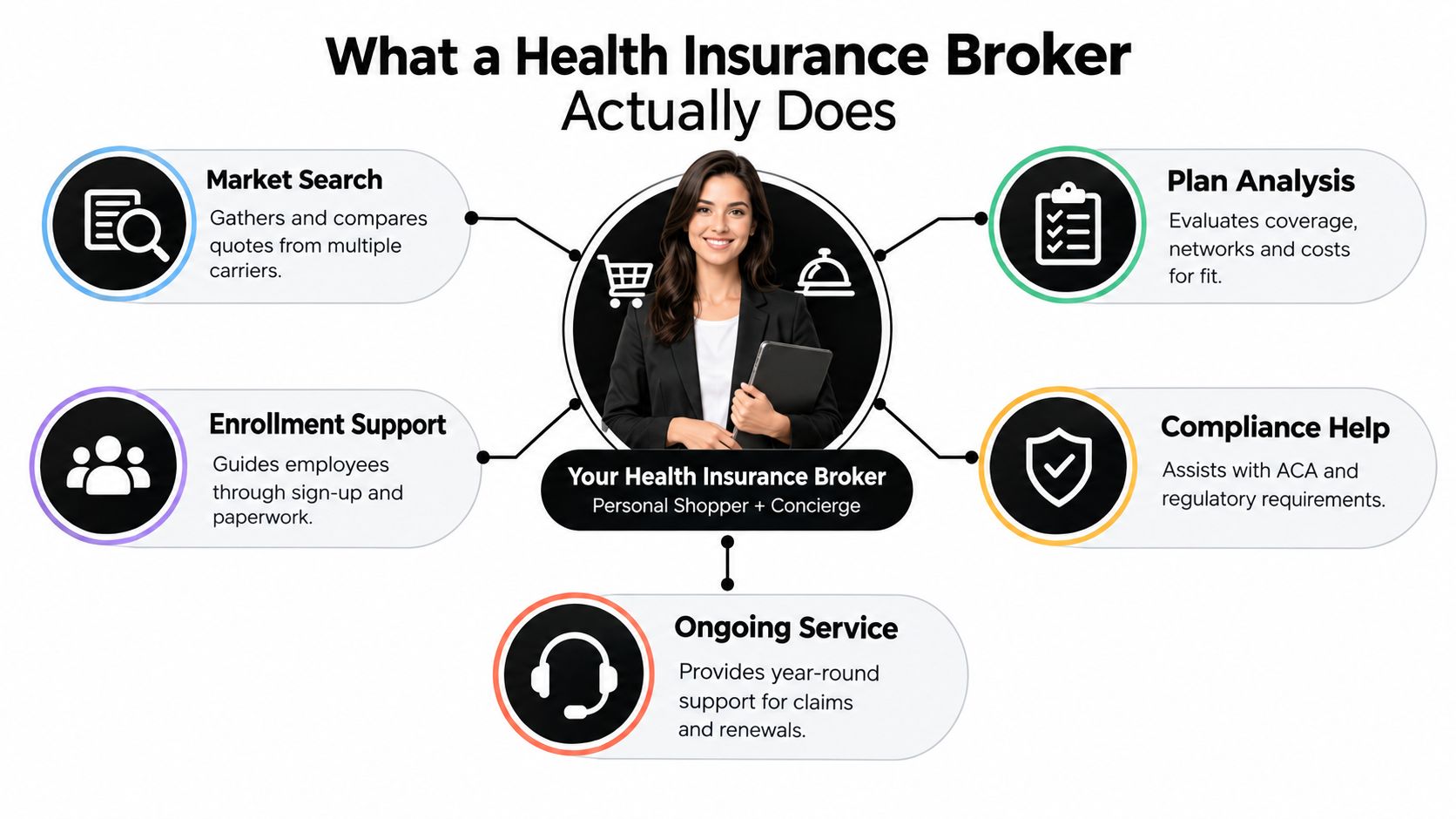
The workflow from search to support
A broker's responsibilities may include:
- Market search: Collecting plan options from represented carriers and organizing them for comparison.
- Plan analysis: Explaining premiums, deductibles, copayments, coinsurance, out-of-pocket limits, provider networks, and prescription coverage in practical terms.
- Enrollment support: Guiding the employer and employees through applications, eligibility information, paperwork, and deadlines.
- Compliance assistance: Helping the employer understand applicable benefit obligations and administrative procedures. A broker is not a substitute for legal counsel, but can support benefits administration.
- Ongoing service: Answering questions, assisting with carrier issues, supporting qualifying life events, and preparing for renewals.
The Centers for Medicare & Medicaid Services says agents and brokers help consumers compare qualified health plans, receive eligibility determinations, and enroll in Marketplace coverage. CMS also describes their role in helping qualified employers and employees enroll through SHOP, including the FF-SHOP Enrollment Pathway and SHOP Agent Broker Portal, in its guidance for agents and brokers.
Broker, agent, and carrier distinctions
People often use “agent” and “broker” interchangeably. The practical questions are which insurers and products the professional can access, how options are selected, and how compensation is handled. Some representatives work closely with one carrier, while others compare offerings from multiple insurers. Ask for that explanation in writing, including any commission or consent controls, rather than relying on the title.
The broker's value should appear in the work product. You should receive a comparison that connects plan features to your workforce and explains the recommendation logic. A forwarded quote followed by silence may speed up a transaction, but it does not necessarily improve the decision.
For business owners assessing support models, Benely's health insurance broker services illustrate services to ask about, including plan comparison, analysis, personalization, and enrollment assistance.
Pros and Cons of Using a Health Insurance Broker
A broker can remove substantial search work, especially when your team doesn't know which plan features deserve attention. Instead of contacting carriers one by one, you can ask the broker to assemble comparable options and explain trade-offs. That support becomes more valuable when employees have different provider preferences, when the company is hiring across locations, or when HR must manage benefits alongside payroll and onboarding.
The case for broker assistance is also reflected in how consumers seek help. A Georgetown review found that brokers were the most common source of help both on and off the Marketplace. Off-Marketplace consumers were nearly twice as likely to receive broker assistance as on-Marketplace consumers, 40% versus 23%, according to the review summarized by InsuranceNewsNet.
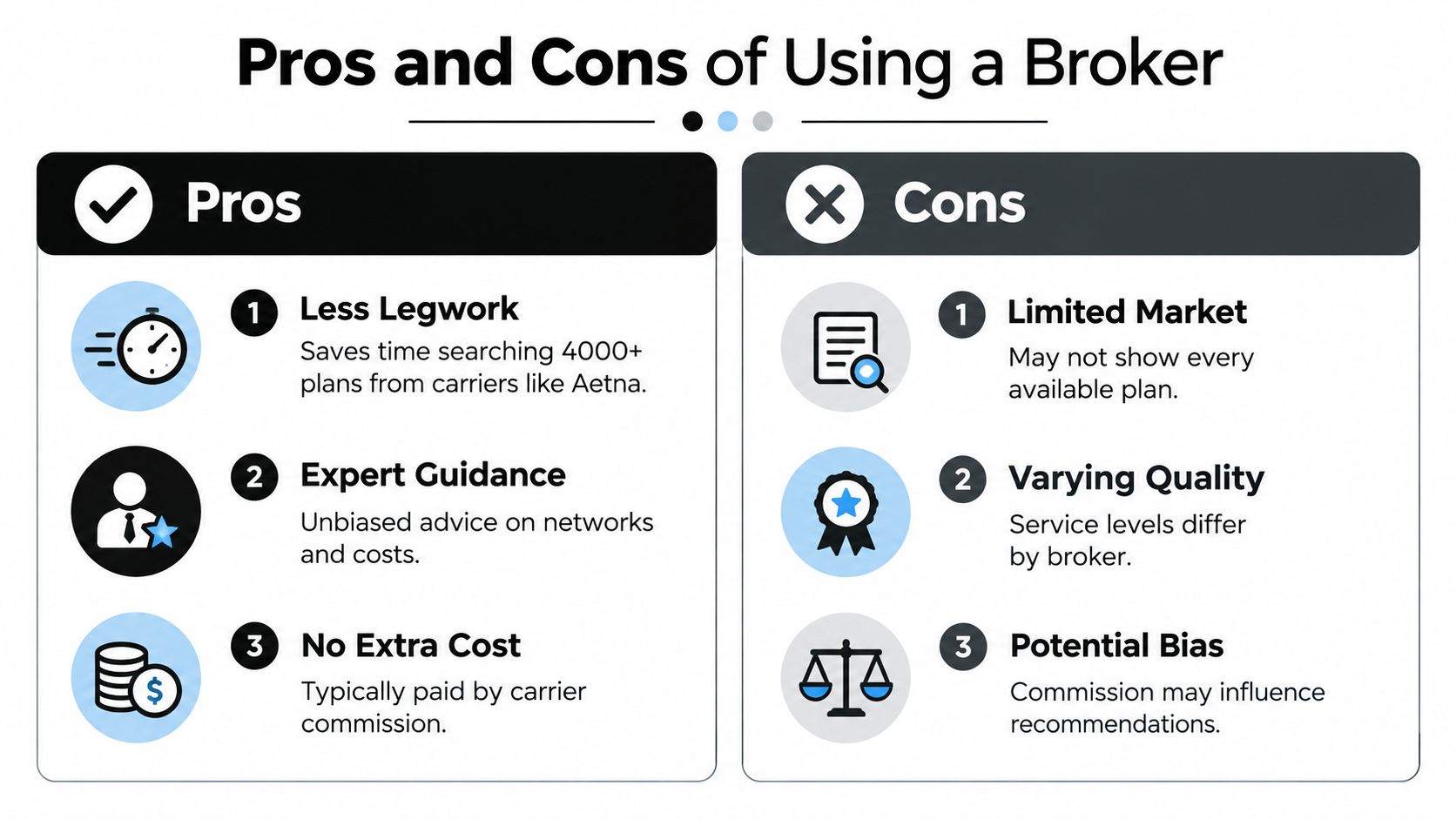
Where a broker can help
- Reduced search burden: Your team spends less time collecting and formatting information.
- Plan interpretation: A knowledgeable advisor can translate insurance language into employee and employer cost consequences.
- Enrollment coordination: The broker may manage communications, forms, deadlines, and carrier follow-up.
- Renewal preparation: A year-round partner can help identify whether the current plan still fits your workforce.
- Administrative perspective: Brokers may recognize compliance and eligibility issues before they become enrollment problems.
Where the arrangement can fall short
The broker may not show every plan available in your market. Market access depends on carrier appointments, product availability, geography, and the broker's business model. Ask for a list of represented carriers and ask how the broker handles options outside that list.
Service quality also varies. One broker may offer structured employee support and prompt issue resolution, while another may focus almost entirely on the sale. A low-friction buying experience can hide weak follow-through during claims questions, eligibility changes, or renewal negotiations.
Compensation creates another consideration. Carrier commissions can align with a conventional brokerage model, but they can also create incentives that deserve disclosure and review. You don't need to assume bad faith. You do need enough information to understand whether recommendations reflect your priorities.
The central trade-off: A broker is valuable when the guidance improves the decision, not merely when it makes enrollment faster.
For a small company with limited HR capacity, the benefits may outweigh the drawbacks. For a larger organization with experienced benefits staff and direct carrier relationships, a broker may need to demonstrate added analytical, administrative, or employee-service value.
How Brokers Get Paid and What It Costs You
Many employers don't receive a separate invoice for ordinary broker support. Instead, the broker may receive a commission from the carrier, with compensation connected to the placement or servicing of the policy. That doesn't mean the service has no economic effect. Compensation can be reflected in the broader pricing structure, and employers should understand how it relates to the plans being recommended.
A broker may also receive other forms of direct or indirect compensation. The details depend on the arrangement, the products involved, and the service agreement. For that reason, “the broker is free” is too simple an explanation for a benefits decision. The better question is, what compensation is expected, from whom, and for which services?
Federal law in the Consolidated Appropriations Act of 2021 requires covered service providers such as brokers and consultants to disclose, in writing, all direct and indirect compensation reasonably expected to be received in connection with services to group health plans, as explained in this broker compensation analysis.
What to request before selecting a partner
Ask for a written explanation covering:
- Payment source: Whether compensation comes from carriers, the employer, or both.
- Compensation type: Whether the arrangement includes commissions, consulting fees, service fees, or other indirect payments.
- Scope of work: Which activities are included, such as plan analysis, employee meetings, enrollment support, and renewal assistance.
- Change implications: Whether compensation changes when you select a different carrier or product.
- Disclosure timing: When you'll receive the disclosure and how updates will be handled.
A written disclosure helps your finance team evaluate total value rather than comparing premiums in isolation. It also gives HR a reference point when leadership asks why a specific carrier or plan design was recommended.
Cost isn't the same as value
A broker can justify compensation by saving staff time, reducing administrative friction, improving employee understanding, or identifying a plan that fits the company more effectively. Those benefits are difficult to judge if the broker provides no documented comparison or decision rationale.
Before renewal, ask the broker to show how recommendations connect to your budget, workforce needs, network priorities, and service expectations. You can also review how insurance brokers get paid to prepare more specific questions about commissions and fees.
Don't treat disclosure as an accusation. Treat it as a normal part of responsible vendor evaluation. Transparent compensation lets you discuss incentives openly and focus on whether the relationship improves your benefits strategy.
Comparing Your Options Beyond a Traditional Broker
A growing company choosing benefits often faces four paths: a traditional broker, direct carrier purchase, a public or private Marketplace, or a PEO. The right comparison is not only about speed. It is about decision quality, control, and who will handle the work after enrollment. Each path moves responsibility among your company, the carrier, the platform, and an outside provider.
Direct buying can fit an employer with experienced benefits staff and a clear understanding of its workforce. The carrier relationship may be straightforward, but your team still needs to compare plans, explain choices to employees, coordinate enrollment, and resolve follow-up issues. A lower-touch route can become expensive if internal staff must fill every service gap.
Marketplace tools organize plan browsing and enrollment. As noted earlier, agents and brokers can help people compare qualified plans, receive eligibility determinations, and enroll. Qualified employers and employees may also receive support through SHOP resources. Availability depends on your company's eligibility, location, and preferred benefit structure.
A PEO follows a different model. It may combine health coverage with payroll, HR administration, and compliance support through a co-employment arrangement. That can suit a fast-growing company seeking fewer vendors. Review pricing, control, plan access, contract terms, and how the arrangement will serve your workforce as the business changes.
Broker vs Direct vs Marketplace vs PEO Comparison
| Option | Best For | Support Level | Trade Off |
|---|---|---|---|
| Traditional broker | Employers wanting comparison and advisory support | Personalized guidance and enrollment assistance | Market access and service quality vary |
| Direct carrier | Teams with benefits expertise and time to manage selection | Carrier-specific support | Less cross-carrier comparison |
| Marketplace | Employers or individuals seeking structured online comparison | Digital enrollment and available assistance | Product and eligibility choices may be limited |
| PEO | Growing companies seeking bundled HR, payroll, and benefits services | Broad administrative support | Co-employment structure and contract terms require review |
Match the path to your operating model
A small business without a dedicated benefits specialist may value hands-on broker support. A mid-sized employer may keep employee communications and approvals in-house while using a broker for market analysis. A rapidly expanding company may compare a brokerage model with a PEO before administrative demands outgrow its internal capacity.
Use consent controls as part of the comparison. Ask who can approve an enrollment or plan change, how authorization is recorded, and who can access employee information. Also compare how clearly each option explains compensation and recommendations. Fast enrollment is useful, but a documented decision with clear controls is safer to operate.
Benely presents PEO solutions alongside benefits and administrative options. Review employee benefits administration outsourcing when deciding whether your main need is plan advice, operational support, or a broader HR solution.
Key Questions to Ask Before You Choose a Broker Partner
A broker can make selection faster, but speed alone does not show that the decision is sound. Ask questions that reveal licensing, compensation, service responsibility, and how the broker controls employee consent. Under NAIC licensing guidance, anyone who sells, solicits, or negotiates insurance, or receives compensation tied to placement, must hold the appropriate insurance producer license.
Use this vetting checklist
- Are you properly licensed? Request the applicable producer license information and verify it with the relevant state insurance authority.
- How are you paid? Ask for written details covering commissions, fees, direct compensation, and indirect compensation. Confirm whether compensation changes the recommendations you receive.
- Which carriers and products do you represent? Find out whether the broker can compare the carriers and plan types that fit your workforce, rather than presenting only a preferred option.
- What happens after enrollment? Identify who handles employee questions, eligibility changes, carrier escalations, renewal analysis, and billing problems.
- What will employees see? Review the enrollment experience, educational materials, decision-support tools, and available help.
- How do you protect consent and identity? Ask how the broker confirms that an employee or employer authorized an enrollment, application, or plan change.
Consent controls deserve a place beside pricing and plan design. CMS finalized 2026 Marketplace rules allowing it to suspend brokers immediately when there is an unacceptable risk to eligibility determinations, operations, or information-technology systems. A 2026 GAO report also said CMS needs stronger controls to prevent unauthorized actions by agents and brokers. For an employer, the practical lesson is clear: identity checks, approval records, and access controls belong in the selection process.
Ask to see the process, not just the promise
Request a sample authorization workflow with sensitive information removed. Ask whether the broker records who approved a change, when approval occurred, what information the employee or employer saw, and how the record can be retrieved. Also ask how the team responds when someone reports that a plan changed without permission.
Test the broker with ordinary failure scenarios. What happens when an employee cannot complete enrollment, a carrier rejects an application, or an eligibility record conflicts with payroll? Strong answers should name the responsible people, systems, escalation paths, and required documentation. A general promise to “help” does not show how the issue will be handled.
Finally, ask how the broker measures service after enrollment. Request examples of response standards, renewal deliverables, and unresolved-case tracking. Reviewing Benely's centralized platform can provide a comparison point for plan comparison, enrollment, and connected benefits administration, even if you select another provider.
Next Steps to Decide and Move Forward With Confidence
A founder facing renewal has two competing priorities: decide quickly and decide well. Start by documenting your current plan, employer contribution approach, employee concerns, renewal workload, and unresolved service issues. Then rate how reliably your team compares options, explains coverage, maintains records, and answers employees. Gaps in those steps show where outside support may improve the decision.
Set a budget and define the results you expect from a partner. These may include clearer plan comparisons, stronger enrollment controls, better employee communication, simpler administration, or more reliable renewal preparation. Ask each candidate to connect its recommendation to those results instead of presenting a generic menu.
Review how the decision will affect employees, not only the premium. Benefits can support recruitment and retention, but employees also judge an employer by how clearly choices are explained and how problems are handled. Ask who can approve changes, how commissions are disclosed, and whether your company controls consent before employee or plan information is changed. Those safeguards affect decision quality as much as speed.
Use a final test: choose a broker when the relationship improves decision quality, administrative reliability, and employee support. Choose direct buying, a Marketplace, or a PEO when that model better fits your expertise, desired control, and operating structure. Revisit the choice when your workforce, locations, plan strategy, or internal HR capacity changes.
Benely helps employers compare health plans, set benefits budgets, automate enrollment, and connect benefits administration with payroll, onboarding, and compliance workflows. Visit Benely to explore a structured way to assess whether broker support fits your coverage decisions and day-to-day benefits management.