 Employee Benefits
 HR & Compliance
 Technology
 Wellness
 PEO Solutions
Florida does not have a broad private-sector family leave mandate, and no enacted Florida law gives most private employees a statewide paid family leave right. For most employers, the rule set is still federal FMLA with up to 12 weeks of unpaid, job-protected leave, plus a few narrow Florida protections that apply in specific situations.
That catches a lot of employers off guard. They search for the Florida Family Leave Act, assume there's a state law they missed, and then build the wrong policy. The problem isn't just terminology. It creates bad manager guidance, sloppy handbook language, and leave decisions that drift into risk.
The practical answer is simpler than people make it. Stop looking for one big Florida statute that governs everyone. Start with the actual layers that do: federal FMLA for covered employers, Florida's domestic violence leave rule, and separate leave protections for state employees. That's the compliance map that matters right now.
Table of Contents
- The Truth About the Florida Family Leave Act Today
- What the Proposed Florida Family and Medical Leave Act Would Have Done
- Federal FMLA as the Baseline for Florida Employers
- Comparing Federal and Narrow Florida Leave Protections
- An Employer's Compliance Playbook for Florida Leave
- Sample Policy Language and Compliance Checklist
- How Benely Simplifies Leave Administration and FAQs
The Truth About the Florida Family Leave Act Today
Stop searching for one Florida statute that covers family leave for private employers. It does not exist.
That mistake causes messy handbooks, bad manager scripting, and leave decisions that create risk for no good reason. If your policy refers to a Florida Family Leave Act as if it were an enacted statewide private-sector law, fix it now. Clear out the label and replace it with the rules your team must follow.
Why employers keep getting this wrong
The confusion is predictable.
One source is the failed proposal from the 2022 session, Senate Bill 688, which used the name Florida Family and Medical Leave Act and still gets cited as if some version survived. It did not, as shown in the filed bill text and legislative history for SB 688.
Another source is plain shorthand. Managers hear "family leave" and lump federal rights, state employee protections, and narrow Florida leave rules into one bucket. That shortcut leads to sloppy answers and overpromising.
Media coverage adds to the problem by using broad labels for a narrow set of rules.
What governs Florida employers
For private employers, the starting point is federal FMLA if the employer and employee meet coverage requirements. Then you add the Florida-specific rules that apply to the workforce you have, not the statewide mandate people assume exists.
Florida does have enacted leave protections, but they are limited in scope. State employees have family and medical leave protections under Florida Statute 110.221. Employees may also have rights under Florida's domestic violence leave law.
Here is the practical rule I give Florida employers: write your process around federal FMLA first, then layer in only the Florida rules that apply.
That approach keeps your policy clean. It also prevents a common compliance failure. HR teams often promise vague "state family leave" in a handbook, then miss the narrower state protections that do require attention.
What smart HR teams should do now
Audit your handbook language. Remove any reference that treats a Florida Family Leave Act as a current broad private-sector law.
Train managers to stop freelancing with umbrella terms. They should know which requests trigger FMLA review, which ones may involve domestic violence leave, and which requests call for a check of employer policy rather than state statute.
Keep an eye on 2026 pressure points too. The legislative push for broader leave has not disappeared, and the gap between what employees expect and what Florida law requires keeps getting wider. That gap is where disputes start.
What the Proposed Florida Family and Medical Leave Act Would Have Done
The failed proposal matters because many employers still think some version of it took effect. It didn't.
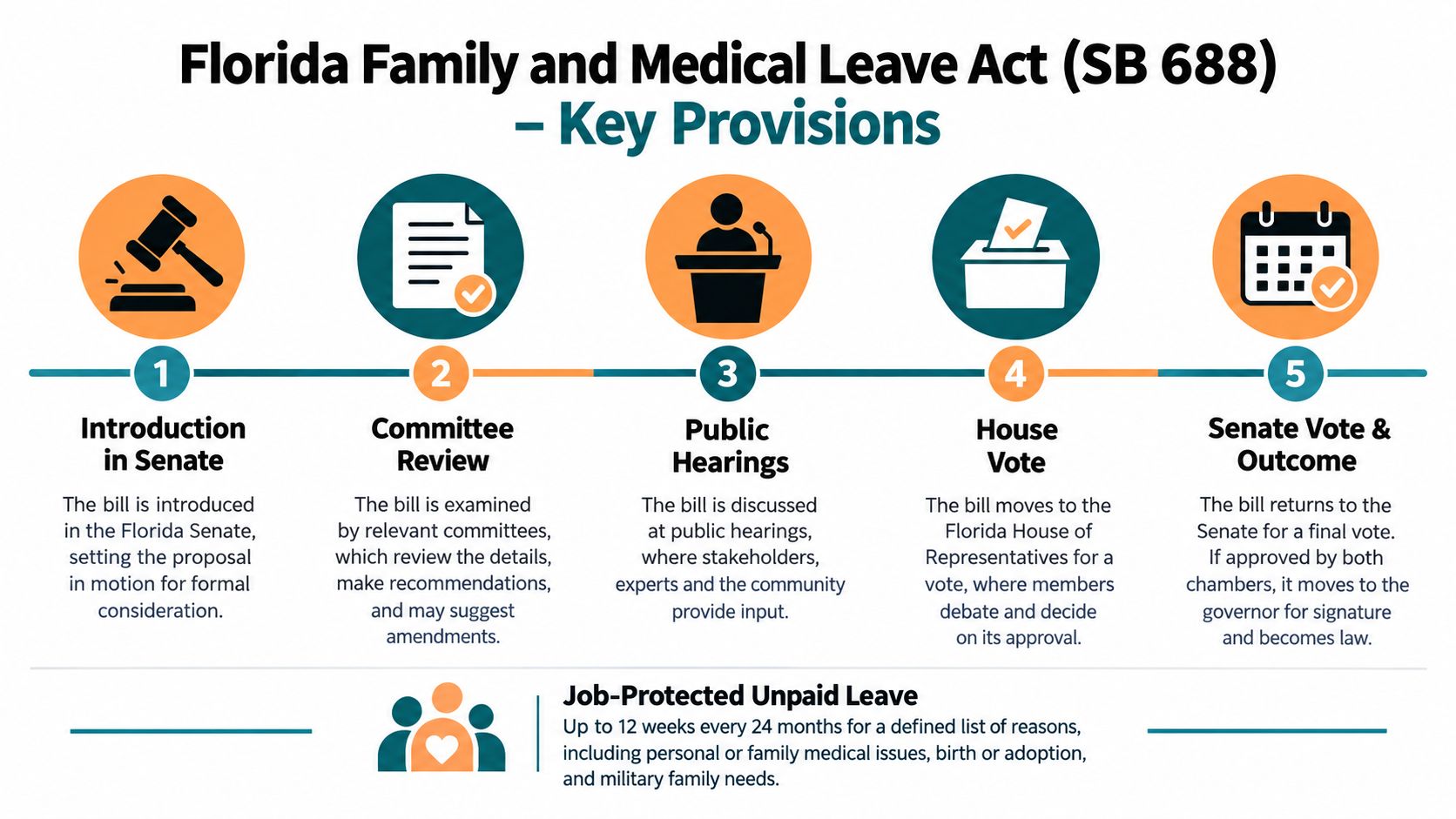
Florida's Senate Bill 688 was introduced in the Senate during the 2022 session, and the bill text proposed creating a new Chapter 444 with 89 sections, numbered 444.001 through 444.019, with an effective date of July 1, 2022, according to the Florida Senate bill text for SB 688. It also moved through the legislative process before dying in Commerce and Tourism on March 14, 2022, which is why people still cite it as if it partially survived. It didn't.
What the bill was trying to create
At a practical level, the proposal would have required employers to allow certain employees to take family and medical leave to bond with a minor child after birth, adoption, or foster care placement. It also would have prohibited adverse action for requesting or using leave, and it would have required leave taken under the proposal to run concurrently with federal family and medical leave rights, as stated in the SB 688 filed text.
That last point is where employers often get tripped up. They assume "concurrent with FMLA" means the law exists because the concept sounds operationally familiar. But a proposed coordination rule is still just a proposal until passed.
The assumption employers need to drop
Here's the bad assumption: "Florida already has its own version of family leave, so we're probably covered if we mention it in the handbook."
No. You're not covered by vague language.
If a successor bill ever passes, you'll need to review at least these areas immediately:
- Eligibility logic: Who qualifies, and after what service requirement.
- Covered reasons: Birth, bonding, caregiving, foster placement, or other family medical events.
- Anti-retaliation rules: What managers can and can't say once leave is requested.
- Concurrent administration: How state leave and federal leave run together.
The cleanest policy language is the most accurate language. If a law hasn't passed, don't write your handbook as if it has.
The smart move is to track proposals, not pre-adopt them. Build a policy that reflects current obligations, then keep a short update plan ready if Florida revives a broader leave bill.
Federal FMLA as the Baseline for Florida Employers
Stop searching for a broad Florida family leave statute for private employers. Your day-to-day leave program in Florida usually rises or falls on federal FMLA administration.
For most private employers, the first question is simple. Are you covered by FMLA, and is the employee eligible? If the answer is yes, that is the framework HR needs to run. If the answer is no, you do not fill the gap by inventing a "Florida family leave" policy from memory or copying a handbook line from another company.
Start with these three checks before you discuss approval, timing, or job protection:
| Check | FMLA rule | Practical Florida example |
|---|---|---|
| Employer coverage | Covered private employers generally have 50 or more employees within 75 miles | A multi-location employer in Central Florida may be covered if enough employees report within that radius |
| Length of service | The employee must have worked for the employer for at least 12 months | A strong performer hired this year may still fail the service test |
| Hours worked | The employee must have worked at least 1,250 hours in the prior 12 months | A part-time employee with a lighter schedule may not qualify yet |
Managers create problems. They hear "baby," "surgery," or "my parent needs care" and start making promises. Train them to do one thing instead. Route every possible leave request to HR or your leave administrator the same day.
Qualifying reasons under FMLA are familiar, but sloppy shorthand causes mistakes. Covered leave can include birth and bonding, adoption or foster placement, the employee's own serious health condition, care for a spouse, child, or parent with a serious health condition, and certain military-related leave needs. Relationship rules matter. So do certification rules.
A common Florida myth needs to die. Caring for a grandparent, sibling, or partner does not automatically mean FMLA applies. HR has to confirm the relationship fits the law before you designate leave.
Administration is more than approving time off. You need a consistent process for notices, certification, designation, benefit continuation, tracking leave usage, and return-to-work handling. Employers get in trouble when they treat FMLA as a courtesy program instead of a documented workflow.
If your team needs a broader multi-state reference for policy setup and process design, use Benely's guide to U.S. family and medical leave rules for 2026.
Comparing Federal and Narrow Florida Leave Protections
Most Florida employers don't need a giant state-law matrix. They need one clean comparison that separates broad federal obligations from narrow Florida-specific ones.
What applies to whom
A private employer with a typical workforce usually lives under federal FMLA if covered. A Florida-specific family or medical leave obligation may apply only in limited settings, especially for state employees. Domestic violence leave is different again. It reaches employers more broadly but covers a much narrower reason for leave.
| Provision | Federal FMLA | Florida State-Employee Leave (Rule 60L-34.006) | Florida Domestic Violence Leave (§ 741.313) |
|---|---|---|---|
| Who it applies to | Covered employers under federal law | State employees under Florida's state-employee framework | Florida employers covered by the domestic violence leave statute |
| Main purpose | Family and medical leave for qualifying events | Parental or family medical leave for state employees | Leave connected to domestic or sexual violence circumstances |
| Duration | Up to 12 weeks of unpaid, job-protected leave under the federal framework already discussed above | Separate state-employee protections and reinstatement rights under Florida law | Up to 3 working days of leave in any 12-month period, and it may be paid or unpaid at employer discretion under Florida Statute 741.313 |
| Job restoration | Yes, if FMLA applies | Yes, with reinstatement to the same or equivalent job under the state-employee statute described earlier | The statute focuses on the leave right itself rather than acting as a broad family-leave system |
| Common HR mistake | Assuming every birth or caregiving event qualifies automatically | Forgetting state employees may have separate rights | Ignoring this statute entirely because it isn't framed as "family leave" |
Two examples that clear up the confusion
A 40-person Tampa retailer may have no Florida state-employee issues at all. Its analysis starts with whether federal FMLA coverage exists. If it isn't a covered employer, the company still can't ignore other targeted rules such as domestic violence leave.
A Tallahassee employer with state workers is a different animal. State-employee leave rights need their own handling, and the handbook can't lazily collapse all leave into one "Florida family leave" paragraph.
One more point. If you want to compare how other states are building true paid leave programs, Benely's overview of Maryland paid family leave is a useful contrast because it shows what an actual statewide framework looks like.
An Employer's Compliance Playbook for Florida Leave
Most Florida leave problems come from process failures, not from employers refusing leave outright. Requests sit in inboxes. Managers improvise. Nobody verifies eligibility the same way twice.
That is fixable.
Start with a quarterly clean-up project and assign one owner. If nobody owns leave intake, your process will drift.
Step one through step four
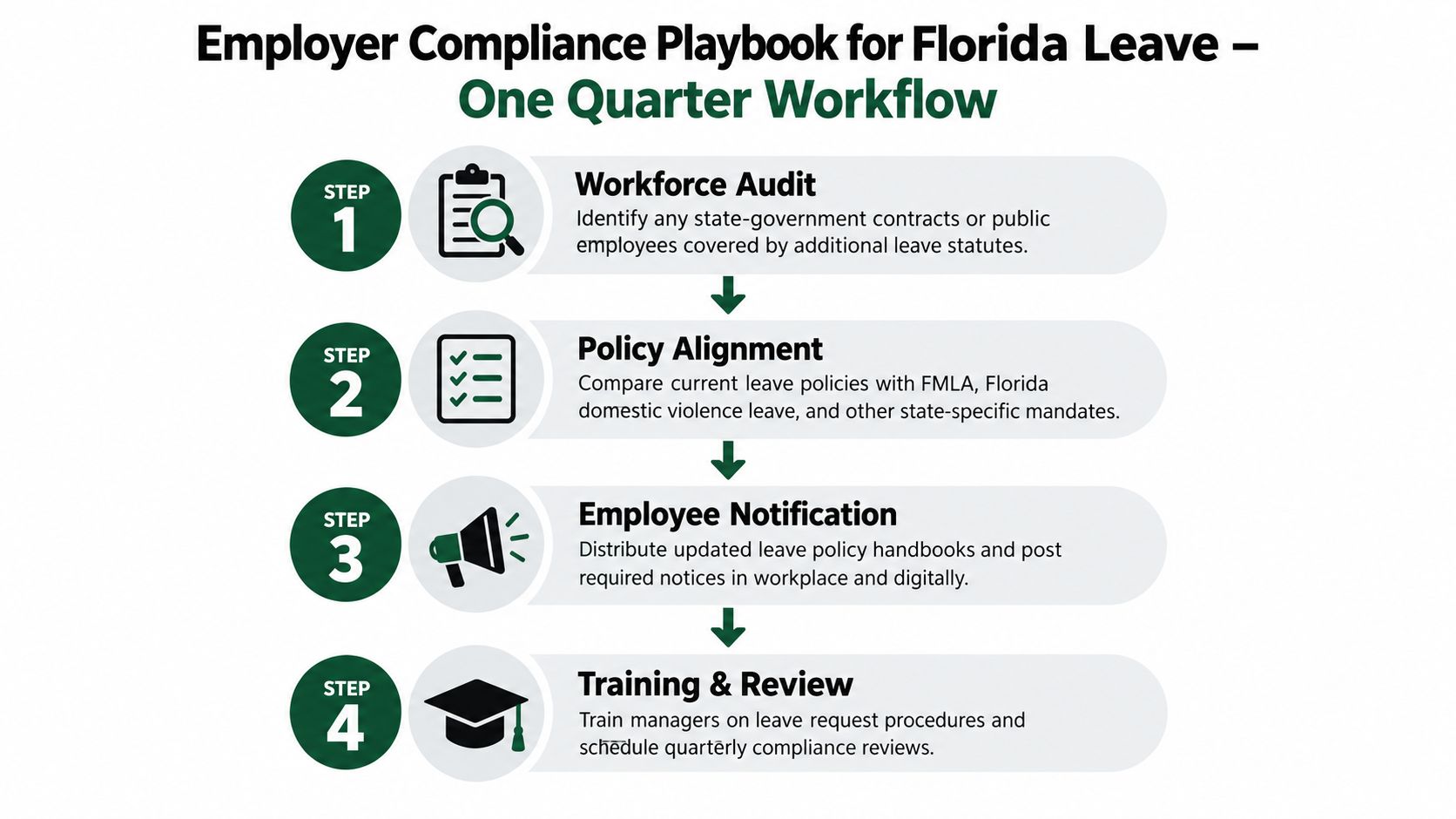
Audit your workforce first. Separate private employees, any state-government employee populations, and any locations that may change federal FMLA coverage analysis.
Rewrite your policy language. Your handbook should cite federal FMLA as the primary entitlement where applicable and reference Florida's narrower statutes only where they apply. Drop vague references to a Florida Family Leave Act.
Standardize intake and designation. Every leave request should hit one workflow. HR should review timing, reason, eligibility status, and whether documentation is required.
Train managers. Their job is to recognize a possible leave trigger and escalate it. Their job is not to interpret eligibility on the fly.
A visual process helps teams keep the sequence straight.
Later in the rollout, use a short explainer for managers:
The details employers usually miss
The federal timing rules matter. The U.S. Department of Labor notes that eligibility depends on covered employer status, 12 months of service, 1,250 hours worked in the prior year, and a worksite with 50 employees within 75 miles, as outlined on the Department of Labor FMLA page. That's why your intake form needs headcount geography, hire date, and hours-worked verification built in from day one.
For recordkeeping and administration, tighten these habits:
- Use one intake channel: Don't let requests die in a shared HR inbox.
- Keep certification handling restricted: HR, not frontline supervisors, should handle medical certification logistics.
- Track intermittent leave cleanly: Spreadsheets fail fast once leave becomes irregular.
- Retain records consistently: Keep a disciplined archive because leave disputes often turn on documentation gaps, not policy intent.
Small employers don't need a complicated leave department. They need one accountable owner, one clean policy, and one repeatable workflow.
Sample Policy Language and Compliance Checklist
Most handbooks either say too little or promise too much. You want neither.
Drop-in policy language
Use language like this and then tailor it to your business:
Family and Medical Leave Policy
This policy governs family and medical leave entitlements under the federal Family and Medical Leave Act (FMLA) where applicable and supplements those rights with any narrower Florida leave protections that apply to the workforce, including Florida domestic violence leave. Eligible employees may request unpaid, job-protected leave for qualifying family and medical reasons under federal law. Employees seeking leave must provide notice as soon as practicable, cooperate with certification requirements where allowed, and follow call-out procedures unless emergency circumstances prevent it. When required by applicable law, the company will maintain protected benefits during leave and will restore eligible employees to the same or an equivalent position at the end of approved leave.
That language does two things right. It makes FMLA the main framework, and it doesn't invent a Florida statute.
What your policy should expressly address
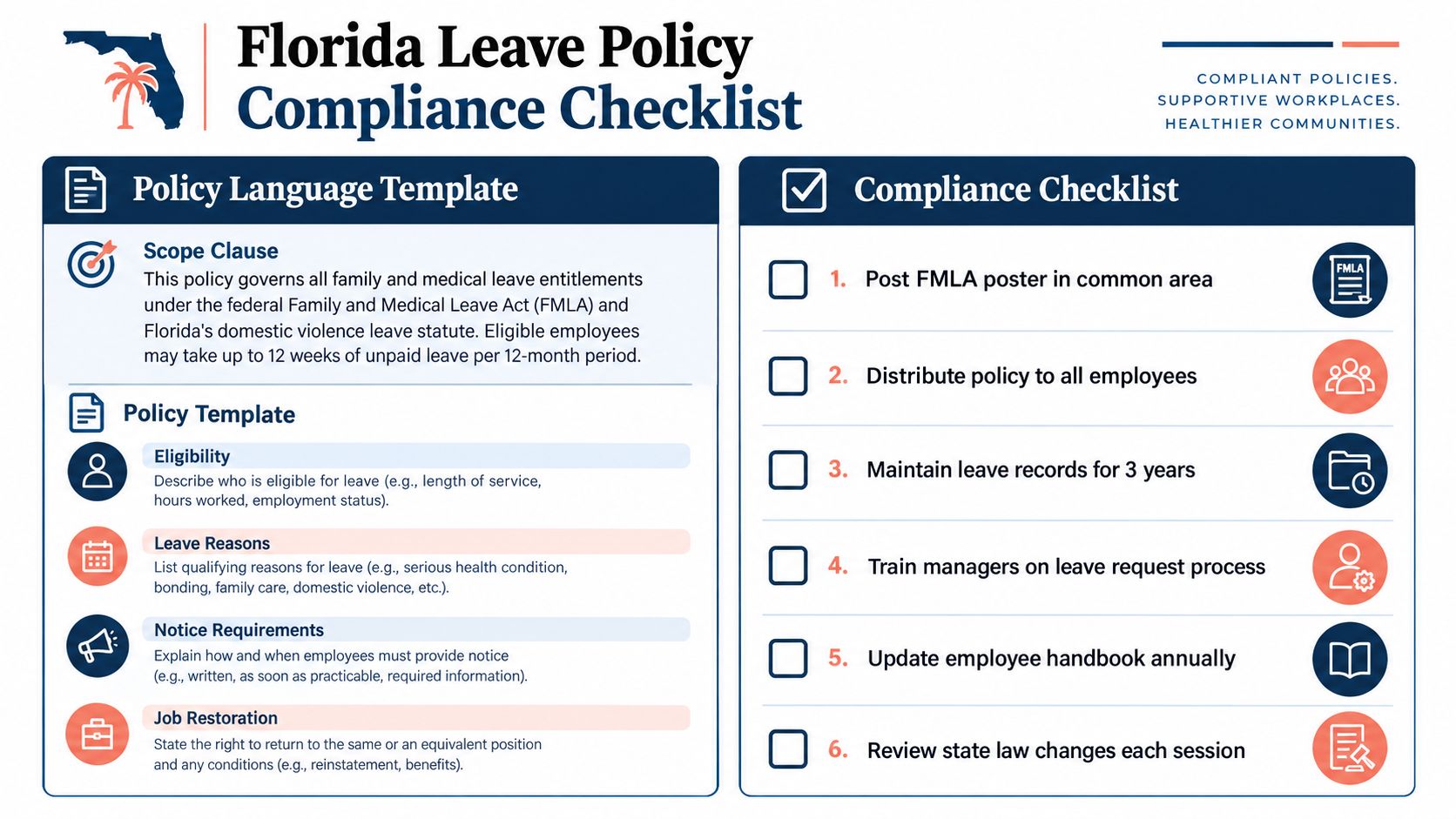
Your handbook section should answer these points in plain English:
- Eligibility rules: Who qualifies under federal coverage tests and how service and hours are calculated.
- Covered leave reasons: Birth, bonding, adoption, foster placement, serious health condition, caregiving, and any supplemental state rule that applies.
- Intermittent leave: When reduced schedule or intermittent leave may be used and how employees report it.
- Certification and return to work: What documentation HR may request and whether fitness-for-duty steps apply.
- Benefit continuation and reinstatement: What happens to benefits during protected leave and what return rights exist.
If you're refreshing your handbook anyway, Benely's employee benefits compliance checklist is a practical companion for broader policy review.
Compliance checklist for growing Florida employers
These are the checks I tell employers to run, in order:
- Covered employer status verified
- 50-employee and 75-mile radius analysis documented
- Handbook policy updated with FMLA-first language
- Florida domestic violence leave addressed separately
- State-employee leave flagged if relevant
- Leave request intake path assigned to one HR owner
- Eligibility notice template prepared
- Rights and responsibilities notice prepared
- Designation notice process standardized
- Medical certification forms reviewed by HR
- Intermittent leave tracking method tested
- Fitness-for-duty language reviewed
- Manager training completed
- Records retention process documented
- Annual legislative review scheduled
The most commonly missed items are the radius analysis, domestic violence leave language, and manager training. Growing employers focus on the handbook and forget the workflow. That's where the actual mistakes happen.
How Benely Simplifies Leave Administration and FAQs
Stop searching for a Florida Family Leave Act form set. What Florida employers need is a leave process built around federal FMLA, the state's narrower leave rules, and a triage path for requests that fall outside both.
That is the admin problem. A supervisor hears "family leave," HR gets an informal text or email, and the team has to decide whether the issue belongs under FMLA, domestic violence leave, workers' compensation, an ADA accommodation review, PTO, or an unpaid personal leave policy. If that sorting happens from memory, errors pile up fast.
A centralized HR platform fixes the part employers usually botch. Intake gets documented the same way each time. Policies live in one place. Leave dates, notices, and supporting records stay tied to the employee file instead of scattered across inboxes and spreadsheets. For smaller employers weighing outside support, PEO comparisons also matter because some providers offer more consistent leave workflows than a stretched in-house team.
Benely is one option that combines benefits administration, HR support, and PEO comparison tools in one workflow. That helps Florida employers connect leave intake, policy updates, benefits coordination, and employee communications without building the whole system from scratch.
Florida leave FAQ quick reference
| Question | Direct Answer |
|---|---|
| What should HR do when an employee asks for "FMLA" but is not eligible? | Do not stop at "not eligible." Send a written ineligibility response, then review domestic violence leave, ADA accommodation duties, PTO, sick leave rules if your policy offers them, and whether unpaid personal leave should be considered under a consistent policy. |
| How should Florida employers document domestic violence leave? | Use a separate intake and filing process. Limit access, collect only what the statute and your policy require, and keep those records out of general personnel files because these requests often contain highly sensitive safety information. |
| Can workers' compensation leave run at the same time as FMLA? | Yes, if the injury also qualifies as a serious health condition. Designate FMLA promptly instead of treating workers' comp as a completely separate bucket, or you risk extending leave longer than necessary through poor tracking. |
| What is the right first step when a manager receives a verbal leave request? | Train managers to stop deciding and start routing. They should document the date, capture the basic reason in neutral terms, and hand the issue to one HR owner the same day. |
| How should HR handle intermittent absences that look suspicious but may still be protected? | Track the pattern, require the allowed certification or recertification, and enforce your normal call-out rules unless a protected leave rule says otherwise. Do not let frustration turn into off-the-cuff discipline. |
| What trips up Florida employers most often? | They chase a Florida statute that does not broadly exist, then miss the rules that do apply. The fix is simple: build your process around FMLA first, add Florida-specific exceptions, and review proposed 2026 changes without treating them as current law. |
The myth worth killing is simple: no broad Florida Family Leave Act means leave administration should be easy.
It is not easy. It is narrower than many HR teams expect, but risk comes from misrouting requests, using inconsistent documentation, and letting managers improvise. If your team is still searching for a law that is not on the books, you are solving the wrong problem. Benely helps employers organize leave administration, compare support options like PEOs, and align benefits, policy language, and HR workflows in one place.