 Employee Benefits
 HR & Compliance
 Technology
 Wellness
 PEO Solutions
Payroll is due Friday. Your office manager is chasing missing timesheets. A new hire wants to compare medical plans. Your controller is asking who owns the payroll tax filings. At the same time, your managers still need to interview candidates, coach employees, and keep the business moving.
That's the moment many small and mid-sized businesses start looking at a PEO.
The problem is that the PEO co-employment relationship is often explained in a way that sounds simple but leaves out the part founders and HR managers need to know. Who controls the employees? Who files taxes? Who carries the risk when a task falls into a gray area? And does co-employment protect you from joint-employer problems, or just organize HR work more clearly?
This guide answers those questions in plain English so you can evaluate the model with fewer surprises.
Table of Contents
- Why Co Employment Matters for Growing Businesses
- How the PEO Co Employment Relationship Actually Works
- Who Handles What Between PEO and Client
- Benefits and Trade Offs for HR and Finance Teams
- Common Misconceptions About Co Employment and Joint Employer Risk
- How to Decide If Co Employment Fits Your Business
- Next Steps for Evaluating PEO Options With Confidence
Why Co Employment Matters for Growing Businesses
A 35-person company can feel simple on paper and overloaded in practice. Managers still run the workday, but the employer side of the job starts spreading across payroll, benefits, leave, tax filings, workers' compensation, and recordkeeping. If no one has clearly claimed each duty, small gaps turn into real risk.
That is why co-employment matters for growing businesses.

The pressure point for SMBs
Early on, one person can usually keep HR administration together with software, spreadsheets, and good intentions. Growth changes that. More employees mean more enrollment questions, more leave tracking, more notices, more payroll variables, and more chances for something to sit in a gray area because everyone assumed someone else had it covered.
That default responsibility gap causes many of the problems founders later describe as “compliance surprises.”
A controller may assume the payroll provider handles a filing. A manager may believe HR is tracking leave paperwork. An owner may expect the benefits broker to solve employee eligibility issues. Sometimes each party handles part of the task, but no one owns the full process from start to finish.
Why more companies pay attention to this model
PEOs are common enough that they deserve a serious look, not a quick dismissal. Industry reporting from NAPEO describes a large and growing PEO market, with millions of covered worksite employees and meaningful use among smaller employers, as noted in the PEO industry footprint analysis published by NAPEO.
The practical takeaway is simple. As the administrative employer workload grows faster than the leadership team, many businesses look for a model that organizes those duties more clearly.
What co-employment helps you solve
Co-employment does not remove your role as the business running the workforce. It can, however, reduce confusion about who handles specific employer functions and where processes live.
That distinction matters because many buyers assume a PEO acts like a legal shield. Value is usually more operational than magical. A PEO relationship can assign and manage defined HR and payroll responsibilities, but your company still needs clear decisions, active managers, and a written agreement that spells out ownership.
A useful way to evaluate the model is to ask:
- Who directs the employees' day-to-day work?
- Who owns each administrative duty from start to finish?
- What happens if the contract is silent on a task, late on a filing, or vague about approvals?
Those questions help separate a well-structured co-employment arrangement from a risky assumption that “the PEO has it.”
Benely's overview of PEO HR solutions is one example of the service categories buyers often compare when deciding which responsibilities might sit with a PEO and which should stay in-house.
How the PEO Co Employment Relationship Actually Works
A founder approves a termination, payroll processes the final check, and then a question hits the team: who was supposed to handle the notice, the deductions, and the state-specific paperwork? That moment explains co-employment better than any sales definition. The relationship matters most when a task falls between the cracks.
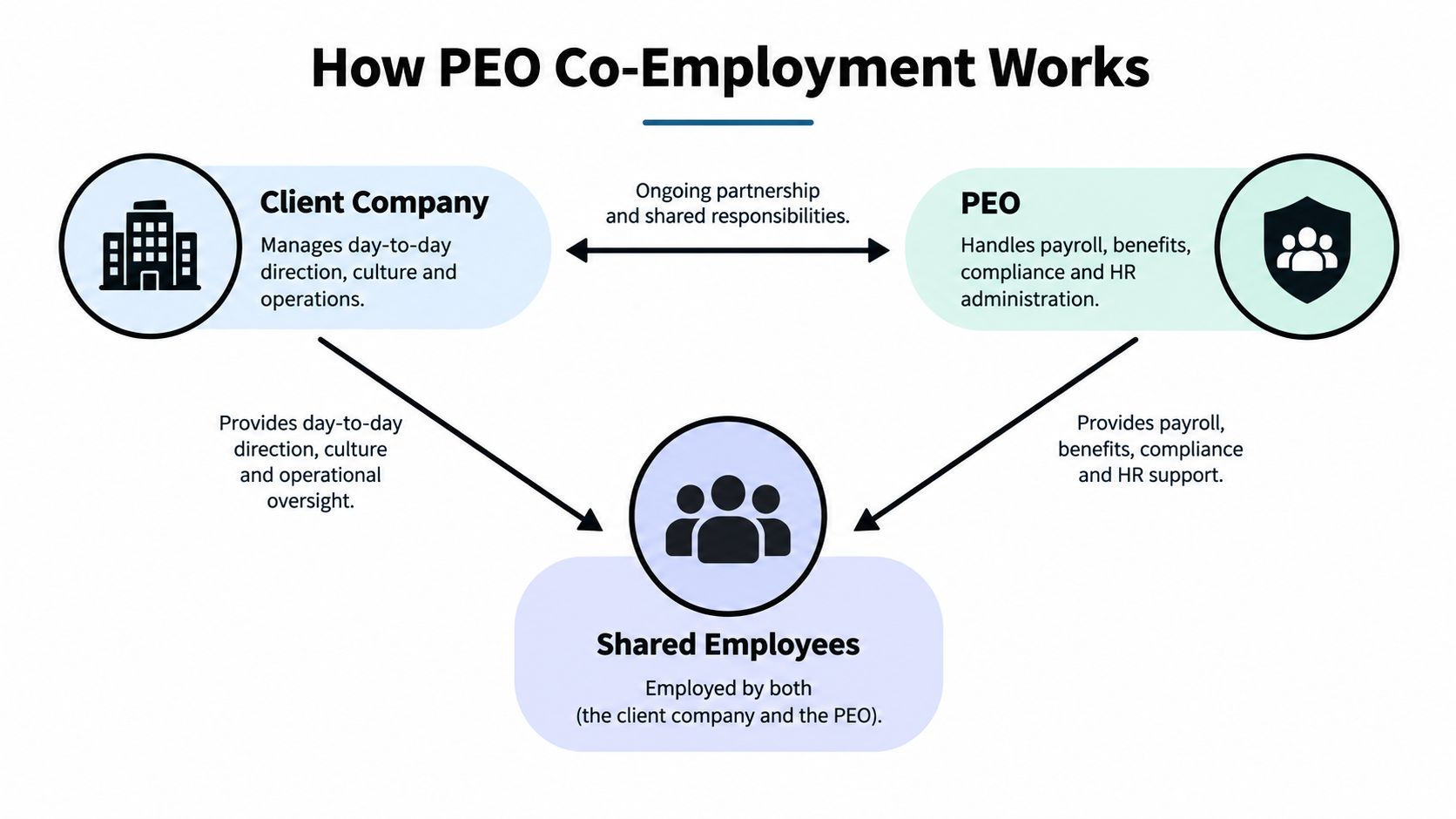
A PEO co-employment relationship works like a shared employer arrangement with separate responsibilities. Your company remains the business employer directing the work. The PEO takes on specific employer functions that the agreement assigns to it, often in payroll, benefits administration, and parts of HR compliance.
Start with the operating reality
A property management comparison helps. The building owner still decides what the property is for, who oversees it, and what standards apply. The property manager may collect rent, maintain records, and coordinate vendors. The manager handles defined functions, but ownership and core control stay with the owner.
A PEO relationship follows the same logic. Your company controls the job itself. The PEO administers selected employer tasks around that job.
That sounds straightforward until people hear the phrase "co-employer" and assume every duty is shared equally. It is not. Co-employment is an allocation model.
Why the written allocation matters
The legal agreement is what turns this from generic outsourcing into a co-employment arrangement. It assigns certain employer responsibilities to the PEO while your company keeps others.
State law often describes that structure directly. Washington law, for example, treats coemployment as an ongoing contractual relationship, not a temporary staffing setup. That distinction helps clear up a common confusion. A PEO does not send workers out to run someone else's operation for a short-term project. Your employees stay your employees in the practical sense that managers still supervise them, set schedules, review performance, and make business decisions.
The harder issue is the default responsibility gap.
If the agreement clearly assigns payroll tax filing to the PEO, everyone knows where that duty sits. If the agreement is vague about leave tracking, wage notice delivery, handbook updates, or approval workflows, the risk does not disappear. It sits with whoever still has legal responsibility under the contract and applicable law, and sometimes that answer is messier than buyers expect.
That is why co-employment should never be treated as a legal shield. It is a framework for dividing employer functions. It can reduce administrative burden and improve consistency, but it does not erase the client's obligations as the operating employer.
A short explainer can help if you want a visual walkthrough before reviewing contracts:
What this means in practice
Three points usually matter most:
- Your company directs the work. Managers assign duties, enforce performance standards, and make operational decisions.
- The PEO handles the functions it is given. Those may include payroll processing, benefits administration, and defined compliance tasks.
- Unassigned or unclear duties can still create exposure. If the contract is silent, late approvals happen, or data is wrong, the problem does not automatically transfer to the PEO.
That last point causes a lot of confusion. Joint involvement does not mean equal ownership of every employment issue. It means two parties have roles tied to the same workforce, and those roles need to be spelled out with enough detail to hold up when something goes wrong.
What co-employment does not change
Your managers still manage people.
Your company culture still belongs to your company.
Employee claims, tax questions, wage disputes, and policy mistakes still depend on who controlled the decision, who had the duty, and what the agreement says.
Who Handles What Between PEO and Client
A common failure point looks simple at first. Payroll closes on Thursday. An employee reports a missed deduction on Friday. Your manager assumes the PEO fixed it. The PEO says it never received approved changes. By Monday, the problem is no longer the deduction. It is the gap between tasks people assumed were covered and tasks no one clearly owned.
That is why role allocation matters so much in a co-employment arrangement. Co-employment links two parties to the same workforce, but it does not spread every employer duty across both parties by default.
One state rule gives a useful picture of the administrative side. South Dakota's co-employment rule describes duties a PEO may handle, including wage payment, payroll tax withholding and remittance, workers' compensation costs and insurance premiums, certain benefit administration, and required tax filings, as outlined in the South Dakota co-employment rule summary.
The split in plain language
The PEO usually runs the HR administration engine. Your company still drives the business.
A practical comparison helps. The PEO often acts like the back office for employment administration. Your leaders still decide who to hire, what standards apply, how work gets done, and what happens when performance falls short. If a supervisor changes a schedule, approves overtime, or ignores a safety issue, those are operating decisions. A PEO can support the process around those decisions, but it does not take control of the worksite just because it processes payroll or benefits.
PEO vs Client Responsibility Split
| Responsibility Area | PEO Typically Handles | Client Typically Retains |
|---|---|---|
| Payroll processing | Wage and salary administration | Timekeeping inputs and approval practices |
| Payroll taxes | Withholding, remitting, and related filings | Accurate worksite payroll data |
| Benefits administration | Welfare and retirement benefit handling | Choosing what fits workforce strategy |
| Workers' compensation administration | Premiums and related administration | Workplace conditions and daily safety enforcement |
| Required employment documents | Preparing and filing required tax returns and related documents | Worksite records tied to supervision and operations |
| Employee supervision | HR administration support | Daily direction, scheduling, coaching, and performance management |
| Hiring and operational staffing choices | Administrative onboarding support where offered | Recruiting decisions, final selection, role design, and team structure |
The responsibility gap that causes confusion
The harder question is not who handles the obvious tasks. The harder question is what happens when the contract is silent, the workflow breaks, or both sides touch the same issue.
Rhode Island's statute points to a rule many business owners miss. Employer duties that are not expressly assigned to the PEO usually stay with the client, and employees may be able to enforce certain rights against either party depending on how the agreement allocates duties, as reflected in the Rhode Island statute on professional employer organizations.
If the agreement does not clearly transfer a duty to the PEO, assume your company still needs to handle it unless the contract says otherwise.
This is also where joint-employer confusion starts. Shared involvement does not mean the PEO becomes a legal shield for every wage, leave, policy, or employee-relations problem. Responsibility usually follows control, contract language, and the facts of what each party did.
Questions to press during contract review
Service lists are a starting point. A duty map is better.
Ask questions like these:
- Records responsibility: Who maintains wage, hour, leave, and personnel records, and where are they stored?
- Complaint handling: If an employee raises a wage or leave issue, who reviews it first, and who gives the formal response?
- Policy ownership: Which handbook policies come from the PEO, and which policies must your managers apply and document?
- Approval workflows: What happens if payroll inputs, status changes, or benefit elections are submitted late or with errors?
- Default obligations: Which duties stay with the client when the agreement does not assign them clearly?
If you are comparing providers, a page like Benely's overview of PEO HR services can help you see how support categories are grouped before you review the actual contract language.
Benefits and Trade Offs for HR and Finance Teams
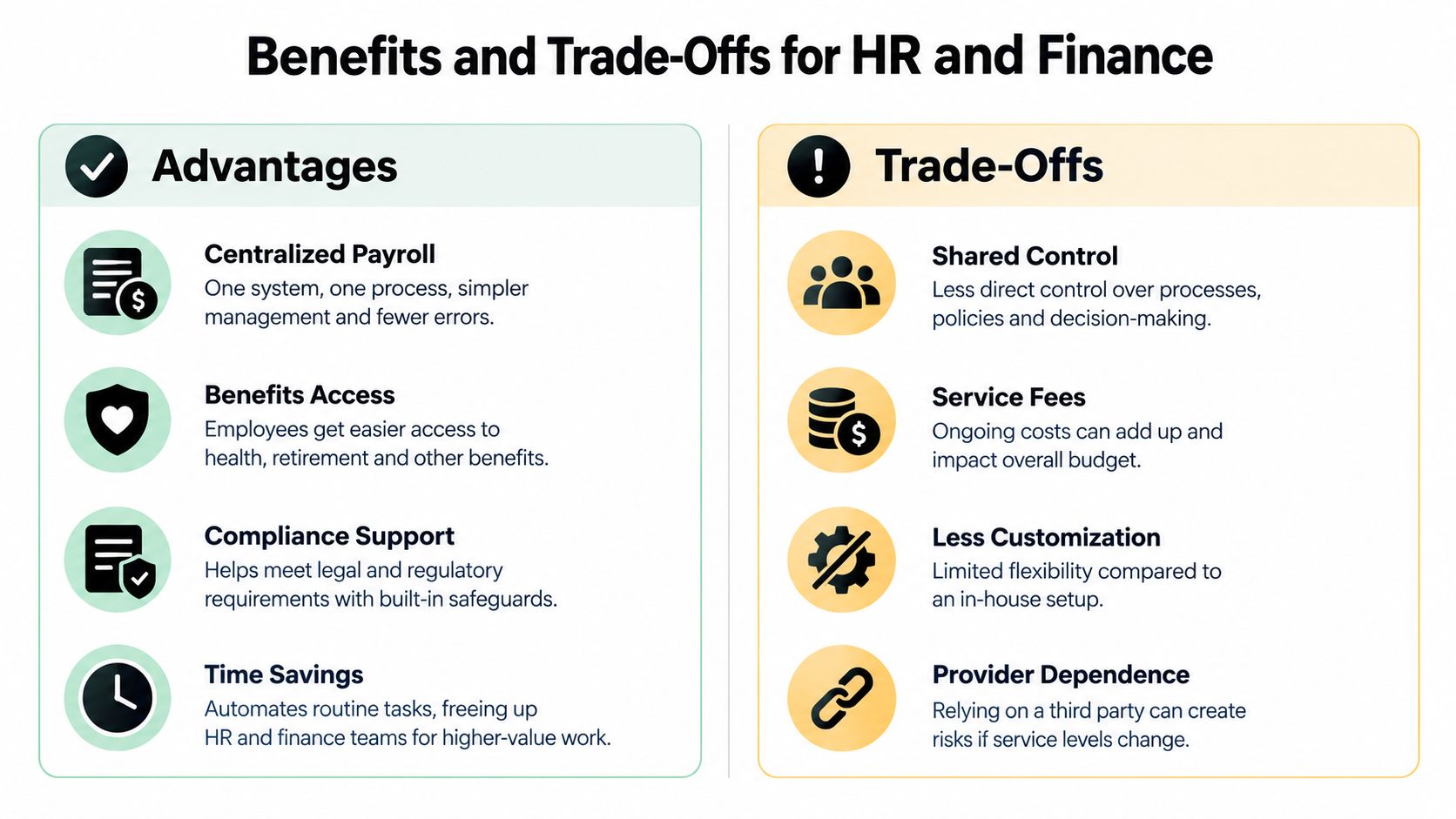
The appeal of a PEO isn't abstract. HR teams want fewer manual processes. Finance teams want cleaner payroll administration, fewer compliance surprises, and more predictability around benefits and reporting.
The trade-off is that convenience doesn't remove the need for oversight.
Why HR teams often like the model
For HR, the biggest gain is concentration. Instead of juggling separate vendors for payroll, benefits administration, workers' compensation coordination, and compliance support, a PEO often brings those functions together.
That can make onboarding cleaner, employee questions easier to route, and recurring admin work less fragmented.
Why finance teams pay attention
For finance, the value often shows up in process discipline. Payroll tax withholding, filings, benefit deductions, and required employment paperwork can be centralized through one operating relationship instead of being spread across disconnected systems and service partners.
That doesn't mean finance can step away. It means finance gets a more structured process to monitor.
A PEO can simplify administration. It can't replace internal review of invoices, payroll inputs, and agreement terms.
Advantages and trade-offs side by side
- Administrative relief: Teams can move payroll, tax handling, and benefits administration into a more coordinated workflow.
- Benefits access: Some businesses pursue a PEO because it may improve access to broader benefit options than they'd manage on their own.
- Compliance support: The model can provide structure around recurring HR and payroll tasks that often create risk when handled inconsistently.
On the other side:
- Shared control boundaries: The arrangement works best when your managers are comfortable operating inside a defined split of responsibility.
- Service fees and vendor dependence: You're adding an outside partner to a core business function, so pricing, responsiveness, and service quality matter.
- Less flexibility in some processes: Standardized workflows can reduce administrative chaos, but they can also limit customization.
Why this has become a mainstream evaluation
Adoption has grown enough that many HR and finance leaders now treat PEOs as a normal option rather than a last resort. Broad industry reporting has described the model as widely used among small and mid-sized employers, including reporting that more than 230,000 U.S. businesses reportedly use PEOs in 2025, as discussed in this summary on PEO usage and market scale.
For decision-makers, that matters less as a sales point and more as a signal. The model is established. The harder question is whether the specific responsibility split fits your business.
Common Misconceptions About Co Employment and Joint Employer Risk
A common failure point looks like this: a founder signs with a PEO, assumes the new arrangement covers "HR risk," and only learns later that no one clearly owned a policy update, manager training issue, or wage-and-hour decision. The problem usually is not the label co-employment. The problem is the responsibility gap that appears when duties are assumed instead of assigned.
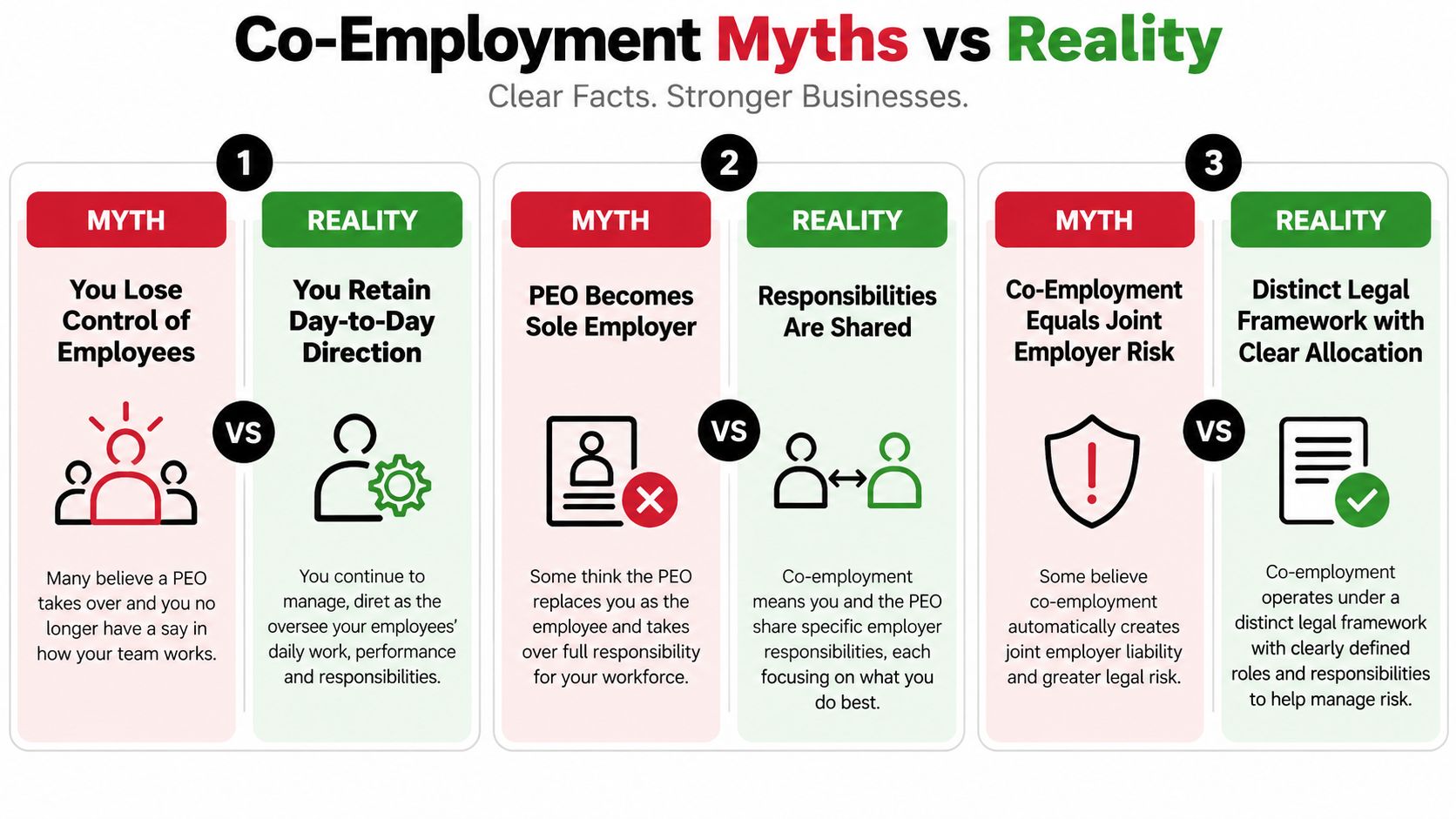
Three misconceptions create most of the confusion.
Myth one you lose control of employees
Your company still runs the business day to day. Your managers assign work, evaluate performance, set schedules, approve time off according to company practice, and address conduct issues.
A PEO relationship works more like shared administration than shared command. One party helps run the HR engine. The other still steers the car.
Myth two the PEO becomes the only employer
Co-employment does not replace your role as employer. It divides employer functions across two parties for different purposes.
That distinction matters because shared status does not mean every duty is shared equally. For example, a PEO may process payroll and support benefits administration, while your company still controls hiring choices, supervision, workplace behavior, and many employee-relations decisions. If the agreement does not spell out who owns a task, confusion tends to fill the gap.
That is where smaller businesses get tripped up. They assume the PEO handles "compliance," but compliance is not one task. It is a series of tasks. Policy drafting, handbook updates, timekeeping rules, leave administration, manager training, and termination documentation may sit with one party, the other, or both in different ways.
Myth three co-employment shields you from joint-employer risk
This misconception causes the costliest mistakes.
A PEO agreement can clarify responsibilities. It does not act as a legal force field. If your company controls working conditions, directs supervisors, sets pay practices, or reserves authority over key employment decisions, those facts may still matter in a joint-employer analysis or another labor dispute.
Put differently, co-employment explains the business arrangement. Joint-employer risk examines who holds or exercises control.
What happens when duties are not clearly allocated
Shared responsibility without clear allocation works like two people assuming the other one locked the door. Everyone feels covered until there is a problem.
In practice, the missed task might be a required notice, a leave-handling step, an overtime classification review, or a manager response to a complaint. If the contract is vague and the operating process is vague, each side may believe the other owned it. That is the default responsibility gap, and it is where avoidable exposure often starts.
The safer approach is specific, written allocation backed by actual workflow. Who drafts policies. Who distributes them. Who trains managers. Who approves terminations. Who monitors legal updates. Who responds when an employee raises a wage, leave, or harassment concern.
Labels help. Clear ownership helps more.
How to Decide If Co Employment Fits Your Business
A founder with 35 employees hires in two new states, adds a richer benefits package, and starts spending Friday afternoons sorting out payroll questions, leave requests, and onboarding issues. At that point, the question is not whether a PEO sounds helpful. The question is whether your business has reached the stage where shared HR administration will close gaps your current setup keeps leaving open.
Co-employment fits best when it solves a specific operating problem. It is less about company size than about strain, complexity, and clarity of responsibility.
A useful test is simple: if routine HR work depends too much on one person remembering every step, your risk is already higher than it looks.
A practical fit check
Co-employment may be a strong match if several of these are true:
- Your managers are doing too much administrative HR: Payroll changes, onboarding tasks, benefits questions, and employee paperwork keep interrupting core work.
- Your process works, but only because a few people hold it together: Tasks get done, yet there is no consistent system behind them.
- Benefits have become harder to manage well: You want more support with plan administration, enrollment, and employee communication.
- Hiring in new states is adding pressure: More jurisdictions usually mean more notice, wage, leave, and recordkeeping obligations.
- You want clearer operating support, not a legal shield: A PEO can help assign and carry out tasks, but your company still needs to understand what authority and decision-making remain in house.
That last point matters more than many buyers expect. If your main goal is to hand off every employment risk, a co-employment model may disappoint you. If your goal is to reduce administrative drag, improve process discipline, and define who handles which HR functions, it may fit well.
Companies with a capable in-house HR lead, stable payroll operations, and strong compliance routines sometimes prefer a narrower service model. In those cases, a side-by-side review of a PEO vs ASO service model comparison can be more useful than starting with vendor demos.
The question that reveals fit fastest
Read the agreement and ask: What happens if this duty is not assigned clearly?
That is the pressure test.
If the contract and workflow leave room for assumptions, the default responsibility gap can reopen. A leave request may sit too long. A complaint may go to the wrong inbox. A payroll correction may stall because each side thought the other owned approval. The business issue is not just service quality. It is confusion about who acts, when, and under what authority.
A good fit means the PEO model closes those gaps instead of adding another layer between your team and the work.
One provider difference worth checking
Some businesses also want to compare PEOs based on tax handling. A CPEO has a specific federal employment tax status for wages it remits, as noted earlier in this article. That can matter during provider review, especially for finance teams, but it does not answer the larger fit question by itself.
The larger question is operational. Will this arrangement give your company a clearer responsibility map, better follow-through, and enough internal control over the decisions you still need to own?
If the answer is yes, co-employment may be a strong fit. If the answer is vague, keep asking for specifics before you sign.
Next Steps for Evaluating PEO Options With Confidence
A founder signs with a PEO after a strong sales call. Three months later, an employee dispute surfaces, a payroll correction is delayed, and both sides assume the other owned the next step. That is the moment to judge the arrangement. The test is not how polished the demo felt. It is whether the agreement gave each duty a clear owner before pressure hit.
Start with the contract and the operating workflow. Sales language can sound reassuring, but co-employment only works cleanly when responsibility is assigned in writing and backed by a practical process. If a task is described loosely, treat that as a warning sign. Loose language is how the default responsibility gap reappears.
A short evaluation checklist
- Ask for the actual agreement: Review the professional employer agreement, not just proposal slides or summary sheets.
- Map the handoffs: Confirm who receives and responds to employee questions about pay, benefits, leave, records, and complaints.
- Check what happens by default: If a duty is not spelled out, ask who is expected to act, how fast, and with what authority.
- Review tax administration details: If the provider is a CPEO, ask how that affects federal employment tax handling for wages it remits, as noted earlier in this article.
- Test real workflows: Walk through onboarding, payroll changes, open enrollment, terminations, and issue escalation step by step.
- Compare alternatives: A PEO may be the right fit, but an ASO or broker-supported model can make more sense if your team wants to keep tighter day-to-day control.
For a practical prep list before vendor calls, use these questions to ask a PEO.
One more filter helps. Ask each provider to show how they prevent confusion when an issue touches both HR administration and employer judgment. That is where many buyers mix up co-employment with legal insulation. A PEO can help carry out assigned functions, but it does not erase your role as the business making employment decisions.
The clearest takeaway is simple. Confidence comes from a responsibility map that still makes sense on a difficult day, not just on a sales call.
Benely helps employers compare benefits strategies and evaluate HR support models, including PEO options, in one place. If you're weighing control, compliance, payroll administration, and benefits together, visit Benely to review your options with certified HR support and a clearer view of how the responsibility split would work for your business.