An employee needs a specialist, but the specialist they've trusted for years isn't in the plan's network. A conventional HMO may leave the employee choosing between changing providers and paying the full bill. An HMO-POS plan creates another route, but that route comes with its own deductible, referral, authorization, reimbursement, and balance-billing rules.
That paperwork determines whether the plan delivers useful flexibility or creates a confusing benefit that employees avoid. For an HR manager, understanding what an HMO-POS plan is means looking beyond the label and checking exactly how the point-of-service tier works in the plan documents.
Table of Contents
- Understanding How HMO POS Plans Actually Work
- Breaking Down Cost Sharing and Out-of-Network Access
- Comparing HMO POS Plans to HMO and PPO Options
- Evaluating Employer and Employee Trade-offs
- Real Enrollment Scenarios and Cost Outcomes
- Essential Checklist Before Enrolling in HMO POS Plans
- Making the Right Benefits Decision for Your Organization
Understanding How HMO POS Plans Actually Work
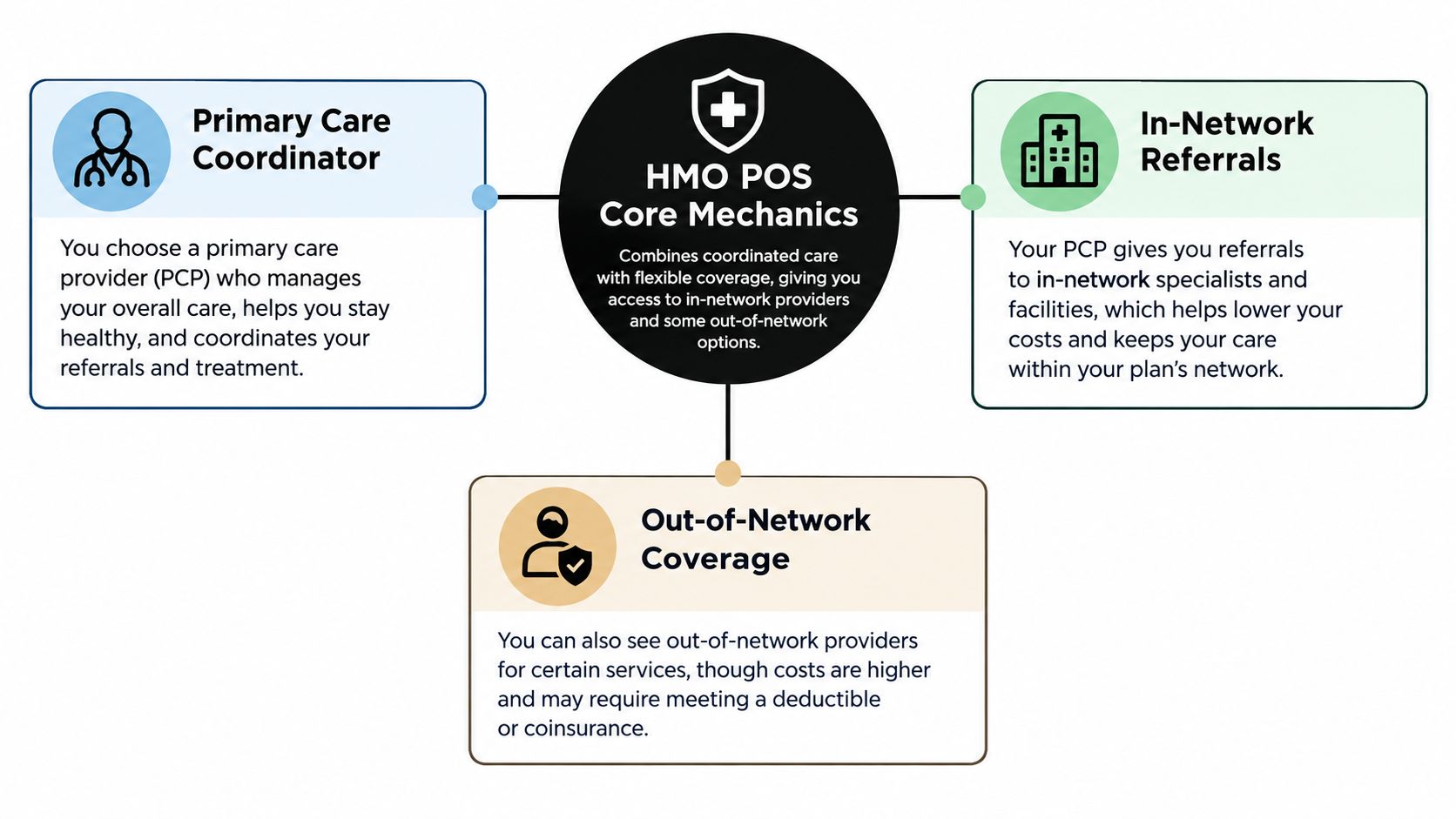
An HMO-POS plan, or Health Maintenance Organization with a Point-of-Service option, starts with the operating model of an HMO. Employees generally select or receive a primary-care physician, use the plan's contracted provider network, and follow coordinated-care procedures for specialist or hospital services. Routine care outside the network is typically excluded under the HMO portion, except where the plan provides a specific POS benefit or emergency protection.
The POS feature adds a controlled exception. If an employee needs an eligible service from a nonparticipating provider, the plan may pay something toward that care. The employee usually pays more through a higher deductible, copayment, coinsurance, or other cost sharing, and may need to submit a claim for reimbursement. The exact services covered outside the network aren't universal, so the plan's evidence of coverage matters more than the acronym.
The employee journey
A typical HMO-POS decision follows a sequence:
- Start with the primary-care physician. The employee checks whether the plan requires a PCP relationship and whether the PCP must coordinate the next stage of care.
- Confirm the referral rule. A specialist appointment may require a PCP referral, and some services may also require plan authorization.
- Check the provider tier. An in-network specialist generally receives the plan's preferred benefit. A nonparticipating specialist may fall under the POS tier, if that service qualifies.
- Verify the financial terms. The employee checks the applicable deductible, coinsurance, reimbursement process, and any annual limit before receiving care.
The U.S. Office of Personnel Management's explanation of plan types describes HMO-POS coverage as combining HMO and fee-for-service characteristics, with higher member costs for non-network care. Healthcare.gov's explanation similarly distinguishes HMO network limits from POS flexibility, noting that in-network care costs less and that primary-care referrals may be required for specialist services.
Why the middle-ground label can mislead
HMO-POS sits between a tightly managed HMO and a broader PPO, but it isn't an unrestricted PPO. Employees get a potential escape route outside the network, not a promise that any provider or service will be covered. The plan may limit POS access to specific services, geographic areas, or provider groups, and it may require different administrative steps than in-network care.
For benefits teams, the useful vocabulary is simple: network care is the default, POS care is conditional. That distinction should appear in enrollment materials, employee examples, and broker conversations. If the summary only says “out-of-network coverage available,” employees may assume they can see any provider and receive a protected benefit. The contract may say something much narrower.
Breaking Down Cost Sharing and Out-of-Network Access
The financial question isn't whether an HMO-POS plan covers out-of-network care in the abstract. The practical question is how much the employee owes after the plan pays, and which rules apply before that payment is calculated.
In-network care normally receives the most favorable benefit design. The provider has a contract with the carrier, the plan applies negotiated rates, and the employee follows the HMO's ordinary referral and authorization process. Out-of-network POS care may be eligible, but it can involve a separate deductible, higher coinsurance, different claim procedures, and exposure to charges the plan doesn't recognize.
Federal regulatory definitions describe POS as an option that lets an HMO member receive specified services outside the network, generally with higher cost sharing. The relevant federal POS definition also recognizes that some designs may involve an additional premium for the POS benefit. OPM notes that non-network care may carry higher deductibles and coinsurance, and that members may need to file reimbursement claims.
Read the tiers as separate financial products
A benefits comparison should place the in-network and POS columns next to each other, not collapse them into one “out-of-pocket” figure. Check:
- Deductible: Determine whether POS services use the same deductible as network care or a separate one.
- Coinsurance: Identify the percentage applied after the deductible and whether it is calculated from the plan's allowed amount.
- Provider billing: Confirm whether the nonparticipating provider can bill above the plan's allowed amount.
- Claims: Establish who submits the claim and what documentation the employee must provide.
- Annual limits: Look for a separate dollar or service limit applying to POS benefits.
For an employee, a routine in-network visit may be straightforward, while the same type of appointment outside the network can trigger several additional steps. The headline premium doesn't reveal that difference. Employers should model likely use by service tier, especially when workers live near network borders, travel frequently, or rely on established specialists.
The in-network versus out-of-network comparison can help HR teams explain why provider status changes both the administrative process and the employee's financial responsibility. A separate resource on whether Medicare pays for house calls may also help employees who are comparing plan rules with questions about home-based care, although it doesn't replace the employer plan's own coverage documents.
What works and what fails
An HMO-POS design can work well when employees mainly use the contracted network and occasionally need a defined outside option. Network steering supports coordinated care and can help an employer control expected utilization. The design works less well when employees interpret POS access as broad freedom and discover only after treatment that a service wasn't eligible, a referral was missing, or the provider's bill exceeded the plan's payment.
Practical rule: Never communicate “out-of-network coverage” without naming the covered services, authorization requirements, cost-sharing tier, and claim responsibility.
Comparing HMO POS Plans to HMO and PPO Options
Leadership teams often reduce the decision to HMO versus PPO. HMO-POS adds an important third position, but its value depends on whether employees need controlled flexibility rather than unrestricted provider choice.
A standard HMO generally directs employees to contracted providers and may require PCP referrals for specialists. Non-emergency care outside the network is typically excluded. A PPO generally gives employees more provider freedom, usually without specialist referrals, while applying higher cost sharing to out-of-network care. HMO-POS keeps the HMO coordination model and adds specified non-network access under plan-defined conditions.
| Plan Type | Network Flexibility | Referral Required | Out-of-Network Coverage | Cost Predictability |
|---|---|---|---|---|
| HMO | Limited to the defined network for routine care | Often, depending on the plan | Generally excluded for non-emergency care | Higher when employees stay in-network |
| HMO-POS | In-network care is preferred, with controlled outside access | Often, depending on the service and plan | Available only for specified eligible services | Strong in-network, less predictable in the POS tier |
| PPO | Broadest choice among these options | Generally not required for specialist access | Usually available at higher member cost | More flexible, but potentially less predictable |
The market context
Availability and enrollment are different measures. KFF's 2024 Employer Health Benefits Survey found that 14% of covered workers were employed by firms offering at least one POS plan, compared with 20% at firms offering at least one HMO and 65% at firms offering a PPO. KFF's 2025 data reported actual enrollment of 9% in POS plans, 12% in HMOs, 46% in PPOs, and 33% in high-deductible health plans with savings options.
Those figures show why a POS option may be available without becoming the dominant employee choice. A company can offer flexibility, yet employees may still select a PPO or a high-deductible design because they value direct specialist access, broader networks, or a different contribution structure.
The HMO overview from Benely is useful when employees need a plain-language explanation of the underlying managed-care model. HR teams should then return to the actual SBC and evidence of coverage, because no category label overrides plan-specific rules.
Choosing by workforce need
Choose an HMO-POS design when the network is strong where employees live, coordinated care matters, and a defined outside-provider option solves a real problem. Choose a standard HMO when the network already includes the providers employees use and simplicity is more valuable than occasional flexibility. Consider a PPO when employees regularly need providers across locations or want specialist access without the HMO-style pathway.
The right comparison is not “which label sounds most flexible?” It is “which rules will employees use, and which costs can they understand before care begins?”
Evaluating Employer and Employee Trade-offs
An employer sees premiums, contributions, network pricing, and administrative requirements. An employee sees a paycheck deduction, a doctor directory, a referral process, and the bill that arrives after treatment. HMO-POS plans create value only when those two perspectives line up.
For the employer, the in-network default can support negotiated pricing and care coordination. For the employee, the same structure may feel restrictive if a preferred specialist sits outside the network. The POS tier helps only when the outside service is eligible and the employee understands the additional financial responsibility.

Availability doesn't equal value
KFF's 2025 employer survey reports that HMOs represented 12% of covered-worker enrollment, while KFF reports they accounted for nearly 30% in the late 1990s. The long-term movement away from HMOs helps explain the current role of HMO-POS plans. They preserve network-based cost control and referral-driven coordination, but their appeal competes with PPOs and increasingly common high-deductible designs. See the KFF 2025 Employer Health Benefits Survey for the broader employer coverage context.
A company may offer POS coverage because it wants to accommodate employees in different locations or preserve access to established specialists. Yet employees may avoid the option if the POS deductible is difficult to understand or if the provider directory doesn't clearly identify participating clinicians. Offering a benefit isn't the same as making the benefit usable.
Test the design against real employee conditions
An HMO-POS plan deserves serious consideration when:
- The network fits the workforce: Employees can reach primary-care physicians, hospitals, behavioral health providers, laboratories, and relevant specialists in their service areas.
- The outside option solves a known problem: Workers travel, live near network boundaries, or have established providers outside the contracted network.
- Education is manageable: HR can explain referrals, authorizations, eligible POS services, claim submission, and cost exposure without reducing the benefit to a misleading slogan.
A simpler HMO may serve employees better when the network is broad and most workers want predictable in-network care. A POS plan may create frustration when its flexibility exists on paper but applies to a narrow list of services with substantial cost sharing.
The cheapest plan on the renewal spreadsheet can become the most expensive benefits decision if employees can't predict how their care will be paid.
Real Enrollment Scenarios and Cost Outcomes
Two employees can enroll in the same HMO-POS plan and have completely different experiences. The difference usually comes from provider choice, not from a change in the plan itself.
Employee one stays inside the network
Jordan selects a PCP listed in the plan directory. When a health concern requires specialist attention, Jordan follows the plan's referral process and chooses an in-network specialist. The provider participates in the carrier's network, the claim moves through the ordinary plan workflow, and Jordan receives the preferred benefit for the visit.
Jordan's experience illustrates the intended operating model. The HMO-POS plan is primarily a coordinated network plan, and the POS feature doesn't need to be used for every episode of care. Employees who can find suitable providers in-network generally face a clearer process and more predictable cost sharing.
The HR lesson isn't that every employee should remain in-network. It is that the employer should make network adequacy easy to verify before enrollment. A directory that lists a hospital but not the relevant specialists can create a practical gap even when the network appears broad.
Employee two relies on outside specialists
Morgan has an established specialist who doesn't participate in the plan. Before scheduling care, Morgan checks whether the service qualifies under the POS tier, whether a PCP referral is required, and whether the plan requires prior authorization. The service is eligible, but the POS deductible and coinsurance are higher, and the provider's billing office doesn't submit the claim.
Morgan may need to pay the provider, collect the required documentation, and request reimbursement from the carrier. Even when the plan pays a benefit, Morgan may owe more than an in-network enrollee and may face additional exposure if the provider charges above the plan's allowed amount.
The misconception to avoid is simple: POS access doesn't make an outside provider equivalent to an in-network provider. The California Department of Managed Health Care's plan explanation describes the HMO-POS distinction as access to specified nonparticipating providers for eligible services, rather than unrestricted routine access.
For employee education, give Morgan a short pre-service checklist. Confirm provider participation, eligible service, referral, authorization, deductible, coinsurance, claim responsibility, and potential balance billing before the appointment. That guidance is more useful than telling employees merely that the plan offers “flexibility.”
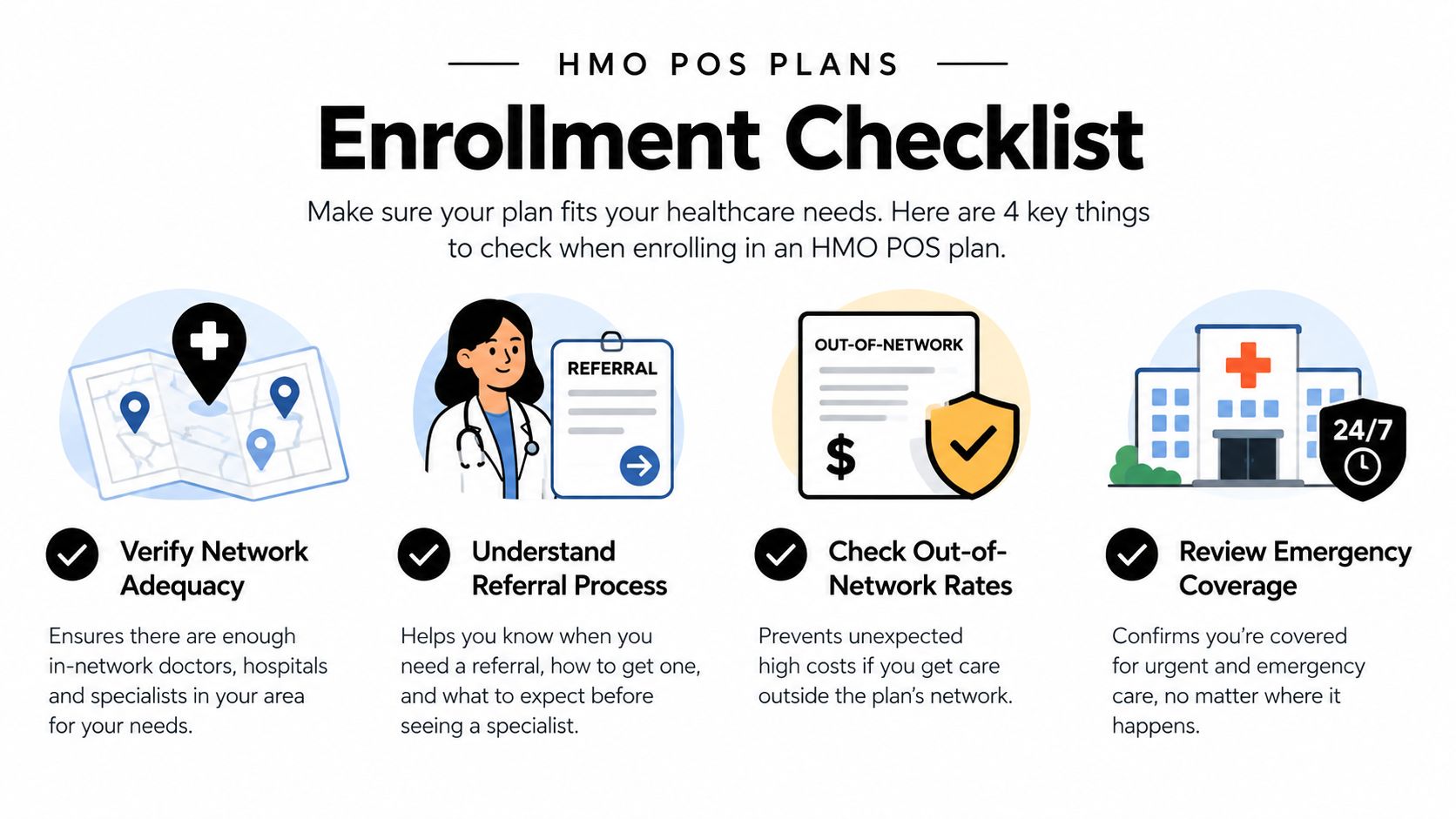
Essential Checklist Before Enrolling in HMO POS Plans
The plan name won't answer the questions that create coverage disputes. Employers should read the SBC, evidence of coverage, provider directory, referral policy, and authorization materials together.
Four mechanics to verify
Eligible out-of-network services. Identify whether the POS tier applies to specialist visits, hospital care, behavioral health, laboratory services, or another defined list. Don't assume that every routine service receives POS treatment.
Referral and authorization rules. Confirm whether the PCP must issue a referral, whether the plan itself must authorize the service, and whether the requirements change between in-network and POS care. A referral from a physician and prior authorization from the plan are different processes.
Member cost sharing. Compare the in-network and POS deductible, copayment, coinsurance, reimbursement basis, and claim-submission responsibility. Ask whether the POS tier has a separate annual limit and whether balance billing can add charges beyond the plan's calculation.
Annual dollar or service limits. Look for limits on the number of covered services, the annual benefit amount, or the maximum enrollee cost sharing. CMS guidance requires HMO-POS materials to identify services available out of network, maximum enrollee cost sharing, and annual benefit limits.
Validate the documents, not just the directory
Ask the carrier or broker to confirm the network at the facility and individual-provider level. An employee may need a specific surgeon, therapist, laboratory, or anesthesiologist, and a facility's participation doesn't automatically answer every provider question.
CMS materials explain that HMO-POS designs must specify their out-of-network services, cost-sharing maximums, and annual limits. The CMS HMO-POS guidance provides a useful regulatory reference for this document review.
Use the same checklist for every plan under consideration. Record the answer in a comparison sheet that employees can understand, then create enrollment examples for a routine PCP visit, an in-network specialist visit, and an eligible POS visit. Employers comparing multiple carriers and coordinating enrollment can use Benely as one platform option for plan comparison and benefits administration.
Making the Right Benefits Decision for Your Organization
There isn't one universally correct network design. The right HMO-POS decision depends on where employees live, which providers they use, how often they need specialty care, how much cost variation the company can tolerate, and how much administrative support the HR team can provide.

Start with workforce evidence
Review employee locations and provider patterns before comparing premiums. A network that works well for a headquarters-based workforce may fail for remote employees, traveling staff, or workers living outside the carrier's strongest service area. Ask whether the plan includes accessible primary care, hospitals, specialists, behavioral health providers, and laboratories where employees seek care.
Then test the cost design. Compare employee payroll contributions with expected use of in-network and POS benefits, and identify which expenses the employer wants employees to predict. If the company values cost control but employees need occasional outside access, HMO-POS may be a reasonable compromise. If employees routinely use nonparticipating specialists, the POS tier may create dissatisfaction even when the premium looks attractive.
The label also varies by carrier, state, employer contract, and Medicare product. CMS guidance makes clear that the specific plan must identify out-of-network services, maximum enrollee cost sharing, and annual benefit limits. Treat every HMO-POS offering as its own contract, not as a standardized product category.
For organizations building a broader benefits strategy, a resource on a modern total rewards approach can help place health coverage alongside compensation, wellbeing, flexibility, and employee experience. The network decision matters because employees judge the benefit through actual access and bills, not through the plan's marketing name.
Turn comparison into an operating process
A disciplined selection process should include:
- Broker review: Ask the broker to explain every POS restriction in plain language and identify services that require special handling.
- Document comparison: Place SBCs, provider directories, referral policies, and authorization rules side by side.
- Employee testing: Ask representative employees to verify their PCPs, hospitals, specialists, and laboratories before finalizing the choice.
- Enrollment communication: Provide examples that show the difference between in-network care and eligible POS care.
- Post-enrollment support: Give employees a clear escalation path when a directory, referral, claim, or reimbursement issue arises.
You can also use a structured health insurance plan comparison process to organize plan features, budgets, and enrollment decisions. Technology doesn't replace broker judgment or contract review, but it can reduce the risk that critical differences remain buried across disconnected documents.
A short educational video can reinforce the distinction between network coordination and POS flexibility after employees have reviewed the written materials.
The strongest HMO-POS decision is the one employees can use without guessing. Before enrollment closes, verify the eligible POS services, referral and authorization steps, cost-sharing tiers, annual limits, provider network, reimbursement process, and balance-billing exposure. Then document those answers in the same place employees go to make their benefits choice.
Benely helps employers compare HMO, HMO-POS, PPO, and other health plan designs, set budgets, and coordinate enrollment and benefits administration through a centralized platform. Visit Benely to evaluate plan options against your workforce's provider needs and cost priorities.