 Employee Benefits
 HR & Compliance
 Technology
 Wellness
 PEO Solutions
Is the PPO really a premium benefit, or are you paying more for flexibility your employees rarely use? That's the question HR leaders should ask before treating a PPO as the automatic upgrade. What's better, HMO or PPO, depends on your workforce, provider geography, utilization patterns, and benefits budget.
For many employers, an HMO delivers lower expected spending and simpler care coordination. A PPO can be the right choice when employees need broad provider access, frequent specialist care, or coverage outside a concentrated local network. The mistake is choosing by reputation instead of testing each plan against how your people receive care.
Table of Contents
- HMO vs PPO Which Fits Your Business?
- Understanding Network Access and Referrals
- Cost Comparison Premiums and Out-of-Pocket
- The Hidden Value of HMO Simplicity
- Choosing the Right Plan for Your Company Size
- Simplifying Benefits Administration with Benely
HMO vs PPO Which Fits Your Business?
An HMO, or health maintenance organization, usually limits covered care to an in-network provider system, except for emergencies. Members commonly select a primary care physician, or PCP, who coordinates treatment and provides referrals to specialists. A PPO, or preferred provider organization, also uses a network, but members can generally see out-of-network providers without a referral, at a higher cost. The HealthCare.gov plan type guide describes these core structural differences.
That distinction matters operationally. An HMO can steer employees toward coordinated, in-network care, which helps employers control plan spending and reduces the number of claims employees must manage. A PPO gives employees more autonomy, but they may face higher premiums, deductibles, coinsurance, or bills when they choose providers outside the preferred network.

| Decision factor | HMO | PPO |
|---|---|---|
| Provider access | Primarily in-network, except emergencies | In-network and out-of-network options |
| PCP | Usually required | Generally not required |
| Specialist referrals | Usually required, with service-specific exceptions | Generally not required |
| Monthly premium | Typically lower | Typically higher |
| Out-of-pocket exposure | Usually lower for covered in-network care | Often higher, especially out of network |
| Best fit | Cost control and coordinated care | Provider flexibility and specialist access |
Why standard advice fails small businesses
The usual advice says, “Offer a PPO if you want a competitive benefits package.” That's too simplistic. A smaller employer may have a workforce concentrated near one health system, with employees who value predictable copays more than nationwide access. In that setting, an HMO may produce better perceived value without forcing the company to stretch its contribution budget.
The reverse is also true. If employees travel often, live across multiple markets, or rely on specialists who aren't included in one HMO network, the PPO premium may be justified. Employers should examine provider directories, not just plan names, before making a decision.
Use a structured health insurance plan comparison to evaluate premiums, networks, referrals, deductibles, and out-of-pocket limits together. Benefits teams comparing related coverage can also use this Style Site Optical insurance guide when reviewing vision benefits alongside medical plans.
Broker's rule: A PPO is worth the extra cost only when the workforce uses the flexibility it buys.
Understanding Network Access and Referrals
The most important HMO versus PPO difference isn't the acronym. It's the employee's experience at the point of care.
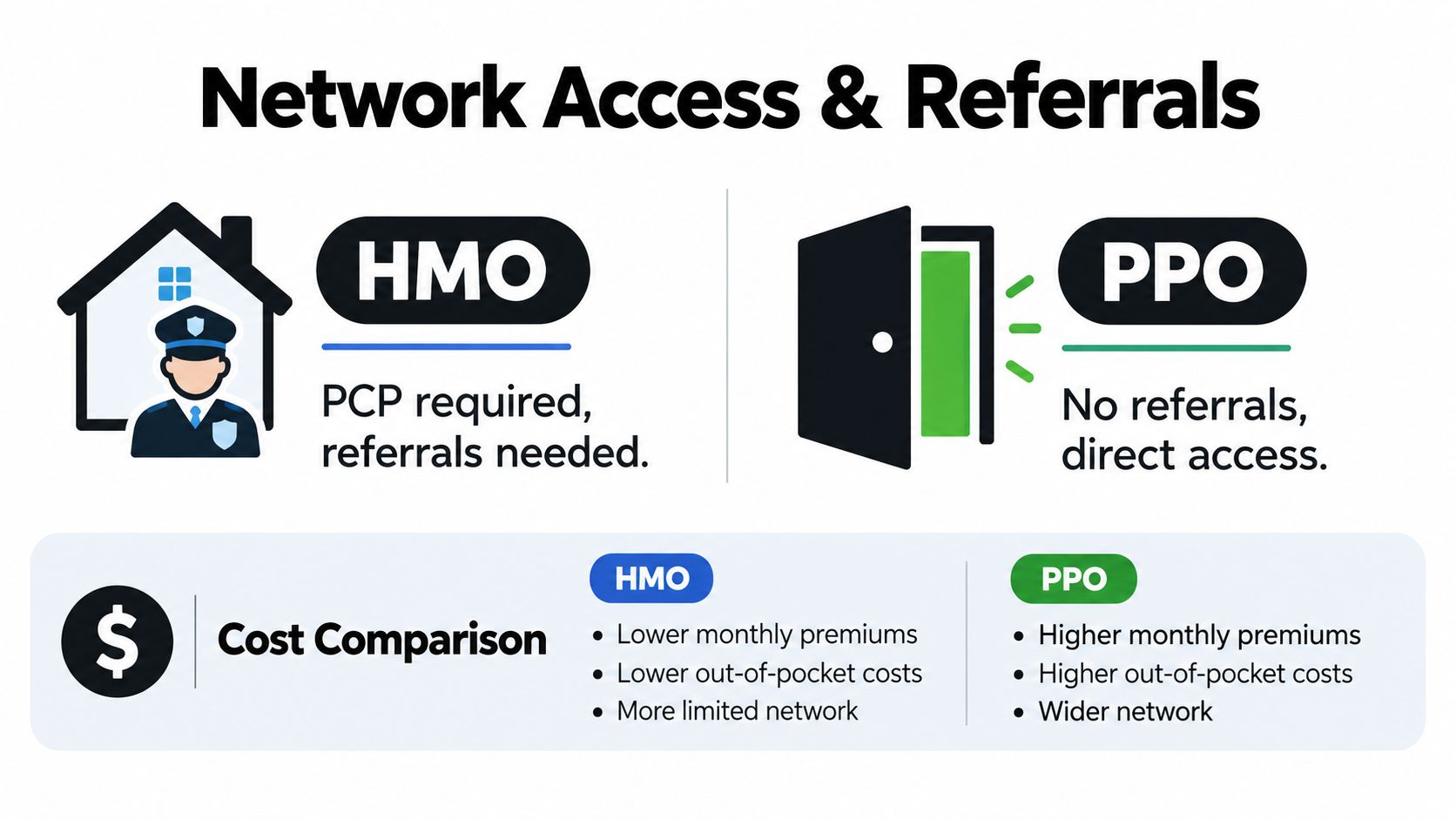
An HMO generally asks the member to start with a PCP. That doctor manages routine care, coordinates treatment, and refers the employee to an in-network specialist when needed. Nonemergency care outside the network usually isn't covered, so an employee who chooses an unaffiliated doctor may be responsible for the full cost.
A PPO removes much of that gatekeeping. Employees can generally schedule specialty care directly, without a PCP referral, and may use out-of-network doctors or hospitals for covered services. The plan still rewards in-network care through lower member costs, but it preserves a broader path when a preferred provider isn't available.
What employees feel day to day
For an HMO member, the process can be orderly but restrictive:
- Primary care entry point: The member usually selects a PCP and begins treatment there.
- Referral pathway: The PCP commonly directs the member to a network specialist.
- Network discipline: Routine out-of-network care may not receive coverage.
- Emergency protection: Emergency care remains an important exception to ordinary network restrictions.
PPO members have a different set of responsibilities:
- Direct specialist access: The employee can generally arrange specialty care without a referral.
- Network choice: In-network providers usually cost less, while out-of-network care costs more.
- More billing exposure: An out-of-network provider may require payment up front, followed by a claim for reimbursement.
- More personal coordination: The employee has greater freedom, but also more work comparing providers and understanding benefit rules.
Referral rules aren't identical across every HMO. Some services, including certain ob-gyn and optometry care, may be available without a referral. HR should tell employees to verify the specific plan documents rather than relying on a generic summary.
A benefits team should also explain the difference between network access and covered access. A PPO may allow an employee to visit an out-of-network provider, but that doesn't make the visit inexpensive. The employee may face a separate deductible, higher coinsurance, balance billing, or a claim process. Clear education prevents a flexible plan from becoming a confusing one.
For a practical explanation of provider participation and member costs, use this guide to in-network versus out-of-network care.
A short visual overview can reinforce the distinction for employees:
Cost Comparison Premiums and Out-of-Pocket
Employers shouldn't compare plans by premium alone. The relevant question is how the plan distributes cost across the company and its employees, including premiums, deductibles, copays, coinsurance, referrals, and the out-of-pocket maximum.
The broad pattern is clear. HMOs commonly have lower monthly premiums and lower out-of-pocket costs. PPOs commonly charge more in exchange for provider flexibility, and out-of-network care can increase the employee's financial exposure. Kaiser Permanente describes this same cost structure, including the possibility that PPO members pay the full out-of-network visit cost first and seek reimbursement later.
The 2026 Medicare Advantage market provides a useful illustration of the tradeoff. Among individual Medicare Advantage enrollees with drug coverage, 61% were in HMOs, compared with 38% in local PPOs and less than 1% in regional PPOs. Average supplemental premiums were $12 per month for HMOs and $18 for PPOs, while average in-network out-of-pocket limits were $4,636 for HMOs and $6,592 for PPOs, according to KFF's 2026 Medicare Advantage analysis.
Those figures don't establish what an employer-sponsored plan will cost. They do show the financial direction of the tradeoff: lower expected spending often comes with tighter network rules, while broader access can carry higher member exposure.
HMO versus PPO cost indicators
| Metric | HMO | PPO |
|---|---|---|
| Typical monthly premium | Lower | Higher |
| Deductible | Often lower or absent | May be higher |
| In-network out-of-pocket cost | Usually lower | Often higher |
| Out-of-network benefit | Usually unavailable except for defined exceptions | Generally available at additional cost |
| Claims complexity | Often simpler for in-network care | Can be more involved, especially out of network |
| Provider flexibility | More limited | Broader |
A separate 2026 analysis from MoneyGeek's health insurance comparison found average Silver plan premiums of $490 per month for HMOs and $748 for PPOs, a $258 monthly difference. Treat that comparison as market context, not a quote for your group. Carrier pricing varies by geography, plan design, contribution strategy, and employee demographics.
Employers should model at least three scenarios:
- Low utilization: Which plan keeps payroll deductions attractive for employees who use little care?
- Expected utilization: How do routine visits, prescriptions, and specialist appointments affect total cost?
- High utilization: What happens when an employee reaches the plan's out-of-pocket maximum?
A lower premium can conceal a difficult employee experience if deductibles and coinsurance are high. Conversely, a PPO can waste contribution dollars when employees stay inside one local provider system and rarely use out-of-network benefits. Review the out-of-pocket maximum definition before comparing plan summaries.
The Hidden Value of HMO Simplicity
The conventional benefits hierarchy treats the PPO as the upgrade and the HMO as the budget compromise. That view ignores what employees often need most: a clear network, predictable navigation, and manageable costs.
Deft Research's 2026 ICHRA findings reported higher employee satisfaction and stronger willingness to recommend HMOs than PPOs. That result challenges the idea that flexibility automatically creates a better benefits experience. For many workers, the ability to choose any provider matters less than knowing which doctor to call, where the plan will pay, and what the visit is likely to cost.
Simplicity can be a benefit
An HMO gives an employer a clearer education story. HR can explain the PCP relationship, the referral process, and the importance of staying in network. Employees still need plan-specific guidance, but the decision path is more contained.
That structure can help in several ways:
- Fewer provider surprises: Employees have a defined network rather than an open-ended search.
- Coordinated treatment: A PCP can help organize specialist care and follow-up.
- Lower administrative noise: In-network care may involve fewer employee claims and reimbursement questions.
- More predictable budgeting: Lower premiums and lower in-network cost exposure can make payroll deductions easier to communicate.
The limitations are real. An HMO may frustrate employees whose doctors aren't included, who live away from the main service area, or who want direct access to specialists. Employers must confirm that the network includes the hospitals, primary care practices, mental health providers, and specialists employees use.
Practical rule: Don't sell an HMO as restrictive or a PPO as generous. Explain the exchange in plain language, then show employees how the network affects their own doctors and costs.
The pricing gap reinforces the need for a workforce-specific decision. The 2026 MoneyGeek comparison found PPO Silver plans averaging $748 per month versus $490 for HMO Silver plans, as documented in its HMO and PPO pricing analysis. The difference may be worthwhile for employees with complex care needs, but it shouldn't be treated as a universal upgrade.
Employers can also consider offering both plan types when their budget and carrier options allow it. That approach gives employees a choice, but it increases communication and administration. If the company offers one plan, choose the plan whose tradeoffs match the majority of the workforce, then provide a clear exception path for employees with specialized needs.
Choosing the Right Plan for Your Company Size
Company size influences the decision, but it shouldn't decide the plan by itself. A small startup with employees in one city may be an excellent HMO candidate, while a similarly sized consulting firm with a distributed, traveling workforce may need PPO flexibility.
Use this decision framework before requesting quotes.
Start with the workforce map
List where employees live, which provider systems dominate those areas, and whether key hospitals and specialists appear in each proposed network. A plan that looks affordable on paper can fail if employees must change established doctors.
Then review work patterns. Frequent travel, remote work across multiple states, and employees with ongoing specialist relationships strengthen the case for a PPO. A concentrated workforce with predictable local care makes an HMO more compelling.
Test the budget against employee value
Decide how much the company will contribute and what payroll deductions employees can reasonably absorb. Don't compare only the employer premium. Review the employee's likely annual cost, deductible, copays, coinsurance, and out-of-pocket limit under ordinary and high-use situations.
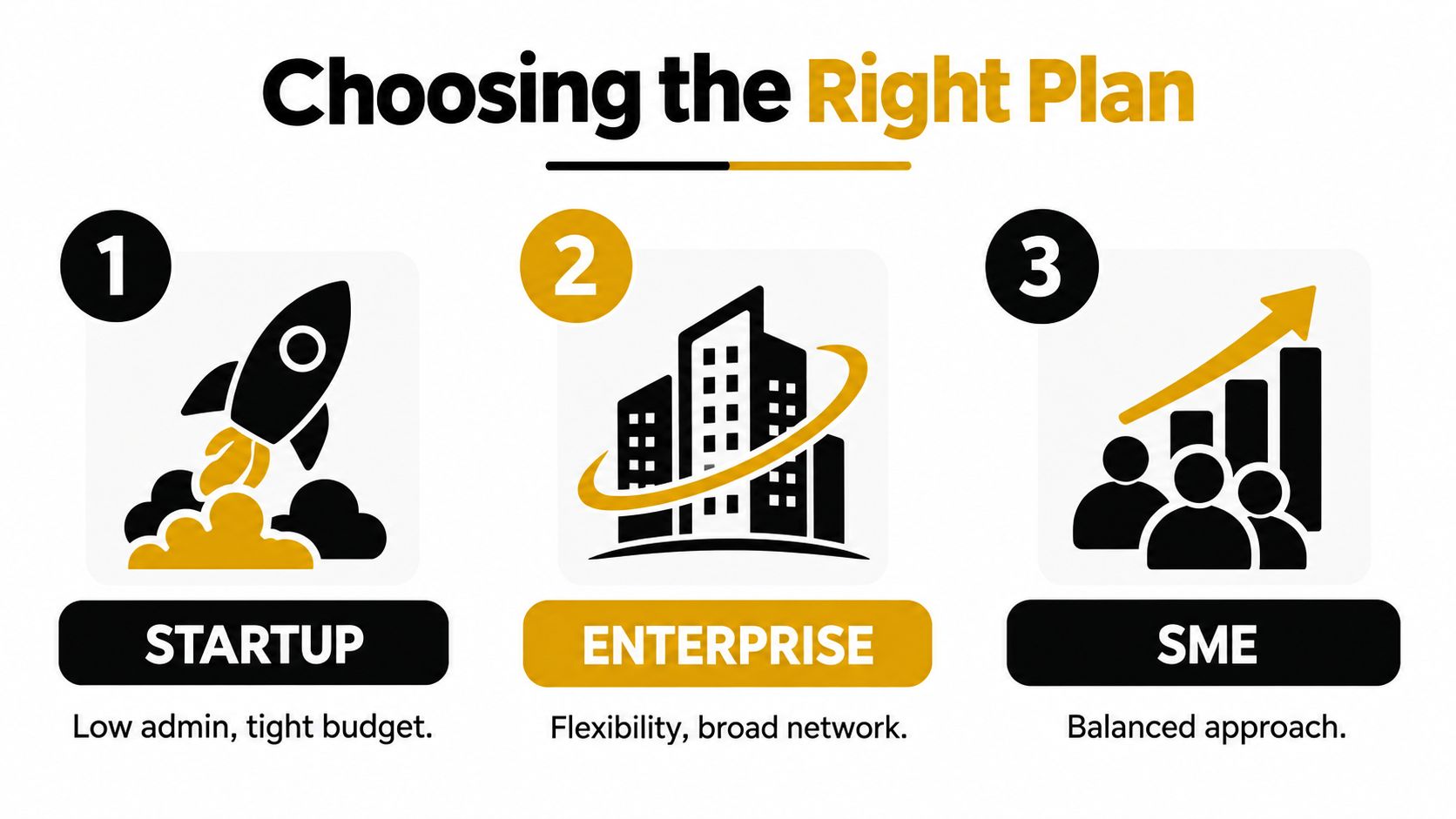
| Business context | Starting recommendation | Reason |
|---|---|---|
| Local startup with a tight benefits budget | HMO | Lower expected costs and simpler administration may protect cash flow |
| Distributed or travel-heavy workforce | PPO | Broader access can reduce disruption when employees need care away from the core network |
| Established SMB with mixed needs | HMO plus PPO choice, if affordable | Employees can select coordination or flexibility |
| Specialist-heavy workforce | PPO | Direct access and out-of-network options may justify the higher cost |
| Workforce concentrated around one health system | HMO | Network restrictions may be less burdensome when preferred providers participate |
Make the decision defensible
Ask employees which doctors and facilities they use, but don't rely on a popularity poll alone. Verify networks, compare plan documents, and model claims exposure. Give managers and employees a short explanation of referrals, out-of-network billing, and maximum financial exposure before enrollment opens.
My default recommendation for a budget-conscious SMB is an HMO when the network is strong and local. Choose a PPO when provider continuity, specialist access, or geographic flexibility is important enough to justify the additional premium. If neither plan serves everyone, offer a carefully explained choice rather than forcing the company into a status-driven answer.
Simplifying Benefits Administration with Benely
Selecting the plan is only one part of the benefits workload. HR still has to compare carrier proposals, confirm networks, set the employer contribution, communicate tradeoffs, collect elections, coordinate payroll, and retain compliance records. A sound HMO or PPO decision can still become an administrative problem if employees can't understand or enroll in the coverage.
Start with a written plan brief. Record the target budget, employee locations, preferred provider systems, specialist requirements, contribution policy, and enrollment timetable. This prevents the team from comparing plans on premium alone and creates a consistent standard for evaluating carrier proposals.
Next, build an employee-facing comparison that answers practical questions:
- Can I keep my doctor? Show the network search path and explain that provider participation must be verified.
- Do I need a referral? State the HMO rule, identify known service exceptions, and explain the PPO process.
- What happens out of network? Describe whether care is excluded, covered at a higher cost, or subject to reimbursement procedures.
- What could I pay? Include premiums, deductibles, copays, coinsurance, and the out-of-pocket maximum.
- Who can help me? Provide a named HR contact, broker contact, or benefits support channel.
Benely can support this workflow as a benefits brokerage and HR platform. Its centralized employee platform lets teams compare more than 4,000 health plans from carriers including Aetna, Kaiser, Anthem, Blue Shield, and UnitedHealthcare, set budgets, automate enrollments, and track open enrollment progress. It also connects benefits work with payroll, onboarding, compliance tools, and certified HR specialist support.
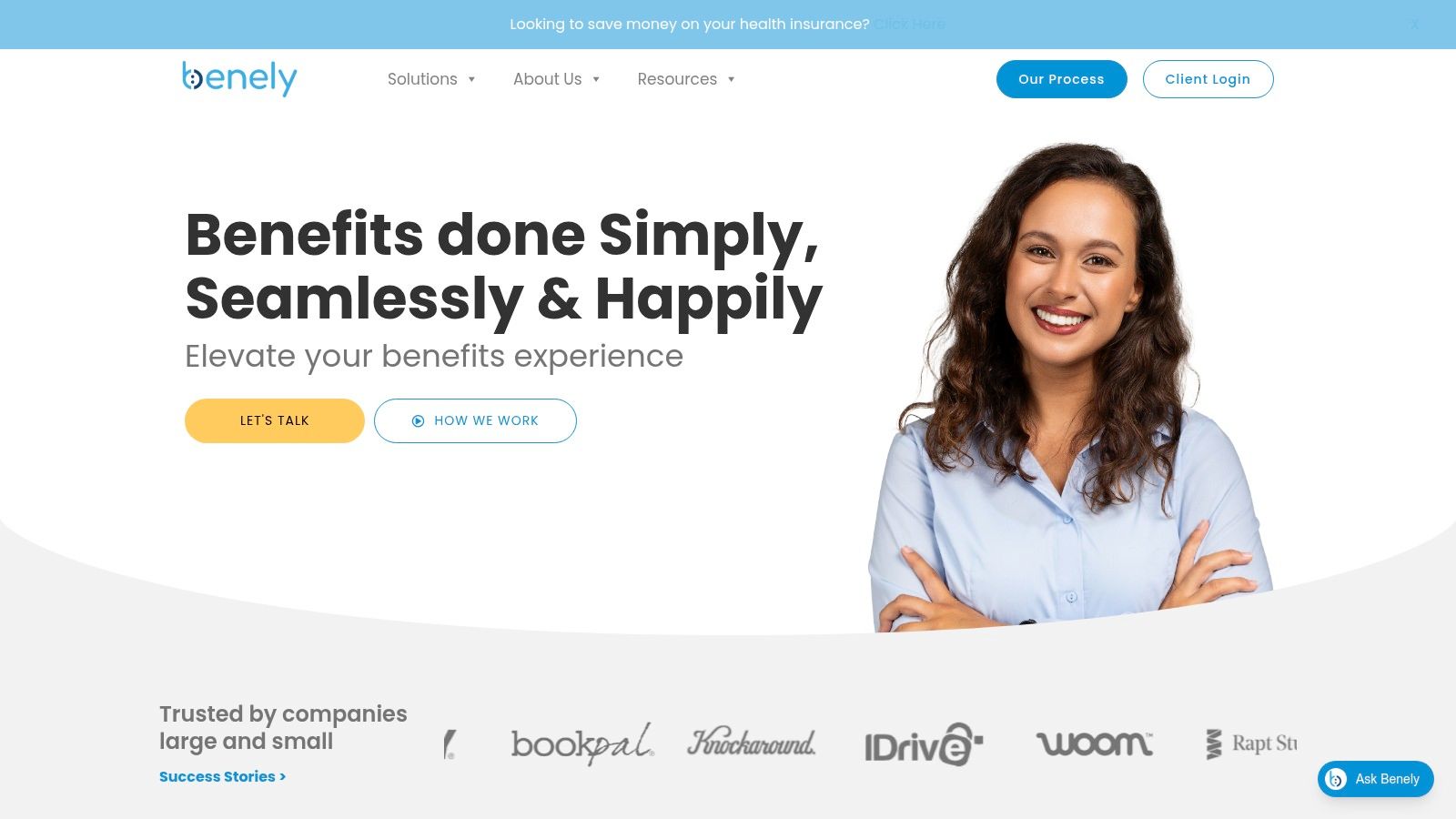
The platform isn't a substitute for plan diligence. HR still needs to validate networks, review plan documents, and communicate limitations clearly. Its value is in bringing comparison, budgeting, enrollment, reporting, and related HR workflows into a more organized process.
For an SMB, the right result is not merely selecting an HMO or PPO. It is choosing a plan employees can use, afford, and understand, then running enrollment without avoidable manual work.
Benely helps employers compare health plans, set benefits budgets, automate enrollment, and connect benefits administration with payroll and HR workflows. Visit Benely to evaluate HMO and PPO options with support for the full benefits lifecycle.