A consumer driven health plan is a high-deductible health plan paired with a tax-advantaged account such as an HSA or HRA. In 2026, the arrangement generally means a self-only HDHP deductible of at least $1,700, a family deductible of at least $3,400, and HSA contribution limits of $4,400 for self-only coverage or $8,750 for family coverage.
You're probably looking at one during open enrollment, comparing a plan with smaller payroll deductions against another plan with copays that feel easier to predict. The lower-premium option may look attractive until you notice the deductible. Then you see the words “HSA eligible” or “consumer driven” and wonder whether you're choosing useful flexibility or just taking on more risk.
The practical answer depends on three everyday questions: Can you handle the upfront cost of care? Will you fund the account? And do you know which services are covered before the deductible? A CDHP can work well when those pieces line up. It can create real financial pressure when they don't.
Table of Contents
- The Plain English Definition of a Consumer Driven Health Plan
- How a High Deductible Health Plan Pairs With an HSA or HRA
- 2026 IRS Numbers That Define How a CDHP Works
- Real Advantages and Trade Offs for Employers and Employees
- What Changes When Members Actually Use a CDHP
- Enrollment Pitfalls and Common Misconceptions
- Deciding Whether a CDHP Is the Right Fit in 2026
The Plain English Definition of a Consumer Driven Health Plan
Suppose you're comparing two employer plans. Plan A takes more from each paycheck but offers familiar copays for office visits and prescriptions. Plan B has a lower premium, but you pay more of the negotiated cost yourself before the plan begins paying for most nonpreventive care. Plan B may be a consumer driven health plan, or CDHP, if it pairs its high-deductible insurance with an HSA or HRA.
A consumer driven health plan is not a separate type of medical treatment or a discount program. It's a plan design that combines two parts:
- A qualified high-deductible health plan, often called an HDHP, that provides major medical coverage after you meet the deductible.
- A healthcare spending account, usually a Health Savings Account, or HSA, or a Health Reimbursement Arrangement, or HRA, that helps pay eligible expenses along the way.
The phrase “consumer driven” describes who makes more of the spending decisions. Instead of the insurer paying a small copay for every service from the beginning, you often decide how to use account funds and whether a service's price, timing, or provider makes sense. The plan gives you more responsibility at the point of care, while the account can provide tax-advantaged money for eligible expenses.
That doesn't mean you're left without insurance. The HDHP still protects you against covered medical costs after the deductible and up to the plan's out-of-pocket limit. The account is the cash-flow tool that helps you handle costs before that protection takes effect. You can review the basic HDHP requirements in this guide to what qualifies as a high-deductible health plan.
The two pieces to identify
When you read a plan summary, separate the insurance features from the funding features. Check the deductible, out-of-pocket maximum, network, prescription rules, and preventive-care provisions on the insurance side. Then check whether the account is an HSA or HRA, who funds it, when money becomes available, and which expenses qualify.
A CDHP can therefore be understood as insurance plus a payment strategy. The insurance controls catastrophic exposure. The account helps you manage routine and early-year expenses.
The design became more visible after the law creating HSAs in 2003. Government Accountability Office reporting describes enrollment growing from about 1.5 million Americans in 2002, less than 1% of the employer coverage market, to about 3 million enrollees and dependents by January 2005, and roughly 5 million to 6 million by January 2006 (GAO's report on consumer-driven health plans).
How a High Deductible Health Plan Pairs With an HSA or HRA
Think of the HDHP as the foundation of a house and the HSA or HRA as a separate repair fund. The foundation protects the structure when a major problem occurs. The repair fund helps you pay for smaller needs before the insurance protection becomes substantial.
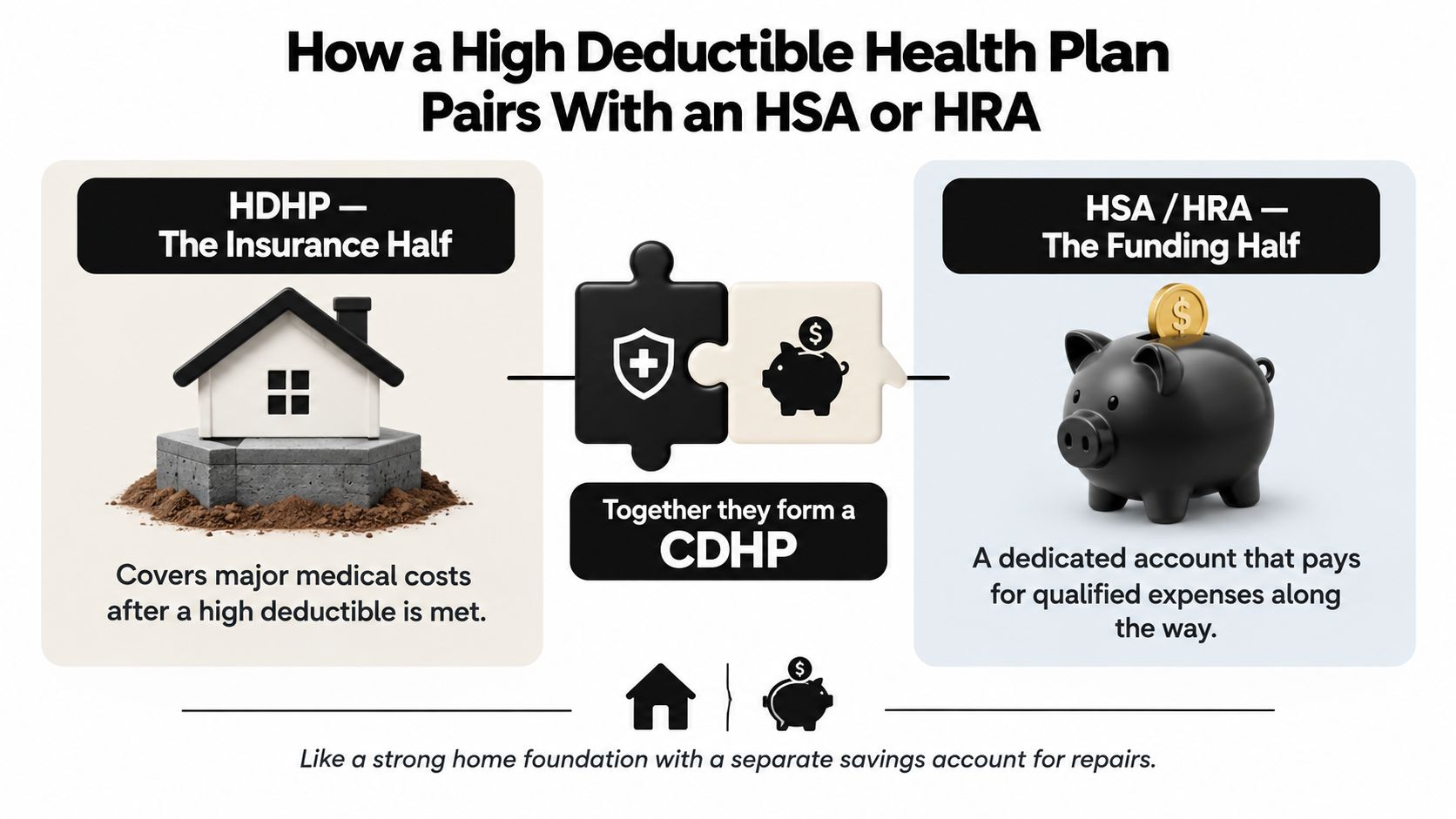
The HDHP is the insurance half. It generally has a higher deductible and a higher potential out-of-pocket exposure than a richer copay plan, often in exchange for a lower premium. Until you meet the deductible, you may pay much of the negotiated cost for nonpreventive services yourself. Preventive care can receive different treatment, which is why the summary plan description matters.
The HSA or HRA is the funding half. An HSA belongs to the individual account holder, and unused money can remain available for future eligible expenses. Employees may contribute through payroll, and employers may also contribute. An HRA is employer funded and reimburses eligible expenses under rules set by the employer and plan. Unlike an HSA, an HRA generally isn't portable when employment ends.
HSA and HRA are not interchangeable
An HSA is generally available only when you're enrolled in an HSA-qualified HDHP and meet other eligibility conditions. In broad terms, you can't fund one while enrolled in Medicare or while someone else claims you as a dependent. HSAs also offer three tax advantages: contributions can receive favorable tax treatment, eligible withdrawals aren't taxed, and account growth can receive favorable tax treatment under applicable rules.
An HRA gives the employer more control over funding and reimbursement design. That makes it useful when some employees can't fund an HSA or when the employer wants to define the eligible reimbursement structure. Employers comparing contribution strategies can review HSA options for employers.
A practical example helps. If you have a qualifying prescription or laboratory bill before meeting the deductible, you might pay it from your HSA if the expense is eligible and your account has funds. If your employer uses an HRA, you may submit the expense for reimbursement according to the HRA's rules instead.
Some specialized services may also qualify for tax-advantaged payment. For example, employees reviewing reproductive or women's health benefits can investigate whether an HSA eligible perimenopause app fits the applicable eligibility rules.
The account doesn't erase the deductible. It changes how you finance it.
A short video can help visual learners distinguish the insurance layer from the account layer:
2026 IRS Numbers That Define How a CDHP Works
The IRS limits determine whether an HDHP can qualify for HSA compatibility and how much an eligible person can contribute. For calendar year 2026, the key figures are:
| Limit | 2026 Amount | What It Means |
|---|---|---|
| Minimum self-only HDHP deductible | $1,700 | The plan's self-only deductible must generally be at least this amount. |
| Minimum family HDHP deductible | $3,400 | The plan's family deductible must generally be at least this amount. |
| Maximum self-only out-of-pocket expenses | $8,500 | Covered in-network expenses excluding premiums generally can't exceed this limit. |
| Maximum family out-of-pocket expenses | $17,000 | The family limit frames the upper exposure for covered expenses excluding premiums. |
| Self-only HSA contribution limit | $4,400 | An eligible person can contribute up to this amount for 2026. |
| Family HSA contribution limit | $8,750 | An eligible family can contribute up to this amount for 2026. |
These figures come from the IRS's 2026 HSA contribution guidance and 2026 HDHP and out-of-pocket limits. The contribution deadline extends to the tax-filing deadline for contributions for that year. The plan's actual deductible and out-of-pocket maximum can be higher or lower than the minimum and maximum rules in the plan documents, but an HSA-qualified HDHP must fit the applicable federal requirements.
Translate the limits into household decisions
For a family enrolled in a qualifying plan, the $3,400 minimum deductible means the household should expect a meaningful amount of responsibility before most nonpreventive claims receive regular plan payment. The family out-of-pocket ceiling of $17,000 is not a bill you should assume you'll owe. It's a boundary for covered expenses excluding premiums, subject to the plan's rules and network requirements.
For a 40-year-old employee with self-only coverage, the $4,400 contribution limit represents the maximum permitted HSA contribution for 2026. It isn't a required deposit, and the employee may not have enough payroll capacity or cash to fund it early. The useful question is whether contributions can be automated and whether the account will contain enough money when a claim arrives.
The IRS also allows qualifying HDHPs to cover preventive care before the deductible. The IRS explains that preventive care generally doesn't include treatment for an existing illness, injury, or condition (IRS guidance on HDHP preventive care). That distinction matters when you schedule screenings, vaccines, or follow-up treatment.
Real Advantages and Trade Offs for Employers and Employees
A CDHP shifts the financial relationship between the employer, the employee, and the insurer. The employer may spend less on premiums or choose a contribution strategy that supports a lower-cost plan. The employee may pay less from each paycheck, but more when care occurs.
The employer perspective
Employers can use a CDHP to offer a lower-premium plan while putting money into an HSA or HRA. Employer HSA contributions can soften the deductible and make the plan easier to use, especially when contributions arrive regularly rather than only after an employee submits a claim. Payroll-based HSA contributions can also have favorable tax treatment when administered correctly.
The design can support more deliberate healthcare decisions. Employees may compare providers, ask about prices, use generic alternatives when clinically appropriate, or postpone elective care that isn't urgent. Those choices work better when the employer supplies usable price information and decision support, rather than handing employees a high deductible.
The employee perspective
The strongest employee advantages usually appear in four places:
- Lower payroll deductions: A lower-premium plan may leave more money in each paycheck.
- Tax-advantaged saving: An HSA can receive contributions through payroll and provide tax-favored payment for eligible expenses.
- Account ownership: HSA balances generally stay with the account holder when the employee changes jobs.
- Preventive access: Qualifying preventive services may be covered before the deductible, subject to network and plan rules.
The trade-off is cash flow. A worker with limited savings may struggle with an unexpected imaging bill or specialist visit even when the annual premium is affordable. A family that uses frequent prescriptions or planned therapy may reach the deductible quickly and experience substantial early-year spending.
| Stakeholder | Key Advantages | Main Trade Offs |
|---|---|---|
| Employer | Potentially lower premium exposure, flexible account contributions, and more tools for engaging employees | Requires careful communication, contribution planning, and administration |
| Employee | Lower payroll cost, HSA tax advantages, account portability, and preventive-care coverage | Higher upfront responsibility, more price decisions, and possible cash-flow strain |
| HR team | A clear framework for comparing plan and funding choices | More questions about eligibility, claims, accounts, and payroll |
| Household | Ability to save for future care while paying eligible expenses from an account | Risk that the account is underfunded when care is needed |
Practical rule: A CDHP is not automatically affordable because its premium is lower. Judge it by the combined cost of premiums, employer account funding, expected care, and the cash required before the account is funded.
A good fit often includes people who can maintain emergency savings, use preventive services, and take advantage of HSA contributions. A poor fit may include households that can't absorb early-year costs or that need predictable copays for ongoing care.
What Changes When Members Actually Use a CDHP
The plan changes behavior because the member feels more of the price before reaching the deductible. In the Milliman impact study, CDHP penetration across six employers ranged from 4.4% to 76%, covering about 225,000 members, which shows that employers can deploy the design very differently across workforces (Milliman's consumer-driven health plan impact study).
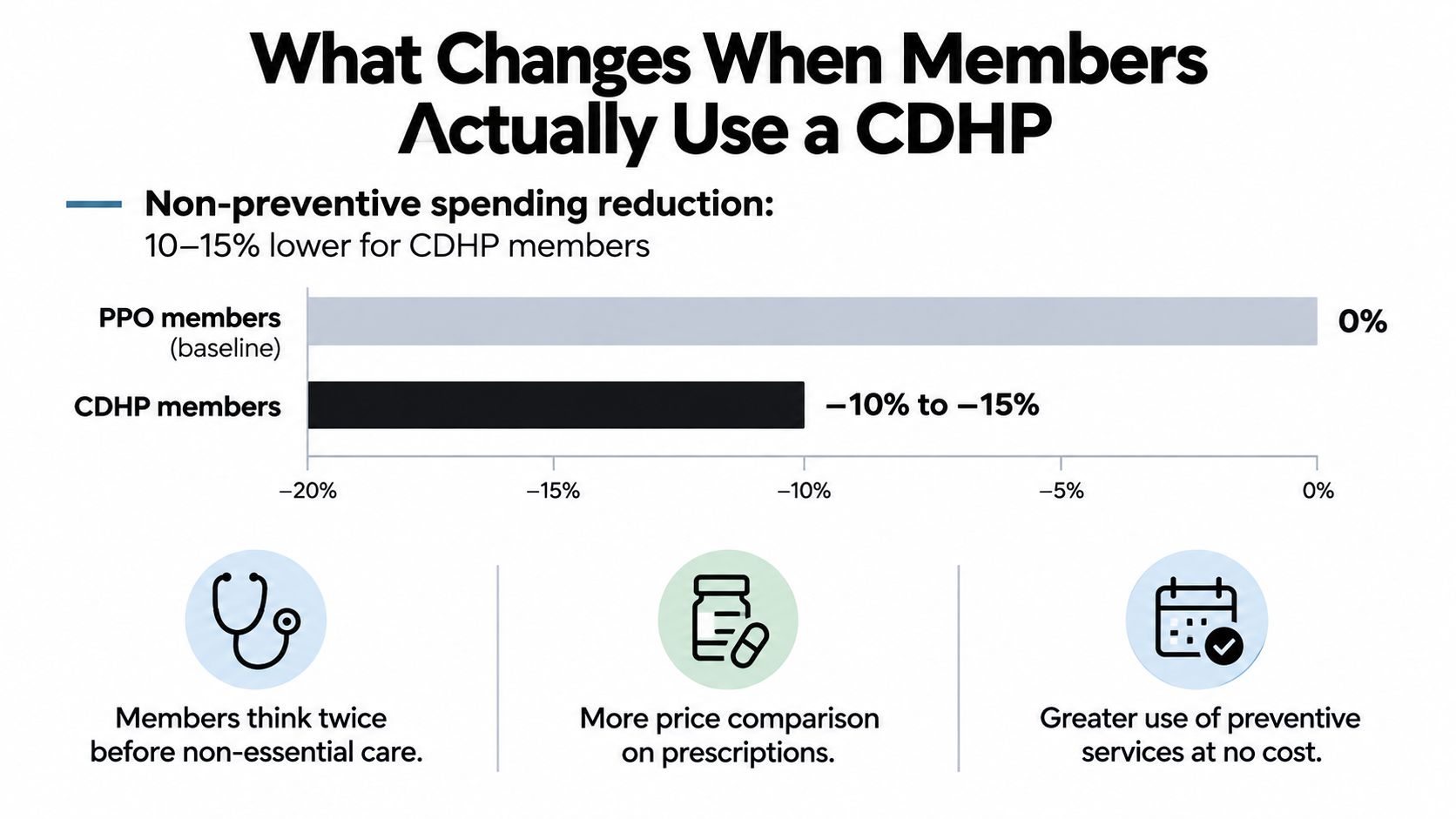
The verified evidence doesn't support treating every service as equally price sensitive. A National Bureau of Economic Research analysis found that when prescription drugs were subject to the deductible, employees used more lower-cost drugs, shifted some purchases into lower-cost periods, and reduced overall drug utilization. That pattern suggests a direct link between the amount members pay and the choices they make, but it doesn't prove that every reduction is harmless or desirable.
The member's decision at the pharmacy
A member may ask whether a generic medication is appropriate, whether a refill can be timed differently, or whether a lower-cost pharmacy is in network. Those decisions can reduce spending, but they can also create risk if a person skips necessary medication or delays a clinician's recommended treatment.
The deductible also changes the experience of chronic care. A person with diabetes, asthma, or another ongoing condition may face recurring costs early in the plan year, even if the plan provides selected preventive or chronic-care services before the deductible. Members need to check the drug formulary, preventive-care rules, and account balance instead of assuming every prescription follows the same pricing path.
Older peer-reviewed research reported that 57% of CDHP members exceeded the deductible threshold in a given year, meaning many members eventually reached the point where additional covered spending no longer created the same marginal incentive. That finding supports a careful interpretation: the plan can influence early decisions, but the incentive changes after the deductible is met.
Price sensitivity isn't the whole story. Members also need transparent prices, reliable networks, employer contributions, and safeguards for chronic conditions. Without those supports, a member may reduce necessary care because the cost is visible and immediate.
Enrollment Pitfalls and Common Misconceptions
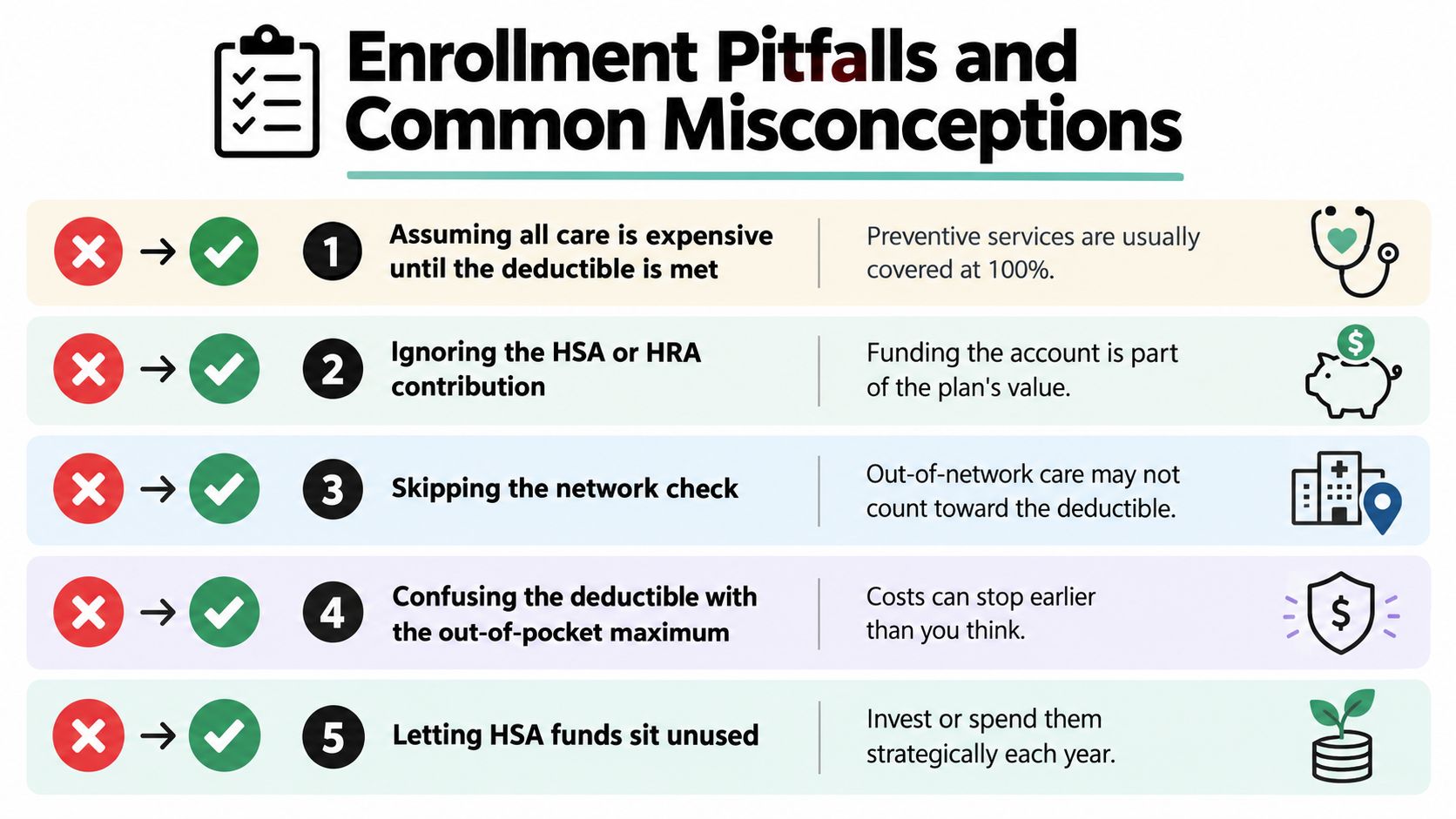
The first mistake is assuming that every medical service costs the full negotiated price until the deductible is met. Qualifying HDHPs can cover preventive care before the deductible, and the federal preventive-care safe harbor can include specified screenings, vaccines, and other services. Treatment for an existing condition is different, so confirm how the plan classifies a service before making an appointment.
Mistakes that affect your account
A few enrollment errors recur because the insurance and account rules sit in different documents:
- Skipping the account contribution: A CDHP's funding strategy matters. If you opt out of automatic HSA contributions only to increase take-home pay, you may lose the easiest way to build a balance before care occurs.
- Confusing HSA and FSA rules: These accounts have different ownership, eligibility, rollover, and contribution rules. Don't assume an FSA election can be treated like an HSA election.
- Funding an HSA during ineligible months: HSA contributions require qualifying HDHP coverage and compliance with other eligibility rules for the months funded. Medicare enrollment and dependent status can also affect eligibility.
- Using funds for the wrong expense: IRS Publication 502 provides the framework for medical and dental expenses that may qualify. Keep receipts and verify eligibility rather than relying on a provider's description.
- Ignoring the network: An out-of-network bill may have different pricing and may not count toward the same deductible or out-of-pocket limit. Confirm network status before nonurgent care.
Using an HSA for nonqualified costs can create income tax consequences. Before age 65, a nonqualified distribution can also face a 20% additional tax, as explained in the IRS's Publication 502 medical expense guidance. The account administrator can explain procedures, but you remain responsible for using distributions correctly.
The preventive-care rules also evolve. IRS instructions explain that specified items, including over-the-counter oral contraceptives, male condoms, certain breast cancer screening, continuous glucose monitors for people with diabetes, and certain insulin products can qualify under the preventive-care safe harbor in applicable circumstances (IRS Form 8889 instructions).
Before enrolling: Ask for the deductible, out-of-pocket maximum, account funding schedule, prescription treatment, preventive-care list, network directory, and claim-reimbursement instructions in writing.
Deciding Whether a CDHP Is the Right Fit in 2026
Start with your cash flow, not the plan label. A CDHP may be financially attractive on paper, but the relevant question is whether you can pay for care before the HSA or HRA has enough money in it.
Consider three common profiles:
The healthy single enrollee may have limited medical use and enough cash to contribute steadily. This person may value lower payroll deductions and the ability to build an HSA balance. The risk is an unexpected early-year bill before contributions accumulate.
The family with predictable prescriptions may benefit from employer account funding and preventive coverage, but should examine the formulary, deductible treatment, and family out-of-pocket exposure. A lower premium won't automatically offset repeated pharmacy and specialist costs.
The worker managing a chronic condition needs a closer review. The plan may still fit if the employer funds the account well and the plan offers helpful preventive or chronic-care coverage, but the employee should model recurring treatment rather than judging the plan by premium alone.
| Member Profile | Cash Flow Impact | Tax Advantage | Care Access Risk | Best Fit? |
|---|---|---|---|---|
| Healthy single enrollee | Usually lighter payroll cost, but early claims can be abrupt | Strong if the member contributes consistently | Moderate if savings are limited | Often suitable when the member can fund the HSA |
| Family with predictable prescriptions | Recurring spending may arrive before the deductible is met | Valuable when employer and employee contributions are coordinated | Moderate to high, depending on drug rules | Suitable only after checking formulary and cash reserves |
| Worker managing a chronic condition | Ongoing early-year expenses can strain the budget | Useful if eligible expenses are substantial and the account is funded | Higher unless chronic-care provisions are clear | Consider with strong employer funding and detailed plan review |
Employers should also check three design questions:
- Workforce risk: Do employees have varied incomes, chronic conditions, or limited emergency savings?
- Contribution strategy: Will the employer contribute to an HSA or HRA, and when will the money become available?
- Communication support: Can employees compare providers, understand preventive care, and use the account without calling HR for every claim?
For a direct comparison of the two plan concepts, review Benely's CDHP versus HDHP guide. Then answer these questions before signing:
- What medical and prescription spending is reasonably predictable for the year?
- Can you fund the HSA early enough to handle an unexpected bill?
- Are you comfortable using cost-transparency and network tools before scheduling care?
Benely helps employers compare health plans, configure budgets, automate enrollment, and manage benefits administration through a centralized platform, with support for payroll and compliance workflows. Visit Benely to evaluate CDHP options and create a clearer enrollment process for your workforce.