 Employee Benefits
 HR & Compliance
 Technology
 Wellness
 PEO Solutions
An uninsured ER visit typically runs $1,200 to $3,000 for a moderate case, and it can climb past $20,000 once imaging, procedures, or admission are added. The financial risk usually isn't the walk-in charge. It's the bill getting bigger after the visit, when separate charges start landing.
If you're reading this with a swollen ankle, a stitched hand, a kid with a fever, or an ER bill sitting open on the kitchen table, you're not looking for a vague “it depends.” You want a real range, what creates the damage, and what to do next.
Here's my blunt take after walking employees through surprise hospital bills for years. The cost of an emergency room visit without insurance is not one number. It's a stack of charges. Facility fee. Physician fee. Labs. Imaging. Medications. Supplies. Sometimes more than one bill from more than one entity. That's why a visit that felt routine can still turn into a painful self-pay balance.
For employers, this matters just as much as it does for patients. A workforce that doesn't know when to use urgent care, telehealth, or the ER is a workforce that gets hit with avoidable bills. Smart benefits design can stop a lot of that damage before it starts.
Table of Contents
- What an Uninsured ER Visit Actually Costs in 2026
- Breaking Down the Components of an ER Bill
- How Visit Type and Geography Change the Price
- Immediate Actions to Lower Your Self-Pay ER Bill
- How Employers Can Reduce Uninsured ER Exposure
- Designing Benefits That Prevent Surprise ER Bills
- Practical Questions About Paying an Uninsured ER Bill
What an Uninsured ER Visit Actually Costs in 2026
At 9:40 p.m., an employee cuts his wrist badly opening a pallet. Urgent care is closed. The bleeding will not stop. He goes to the ER expecting a bill for stitches. What usually arrives is a stack of charges that starts with the visit and grows fast if the hospital adds imaging, procedures, or an overnight stay.
That distinction matters. The cost of an emergency room visit without insurance is not a single price. It is a facility charge, a clinician charge, and whatever else the case triggers after triage.
Published 2026 self-pay pricing guides put uninsured ER visits in a wide range. A separate 2026 consumer pricing guide says minor uninsured ER visits can start around $650 to $700, while high-severity or trauma visits can exceed $5,000 and pass $20,000 once imaging, labs, and procedures are added, based on The Pricer's emergency room cost overview. Another 2026 pricing breakdown explains the same pattern clearly: the bill climbs with acuity, and CT scans, specialist treatment, and admission are what usually turn a manageable balance into a serious financial problem, as outlined in this breakdown of uninsured ER pricing in 2026.
Here is the blunt takeaway I give employers and employees. The walk-in decision is only the start. The exposure comes from everything attached to that visit after the patient is roomed, evaluated, tested, treated, and possibly admitted.
Uninsured patients also face hospital chargemaster pricing unless they push for a self-pay discount, charity care review, or a prompt-pay reduction. That is why two people with what sounds like the same ER problem can leave with very different balances.
For employers, this is not just an employee budgeting issue. It is a benefits design issue. If your workforce lacks clear steerage to telehealth, urgent care, after-hours nurse support, and an affordable primary care path, avoidable ER bills will keep landing on kitchen tables and payroll stress will follow. Small and mid-sized employers can prevent a lot of this by building plans that route people to the right level of care before the most expensive setting becomes the default.
If a large bill hits before the discount conversation is finished, a short-term cash advance for unexpected bills can help cover timing. Use it as a bridge, not as your main strategy. The main strategy is getting the bill reduced before you agree to pay it.
Breaking Down the Components of an ER Bill
A patient walks in expecting one big hospital charge. What usually shows up is a pile of separate charges from separate parties, each adding weight to the final balance.
That is the first mistake to avoid. The cost of an emergency room visit without insurance is not one price. It is a stack of fees that grows with acuity, testing, and the number of clinicians involved.
What usually shows up on the bill
Self-pay ER bills commonly break into these parts:
| Bill Component | What It Covers | Typical Self-Pay Range |
|---|---|---|
| Facility fee | Use of the emergency department, nursing, room, monitoring, overhead | Often the largest base charge |
| Emergency physician fee | Evaluation and treatment by the ER doctor or clinician group | Frequently billed separately from the hospital |
| Lab work | Bloodwork, urine testing, pathology-related testing | Adds up fast when multiple tests are ordered |
| Imaging | X-ray, ultrasound, CT, MRI, radiology read | One of the biggest drivers of a higher total |
| Medications | IV drugs, injections, pain meds, fluids | Charged by drug and administration |
| Supplies | Sutures, splints, dressings, crutches, wound care supplies | Smaller line items that still raise the bill |
The split matters because each line can come from a different billing office. Hospital, ER physician group, radiology, and lab bills may all arrive separately. Employees often pay one statement and assume they are done. Then the rest lands.
Why the total jumps
The jump usually starts with the facility fee, then gets worse when the visit moves beyond an exam. Labs add cost. Imaging adds more. Procedures, medication administration, monitoring, and specialist input push it higher again.
A simple example shows how this happens. A patient comes in with abdominal pain. The visit starts as an evaluation. Then the ER orders bloodwork, urine testing, IV fluids, pain medication, and a CT scan. The patient did not buy one ER service. The patient bought a stack of services, and every added service raises the bill.
That is why two visits that sound similar over the phone can price very differently on paper.
The biggest trap is list pricing
Uninsured patients often get the hospital's full self-pay charge first. That is list pricing, not the discounted rate insurers negotiate. If the bill includes separate professional fees, those groups may also charge their own list rates.
Ask for an itemized bill right away. Ask whether the physician, radiologist, and lab billed separately. Ask which charges came from the hospital and which came from outside groups.
Do not negotiate a lump sum you cannot see.
For employers, benefit design stops being abstract. If workers have no clear low-cost care path before a problem becomes an ER visit, this fee stack becomes their problem at home. Better plan design reduces exposure before the first facility fee ever hits the account.
How Visit Type and Geography Change the Price
Your coworker goes to the ER for chest pain and leaves with a bill that looks brutal. Another goes in for a deep cut and gets a very different number. Both visited the same kind of place. They did not buy the same level of care.
That is the right way to price an uninsured ER visit. Start with acuity. Then factor in local hospital pricing.
Cost by visit type
A low-acuity visit that stays close to an exam and basic treatment sits at one end of the range. A visit that turns into imaging, observation, a procedure, or admission jumps fast. The bill rises because the fee stack gets taller as the case gets more complex.
Use these ranges as rough planning brackets, not promises:
| Visit Type | Typical Self-Pay Range | What Usually Pushes It Higher |
|---|---|---|
| Evaluation only | Roughly $500 to $3,000 | Medications, monitoring, extra testing |
| Moderate visit | Roughly $1,200 to $3,500 | Multiple labs, IV treatment, imaging |
| Imaging, procedures, trauma, or admission | $5,000 to $20,000+ | CT or MRI, specialist care, procedures, hospital admission |
Minor problem. Lower bracket.
Uncertain problem with testing. Middle bracket.
High-risk problem or anything that escalates. Entirely different bill.
If the condition is minor and clearly not life-threatening, compare the ER against urgent care prices without insurance. That single decision can keep an employee from walking into the first big facility fee.
Geography changes the stack before treatment even starts
Hospitals do not price the same way across markets. Urban academic systems, dominant regional hospital chains, and areas with limited competition often post much steeper self-pay charges than smaller community markets. The service may look similar on paper. The starting charge can still be far apart.
That matters because uninsured patients usually get billed from the chargemaster first. In expensive markets, every layer of the visit starts from a higher number. Facility fee, physician fee, imaging, lab work, and observation time all have more room to hurt.
The result is simple. A moderate ER visit in one city can cost less than a basic workup in another.
The rule I give employees and employers
Do not ask, “What does an ER visit cost?” Ask, “How likely is this visit to escalate, and what does my local hospital usually charge for each layer?”
That framing is more useful for employers too. A bad benefits setup does not just leave workers exposed to one random ER bill. It leaves them exposed to a stack of separate charges in one of the most expensive care settings in their market. Small and mid-sized employers can cut that risk by giving employees a real after-hours care path, telehealth triage, and urgent care access before the problem turns into an uninsured ER claim.
If there is a true emergency, go. If there is room to choose, choose the lower-cost site of care before the fee stack starts.
Immediate Actions to Lower Your Self-Pay ER Bill
If the visit already happened, don't freeze. Most uninsured patients still have options after discharge. The mistake is paying the first statement blindly or ignoring it until collections gets involved.
Start with this checklist.
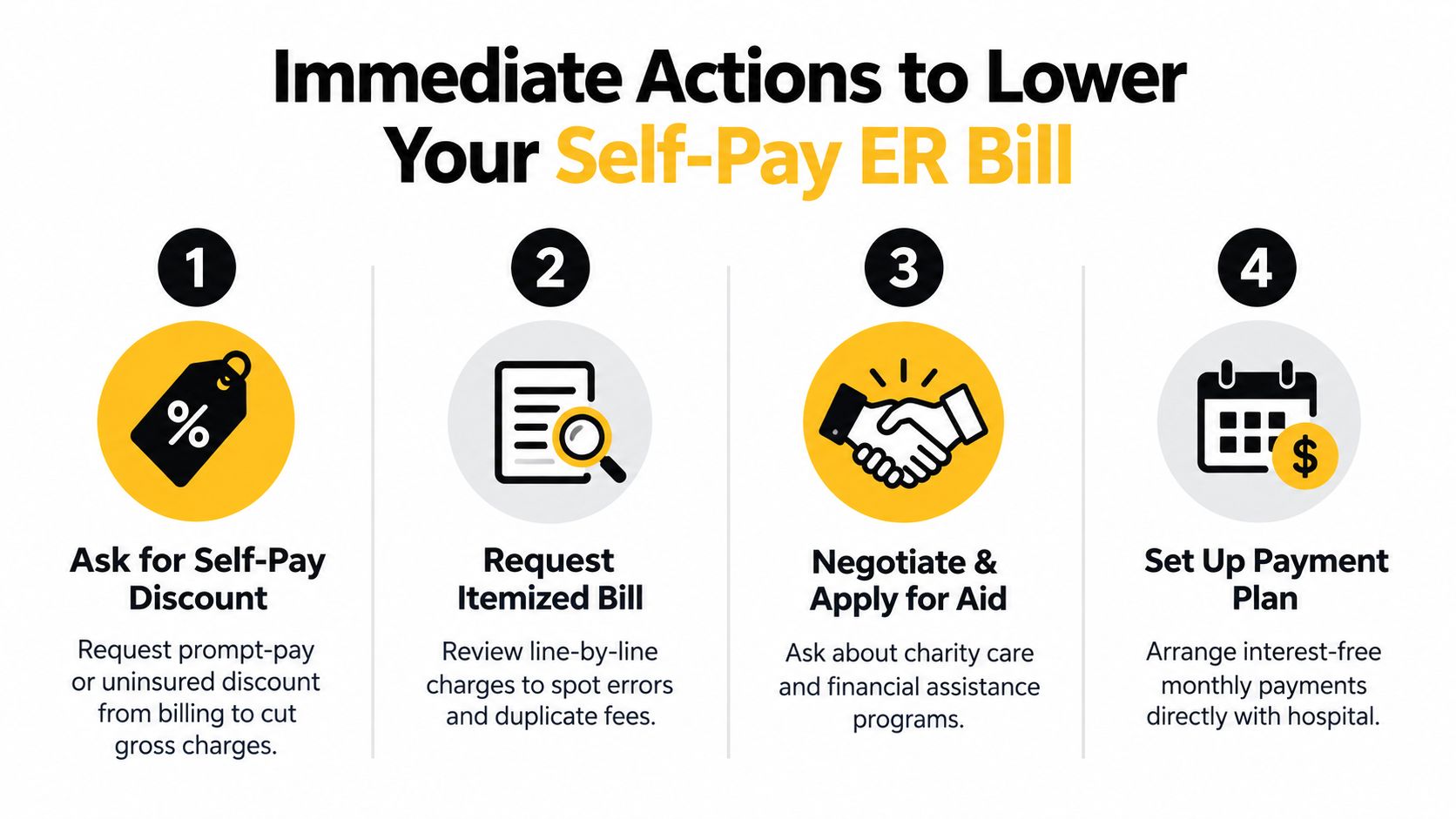
Ask for the self-pay discount first
Call the hospital billing office and say plainly: “I'm uninsured and I want the self-pay or prompt-pay rate applied before I make any payment.”
Don't overexplain. Don't start with hardship. Start with the pricing policy. Many hospitals have one. You want it documented on the account before you discuss payment.
When you were treated, the hospital may have captured registration details that matter now. Get copies of your discharge papers, every bill that arrives, and the exact names of the hospital, ER physician group, radiology group, and lab company. Those names matter because you may need to negotiate with each separately.
Request the itemized bill and challenge the stack
A summary bill is useless for disputes. Ask for the full itemization.
Then review it for:
- Duplicate charges: The same supply or service listed more than once.
- Unknown providers: Bills from groups you didn't realize were separate.
- Services you question: Imaging, labs, or medications you don't understand and want explained.
- Bundled assumptions: Charges that read like broad hospital categories without detail.
A cost-comparison article notes that uninsured emergency department visits for common conditions average $1,000 to $2,500, while urgent care is the lower-cost option for non-life-threatening issues, according to Solv's urgent care versus ER cost comparison. Use that as a practical lesson for the next episode of care, not as a reason to fight medically necessary treatment you already received.
Here's a useful explainer if you want a walkthrough in plain English before you make the calls:
Apply for financial assistance and lock in a payment plan
Ask whether the hospital offers charity care, financial assistance, or an uninsured patient relief policy. Many nonprofit hospitals do, and some for-profit systems offer internal hardship review as well.
Use simple language:
- At registration or after discharge: “I need the financial assistance application.”
- When the bill arrives: “Please pause collections activity while my assistance request is reviewed.”
- If aid is denied: “What interest-free payment plan can you offer directly through the hospital?”
Get every payment agreement in writing before you give card information.
How Employers Can Reduce Uninsured ER Exposure
An employee leaves work early with a child who has a high fever at 7:45 p.m. They do not know where to go, the primary care office is closed, and the plan materials are buried in an inbox. They end up in the ER. A week later, the bill shows up as a stack of charges, not one price, and the employee is staring at a financial hit they did not see coming.
That is not just an employee problem. It is a benefits design failure.
For small and mid-sized employers, uninsured or underinsured ER exposure usually starts with gaps. No real after-hours option. No cash set aside for first-dollar care. No simple triage path. Then one low-clarity medical episode turns into facility fees, physician fees, imaging, labs, and sometimes separate specialist charges. The higher the acuity, the faster that stack grows.
The employer playbook that actually helps
The employers that reduce these bills do a few plain things well.
| Employer Lever | Annual Cost Per Employee | What It Prevents |
|---|---|---|
| Defined-contribution medical support | Varies by employer budget and market | Helps workers buy at least basic major-medical protection instead of going effectively uncovered |
| HSA or FSA seed funding | Varies by contribution strategy | Gives employees cash for urgent upfront care before the ER feels like the only option |
| Care navigation or steerage support | Vendor and scope dependent | Directs lower-acuity episodes to telehealth, urgent care, or primary care |
| Direct primary care access | Membership pricing varies | Gives employees a real first call for common problems and follow-up questions |
| Zero-copay tele-urgent access | Plan design dependent | Reduces after-hours ER use driven by convenience and confusion |
Skip cosmetic fixes. A thicker benefits guide will not solve this. Employees need a clear front door and a way to pay for the right site of care.
KFF explains the legal side that matters here. Under federal emergency care rules, hospitals must screen and stabilize emergency patients regardless of insurance status or ability to pay, which means the bill discussion usually happens after care is delivered, not before, according to KFF's overview of EMTALA and emergency care obligations. Employers should plan around that reality. Once a true emergency episode starts, cost control is mostly gone.
Where employers get this wrong
HR teams often assume employees can sort this out in the moment. They cannot. Pain, fear, and after-hours timing push people to the highest-cost setting.
Give workers a simple decision path they can use:
- Tele-urgent for common illnesses, medication questions, rashes, and similar concerns when virtual care fits the symptoms
- Urgent care for same-day in-person issues that are painful or disruptive but not life-threatening
- ER for chest pain, stroke signs, major bleeding, serious breathing trouble, severe trauma, or other symptoms that need immediate stabilization
The point is not to discourage emergency care. The point is to stop avoidable ER use before the bill turns into five separate bills.
My recommendation for HR leaders
Put the care path in three places. Onboarding. Open enrollment. The employee's phone.
Then fix the money problem. Seed HSAs or FSAs if your plan allows it. Offer tele-urgent care with no copay if you can. Publish local urgent care options near worksites and where employees live. If your workforce has meaningful uninsured exposure, reconsider whether your current contribution strategy is saving money. Many thin plans just shift medical debt onto employees and call it cost control.
That is penny-wise benefits design. It usually ends with a retention problem and a payroll problem.
Designing Benefits That Prevent Surprise ER Bills
The biggest driver of avoidable ER spending isn't bad intent. It's confusion.
Employees don't make care decisions from a benefits glossary. They make them when a child spikes a fever on Sunday night or when they twist a back lifting something heavy after clinic hours. If your plan design doesn't meet that moment, the ER becomes the default.
Build the front door before you talk about the deductible
Start with education. Every plan should include a one-page triage guide written in plain language. Not insurance language. Human language.
Use a simple framework:
- Use tele-urgent for common illnesses, medication questions, rashes, minor infections, and follow-up concerns when virtual care is appropriate.
- Use urgent care for stitches, sprains, minor fractures, ear pain, fevers, and similar non-life-threatening problems needing in-person evaluation.
- Use the ER for symptoms that may cause permanent harm or require immediate stabilization.
Employees also need protection when the event is real and expensive. That's where supplemental coverage can help. A hospital indemnity plan can soften the blow of hospital-based care, especially for workers who fear the deductible more than the premium. If you're evaluating that approach, hospital indemnity coverage is worth understanding in plain terms before renewal season.
Replace fragmented billing exposure where you can
ER billing gets ugly because the charges fragment. Facility. physician. imaging. follow-up. Employers can't rewrite hospital billing rules, but they can reduce how often workers enter that environment for low-acuity needs.
The strongest design choices usually include:
- A visible tele-urgent option: It needs to be easy to access, not buried in a PDF.
- Clear urgent care steerage: Include locations, hours, and examples of when to go.
- Primary care access that works fast: If employees can't get seen promptly, they'll bypass lower-cost care.
- Deductible support where possible: Seeded HSAs or other employer-funded support reduce panic decisions.
Benefits only change behavior when employees can use them in real time.
What HR should track
Don't judge the program by whether employees say they “like” it. Track whether it changes where care happens.
At a minimum, monitor:
- ER utilization patterns
- Average hospital emergency claim severity
- Tele-urgent resolution before in-person escalation
- Repeat low-acuity emergency use
If those numbers don't move, the issue usually isn't the plan itself. It's access, communication, or both.
Practical Questions About Paying an Uninsured ER Bill
Once the bill is real, people ask the same practical questions. Can I get a payment plan? What if I can't pay right away? What documents should I save? Those are the right questions.
Start with the hospital billing office, not a collector. Ask for the balance after any self-pay discount, then ask for the longest interest-free payment plan they'll approve directly.
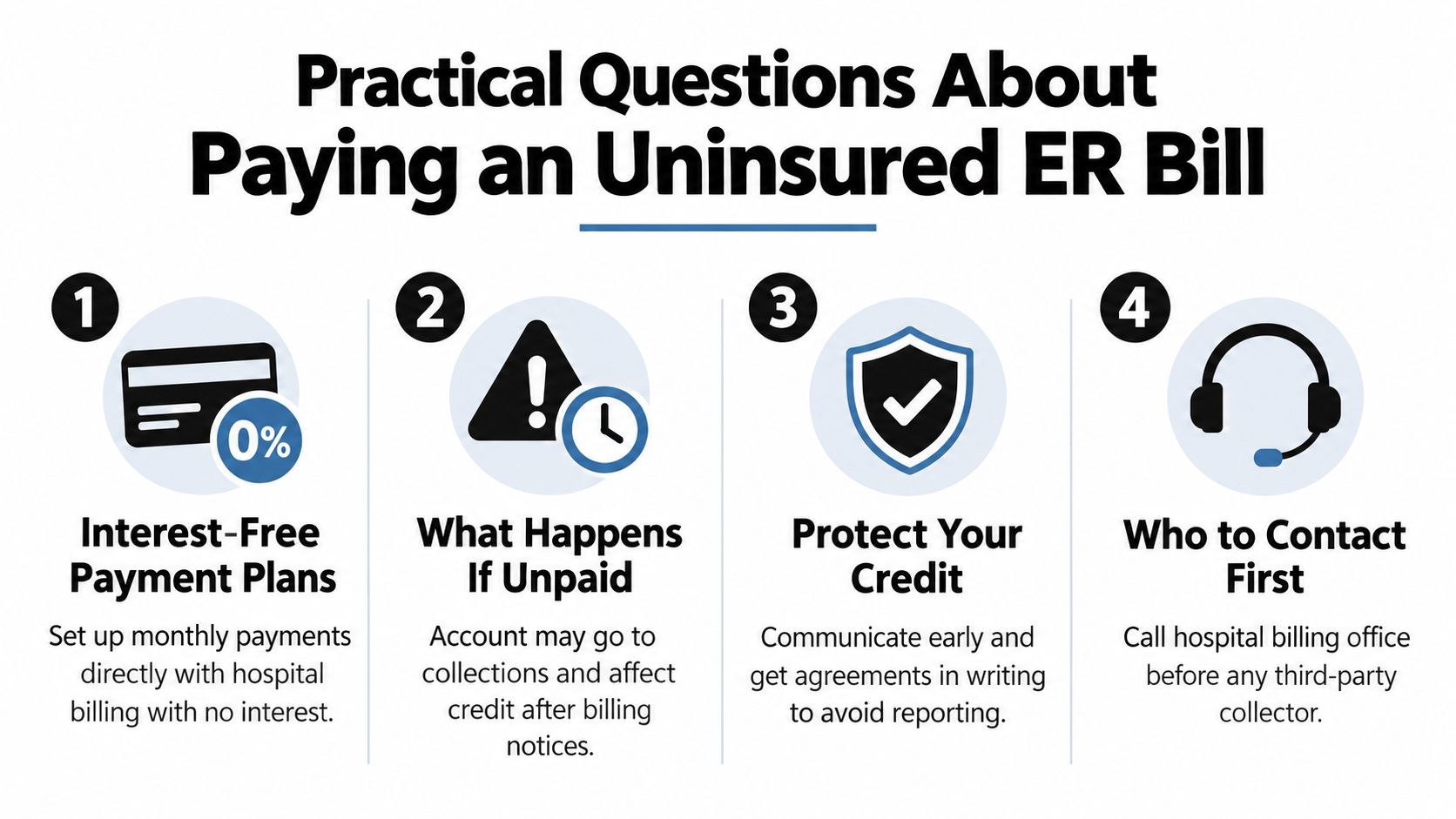
What to do if you can't pay the full amount
If your budget is already stretched by food, housing, or utility pressure, deal with those basics at the same time you handle the medical bill. A practical directory of SNAP and TEFAP housing help can be useful when the ER bill is only one piece of a wider household crunch.
Keep your records organized:
- Itemized bill: Not just the summary statement
- Explanation of charges: Notes from billing calls and written clarifications
- Proof of payments: Receipts, confirmations, and bank records
- Aid application copies: Financial assistance forms and supporting documents
- Written agreements: Payment plans and discount approvals
How to think about out-of-pocket exposure
If you do have coverage for a future emergency, learn how your plan's cost-sharing limits work before you need them. Understanding your out-of-pocket maximum can keep one emergency from turning into months of confusion.
For uninsured patients, the key distinction is simpler. You're negotiating the bill itself, not arguing over insurer cost-sharing.
The closing checklist
Before you move on from an uninsured ER bill, make sure you have done these things:
- Requested the self-pay rate
- Asked for the itemized bill
- Applied for financial assistance
- Set up a direct payment plan if needed
- Saved every document and note
If you only do one thing today, do the call to billing. Silence is expensive. Early contact gives you the best shot at discounts, aid, and a manageable payment arrangement.
Benely helps employers build benefits that are easier to use when people need care, not just easier to describe during open enrollment. If you want a cleaner strategy for reducing avoidable ER exposure, improving care navigation, and giving employees better coverage choices, visit Benely.