 Employee Benefits
 HR & Compliance
 Technology
 Wellness
 PEO Solutions
A founder reaches 22 employees, switches everyone to direct deposit, and assumes the hard part of HR is over. There's no handbook, no reliable timekeeping process, and no single owner for state notices. Then a former hourly employee files a wage claim alleging two years of unpaid pre-shift work. The payroll system shows what the company paid, but it doesn't prove the company paid for every minute worked.
That's the trap in HR compliance for small business. Owners often treat compliance as a folder of policies. In practice, it's a liability system connecting headcount, worker location, pay rules, classifications, benefits, notices, and records. The system only becomes visible after a complaint, audit, or lawsuit exposes the gaps.
Table of Contents
- The Compliance Wake-Up Call Most Small Businesses Get
- What HR Compliance Actually Means in 2026
- The Federal Floor Every Small Employer Must Meet
- Required Policies, Posters, and Documents to Have on File
- Pay, Classification, and Benefits Traps That Drive Real Risk
- In-House HR Versus a PEO Versus a Tech-Enabled Partner
- Your 30-60-90 Day Compliance Plan and Audit Checklist
The Compliance Wake-Up Call Most Small Businesses Get
Most small employers don't discover compliance problems during a calm quarterly review. They discover them through a formal complaint or investigation.
A state labor commissioner complaint can begin with a single employee who believes wages, overtime, meal periods, sick leave, or final pay were handled incorrectly. A U.S. Department of Labor Wage and Hour Division investigation can examine time records, payroll practices, worker classifications, and supervisor instructions. An Equal Employment Opportunity Commission charge can challenge hiring, promotion, discipline, termination, harassment, or accommodation decisions.
Each door creates a different operational problem:
- Wage claim: The business may need to calculate back pay, review comparable employees, and defend records it never maintained.
- Wage and hour investigation: Unpaid overtime can create back wages and, depending on the violation and proceeding, liquidated damages or civil penalties.
- EEOC charge: The owner must preserve emails, interview notes, performance records, accommodation communications, and disciplinary documents while responding to the agency.
The former hourly worker in the opening scenario may not need to prove that the founder intended to underpay anyone. The question is whether the business required or allowed work before the recorded shift and whether its controls caught that work. A manager telling staff to open the store, prepare equipment, or answer messages before clocking in can create exposure even when payroll runs on time.
Operational rule: Direct deposit proves that money moved. It doesn't prove that the amount was correct.
The federal government's Canadian SME compliance report illustrates why this burden matters to smaller employers. It found regulatory compliance costs of about C$370 per employee per year, with an average overall burden rate of 0.28% of revenues. Annual costs also rose from roughly C$1,000 for non-employers to about C$10,600 for firms with 20 to 99 employees, showing how added staff and complexity increase the administrative load. The federal SME regulatory compliance cost report provides the underlying figures.
The answer isn't a thicker handbook. It's a live operating system that tells you what changes when the company hires, expands into a jurisdiction, changes a pay practice, or adds a benefit plan.
What HR Compliance Actually Means in 2026
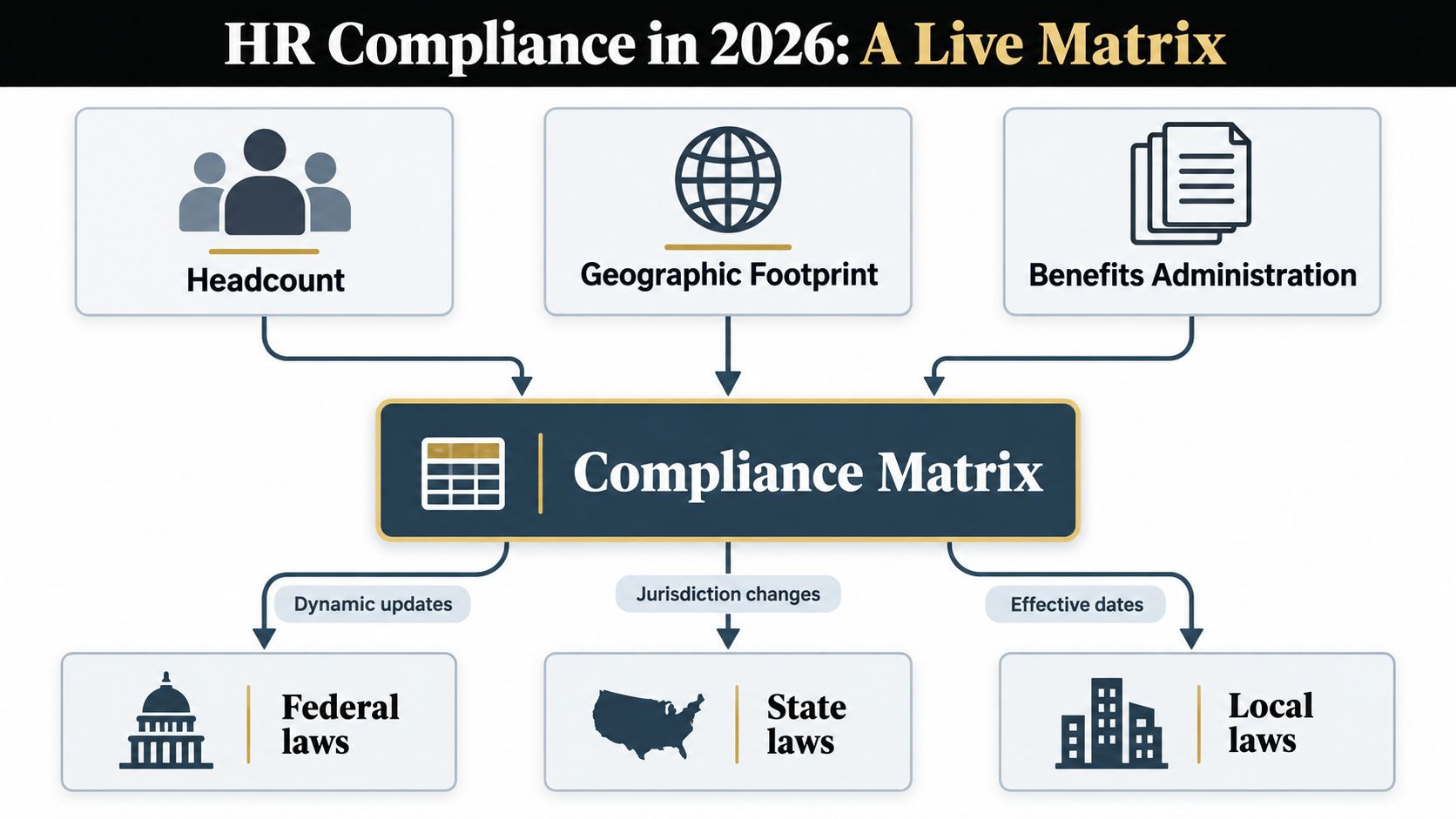
HR compliance is a live matrix, not a one-time checklist. The matrix has three inputs: headcount, geographic footprint, and benefits administration.
Headcount determines when certain federal obligations become relevant. Geography determines which state and local wage, leave, posting, privacy, and pay-transparency requirements apply. Benefits administration adds another layer, because eligibility, notices, deductions, carrier records, and reporting must agree with payroll and employee data.
The cost is material. A U.S. workplace-regulation study found that firms with fewer than 100 workers faced total compliance costs of about $2,500 per employee, compared with $1,530 per employee in large firms, making the smaller-firm cost 68% higher. The study also found that small firms' compliance costs equaled 2.4% of receipts, compared with 1.6% for the overall sample. Worker health and safety rules represented about one-third of compliance costs, while employee benefits rules represented about one-fourth. The Mercatus Center workplace-regulation study supports those findings.
Thresholds create sudden work
The critical mistake is waiting for an annual review. A new hire in another state, a remote employee who moves, or a headcount change can alter the compliance map immediately. Guidance for small and mid-sized employers specifically warns owners to update their programs when they hire in a new state, add remote staff, or cross thresholds such as 15, 25, or 50 employees. SixFifty's small-business HR compliance checklist describes this threshold-drift problem.
The practical model is simple:
- Track every worker's location.
- Track headcount against applicable thresholds.
- Connect benefit eligibility and administration to the same employee record.
- Trigger a review whenever one of those inputs changes.
A static policy binder can't perform those tasks. A maintained matrix can. Treat compliance as an operating asset with an owner, change log, review cadence, and evidence trail.
The Federal Floor Every Small Employer Must Meet
Federal law establishes the baseline. States and cities may require more, but they can't be used as an excuse to miss the federal floor.
Start with wage and hour controls
The Fair Labor Standards Act uses a federal minimum wage of $7.25 per hour. It also requires overtime at 1.5 times the regular rate for hours worked over 40 in a workweek. For the white-collar exemption, the salary basis threshold is $684 per week, or $35,568 per year, and the employee must also satisfy the applicable duties test. The FLSA overview from EmploySome summarizes these requirements.
The owner's action this quarter is to audit timekeeping, off-the-clock work, overtime calculations, and exempt classifications. Don't let supervisors edit time records casually or reward employees for reporting fewer hours.
Know the federal civil-rights layer
The EEOC enforces federal anti-discrimination laws, including Title VII, the Americans with Disabilities Act, and the Genetic Information Nondiscrimination Act. Your hiring, performance, promotion, termination, harassment, and accommodation processes should produce consistent records, not improvised explanations.
Your action is to standardize interview notes, complaint escalation, accommodation documentation, and adverse-action approvals. Keep applicant and employee records organized so the business can respond to an agency request without reconstructing decisions from memory.
Prepare before leave and benefits thresholds
Federal FMLA obligations generally attach to covered employers with 50 employees within 75 miles. Eligible employees may receive 12 weeks of unpaid, job-protected leave, and the employer must maintain group-health coverage under the applicable conditions. The action is to assign one person to manage eligibility, notices, certifications, leave balances, and return-to-work steps.
COBRA applies to group health plans of 20 or more employees, subject to its coverage rules, and qualifying individuals generally receive a 60-day election window. The action is to test the qualifying-event and notice workflow with your benefits administrator.
Under ACA employer shared-responsibility rules, an employer becomes an applicable large employer when it averages at least 50 full-time equivalent employees in the prior calendar year. That status can trigger penalties when qualifying coverage isn't offered. The ACA employer mandate explanation from Arvori explains the threshold and consequence. For an operational overview, use Benely's ACA compliance guide.
| Law | Threshold | Key 2026 Number | Action This Quarter |
|---|---|---|---|
| FLSA | Covered employees | $7.25 federal minimum wage, overtime at 1.5 times the regular rate after 40 hours | Audit time, overtime, and classifications |
| FLSA exemption | White-collar exemption | $684 per week, or $35,568 per year, plus duties test | Recheck exempt roles |
| FMLA | Generally 50 employees within 75 miles | 12 weeks of unpaid, job-protected leave | Assign a leave owner |
| COBRA | Group health plans of 20 or more | 60-day election window | Test notice delivery |
| ACA employer responsibility | 50 full-time equivalent employees on average in the prior calendar year | Coverage obligations and possible penalties | Monitor FTE status and benefits reporting |
The Department of Labor announced on May 14, 2026 that it restored the exempt salary level to $684 per week and the highly compensated employee threshold to $107,432 per year, reversing higher 2024 levels that had been vacated. The DOL announcement is the controlling reference for that update.
Required Policies, Posters, and Documents to Have on File
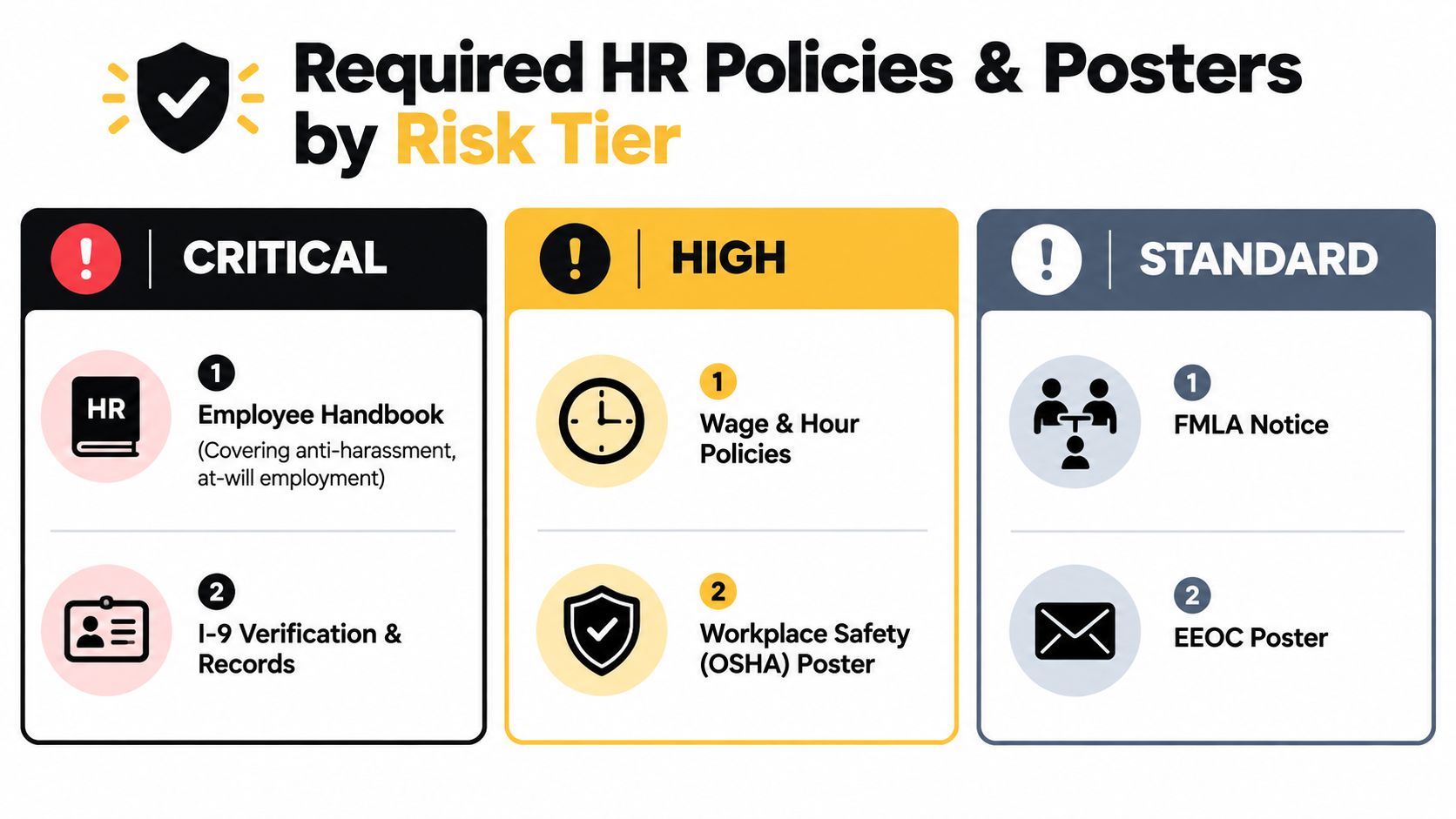
Policies matter, but not all documents deserve equal attention. Build your library by risk, then connect every policy to a process someone follows.
Critical documents come first
Start with the documents that shape daily decisions:
- Employee handbook: Cover employment practices, workplace expectations, wage and hour rules, leave, remote work, reporting channels, and state supplements.
- Code of conduct: Define conflicts, confidentiality, respectful behavior, and escalation.
- Anti-harassment policy: Give employees more than a generic prohibition. Identify reporting channels, investigation ownership, confidentiality limits, and anti-retaliation expectations.
- Wage and hour policy: Prohibit off-the-clock work, explain time reporting, and state that employees must report corrections promptly.
- Leave policy: Combine federal requirements with the state and local rules applicable to each employee.
- Accommodation policy: Document the interactive process for disability, pregnancy, religion, and other protected needs.
- Recordkeeping SOP: Establish what gets stored, who can access it, how versions are controlled, and how retention is handled.
A signed handbook acknowledgment helps prove distribution. It doesn't prove managers followed the policy, so train managers on the decisions they make every week.
Conditional documents depend on the matrix
Some requirements activate only when headcount, location, or workforce composition changes. Maintain I-9 records separately from general personnel files and verify that your retention process follows current federal requirements. Keep the USERRA poster available, add the FMLA posting when the applicable threshold is reached, and prepare for EEO-1 reporting when the business reaches 100 employees.
State overlays can be more demanding. A remote employee in California or New York may bring wage, leave, notice, and posting requirements that don't exist where the owner sits. Map every worker to the jurisdiction where they perform work, not merely to the company's headquarters.
Treat posters as controls
The federal and state labor-poster wall must match the current jurisdiction. Remote workers should have digital access where required or appropriate, while physical workplaces need readable, current postings. A missing or illegible poster can become a citation even when the underlying policy exists.
A policy that employees can't find, understand, or use is not a control. It's a document.
Review the poster set after every new hire in a new jurisdiction, office move, or legal update. Keep a dated copy or screenshot of the version displayed so you can demonstrate what employees saw.
Pay, Classification, and Benefits Traps That Drive Real Risk
The most expensive compliance failures usually sit inside workflows, not handbooks. Payroll calculates the wrong rate, a manager approves unrecorded work, or the company labels a worker an independent contractor without testing the actual relationship.
Classification is a recurring decision
For white-collar exemptions, the federal salary basis is $684 per week, or $35,568 per year, and the duties test still applies. Salary alone doesn't make someone exempt. Review what the employee does, who controls the work, how the role operates, and whether the classification matches the applicable rule.
Misclassification can create back wages, liquidated damages, unemployment-insurance back-charges, and tax exposure if the IRS reclassifies the worker. For disputed worker status, the IRS uses processes including Form SS-8, while a worker may use Form 8919 to address uncollected Social Security and Medicare taxes. These cases require facts and professional review, not a title change.
Off-the-clock work is another predictable failure. Require employees to record pre-shift preparation, post-shift closing, work messages, and required training. In states with stricter meal and rest-break rules, such as California, your timekeeping and scheduling workflows must reflect local requirements.
Benefits and reporting need reconciliation
Benefits administration creates risk when enrollment data, payroll deductions, carrier invoices, and employee eligibility records disagree. ACA status, COBRA notices, ERISA documentation, and state-mandated benefits should sit on the same review calendar as payroll rather than in a separate benefits folder.
BBSI's 2026 HR compliance checklist highlights a broader reporting and cost-management issue for 2026. Employers may need to report overtime premium pay separately, total tip income, and student-loan contributions on tax forms, while inflation-adjusted limits changed for Dependent Care FSAs, ACA affordability, 401(k)s, and HSAs. The practical lesson is clear: payroll and benefits settings need a deliberate review before forms are issued.
| Risk Area | Trigger | Typical Penalty | Quick Fix |
|---|---|---|---|
| Off-the-clock work | Required tasks outside recorded time | Back wages and possible liquidated damages | Require complete time reporting |
| Exempt classification | Salary or duties don't satisfy the exemption | Back overtime and related payroll exposure | Audit duties and salary basis |
| Worker classification | Contractor relationship functions like employment | Back wages, tax exposure, and unemployment charges | Review the actual working relationship |
| Benefits administration | Eligibility, deductions, or notices don't match | Corrections, notices, penalties, or employee claims | Reconcile payroll, carrier, and HRIS data |
| Multi-state payroll | Employee works from a new jurisdiction | State tax and wage-law exposure | Register and map requirements before payroll |
Your reporting calendar should assign owners for W-2, 1099-NEC, Forms 941 and 940, EEO-1, OSHA 300A, ACA filings where applicable, and state new-hire reports. A calendar without an owner is just a list of future mistakes.
In-House HR Versus a PEO Versus a Tech-Enabled Partner
Choose an operating model based on headcount, states, benefits complexity, and risk appetite. There's no prize for keeping HR in-house if one overloaded finance manager is carrying payroll, benefits, employee relations, and compliance.
The three models
In-house HR works when the company can support a dedicated generalist or HR team with clear authority. It offers direct control and institutional knowledge, but a small team can miss jurisdictional changes, benefits notices, or classification problems when growth accelerates.
A traditional PEO can handle payroll, tax administration, benefits pooling, and HR support through a co-employment model. That can reduce administrative work, but the arrangement may involve multi-state licensing considerations, contract constraints, and less flexibility over how the company manages its HR technology.
A tech-enabled partner can connect HRIS records, policy workflows, benefits administration, payroll inputs, compliance monitoring, and human support without requiring the same co-employment structure. Benely is one example of this model, with benefits, onboarding, payroll, and compliance workflows connected through a centralized platform. Benely's PEO and HR solutions can also help employers compare PEO options when co-employment is under consideration.
For payroll owners who need a practical control list, the PA payroll compliance checklist offers a useful example of how payroll tasks can be organized by obligation and review point.
| Criterion | In-House HR | Traditional PEO | Tech-Enabled Partner |
|---|---|---|---|
| Cost predictability | Depends on hiring and internal systems | Contract-based, with bundled services | Subscription or service-based, depending on scope |
| Compliance coverage | Depends on internal expertise | Broad support through the PEO model | Monitoring and workflows with human support |
| Time-to-value | Slower while processes are built | Faster after implementation | Fast when integrations and data are clean |
| Scalability | Strong with a mature team | Strong across supported jurisdictions | Strong for distributed, growing teams |
| Control | Highest internal control | Shared administrative structure | More control than co-employment models |
| Best fit | Stable company with dedicated HR ownership | Employer seeking bundled administration | Growing or distributed company needing connected systems |
The recommendation is straightforward. Build in-house when you have a real HR owner and enough operating maturity to maintain the matrix. Consider a PEO when bundled payroll, benefits, and employment administration outweigh flexibility concerns. Choose a tech-enabled partner when the business is growing across locations and needs connected records, automated reminders, and specialist support without handing over the entire employment structure.
Your 30-60-90 Day Compliance Plan and Audit Checklist
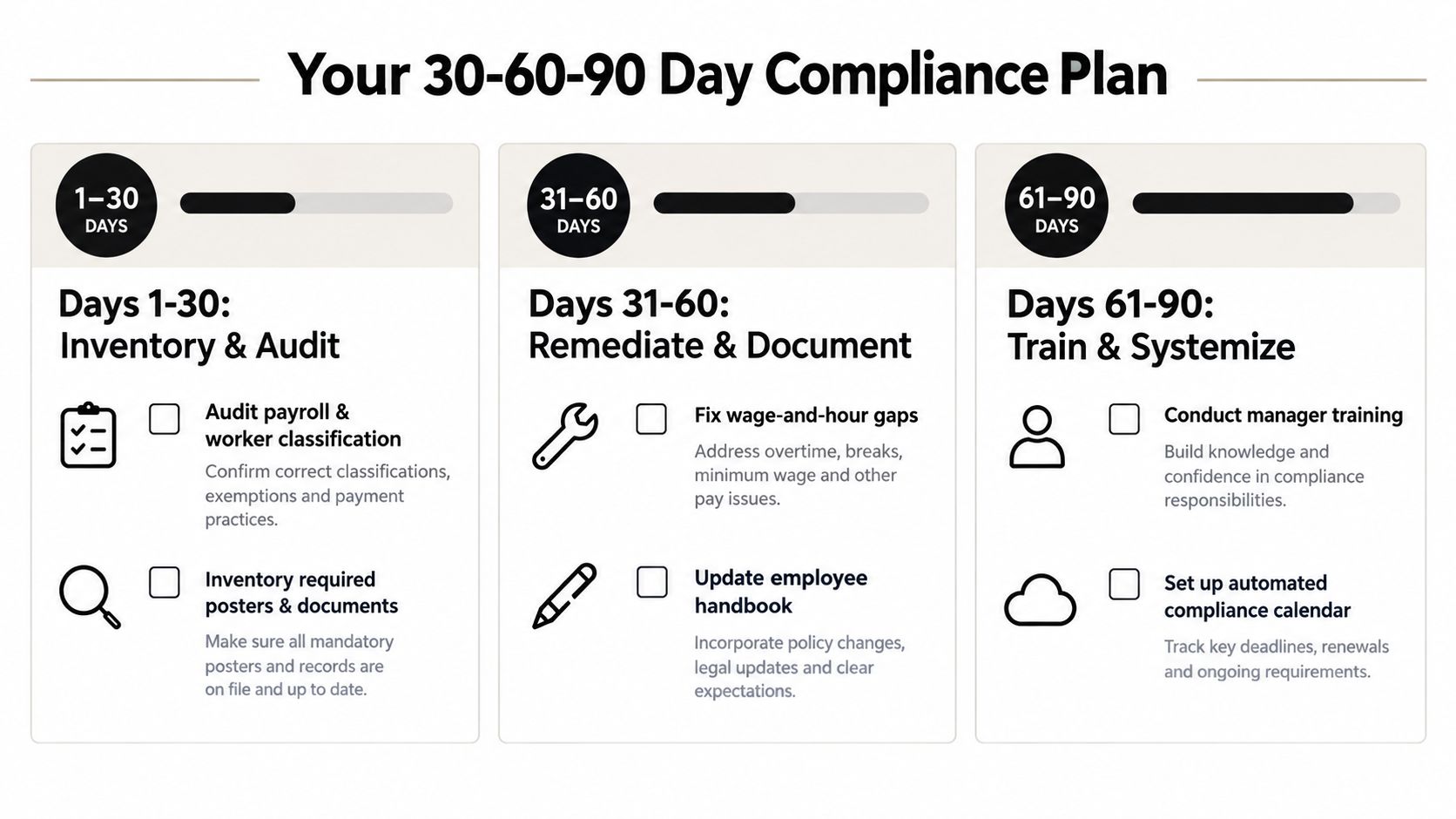
A compliance program improves when someone can execute it in sequence. Don't start by rewriting every policy. Start by finding the gaps that can create immediate payroll, classification, benefits, or recordkeeping exposure.
Days 1 through 30
Create a one-page audit sheet and inventory:
- People: Employee names, work locations, employment status, manager, hire date, and classification.
- Pay: Rates, salary basis, time records, overtime, deductions, commissions, tips, and payroll approvals.
- Policies: Handbook version, acknowledgments, leave, accommodations, conduct, harassment, and wage rules.
- Posters: Federal, state, local, physical, and digital postings.
- Proof: I-9 records, payroll records, benefit elections, notices, training logs, and policy history.
Mark every item as complete, missing, inconsistent, or requiring legal review. Assign one owner and one due date to every gap.
Days 31 through 60
Fix wage-and-hour exposures first. Reconcile time records to payroll, investigate recurring pre-shift or post-shift work, test overtime calculations, and review exempt and contractor classifications. Then update the handbook and state supplements so the written rules match actual practice.
Enroll ACA and COBRA workflows where applicable, reconcile benefit deductions against carrier invoices, and confirm state tax registrations for every employee location. For a broader employee-training framework, use this scope compliance training resource to organize role-specific training and completion records.
Days 61 through 90
Run a tabletop audit. Give a manager a hypothetical wage complaint, accommodation request, leave request, or employee move to another state, then trace how the company would respond. Document every handoff, missing record, and system limitation.
Train managers on time reporting, retaliation, harassment escalation, accommodations, leave routing, and performance documentation. Connect the resulting actions to an automated compliance calendar, and use Benely's employee benefits compliance checklist to verify that benefits-related tasks have owners and evidence.
Use this copy-ready checklist:
- People: Confirm each worker's state and local work location.
- People: Confirm employee, contractor, exempt, and non-exempt classifications.
- People: Record hire dates, manager assignments, and status changes.
- People: Review remote-work changes before payroll is processed.
- People: Verify onboarding ownership.
- Pay: Audit minimum-wage and overtime settings.
- Pay: Test time capture for pre-shift and post-shift work.
- Pay: Reconcile payroll registers to approved time.
- Pay: Review deductions, tips, commissions, and bonuses.
- Pay: Check salary basis and duties for exempt roles.
- Policies: Maintain the current handbook and acknowledgment log.
- Policies: Review anti-harassment and reporting procedures.
- Policies: Review leave and accommodation procedures.
- Policies: Maintain a recordkeeping SOP.
- Policies: Document policy versions and effective dates.
- Posters: Verify federal workplace posters.
- Posters: Verify state and local posters for each worksite.
- Posters: Provide appropriate digital access for remote staff.
- Posters: Check that displayed notices are readable.
- Proof: Separate and secure I-9 records.
- Proof: Preserve payroll and time records.
- Proof: Reconcile benefits enrollment and deductions.
- Proof: Track required notices and delivery evidence.
- Proof: Record manager and employee training.
- Proof: Assign owners to reporting deadlines.
- Proof: Review headcount and location changes quarterly.
Hold a 30-minute quarterly review. Spend the first ten minutes on headcount and locations, the next ten on payroll and benefits changes, and the final ten on upcoming notices, filings, and policy updates. Recheck any threshold change, including the company's approach to FMLA and ACA obligations at 50 employees, any applicable $600 in 1099-NEC payments, and state wage floors. If the matrix changed, update the process immediately.
Benely helps small and growing employers connect benefits administration, payroll, onboarding, ACA reporting, COBRA notifications, and HR compliance workflows in one system with specialist support. If your compliance matrix is currently spread across spreadsheets, inboxes, and memory, visit Benely to evaluate a more structured way to run it.