 Employee Benefits
 HR & Compliance
 Technology
 Wellness
 PEO Solutions
At open enrollment, an employee sees two Blue Cross Blue Shield options. The PPO costs more from every paycheck. The HDHP looks cheaper, so the employee chooses it without checking the deductible, prescription rules, or available savings. Months later, an unexpected specialist visit or family medical bill exposes the problem: the lower payroll deduction didn't make healthcare affordable. It only moved more of the cost into the employee's cash flow.
That's why the BCBS PPO vs HDHP decision deserves more attention than a premium comparison. For an SMB leadership team, the right question isn't which plan looks cheapest. It's which plan gives employees a manageable combination of monthly cost, routine-care access, deductible exposure, provider flexibility, and financial protection.
Table of Contents
- Navigating the Open Enrollment Dilemma
- Defining the Structural Differences
- Evaluating Real-World Cost Exposure
- Matching Plans to Employee Profiles
- Designing a Dual-Option Benefits Strategy
- Securing Long-Term Workforce Health
Navigating the Open Enrollment Dilemma
An employee named Jordan earns a solid salary but doesn't keep much cash in reserve. During open enrollment, Jordan compares a BCBS PPO with a BCBS HDHP. The PPO deduction is visibly higher on each paycheck, while the HDHP appears to create immediate savings. Jordan selects the HDHP, assuming that limited healthcare use means limited financial risk.
That assumption works until an ordinary year becomes an expensive one. A new diagnosis, a series of tests, or care for a dependent can create substantial bills before the plan begins sharing costs. The employee may still have excellent insurance, but insurance doesn't automatically solve a timing problem. A bill due this month can be unaffordable even when the employee's total annual healthcare spending would be manageable.
Practical rule: Never present the HDHP as the “cheap plan.” Present it as the lower-premium plan with greater responsibility for early-year spending.
The PPO creates a different experience. Employees generally pay more through payroll, but they may receive more predictable copays or lower point-of-service costs for covered care. That predictability has value for employees managing ongoing prescriptions, frequent appointments, or family healthcare needs. It also reduces the chance that an employee avoids care because the next visit feels financially dangerous.
Employers shouldn't expect workers to decode plan documents unaided. Give them a plain-language comparison that shows the payroll deduction, deductible, primary-care rules, specialist costs, prescription treatment, out-of-pocket maximum, network differences, and HSA mechanics. A practical open enrollment checklist for HR can help your team organize the decision around employee questions rather than carrier terminology.

The employer's role isn't to steer everyone toward the plan with the lowest premium. It's to make the trade-off visible. If employees understand how each plan behaves during a routine year and a high-use year, they can choose coverage that fits their finances instead of reacting to sticker shock.
Treating enrollment as a compliance task also wastes a retention opportunity. Employees judge whether leadership understands their real lives, including whether a benefits package protects someone who can't comfortably absorb a large bill. Good plan communication won't eliminate every difficult healthcare decision, but it can prevent avoidable surprises.
Defining the Structural Differences
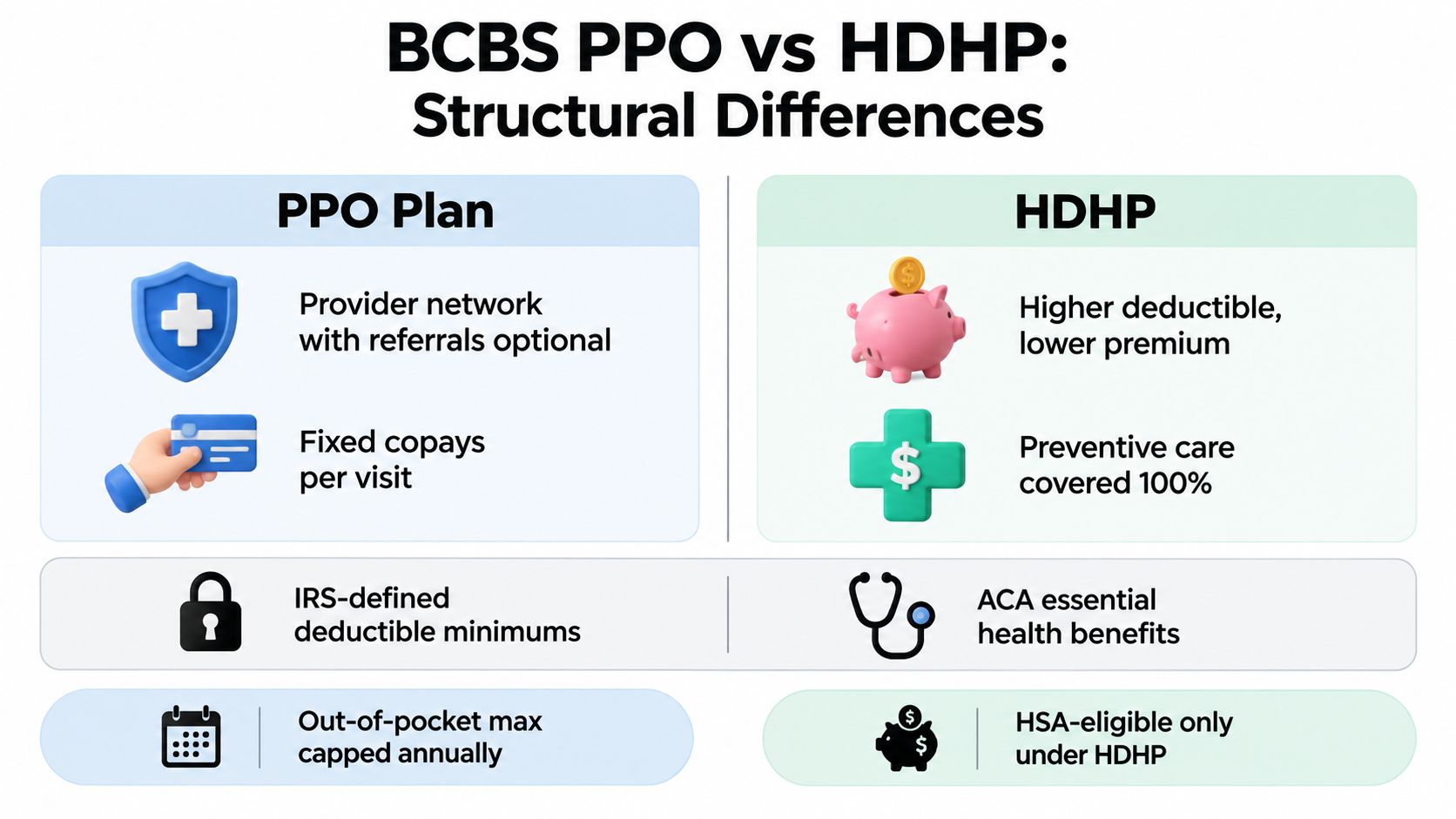
A Preferred Provider Organization, or PPO, and a High Deductible Health Plan, or HDHP, allocate cost and risk through different structures. They are not merely expensive and inexpensive versions of the same coverage. The carrier, network, deductible, coinsurance, copays, and out-of-pocket maximum shape the final experience, while the plan architecture determines when employees pay and how much cash they need available.
An HDHP must meet federal requirements if it will be paired with a tax-advantaged Health Savings Account. For 2026, the IRS minimum annual deductible is $1,700 for self-only coverage and $3,400 for family coverage. The annual out-of-pocket maximum is capped at $8,500 for self-only coverage and $17,000 for family coverage, as described in the IRS guidance on HSAs and high-deductible plans. Employers reviewing HSA eligibility should also use this guide to what qualifies as a high-deductible health plan to check the federal qualification rules.
A PPO is not subject to those federal HDHP deductible minimums. Employers and carriers therefore have more room to design lower point-of-service cost sharing, often in exchange for a higher recurring premium. The plan may include copays for certain visits, broader practical provider access, and less immediate financial exposure when an employee starts using care.
How the HSA changes the equation
The HSA gives the HDHP a financing mechanism that a PPO generally does not offer. Employees can make tax-advantaged contributions, and employers can add funds for qualified medical expenses. That account can make an HDHP workable, but only if employees have enough money available when care occurs.
For an SMB finance team, the cash-flow distinction matters more than the premium headline. A lower premium reduces spending before care, while the employee may carry more responsibility when a visit, prescription, test, or procedure occurs. An employer HSA contribution can reduce that burden, especially for workers with limited savings, but the contribution should be assessed against the deductible and out-of-pocket maximum.
A university employer benefits program illustrates another important point. An HDHP can have the same network access and preventive-care coverage as a PPO, while still requiring the employee to pay more up front until the deductible is met. Review the actual plan documents rather than assuming that an HDHP has a narrower network or weaker preventive coverage. The University of Oklahoma insurance program guide provides a concrete example of this structure.
For leadership, the choice is architectural:
- PPO: Higher recurring premium, generally more predictable cost sharing, and no HSA eligibility based solely on being a PPO.
- HDHP: Lower recurring premium, greater early spending exposure, and HSA eligibility when the plan satisfies federal rules.
- Both: Network quality, exclusions, pharmacy design, preventive services, and out-of-pocket protection require plan-level review.
Employees need a clear answer to three questions: why the HDHP connects to an HSA, when the deductible applies, and how much employer or personal money will be available if care is needed early in the plan year.
Evaluating Real-World Cost Exposure
The deductible is important, but it isn't the entire employee experience. Two plans can both carry a high deductible while treating primary care, prescriptions, laboratory services, and specialist visits very differently. A benefits team that compares only premiums and deductibles is leaving out the spending that employees encounter most often.
The latest available comparison in the supplied SHRM benefits survey summary reports average single deductibles of $1,337 in PPOs and $2,609 in HDHP/SOs. Yet 78% of covered workers in PPOs and 66% of covered workers in HDHP/HRAs are in plans where the deductible doesn't have to be met before primary-care office visits are covered.
That finding changes the conversation. An HDHP isn't automatically a plan where every routine service is paid entirely out of pocket until the deductible is met. Some designs cover primary-care visits earlier, which can make the plan more usable for employees who need regular but predictable care. A PPO can also expose employees to meaningful cost sharing, especially through deductibles, coinsurance, and specialist treatment.
PPO versus HDHP cost and coverage matrix
| Feature | BCBS PPO | BCBS HDHP |
|---|---|---|
| Payroll premium | Usually higher | Usually lower |
| Deductible | Typically lower than the HDHP design | Typically higher and subject to federal HSA qualification rules |
| Primary-care access | May use copays before the deductible, depending on the plan | Some designs cover primary-care visits before the deductible |
| Specialist and diagnostic care | Often more predictable at the point of service | May create higher early-year bills before the deductible |
| HSA eligibility | Not based on PPO status | Available when the plan meets federal requirements and the employee otherwise qualifies |
| Preventive care | Qualifying in-network preventive care is covered before the deductible | Qualifying in-network preventive care is also covered before the deductible |
| Cash-flow profile | More cost paid through payroll, potentially less at the time of care | Less cost paid through payroll, potentially more at the time of care |
| Worst-case protection | Defined by the plan's out-of-pocket maximum | Defined by the plan's out-of-pocket maximum, with federal caps applying to HSA-qualified designs |
Qualifying in-network preventive care must be covered on non-grandfathered plans with no copay, coinsurance, or deductible. That rule applies to both PPOs and HDHPs for qualifying services, as summarized by Benefits Decoder's explanation of HDHP and PPO coverage. It doesn't mean every service connected to a preventive visit is free. Diagnostic tests, treatment, follow-up care, and out-of-network services can follow different cost-sharing rules.
Test the bad month, not just the average month
Your evaluation should model at least three employee experiences:
- Low-use year: The employee uses preventive services and little additional care. The HDHP's lower premium may be attractive, particularly if the employer contributes to the HSA.
- Routine-use year: The employee has primary-care appointments, prescriptions, or specialist consultations. Pre-deductible coverage and pharmacy rules now matter more than the plan label.
- High-use year: The employee or a dependent needs substantial care. The deductible, coinsurance, and out-of-pocket maximum determine whether the plan remains financially survivable.
The key question is whether employees can cash-flow the deductible. A worker may prefer an HDHP mathematically but still struggle to pay a large bill in January. Employers should show the HSA contribution, expected employee payroll cost, deductible, and out-of-pocket maximum together. Don't hide the risk behind an annualized calculation that assumes employees have savings available today.
Matching Plans to Employee Profiles
The right plan depends on more than age or job title. It depends on predictability of care, household cash reserves, provider preferences, and tolerance for variable expenses. A young employee with few medical needs may value lower payroll deductions and the ability to build an HSA balance. A manager supporting dependents may place a higher value on predictable access to care, even when the PPO costs more every pay period.
Consider four common employee profiles.
The low-utilization employee with limited recurring care
An employee who rarely uses healthcare may find the HDHP attractive, especially when the employer funds part of the HSA. The lower payroll cost can matter more than a lower deductible if the employee has enough reserve to manage an unexpected bill. That employee still needs to verify network access, prescription treatment, and pre-deductible services instead of assuming the plan is automatically simple.
The employee managing ongoing treatment
Someone who regularly sees clinicians, fills prescriptions, or coordinates care for a dependent needs predictability. The PPO is often the safer recommendation when the employee values fixed costs and can afford the higher payroll deduction. The decision should be based on the actual plan's visit and pharmacy rules, not on the PPO label alone.
The household with variable financial capacity
Two employees with the same expected healthcare use may need different plans because their cash reserves differ. An employee with substantial savings may absorb an HDHP deductible, while an employee living close to each paycheck may face hardship from the same claim. This is why employer HSA funding isn't a minor enhancement. It can determine whether lower-premium coverage is usable across the workforce.
The employee who needs provider flexibility
A PPO may suit workers who want broader practical access or who don't want to manage restrictive referral patterns. An HDHP can also offer meaningful network access, as the BCBS-administered example noted earlier demonstrates. HR should tell employees to check whether their preferred doctors, hospitals, and specialists participate in the specific network attached to each option.
The broader market supports offering choice rather than forcing a single answer. KFF's 2024 Employer Health Benefits Survey reports that 48% of covered workers were enrolled in a PPO and 27% in an HDHP with a savings option. Over the prior decade, PPO enrollment fell by 10%, while HDHP enrollment rose from 20% to 27%. Both designs now serve substantial portions of the employer market.

A one-plan strategy usually forces part of the workforce to overpay for predictability or accept more exposure than they can manage. A dual option lets employees match coverage to their circumstances, provided the employer explains the differences clearly and doesn't make the HDHP the only financially realistic choice.
For the HSA side of the strategy, employers can review practical guidance on HSA design for employers, including how contributions can support adoption without disguising the underlying plan risk.
Designing a Dual-Option Benefits Strategy
Offering both plans is usually more effective than declaring one plan universally superior. The employer preserves choice, while the benefits team can use contribution strategy and communication to keep the HDHP from becoming an option only comfortable for employees with significant savings.
Start with the plan comparison, not the carrier presentation. Ask the broker to place the BCBS PPO and HDHP side by side and show:
- Employee payroll cost: What comes out of each paycheck under each coverage tier?
- Early-year exposure: What does an employee pay for primary care, specialists, diagnostics, prescriptions, and hospital care before the deductible?
- HSA funding: How much will the employer contribute, when will funds become available, and how does that contribution interact with the deductible?
- Network fit: Do the doctors, hospitals, and facilities employees already use participate in each network?
- Maximum exposure: What is the in-network out-of-pocket maximum, and which services don't count toward it?
Set the employer contribution deliberately
An HDHP with no meaningful HSA support can shift too much risk to employees. A contribution makes the plan more workable, but leadership shouldn't choose an amount by instinct. Compare the employer's premium savings with the contribution required to make the deductible manageable for workers across different pay levels.
The contribution structure also matters. An amount available early in the plan year may help an employee handle a January claim more effectively than the same annual amount distributed slowly through payroll. Your broker and tax advisors should confirm the design and administration rules before implementation.
Communicate decisions in employee language
Don't lead with “actuarial value” or a dense summary of benefits. Use examples that show what happens when an employee has a preventive visit, needs a specialist, fills a prescription, or faces a high-use year. Make employees answer the practical questions:
- How much more or less comes out of my paycheck?
- What will I pay when I use care?
- How much money is available in my HSA?
- Can I handle the deductible if care happens early?
- Are my doctors and medications covered under the plan?
Automate the administration
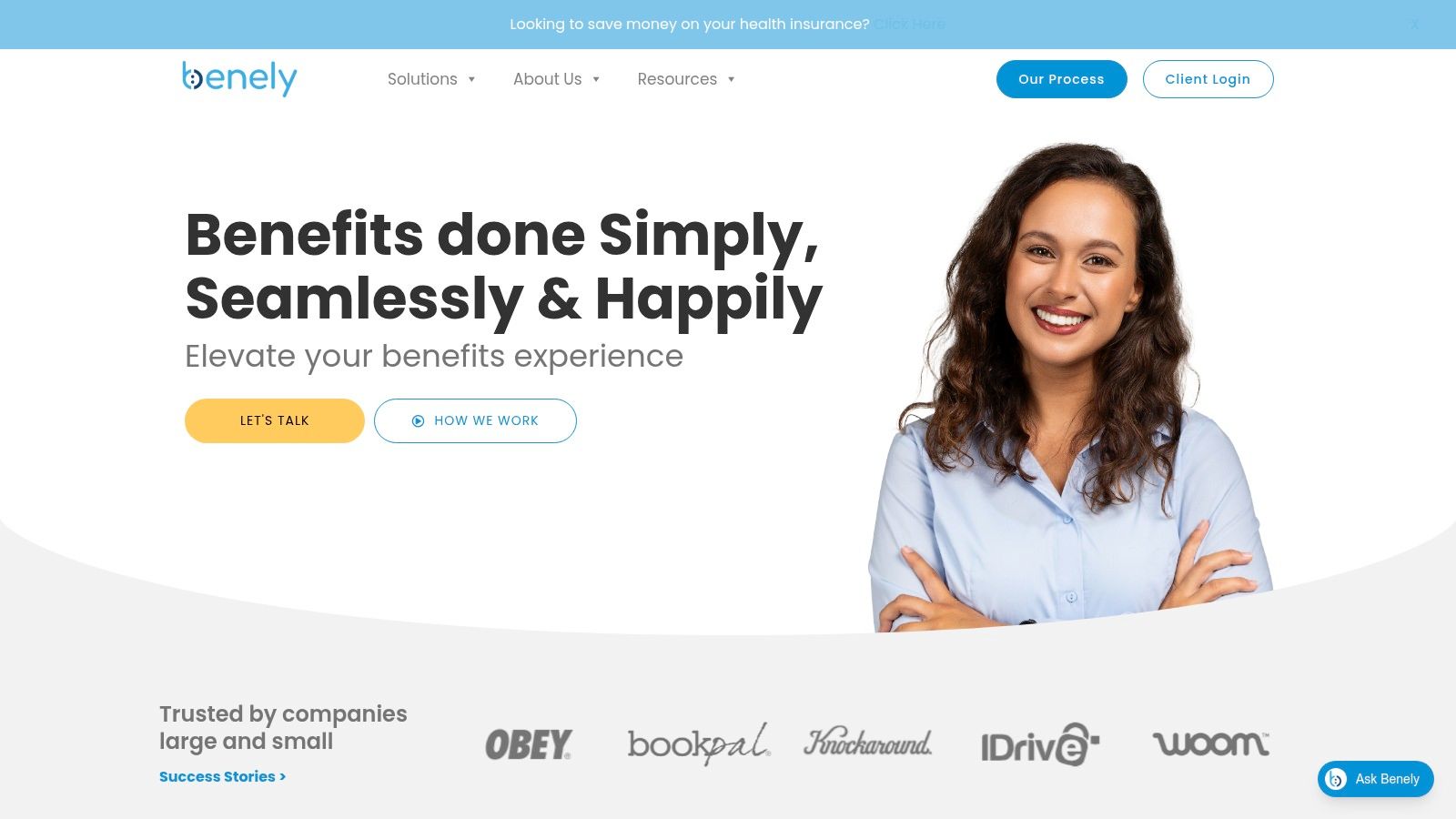
Multiple plan designs create more work if HR relies on spreadsheets, email attachments, and manual reminders. A benefits platform can centralize plan comparisons, employee elections, payroll coordination, enrollment tracking, and compliance workflows. Benely, for example, lets employers compare more than 4,000 health plans side by side, including PPO and HDHP options, with details such as deductibles, out-of-pocket exposure, employee contributions, and budget impact.
Use technology to make the strategy visible, not to replace judgment. Leadership still needs to decide how much risk the company is comfortable shifting, which employees need stronger support, and whether the HSA contribution reflects the stated commitment to financial wellness.
Securing Long-Term Workforce Health
A health plan isn't successful because the employer selected the lowest premium. It's successful when employees can use the coverage without avoiding necessary care or experiencing a financial shock they couldn't reasonably absorb.
For most SMBs, the strongest recommendation is a well-explained dual-option strategy. Keep the PPO for employees who value predictable cost sharing, ongoing care, or broader practical flexibility. Offer the HSA-qualified HDHP for employees who can manage more variable spending and want lower payroll deductions plus tax-advantaged savings. Fund the HSA thoughtfully, then explain the plan using real care scenarios.
Education also needs to continue after enrollment. Employees should know how to confirm network status, compare provider costs, use preventive benefits, track deductible progress, and decide when HSA funds can help. A short reminder during the year can be more useful than another dense benefits guide during open enrollment.
Benefits leaders can also look beyond insurance mechanics when building a broader employee-support strategy. For organizations reviewing workplace health, wellbeing, or related workforce resources, Telomyx offers a relevant point of reference for considering how employee support can extend beyond annual plan selection.
The employer's strategic job is to align coverage design, cash-flow protection, education, and administrative execution. When those pieces work together, employees receive meaningful choice and leadership gains a benefits program that supports recruitment, retention, and responsible spending.
Benely helps employers compare PPO and HDHP options, evaluate deductibles and out-of-pocket exposure, set budgets, automate enrollment, and connect benefits administration with payroll and HR workflows. Visit Benely to review your current plan strategy and build a benefits experience that employees can understand and afford.