You've signed a vendor agreement, collected a certificate of insurance, and checked the box requiring blanket additional insured status. Everyone moves on. Months later, a worker is injured, the claim reaches your company, and the carrier asks for the written contract and the actual endorsement. The contract never clearly required additional insured status, or the endorsement covers only a narrower class of work than the claim involves.
That's the hidden risk. A blanket additional insured endorsement can make vendor onboarding faster, but it doesn't turn vague contract language into coverage. The endorsement, the written agreement, the policy wording, and the actual loss must all line up.
Table of Contents
- The False Security of Automatic Coverage
- How Blanket Additional Insured Endorsements Work
- The Contract as the Ultimate Trigger
- Coverage Limits and the Negligence Gap
- Matching ISO Forms to Your Operational Timeline
- Practical Risk Management for HR and Operations
- Building a Resilient Contract and Coverage Strategy
The False Security of Automatic Coverage
A facilities company hires a contractor to renovate an office. The contract requires the contractor to “maintain appropriate insurance and protect the company from claims arising from its work.” The broker issues a certificate showing general liability coverage and notes that additional insured status applies as required by written contract.
The company files the certificate and assumes the contractor's insurer has accepted the risk. After a worker is injured on the premises, the company tenders the claim. The carrier requests the agreement and points out that it never specifically requires the company to be named as an additional insured. An indemnity clause appears in the contract, but indemnity and additional insured status are different obligations. Without clear insurance wording, the blanket endorsement may not attach.

Efficiency isn't the same as risk transfer
Blanket wording began as an administrative shortcut. Rather than issue a new endorsement whenever a landlord, general contractor, client, or other counterparty needed coverage, an insurer could grant automatic status when the named insured had the required written agreement.
That approach solved a practical problem for construction, leasing, and other relationships involving multiple counterparties. It still depends on precise drafting. Industry guidance records that ISO released its first additional insured endorsement in November 1985. Later forms, including CG 20 33 and CG 20 38, provided automatic status when a written construction agreement required it. ISO revised standard language by 2004, limiting coverage to injury or damage “caused, in whole or in part” by the named insured's acts or omissions. IRMI's discussion of blanket endorsements and underlying agreements places that development in context.
The word blanket describes the administrative method, not the scope of protection. It does not guarantee coverage for every claim involving the additional insured, every location, every service, or every theory of negligence.
Practical rule: Treat “blanket additional insured” as a prompt to review the contract, endorsement, operations, and loss. It is not proof that the upstream party is protected.
Documentation failures create a separate exposure. Vendor teams must distinguish an expired certificate, a missing renewal, and an endorsement that never applied. This guide to what a lapse in insurance coverage means helps clarify that difference. Agencies managing client-specific professional exposure may also need to assess E&O coverage for independent agencies when a documentation error contributes to a disputed claim.
How Blanket Additional Insured Endorsements Work
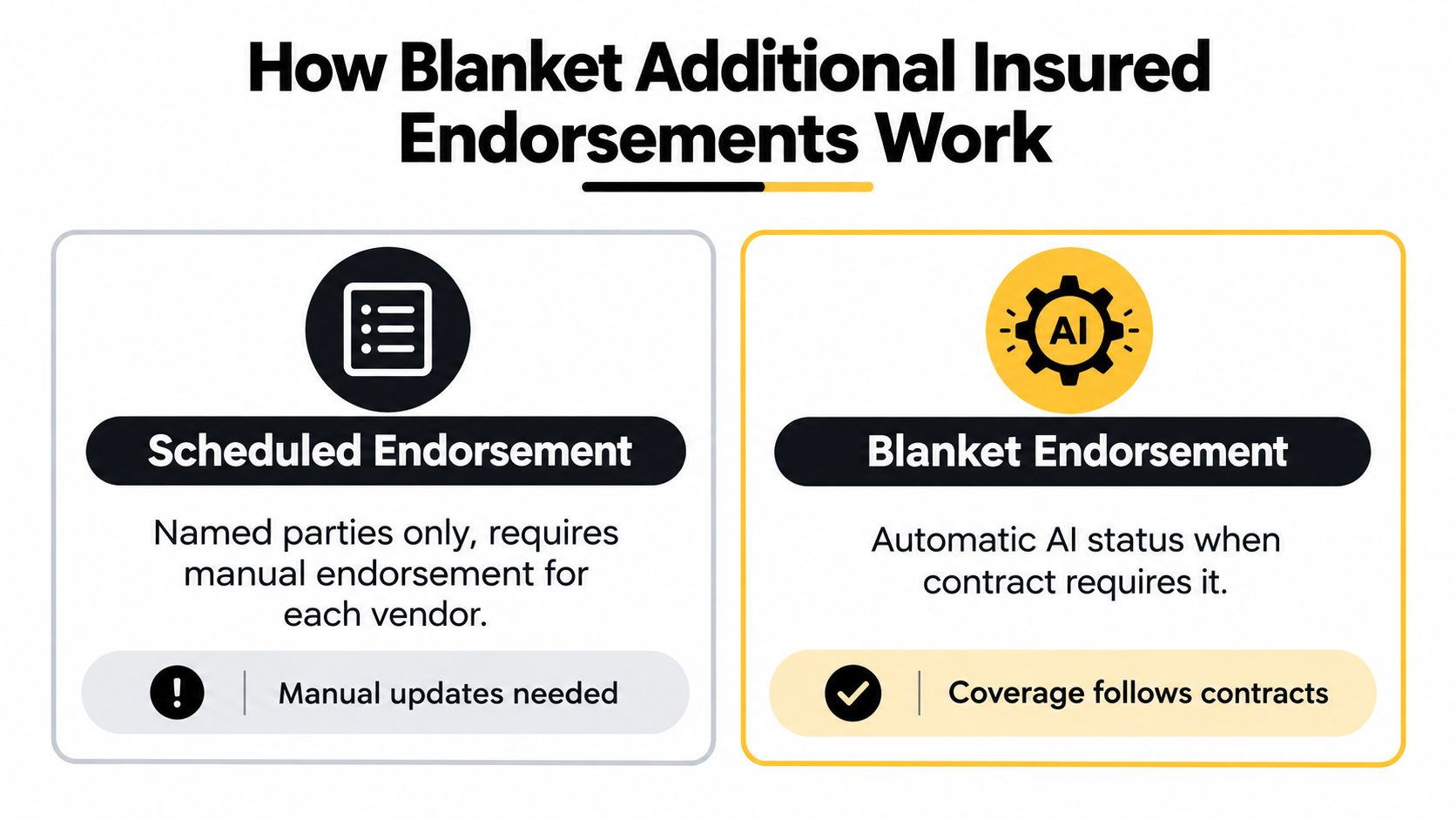
A scheduled endorsement names an individual additional insured, often alongside a specific project, location, or relationship. The insurer issues that endorsement for the identified party. If another landlord, customer, or contracting partner needs status, the policy usually requires a separate request and endorsement.
A blanket endorsement uses a broader eligibility rule. It can grant additional insured status when the named insured is contractually required to provide that status. The contract supplies the qualifying condition, while the endorsement supplies the insurance mechanism. If the agreement misses the form's requirements, the automatic status may fail when the claim arrives.
The operating sequence
- The named insured buys the policy. The contractor, supplier, tenant, or service provider is the policyholder.
- The endorsement defines automatic status. Its wording identifies qualifying contractual relationships and the operations covered.
- The business signs an agreement. The agreement must clearly require the named insured to provide additional insured status.
- The additional insured relies on the resulting scope. Protection remains subject to the endorsement, policy, contract, and facts of the claim.
The process works well across a consistent vendor portfolio because the broker does not need to issue a new endorsement for every customer or landlord. A scheduled form is the better choice for unusual relationships, sensitive projects, or bespoke wording. A blanket form fits repeatable contracts only when the insured maintains reliable document controls.
Use the master-key analogy as an audit instruction. Tag every vendor agreement that contains an additional-insured requirement in the contract-management or vendor system. Store the signed agreement, renewal date, required operations, and certificate together. During a claim, that record lets the risk team test whether the relationship qualified instead of relying on a certificate label.
The format reduces transaction friction, but it does not replace underwriting controls or legal review. Automatic status still depends on the exact contract and endorsement language.
Watch this explainer for a visual introduction to the distinction between scheduled and blanket status.
The practical rule is direct: use blanket status for consistent contractual relationships, then audit each qualifying agreement before relying on it.
The Contract as the Ultimate Trigger
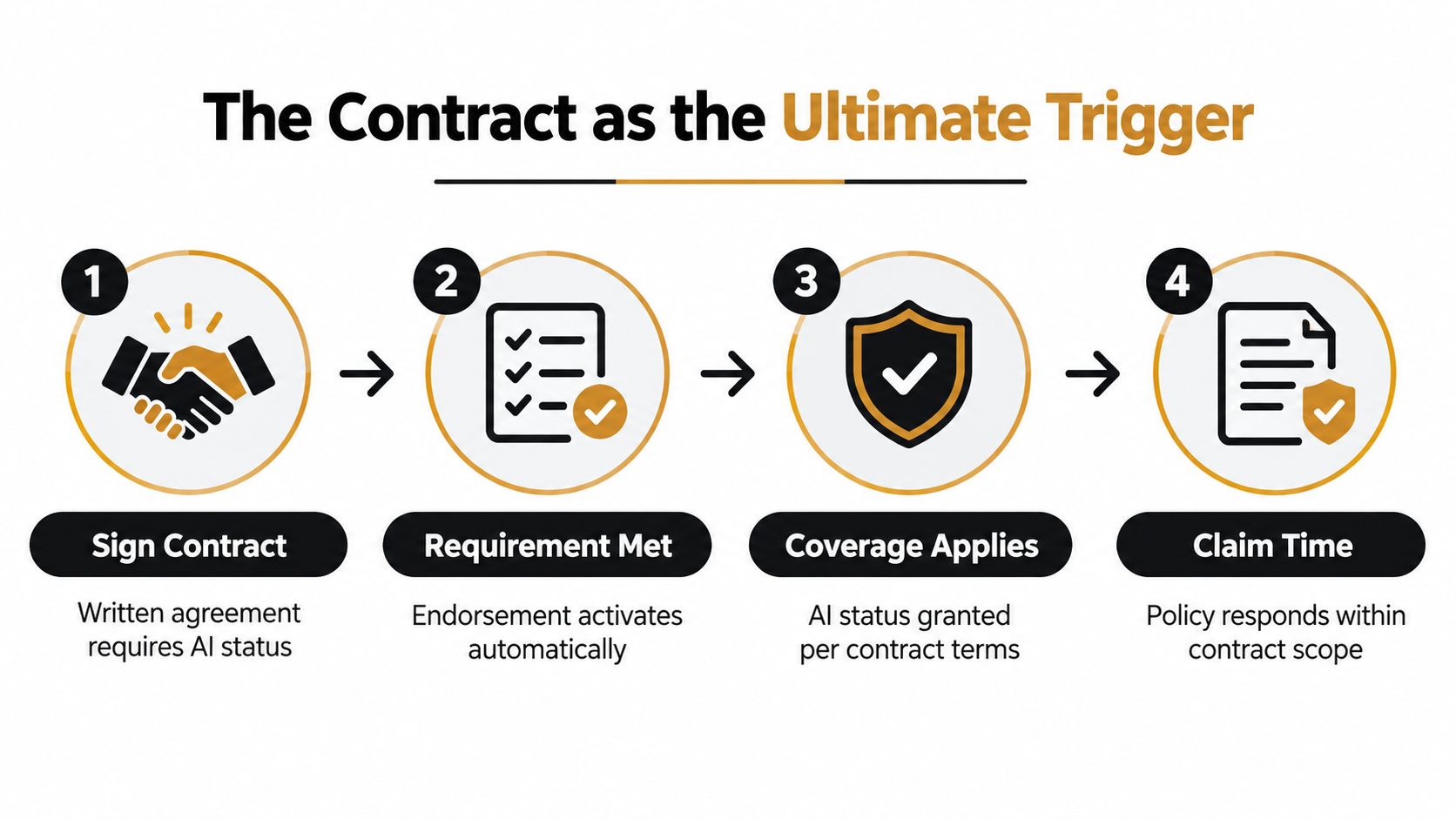
The written agreement sits between the business need and the insurance response. If the endorsement grants status only when the named insured is required to provide it, then the contract must contain an explicit obligation. A general promise to carry insurance may not be enough.
The cause-and-effect chain looks like this:
- Contract wording: The agreement requires the vendor to add the hiring company as an additional insured.
- Endorsement condition: The blanket form recognizes that type of written contractual requirement.
- Status: The hiring company qualifies under the endorsement.
- Claim analysis: The carrier tests the loss against the operations, limits, exclusions, and other restrictions in the policy.
Wording that activates the mechanism
A stronger provision identifies the obligation directly. For example, a contract might require the vendor to provide additional insured status to the company and its specified affiliates, where the status applies to liability arising from the vendor's operations under the agreement. The contract should also identify the required policy type and address any form, priority, or completed-operations requirements that matter to the relationship.
A weaker clause says the vendor must maintain “adequate insurance” or “protect the company against claims.” That language may support an indemnity dispute, but it doesn't necessarily satisfy an endorsement that requires a contractual obligation to provide additional insured status.
The distinction matters because the endorsement may apply only to specific contract types or counterparties, not to every third party connected to the named insured. A blanket form isn't a universal designation. Its scope depends on the relationship described in the contract and the endorsement's own wording.
If the contract doesn't clearly require additional insured status, the carrier has room to argue that automatic status never attached.
Business teams often create avoidable exposure at this stage. Procurement signs a vendor's paper, HR assumes the certificate confirms compliance, and legal sees the insurance requirement only after a dispute begins. The named insured may then face breach-of-contract exposure because it promised protection that the policy never delivered. IRMI's definition of a blanket additional insured endorsement describes this contract-dependent structure and its consequences.
Make the insurance clause readable, specific, and consistent with the policy program. Don't copy a broad requirement into every agreement without checking whether the vendor's carrier issues the requested status.
Coverage Limits and the Negligence Gap
“Blanket” sounds broad. The coverage usually isn't.
The central question is whether the upstream party wants protection for liability connected to the vendor's work, or protection for its own independent conduct. Additional insured coverage generally follows liability arising from the named insured's operations. It doesn't operate like the upstream party's own general liability policy.
Consider a property owner that hires a maintenance company. A visitor trips over equipment the maintenance company left in a corridor. The owner may have a stronger argument that the claim arises from the contractor's work. If the visitor trips because the owner independently ignored a known building defect, the endorsement may not respond to the owner's own negligence. The facts and wording control the outcome.
What the endorsement may not solve
- Independent negligence: The additional insured may not receive protection for liability caused solely by its own acts or omissions.
- Vicarious liability limits: Some wording focuses on liability imposed on the additional insured because of the named insured's conduct, rather than liability arising from the additional insured's separate decisions.
- Professional services: A commercial general liability endorsement isn't a substitute for professional liability coverage when the alleged harm results from design, advice, certification, or other professional work.
- Workers' compensation: Additional insured status on a general liability policy doesn't replace workers' compensation obligations or create that form of protection.
- Policy and endorsement restrictions: The form may narrow operations, locations, contractual relationships, or the period in which status applies.

A buyer that relies on a vendor's blanket endorsement for every operational risk is underinsuring its own business. Maintain a primary insurance program for exposures the company itself creates, and use additional insured requirements to support targeted risk transfer for vendor-related liability.
The precise language deserves more attention than the label. IRMI's analysis of how well blanket coverage protects an upstream party highlights the difference between liability arising from the named insured's work and the additional insured's independent negligence. Before accepting a certificate, compare the contract's allocation of risk with the actual endorsement.
A separate administrative control also matters. Track cancellations, expirations, and missing documentation through a defined process, rather than assuming a previously collected certificate remains valid. Teams reviewing an insurance cancellation policy can use that process to clarify who receives notice, who updates the vendor record, and who escalates a coverage interruption.
Matching ISO Forms to Your Operational Timeline
Coverage needs to follow the risk through its lifecycle. A contractor may be working on your premises today, but the claim may arise after the work is complete. If the contract and endorsement address only ongoing operations, the business can lose the protection it expected when the project closes.
The relevant ISO forms divide the timeline between active and completed work. Industry guidance identifies CG 20 10 and CG 20 33 for ongoing operations, and CG 20 37 and CG 20 38 for completed operations. The form family and edition date affect what is covered and when, as explained in this comparison of scheduled and blanket additional insured forms.
| ISO Form | Coverage Phase | Primary Use Case |
|---|---|---|
| CG 20 10 | Ongoing operations | Contractor or vendor actively performing work |
| CG 20 33 | Ongoing operations | Automatic-status arrangements tied to qualifying written contracts |
| CG 20 37 | Completed operations | Claims arising from work after the active project phase |
| CG 20 38 | Completed operations | Automatic-status arrangements for qualifying completed-work exposures |
Match the form to the actual risk
For an office build-out, ongoing operations status addresses incidents while the contractor is working. Completed operations status addresses a later claim connected to the finished work, such as damage linked to an installation defect. The contract should reflect both phases when the post-completion exposure matters.
A logistics relationship can create a similar issue. A carrier may be actively delivering goods during the engagement, while a later claim involves damage connected to a completed shipment or service. Don't let the vendor's active certificate file determine the entire risk period.
Review the endorsement itself, not only the form name. Confirm the edition, operations description, qualifying contract, and period of status. A blanket endorsement can still be limited to ongoing operations, a defined class of contracts, or a narrower liability trigger.
Practical Risk Management for HR and Operations
HR and operations leaders often own the vendor onboarding workflow even when legal and insurance teams control the policy language. That makes the process design important. The safest program treats the contract, endorsement, certificate, and renewal record as one connected file.
Start with the contract template. Ask legal counsel and the insurance broker to review the insurance clause together, because a clause can be legally broad but incompatible with the vendor's actual endorsement. Define who must receive additional insured status, which operations matter, and whether completed operations protection is required.
Use a controlled onboarding sequence
- Classify the relationship. Identify whether the counterparty is a contractor, landlord, service provider, supplier, or another party with a distinct exposure.
- Set the contract requirement. State the additional insured obligation clearly and avoid relying on “adequate insurance” alone.
- Request the endorsement. Collect the actual endorsement with the certificate. A certificate can support the file, but it isn't the policy amendment itself.
- Compare documents. Check the named parties, qualifying contract, operations, form wording, edition, and applicable dates.
- Escalate exceptions. Send substitutions, unclear blanket wording, and missing completed-operations coverage to the broker or legal reviewer before approval.
- Track the lifecycle. Keep the vendor record active through the relevant contract period and any required post-completion period.
Give ownership to a named person
A workflow fails when everyone assumes someone else checked the endorsement. Assign responsibility for collecting documents, reviewing exceptions, recording dates, and following up on renewals. Store the final approval with the contract so a future claims handler can understand why the vendor was accepted.
A platform can help organize compliance records, but no software can repair an ambiguous insurance clause after a loss. Benely provides employee benefits, HR, onboarding, payroll, and compliance tools through a centralized platform, so companies evaluating broader workforce processes can consider it alongside their insurance broker's vendor-compliance workflow. The insurance judgment still belongs with qualified legal and risk professionals.
Building a Resilient Contract and Coverage Strategy
A blanket additional insured endorsement is useful because it removes repetitive endorsement requests from a high-volume contracting process. Its value ends when teams treat the word blanket as a guarantee of broad protection.
The resilient approach has three owners. Legal counsel drafts a requirement that clearly triggers the intended status. Operations matches that requirement to the vendor's actual work and timeline. The broker confirms that the endorsement wording supports the contract and identifies gaps before the relationship begins.
Make the file claim-ready
A defensible vendor file should show:
- The signed agreement: Include the exact insurance and additional insured language.
- The endorsement: Keep the policy attachment, not merely a certificate notation.
- The coverage interpretation: Record any limitation involving operations, completed work, negligence, or contract scope.
- The review trail: Identify who approved the documents and when the next review is due.
Teams that need to find your insurance certificate can use that process as one part of a broader documentation program, but certificate retrieval isn't the same as endorsement verification. Also understand the commercial arrangement with your broker, including how insurance brokers get paid, so the people advising on coverage and the people managing the contract process have clear responsibilities.
Your company's own primary policies remain essential. Vendor risk transfer should supplement them, not replace them. Review the contracts that create the greatest operational exposure first, then build a repeatable approval process for the rest.
Benely helps companies organize HR, benefits, onboarding, payroll, and compliance workflows, giving growing teams a clearer way to manage documentation alongside their broader risk processes. Visit Benely to evaluate how its centralized platform and HR support can fit your organization's operating model.