
A self-insured health plan is an employer-sponsored arrangement in which the company pays covered medical claims from its own funds instead of buying a fully insured policy. You're probably reading this after a renewal quote landed higher than you expected, and someone suggested you could keep the difference in a good year if you funded claims yourself. That can be true, but it's only half the trade. You also take the month when claims spike, the hospital bill that arrives before reimbursement, and the compliance work a carrier used to carry. That's why what is a self insured health plan is best understood as a cash-flow decision first, and a plan design decision second.
Table of Contents
- What a Self-Insured Health Plan Actually Is
- How Money and Claims Move Through the Plan
- Stop-Loss Coverage and Where the Risk Stays
- Self-Insured Versus Fully Insured Trade-Offs
- What Drives Self-Funded Plan Costs
- The ERISA Rules That Shape Self-Funded Plans
- Who Should Self-Fund and How to Decide
What a Self-Insured Health Plan Actually Is
Say your renewal arrives and the premium jumps again, even though your group had a quiet year. A broker sketches an alternative on a whiteboard. Instead of sending that premium to an insurer, you'd hold the money yourself and pay claims as they come in.
You act as your own bank. In a fully insured plan, you deposit a fixed premium with the insurer and it pays the bills. In a self-insured plan, also called self-funded, you hold the deposits and pay employees' medical bills from that account yourself.

That doesn't mean you process claims at your kitchen table. Most employers hire a third-party administrator, or a carrier working in that role, to check eligibility, apply the plan rules, run the provider network, issue ID cards, and handle member questions. That administration doesn't make the plan fully insured, because the administrator isn't risking its own money on claims. You are.
What Your Employees See
From an employee's chair, very little changes. They still get an ID card, visit doctors in a network, pay a deductible, copay, or coinsurance, and receive an explanation of benefits. Dependents covered under the plan use it the same way.
What changes sits behind the scenes, with you. You've swapped a predictable premium for variable claims exposure. If utilization runs light, you keep money a carrier would have kept. If one high-cost claimant appears, or workforce health worsens, your required cash funding rises with it.
Self-funding changes who pays the claim, not which doctor your employee can see.
Large employers use this model most often because a big workforce spreads unpredictable claims more evenly. One expensive case matters less when it's pooled across thousands of people than across forty. The KFF 2025 Employer Health Benefits Survey found that 67% of covered U.S. workers were enrolled in self-funded plans, compared with 27% of covered workers at firms with 10 to 199 employees and 80% at larger firms.
For a smaller company, that gap is the warning and the opportunity in one figure. The model is proven at scale, but scale is part of why it works. Before you compare a premium quote with expected claims, you need to know whether your enrollment, reserves, and cash flow can handle the variance that a larger pool absorbs.
How Money and Claims Move Through the Plan
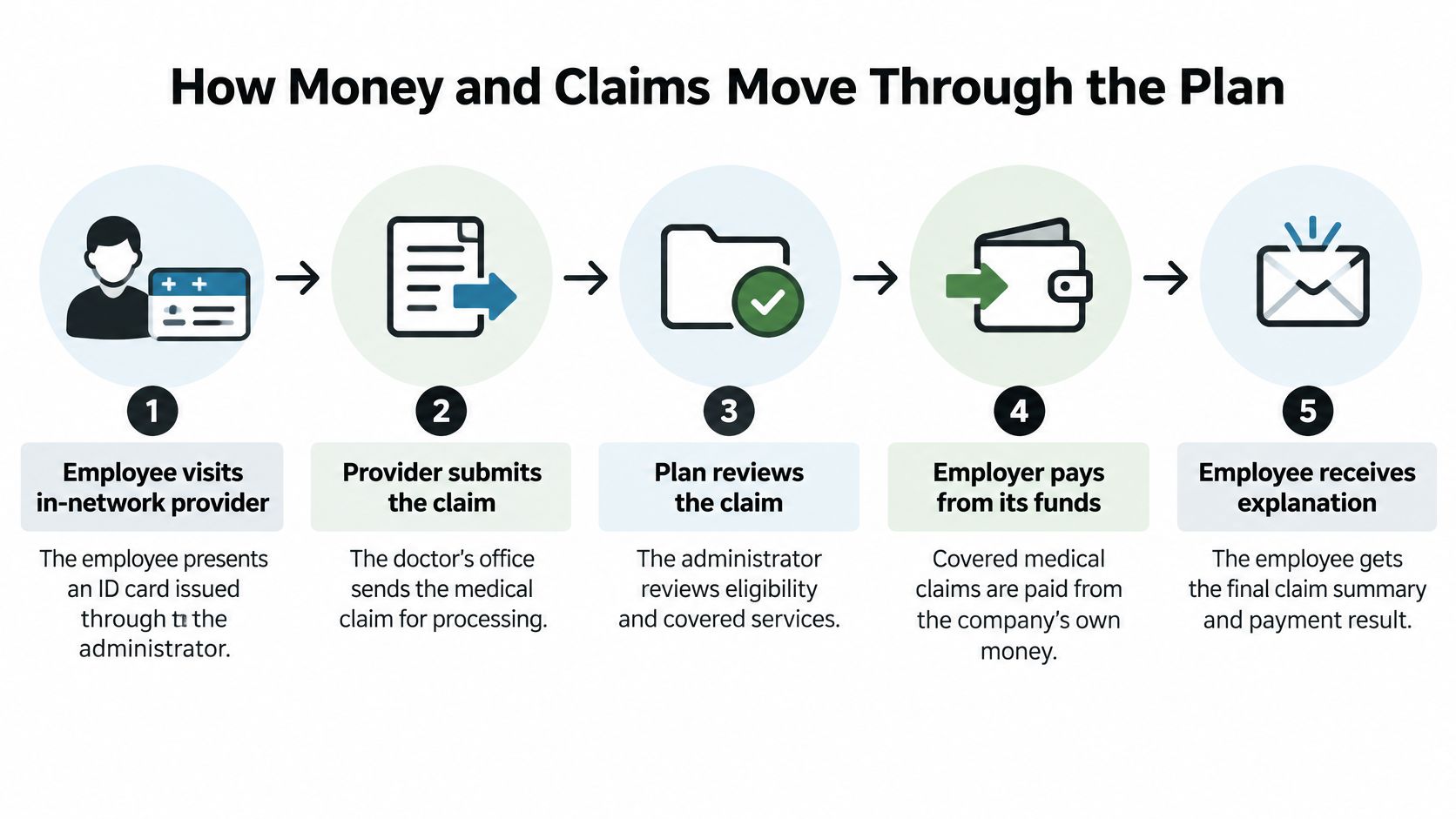
Follow one ordinary claim and the whole structure becomes clear. The steps look routine to the employee, but each one moves money from a different pocket.
Five Steps From Doctor Visit to Payment
- The employee visits an in-network provider. She presents the ID card issued through the administrator. The front desk copies it just as it would with any other plan.
- The provider submits the claim. The doctor's office sends the billed services to the administrator for processing, not to you directly.
- The administrator reviews and prices it. It confirms the person is eligible, checks that the service is covered, applies network pricing, and works out the deductible, copay, and coinsurance. If you're comparing vendors for this work, our guide to third-party administrators and what they actually do explains what to ask before signing.
- The provider gets paid from your claims account. The administrator releases the covered amount, and you fund that payment from company money. You then reconcile what's been paid against eligibility and plan terms.
- Stop-loss reimburses you if a threshold is crossed. If that claim, or your total claims, passes a contractual attachment point, the stop-loss carrier reimburses you for the eligible amount above it.
Who Pays What in a Self-Insured Plan
| Party | Role in the Plan | Money at Risk |
|---|---|---|
| Employer | Funds claims from its own assets and sets plan design | Full claims cost up to stop-loss attachment points |
| Employees and dependents | Pay deductibles, copays and coinsurance | Their cost-share as defined in the plan document |
| Third-party administrator | Processes claims, runs provider network, issues ID cards | Administrative fee, no claims risk |
| Stop-loss carrier | Reimburses claims above contract thresholds | Pays only after attachment points are exceeded |
The Monthly Cash Rhythm
Claims don't arrive on a neat schedule. You fund a claims account in advance, claims draw it down unevenly, and some bills show up weeks after care was delivered. Those are incurred but not reported claims, care your plan already owes for even though no bill has reached you yet.
That's why you need a liquidity cushion on top of your expected claims budget. A quiet month doesn't mean you saved money permanently. It may mean the bills haven't landed.
Try this check with your current plan. Take one recent claim and trace it through the five steps above, naming who holds the money at each stage. If you can't answer that for step four without calling someone, you're not ready to be the one funding it.
Stop-Loss Coverage and Where the Risk Stays
Start with a concrete case. Say you hold a $100,000 specific attachment point and one employee's treatment produces a $250,000 eligible claim. You pay the first $100,000. The stop-loss carrier reimburses the $150,000 above that point, subject to the contract terms.
That ceiling is what makes self-funding survivable for most employers. Stop-loss coverage isn't health insurance for your employees. It's insurance for your plan, and it reimburses you after claims pass thresholds you agree in advance. If you want the terms defined in one place before you shop, start with our explanation of stop-loss insurance and how attachment points work.
The Two Forms of Protection
Specific stop-loss applies to one claimant. It triggers when a single person's eligible claims pass the individual attachment point during the contract period.
Aggregate stop-loss applies to the whole plan. It triggers when total eligible claims for everyone pass an annual attachment point, protecting you against a year that's broadly worse than expected rather than one catastrophic case.
Attachment points are not standardized, which makes comparison shopping harder than it looks. The U.S. Department of Labor stop-loss record cited one ERISA arrangement with specific attachment points ranging from $20,000 to $500,000. A lower point shifts more risk to the carrier and raises your premium. A higher point lowers the premium and leaves more of each large claim with you.
Stop-Loss Types and What to Check
| Stop-Loss Type | Triggers When | Protects Against | Watch For |
|---|---|---|---|
| Specific | One claimant passes the individual attachment point | One catastrophic claim | Exclusions and laser limits on named claimants |
| Aggregate | Total eligible claims pass the annual attachment point | A year of unexpectedly high claims overall | Attachment point set by contract and reimbursement basis |
Contract Terms That Decide Real Protection
- Exclusions: Services or conditions the policy won't reimburse, even above the attachment point.
- Lasers: Higher individual attachment points set for named high-risk claimants, which leave you holding more of that person's claims.
- Run-in and run-out provisions: Rules for claims incurred before the contract starts or paid after it ends.
- Incurred versus paid basis: Whether reimbursement depends on when care happened or when you paid for it.
- Renewal terms: How pricing and lasers can change after a bad year.
Stop-loss protects cash flow, but it doesn't turn your plan into an insured plan. You're still responsible for every dollar up to the attachment points, and you usually pay first and get reimbursed later.
Run a three-part test on any quote. Compare expected claims plus the stop-loss premium against your fully insured alternative. Estimate the maximum plausible retained loss if several large claims land in one year. Then ask the carrier to show renewal sensitivity after a high-cost claim, because next year's price is where a bad year keeps costing you.
Self-Insured Versus Fully Insured Trade-Offs
The fastest way to see the difference is side by side. These are the criteria employers ask about most when they're deciding whether the premium they're paying buys them anything besides predictability.
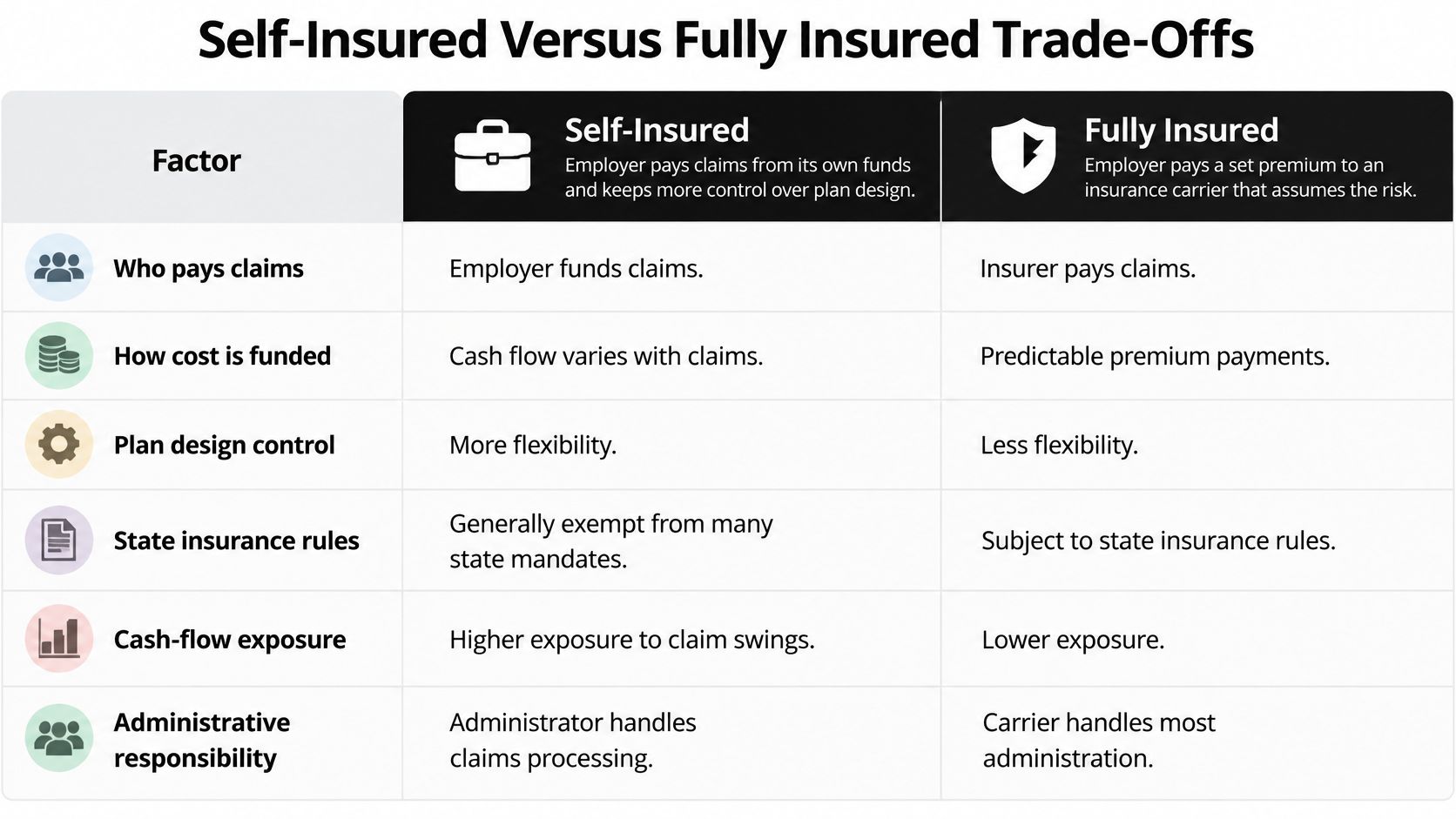
Fully Insured and Self-Insured Plans Side by Side
| Criterion | Fully Insured | Self-Insured |
|---|---|---|
| Who pays claims | Insurer | Employer from its own funds |
| Cost structure | Fixed premium | Variable claims plus stop-loss and administrative fees |
| Plan design control | Limited to carrier forms | Greater flexibility and claims data access |
| State insurance rules | Apply to the policy | Generally federal ERISA rules rather than most state insurance rules |
| Cash-flow exposure | Low and predictable | Timing risk and exposure in high-claim years |
| Best fit | Employers needing budget certainty | Stable groups with reserves and stop-loss protection |
The Central Trade-Off
Everything in that table flows from one exchange. Self-funding swaps a predictable premium for variable claims cost. In a healthy year, you pay for the care your group used, plus administration and stop-loss, and you keep what's left. In a bad year, there's no carrier absorbing the overrun.
The advantages are real when claims cooperate. You avoid the carrier's premium load in years when claims run below expectations, since you never sent that money away in the first place. You get more control over plan design, because you're not limited to the benefit packages a carrier files and sells. You also get access to your own claims data, so you can see which conditions, facilities, and service categories drive your spending instead of relying on a summary at renewal. On the self-funded portion, you also avoid some state premium taxes that are built into insured premiums.
Where Self-Funding Costs You
- High-claim years land on you: Stop-loss caps the extremes, but ordinary bad luck below the attachment points is yours.
- Reserves tie up cash: Money sitting in a claims account as a cushion can't fund hiring, equipment, or growth.
- Administration gets heavier: Eligibility, claims oversight, vendor management, and compliance move onto your plate.
- Fewer state consumer protections apply: The state insurance rules that govern insured policies generally don't govern your plan, which puts more responsibility on how you run it.
Don't read that list as a verdict against fully insured coverage. For a small employer, a fixed premium is a genuine benefit, not a failure of imagination. You get a budget you can plan payroll around, and you transfer claims risk to a carrier whose pool is far larger than yours. Fully insured suits employers who need that certainty or who don't have staff time to manage vendors. Self-funded suits stable groups with reserves, reliable reporting, and stop-loss terms they've stress tested.
Practical rule: If a bad claims month would force you to choose between funding the plan and meeting payroll comfortably, the premium you're trying to avoid is buying you something worth keeping.
What Drives Self-Funded Plan Costs
A claims month can outweigh a small difference in administrative fees. For an employer, self-funding is first a cash-flow decision: claims must be paid as they come in, while plan design determines how much each claim costs and who pays what share.
Cost Drivers and Where They Hit the Budget
| Cost Driver | What Moves It | Where It Shows Up |
|---|---|---|
| Claims frequency and severity | Workforce age, chronic conditions, one high-cost claimant | Claims funding |
| Plan design | Deductible, copay, coinsurance, out-of-network rules | Share of each claim the employer pays |
| Provider pricing | Network discounts and reimbursement rates | Cost per paid claim |
| Administrative fees | Third-party administrator, network access, ID cards | Fixed cost each year |
| Stop-loss premium | Specific attachment point and aggregate terms | Price of the ceiling |
| Reserves and liquidity | Claims lag, incurred-but-not-reported claims | Cash tied up in the claims account |
| Compliance workload | ACA, COBRA, ERISA filings and plan documents | Staff time or advisor fees |
Claims are usually the largest variable. Frequency means how often employees use care; severity means the cost of that care. More frequent claims raise spending steadily, while one expensive diagnosis can create a sharp spike. Plan design can shape how costs are shared, but it cannot prevent every high-cost claim.
Plan design sets the terms for splitting those costs. A higher deductible means employees pay more before the plan begins paying. Coinsurance determines the ongoing share each party pays after the deductible. Out-of-network rules affect which providers employees use and how much the plan pays for their care. These terms belong in the plan document, which guides the administrator's decisions when claims are paid.
Provider pricing affects the cost of each claim. Two plans can cover the same service but pay different amounts because their networks negotiate different rates. Repriced claims flow directly into claims funding, so network discounts can matter more than a small difference in administrative fees. Resources on insurance network pricing for therapy patients explain how network arrangements can affect the price of care.
Other expenses continue even when claims are low. Administrative fees recur, and the stop-loss premium pays for protection above the contract's attachment points. Reserves provide cash for claims that arrive before all related information is available, while compliance work uses staff time or advisor support. Group size and turnover also affect how predictable claims are, which in turn shapes how much cash the employer needs available.
The practical test is whether the business can pay claims through a costly month without disrupting other commitments. A favorable annual estimate does not remove the need for enough accessible cash when claims come due.
The ERISA Rules That Shape Self-Funded Plans
ERISA is the federal law that sets minimum standards for job-based health and retirement plans, covering reporting, disclosure, fiduciary duties, and how claims and appeals must be handled. The Department of Labor report on self-insured group health plans notes that ERISA was signed into law by President Gerald Ford in 1974. That same Department of Labor data reported approximately 50,700 self-insured group health plans filing Form 5500 in 2023, covering nearly 39 million participants.
Why Federal Rules Matter More Here
When you buy a fully insured policy, the carrier's product sits under state insurance regulation. When you self-fund, there's no insurance policy for the state to regulate in the same way, so your plan is generally governed primarily by federal law. Many state rules on mandated benefits, reserve requirements, and premium taxes that apply to insured policies don't apply to your plan.
That freedom cuts both ways. You can design benefits around your workforce instead of a state's mandate list, and a multi-state employer can run one plan under one rulebook. But federal obligations still apply in full, and now they're yours directly rather than filtered through a carrier. If you're building your compliance checklist, our plain-language guide to ERISA and what it requires of employers is a useful starting point.
Your Job as a Fiduciary
Under ERISA, the people who control the plan act as fiduciaries. In plain terms, that means making plan decisions in participants' interest, following the plan documents, selecting service providers prudently, and monitoring whether the fees you're paying are reasonable. Hiring an administrator doesn't transfer that duty away. The administrator does the work. You remain answerable for how it's done.
The annual workload is concrete, not abstract. It includes ACA reporting, COBRA administration for people who leave or lose eligibility, ERISA filings such as Form 5500 where required, and keeping plan documents and summary plan descriptions current and consistent with how the plan operates. Our compliance evaluation helps ensure a client's ACA reporting, COBRA and ERISA filings are up-to-date and compliant, which matters because a missed or sloppy filing can create penalties and participant disputes.
For a smaller employer, the lesson is simple. Compliance is not optional overhead you can trim after switching. Budget the time or the advisor fees for it before you move, and name the person who owns each filing. If nobody owns it, it's already late.
Who Should Self-Fund and How to Decide
A business can look ahead on premiums and still run short on cash after a bad claims month. Self-funding is a cash-flow decision first: the employer pays claims as they arise, while stop-loss coverage may reimburse certain losses later. Reserves, claims patterns, and the timing of reimbursement matter alongside headcount.
Signs You Are a Reasonable Candidate
- Stable headcount: Enrollment does not swing sharply from quarter to quarter.
- A readable claims history: You can review past claims and understand the large ones.
- Real cash reserves: You can pay claims without putting operating expenses at risk.
- Clear monthly reporting: Your administrator shows paid claims, large claimants, and payment delays in a format you can review.
Thin reserves, frequent workforce turnover, or an expectation of savings in the first year can make self-funding a poor fit. So can limited time for vendor oversight and compliance. A fixed premium may suit the business better at this stage.
Stop-loss does not remove the timing risk. The plan may have to pay eligible claims before reimbursement arrives, and exclusions, documentation requests, or disputes over contract dates can delay recovery. The result can be pressure on cash even when the plan has stop-loss coverage.
A Five-Step Decision Path
- Review your claims history. Look at past claims and identify the largest individual claims and what drove them.
- Compare the full costs. Set the fully insured premium against expected claims, stop-loss premiums, and administrative fees. Comparing the premium with expected claims alone leaves out important costs.
- Stress-test cash flow. Estimate how much cash the business would need to pay claims before any stop-loss reimbursement arrives.
- Read the stop-loss terms. Confirm attachment points, laser limits, run-in and run-out provisions, and whether coverage is based on when claims are incurred or paid.
- Assign compliance work. Decide who will handle ACA, COBRA, and ERISA reporting, and account for the time or fees involved.
Then ask your finance lead: could the business cover a high-claims month without missing payroll or drawing on a credit line? If not, a fixed premium may be the more workable choice.
Benely's Evaluate step compares a client's current insurance plans with other market options to find cost-effective solutions. Benely shops, analyzes, and personalizes group benefits, while the client makes the final decision. Before committing, request a written renewal scenario for each option so you can compare how the terms and costs may change.
If you're weighing whether your reserves, claims history, and headcount can support self-funding, Benely can compare your current plan with other market options, help set your budget, and set up enrollment once you decide. You keep the final call on every plan presented. Visit Benely to start a comparison.