Most advice sells zero-based budgeting as a guaranteed way to cut costs. That promise is exactly where many small companies get misled. The strongest benefits of zero based budgeting aren't always lower totals in year one. They're clearer priorities, better information, and money moved from habits you can't explain to work you can defend. That's especially useful in benefits and HR, where renewals, subscriptions, and small add-ons often grow without anyone reviewing the whole picture.
Table of Contents
- Zero-Based Budgeting Explained From an Empty Ledger
- Benefits of Zero Based Budgeting at a Glance
- Realistic Return and How to Measure It
- Zero-Based or Traditional Budgeting by Situation
- How to Run a Zero-Based Cycle on Benefits and HR Spend
- Pitfalls That Turn ZBB Into Busywork
- Start With One Cost Category This Quarter
Zero-Based Budgeting Explained From an Empty Ledger
Think of a traditional budget as last year's suitcase. You keep most of what's inside, remove a shirt, add a jacket, and call it packed. Zero-based budgeting empties the suitcase first. Every item has to earn its place again.

In plain terms, each department justifies its spending from zero each cycle instead of carrying forward last year's total with an adjustment. The question changes from "how much more do you need?" to "what should we fund, at what level, and why now?" If you're still building a basic budget that your team will actually follow, Stewart Accounting Services on business budgets is a practical starting point before you try a full zero-based review.
Where the method came from
The idea has public-sector roots. The Nevada Legislature describes agency budgets justified from scratch, and U.S. federal agencies used the method in the late 1970s. The City of San Diego later documented a framework built around decision units, alternative service levels, and performance measures. A peer-reviewed federal evaluation and McKinsey's later work both return to the same core mechanic: justification before funding.
What it is not
Zero-based budgeting isn't a rule that every line must be cut. It isn't a one-off reset you do in a spreadsheet workshop, and it doesn't fix overspending by itself. A team can rebuild every line from zero and still fund the wrong things if it doesn't rank them candidly.
Start from zero doesn't mean spend zero. It means no expense gets funded just because it existed last year.
It matters for small and mid-sized companies because benefits, software, and HR services rarely grow through one big decision. They grow through renewals and add-ons. The rest of this guide separates three things: where the benefits are well supported, where savings claims are overstated, and when the extra work is worth it.
Benefits of Zero Based Budgeting at a Glance
| Benefit | What changes in practice | Who feels it most | Evidence strength |
|---|---|---|---|
| Priority ranking of programs | Every activity is ranked and funded in order of priority | CFOs and department heads | Federal first-year evaluation found it effective for allocation |
| Explicit trade-offs | Managers compare minimum, current and enhanced service levels with their costs | Finance and HR leads | City of San Diego framework requires cost and performance linkage |
| More management involvement | Department heads explain assumptions instead of accepting an inherited total | Department heads | Public-sector adoption study, survey-based |
| Better decision information | Budget owners get clearer information for important decisions | Budget owners and executives | Public-sector adoption study, survey-based |
| Cost discipline on recurring spend | Benefits, software and outsourced HR services are reviewed on current value, not renewed by default | HR and benefits administrators | Practitioner-reported, limited direct measurement |
The strongest early finding is about allocation, not savings. A peer-reviewed evaluation of the first year of U.S. federal zero-based budgeting found agencies viewed the method as an effective tool for allocating limited resources. Its top reported benefits were priority ranking of programs, greater management participation, and explicit trade-offs within and across programs.
That same evaluation didn't find significant tangible cost savings in federal agency budgets for 1979. Resources moved toward higher-priority activities instead. Don't treat that as failure. For a growing company, redirecting money from low-value spending to work that supports hiring, retention, or service quality can be where the true return lies.
What this looks like in a small company
Say usage data shows only a handful of employees still log into a software subscription your company renews every year. Under traditional budgeting, that line survives because nobody owns the decision to remove it. Under a zero-based review, the owner has to justify the current service level, a smaller tier, or cancellation. The freed money can move to a tool the team uses daily.
Outsourced HR services and recruiting platforms follow the same pattern. Each contract looked reasonable when signed. Nobody reviewed them together against current headcount, hiring volume, or internal capacity.
Reader confusion usually starts with involvement and information quality, because they sound soft. They're measurable. In a public-sector adoption study, 52% of respondents said department heads became more proactive, and 68% reported a significant improvement in information quality for budgeting decisions, according to the public-sector zero-based budgeting adoption study. Better information is what lets a CFO challenge a renewal without guessing.
Start by choosing the two benefits in the table your finance and HR teams need most. Score your current benefits, software, and HR services against them. If you can't rank those costs or explain their trade-offs, you've found your first candidate for a review.
Realistic Return and How to Measure It
Savings claims vary because implementation, company complexity, and what leaders protect during cuts vary. McKinsey reports properly implemented programs can reduce selling, general, and administrative costs by approximately 10% to 25%, sometimes within six months, and cites one company with 11% operating-budget savings in its first four months, in its McKinsey analysis of five myths and realities about zero-based budgeting.
That isn't the whole evidence picture. A peer-reviewed archival study found no significant cost reduction across adopters overall, with stronger reductions in firms associated with the 3G Capital model, as reported in the peer-reviewed archival study of zero-based budgeting adopters. The public-sector study noted earlier also found resources shifted to higher priorities without a statistically significant cost reduction.
Why sustained savings are harder
McKinsey's analysis also sets a durability test. In a separate analysis of 238 corporate cost-reduction programs, only 26% sustained reductions for four years, and only 17% both sustained reductions and grew. Those figures sit in the McKinsey publication linked above, so don't read the savings range without the follow-through problem sitting beside it.
Adopters in the archival research also tended to be smaller and younger than non-adopters. Lower organizational complexity may help explain smoother adoption. A 40-person company can often review benefits and software more cleanly than a layered organization with dozens of budget owners.
| Metric | How to calculate it | What to watch |
|---|---|---|
| Share of spend tied to strategic goals | Dollars in funded priority packages divided by total budget | A rising share across two review cycles |
| Benefits utilization | Active users or claims divided by eligible employees | Low use signals spend that should be reviewed |
| Administrative hours per enrollment cycle | Hours logged by HR and finance for enrollment and renewal | Should fall after the first cycle |
| Budget variance | Actual minus planned spend, by cost category, each month | Large swings that point to weak planning assumptions |
| Savings redirected to higher-value programs | Dollars moved from low-priority packages into funded packages | Redirection, not only cuts, is the goal |
| Planned versus realized savings | Monthly comparison by cost category | A persistent gap signals unrealistic plans |
Judge the first cycle mainly by allocation and visibility. Judge later cycles by whether savings persist without damaging capacity. When you're modeling a renewal, pair these metrics with a clear view of health insurance cost for employers so premium decisions don't get separated from utilization and administration.
Here's an illustrative check, not a benchmark. A 40-person company logs 60 hours per enrollment cycle across HR and finance. After its first review, the same work takes 40 hours. The return is 20 hours per cycle, but it's worth keeping the process only if the review also redirects or reduces premium and software spend. Time saved on paperwork while low-value contracts renew untouched isn't a strong result.
Track realized versus planned reductions monthly, protect spending with measurable productivity or retention effects, and test whether a cut merely shifted cost into overtime, contractors, or employee turnover.
Zero-Based or Traditional Budgeting by Situation
Decision rule: zero-based budgeting pays off when costs are volatile, discretionary, or growing through unreviewed add-ons. Traditional budgeting works when costs are stable and contractually fixed.
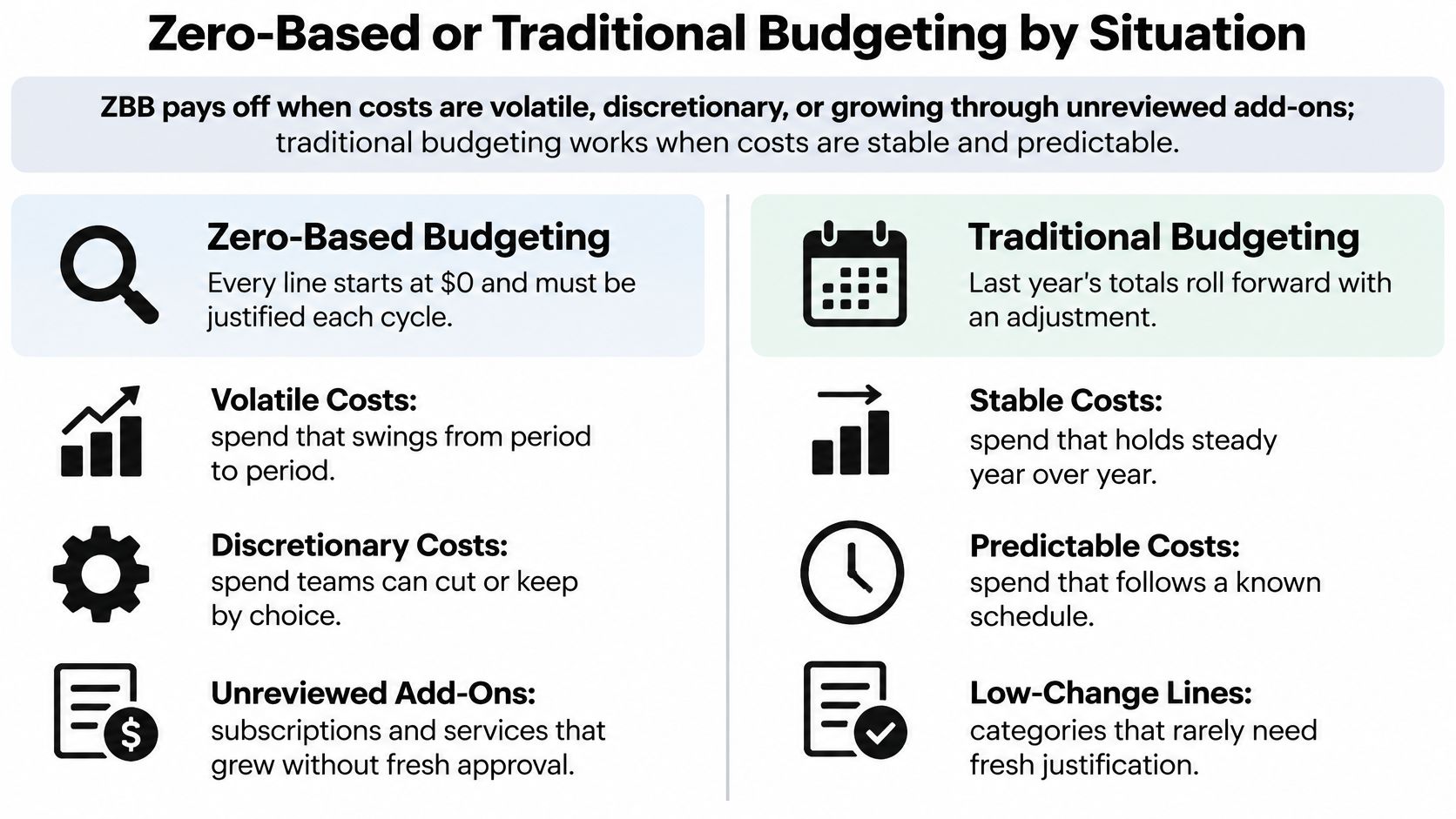
| Criterion | Zero-based budgeting | Traditional budgeting |
|---|---|---|
| Starting point | Zero each cycle | Last year's total plus an agreed adjustment |
| Justification required | Every line item and service level | Only the changes requested |
| Staff time | High, especially in the first cycle | Low, once the template exists |
| Best fit | Volatile, discretionary, or add-on-driven spend | Stable, predictable, or contractually fixed costs |
| Main risk | Analysis burden and underfunded long-term investments | Inherited waste and creeping costs |
| Governance output | Ranked decision packages with stated outputs | Variance report against prior year |
Three situations
- A 40-person company with add-on creep: benefits extras, recruiting tools, and software tiers accumulated one approval at a time. This is a strong zero-based candidate because leaders can't explain the combined total.
- A 150-person firm with stable obligations: payroll is predictable and insurance sits in a multi-year contract. Traditional budgeting with focused annual reviews is usually enough. Rebuilding every stable line from zero adds meetings, not insight.
- A fast-growing company with no budgeting analyst: start proportionally. Review one or two volatile categories deeply and keep the rest on a lighter cycle.
The administrative cost is the part many guides skip. Research identifies complexity, extra work, training requirements, data limitations, and resistance to change as recurring barriers, and notes the tension between bottom-up participation and top-down targets, in a review of zero-based budgeting implementation barriers. In an SMB, that burden lands on the same people responsible for payroll accuracy, compliance, open enrollment, and hiring.
The proportional split
Apply full zero-based review to benefits renewals, contractors, travel, software, marketing, and facilities. Use baseline-plus-review for legally required payroll costs, core insurance obligations, and stable service contracts. That split protects staff time while still challenging spend that leaders can change.
Use zero-based budgeting where you can't explain last year's number. Use a lighter review where last year's number is stable, required, and easy to verify.
Successful implementation also depends on leadership, training, capable information systems, and a supportive culture. The technique alone doesn't create discipline. Managers need data they trust and permission to rank a familiar program below a newer priority.
How to Run a Zero-Based Cycle on Benefits and HR Spend
Use one benefits renewal to learn the process. The mechanics are consistent: identify decision units, build decision packages, then rank those packages for funding.
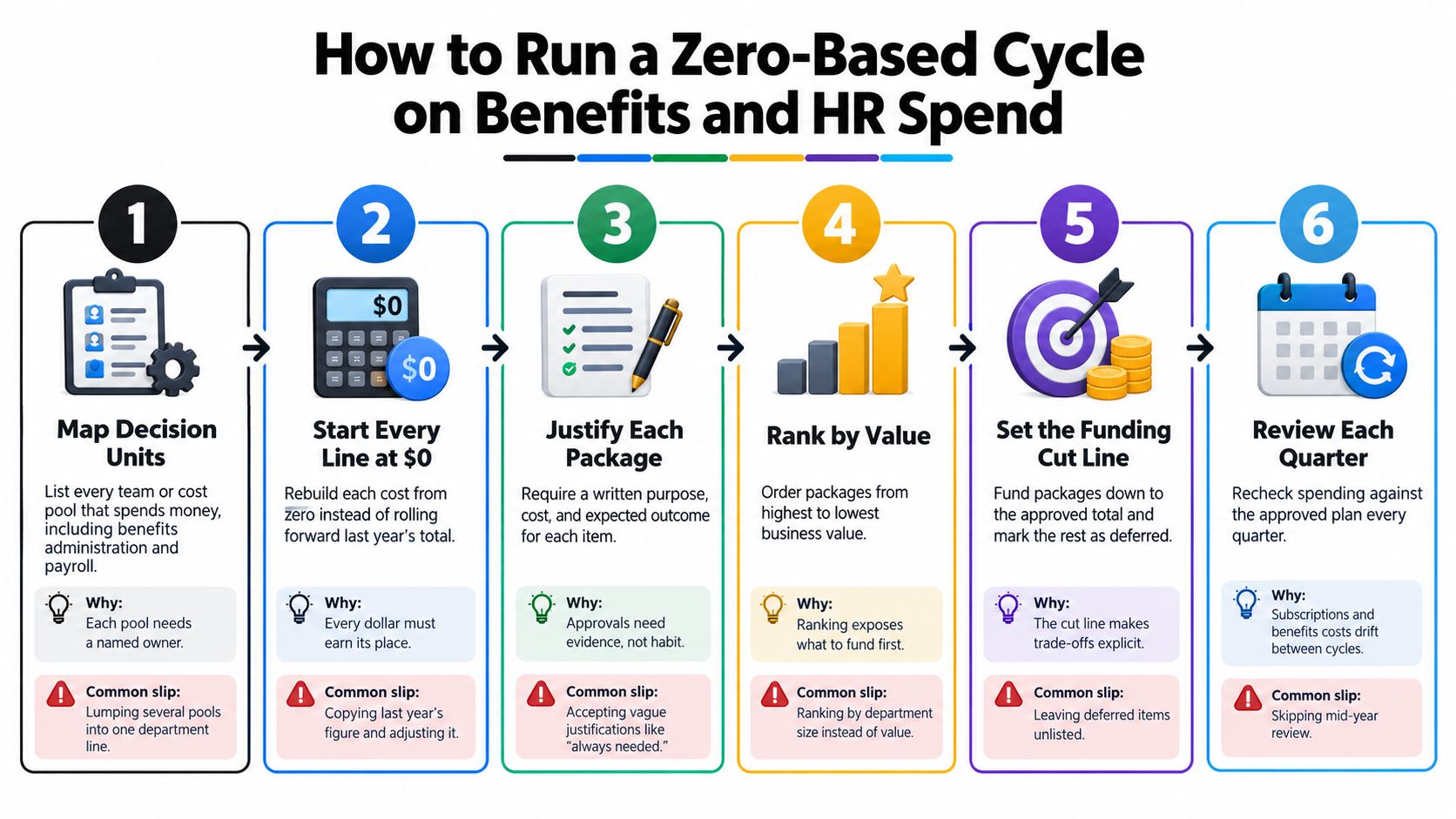
- Map decision units by spend: list benefits administration, payroll, recruiting, wellness, HR software, and outsourced services as separate cost pools with named owners. Don't map by org chart alone, because one department line can hide five unrelated contracts.
- Set the envelope first: leadership fixes total available funds and any savings target before requests arrive. Bottom-up packages still need reconciliation with top-down limits, and requests that exceed the envelope by a wide margin usually mean the target was never made clear.
- Build packages at three levels: each unit prepares minimum operating, current, and enhanced options. Every package states cost, expected output, a measurable result, and compliance value. A package that describes activity but not results isn't ready.
- Rank across the company: compare a wellness package against recruiting support and an HR software upgrade in one list, not in separate departmental queues. Ranking by loyalty or department size defeats the purpose.
- Fund down the list: approve packages until the envelope runs out. Record what was declined, what service level changed, and why, so next year's team doesn't relitigate the same question from memory.
- Monitor monthly: compare planned versus realized savings by category and note where money was redirected. A quarterly check catches enrollment changes and subscription drift before renewal season.
A health-plan renewal as three packages
A minimum package might meet compliance requirements and preserve core coverage. The current-level package keeps today's contribution approach and service support. An enhanced package could improve a specific employee outcome, but it must show cost per employee, expected enrollment impact, and the result leadership expects to see.
Before ranking, ask employees what they use and value. An employee benefits survey template gives you structured input instead of relying on the loudest voices during open enrollment. Pair that input with utilization and administrative time, because popularity alone doesn't prove value and low awareness can hide a useful program.
The Nevada Legislature describes each agency budget as justified from scratch in its Nevada Legislature background paper on zero-based budgeting. For a company, scratch doesn't mean ignoring history. It means history becomes evidence, not entitlement.
The City of San Diego framework goes further. Its City of San Diego zero-based budgeting framework requires decision units to describe activities, evaluate alternative delivery methods, identify inputs such as dollars and personnel, and attach performance measures to each funding level. It also analyzes historical expenditures for cost-effectiveness against targeted outcomes.
Apply that discipline to HR. For payroll support, state error risk and staff hours. For recruiting, state hiring need and cost per filled role. For wellness, state participation and the outcome you'll review. If a package can't connect cost to an output, send it back for revision rather than funding it at last year's level.
Close the cycle with a named owner and review date for every funded package. That's what turns a budget exercise into governance.
Pitfalls That Turn ZBB Into Busywork
The most expensive mistake is treating zero-based budgeting as a yearly reset instead of a recurring governance system. Teams produce long justifications, leaders approve a ranked list, and nobody checks whether planned savings happened or simply moved.
| Pitfall | Warning sign | Fix |
|---|---|---|
| Zeroing every category at once | Team fatigue by the third week and rushed justifications | Start with one volatile category, then expand after a clean cycle |
| Relying on an annual reset | Preventive and development programs cut, then needed the next year | Multi-year metrics for compounding investments |
| Savings that shift cost elsewhere | Spend falls in one line and rises in another | Track total cost by outcome across lines |
| Bottom-up requests ignoring targets | Requests far exceed available funds | Set envelope targets first, then rank packages |
| Untrained managers | Vague packages with no measurable result | Short training on writing decision packages |
| Missing operational data | Cost cannot be linked to utilization or enrollment | Connect plan, enrollment and utilization data before each review |
The compounding risk needs special care. Aggressive annual resets can underfund investments whose returns build over several years, including preventive healthcare, employee development, and retention initiatives. Don't exempt them from review. Protect them with multi-year metrics and require evidence over a longer window.
Consider a company that cuts its wellness budget to help fund a higher-premium health plan. The benefits line looks controlled on paper. If absence and turnover rise the following year, the company hasn't saved money. It has moved cost into replacement hiring, lost capacity, and employee experience.
Check before every cut: name the owner, define the measurable result, and set the review date. If you can't do all three, you don't have a saving yet. You have a guess.
Vague packages create a quieter failure. Managers write that a service is essential, finance challenges the price, and the discussion becomes negotiation rather than evidence. Require purpose, utilization, expected return, and an alternative delivery method. That's how the benefits of zero based budgeting show up as decision quality, even when total spending stays stable.
Missing data produces the same problem. If HR can't connect plan cost with enrollment activity and utilization, leaders will rank packages by familiarity. Fix the data link before asking managers to defend numbers they can't verify.
Start With One Cost Category This Quarter
Pick one recurring cost category this quarter, not the whole budget. Benefits renewals or software subscriptions are good starting points because the contracts are concrete, renewal dates force a decision, and usage data is usually available.

Run that category through the six steps above. Set the envelope, require three service levels, rank them against other priorities, and record what you decline. If benefits are your first category, review how to offer employee benefits alongside your cost packages so funding choices stay tied to eligibility, enrollment, and employee communication.
Benely supports that focused review by bringing plan costs, enrollment activity, and compliance deadlines into one employee platform, giving HR and finance leaders the operational data a quarterly cycle needs. That's the practical middle ground between a manual company-wide rebuild and another automatic renewal.
This short video is a useful refresher before your first ranking meeting:
At the next quarterly review, report two numbers: whether savings were realized and whether money was redirected into funded packages. Add a second category only if the first ran cleanly. Ask your team one question in the next meeting: which expense would we fund if we had to justify it from zero today?
If your next benefits renewal is approaching, use Benely to compare health plans, set a clear benefits budget, model employer contributions, and track enrollment in one place. Bring one cost category, your current utilization data, and your funding priorities, then build a package your finance and HR leaders can defend together.