The renewal letter is on your desk, the increase is ugly, and open enrollment is closer than your calendar admits. You run HR, finance, or both for a company that is big enough for real benefit costs and small enough that one person still owns the spreadsheet. Employees will ask what changed. Payroll will ask what to deduct. The carrier will bill whoever is on last month's census, right or wrong.
That is the job employee benefits brokerage is supposed to take on. A good brokerage shops the market and keeps eligibility, deductions, and invoices in line. A weak one hands you a cheaper premium and leaves the mess in your files. A cut that employees will not enroll in is not a savings, and a file error between HR, payroll, and the carrier is a bill you keep paying.
Table of Contents
- What an Employee Benefits Brokerage Does
- Which Model Fits
- Where Plan Shopping, Compliance and Automation Pay Off
- How Benefits Connect to Payroll and Onboarding
- Cost Savings Versus Keeping Employees Covered
- How to Evaluate and Select a Benefits Broker
- Choose Your Model and Benchmark Before Open Enrollment
What an Employee Benefits Brokerage Does
Say the company has 60 people. The renewal arrives with a steep increase and a short menu that is really one plan with a higher deductible. Nobody has a week to call carriers before payroll locks.
An employee benefits brokerage is the intermediary that shops, compares, and administers employer-sponsored benefits for you. The closest analogy is a buyer's agent. The agent knows the listings and negotiates. You still sign.
Employer coverage has been part of pay since it expanded after World War II, and it still reaches a large share of workers. The KFF 2025 Employer Health Benefits Survey found that 61% of firms with at least 10 workers offered health benefits to at least some employees, and that employer plans covered 55% of all workers. Average annual premiums in 2025 were $9,325 for single coverage and $26,993 for family coverage. Employees paid $1,440 and $6,850 of those amounts. Employers funded the rest. At that scale, a sloppy census is not a paperwork issue. It is real money.

Three layers, six jobs
The work sits in three layers.
Finding plans means marketing the group across carriers on a like-for-like basis, then modeling the budget and the employee share by coverage tier. Running the year means open enrollment that collects elections and shows who has not finished. Keeping it running means compliance calendars for the ACA and for prescription coverage, a renewal that actually tests the market, and a benchmark against similar employers.
A broker earns the fee on the market test and the contribution model. A broker does not fix a census you have not cleaned. If eligibility is wrong, the prettiest quote still bills the wrong people.
Medical premiums are not the only place people feel the program. When stress and counseling questions show up in exit interviews, it is worth the time to explore employee assistance program benefits before you treat the medical rate as the only lever.
Practical rule: List every benefits task your team handles, mark what repeats each year, and note where an error already happened. That list is the test for every service above.
Which Model Fits
Three setups get pitched as if they were the same product. They are not. The split is who employs the staff, who picks the carrier, who owns compliance, and who gets paid.
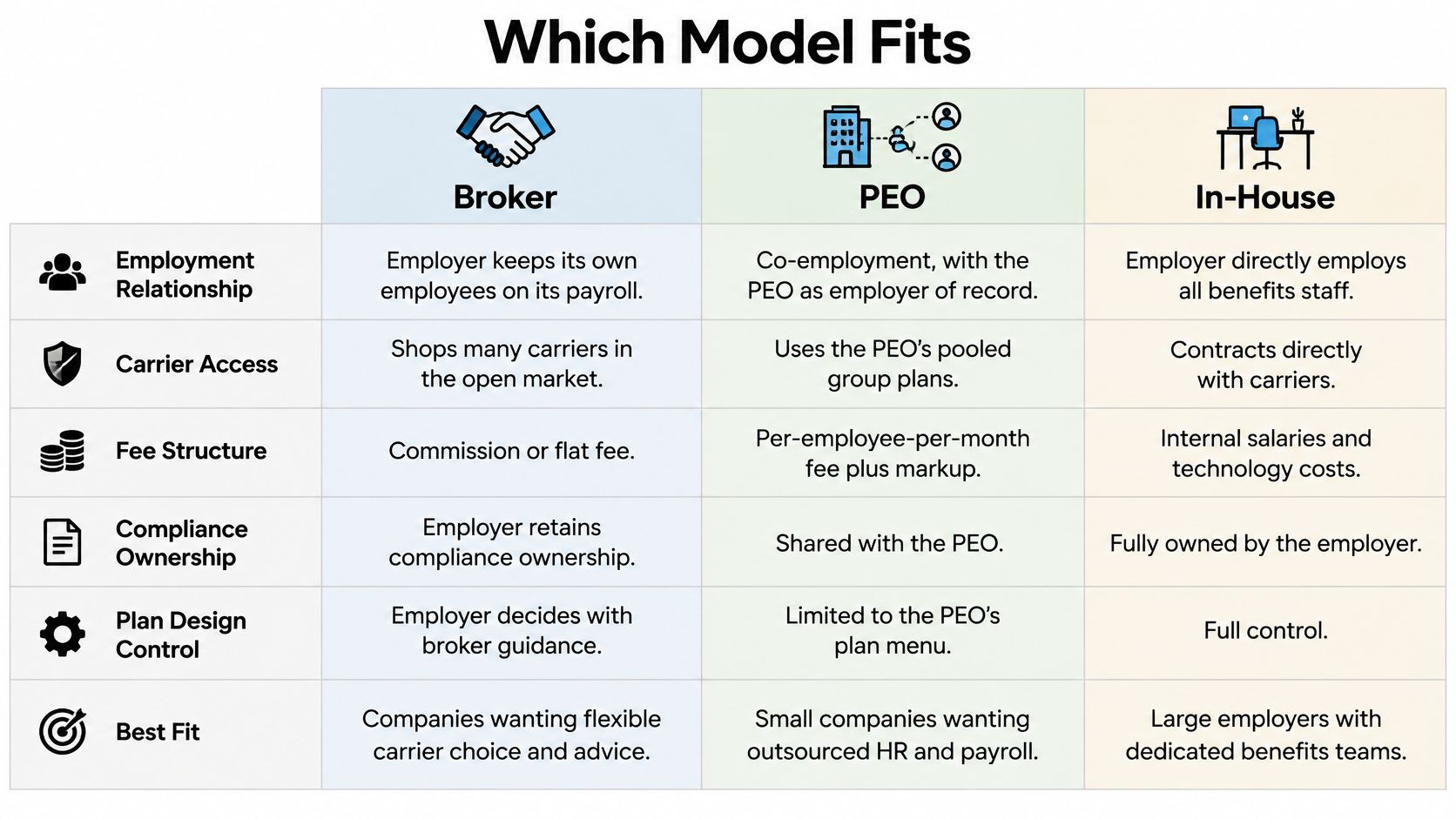
| Factor | Benefits Broker | PEO | In-House Team |
|---|---|---|---|
| Employment relationship | Employer stays sole employer | PEO becomes co-employer for payroll and benefits | Employer is sole employer and runs everything |
| Carrier access | Multiple carriers and plan designs | Usually the PEO's own plans, with limited choice | Only the plans the employer can buy directly |
| Fee structure | Broker fee, carrier commission, or both | Per-employee fee bundled with HR and payroll | Salaries, software, and carrier relationships |
| Compliance ownership | Advice is shared, employer keeps the legal duty | Shared through co-employment | Fully owned by the employer |
| Plan design control | High, within available carrier options | Moderate, within PEO plans | Highest |
| Best fit | Employers wanting choice while keeping HR control | Smaller employers wanting bundled HR | Larger employers with dedicated benefits staff |
What you keep and what you give up
A broker leaves you as the sole employer and opens the carrier market. You still run HR and payroll. That is the right trade when you want plan choice and you already have someone who can own the employee file. It fails when you expected the broker to become your HR department.
A professional employer organization (PEO) becomes a co-employer and folds payroll, HR, and benefits into its own plans. Administration gets simpler. Plan choice gets narrower, and leaving later means rebuilding payroll and coverage at the same time. Read the co-employment terms before you compare premiums.
An in-house team gives you full control. You pay for it in salaries, software, and carrier relationships a small company rarely justifies. Full control with no staff is just unpaid overtime.
In 2025, 79% of employers reported turning to brokers or benefits advisers to identify, evaluate, and select benefits, according to LIMRA research on workplace benefits brokers. The models also overlap. Some firms keep a PEO for payroll and a broker for plan design, so this is not always either-or. If you are weighing that mix, start with a clear look at a PEO versus a broker for employee health benefits.
I would not pick a model from the fee line alone. Pick it from who must still sign the compliance filing when something is late.
No HR staff and under 50 employees: a broker or a PEO. Past that headcount with an HR lead: keep administration inside and use a broker to shop. You want every plan detail under your control: in-house, with a consultant, not a silent carrier rep.
Where Plan Shopping, Compliance and Automation Pay Off
The fee pays off in three places. Quote quality, a calendar you do not miss, and enrollment that stops living in email. Miss one and the other two do not save you.
Like-for-like shopping
A useful shop compares the same deductible, network, and contribution split across carriers such as Aetna, Kaiser, Anthem, Blue Shield, and UnitedHealthcare. You get one grid instead of five PDFs that do not match. What does not work is a "savings" quote that drops a hospital your staff uses, then calls the lower rate a win. Ask for the network difference in writing before you celebrate the premium.
The headcount trigger
Under the Affordable Care Act, workforce math decides whether employer shared responsibility and reporting apply. The IRS employer guidance treats you as an applicable large employer when you average at least 50 full-time employees, including full-time equivalents, in the prior calendar year. You add full-time and full-time-equivalent employees for each month, then divide by 12. A company near that line needs hours every month, not a guess in December.
Notices that recur
Prescription coverage adds its own clock. CMS creditable coverage rules require a written notice, generally before October 15, telling Medicare-eligible people whether the plan is expected to pay, on average, at least as much as standard Medicare Part D. That notice covers active employees and dependents, COBRA participants, disabled individuals, retirees, and their dependents. Plan sponsors also file online with CMS.
| Requirement | Applies To | Trigger or Deadline | Action |
|---|---|---|---|
| ACA applicable large employer status | Employers averaging 50 or more full-time and FTE employees | Monthly averaging over the prior calendar year | Track full-time and FTE hours every month |
| Creditable prescription coverage notice | Plans with prescription-drug coverage | Annually, before October 15 | Notify Medicare-eligible employees, dependents, COBRA participants, and retirees |
| CMS online disclosure, new plan year | Plan sponsors | Within 60 days after the plan year begins | Submit online to CMS |
| CMS online disclosure, plan termination | Plan sponsors | Within 30 days after plan termination | Submit online to CMS |
| CMS online disclosure, status change | Plan sponsors | Within 30 days after a change in creditable-coverage status | Submit online to CMS |
Count the rows you already miss. Put one name on each row. A shared inbox is not an owner.
Automation, with a catch
Online elections, eligibility checks, and live progress tracking move open enrollment from chasing emails to reviewing exceptions. That removes retyping. It does not repair a bad hire date. Automation copies whatever you feed it, faster. Clean the roster first, or you will automate the wrong deduction for every pay period until someone complains.
How Benefits Connect to Payroll and Onboarding
Benefits administration is a data handoff, not a once-a-year meeting. Follow one new hire from the offer letter to the carrier bill and you will see every place money leaks.
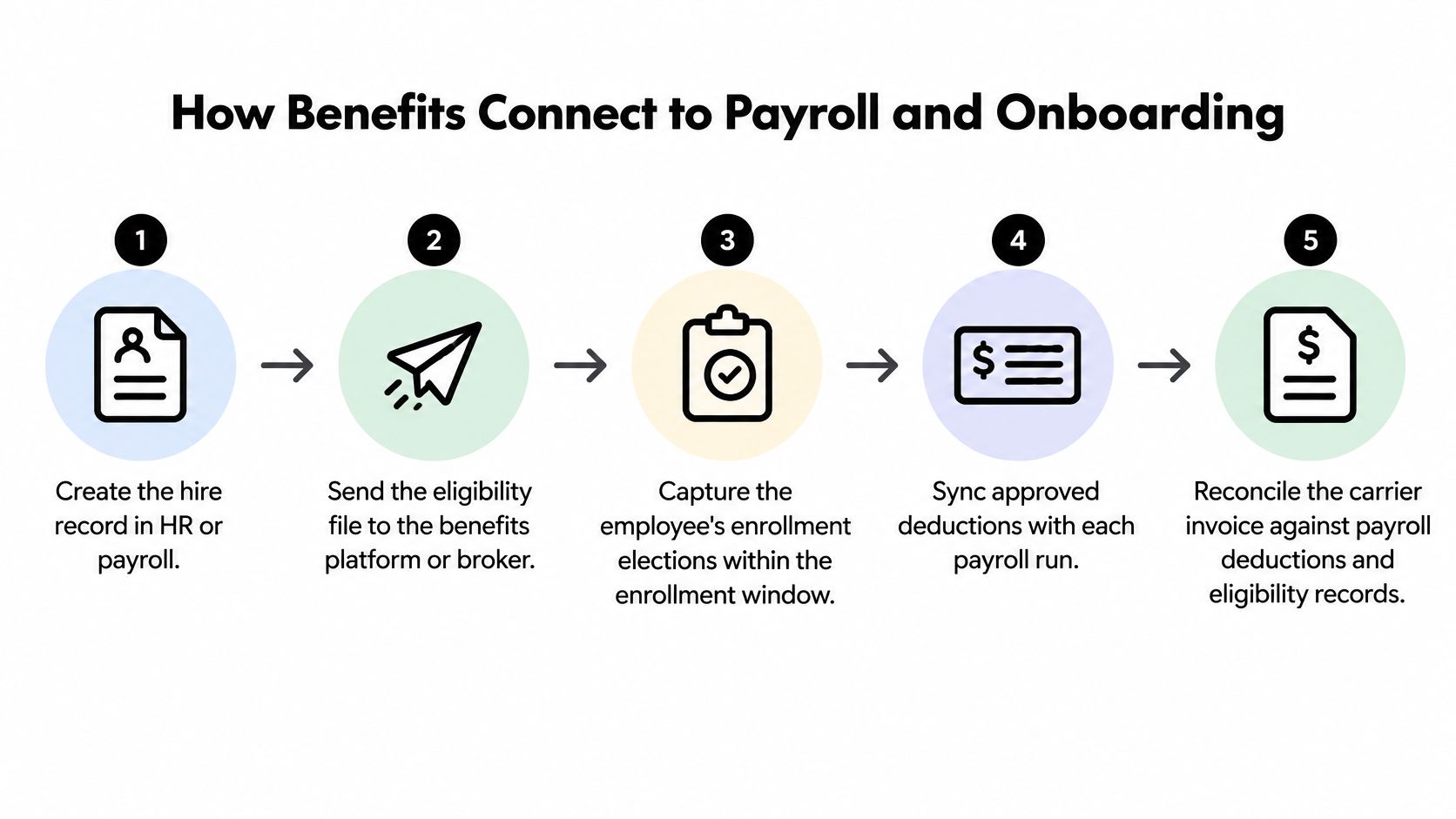
- Create the hire record in HR or payroll, with the actual start date, not the date someone remembered to type it.
- Send the eligibility file to the benefits platform or the broker on a set schedule.
- Capture the election and its effective date before the window closes.
- Set the payroll deduction by coverage tier and pay frequency.
- Receive the carrier invoice and read it against the census, not against last month's total.
- Reconcile every month. Compare the enrolled census, the deductions, and the invoice. Close every variance in writing.
Employers already treat this as a systems problem, not a paperwork hobby. In a PwC survey of employer benefits decision-makers, more than 80% said digital healthcare tools mattered for future workforce needs, and 61% were willing to spend on an integrated digital ecosystem. The same standard should apply to the pipes between HR, enrollment, and the carrier. A platform that only looks good at open enrollment and goes quiet in March is a brochure.
Paycheck math is the part employees feel first. In the KFF 2025 California Health Benefits Survey, covered workers contributed an average of 14% of the premium for single coverage and 27% for family coverage, typically through payroll deduction. A wrong tier does not stay theoretical. It hits a paycheck.
Where the handoff breaks
Say the start date is entered two weeks late. The new hire is either uncovered for those two weeks or, once someone fixes the file, you get a retroactive bill. Both outcomes annoy the employee. One of them also surprises finance.
| Control Point | Failure If Missed | Monthly Check |
|---|---|---|
| Eligibility feed from HR system | New hires left uncovered | Compare the employee roster with the carrier census |
| Coverage effective dates | Coverage gap or retroactive bill | Confirm effective dates match hire and election dates |
| Coverage tier in payroll | Wrong deduction and employee relations issues | Match each deduction to the employee's election |
| Carrier invoice | Paying for leavers or missing additions | Reconcile the invoice line by line to the census |
| Duplicate or retroactive records | Double deductions or double billing | Review the exception report and resolve every item |
| Termination processing | Premiums billed after employment ends | Confirm termination dates reached the carrier on time |
The question for a broker is not only how many plans they quote. Ask who owns each file, how often it runs, and who fixes exceptions. A walkthrough of employee benefits enrollment software makes that question concrete, because you can see whether an election becomes a deduction.
Open enrollment happens once a year. These checks run every month. If your only reconciliation is "the invoice looked about the same," you are paying for people who left and missing people who joined.
This short walkthrough shows how a hire record, an election, and a payroll file are supposed to meet.
Cost Savings Versus Keeping Employees Covered
Shifting cost onto employees is not a neutral fix. It is a pay cut aimed at the people who enroll, and it lands hardest on lower-paid staff who were already stretching to cover dependents.
Mercer reported that employers expected health-benefit costs to rise 5.8% in 2025 even after planned reduction measures. Without intervention, smaller employers with 50 to 499 employees projected roughly 9% growth. Family premiums rose 6% in 2025 to nearly $27,000, and workers at small firms contributed about $8,889 toward family coverage versus $6,227 at larger firms. Small-company employees are already paying more for the family tier. Another contribution hike is not a rounding error.
Access is uneven before you touch the plan. A Peterson-KFF analysis of Bureau of Labor Statistics data found that 88% of management, professional, and related workers had access to job-based health benefits, versus 52% of service workers. Take-up ran from 71% in natural resources, construction, and maintenance occupations to 52% in service occupations. A plan that is "offered" and a plan people can afford are not the same thing.
| Lever | Immediate Cost Effect | Retention Risk | Best Use |
|---|---|---|---|
| Raise the deductible on a high-deductible plan | Lower premium | Higher out-of-pocket costs for employees | Younger, healthier groups with HSA funding |
| Raise the employee premium share | Lower employer spend | Affordability strain for lower-paid staff | Groups with strong pay and high participation |
| Narrow the provider network | Lower premium | Disruption when staff lose trusted providers | Stable workforce with local providers in network |
| Keep the employer contribution and re-bid carriers | Moderate, through competitive bids | Low risk | Companies with stable headcount |
| Add voluntary benefits | Low, often employee-paid | Low risk, and it adds perceived value | Workforces wanting choice without a premium increase |
| Add mental-health or virtual-care access | Modest added cost | Low risk, often valued by younger staff | High-turnover or high-stress roles |
A 120-person test
Take a 120-person company with a large service group. Moving everyone onto the cheapest plan cuts the premium on paper. If take-up in that group falls, the savings shrink, and you start paying to replace people who left over a benefit they could not use. Network breadth, predictable copays, and a stable employer contribution often beat a headline rate for the roles you are struggling to fill.
The useful scorecard question is not "Which plan is cheapest?" It is "Which change still looks like a benefit to the people we most need to keep?"
If you need a way to judge a wellness add-on against turnover rather than against a slogan, measuring ROI from workplace wellness benefits is a practical checklist. Use it beside participation and claims, not instead of them.
How to Evaluate and Select a Benefits Broker
Treat the search like a purchase with a spec, not a series of friendly lunches. Each step below has a proof you should demand before you move on.
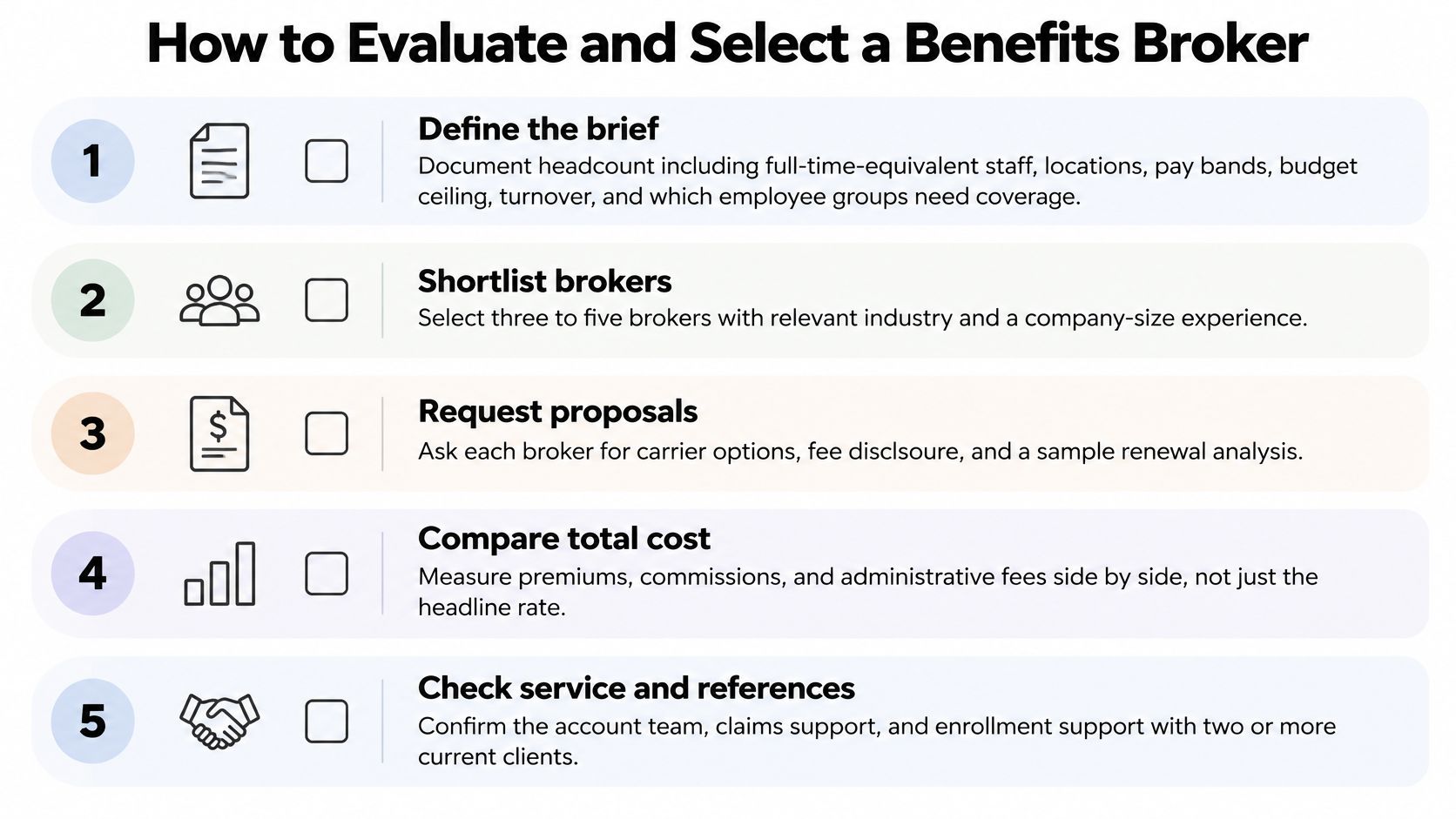
- Write the brief. Headcount including full-time equivalents, locations, pay bands, budget ceiling, turnover, and which groups must have coverage. Without that page, every proposal is aimed at a different company.
- Shortlist three to five. Confirm the license and that they can place business with the carriers you named. Industry slogans are not access.
- Demand like-for-like proposals. Same deductible, same network type, same contribution split for every bidder. A quote that shows premiums only, with no network or deductible detail, is a red flag. Send it back.
- Test the integration. Ask how eligibility files move, how often they run, how deductions reconcile, and who fixes exceptions. "We work with your payroll vendor" is not an answer. A sample file map is.
- Test the service. You want a named account manager, a stated response time, and a path to a certified HR specialist when a notice is due. Ask who covers you when that person is out.
- Get paid-how in writing. Broker fee, carrier commission, or both. Put the terms next to the quote so a "free" broker is not more expensive in practice. A plain explanation of how insurance brokers get paid keeps that conversation from staying vague.
- Require a split by employee group. Company-wide averages hide a service team that will not enroll. Ask for cost and expected participation by pay band, not one blended rate.
- Sign a 12-month scope. Reporting on enrollment completion, invoice variance, and the renewal change. If they will not report variances, they will not catch them.
One price, four lines
Ask every bidder for total cost of ownership. Broker fee, carrier commission, any PEO per-employee fee, and the hours your team will still spend. That is how you compare a flat fee with a commission proposal on one basis.
Platforms such as Benely put plan comparison, automated enrollment, and payroll connections in one place, so steps 4 and 5 can be a live demo instead of a slide. Watch whether a test hire becomes a deduction without a manual fix. If the demo needs a spreadsheet on the side, the production process will too.
Choose Your Model and Benchmark Before Open Enrollment
Pick the model before you request a quote. Broker, PEO, or in-house with a consultant. A proposal cannot make that choice for you, and shopping first just produces three prices for three different jobs.
Benchmark the current program before anyone sells you a new one. Contributions, participation, and enrollment completion are the baseline. Benely is a practical place to start that benchmark, because you can rate the process you have before a carrier number distracts you.
Then pin the calendar to dates that do not move. The creditable-coverage notice is due before October 15. The CMS online disclosure for a new plan year is due within 60 days after the plan year begins.
A 90-day run
90 days before renewal, run the benchmark and the compliance check. 60 days before, request proposals on the like-for-like test. 30 days before, confirm payroll and eligibility integration and the employee communication plan. After enrollment closes, run the first monthly reconciliation, then write down which elections and exceptions to fix before next year. That review is the cheapest consulting you will do.
Benely helps employers compare group health plans, automate enrollment, and connect benefits with payroll and compliance work instead of treating renewal as a one-week scramble. If you are weighing a broker, a PEO, or a tighter in-house process, start by seeing how your current program scores. Visit Benely and benchmark the setup you have before the next renewal letter sets the deadline for you.