You leave your employer, land your first few clients, and finally get the freedom you wanted. Then health insurance shows up and ruins the mood. The individual plans look expensive, the deductibles feel punishing, and somewhere along the way you hear that maybe you can just get a small business group plan for yourself.
That's where a lot of self-employed people lose time. They search for group health plans for self employed workers, assume there must be a “group of one” workaround, and end up comparing options that do not apply to their business structure.
The confusion is understandable. In the U.S., self-employed workers were more than twice as likely to lack health insurance compared to those employed by private firms or government in 2018, and nearly one in four newly self-employed workers lacks health insurance according to the USDA Economic Research Service. If you want a broader overview of the individual-market side before narrowing your strategy, this self-employed health insurance guide is a useful companion.
This article cuts through the part that trips people up most. Not the marketing language. Not the wishful thinking. The actual rules, the practical alternatives, and the trade-offs that matter when you're buying coverage as a founder, consultant, freelancer, or solo operator.
Table of Contents
- The Self Employed Health Insurance Dilemma
- The Group of One Myth and The One Employee Rule
- Four Real Pathways to Group Caliber Benefits
- How to Choose the Right Health Plan Approach
- Navigating Critical Tax and Legal Implications
- Your Next Step Finding the Right Benefits Partner
The Self Employed Health Insurance Dilemma

The familiar version of this problem looks like this: revenue is coming in, your business is real, but your benefits still feel temporary. You're shopping plans built for individuals while running a company that no longer feels like an individual project.
A consultant with solid income might find an ACA plan that works, but hate the deductible. A solo agency owner may want the predictability of a group plan because they've had one before. A freelancer with a spouse's employer coverage may wonder if joining that plan is smarter than buying on the Marketplace. These are not edge cases. They're standard self-employed decisions.
Why the frustration is rational
The market asks you to think like both an employee and an employer at the same time. You're paying the full bill, evaluating network quality, and trying to structure the purchase in a tax-efficient way. That's hard enough before anyone starts throwing around terms like SHOP, PEO, HRA, AHP, and “group of one.”
The coverage gap is real. In 2022, approximately 3.3 million self-employed workers and small business owners ages 21 to 64 obtained health insurance through the ACA Marketplaces, and the same Treasury analysis notes that this channel became a critical source of coverage for people without access to employer-sponsored plans, with average premiums for enrollees reduced to $111 per month through income-based premium tax credits in many cases, as detailed by the U.S. Treasury Department.
The mistake isn't wanting employer-style benefits. The mistake is assuming the legal path to them is the same when you work for yourself.
What usually goes wrong
One often makes one of two bad moves:
- They chase a plan they can't legally buy. That usually means spending days looking for a solo small-group policy that isn't available in their state or under their business setup.
- They buy too quickly on premium alone. Lower premium can preserve cash flow, but it can also shift more cost into deductibles, provider limits, or out-of-pocket exposure.
The good news is that there are workable options. Some look like traditional group coverage. Some recreate the economics of group coverage without becoming a true small-group plan. The key is knowing which category you're in before you start shopping.
The Group of One Myth and The One Employee Rule
The biggest misconception in this space is simple: a sole proprietor or single-owner LLC assumes they can buy a regular small-group health plan for themselves. In most cases, they can't.
According to Wilson Insurance Services, to qualify for a group health insurance plan as a self-employed individual in the United States, you generally must have at least one employee on payroll who is a W-2 employee, as the IRS and most insurers do not permit a single-person business to purchase a true group plan without an additional employee.
What the rule actually means
A true small-group plan is built around an employer sponsoring coverage for a group of employees. Insurers price that product using group census information and participation rules. A one-person business usually doesn't create the kind of risk pool that small-group insurance is designed for.
That's why the phrase one-employee rule matters. In general, the owner alone doesn't satisfy the requirement. A spouse also often won't solve the problem by default, because carriers and state rules can treat owner-family setups differently.
W-2 employee versus 1099 contractor
Founders often get tripped up at this point.
| Worker type | Usually counts for small-group eligibility | Why it matters |
|---|---|---|
| W-2 employee | Yes | On payroll as an employee of the business |
| 1099 contractor | No | Not treated as a common-law employee for plan eligibility |
| Owner only | Usually no | Doesn't create the additional employee base insurers expect |
If you hire an independent contractor and assume that enables group coverage, you're likely building on the wrong foundation. Group insurance generally follows employee status, not just the fact that another person does work for your business.
Practical rule: If your plan depends on counting a contractor as an employee, stop and verify the structure before you apply.
Why insurers care
Insurers don't use the small-group category as a convenience product for solo buyers. They use it as a regulated market with eligibility standards. The group format spreads risk differently, uses employer sponsorship rules, and often comes with participation and contribution requirements.
There are exceptions in some states. Some solo-owned corporations or LLCs may access group coverage under narrow state-specific rules. But that's exactly why broad internet advice is dangerous here. A rule that works in one state can waste your time in another.
The practical takeaway is blunt: if you're shopping group health plans for self employed businesses and you don't have at least one qualifying W-2 employee, assume the standard small-group market is closed until proven otherwise. Then focus on effective pathways that can still get you close to group-level value.
Four Real Pathways to Group Caliber Benefits
Not every self-employed person needs a traditional group plan. Many need a better way to reach the same outcome: stronger benefits, steadier costs, or more efficient tax treatment.
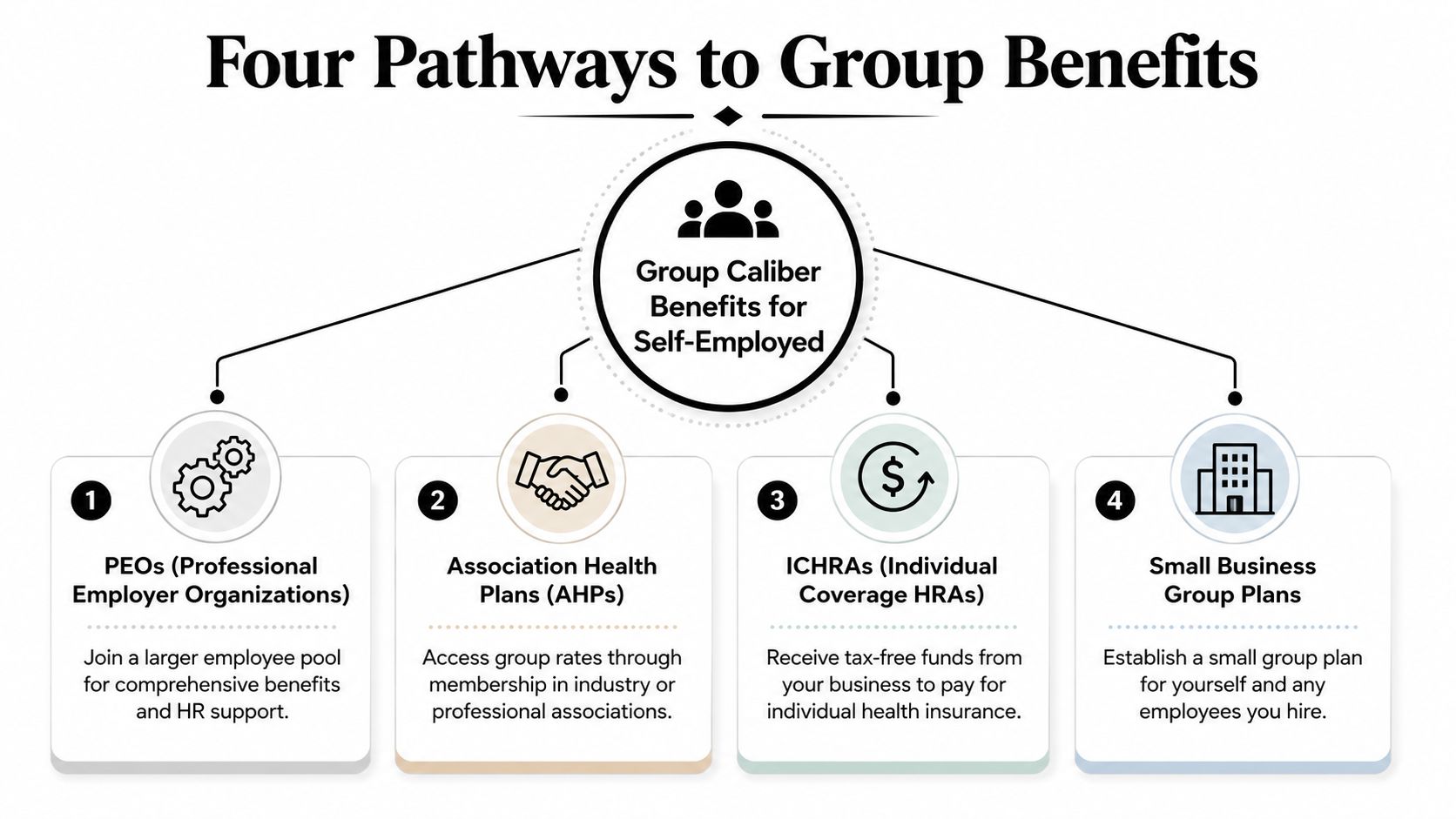
A true small business group plan
If you do have a qualifying W-2 employee, this is the classic route. You sponsor a group policy through the business and offer coverage to eligible employees under standard small-group rules.
This approach usually fits owners who want familiar employer-sponsored coverage and are prepared to manage enrollment, renewals, carrier decisions, and participation requirements. It can also feel more stable for hiring because candidates understand it immediately.
The downside is structural. Once you're in true group coverage, the business is sponsoring a formal benefits program. That creates more administration and less improvisation.
A PEO arrangement
A Professional Employer Organization can give a small company access to a broader benefits structure through co-employment. That often appeals to founders who want payroll, HR support, and benefits under one roof instead of building all of it from scratch.
If you're evaluating that route, this overview of PEO health plans is a practical starting point.
PEOs tend to make the most sense when health insurance is only one of several operational headaches. If you're also juggling onboarding, compliance, payroll coordination, and employee administration, a PEO can solve a bigger business problem than insurance alone.
An association health plan
Association Health Plans can be the closest thing to a group workaround for certain freelancers and self-employed professionals. According to The Jordan Insurance Agency, Association Health Plans allow freelancers to pool together, converting individual risk into group risk, and this structure can reduce annual premium increases by 15 to 25 percent compared to individual plans because rates are tied to the group's collective claim history.
That doesn't mean every association plan is a fit. Eligibility depends on the association, your profession, and what's available in your jurisdiction. But for consultants, creatives, and industry-specific operators, this is one of the most overlooked paths to more group-like pricing behavior.
An HRA funded individual strategy
This route doesn't pretend the individual market is a group plan. It uses employer dollars more intelligently.
With an HRA arrangement, the business reimburses eligible medical expenses or individual health insurance premiums within the rules of the arrangement. For a self-employed founder with employees, this can offer budget control while preserving plan choice for each employee.
Here's where this works well:
- You want fixed employer costs. The business sets a contribution strategy instead of absorbing the full volatility of a group premium.
- Your team is distributed. Individual-market choice can work better when employees live in different areas and need different carrier networks.
- You value flexibility over uniformity. One employee may want a lower-premium Bronze plan, another may want richer coverage.
Some businesses don't need one shared health plan. They need one benefits budget and a clean way to deploy it.
Which pathway tends to work best
That depends less on ideology and more on business structure.
- Solo with no W-2 staff: Traditional small-group usually isn't your path. Look harder at ACA coverage, association options where available, or an individual strategy built around tax efficiency.
- Micro-business with one real employee: Group coverage may become available, but compare it against defined-contribution models before assuming it's better.
- Founder building fast: PEOs can make sense when benefits, payroll, and HR complexity are all rising together.
- Industry-connected independent professional: Association membership can offer options many general marketplaces don't surface clearly.
The wrong move is trying to force all self-employed buyers into one model. The right move is matching the legal structure, the hiring plan, and the budget discipline to the coverage strategy.
How to Choose the Right Health Plan Approach
A founder with no W-2 staff often starts in the wrong place. They ask, “How do I get a group plan?” The better question is, “Which setup gives me the best coverage, tax treatment, and administrative fit for the business I have?”
That distinction matters because the group-of-one myth pushes self-employed owners toward an answer they may not even qualify for. The one-employee rule is usually the defining condition. Once you accept that, the decision gets clearer.
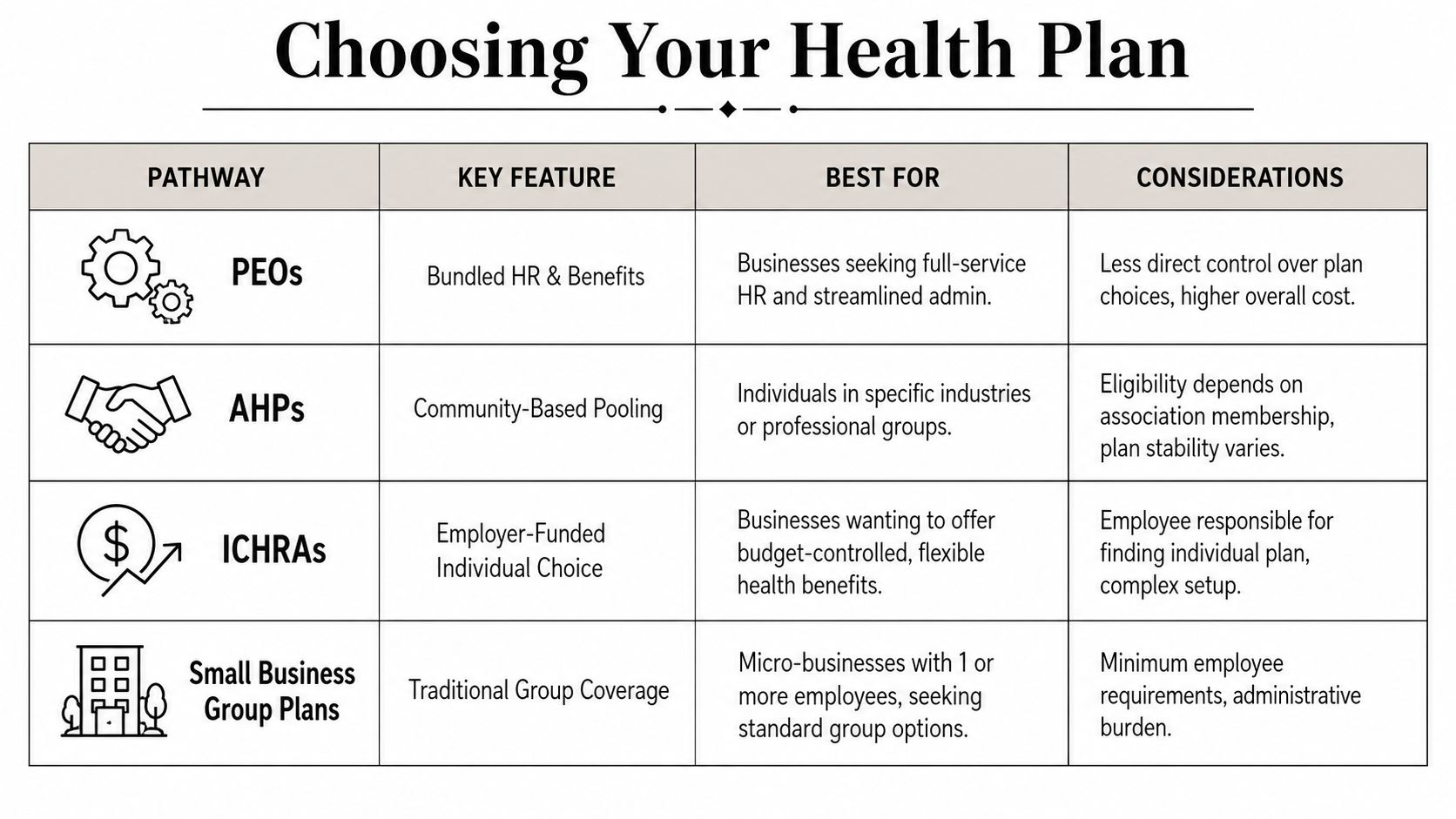
Use four filters to compare your options: budget control, administrative load, employee choice, and hiring plans over the next 12 to 24 months.
Start with budget control
If you need a hard cap on employer spending, an HRA-style approach often deserves the first review. The business sets the contribution. Employees choose individual coverage that fits their doctors, prescriptions, and premium tolerance.
That works well for founders who care more about cost discipline than offering one uniform plan.
Traditional small-group coverage and PEO arrangements can still be the right call. They are usually less predictable at renewal, and they come with participation rules, carrier paperwork, and plan design decisions that do not matter in the same way under a defined-contribution model.
Then measure your tolerance for administration
Some owners will handle forms, notices, renewals, and employee questions without much friction. A busy founder with a lean team usually should not.
| Pathway | Admin burden | Choice level | Best fit |
|---|---|---|---|
| Small business group plan | Moderate to high | Lower | Businesses that want a standard employer plan |
| PEO | Lower on your internal team | Moderate | Teams that want bundled HR and benefits support |
| AHP | Moderate | Moderate | Professionals who qualify through an association |
| HRA strategy | Moderate setup, cleaner budget control | Higher | Teams that want flexibility and defined contributions |
PEOs reduce day-to-day benefits administration because they bundle payroll, HR support, and plan management. Small-group plans offer a familiar employer benefit, but someone still has to handle eligibility tracking and compliance tasks. HRA arrangements can be efficient, but only if they are set up correctly and documented properly. Founders who want to understand the compliance framework behind employer-sponsored benefits should review this plain-English explanation of ERISA basics for business owners.
Match the plan to the business you expect to run
The right choice changes if you expect to stay solo, add one employee, or build a team quickly.
A solo owner with no common-law employee usually gets more value from optimizing individual-market coverage and tax treatment than from chasing a small-group contract that may not be available. A founder with one real employee should price both paths carefully. Group coverage can open up at that point, but it is not automatically the better buy. A business hiring across multiple states often gets better employee fit from individual-plan choice or a PEO than from forcing everyone into one carrier network.
Industry and trade association options also deserve a closer look if you qualify. They are uneven by state and by association, but sometimes they fill the gap between pure individual coverage and a standard small-group plan.
One more practical point. If part of your work or tax picture crosses into the UK freelance world, this guide for UK freelancers on tax helps separate UK rules from U.S. health-plan advice, which online articles often blur.
Choose the structure you can afford, administer, and keep in place for at least a full plan year.
Founders get into trouble when they buy for status instead of fit. “Group” is not automatically better. The better approach is the one that lines up with the one-employee rule, your hiring reality, and the level of complexity your business can support.
Navigating Critical Tax and Legal Implications
A health plan decision is more than just a matter of coverage. It becomes a tax decision, a compliance decision, and sometimes a household decision.
The deduction is valuable but not unlimited
For self-employed business owners, the Self-Employed Health Insurance Deduction allows 100 percent deductibility of health insurance premiums for the owner, spouse, and dependents, but it's limited to the net profit from the business, as explained in this Take Command summary of self-employed group insurance issues.
That limit matters. Founders often hear “fully deductible” and stop there. But if business profit doesn't support the deduction, the tax benefit may not work the way they expect.
For U.S. tax treatment, that's the key self-employed rule to understand. If you also do cross-border or freelance work in the UK, this separate guide for UK freelancers on tax is useful context because the framework is different and many online articles blend jurisdictions carelessly.
Spouse coverage changes the math
The same Take Command analysis highlights an important trade-off: if you're eligible for a spouse's group plan, you lose eligibility for the Premium Tax Credit on ACA Marketplace plans. That can make the obvious option less obvious.
A spouse's employer plan may offer stronger network access or lower household risk. But if joining that plan removes Marketplace subsidy eligibility, the total cost comparison can shift quickly. The “best” option on paper can be the wrong one once tax credits disappear.
This is one reason founders should compare plans at the household level, not just the business level.
Compliance matters more than most founders expect
A reimbursement strategy can be powerful, but sloppy setup creates problems. If you're using an HRA approach or any employer-sponsored benefits arrangement, you're also stepping into plan document, notice, and ERISA territory.
This plain-English resource on ERISA basics for employers is worth reading before you improvise a reimbursement plan from advice in a forum thread.
Here are the common legal blind spots:
- Plan design confusion: Founders mix personal premium payments with business reimbursements without formal structure.
- Employee classification errors: They assume contractors can be handled like employees for benefits purposes.
- Documentation gaps: They reimburse expenses informally and only think about compliance later.
Clean tax treatment usually depends on clean plan structure.
If you're self-employed with no employees, your path may be simpler. Once employees enter the picture, even one, benefits decisions deserve the same rigor you'd give payroll or entity setup.
Your Next Step Finding the Right Benefits Partner
A founder hears “group plan,” assumes the group-of-one route will work, then spends weeks quoting options that were never available under state or carrier rules. That mistake is common, and it is expensive in time.
The practical job now is simpler. Confirm which paths fit your business, then choose the advisor who can rule out bad options early. For a self-employed owner, that usually means pressure-testing four areas: eligibility, household economics, compliance, and administration.
What a good advisor should help you answer
A strong benefits partner should be able to answer these questions without drifting into generic sales talk:
- Do you qualify for small-group coverage under your state and carrier rules?
- If a PEO is on the table, are you buying better benefits access, or adding HR infrastructure you do not need?
- Does the best answer sit inside the business, or at the household level through Marketplace coverage or a spouse's plan?
- If you use a reimbursement approach, is it set up correctly on both the tax and compliance side?
That is the value of an advisor in this category. Not just quoting plans. Sorting out whether the one-employee rule blocks a true group plan, whether a PEO is justified, and whether an individual-market strategy will leave you better off after taxes and administration are factored in.
If you are reviewing brokers, ask how they handle edge cases. Ask how they evaluate owner-only businesses versus firms with one common-law employee. Ask what they do before presenting quotes. A broker with a strategic process should be able to explain that clearly. These health insurance broker services are a useful example of that kind of work.
If you're ready to move past the myths and choose a structure that fits your business, Benely can help. We sort through eligibility, compare PEO and broker strategies, and build a benefits setup that fits your headcount, budget, and compliance needs without sending you down paths that do not apply.