 Employee Benefits
 HR & Compliance
 Technology
 Wellness
 PEO Solutions

Your company is growing, payroll is getting harder to manage, and employees are asking for better benefits. Meanwhile, you're spending too much time chasing tax filings, fixing enrollment issues, and answering questions that shouldn't land on your desk. A PEO can relieve that pressure, but choosing the wrong one can make switching payroll, benefits, and employee data far more painful than expected.
The key question isn't just how to choose a PEO with the lowest fee. It's how to choose a PEO that protects your company when something goes wrong, fits your operating model, and remains practical to leave if the relationship stops working. Accreditation, financial safeguards, service quality, and total cost per employee per year deserve more attention than a polished benefits presentation.
Table of Contents
- What a PEO Actually Does and When It Makes Sense
- The Risk and Compliance Signals You Must Verify First
- Modeling Total Cost Beyond the Headline Admin Fee
- Service Quality, Payroll Integration, and Multi-State Coverage
- A Step-by-Step PEO Selection Workflow
- PEO Selection Checklist and Final Decision Framework
What a PEO Actually Does and When It Makes Sense
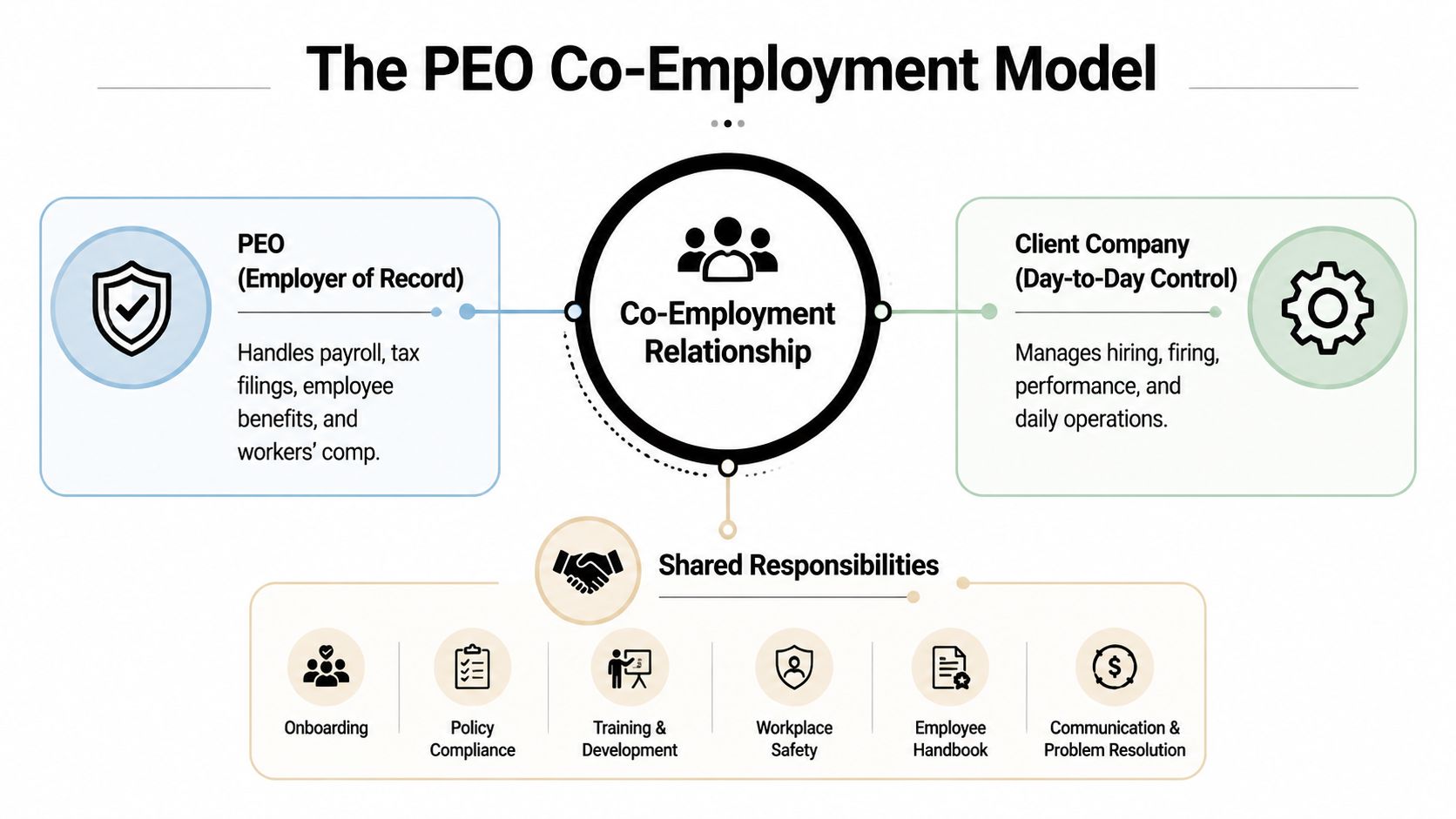
A Professional Employer Organization, or PEO, enters a co-employment relationship with your company. Under the service agreement, the PEO can act as the employer or co-employer for payroll-tax purposes, while your company continues to control hiring, firing, performance management, and daily business operations. The IRS explanation of PEO arrangements makes the tax relationship clear: the PEO must assert that it's the employer or co-employer of the workers covered by the agreement.
That division of responsibility matters. The PEO generally handles payroll processing, payroll tax administration, benefits administration, workers' compensation, and employment-related filings. Your leadership team still decides who joins the company, what work they do, how they're managed, and when employment ends.
The services inside the contract
A typical PEO package may include:
- Payroll administration: Processing wages, deductions, withholdings, and payroll reports.
- Tax compliance: Remitting employment taxes and managing related filings.
- Benefits administration: Providing access to health, dental, vision, life insurance, and retirement offerings. NAPEO describes these as common benefits available through PEO relationships in its PEO benefits FAQ.
- Workers' compensation: Managing coverage, certificates, claims coordination, and related administration.
- HR support: Supplying policy resources, employee handbooks, onboarding workflows, and guidance on workplace issues.
- State compliance support: Helping manage obligations that arise when employees work across multiple jurisdictions.
A PEO often fits a small or midsize employer that needs stronger benefits access and compliance support without building a large internal HR department. It can also help a company expanding across states, especially when leaders lack the time or expertise to manage registrations, payroll rules, and changing employment requirements.
When another model makes more sense
A PEO isn't automatically the right answer. An in-house HR hire may be better if you need a dedicated strategic partner who works inside your culture every day. An Employer of Record, or EOR, is a different model designed primarily for employing workers in locations where your company may not have its own entity, especially in international hiring situations.
HR software alone can also be enough if your team already understands payroll, benefits, workers' compensation, and compliance, but needs better automation. The threshold question is simple: does pooled benefits access and outsourced compliance deliver more value than structured internal HR and software would cost? If not, don't choose a PEO just because the sales process is convenient. For a plain-language overview of the model, review what PEO services mean.
The Risk and Compliance Signals You Must Verify First
Start with risk, not price. A PEO controls or influences payroll, tax remittance, benefits administration, and workers' compensation obligations, so a weak provider can expose your company to problems that a low administrative fee won't offset.
Accreditation is a due-diligence filter
The Employer Services Assurance Corporation, or ESAC, was established in 1995 as an independent, nonprofit national accreditation program for the PEO industry. ESAC launched its financial assurance program in 2000, creating additional protection for clients, worksite employees, insurers, and taxing authorities. By 2022, nearly 73% of all PEO industry wages were paid through ESAC-accredited PEOs, according to ESAC's history and accreditation overview.
That history makes accreditation more than a logo on a proposal. ESAC says accreditation verifies financial stability, ethical conduct, and regulatory compliance, including obligations involving employment taxes, health and employee benefits, and workers' compensation. Ask the provider to explain its current accreditation status and give you documentation rather than accepting a slide in a sales deck.
The same ESAC source records financial assurance coverage growing from more than $5 million in 2006 to more than $10 million in 2008 and more than $15 million in 2014. Those milestones show why financial safeguards deserve attention when a PEO will handle payroll and tax-related processes.
Confirm IRS certification and financial strength
Check whether the provider is an IRS Certified Professional Employer Organization, or CPEO. The IRS certification framework can reduce certain federal payroll-tax complexities for qualified worksite employees, and ESAC explains that certified PEO status can clarify eligibility for federal tax credits through its CPEO frequently asked questions.
Then request independent CPA-audited financial statements, the identity of insurance carriers, and an explanation of how the provider manages client funds and tax remittances. Review its operating history and reputation. For broader people-risk practices, a resource on compliance for talent leaders can help your team organize questions beyond the PEO's marketing materials.
Validate the actual operating model
Ask whether benefits administration is performed internally or subcontracted. Confirm whether the arrangement is a PEO relationship or an Administrative Services Organization, or ASO, that provides HR services without the same co-employment structure. Also verify state licensing or registration requirements wherever your employees work, including any surety bond obligations.
A provider that closed during a contract, outsourced critical benefits work, or gave unclear answers about tax responsibility should leave your shortlist immediately.
Modeling Total Cost Beyond the Headline Admin Fee
The headline administrative fee is often the least useful number in a PEO proposal. Build your comparison around total cost per employee per year, using identical assumptions for every bidder.
Give each PEO the same employee count, state mix, average wage, benefits tier, payroll schedule, and optional-service requirements. If one provider models a richer medical plan while another uses a thinner option, the comparison is already distorted. Ask each bidder to quote the same plan or the closest equivalent, then show the benefits loading separately.
Separate every layer of the cost stack
Your request should identify the administrative fee per employee per month, payroll frequency charges, W-2 and 1095 production fees, off-cycle payroll charges, and event-based fees for garnishments or unemployment claims. Workers' compensation should appear as its own line, typically tied to payroll and class codes.
Benefits loading deserves especially close scrutiny. It represents the markup or additional cost attached to group health, dental, vision, and life plans, and it can outweigh the administrative fee. For example, a proposal showing $99 PEPM with 30% benefits loading can cost more than one showing $139 PEPM with 8% loading and no add-on fees. Those figures are a comparison example, not a market benchmark. The point is that a lower PEPM figure doesn't prove a lower total price.
Include pass-through items such as state unemployment insurance, FUTA, leave administration, and per-event charges. Ask whether renewal increases, carrier changes, compliance projects, and special payroll work are included or billed separately. A useful benefits-specific comparison should also account for plan availability and employee experience, which is why reviewing PEO health plans can help your team frame the benefits portion of the proposal.
| Cost Component | Typical Pricing Model | Hidden Risk to Watch |
|---|---|---|
| Administrative fee | Per employee per month or percentage of payroll | The fee may exclude routine services |
| Payroll processing | Included, per run, or subject to frequency surcharge | Frequent payroll schedules can add charges |
| Tax filings | Included or separately itemized | Confirm responsibility for corrections and notices |
| W-2 and 1095 production | Per form or included | Year-end charges may sit outside the quoted fee |
| Off-cycle payroll | Per run or per employee | Urgent corrections can become expensive |
| Workers' compensation | Rate tied to payroll and classification | Carrier terms, audits, and claims handling may vary |
| Benefits loading | Percentage or embedded plan pricing | The largest cost difference may be hidden here |
| Pass-through costs | Actual cost, fixed fee, or percentage | State unemployment, FUTA, leave, and claims fees can accumulate |
Practical rule: Require identical inputs and an all-in annual comparison before you discuss which proposal is “cheaper.”
Service Quality, Payroll Integration, and Multi-State Coverage
Once a provider clears the risk and cost screens, test how it operates on an ordinary Tuesday. A PEO can have sound credentials and competitive pricing yet still create daily friction through slow responses, weak integrations, or unclear ownership of employee issues.
Ask who will handle your account. You want to know whether you'll receive a dedicated account manager, a specialized service team, or access to a shared queue. Request written service levels for payroll tickets, escalations, garnishments, new-state hires, benefits questions, and employee support. Don't accept “responsive support” as a service commitment.
Score the operating experience
Use a live platform demonstration, not a brochure. Have the provider show payroll approvals, employee self-service, benefits enrollment, reporting, onboarding, and correction workflows. Ask what happens when a new hire works in a state where you've never employed someone before.
Integration depth is equally important. Confirm API availability, HRIS synchronization, payroll exports, and whether the PEO can mirror your chart of accounts. A platform that forces manual re-entry into accounting or workforce systems will create recurring work even if implementation looks smooth.
| Dimension | What to Verify | Pass/Fail Threshold | Weight |
|---|---|---|---|
| Payroll support | Ticket ownership, escalation path, response commitments | Written process and named escalation contact | High |
| Account management | Dedicated manager or shared service structure | Clear owner with backup coverage | High |
| Employee self-service | Payroll, benefits, documents, and profile changes | Live demonstration of core workflows | Medium |
| Integration | API, HRIS sync, exports, and accounting compatibility | Documented integration plan | High |
| Multi-state compliance | Registrations, tax setup, and state-law updates | Specific experience in every employee state | High |
| Workers' compensation | Carrier, claims process, and financial-strength information | Written carrier and claims workflow | Medium |
| References | Similar headcount, industry, and geographic footprint | Two relevant client conversations | High |
Multi-state capability is more than a map showing nationwide coverage. Ask for examples of jurisdiction-specific tax registration, state-law update cadence, and new-hire onboarding. Request the workers' compensation carrier and review its financial-strength information, including relevant A.M. Best ratings.
Speak with two clients that resemble your company in headcount and geographic footprint. Ask what happens during payroll corrections, benefits renewals, employee disputes, and urgent compliance issues. Put a 90-day service review into the contract, with meaningful remedies or exit rights if the provider misses agreed service levels.
A Step-by-Step PEO Selection Workflow
A disciplined selection process prevents the sales presentation from becoming the decision. Start internally, then force every provider to answer the same questions and accept the same comparison rules.
1. Define the business problem
Write down why you're considering a PEO. Is the problem benefits access, payroll capacity, multi-state compliance, workers' compensation administration, or the lack of internal HR support? Establish your headcount forecast, state map, benefit priorities, and target total cost per employee per year before contacting vendors.
2. Build and narrow the provider list
Create a longlist of 8 to 10 PEOs, then reduce it to 3 to 4 finalists using accreditation, CPEO status, financial transparency, and geographic fit. NAPEO reports that about 14% of employers with 20 to 499 employees use a PEO, while roughly 15% of employers with 10 to 499 employees do so. Adoption reaches 16% among firms with 20 to 49 employees, according to NAPEO's industry overview. Those figures reinforce the practical point that PEOs primarily serve smaller and midsize employers, not just large enterprises.
Issue one RFP to every finalist. Use identical employee data, wage assumptions, states, benefit priorities, payroll requirements, and optional services. Score responses in one matrix covering cost, compliance, service, and integration.
3. Test the claims
Run two reference calls per finalist, including one conversation focused on an at-risk situation such as a payroll failure, benefits dispute, state expansion, or termination. Ask to see the platform, sample reports, implementation plan, contract, and service-level agreement.
For technology and security questions that overlap with broader IT operations, a guide to choosing a security-focused MSP in North Texas can provide useful evaluation context. Keep the PEO assessment focused on payroll, benefits, HR data, and compliance ownership.
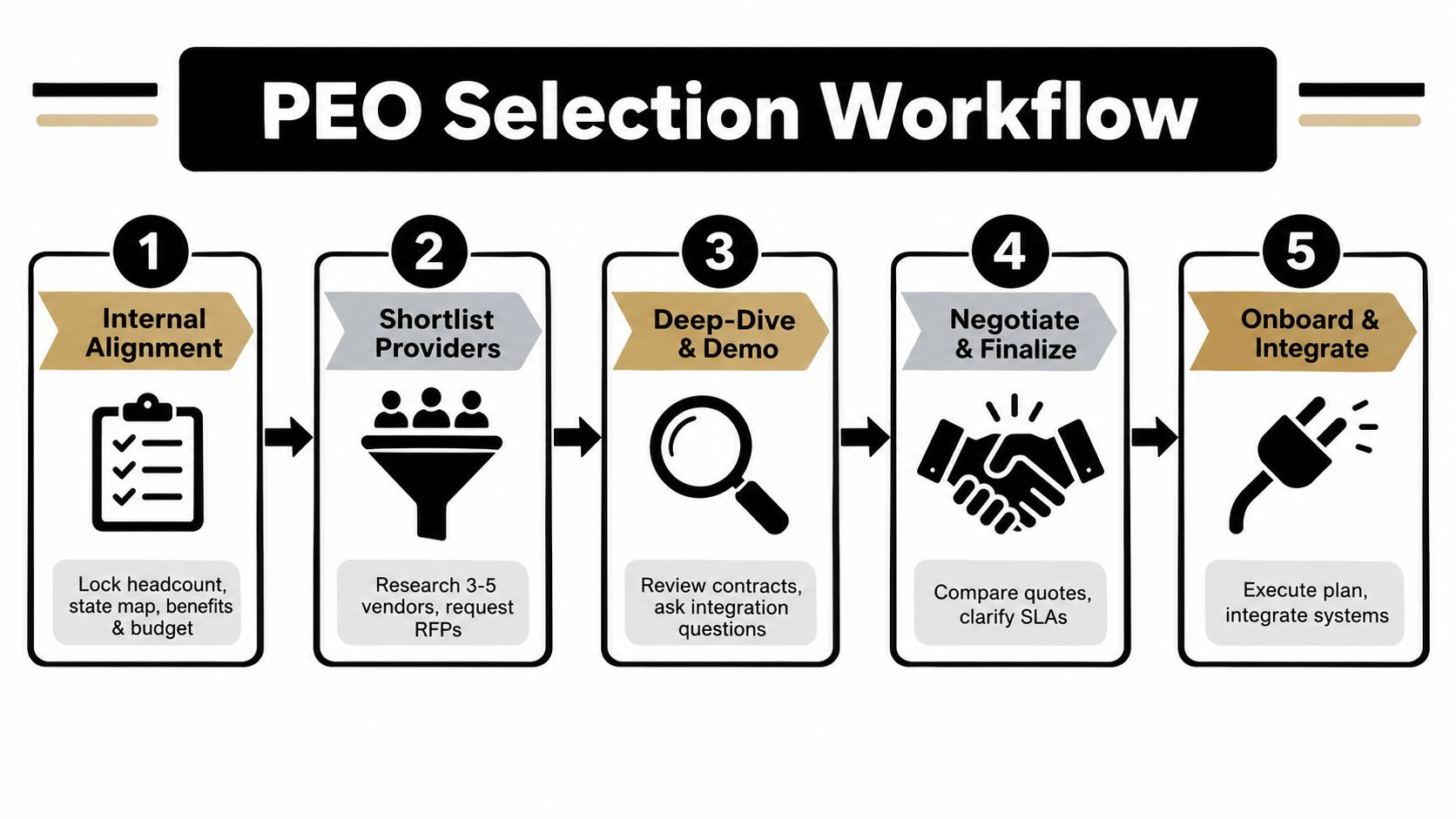
4. Negotiate before signing
Negotiate pricing escalation caps, benefit renewal pass-throughs, termination for convenience, data portability, and Surrogate Employer for Taxes assignments before execution. Don't wait until implementation to ask how you'll retrieve payroll history or transition employee records.
5. Plan the transition and document the exit
Build a 60-to-90-day transition plan with payroll parallel runs, employee communications, benefits enrollment testing, tax registration checks, and a named implementation owner. The exit clause should explain notice periods, final filings, data exports, employee support, and responsibility for outstanding claims or tax notices.
PEO Selection Checklist and Final Decision Framework
Choose the provider that offers the strongest risk-adjusted operating value, not the one with the most attractive presentation. Your final review should force the team to document what it verified and what it accepted as a trade-off.
Use five decision categories
Accreditation and financial health come first. Confirm ESAC accreditation, IRS CPEO status where relevant, audited financial statements, insurance carriers, and state registration coverage.
Cost modeling clarity means every proposal includes the same assumptions and every fee appears in the all-in annual calculation. Reject any bidder that won't separate administrative fees, benefits loading, workers' compensation, pass-through costs, and event charges.
Service-level commitments should identify response times, account ownership, escalation routes, employee support, payroll correction procedures, and implementation responsibilities. Review questions to ask a PEO before your finalist meetings so your team doesn't rely on vague sales answers.
Integration and multi-state readiness require a live platform demonstration, a documented payroll and HRIS integration plan, state-specific compliance experience, and a clear process for adding employees in new jurisdictions.
Contract exit terms protect you from the hidden cost of a bad decision. Require data portability, termination rights, renewal rules, pricing protections, and post-termination support in writing.
Treat these as deal-breakers
- Missing certification evidence: The provider can't substantiate relevant IRS CPEO status or explain its tax model.
- Opaque renewal pricing: Benefits or administrative charges can change without clear notice or limits.
- No practical termination right: The agreement lacks a workable termination-for-convenience or service-failure provision.
- No data export process: The provider won't explain how payroll, benefits, tax, and employee data will be returned.
- No sample SLA: The sales team refuses to share a meaningful service-level document.
Use a weighted scorecard that assigns importance to cost, service, compliance, integration, and exit risk. The weights should reflect your company's priorities, but the method matters more than the exact allocation because it makes hidden preferences visible.
At the 90-day post-implementation review, verify payroll accuracy, tax remittance, benefit enrollment, employee access, ticket handling, reporting, integrations, and state compliance workflows. Compare actual charges with the signed proposal and document every missed commitment. If the PEO isn't delivering, use the contract's service remedies and exit protections instead of allowing switching costs to grow.
Benely can help companies compare PEO solutions alongside benefits, payroll connectivity, and compliance requirements so the decision isn't driven by an isolated admin fee. Visit Benely to evaluate your options and prepare a more disciplined, all-in PEO comparison before signing.