 Employee Benefits
 HR & Compliance
 Technology
 Wellness
 PEO Solutions
Monday morning starts with a renewal email marked “urgent.” Your founder has two spreadsheets open, the finance lead is recalculating payroll deductions, and three employees are asking whether the new plan still covers their doctors. The broker who promised guidance appears only when quote requests are due.
That isn't a benefits strategy. It's a recurring fire drill.
A capable small business benefits broker does more than collect carrier quotes. They translate complex plan language, engineer employer and employee contributions, test affordability by coverage tier, coordinate enrollment, and keep compliance work from becoming a surprise. The right partner also gives your team a usable operating system instead of another folder of PDFs.
The practical question isn't which plan has the lowest premium. It's whether your workforce can afford to use the plan, whether your company can sustain it, and whether the administration will still work as headcount changes. This guide treats brokerage as affordability engineering, then applies that idea to operating models, broker selection, cost modeling, and implementation.
Table of Contents
- The Monday Morning a Founder Dreads
- What a Small Business Benefits Broker Does
- Why Size Changes the Benefits Equation
- Broker vs PEO vs In-House
- Modeling Cost Beyond the Headline Premium
- How to Vet a Broker Before You Sign
- From Selection to Steady-State in 90 Days
- A Practical Way Forward for Growing Teams
The Monday Morning a Founder Dreads
By 9:15 a.m., the founder has already answered the same question twice: “Why did my deduction increase?” The renewal spreadsheet shows a cheaper option, but its deductible is higher and the network excludes a doctor several employees use. Another plan protects the network but pushes family coverage beyond what several households can comfortably absorb.
The broker's email contains three attachments and no recommendation. There's no employer-cost forecast, no employee affordability view, and no explanation of what happens if dependent enrollment changes. The founder now has to act as CFO, HR director, benefits analyst, and employee counselor at the same time.
This situation is common because smaller employers lack the purchasing scale and internal administration of larger organizations. In 2025, 61% of U.S. firms with at least 10 workers offered health benefits to some employees, down from 68% five years earlier; only 51% of firms with 10–24 workers offered coverage, according to the 2025 KFF Employer Health Benefits Survey.
A useful broker changes the rhythm. They start with your census, budget, locations, payroll structure, and workforce priorities. They compare plans by total exposure, explain trade-offs in plain English, and build an enrollment process employees can easily follow.
Practical rule: If your broker only appears at quote time, you don't have a benefits partner. You have a renewal messenger.
The rest of the year should produce fewer surprises, not merely a better renewal presentation. That means selecting an operating model that fits your HR capacity, setting contribution rules before choosing a plan, and connecting selection, enrollment, payroll, and compliance in one workflow.
What a Small Business Benefits Broker Does
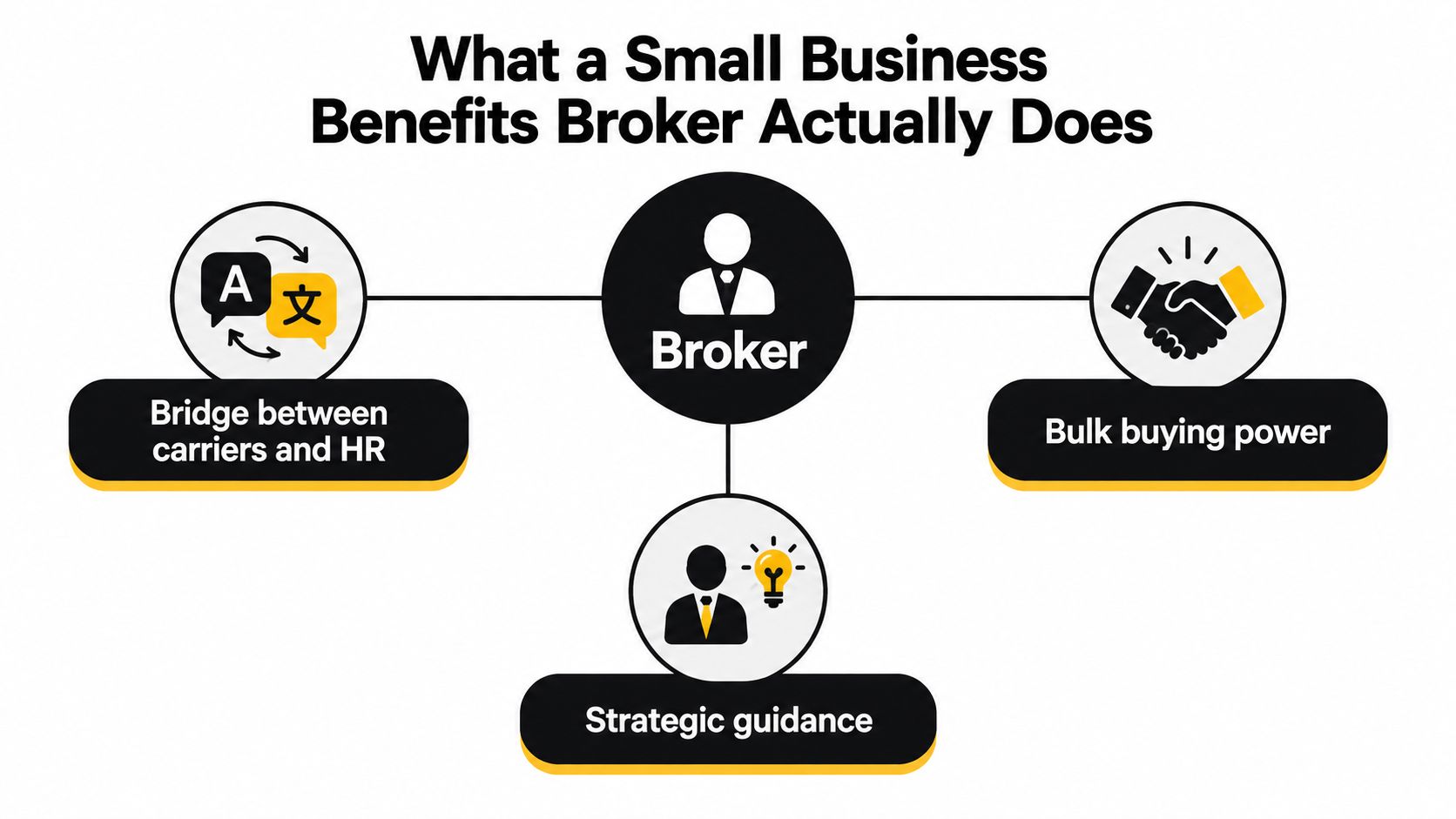
A small business benefits broker should do more than present plan options. The role combines translation, purchasing strategy, and compliance support, with affordability engineering at the center. The broker models total coverage cost by employee tier, workforce mix, and payroll structure instead of treating the headline premium as the decision.
The translator
Carriers describe networks, actuarial values, formularies, eligibility rules, exclusions, and renewal assumptions. Employees ask, “Can I keep my pediatrician?” and “What will an emergency cost me?” A broker turns carrier language into answers employees can use.
That explanation must come before enrollment. Your team needs side-by-side comparisons of premiums, deductibles, copays, coinsurance, out-of-pocket maximums, provider access, prescription coverage, and dependent costs. Employees experience a plan when they fill a prescription, schedule care, or receive a bill, not when they read its brochure.
The buyer
A broker takes your workforce requirements, budget, locations, and contribution goals to multiple carriers and plan structures. Market access varies. A captive agent tied to one carrier may explain that carrier clearly, but cannot provide a broad comparison.
An independent or technology-enabled broker should show how it evaluates carrier choice, network fit, funding structures, and contribution design. Ask for a recommendation supported by cost modeling, not a stack of quotes that sends the analysis back to you.
The Benely health insurance broker services overview illustrates how brokerage can connect plan comparison with administration instead of treating selection as a one-time transaction.
The compliance co-pilot
Benefits work continues after employees elect coverage. Someone must coordinate eligibility, effective dates, qualifying life events, carrier files, payroll deductions, notices, and employee-status changes. A broker should also flag when company growth changes your administrative obligations.
During a typical year, the work includes:
- Market scanning: Compare carriers, plan designs, networks, and funding approaches.
- Contribution modeling: Separate employer cost from employee payroll deductions by coverage tier.
- Enrollment setup: Configure eligibility, communications, elections, and carrier submission.
- Employee education: Explain practical use cases, not just plan names.
- Year-round service: Resolve carrier issues and correct administrative errors.
- Renewal planning: Compare alternatives before deadline pressure takes over.
The right platform connects selection, enrollment, payroll, and compliance in one workflow. Technology removes repetitive administration, while the advisor focuses on affordability, risk, and decisions that affect your people.
Why Size Changes the Benefits Equation
Offering health coverage isn't the finish line. Usable coverage at a sustainable cost is the finish line.
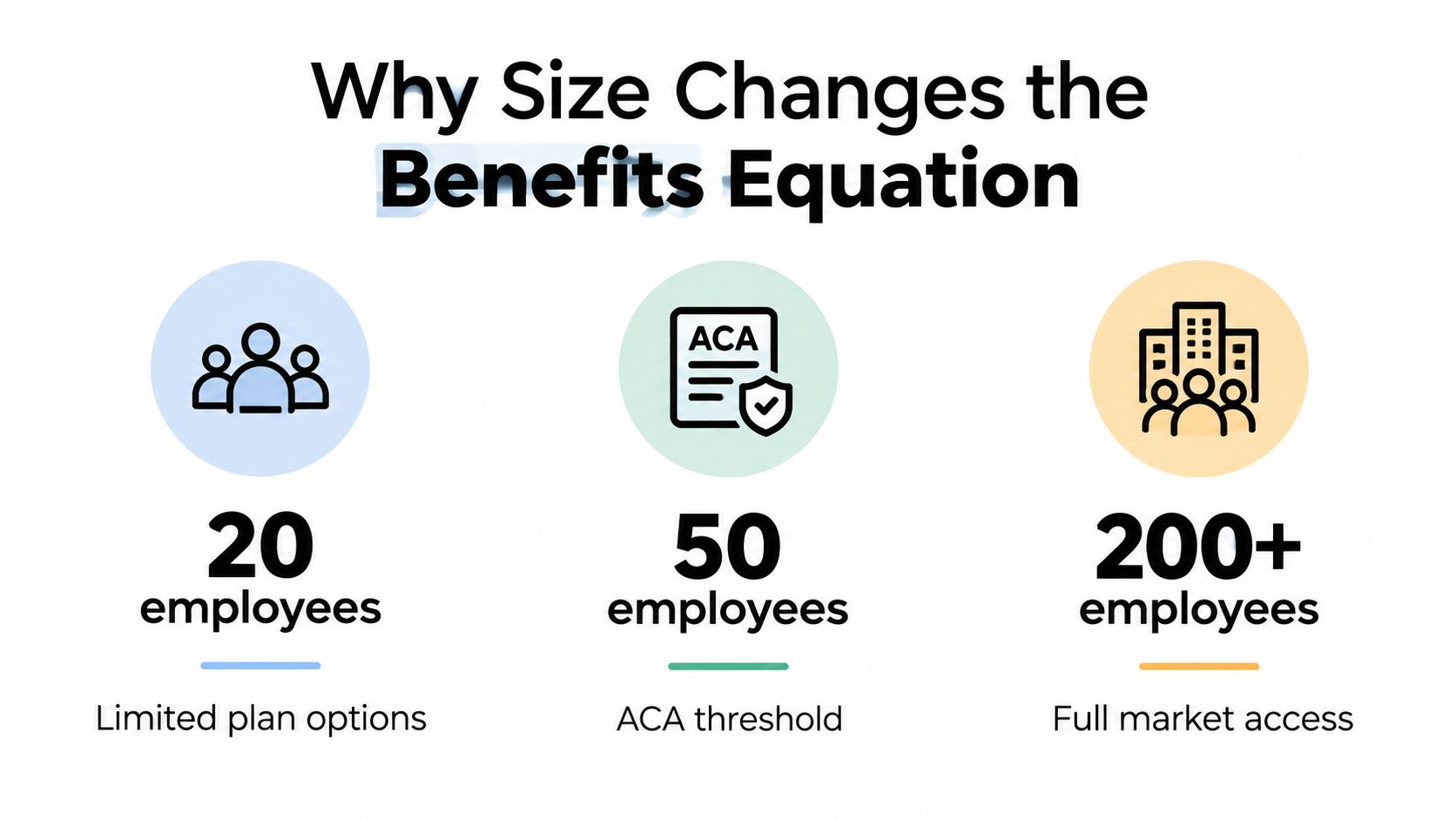
The KFF data shows a sharp size gradient. In 2025, 51% of firms with 10–24 workers offered health benefits, compared with 64% of firms with 25–49 workers and 89% of firms with 50–199 workers, according to the KFF employer benefits findings. A company with fewer than 25 employees faces a very different purchasing problem from one with a larger workforce.
Three lessons for smaller employers
First, size affects access. Carriers evaluate group characteristics, geographic distribution, participation, and plan fit. A broker who primarily serves large employers may not have the patience or process needed for a smaller group. You need someone who understands the constraints of your segment, not someone squeezing your company into a larger-market template.
Second, default rules can fail. A flat employer percentage sounds fair, but it doesn't create the same employee experience across coverage tiers. Family enrollment can produce much higher payroll deductions than employee-only coverage. If the company applies one rule without testing the result, the benefit may look generous in the budget while feeling unusable to families.
Third, contribution design often matters more than plan selection. Two plans can have similar headline premiums but very different employee experiences once deductibles, payroll deductions, networks, and dependent costs enter the picture. A smaller employer can't assume that adding a plan automatically solves recruitment or retention concerns.
The useful benchmark isn't “Do we offer benefits?” It's “Can the people we want to retain afford to use them?”
A good broker therefore starts with workforce distribution and affordability ceilings. They should model employee-only and family enrollment separately, consider employee wage differences, and show how the employer budget changes if enrollment shifts.
That approach also protects against a common mistake: choosing the cheapest premium without examining the cost transferred to employees. Small employers need a plan architecture that remains credible to employees, not merely defensible in a finance meeting.
Broker vs PEO vs In-House
Choosing an operating model is more consequential than choosing a carrier. The wrong model creates persistent administrative friction, while the right one gives your team a clear owner for decisions, deadlines, and employee support.
| Criterion | Benefits Broker | PEO | In-House HR |
|---|---|---|---|
| Total cost of coverage | Compares external plans and contribution structures | May provide pooled purchasing, with bundled pricing and service costs | Depends on internal expertise and market access |
| Plan design control | Usually high, subject to carrier availability | Can be limited by the PEO's program | High if the team has the required expertise |
| Compliance workload | Shared with broker and internal team | More administrative support through the PEO | Primarily internal |
| Payroll integration | Depends on technology and payroll connections | Usually bundled into the operating model | Requires internal coordination |
| Growth flexibility | Strong when the company wants to keep its own HR stack | Useful when administrative capacity is limited | Works when HR capability grows with the business |
Choose a broker when control matters
A standalone broker fits an employer that wants to keep its payroll and HR systems, compare the external market, and make its own contribution decisions. It's also the cleaner route when the company has enough internal ownership to manage broader HR responsibilities but needs benefits expertise.
You'll need to confirm who handles enrollment corrections, employee questions, carrier escalation, and compliance calendars. A broker can provide expertise without taking over the employer's operating model.
Choose a PEO when administration is the constraint
A PEO may make sense when the company lacks HR infrastructure, operates across jurisdictions, or values bundled support more than plan-design control. The trade-off is that you must understand co-employment terms, pricing components, available plans, and exit conditions before signing.
For a practical discussion of the broader employment risks involved, review this Guide on Employment Risk for SMB Leaders from Paradigm International Inc. It's especially relevant when a founder is evaluating a PEO as an HR operating model rather than merely as an insurance purchasing route.
Choose in-house when ownership is already mature
In-house HR can work for a company with a capable benefits administrator, established payroll controls, and enough time to manage carrier relationships. It offers control, but it doesn't automatically offer market advantage or specialized compliance knowledge.
The Benely PEO and HR solutions option is relevant for teams comparing a broker-led approach with a more bundled model.
Decision test: Pick the model that matches your weakest operational capability. If your team can design strategy but can't manage enrollment, buy administration. If it can administer benefits but lacks market insight, buy brokerage.
Don't compare only the visible fee. Compare employer spend, employee experience, payroll integration, responsibility allocation, renewal risk, and what happens if you switch later.
Modeling Cost Beyond the Headline Premium
A broker earns their fee by showing what coverage costs after enrollment. The sticker price is only the starting point.
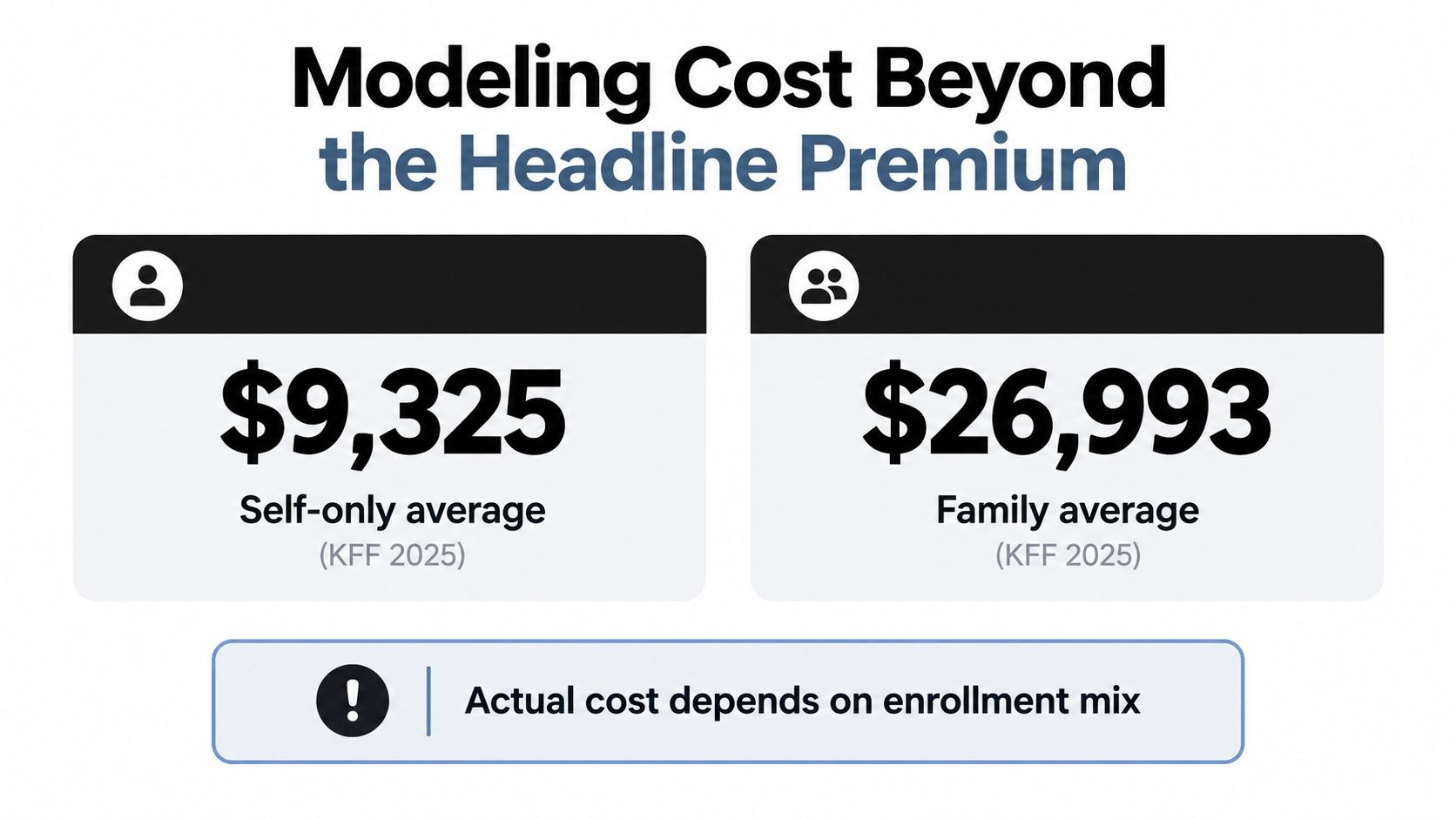
KFF's 2025 averages were $9,325 for self-only coverage and $26,993 for family coverage, while employees contributed $1,440 and $6,850, respectively, through payroll deductions, according to the KFF Employer Health Benefits Survey series. Those figures imply approximate employer-paid amounts of $7,885 for self-only coverage and $20,143 for family coverage.
Build a contribution matrix
Start with coverage tiers, not a single employer percentage.
| Coverage tier | What to model | Why it matters |
|---|---|---|
| Employee only | Employer allowance, payroll deduction, deductible exposure | Establishes the baseline employee experience |
| Employee plus dependents | Employer allowance, dependent contribution, participation | Shows how quickly family enrollment changes spend |
| Family | Total employer cost, employee deduction, worst-case exposure | Protects affordability for households |
A fixed employer dollar allowance for employee-only coverage can create budget predictability. Dependents may then receive a defined percentage or tiered allowance. The exact design depends on workforce priorities, wages, enrollment, and cash flow, but the principle is consistent: model employer and employee exposure separately.
A flat “we pay half” rule often produces a distorted result. It may look reasonable for employee-only coverage while making family enrollment prohibitively expensive. That can damage perceived benefit value and leave employees choosing plans based on payroll deduction alone.
Stress-test before enrollment
Ask the broker to show at least three scenarios:
- Current enrollment: What does the employer pay under the present mix of employee-only, employee-plus-dependent, and family elections?
- Dependent growth: What happens if more employees add spouses or children?
- Renewal pressure: What happens if premiums rise and the company keeps the employee affordability ceiling?
Then add the plan features employees feel after enrollment. A higher-deductible plan may lower premiums while increasing exposure at the point of care. Compare premium, deductible, copays, coinsurance, out-of-pocket maximum, network breadth, prescription costs, and available HSA or FSA options together.
The lowest premium can be the most expensive choice if employees can't afford to use the coverage.
KFF's survey included 1,862 randomly selected employers with at least 10 workers, while firms with 3–9 employees were excluded from the 2025 sample, as described in the survey methodology and findings. Use national benchmarks as context, not as a substitute for your own workforce model.
How to Vet a Broker Before You Sign
The sales call reveals the service model. Don't let a polished presentation substitute for evidence.
Ask about market access
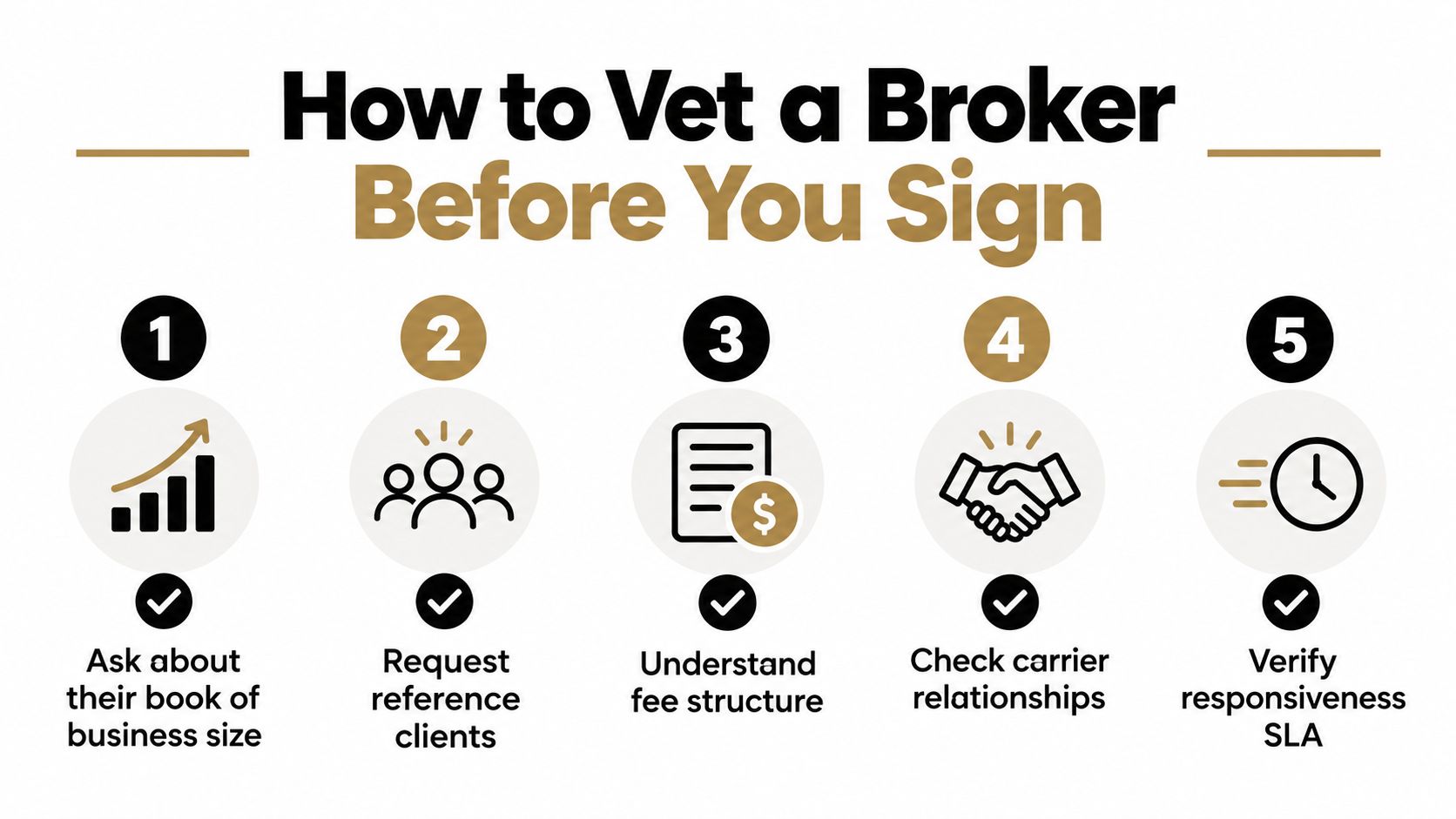
Ask which carriers and plan structures they can access, how they evaluate networks, and whether they'll show alternatives outside your current carrier. A strong answer includes a defined comparison process. A weak answer relies on relationships without explaining the scope of the market review.
Captive-carrier bias is the first red flag. If every recommendation leads back to one carrier, you're not receiving independent advice.
Test contribution engineering
Ask the candidate to model your current employer budget by tier. Then ask them to show employee payroll deductions, dependent affordability, and the effect of enrollment changes.
You should hear specific language about contribution matrices, plan design, and affordability ceilings. “We'll find a competitive rate” isn't enough. Your broker must show how the rate affects both your ledger and your employees' paychecks.
In a 2025 small-business survey, 40% of employers cited limited budgets, 37% cited rising benefits costs, and 19% cited lack of resources as their top benefits challenges. A broker who doesn't address all three is missing the operating reality.
Pin down service ownership
Ask:
- Who answers employee questions: Is there a named account team, employee support channel, or escalation path?
- What happens between renewals: Will the broker manage life events, carrier issues, and eligibility corrections?
- Which deadlines are tracked: Does the service model include compliance calendars and renewal planning?
- How fast is support: Will the broker put response expectations in writing?
A vague renewal strategy is another warning sign. “We'll shop the market” should come with dates, deliverables, and a clear explanation of what gets compared.
Inspect the technology
Ask whether the platform connects plan comparison, employee elections, carrier submission, payroll deductions, and progress reporting. You don't need every function in one product, but disconnected spreadsheets create avoidable handoffs.
The strongest signal is a platform that lets your team compare plans, set budgets, run enrollment, and see progress without waiting for a broker to email the next file. For a plain-language explanation of broker compensation, review how insurance brokers get paid.
From Selection to Steady-State in 90 Days
A broker relationship should have a visible implementation path. The first 90 days should produce decisions, configured systems, trained employees, and a renewal calendar.
Days 1 to 30
Begin with a complete data intake. Gather the current plan documents, employee census, locations, eligibility rules, payroll deductions, renewal date, and workforce priorities. The broker should then produce a one-page strategy memo that states the budget, coverage goals, contribution philosophy, and decision criteria.
The market scan belongs in this phase. Require a side-by-side carrier comparison that shows premium, employer cost, employee cost, network fit, deductible structure, and major trade-offs. Don't approve a recommendation that hides the losing options.
Days 31 to 60
Once the plan is selected, the work becomes operational. Configure eligibility rules, effective dates, employee classes, payroll deductions, carrier files, and enrollment communications. The broker should deliver an enrollment readiness checklist and identify who owns each task.
Employee education belongs here too. Use short plan summaries, decision examples, office hours, and clear instructions for adding dependents or reporting life events. Employees shouldn't need to decode a summary of benefits while trying to meet an enrollment deadline.
Days 61 to 90
Open enrollment should run through a controlled workflow with visible completion status. Reconcile elections against payroll deductions and carrier records before coverage begins. Then schedule a structured handover to ongoing service, with unresolved items, contacts, and escalation procedures documented.
ACA tracking deserves early attention. Under the Affordable Care Act, an employer generally becomes an applicable large employer when it averaged at least 50 full-time employees, including full-time-equivalent employees, during the preceding calendar year, according to the IRS employer shared responsibility guidance. The calculation uses the preceding year, not merely today's headcount, so growing companies shouldn't wait until crossing the threshold to build tracking discipline.
Implementation standard: By the end of the first 90 days, you should know what you're offering, what employees pay, who owns each workflow, and when the next renewal process starts.
State-specific requirements for distributed teams and life-event processing need the same attention. A modern platform can compress repetitive setup and reporting work, but the broker still needs to make the decisions visible and accountable.
A Practical Way Forward for Growing Teams
A small business benefits broker should engineer affordability, not shop plans. That means modeling employer cost, employee deductions, coverage tiers, workforce demographics, network access, and worst-case exposure before enrollment.
The legacy experience sends quotes by email, attaches PDFs, and schedules a call during open enrollment. A modern broker platform can let teams compare more than 4,000 health plans from top carriers, automate enrollments, connect payroll, and track open enrollment progress in days rather than weeks, based on Benely's stated platform capabilities.
Benely also supports teams that want to benchmark their current program, evaluate PEO options in one place, and access a free 30-page guide adapted to company size and stage. The point isn't to replace judgment with software. It's to give founders, CFOs, COOs, and HR leads a shared view of cost, coverage, and execution.
The best next step is practical: gather your current plan documents, enrollment data, employer contribution rules, and renewal date. Then ask any prospective broker to turn that information into a contribution matrix and a side-by-side recommendation. If they can't explain the employee experience as clearly as the premium, keep looking.
Benely combines benefits brokerage, plan comparison, enrollment support, payroll connectivity, and HR guidance for growing teams. Visit Benely to benchmark your current program, compare coverage and PEO options, and start building a more predictable benefits workflow.