 Employee Benefits
 HR & Compliance
 Technology
 Wellness
 PEO Solutions
A PEO employee performs day-to-day work for a client company while a third-party PEO manages payroll, taxes, benefits, and related HR administration under a co-employment arrangement. At the end of 2025, 502 PEOs served approximately 5.4 million worksite employees at 233,000 client businesses in the United States, with those employees receiving about $386 billion in wages during the year.
That scale matters because the arrangement often begins with a familiar small-business problem. The founder is still approving timesheets, answering benefits questions, reviewing payroll reports, and trying to keep up with employment rules, but the company isn't large enough to build every HR function internally. A PEO can take much of that administration off the owner's desk without taking over the employee's daily job.
The simplest way to understand a PEO employee is to separate workplace control from employment administration. Your company usually decides what work gets done, who manages the employee, how performance is evaluated, and whether the employee remains on the team. The PEO may process wages, withhold and report employment taxes, administer benefits, support workers' compensation, and provide compliance assistance.
The word co-employment describes how those responsibilities are shared. It doesn't automatically mean the PEO becomes the employee's manager or makes every employment decision. The contract, the services the PEO performs, and the applicable tax arrangement determine who handles each obligation.
Table of Contents
- What Is a PEO Employee in Plain Language
- How Co-Employment Actually Works
- Payroll, Taxes, and Benefits in Practice
- Certified PEO Versus Standard PEO Arrangements
- Pros and Cons for Small and Mid-Sized Businesses
- When a PEO Is the Right Move and What to Check First
- Key Takeaways for Employers and Employees
What Is a PEO Employee in Plain Language
A small agency hires a new designer. On Monday, the designer takes assignments from the creative director, joins the same team meetings as everyone else, and works toward the agency's client deadlines. On payday, the paystub may come through a PEO system, benefits questions may go to a different portal, and some HR paperwork may be handled by a company the designer never sees in the office.
That employee is often called a PEO employee.
In plain language, the person still works for the client business in the day-to-day sense, while the PEO handles agreed parts of employment administration under contract. The IRS explanation of professional employer organizations describes a PEO arrangement as one in which the PEO performs some or all federal employment tax withholding, reporting, and payment functions for workers who continue serving the client. That last part matters. The worker continues serving the client.
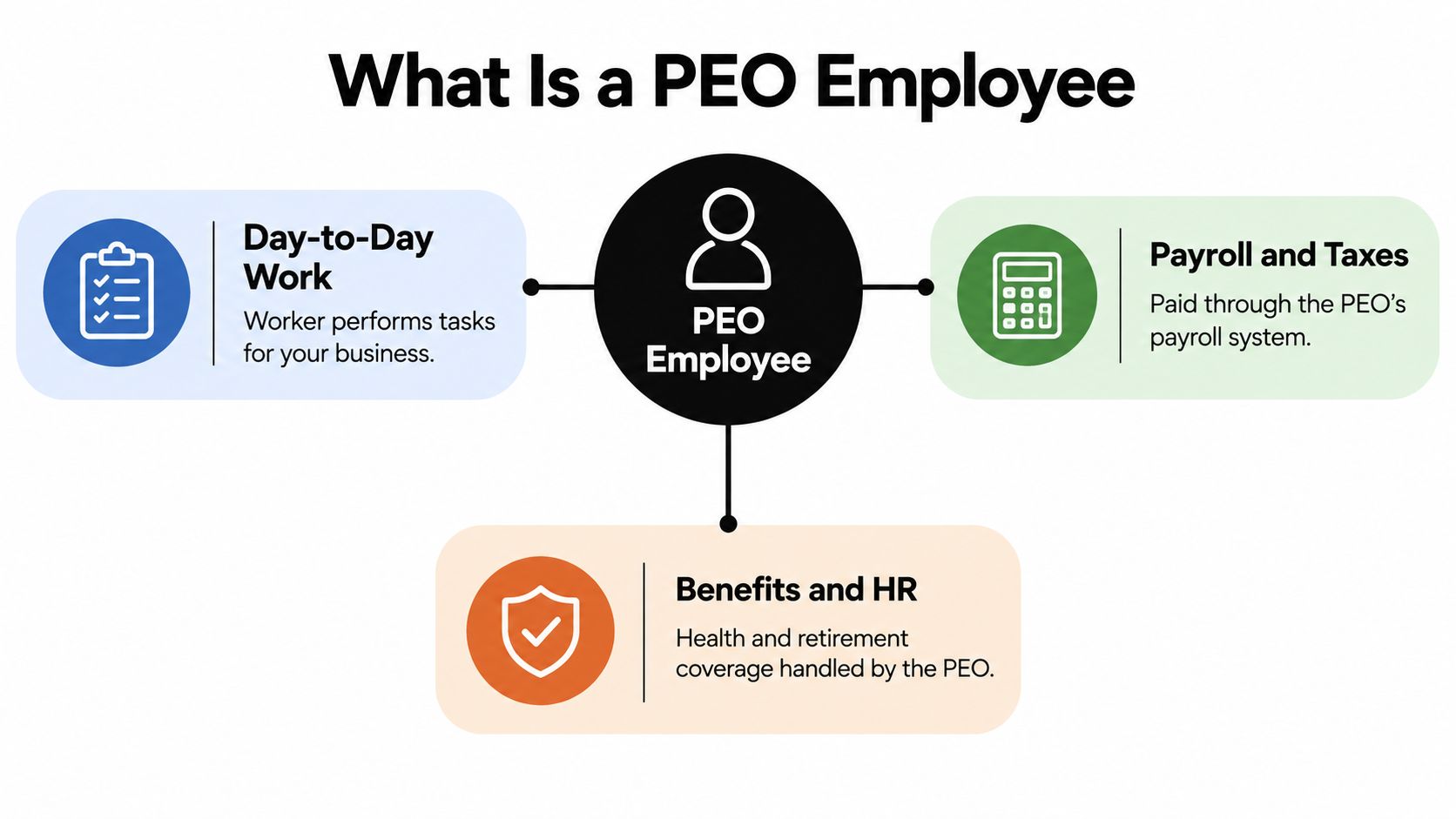
The easiest way to understand it is to separate two lanes of responsibility. One lane is the actual job. Who assigns work, approves time off, reviews performance, addresses conduct problems, and decides whether the employee stays on the team. The other lane is employment administration. Who runs payroll, withholds taxes, manages benefits enrollment, supports workers' compensation, and handles parts of HR recordkeeping.
Employees usually feel both lanes at once. Their boss is still the client company's manager, but their pay, tax forms, and benefits may flow through the PEO. For a worker, that can feel confusing at first. For an owner, it often feels like finally having help with back-office HR tasks without handing over daily control of the business.
A simple example clears this up. If the designer misses a deadline, the agency manager handles the performance conversation. If the designer has a question about a paycheck deduction or open enrollment, the PEO may handle that process. If a complaint or termination issue comes up, the answer is often shared. The client usually drives the business decision, while the PEO supports the process and paperwork based on the contract.
That is why it is risky to say only, “the PEO is the employer.” The more accurate explanation is that the employee works in a shared arrangement where the client remains the operational employer and the PEO takes on specified employer functions.
This structure is common enough that many founders and employees will run into it. The National Association of Professional Employer Organizations reported that, at the end of 2025, PEOs served approximately 233,000 client businesses and 5.4 million worksite employees in the United States (NAPEO industry analysis).
How Co-Employment Actually Works
A founder hires a sales manager, sets the targets, and coaches the work each week. The same employee logs into a PEO portal to enroll in benefits, review paystubs, and ask about a tax form. Both experiences are real. That is co-employment in practice.
The easiest way to understand it is to separate work control from employment administration. The client company still runs the business. It decides what the employee does, who the employee reports to, how performance is measured, and whether someone is a fit for the team. The PEO handles selected employer functions under the service agreement, often including payroll administration, benefits administration, parts of HR recordkeeping, and compliance support.
Federal tax law does not give one simple all-purpose definition of “co-employer.” Instead, Treasury Regulation 31.3504-2 addresses situations where a person paying wages under a service agreement is designated to perform employer-related acts. In plain English, the legal question is less “Who has the label?” and more “Who is doing which employer jobs?”
That question matters on both sides of the relationship. Employees want to know who answers the practical stuff. Owners want to know who carries out the paperwork and who is still responsible for the business decision.
Typical allocation of employer responsibilities
| Responsibility | Client Employer | PEO |
|---|---|---|
| Hiring decision | Chooses whether to hire and selects the candidate | May support paperwork or recruiting, depending on the contract |
| Day-to-day supervision | Assigns work, sets priorities, and manages performance | Doesn't normally direct the employee's daily tasks |
| Performance reviews | Conducts reviews and gives operational feedback | May provide templates, guidance, or compliance support |
| Payroll processing | Supplies accurate hours, compensation changes, and worker data | Runs payroll and delivers pay information |
| Employment-tax withholding | Verifies worker and wage data | May withhold, report, and pay federal employment taxes under the arrangement |
| Benefits | Chooses priorities and approves the relationship with the provider | Administers enrollment, deductions, plan communications, and related records |
| Workers' compensation | Reports incidents and supports workplace safety | May provide coverage arrangements and claims administration |
| Unemployment matters | Supplies facts about the employment relationship and separation | May prepare or manage claims responses if assigned by contract |
| Discipline | Makes the operational decision | Advises on process and documentation where included |
| Termination | Decides whether and when to end employment | May review the process, prepare records, or administer final payroll |
This table explains why a PEO employee may have two regular points of contact. If an employee wants to ask about a waiting period for benefits or a paycheck deduction, the PEO may be the right stop. If that same employee wants approval for time off during a busy launch, wants clarity on a promotion path, or disagrees with performance feedback, the manager at the client company usually handles it.
Complaints can be less obvious, which is where confusion starts. A harassment complaint, leave request, wage concern, or termination review may involve both parties at once. The client usually knows the workplace facts and makes the business call. The PEO often helps the client follow the right process, document the steps, and handle the related forms.
Why the contract matters
A co-employment arrangement works like a split-control system. One side directs the work. The other side may carry out agreed administrative employer tasks. The contract decides where that line sits.
For example, a client may decide to terminate an employee after repeated performance problems. The PEO may then review the documentation, help confirm the timing and process, and calculate final payroll. From the employee's point of view, one party made the decision and another handled the mechanics. From the owner's point of view, that split is exactly why the agreement needs to be clear.
Read the service agreement carefully. Check who handles leave administration, workplace complaints, unemployment claims, discipline support, termination review, and responsibility for filing errors. Co-employment works well when everyone knows which door to knock on, and for what.
Payroll, Taxes, and Benefits in Practice
A typical payroll cycle starts with information from the client. Managers approve hours or salary changes, the client reports new hires and departures, and the PEO uses that information to calculate wages, deductions, and withholdings. The employee may then view a paystub through the PEO's system, even though the client remains responsible for managing the work.
The PEO's tax role depends on the arrangement and the functions it assumes. A Certified Professional Employer Organization, or CPEO, may file aggregate federal employment-tax returns and submit employee-level allocation schedules. The IRS explains in its Publication 15 employer tax guide that Schedule R for Forms 940 or 941 can identify the clients and wage amounts covered by an aggregate filing.
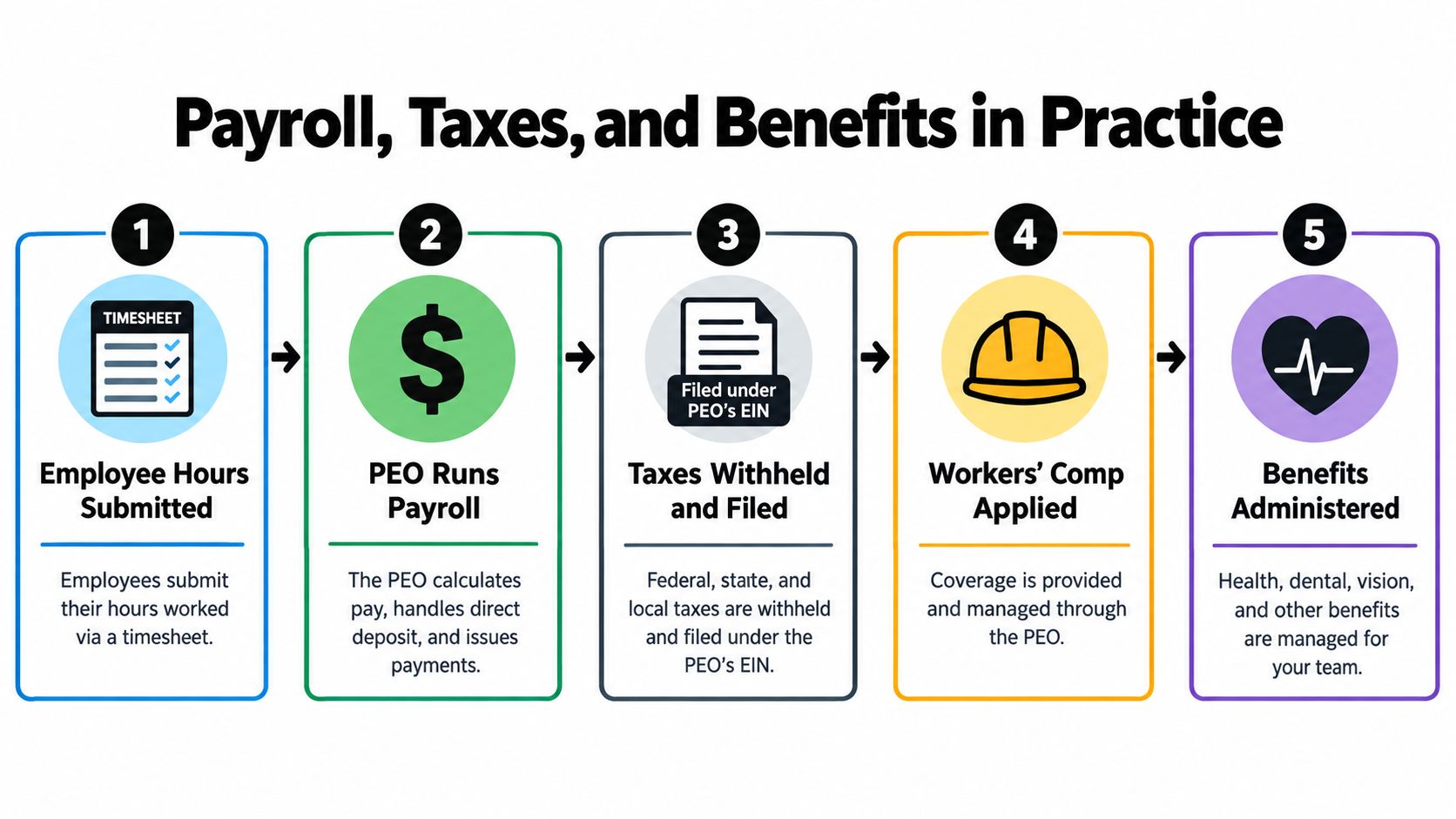
A practical payroll flow
The employee's time and pay data enters the process. The client confirms hours, salary changes, bonuses, taxable benefits, start dates, and terminations.
The PEO calculates and runs payroll. It applies deductions and withholdings, then issues payment through its payroll system.
Employment taxes are reported and paid. In a CPEO arrangement, aggregate federal returns may be paired with allocation schedules that identify each customer and covered wages.
Workers' compensation administration follows the relationship. The PEO may coordinate coverage, classifications, payroll-related information, and claims support, while the client still reports workplace incidents and manages safety.
Benefits administration connects to payroll. The employee enrolls through the PEO's benefits system, and deductions flow through payroll. Available plans depend on the provider and contract. Options may include health coverage from carriers such as Aetna, Kaiser, Anthem, Blue Shield, or UnitedHealthcare, along with retirement, dental, and vision benefits.
Before selecting a setup, finance teams can compare their current process with these step-by-step payroll instructions from Allied Tax Advisors. The purpose isn't to replicate a PEO's work. It's to identify which data controls the company must still own.
For employees, the visible parts are straightforward. The PEO may provide the paystub, benefits enrollment portal, insurance cards, and HR service number. The client still controls the job itself. A benefits question may go to the PEO, while a question about a manager's conduct may need to go to the client or to a designated shared process.
Benely provides information on PEO employee benefits for businesses comparing benefit administration and co-employment options.
Verification still belongs on the client side
A PEO can centralize payroll controls, but the client can't stop checking the data. Reconcile worker classifications, taxable wages, start dates, benefit deductions, and termination records against the PEO's records. Confirm who corrects errors and who pays penalties or interest if a filing problem occurs.
A clean reconciliation process protects both sides. It also prevents a common misunderstanding, namely that outsourcing payroll means outsourcing the duty to provide accurate information.
Certified PEO Versus Standard PEO Arrangements
“PEO” and “CPEO” aren't interchangeable terms. A standard PEO arrangement describes a contractual relationship in which the PEO performs specified payroll, tax, benefits, workers' compensation, and HR functions. CPEO refers to a PEO that has obtained voluntary certification from the IRS and meets the applicable requirements for that status.

What certification changes
The IRS requires a PEO seeking certification to satisfy statutory and regulatory requirements involving background and experience, business location, financial reporting, tax compliance, and bonding. The agency also maintains public listings of certified providers and organizations whose certification has been suspended or revoked. Employers can review the IRS information on certified PEO applications and public listings as part of vendor due diligence.
Certification matters most when the business is evaluating federal employment-tax treatment. For a covered worksite employee, the IRS generally treats a CPEO as the employer for wages and other compensation paid by the CPEO. That rule applies to the remuneration remitted by the CPEO. It doesn't automatically move every workplace responsibility to the PEO.
| Question | Standard PEO arrangement | CPEO arrangement |
|---|---|---|
| Is the relationship contractual? | Yes | Yes |
| Is IRS certification present? | Not necessarily | Yes, if the provider remains certified |
| Can the PEO handle federal tax functions? | It may, depending on the agreement | Yes, within the certified framework |
| Can aggregate federal returns be used? | Treatment depends on the arrangement | The CPEO may file aggregate returns with allocation schedules |
| Does certification transfer all employment duties? | No | No |
| Should the client verify the provider and contract? | Yes | Yes |
Certification isn't a complete handoff
A certified status can improve the clarity of federal tax administration, but it isn't a blanket guarantee that every employment-law obligation has moved away from the client. The client may still direct work, make hiring and termination decisions, maintain workplace safety, and supply accurate payroll data.
This distinction is especially important for employees. A CPEO may appear on payroll documents or handle benefits administration, but the employee's supervisor may still work entirely for the client. The employee should know where to raise a pay issue, where to report a workplace complaint, and who decides whether employment ends.
Businesses comparing a PEO with an administrative-services-only structure can review ASO versus PEO arrangements, then match the contract to the responsibilities they want to retain.
Pros and Cons for Small and Mid-Sized Businesses
A PEO solves a capacity problem. A small company may need reliable payroll, benefits administration, workers' compensation support, and HR guidance before it can justify a full internal team. The PEO brings an established operating structure, but the company pays for that structure and accepts a more coordinated decision process.
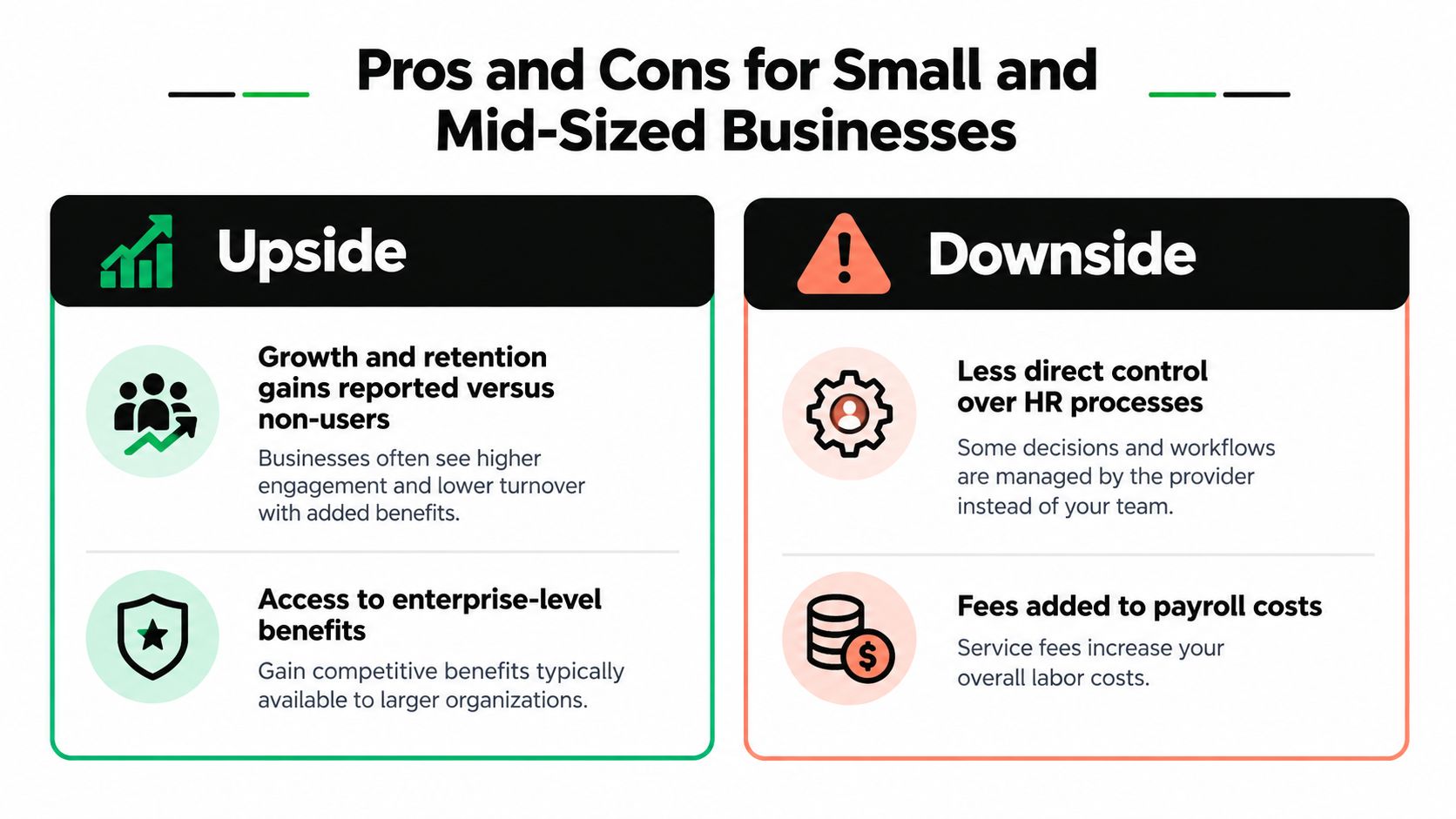
The strongest evidence in the supplied industry research is comparative rather than universal. Research summarized by the National Association of Professional Employer Organizations reports that businesses using a PEO have been found to grow 7 to 9 percent faster, experience 10 to 14 percent lower employee turnover, and be 50 percent less likely to go out of business than comparable nonusers (NAPEO research summary). Those findings support the model's strategic potential, but they don't guarantee a result for every company.
Where the model helps
- Benefits reach: A PEO can give a smaller employer access to broader health, retirement, dental, or vision administration than the company might arrange alone.
- Administrative capacity: Payroll, tax filings, enrollment changes, and workers' compensation workflows have a defined owner.
- Hiring support: A more organized benefits and payroll experience can make the employer easier for candidates to evaluate.
- Compliance guidance: The client gains a partner for documentation and employment-process questions, while retaining operational judgment.
- Growth readiness: A company can add employees without recreating payroll and benefits processes from scratch each time.
The value is highest when administrative work is already distracting leaders from operations or when the company struggles to offer benefits that support recruitment and retention.
Where the model creates friction
Fees are commonly connected to payroll costs or another contractual pricing method, so the owner must understand the total cost rather than looking only at a headline rate. Benefits choices may also become less flexible because the employer is working within the PEO's available plans and administrative rules.
Switching can be disruptive. A move between providers may affect benefits plans, payroll records, workers' compensation arrangements, employee contacts, and year-end reporting. Employees may experience new enrollment steps even when their job and manager stay the same.
A PEO reduces administrative burden, but it doesn't eliminate employer judgment.
The client also shouldn't assume that shared employment administration removes every common-law employer obligation. A PEO may advise on discipline or termination, but the client often makes the operational decision. The right question isn't whether a PEO is universally cheaper or safer. It's whether the value of its infrastructure justifies the cost, reduced control over certain processes, and exit work.
When a PEO Is the Right Move and What to Check First
A PEO tends to fit when a small or midsized employer needs more HR capacity than its current team can provide. That may include a company offering benefits for the first time, a business hiring across multiple states, or a founder who wants payroll and compliance workflows without building each function internally.
It may be a poor fit when the company needs complete control over benefit carriers, already has a capable HR and payroll operation, or can't accept the provider's contract terms. A payroll-only service or an administrative-services arrangement may be more appropriate if the business doesn't need a co-employment structure.
Use a written due-diligence path
Start with the provider's status. If the vendor presents itself as a CPEO, check its identity against the IRS public listings, including any suspension or revocation information. Certification is voluntary, so don't treat the word “certified” as self-proving.
Then request the full commercial and operational documents. Review:
- Responsibility allocation: Identify who handles hiring paperwork, payroll, tax filings, benefits, workers' compensation, leave, complaints, discipline, unemployment matters, and termination.
- Data controls: Confirm how the client submits hours, wage changes, classifications, taxable benefits, start dates, and termination records.
- Error responsibility: Ask who bears penalties or interest caused by incorrect filings and how corrections are communicated.
- Year-end reporting: Clarify who prepares wage statements, reconciles records, and handles employee questions.
- Exit terms: Check notice requirements, data migration, benefit continuity, payroll records, and workers' compensation administration during a transition.
- Service standards: Read the service-level agreement for response times and escalation routes.
The IRS emphasizes that a PEO's tax obligations depend on the functions it assumes, not merely on the label “co-employer.” Its guidance on Form 8027 and employer responsibilities reinforces why written allocations matter.
If your workforce strategy includes international hiring or Latam staffing, keep that evaluation separate from a domestic PEO review. Different hiring structures can create different tax, entity, and compliance questions.
For a practical interview checklist, use questions to ask a PEO before comparing proposals. The goal is to turn a broad promise of “full-service HR” into a list of named tasks, owners, deadlines, and escalation paths.
Key Takeaways for Employers and Employees
A PEO arrangement works like a split dashboard. The business owner still directs the work. The employee still reports to the company manager. At the same time, the PEO may sit behind the scenes handling payroll, employment taxes, benefits administration, workers' compensation, and some HR processes.
That division matters in everyday moments, not just in the contract. If an employee has a paycheck issue, a benefits enrollment question, or confusion about tax forms, the PEO may be the first stop. If the issue involves job duties, performance, team fit, culture, or a final call on termination, the client company usually stays in charge. Employees should know who owns pay, leave, complaints, discipline, safety, and separation before a problem arises.
For small and mid-sized businesses, the smart approach is practical and detailed. Match each task to a named owner, confirm how data moves, review benefit options, and check what happens if the relationship ends. Benely can help businesses compare PEO, benefits, and HR solutions in a structured way, with attention to coverage, administration, budget fit, and the employee experience.